
Tides of Tomorrow review
- 0 Comments

An engaging roleplaying experience surfaces from this splashy “plasticpunk” multiplayer adventure
By any normal metric, Digixart’s Tides of Tomorrow is a fine adventure game. Players get to explore a stunning near-future flooded world, navigating varied gameplay systems via multi-route choices, with their subsequent actions having real ramifications for how the plot unfolds. But Tides of Tomorrow isn’t looking to be measured solely by normal metrics. Instead it is striking out with an interesting twist on something already seldom seen in the genre: multiplayer. It’s certainly unique, but in doing so the game sometimes lacks focus – and as a result, impact – in its delivery. It’s an experience worth undertaking regardless, thanks to its great art direction and solid gameplay loop, though it ultimately feels more like a great single player experience with an experimental multiplayer function sewn in.
Tides of Tomorrow opens with players choosing their avatar – a simple process of selecting from one of several full-body suits and either a male or female denomination. This sequence, and the entire game thereafter, takes place in first-person, so the only people who will see your chosen outfit are other players who follow you (more on that in a minute), while your gender assignment is merely there for the supporting cast to get your pronouns right and dictate what type of grunts your avatar makes in action.
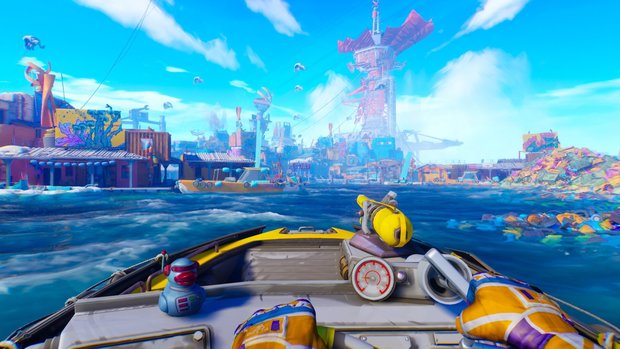
This customization screen takes place underwater amidst a sea polluted with plastic scraps. The studio describes the game as “plasticpunk,” and the pinks, purples, greys, and reds of its plasticbergs contrast nicely with the aquamarine water, immediately making you ponder what the world above holds in store. You’ll soon find out, as you need to start mashing buttons in order to swim to the surface. Playing with either the keyboard and mouse or a controller (which I opted for), the controls are pretty much exactly in line with what you'd expect of a modern 3D free-roaming game.
You are pulled out of the water just in time by a woman named Nahe. She welcomes you aboard her vessel, referring to you as a Tidewalker – someone who can have premonitions; seeing and hearing echoes throughout time. Moving to the deck of her boat, you gaze out at the sea ahead, with the bright sun shining over the rainbow of pollution below; foothills of plastic waste lining the water’s surface.
You soon learn from Nahe that this pollution has not only ruined the sea, but has had a profound effect on humanity, too. A condition known as plastemia is ravaging the population, causing a discoloration of skin with plastic fibres, eventually mummifying the victim’s entire body into a plastic mass. Furthermore, it causes lapses in memory. As you come to see in the various settlements spread across the ocean, there are very few elderly people left, with plastemia (or other dangers) keeping the average age of the population low. Fortunately, a medication known as ozen can reduce plastemia’s effects.
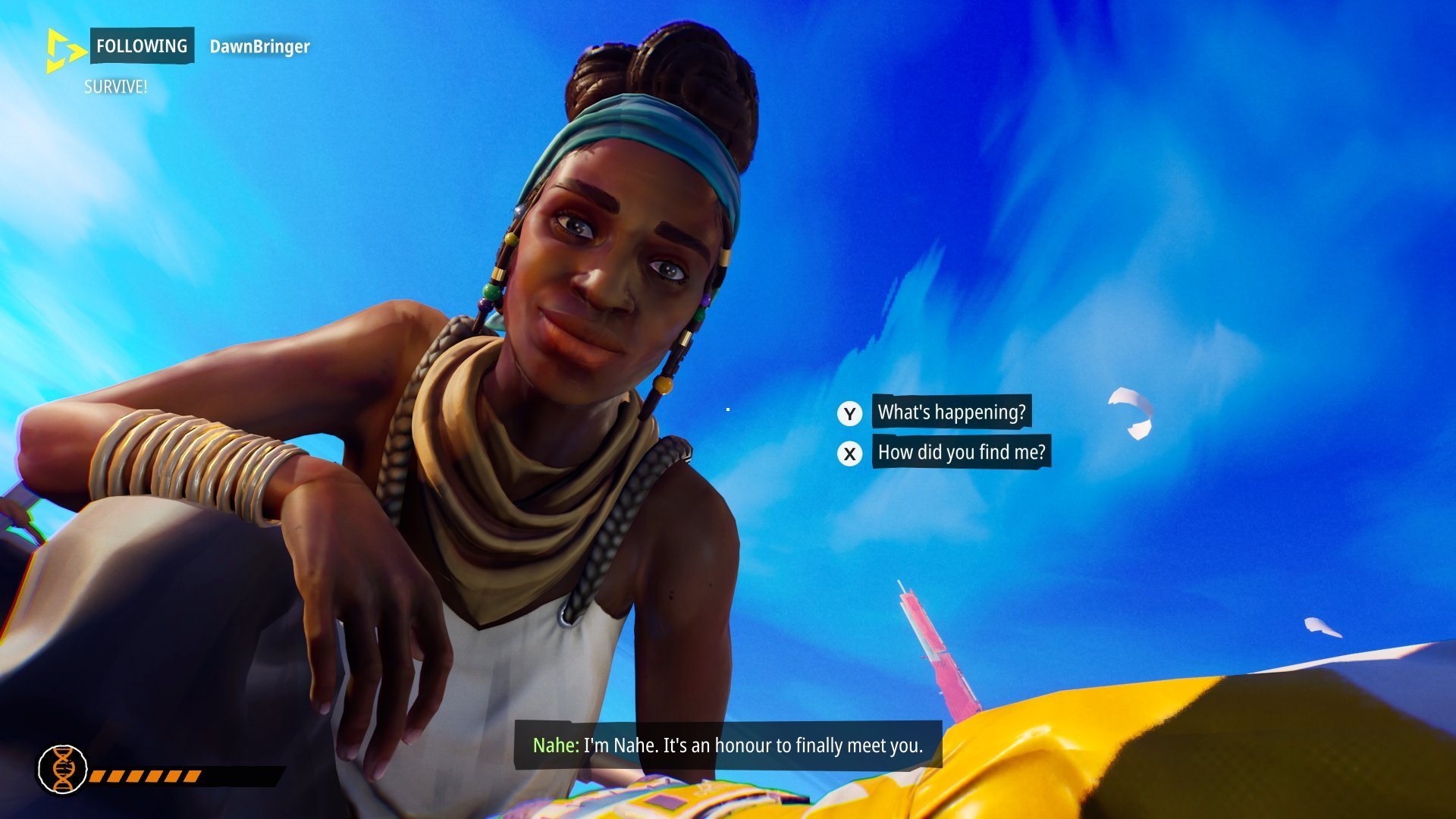
While receiving this crash course in Tides of Tomorrow lore from Nahe, your life bar is noted. Tidewalkers are not immune to plastemia, so you will need to procure ozen to combat the disease’s effects if you want to see one of the game’s good endings. It’s also here that the game’s multiplayer aspect is first introduced. In my playthrough, Nahe informed me that the previous Tidewalker she rescued opted not to use the ozen canister in her possession, instead saving it for me, the next Tidewalker. I did, however, decide to use it, restoring a bar of my health but carrying the heavy knowledge that the next player to follow in my footsteps would have to find their own ozen.
The multiplayer feature is quite unlike anything else. When starting out, you are given the option of inputting a friend code (Tides of Tomorrow’s player-unique ID) to follow someone specific, or you can simply follow a random player who has already begun playing before you, but you must follow another Tidewalker. In turn, you become a potential Tidewalker for other players to follow in your wake.
As a Tidewalker yourself, your powers of foresight are revered by the populous. Using your visions, you can help, hinder, or even cause chaos in the world. You can also see what your predecessor, who is just a step ahead of you, did in the world, and either contribute to or detract from their efforts. With this knowledge in mind, you’re taken by Nahe to Scrap Harbour, the first of several settlements you’ll visit, and you begin your search for answers.
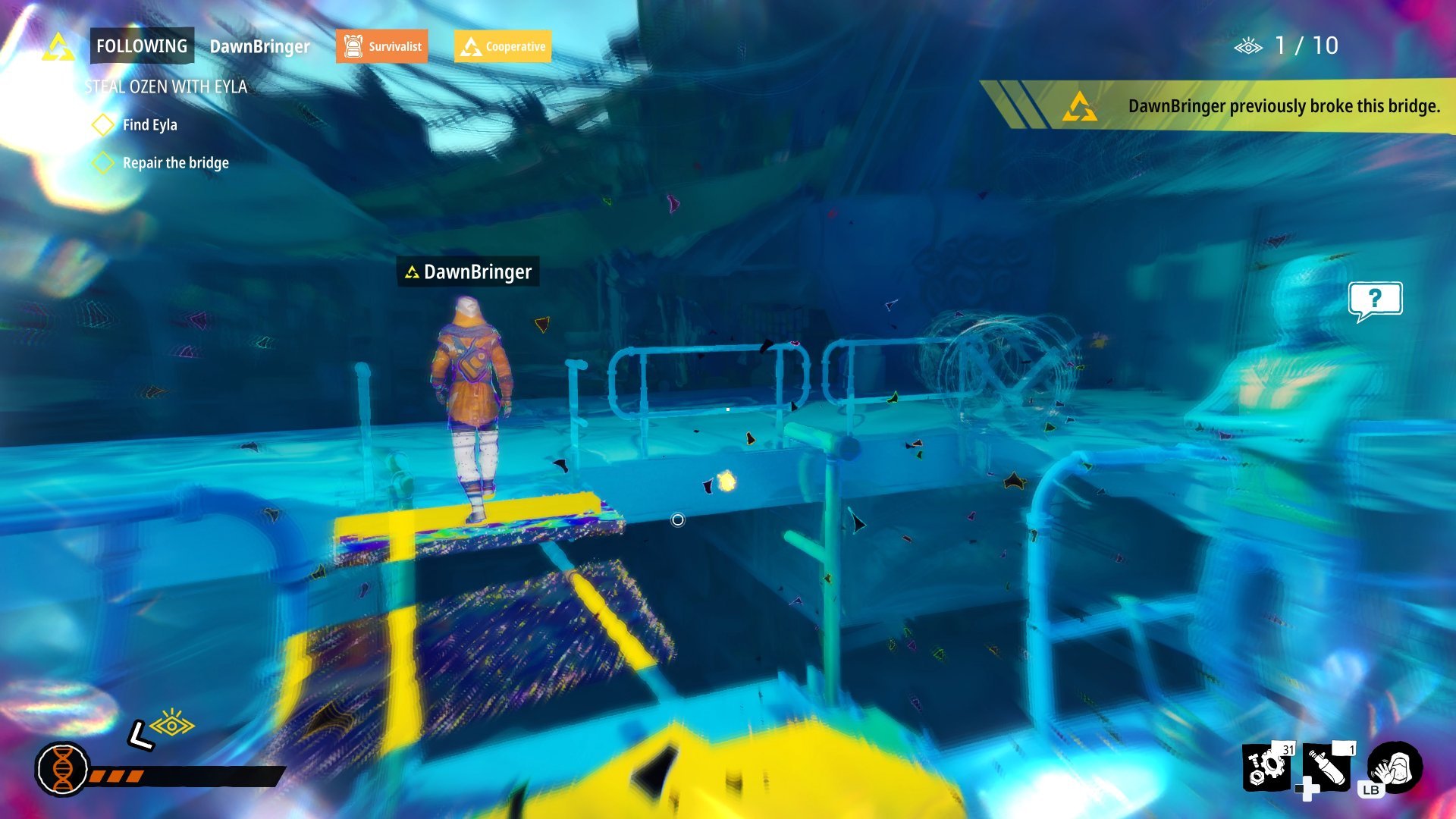
To follow your Tidewalker, you open a sort of sixth sense, observing the game world through a purple, almost film negative filter. Here you can see balls of warping energy floating throughout the environment, connoting recorded actions of the person who preceded you. These may be simple revelations about dialogue choices they made, showing the consequence of their actions as a warning or clue. Other times, they may display their actions, like where they hid when a guard was alerted to their presence, forcing you to choose a different hiding spot. Or, their “ghost” may be recorded on the racing track, acting as a challenge for you to beat. During a boxing match, you can use your Tidewalker sight to see what moves your opponent used previously, and dodge or strike accordingly in order to get the jump on them.
Sometimes, however, your fellow Tidewalker’s actions are only alluded to. Near the end of the game, one of the settlements is under bombardment from a storm, and you’re asked for help in repairing the structure before the waves come in. You have a strict time limit to do so, and depending on how much work your predecessor was able to get done before your arrival, you may be able to fix the entire structure.
You may feel inclined to stick with the same Tidewalker throughout the game, but it’s not strictly necessary. In fact, it’s possible that the person you choose to follow may not have completed the game, meaning you can eventually surpass them in the story. Whenever you select a new destination to visit, the game will show the names of both your current Tidewalker (if applicable) and a group of seemingly randomly others who came before you, allowing you the chance to switch to a new Tidewalker or even chart your own course if none of your assigned group blazed that same trail. If the latter occurs, locations you travel to will simply be blank, and you will be the first one (in your unique playthrough) to interact with the NPCs there.
Either way, the typical flow of the game plays out as follows: You’ll enter an area, interact with its inhabitants and accomplish some sort of goal, like acquiring an object or new information, or meeting with a supporting character. Then you’ll hop into your personal watercraft and head back out to sea, where you’ll sometimes receive a radio message from one or more NPCs, asking for assistance. Then you typically have between one to four choices of where to sail to next. The gameplay loop involves landing in your chosen location, disembarking from your boat, performing an errand that lasts anywhere from ten to twenty minutes, and heading back out to sea. Your progress is recorded automatically whenever you enter a new area in the only available save slot. (No save scumming allowed. You will have to live with your choices.)
It’s hard to summarize the plot in any cohesive way, as there are so many factors at play, but the gist is that ozen supplies are running low in the world and you’ve got to do something about it. It took me approximately ten hours to complete Tides of Tomorrow, though there are such diverse possible paths depending on your actions, and those of the Tidewalker you are following, that seldom if ever will two playthroughs be alike.
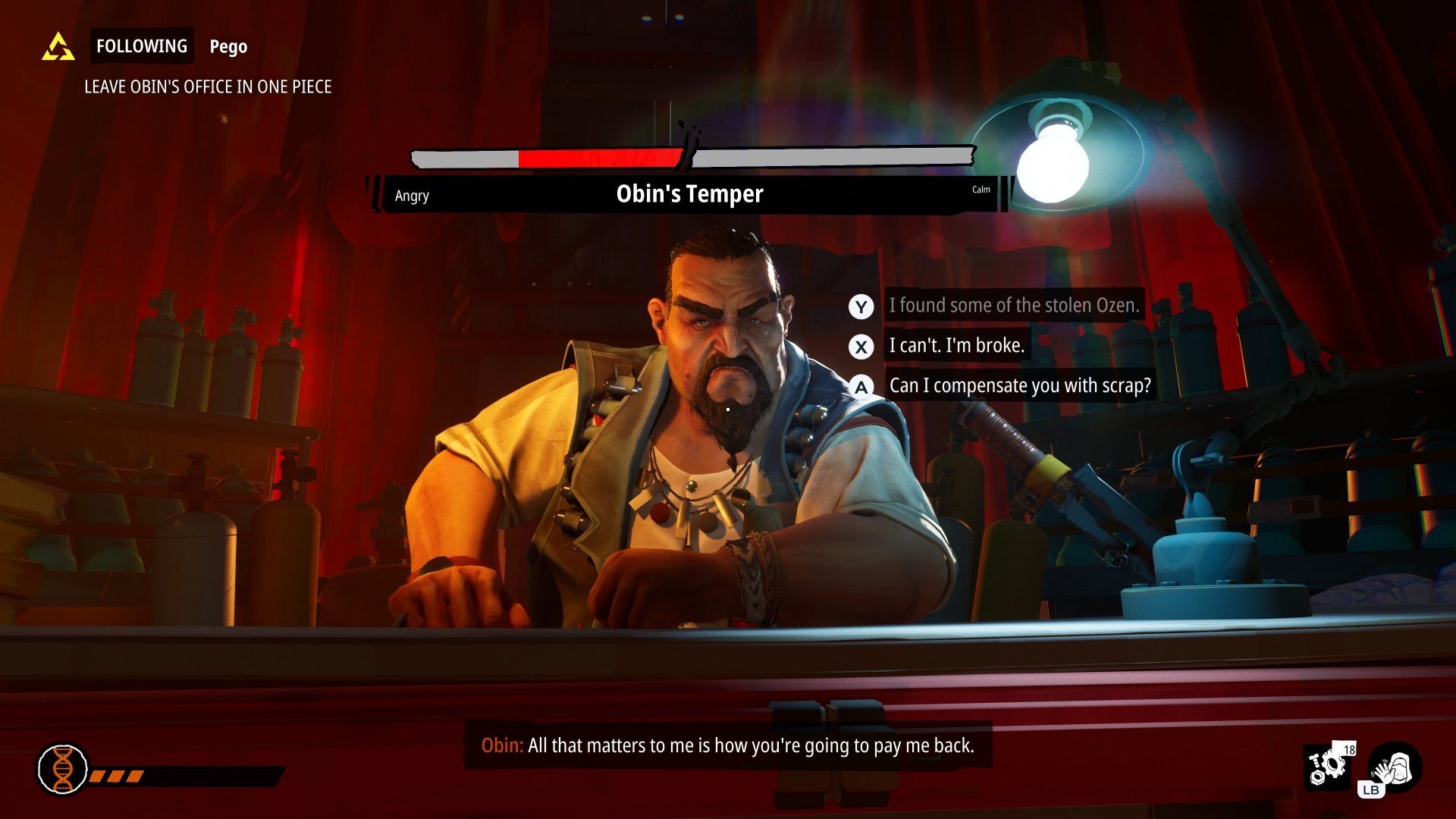
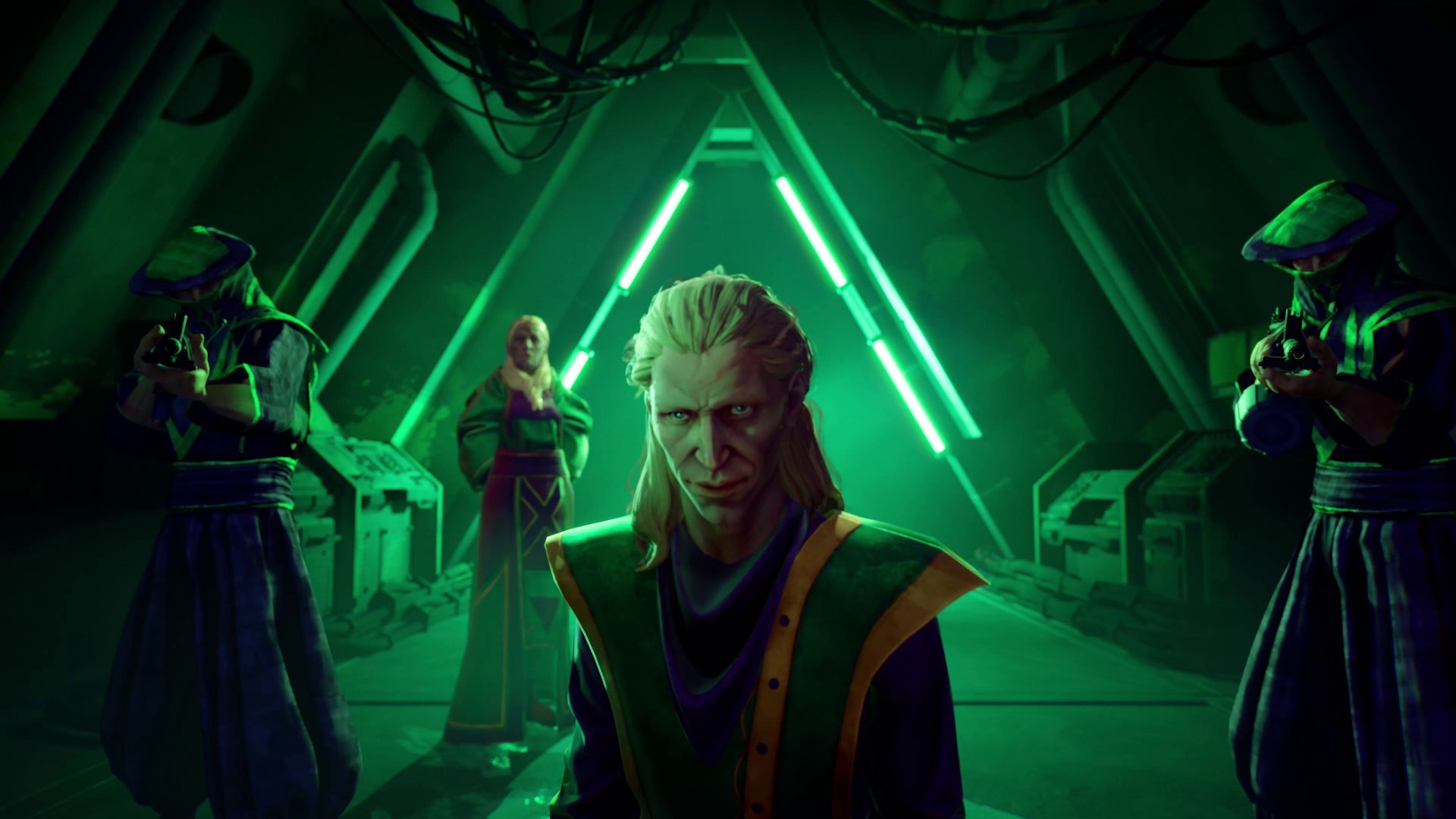
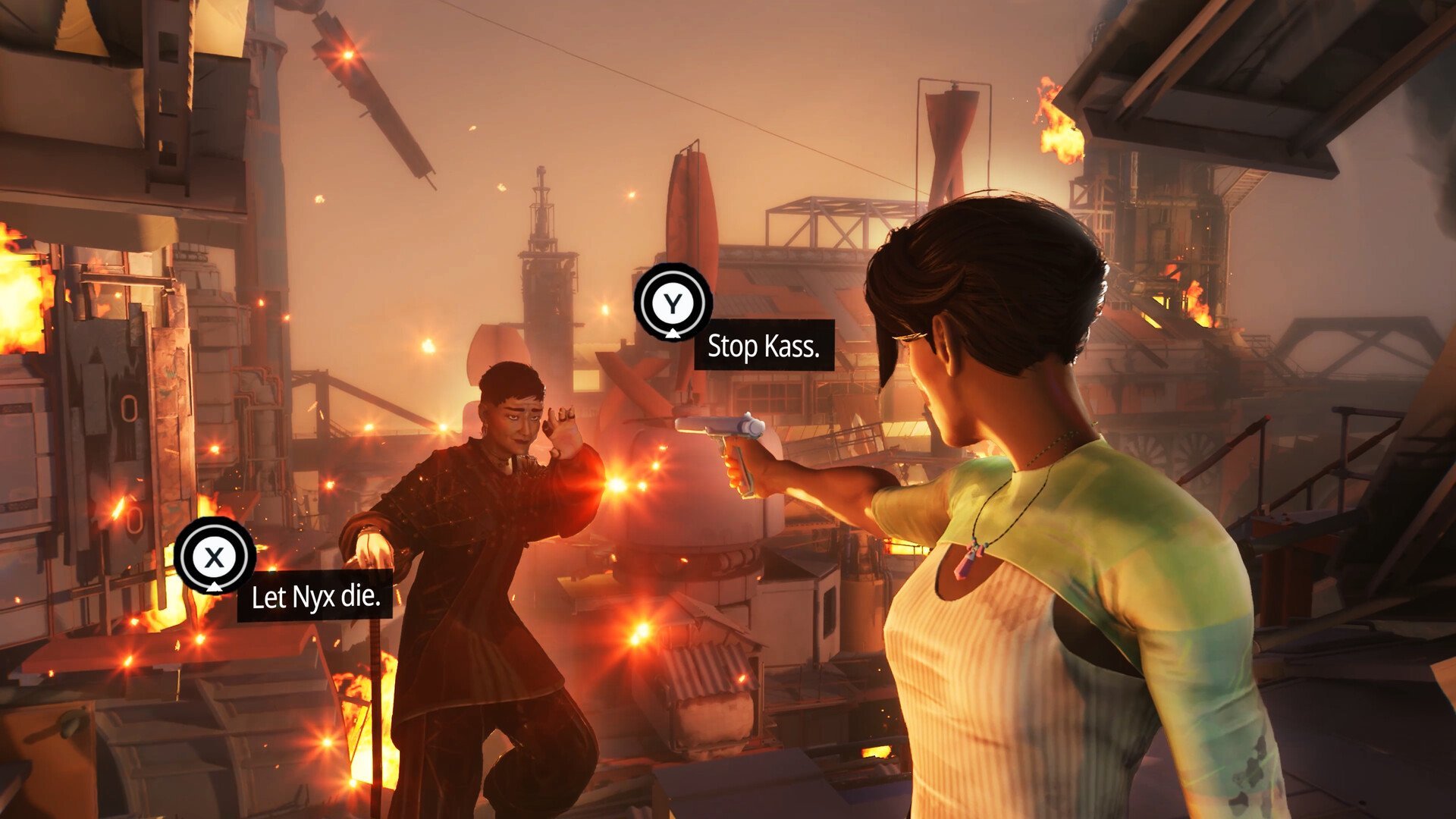
At the beginning of each of the game’s five chapters, the world population is listed, and it steadily decreased from the hundreds of thousands to five digits by the end of my playthrough. The survivors are ruled by various factions: there’s Obin, a tough-as-nails brute who controls the world’s ozen supply, and his daughter Kass, who works alongside her father to distribute the medicine; Nyx, ruler of Pleasureland, a resort of sorts focusing on sport, party, and gambling; and Voot, leader of the Mystics, who are monastic people dedicated to learning about the pre-flood world and deciphering the prophecies of a god-like force named Delta, which emanate out of ancient (though quite hi-tech) computers. Needless to say, all of these factions could use your talents, and your alignment with (or rejection of) each of them has major repercussions on your route through the game.
Though Tides of Tomorrow is a free-roaming adventure, the core gameplay is rooted in dialogue with other characters, as well as roleplaying choices you make at set points of interaction. By selecting certain responses in conversation, you will steadily build up stats in five specific traits: Pro-mankind, Pro-environment, Cooperative, Troublemaker, and Survivalist. These categories level up after enough choices are made in their favour, unlocking new and unique dialogue responses.
Most of my playthrough ended up being divided between Pro-mankind and Pro-environment choices, so I would often see blacked-out responses for Troublemakers that I was unable to select. Pro-mankind alliances aren’t tied to any specific faction; they simply boil down to helping your fellow man, like giving a sick person ozen instead of saving the canister for yourself. Scrap, the game’s currency, is found scattered throughout the environment, and can be exchanged for goods like more ozen or used repair structures, or even donated to an NPC’s cause. Leaving scrap or ozen in a special cache for other Tidewalkers who may follow you heightens your Cooperative level, and again unlocks new action and dialogue choices.
Many of the decisions you make are in dialogue, though some directly relate to actions you take. In certain instances these choices are timed, forcing you to pick an option on the fly. Other times you’ll be required to give a speech or engage in a debate, attempting to turn the tide of the conversation toward your chosen position, with the allegiance of the audience indicated by a bar at the top of the screen, letting you know how well your arguments are swaying them.
You’ll meet numerous characters that can help you in your quest should you align with them and attempt to make friends. Taj is an early potential ally who pops up continually in the story and is always looking to help his fellow citizens. Eyla is a passionate environmentalist who is determined to help make life better for the mereids (an intelligent sea animal seemingly immune to the effects of the plastic pollution). The player you’re following may have gone out of their way to help an NPC, resulting in their opinion of Tidewalkers being more kind, thus letting you forgo some of the barriers your predecessor had to endure. But if they aligned themselves with a different faction than the one you prefer, these barriers may still be present. Similarly, how you interact with these people doesn’t just impact your playthrough, but any players who follow you as well.
The game blatantly tells you via text notification what the Tidewalker you are following did or did not accomplish in these scenarios, like “so-and-so convinced the Mystics to (fill in the blank).” The path resulting from your predecessor's playthrough is fairly easy to distinguish in most cases, like in one segment where I had to sneak into the Mystics’ caverns. I found the guard for the area stripped down to his underwear, who said he would help me sneak in if I got his clothes back. Once I did, he held up his end of the deal. However, his clothes were only missing because my predecessor had stolen them in order to sneak in disguised. Thus, my successor(s) will once again have to steal his clothes or find an alternative way to get in, and so on and so forth.
Tides of Tomorrow
| Genre: | Drama, Science Fiction |
|---|---|
| Presentation: | Realtime 3D |
| Theme: | Team-up, Post-apocalyptic |
| Perspective: | First-Person |
| Graphic Style: | Illustrated realism |
| Gameplay: | Quest, RPG, Choices matter, Resource management |
| Control: | Direct Control |
| Game Length: | Medium (5-10 hours) |
| Action: | Combat, Driving |
| Difficulty: | Medium |
That’s assuming they take the same route as I did, of course. For some players, this may not even be a plot point if they align with a completely different faction than I did. However, many of the multiplayer implementations come in the form of these binary choice scenarios. On one hand, this negates some of the magic of the indirect multiplayer system, and makes you feel like a mere follower instead of the main protagonist. On the other hand, it makes you appreciate all of the branching pathways.
One sequence had me meeting with the Mystics, where Voot asked me to align myself with a certain cause by placing an ancient artefact within one of three altars. By using my Tidewalker vision, I could see where my predecessor had claimed to put their alliance by striking a pose (done by choosing from a selection of several silly possibilities), though their actual choice ended up being different from the selection telegraphed.
While you’ll only ever play by yourself, there are opportunities to consider your followers indirectly, like the aforementioned caches or by fixing things like ladders in the environment. Sweet-talking certain characters may make it easier for your successor to access a certain area, or donating some of your time or resources to help someone in need may cause them to stop the next Tidewalker they see and give them a gift. It’s a neat way to build community – or a fun way to mess with other players if you simply want to be an agent of chaos. I don’t know if I would have been able to make it through without the generous ozen caches left by others.
While the choice system is simple enough on paper, you will not only need to keep your alliances and goals in mind, but also the impact of plastemia. Every time you travel to a new area, you lose two bars of health; ozen canisters restore one bar. When looking through your spyglass at the locations you can travel to, the central quest goals will be displayed at the top left of the screen. This lets you know what you can potentially accomplish there, like freeing a captive mereid or attempting to forge an alliance with a clan. At the base of the screen are pictographs of scrap, ozen, and caches. If highlighted, that means that the listed resource will be available there. So, while you may want to prioritize a certain task, you may have to choose another route in order to search for, or purchase, more ozen.
Thankfully, there are certain routes called Ocean Events. These events take place outside of the main story, and typically offer rewards like ozen or scrap. Travelling to these events does not decrease your health bar, meaning they are relatively risk-free (and arguably necessary) in order to procure the supplies you need to continue. I completed every Ocean Event available in my playthrough (according to a Steam achievement), and even so I was barely getting by with my ozen supply.
In addition to the numerous dialogue choices you must make, there are other gameplay mechanics in Tides of Tomorrow, one of which is water combat. Some Ocean Events have you taking down pirates or other aggressive NPCs by shooting them into submission with your mounted mortar gun. Enemies will shoot back, with the landing spot of their shells highlighted by orange circles in the water after launch. Your boat can take three hits initially, though it can be upgraded to take five with enough scrap, should you wish. Combat occurs in the main campaign from time to time as well, and the consequence for failure is usually a pillaging of your supplies – including ozen.
Though seafaring is a relatively small part of the game, navigating a mine field or taking out enemy vessels is a nice break from the otherwise dialogue-heavy structure. It also really engages with the setting of a flooded world, having to travel far distances in order to survive. Fights are not terribly difficult, but lining up your slow-firing (auto-aim) mortar while dodging enemy fire is good fun, as is boarding a vessel and grabbing all of the scrap and ozen you can before it sinks, or meeting the surrendering party and learning more about their story.
You’ll also need to perform a bit of light platforming and sneak around at times throughout your travels. Players can run, jump, crouch and/or slide, or grab hold of a zipline in order to outrun pursuers. These sections too are relatively easy, but they are exciting bits of action, with bullets zooming by your head as you escape, or as you climb a flooding chamber to freedom. Stealth is similarly basic, largely featuring the simple “crouch to hide” mechanic. Guards have weapons with laser sights acting as an obvious line-of-sight indicator, and staying out of range is never hard.
You’ll also get to pilot a small submersible in underwater sequences that are highly enjoyable. You are tasked with navigating reefs, caverns, and the ruined structures of the old world while using the sub’s vacuum to obtain resources like scrap, or possibly mereid eggs – another one of the game’s forms of currency. There is even a racing segment in Pleasureland where you can ride Jet Moto-style hovercrafts, though the weight and feel of these crafts is, sadly, quite dull, and ends up being one of the game’s shallower elements.
There are puzzles in the game too, but they are few and far between. At one point I had to gain access to a safe by inserting a correct sequence of keys, as dictated by written notes hidden around the area. Box puzzles show up later on, allowing you to lift and carry certain boxes, usually as a means to access a higher area by using them as steps. It’s hardly cerebral, but these sequences do add more variety, and some suspense, as you navigate your way through restricted areas.
While the puzzles aren’t a primary aspect of the gameplay, they are woven well into the story and sometimes you only get one shot to solve them correctly. One puzzle had me helping a scientist calculate a formula in his lab. Using a variety of switches, I needed to balance a chemical dosage for a captured mereid, but I messed up by pulling the wrong levers and ultimately killed the animal. I felt terrible, but had no choice but to move on.
You can “die” in Tides of Tomorrow when your health bar reaches zero. Near the start of chapter three, I succumbed to plastemia and awoke in a creepy, underground dump ruled by an almost entirely plastified madman. He had created a sort of museum of victims, and as I made my way through the dump, the game warned me (via text) that dying one more time would prevent me from reaching certain endings. I don’t know whether the game would have concluded entirely upon a second death or whether I would have just had fewer options for proceeding, but luckily I was able to make it without another death.
Upon completing the game you’ll be treated to an epilogue of still images, showing you how the world ended up as a result of your choices. The ending I received was bittersweet in many ways, but considering all of the decisions I had to make in order to reach it, that fit well with the game’s tone.
The story is credited to the whole staff in the game’s credits, and it shows. The scope of the narrative is truly impressive, and it’s nice to see that this passion project was shared by everyone at Digixart. That said, as fun as it can be to explore the various environments, the script itself is one of the game’s weaker aspects. The characters are all two-dimensional, and even for those who do exhibit minor growth, their paths are entirely predictable, with relatively few surprises in an otherwise interesting world. While this makes plotting your intended route through the game fairly straightforward, getting through the sometimes cringe-inducing dialogue can hit a nerve on occasion.
The multiplayer aspect, while innovative, does detract a little from the narrative impact as well. Since you’re not playing with other players directly, the game never quite decides whether you or your predecessor is the hero here. Most of the time you’re treated as the main force in the world, but this kind of ends up diminishing the actions of your predecessor, like you’re the mighty Tidewalker and they were just someone who insulted a guard and now there’s more security for you – or vice-versa, with you just trailing along behind them to finish what they started. Despite the myriad of choices and routes you can take, sometimes it feels like an on-rails experience, with your predecessor going left and you going right until the tracks meet up again a short while later. It’s a thoughtful and interesting way to create the illusion of live multiplayer when in fact it is indirect, but it results in some segments of the story feeling anticlimactic.
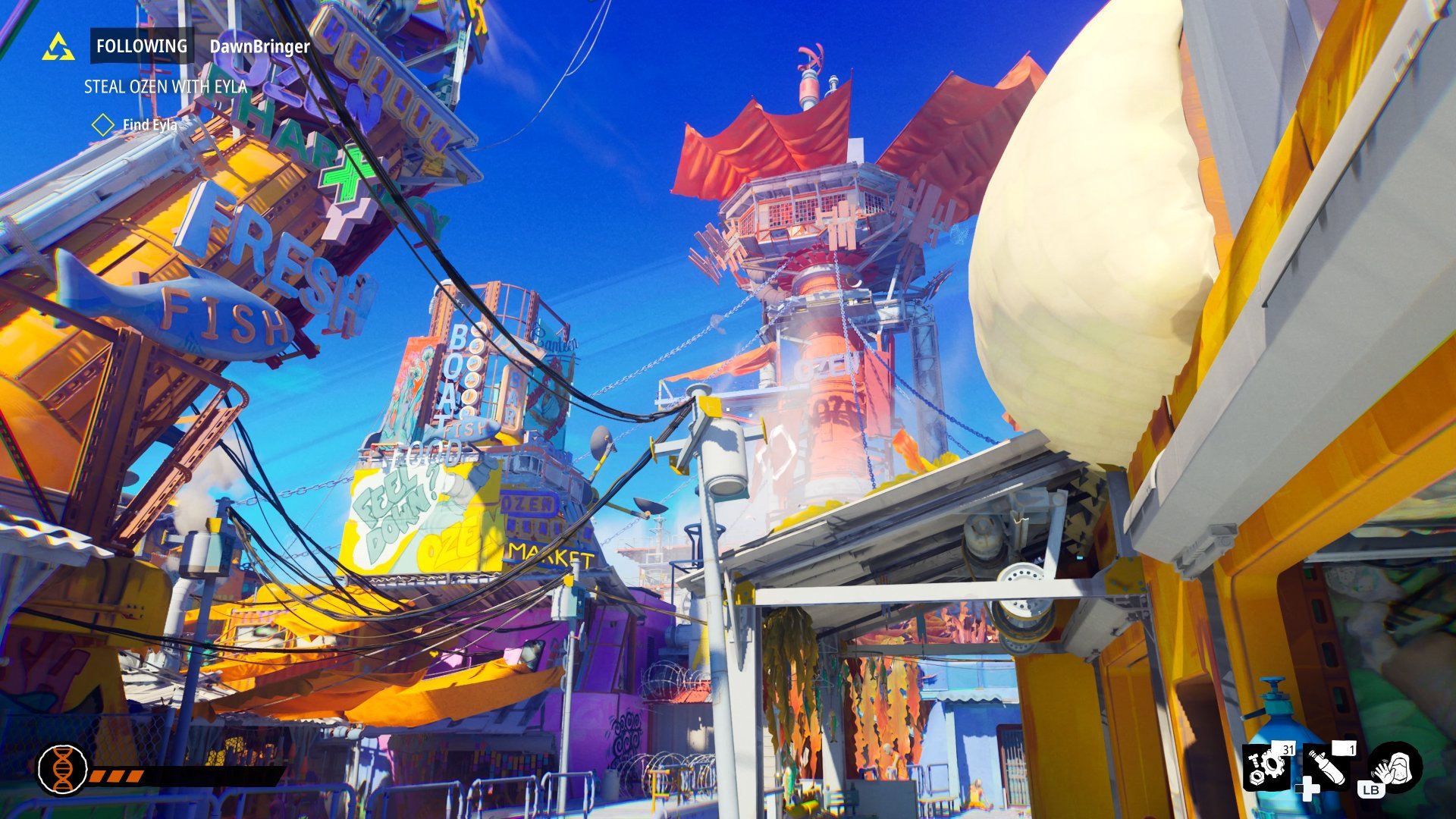
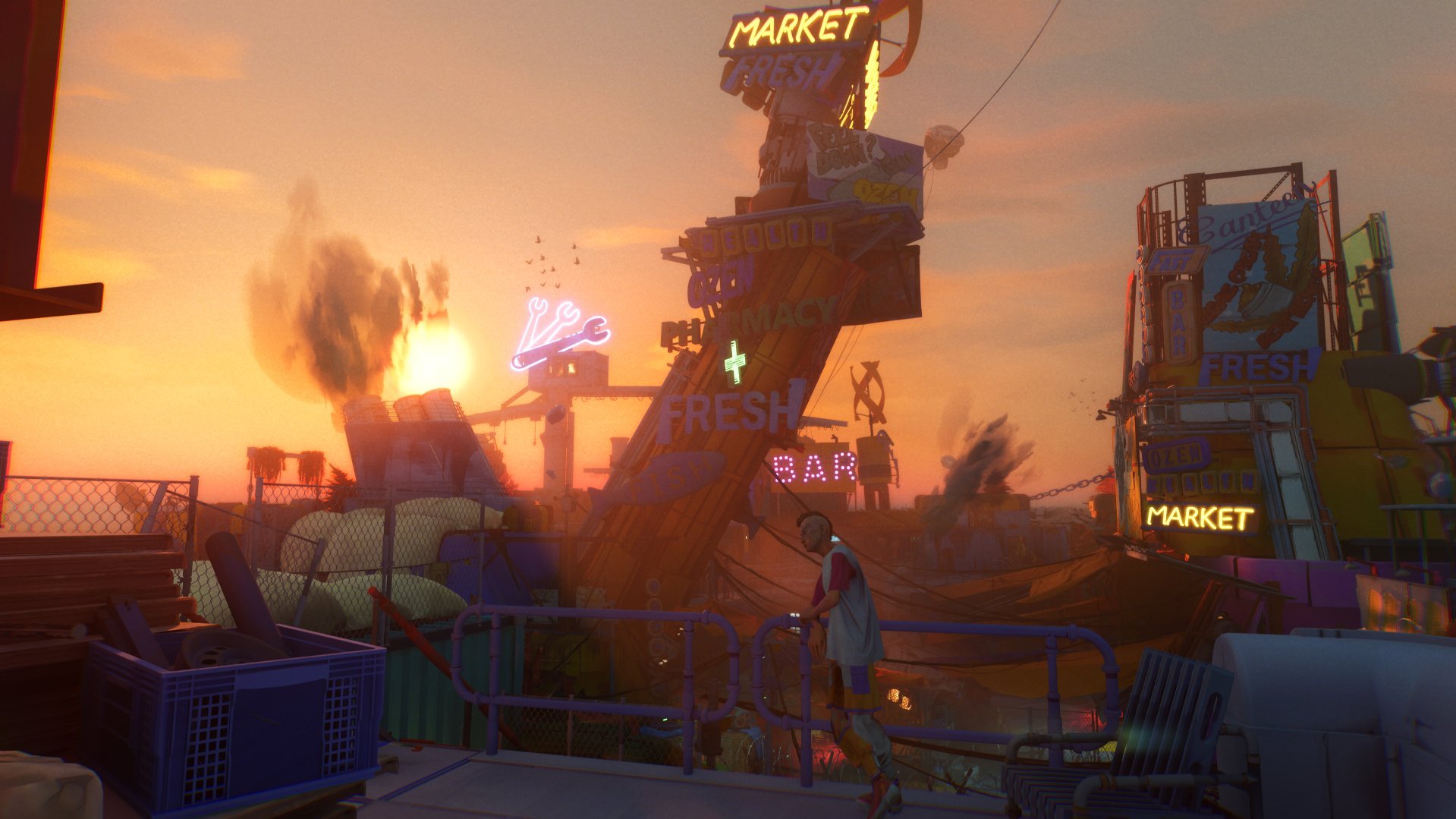
What definitely isn’t an illusion is what a visual feast Tides of Tomorrow is. From the neon lights of Pleasureland to the old, haphazard industrial constructions of Scrap Harbour, to the coral spires of the Citadel, every location has been painstakingly detailed with its own unique models and texturing of flora, metal, stone, and, of course, plastic, with surprisingly little repetition. Lighting effects look great as well, with both celestial and terrestrial sources painting each and every area with their own distinctive glows. The pastel plastics floating in the water are mesmerizing, especially considering all their little bits conform to and move with the waves. Speaking of which, water effects are spectacular, too. Sometimes you’ll be navigating rolling and foaming waves, while other times it's smooth sailing over glass. While individually none of the game’s graphical aspects are state-of-the-art, they have been combined in artistically intelligent ways, making it feel like an AAA production.
Character design matches the variety and scrappiness of the environments, with eclectic garb ranging from Eyla’s plastic suit to the Mystics’ humble robes. The effects of plastemia manifesting in the populous is a nice detail as well, with coloured plastic veins marking people’s skin as the disease takes hold. Some bodies are completely solidified, reduced to contorted, gaunt, radically colored shiny corpses, reminding you what horrid fate awaits should you fail in your quest. Though mereids are the only animal you’ll see, details such as plastic bags floating overhead like birds on a calm day add to the strange beauty of this dying place. Character animation can be somewhat, for lack of a better term, plastic at times, and immersion takes a bit of a hit there, but the effort put into different facial expressions is noteworthy for a smaller studio.
Musically, Tides of Tomorrow is also diverse, with rock, dance, reggae, and other interesting fusions scoring the adventure both environmentally as you pass through and cinematically as you perform certain tasks. It’s all great, and matches the game’s impressive visual presentation. Voice acting is top-notch as well, and even though I wasn’t overly moved by the cast’s plight, the actors’ delivery is perfect.
I did encounter one glitch in my playthrough, though it was largely inconsequential. At one point a battle broke out and Kass, whom I had allied with, was pinned down in an alleyway without a weapon. I found one for her and she managed to escape unharmed, and the rest of the ten-minute mission continued as normal. However, as I returned to the dock, meeting Kass before leaving in my watercraft, I heard her cry for help from the alleyway in which I had met her minutes earlier, despite the fact that she was standing right in front of me. It was comical more than game-breaking, and considering all of the narrative threads running at any given time, I’m surprised this was the only hiccup I encountered.
Final Verdict
Tides of Tomorrow is a great mix of light action, roleplaying and deep narrative design. Its structure makes it easy to sit down and complete a single sequence in twenty minutes or so, but it’s just as easy to lose yourself in the world and play for hours. It’s a stunning game to behold, and its numerous routes and endings ensure there’s high incentive to replay. I think it would be more enjoyable to play with a friend, following in their footsteps, but the random pairing I was assigned still made the game’s interesting experiment with multiplayer enjoyable, and I hope that whoever follows in my footsteps experiences the same. It’s not a deep experience for a post-flood world, but it’s fun wading into this exciting, beautiful adventure.
Hot take
Its numerous gameplay systems vary widely in depth, but even at its shallowest, Tides of Tomorrow is a fun, beautiful game with some great ideas and a unique implementation of multiplayer in an otherwise solo experience.
Pros
- “Plasticpunk” perfectly realized through art design and world-building
- Unique multiplayer component is interesting
- Numerous gameplay systems keep the pace moving and the experience fresh
- Excellent vocal performances by the entire cast
- Catchy, diverse, soundtrack
Cons
- Actual narrative and character arcs aren’t as interesting as the world
- Multiplayer, though innovative, effects narrative impact at times
Drew played Tides of Tomorrow on PC using a review code provided by the game's publisher.

- Advertisement
- Help support AGH by advertising with us








0 Comments
Want to join the discussion? Leave a comment as guest, sign in or register in our forums.
Leave a comment