
Tormentum II review
- 2 Comments

The agony of waiting is over, as the sequel delivers a macabre, richly atmospheric nightmare experience
In a world of rapidly advancing technology, sometimes it can be hard to tell the difference between what is truth and what is fiction. And sometimes we can’t help but feel like the only truth is full of darkness and despair. The human mind can be both a fascinating and frightening thing to behold as our perceptions warp the world around us. Nowhere is this better exemplified than in Tormentum II, the next standalone chapter in OhNoo Studio’s surreal series begun over a decade ago. Once again utilizing gorgeously macabre artwork, this is a twisted tale that will have you questioning what is real yourself by the end of the game. The developers went all out on the atmosphere, and the story alone is worth the price of admission, though there’s plenty of gameplay to puzzle through as well.
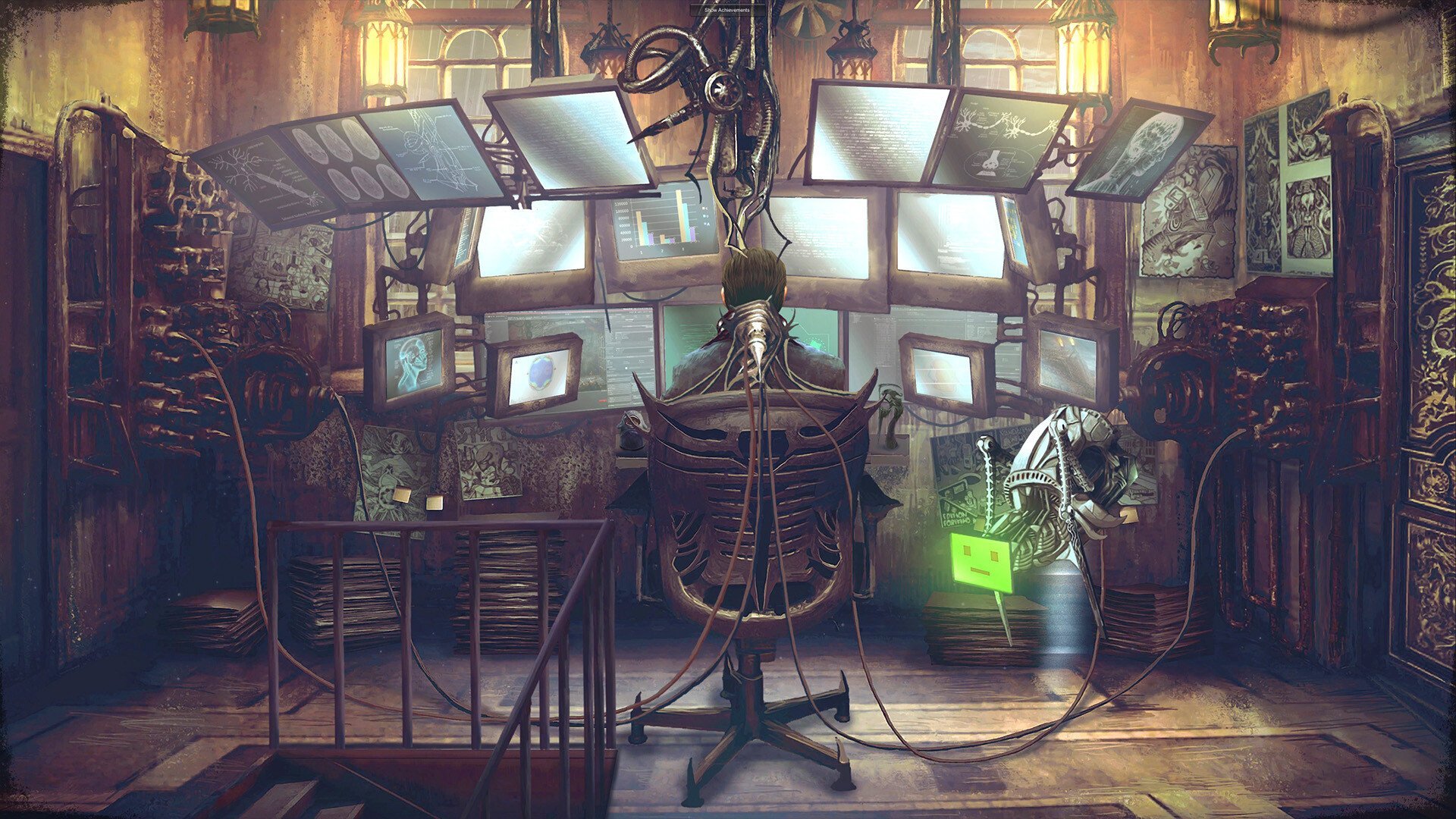
Instead of a continuation of Dark Sorrow, this is an all-new futuristic story in which you play as David, a computer engineer and programmer who is in the process of building a virtual simulation he aptly calls “Tormentum.” The protagonist’s world is plagued by pollution and nobody can go outside without a filtration mask. We only get a very brief glimpse of this desolate landscape from the balcony of David’s apartment, as he doesn’t like leaving his place unless he absolutely has to. In fact, it seems like he gets most of his stuff via drone drop-off.
The first part of Tormentum II follows David as he works on getting the processor and coprocessor for his simulation to stably work. To do so, he has to get into the building’s server room and install the program. It’s easier said than done, as for some reason the room is locked and David has trouble getting the key to work. These early challenges introduce us to basic mechanics such as inventory management and interacting with the environment around David. For point-and-click veterans, these elements should be second nature.
Eventually David succeeds in his task, but things quickly go sideways. Regaining consciousness inside of a prison cell, he finds himself trapped in a world unlike anything he’s ever experienced outside of his simulation. The immediate task at hand is to escape, but once he does, he is confronted with an ocean full of islands he’ll need to traverse to find a chest he has been dreaming of for quite some time. How he knows this chest is located somewhere among this archipelago is anyone’s guess, but reaching it is his overarching goal, in the hope that by doing so he can return to his own world.
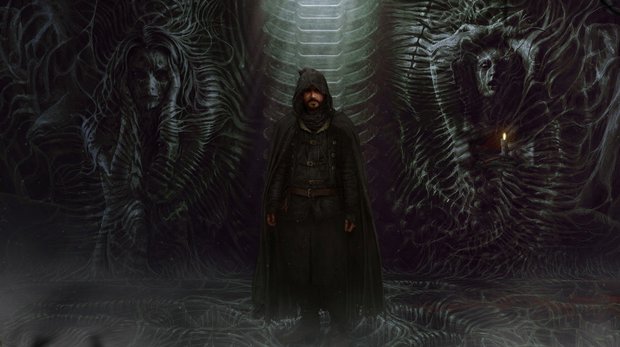
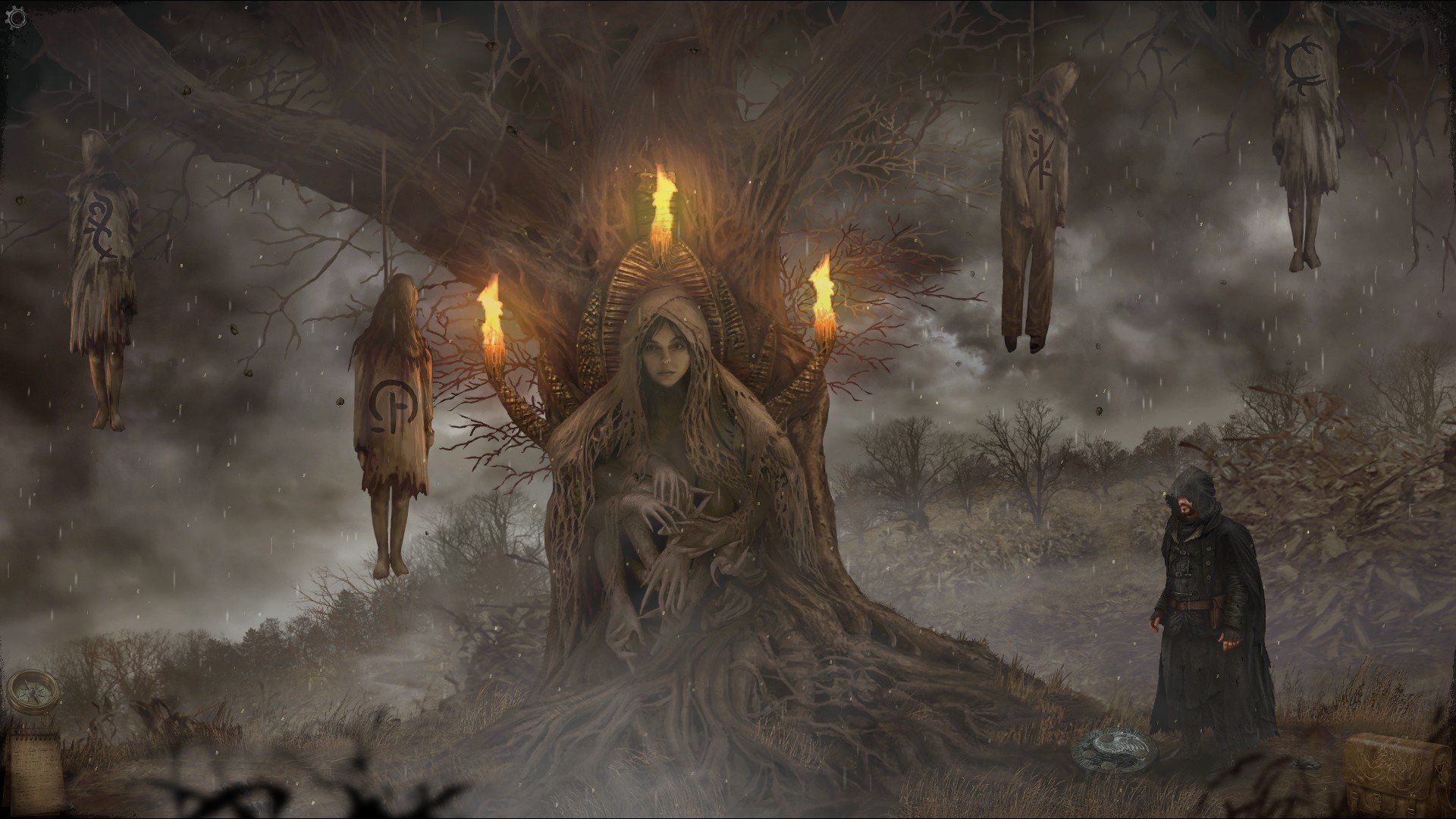
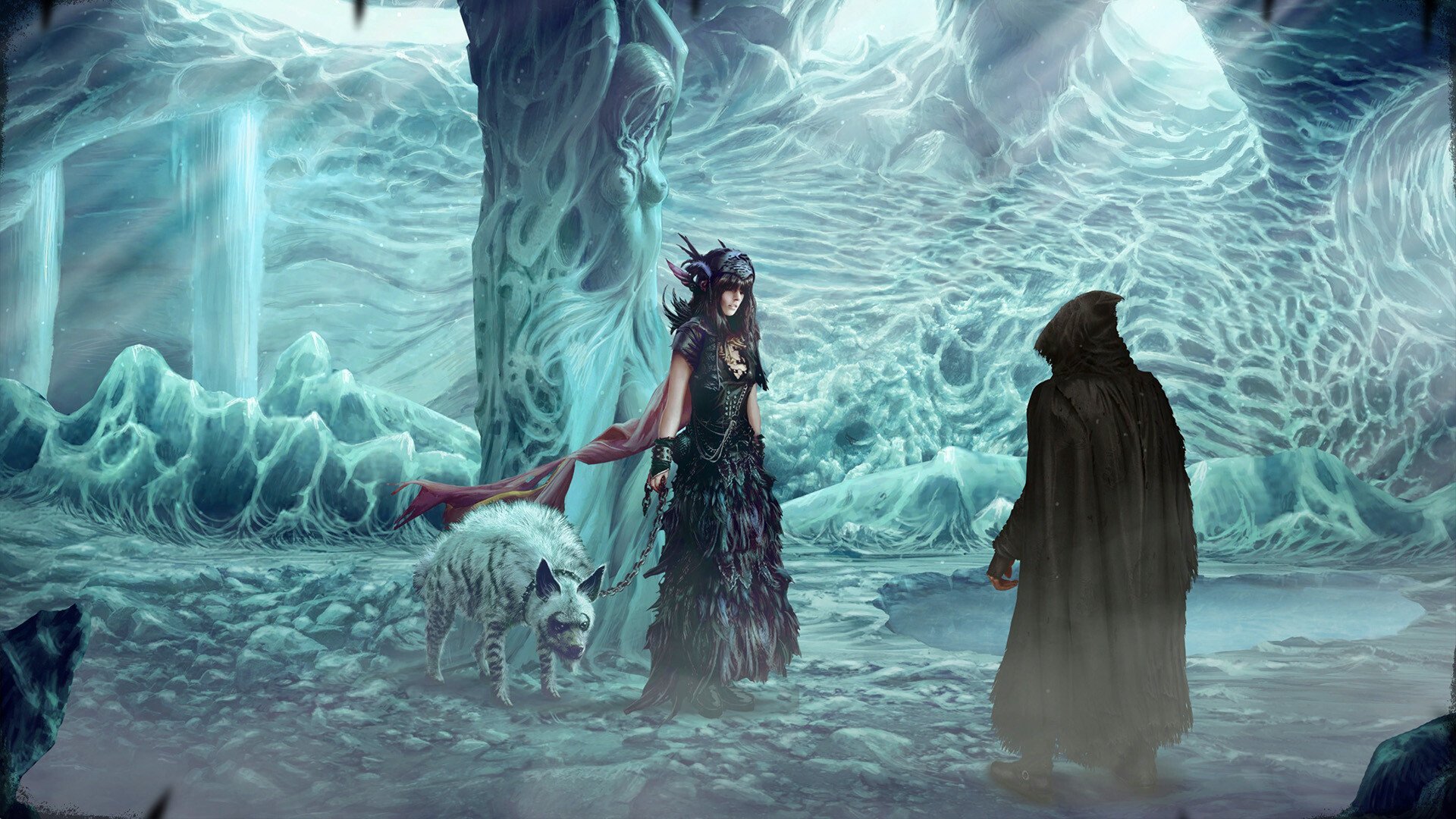
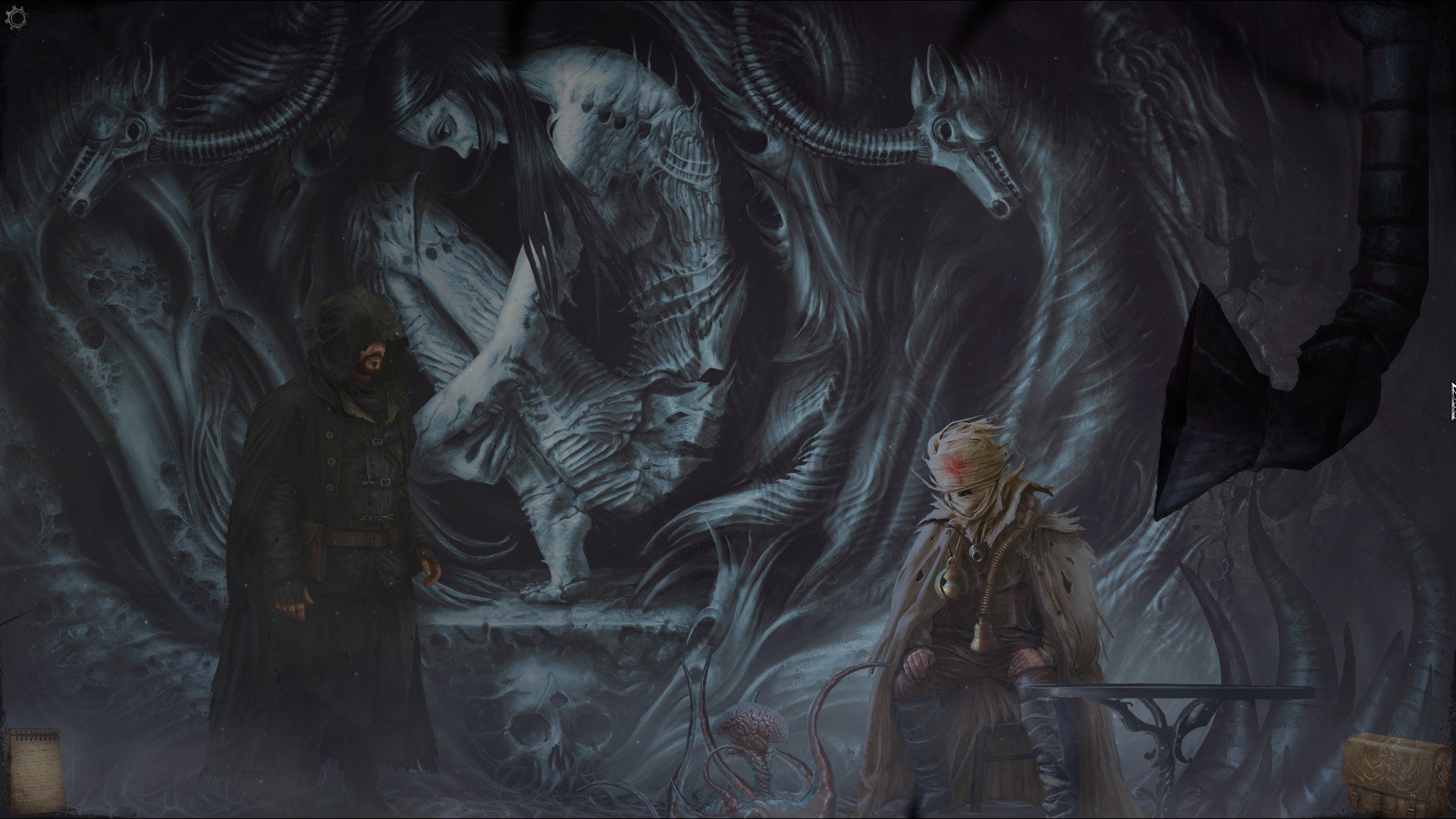
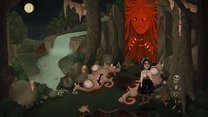
The artwork here is a stunning homage to painters Zdzisław Beksiński and the great H.R. Giger, best known for his biomechanical look blending organic with machine. As with the first game, everything is drawn using a dark palette featuring a lot of blacks, browns, and greys. One of the islands looks like it’s completely malnourished, as the little vegetation that remains looks dead. But plants are not the only thing that’s dead, as there’s even a hanging tree where bodies swing from its branches. There are plenty of bones and viscera littered throughout some of the areas, and various temples feature statues that look like skeletal structures gazing down upon their dreary inhabitants.
The characters you meet in Tormentum II are equally disturbing in their own right. One such unnerving individual you encounter early on has a blocky head and a very toothy grin. And then there’s a giant boney-looking worm that David needs to shoo away to get past and continue his journey. Even the more human-looking people have an air of unease and tension. This is no Disney cartoon but a fever dream of madness.
There are no voices, but the soundscape adds a lot to the eerie atmosphere of being alone in a strange land full of anguish. The music is full of depressing notes, predominantly utilizing wind instruments and deep bass, while the more intense scenes are hit with crescendos that make for a nervous rollercoaster ride of emotion. The squelching noises of organic material and the moaning of the damned and rattling of chains further heighten the tension. Along with the grotesque visual elements, this makes for a disturbing, relentlessly distressing experience. This is not a game for the faint of heart.
This would all be terrifying enough on its own, but here’s the kicker: From time to time we see glimpses of technology that shouldn’t be here but is. Could David be inside his own simulation? I never really got an answer to that question in my playthrough, but the ambiguity just adds to the appeal of such a depressing narrative. It is very hard to tell what is real or what might just be the computer program. This may bother some, but I’d much rather have that left unclear than be told outright what is actually happening. It keeps you guessing even after the credits roll.
Tormentum II
| Genre: | Fantasy, Horror, Science Fiction |
|---|---|
| Presentation: | 2D or 2.5D, Side-scroller |
| Theme: | Escape, Futuristic, Other worlds/dimensions, Technology |
| Perspective: | Third-Person |
| Graphic Style: | Illustrated realism |
| Gameplay: | Puzzle, Quest |
| Game Length: | Medium (5-10 hours) |
| Difficulty: | Medium |
Real or not, David is lost in a land that wants to drive him either to his grave or complete insanity. Along the way to uncovering his dream chest, he has to either help – or hinder – the other denizens of this bleak world. In an ice-filled cavern, David is asked to help get a fish from under the frozen water to feed a woman’s pet wolf, while elsewhere he is forced to make anyone bound to a windmill suffer just so he can power an orb. On one of the larger islands, you’ll need to get the water pumping from a well to unlock a tower.
To accomplish these tasks, Tormentum II has you pointing and clicking around the environment, talking to other characters, picking up items, and solving puzzles over the course of roughly eight hours. The backgrounds, however, are static throughout, and David himself doesn’t move as you’re clicking around the screen. In fact, he’s rarely shown touching things at all. There is no hotspot highlighter in this game, but whenever the cursor lands on something that can be interacted with, it’ll glow and show one of a handful of icons depending on what you’re allowed to do with it. There’s a magnifying glass that lets you either look at or zoom in on an object, a hand icon that indicates you can pick something up, and of course a speech bubble for talking to others.
In addition to using inventory items, there are a handful of other types of puzzles David needs to solve to move on. One of my favorites early on was adjusting frequency and amplitude on a computer terminal to match a tattoo. Another includes figuring out how to mix a potion from a cryptic riddle and a diagram found in the same area. (There are a handful of other riddles that make the solution much clearer if you can decipher them.) I’m not particularly fond of mazes in adventure games, but there is one near the end that is fortunately a pretty simple affair. You’re even provided a map showing the layout of the labyrinth.
With the use of a handy notebook, you can keep track of what’s needed to solve these puzzles, such as a pattern of notes played on a sequence of crystals. David also liberally sketches what he sees on the off-chance that it will help with a puzzle – which, of course, is usually the case. Thankfully, most roadblocks are quickly resolved through logic or even trial and error, but having some sort of hint system might have alleviated some frustration. Trying to figure out how to get a beating heart out of a tank using blood as a vector had me completely stumped, and I had to reach out to the Tormentum II community for help. In hindsight, the solution was simple enough that I just had to slap myself on the forehead and ask why I didn’t I think of that.
Speaking of maps, you’re given one by another prisoner early on that acts as a way to travel between the islands. There are only about three or so to start with, but as David wanders among them, he’ll discover more. When he’s finished with one, he’ll cross it off the map with a big old X to show you’ve done everything you can there. This is a fun way to indicate advancement in the plot. Some of the islands are only a few screens long, but the bigger ones can span almost a dozen.
As befitting what in essence is a psychological horror story, you are faced with several choices, such as whether you want to take painkillers or not, or even if you should save or kill someone. The best part of this is that what you decide matters. David keeps falling deeper and deeper down the proverbial rabbit hole as his actions dictate the way the world reacts to him. If he was to sacrifice something that was clearly important to someone, they’ll react to him negatively and call him a monster. If he does a good deed and, say, agrees to end another person’s suffering, they’ll thank him as they shuffle off this mortal coil. As far as I can tell, there are no ways for David himself to actually perish in the game.
That’s another great thing about Tormentum II. It makes you feel for the inhabitants of a world that seems to know only death and misery. The struggles they go through on a daily basis just to survive in a hostile place make them quite sympathetic. Even if my suspicions about this all going on either in David’s head or through a computer simulation are correct, it doesn’t take away from the feeling of wanting to make things right.
The consequences of your choices ultimately lead to one of several endings. By the final stretch, David can have up to three nonplayable characters with him or he can go it alone. It’s not always easy to tell what repercussions a decision might have, however. I kept making what I thought was a good choice only to be told that someone I wanted to protect had just perished. I desperately wanted to load up a previous save (nine manual slots are provided, but the game also autosaves liberally) just to see if I could get a better outcome.
The one I got was pretty bleak, and while I’m certain it would be classified as a “bad” ending, it’s really hard to tell with this type of game what differentiates a “good” from a “bad” conclusion. The game isn’t designed to restore near the end to see alternate finales, but it’s tempting to replay the whole game, as the first playthrough made me second guess myself. Did I just doom the realm of Tormentum for my own sake? Am I the bad guy here?
Final Verdict
Like its predecessor, Tormentum II is a richly atmospheric experience blending eerie sound work with macabre visuals. It is not a title to be played if you’re in a depressed mindset, as all the suffering you witness can be unnerving. It does give you plenty of reason to care, however, and keeps you constantly guessing what is and isn’t real. There are more puzzles to solve this time, and your choices will stick with you until the credits roll, making you sure to wonder if what you did was the right thing. I very much enjoyed the original game, but it’s been quite some time since I played it to offer a proper comparison. However, both series newcomers and fellow fans of the first Tormentum should find lots here to enjoy, as OhNoo Studios clearly took what they learned from that game to create a masterpiece of surrealism the second time around.
Hot take
Bigger and arguably better than its predecessor, the long-awaited Tormentum II is a welcome darkly atmospheric psychological horror sequel that will have you constantly questioning yourself, even your own perception of what is real.
Pros
- Dark, macabre artwork impressively conveys a sense of unease
- Eerie and depressing music accentuates the psychological horror
- Thought-provoking narrative in a dark fantasy setting
- Player choice and multiple endings allows for replayability
- Plenty of puzzles, often cleverly implemented
Cons
- Some puzzles can be especially tricky to figure out
- No voice-overs for any of the characters
- Consequences of choices are not always clear
Serena played Tormentum II on PC using a review code provided by the game's publisher.

- Advertisement
- Help support AGH by advertising with us



2 Comments
Want to join the discussion? Leave a comment as guest, sign in or register in our forums.
" There is no hotspot highlighter in this game, but whenever the cursor lands on something that can be interacted with, it’ll glow and show one of a handful of icons depending on what you’re allowed to do with it". Press the Spacebar to highlight all hotspots.
Reply
Thanks for clarifying. There was no indication that pressing space highlighted everything, but even then it wasn't hard to spot what needed to be clicked on anyway.
Reply
Leave a comment