
Sleepytime Village review
- 0 Comments

Slumberland adventure starts out dreamy but jolts you out of it just when thing are getting good
Growing up is a part of life, and as we age it can be hard to remember what it was we found so magical about the things we loved as kids. This is especially so with television shows made for early childhood, which can go from being enrapturing for toddlers to downright unsettling for adults. Whether it’s Barney & Friends or Teletubbies, there’s a sense of uncanniness to these productions and their bizarro realities filled with over-the-top cheery characters. With Sleepytime Village, by Lightfoot Bros Games, an adult’s perspective is dropped into the dreamworld weirdness of children’s programming and forced to make sense of it all. It’s a great premise with an important underlying message behind it, and there are certainly moments that embrace its thoroughly surreal nature, but between some curious design decisions and abbreviated runtime, I was left feeling like the dream ended before ever reaching its full potential.
You play as Rufus Stone, a workaholic who has strained the relationship with his wife Amanda and daughter Phaedra to its breaking point by focusing on his career. With Rufus putting in such long hours on the job, taking care of Phaedra has largely fallen on Amanda. Tonight, Amanda is having a night out with her friends for the first time in months so Rufus has agreed to watch Phaedra. At least, that’s what was supposed to happen. But when Rufus is asked by his boss to cover for him at a big meeting, he ends up running so late that Amanda is forced to stay home. Again.
This isn’t the first time, and now Amanda has finally had enough. She calls Rufus and sends him a text when he doesn’t pick up to let him know that she’s leaving him and taking Phaedra with her. While reading her message in the back of a taxi, an exhausted Rufus drifts off to sleep. But instead of waking up outside his house, Rufus finds himself in a bizarre town of colorful characters and childlike creativity right out of the kind of TV shows his daughter would watch. Now he’ll have to think like a kid in order to solve puzzles and bring happiness back to the denizens of the titular village, as only then can he hope to find a way home.
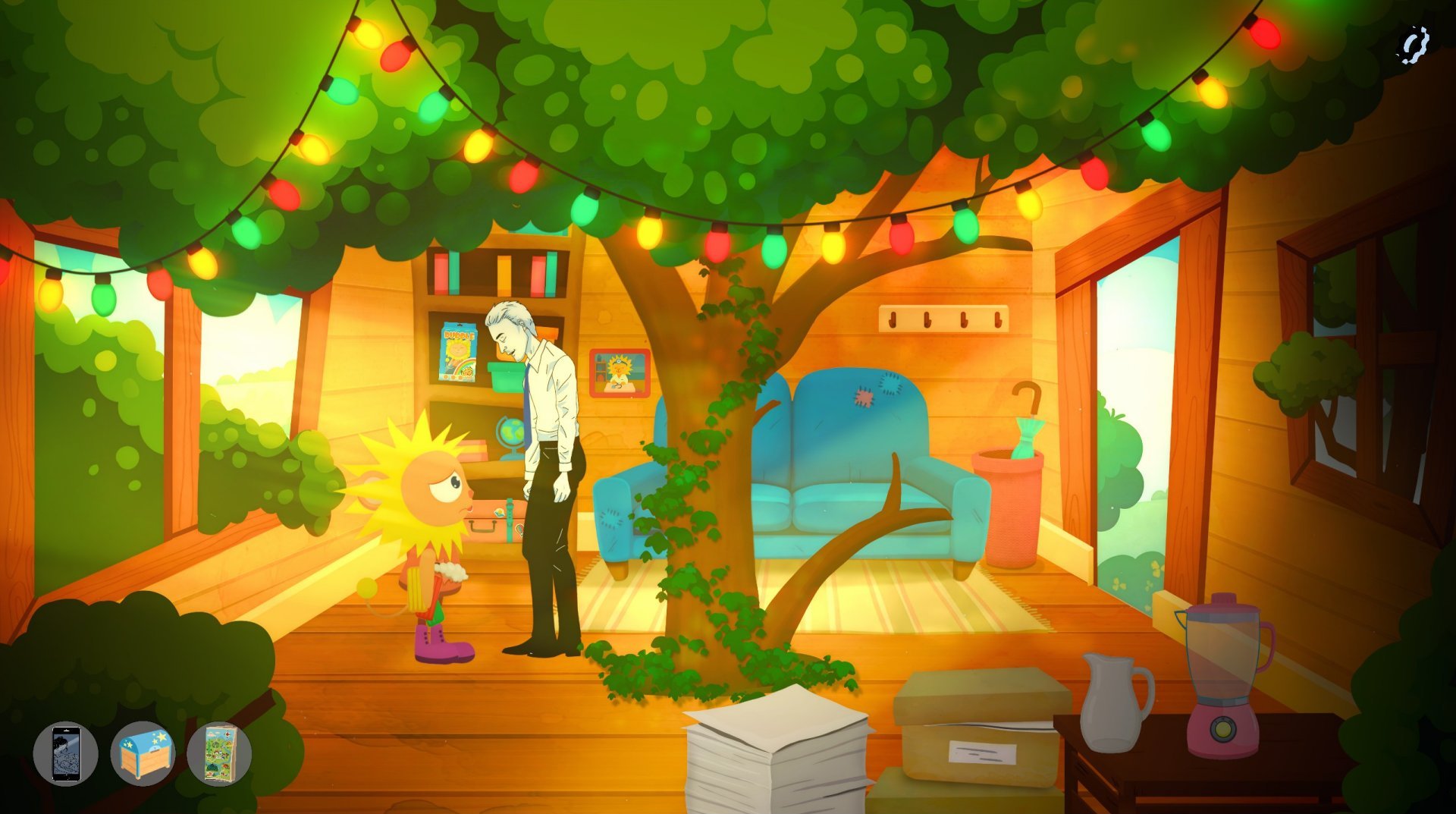
Sleepytime Village is a classic-styled point-and-click adventure and all of the standard controls are here, from left-click interactions to a cursor that automatically changes modes depending on what you’re mousing over. Double-clicking will break Rufus into a run, which moves a little faster than his base walking speed. The inventory is at the bottom of the screen, denoted by a brightly colored toy chest, along with your cell phone (where notes and objectives are stored) and a map of the village that gradually fills out as you explore new areas and can be used to fast travel between locations you have discovered so far. You can manually record your progress at any time, but an auto-save updates periodically as well.
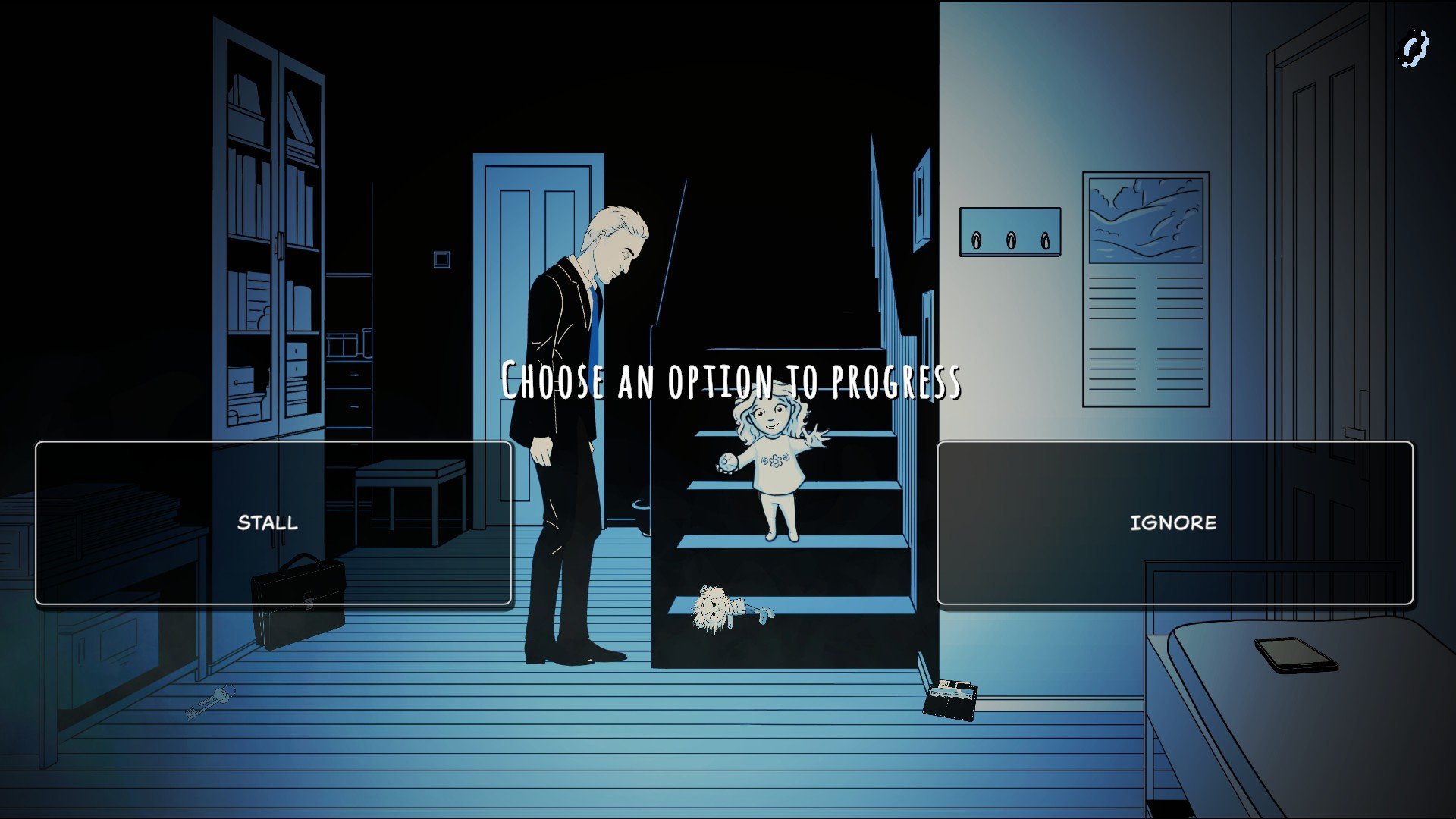
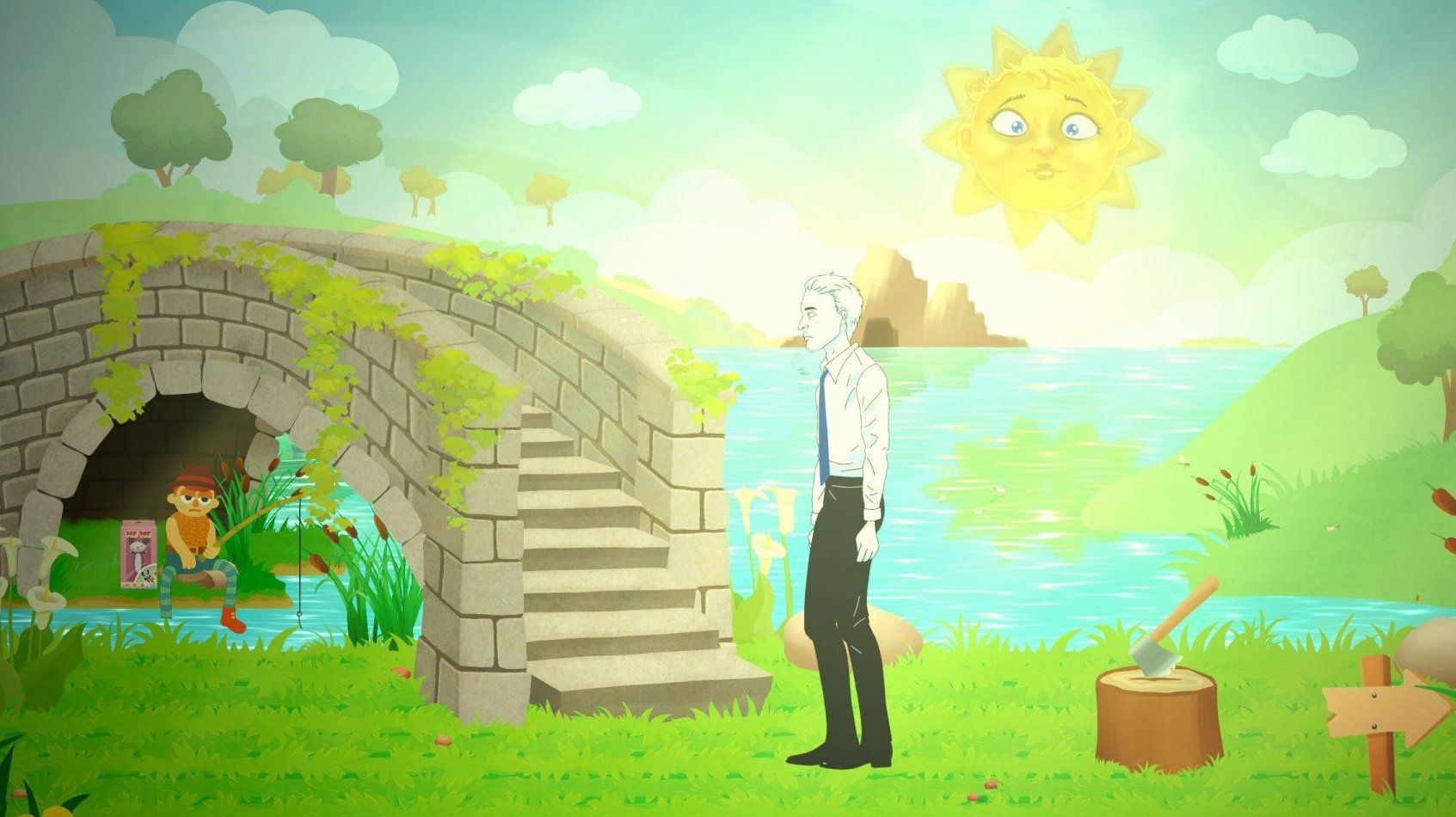
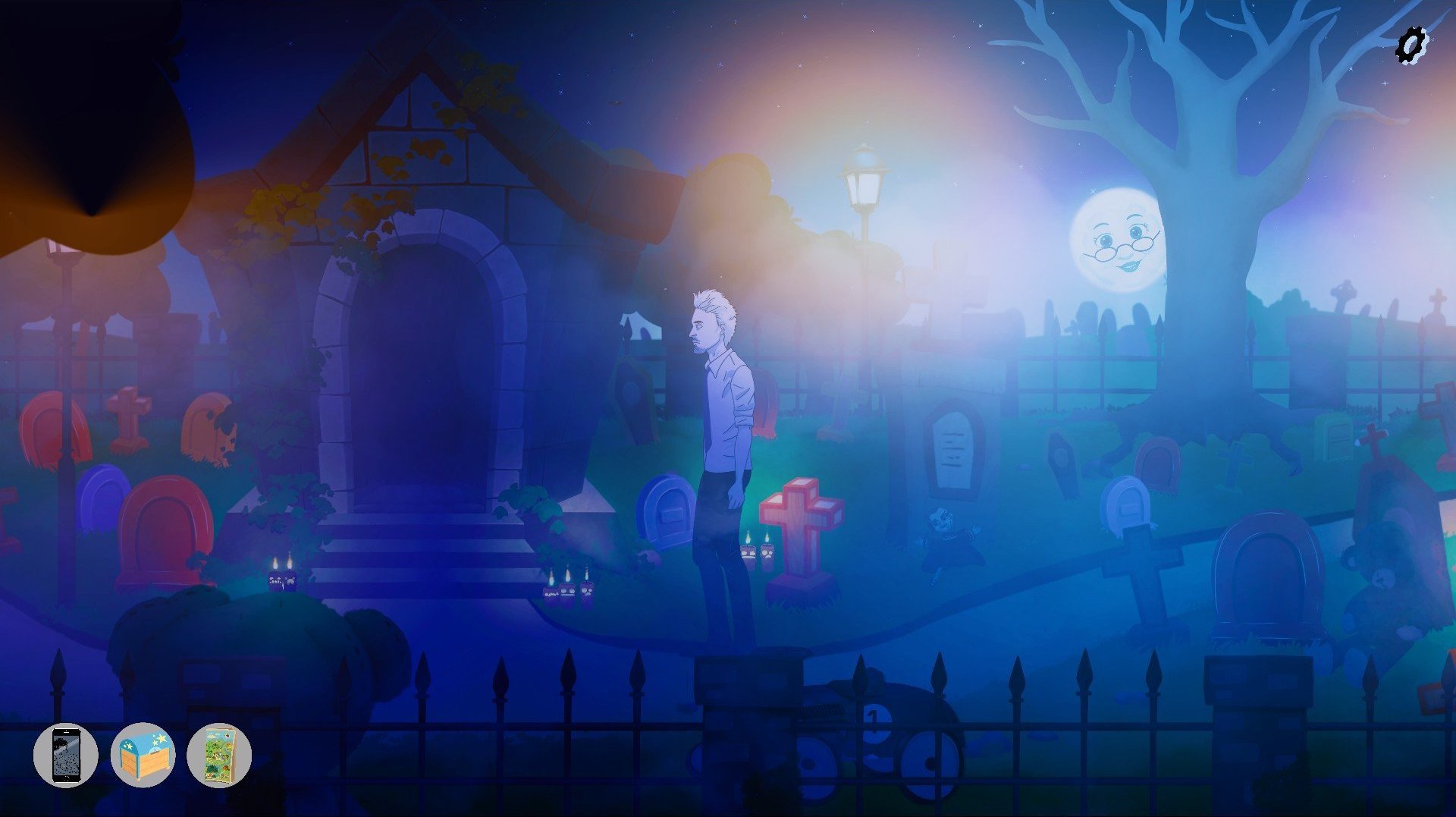
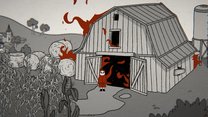
Everything is presented in a 2D comic style but with sharply contrasting looks. The dreary “real world” is depicted with bolder lines and a darker palette of blues and blacks on white, while the village lacks ink outlines and features bright colors like purples, pinks, yellows, and greens. Having only a washed-out Rufus fully outlined in a world with a vastly different aesthetic works great in making him feel like he doesn’t belong, while also making him immediately visible against the colorfully cartoonish backgrounds.
Accompanying your wanderings is a wonderful musical score filled with tunes both cheery and creepy. A particular standout is the dramatic piece that plays in the toy graveyard (which was already an unsettling place in a childlike dream world to begin with). There aren’t a ton of tracks, but I enjoyed the ones that are here.
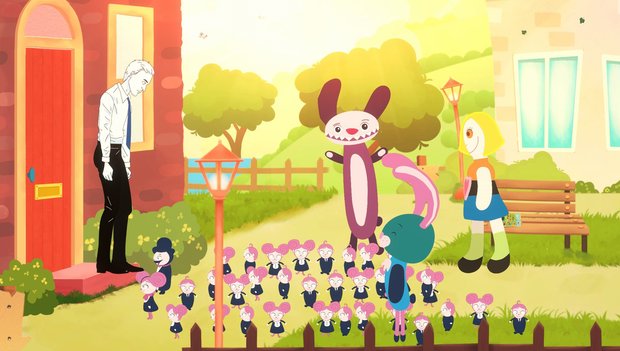
Following the prologue, which takes place entirely in Rufus’s mundane world, Sleepytime Village is split into three acts, with each expanding the area of the village you can explore. The first act takes place entirely within one house, belonging to the lanky pink and purple spiky-toothed rabbit thing named Me-Me. As you leave the house, you find more creatures like Me-Me – all of which were designed from drawings made by the young daughter of the game’s writer. These characters are wonderfully distinct in a way that feels different from other games taking place in imaginary worlds. Here, though, they are all sad after an unfortunate mishap (that is entirely Rufus’s fault), and your main goal is to help them be happy again by solving their various problems. As you assist these strange creatures with their woes, you’ll slowly lead Rufus closer to finding his way out of this bizarre TV cartoon world.
None of the characters Rufus meets in the village says anything other than their name, which makes it a bit difficult to discern what it is they want from you. Or it would be, if not for the nameless, seemingly omnipotent narrator. Throughout your 4-6 hours of play time, a constant companion will be the voice of the narrator chastising Rufus and pushing him to help others (to the protagonist’s annoyance). He will offer over-the-top cheery explanations for the various challenges you encounter, acting something like the narrator of Thomas the Tank Engine but with a slight hint of Mad Hatter that makes his commentary feel slightly… off. His delightfully unhinged delivery contrasts nicely with Rufus’s down-to-earth everyman performance.
Unfortunately, this tonal mismatch doesn’t work nearly as well for the game itself. In fact, I’m not entirely sure how to categorize this game. It starts out with some intriguing personal family drama, but once you arrive in the village, many scenarios fall into slapstick, like Rufus getting bitten by a massive Venus flytrap or puking his guts out after riding the magical train named Choo-Choo. Then there’s Rufus’s relentless foul language. I’m not one to take offense to swearing by any means, but the number of f-bombs dropped here feels like the writers really wanted to hammer home that this is a game for adults in spite of its whimsical world. There is an option to bleep out Rufus’s constant cussing, but the bleeps were so distracting that I ended up switching back to standard obscenities after a couple minutes.
But this isn’t just an R-rated comedy either, and not everything in the village is nonsensical. There are many sequences of intriguing flashbacks to Rufus’s past, showing his relationship with his late grandmother and the upbringing that led to his obsessive career tendencies. The connections to Phaedra’s plush toy Duddle, a hand-me-down from Rufus’s past, were especially interesting and served to bridge the dreamlike existence of the village with Rufus’s regular life back home.
The one thing I was actually expecting Sleepytime Village to be never ended up happening at all. Across all of its marketing, the game has been referred to as a “creepy AF” adventure. I kept waiting for it to fulfill that promise, but with no real payoff. A few areas like the basement workshop of Me-Me’s home and a vast cavernous tunnel under the gingerbread house hint at something deeper and more sinister going on here, but at no point did I ever get the sense that I was putting together the pieces of a grander mystery, and certainly never felt anything resembling fear. There’s a boarded-up purple house in the main square that the villagers no longer go to since “the incident,” but it’s played off as a bit and never comes up again.
Sleepytime Village

| Genre: | Fantasy, Mystery |
|---|---|
| Presentation: | 2D or 2.5D |
| Theme: | Escape, Psychological |
| Perspective: | Third-Person |
| Graphic Style: | Stylized |
| Gameplay: | Quest |
| Control: | Point-and-click |
| Game Length: | Short (1-5 hours) |
| Difficulty: | Medium |
The majority of puzzles are challenging enough to be engaging while not being too difficult. One standout involves the various fruits and vegetables you have to gather for a smoothie from the strange plants either oozing pus or swinging deadly scythes from bone-like branches. But there were other times when I felt the game was dipping into the realm of moon logic. One section requires Rufus to sharpen the blade of a dull axe, and there’s an object you can examine that Rufus mentions would work great in doing so. So I used the axe with the object, but Rufus just gave his usual “What are you thinking?” response. At that point I figured the solution must lie elsewhere, but after far too long searching without success, it turns out I was on the right track all along, but the method for reaching the solution was not just ludicrous but went directly against a hint the game gave me.
At various points you will find notes written for Rufus by an unseen third party, which will have hints to some of the puzzles written out. It’s a clever concept but whenever I found one of these notes, the hint would either be for a puzzle I had already solved or something so obvious that I had already deduced it without additional help. The puzzles I actually had trouble with were ones that didn’t have any notebook pages I could find, leaving me to brute force my way through solutions until something stuck (or in one case sought outside assistance).
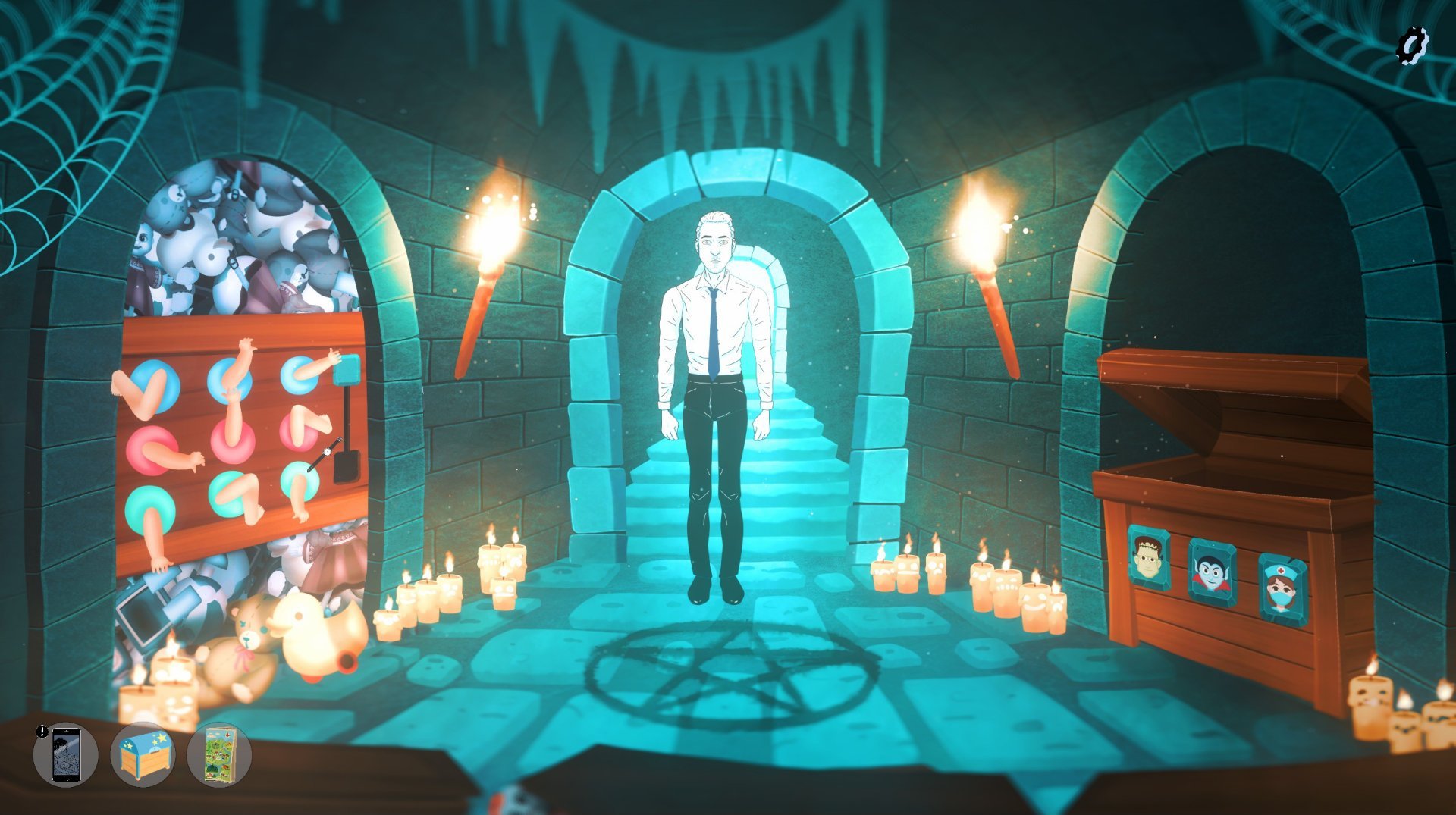
While the axe puzzle was most egregious, another puzzle requires you to cut rainbow bamboo, but it can only be cut with a specific object for arbitrary reasons that are never explained aside from the narrator saying this is “just how things work in the village.” The stuffed lion character Duddle has a tear in his chest, and I found a bobbin of thread pretty early on that made sense to patch him up with. There was a needle clearly visible in the basement of Me-Me’s house sticking out from one of the plush toys in the background. However, this needle is not the one you use for this puzzle, and in fact you are told by the narrator not to touch the toy it’s currently stuck into.
In another instance, there’s an item you can click on but Rufus remarks that he doesn’t want to pick it up, until later in the game when it becomes a required part of a multi-step puzzle solution. This is the only item in the game that Rufus won’t pick up the first time you see it, so it’s both bizarre and potentially misleading that you can’t just slide it in with the other random objects that line Rufus’s pockets. The logic flow doesn’t maintain consistency even by the standards of the village’s oddities, and it’s a real shame with how inventive the world is.
In a few sections you have multiple options for how to respond as Rufus (mainly in the prologue), and while I’m glad these are here to keep Rufus engaging as a character, these choices largely amount to an additional line of dialogue rather than major crossroads for the direction of the plot.
While working my way through Sleepytime Village, an unexpected obstacle proved to be the interface. When opening your inventory, you’re able to left-click any item to use with another or in the environment, or right-click to examine. There’s a big “X” at the bottom, but instead of clicking it to close the inventory, simply mousing over it is all that’s required. The problem is that it’s very easy to do this accidentally, compounded by the fact that you need to re-open your inventory and select items again whenever you make an incorrect attempt, even when simply attempting to combine two items together.
Another annoyance arises when you’ve finished using an item for good, as the narrator will remark that it is no longer needed and an animation plays of it disappearing in a puff of smoke. This wouldn’t be a problem if it just happened once, but it happens every. Single. Time. When multi-part puzzles have several items being whisked away in quick succession, you have to sit through the same animation and narration each time.
I experienced various minor visual bugs as well. Twice the rabbit Bumpity’s 2D model reappeared frozen in place after he had previously left the scene. Several objectives on Rufus’s phone did not disappear after I completed them either. Fortunately these didn’t interfere with my progress at all.
Eventually I was able to make it to the point in the game when the narrator told me everything would be made clear. I was excited to see what the next half of the game would hold, breaking down the metaphors and mystery of the strange inhabitants of the village and finding out what this place really is. And then, after a bizarre interaction with a character that felt entirely out of place with everything to that point, the game ended. There’s a final choice to make in order to witness one of two possible endings, and the handy save system makes it easy to go back and choose the other, but there’s only really one choice that makes sense within the context of the rest of the game.
Final Verdict
It’s clear a lot of care went into crafting Sleepytime Village’s weirdly wonderful world inhabited by strange creatures. The story offers an intriguing look into what would happen if you dropped a work-obsessed adult into the realm of a child’s imagination, and there’s an important moral about making time to connect with those we care about through play. But even with these strengths, I was left feeling disappointed. I have so many unanswered questions, and not in the fun way of trying to interpret something profound – more so in the sense that I legitimately have no clue even now as to what the village actually is. The narrator is a fun presence, but like the villagers he doesn’t seem to serve a purpose other than cheerfully torturing Rufus to try to teach him a lesson about how to live a better life. When the credits rolled, I audibly uttered “Seriously?” because I thought we were just about to start getting into deeper truths. While the ending is fine for what it is, it’s hard not to feel that there was so much more to uncover in a village we never got to fully explore.
Hot Take
Sleepytime Village offers a unique premise with plenty of potential, but some questionable design decisions combined with a lack of closure around key mysteries may leave you longing for the rest.
Pros
- Fascinating cartoon world nails the children’s TV programming aesthetic it’s going for
- Catchy music that’s equally upbeat and unsettling
- Full voice acting, with standout performances for the protagonist and narrator
- Relatable story about the struggles of adulthood, especially as a parent
Cons
- Tone feels consistently at odds between dark and serious and silly and whimsical
- Some puzzles teeter on the brink of moon logic
- Minor interface annoyances combine with numerous small bugs
- Abrupt ending leaves more questions than answers
Sam played Sleepytime Village on PC using a review code provided by the game's publisher.

- Advertisement
- Help support AGH by advertising with us





0 Comments
Want to join the discussion? Leave a comment as guest, sign in or register in our forums.
Leave a comment