
HORSES review
- 0 Comments

Disturbing but thought-provoking farm adventure trots out surreal themes that are worth working through
I got my first job at fifteen years old, washing dishes at a restaurant for one week during summer break. My parents had arranged the whole thing, as I was more than content to just sit in the basement and play video games. I remember being tired, sweaty, and out of my comfort zone around the foul-mouthed chefs. Then, at the end of the week, I walked home with a paycheque for $90 – barely enough for a new video game. I hated the whole experience and, needless to say, it put me off work for a few more years.
Santa Ragione’s Horses is about a young man named Anselmo who is also getting his first real taste of the working world, and in retrospect he had it much worse than me. This is a provocative and deeply disturbing game, but one I found it hard to tear myself away from. The gameplay is intentionally mundane but manages to smartly use metaphor to explore a horrifically bizarre yet unsettlingly familiar world. Anselmo’s first gig is anything but normal, and despite the meandering and seemingly innocent job description on paper, a day’s work on the farm here is one you won't soon forget.
Horses opens with a warning about its graphic depictions of abuse before cutting to a peaceful title screen of flowers blowing gently in the wind while classical music plays. Starting the game proper, players assume the role of the 20-year-old protagonist as he rings the bell at the front gate of a large property in the Italian countryside. After being buzzed through, you walk up the estate’s long, winding driveway to the farm. Here “the Farmer,” a portly, middle-aged man, greets you with a smile before escorting you to your room inside a quaint bungalow, followed by a tour of the vegetable garden, meeting his dog Fido, and then finally to the Farmer’s pride and joy, his horses.
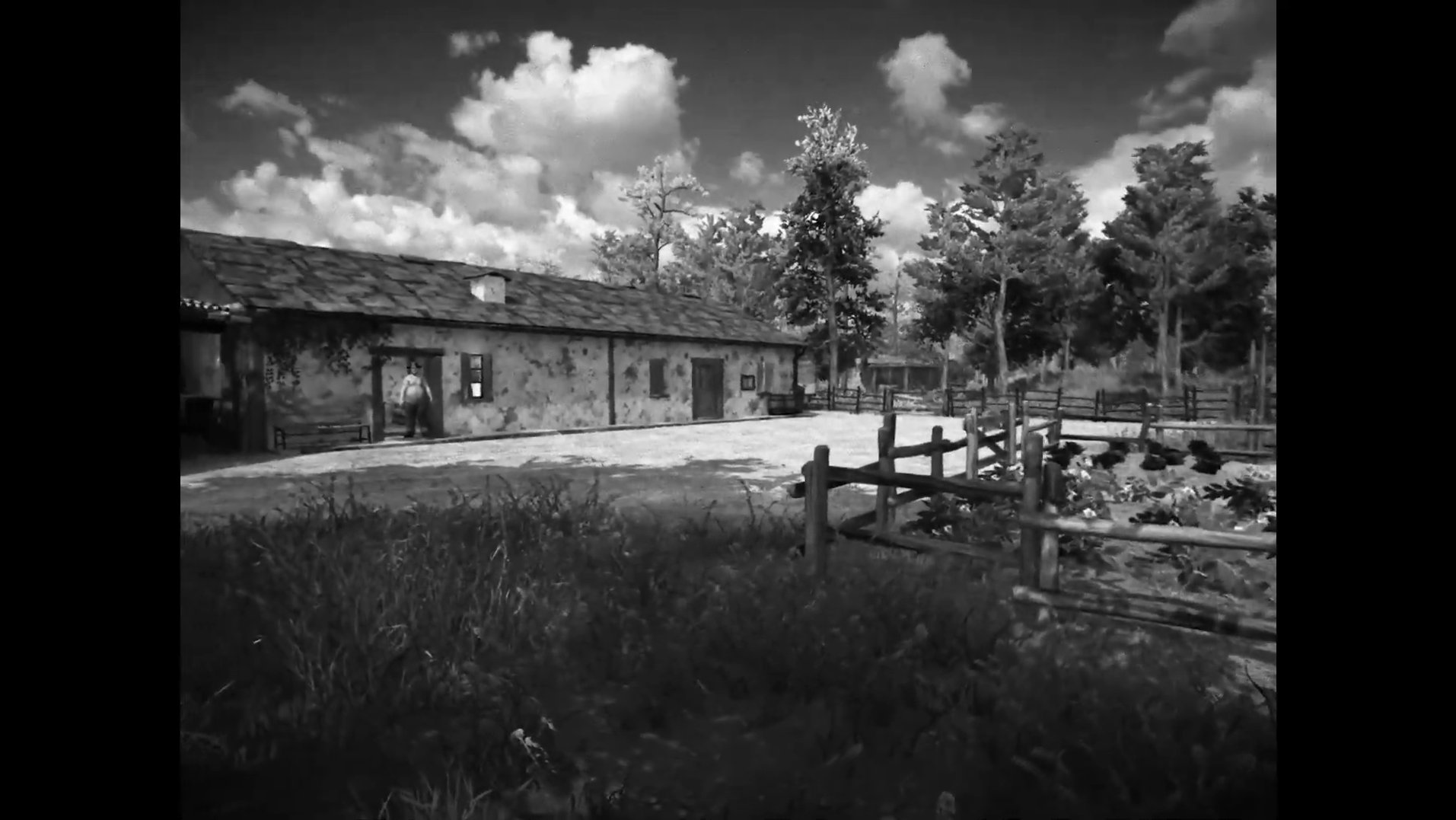
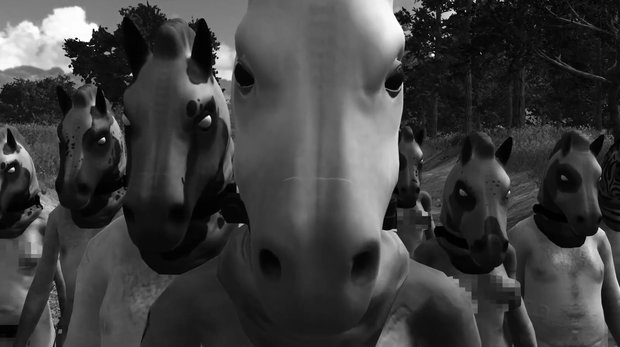
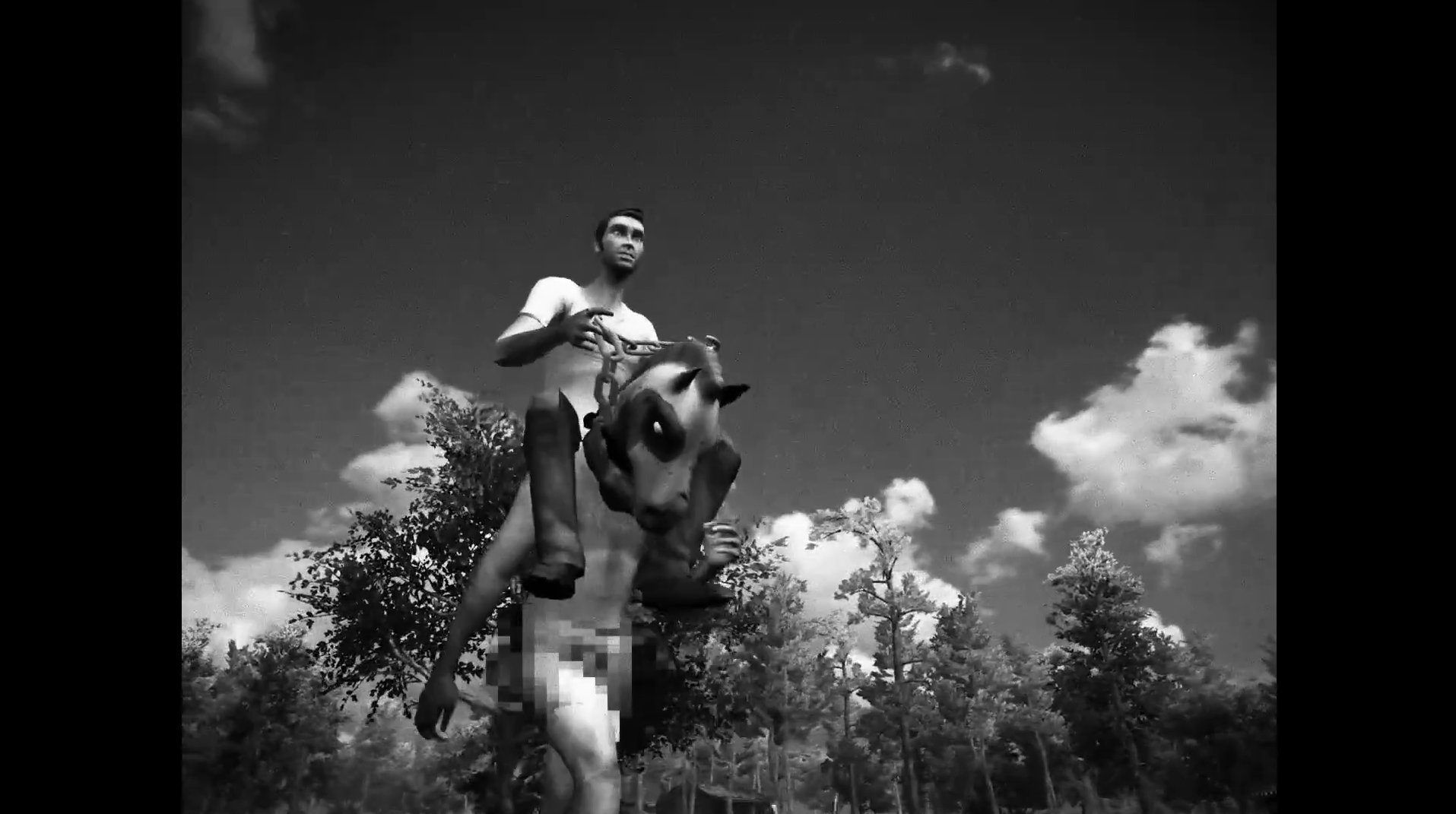
As you round the back of the farmhouse, ominous music begins to swell, and for good reason, because when you approach the pen, it is revealed that all of the horses are in fact people. These “horses” stand in cramped quarters, exposed to the elements, ankle deep in their own waste, and entirely nude (though censored) aside from the prop horse heads affixed to their necks with metal collars. Anselmo, while silent, is shocked at the revelation, as revealed by the camera occasionally turning around to focus on his reaction. The Farmer then invites you to ride with him by piggybacking the horses, showing you the rest of the estate before challenging you to a race, scored by an upbeat piano arrangement.
You will stay fourteen days on this farm, and after the first one you’ll be introduced to your duties. The Farmer leaves a note with instructions each morning, such as watering the garden and chopping wood, which, in any other circumstance, would more or less seem normal. After leaving your room you can eat your breakfast (or often skip it, if so desired), then feed Fido and usually proceed to check the chore list, though some days dispense with this formula in favour of some immediate narrative event. You use WASD and the mouse to move Anselmo in first-person view, and use the mouse buttons to pick up or drop objects, of which you can only carry up to two at any one time. There are pre-set points of interaction within the environment that are highlighted when approached, like turning on a hose tap or finding a vegetable ripe for picking.
You can easily call up your chore list after collecting it, and the various tasks are crossed off as you complete them. The property is quite small, and with the list to fall back upon your present goal is always clear, so you’ll rarely find yourself wandering around aimlessly. All tasks must be completed in order to move the plot forward, with time essentially standing still until you do so. Sometimes you’ll even be “gated” into an area until you’ve finished your work.
Early on, the Farmer states that his room is off limits as he likes his privacy. Eventually you will have to go inside, but there are a few select opportunities to go snooping before this mandatory segment in order to get additional plot information, should you wish. You can explore the farm at your leisure at times, though only the relevant items and hotspots will be interactive. The Farmer, while often out when you first wake up, comes back later in the day to act as a key source of direction for Anselmo in what needs to be done next, with new tasks appearing on his chore list.
There are a few puzzles late in the game, and while not overly difficult, they did make me stop and think for a few minutes. The main puzzle involves deducing the code to a door lock, and you’ll need to gather clues to the combination from the Farmer’s room. The clues are laid out in plain sight, so you won’t need to do much searching, but you’ll also need to compare the numbers gathered from the room with another resource nearby. It’s a well-built puzzle, set against the climax of the story, and a few more challenges like it throughout the game would have been welcome.
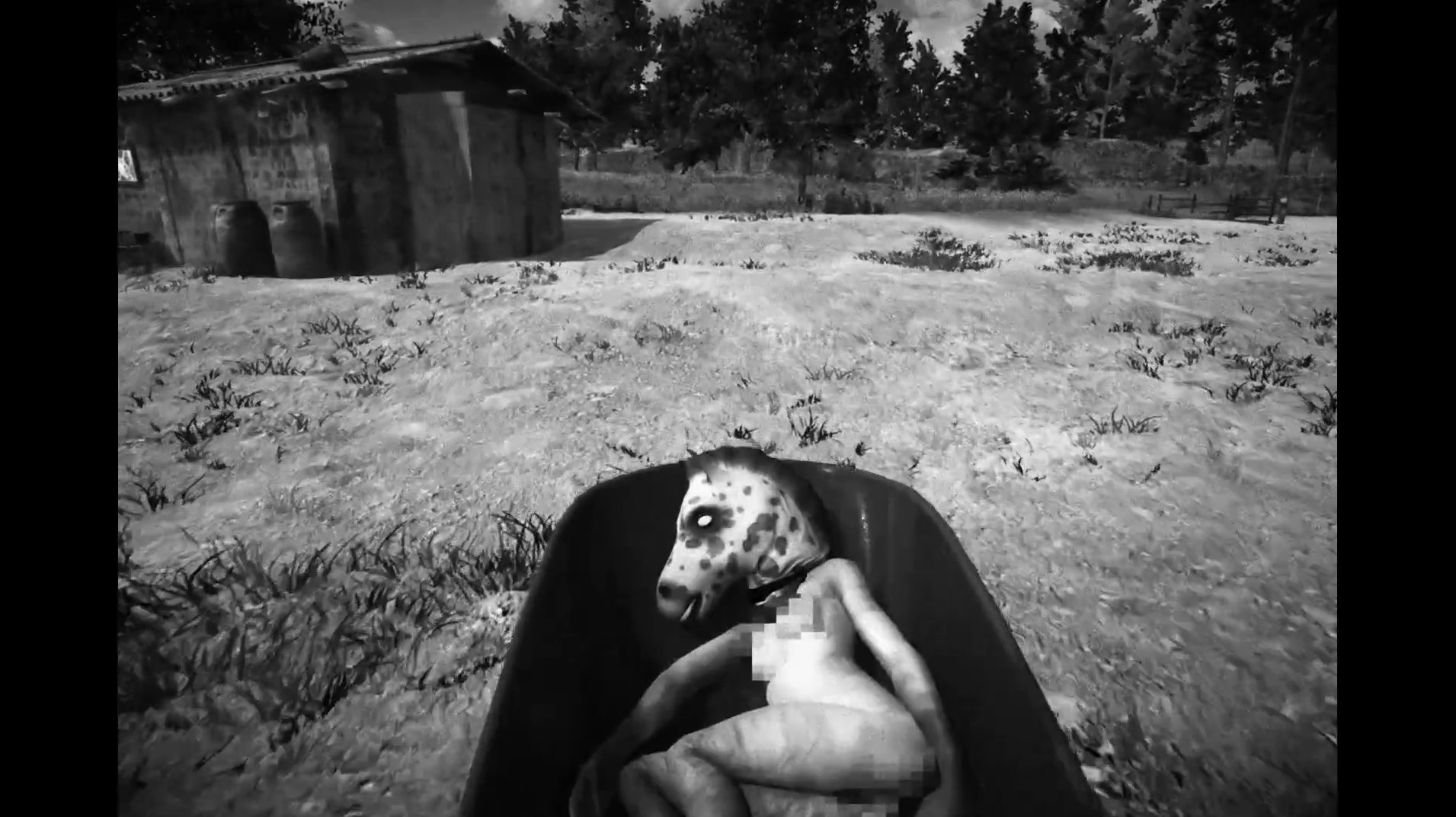
Unfortunately, my initial venture into the hallway with said locked door glitched out, not allowing me to leave. Elsewhere I encountered another issue where the trigger to progress did not appear, forcing me to once again reload the last automatic checkpoint. While not a bug, one segment that initially caused me confusion was when I was tasked with digging a grave for a dead horse. I grabbed a shovel from the shed as instructed, then after digging the hole I returned with a wheelbarrow to move the body. However, the Farmer simply continued to tell me to dig a hole. It turned out I had to dig several times in order to make the grave deep enough, which makes sense in hindsight but I had no inkling at the time why I wasn't able to progress.
Not every day at the farm is routine, and occasionally you are forced to assist with the “care” (and disciplining) of the horses. Next to the posted list of chores are the horses' names. You are presented a brief slideshow of each to introduce who is who, but after this it is often easier to simply memorize the horses’ identities by their headdress and hair patterns. Nevertheless, I did find myself inclined to learn the horses’ names, and memorized the list as best I could.
The Farmer warns you that the horses are not supposed to behave badly, and that fornication between them is strictly forbidden. On one occasion the horses manage to escape their pen as well, and in situations like these, the Farmer will ask you to identify the troublemakers. Several of these scenarios result in the Farmer physically abusing the horses, with Anselmo forced to assist with the aftercare, like tending to their wounds or cleaning up blood. There is also a scenario where Anselmo must unavoidably assault one of the horses physically, though you can try several other approaches before being forced into the act.
HORSES
| Genre: | Horror |
|---|---|
| Presentation: | Realtime 3D |
| Theme: | Psychological, Surreal, Animal |
| Perspective: | First-Person |
| Gameplay: | Simulation, Choices matter |
| Control: | Direct Control |
| Game Length: | Short (1-5 hours) |
| Difficulty: | Low |
| Graphic Style: | Low poly |
You sometimes have the choice of how to react to the Farmer’s requests. These are never dialogue options in terms of actual words, but rather picking either a thumbs up or down, or even smiley face variations, in response to something the Farmer has just said. Different choices lead to different results, and due to the disturbing nature of the tasks given, picking a genuine reaction is never hard.
Upon first arriving at the farm, for example, when the Farmer asks you to ride a horse with him, your response can be one of glee or discomfort – but either way, you have to ride. The narrative remains largely unchanged no matter your decisions, and there is just a single ending to the game. This only became evident during my second playthrough, but even with its linearity disguised, the game doesn’t give you full freedom of choice. When asked to give up the identities of horses caught fornicating, for example, you must reveal one – whether it is in fact the real culprit is up to you, but refusing entirely is not an option. Still, there’s just enough freedom that I enjoyed my second go ‘round anyway, finding new ways to interact with the Farmer and choosing other reactions to some of the horrific acts he requests of you.
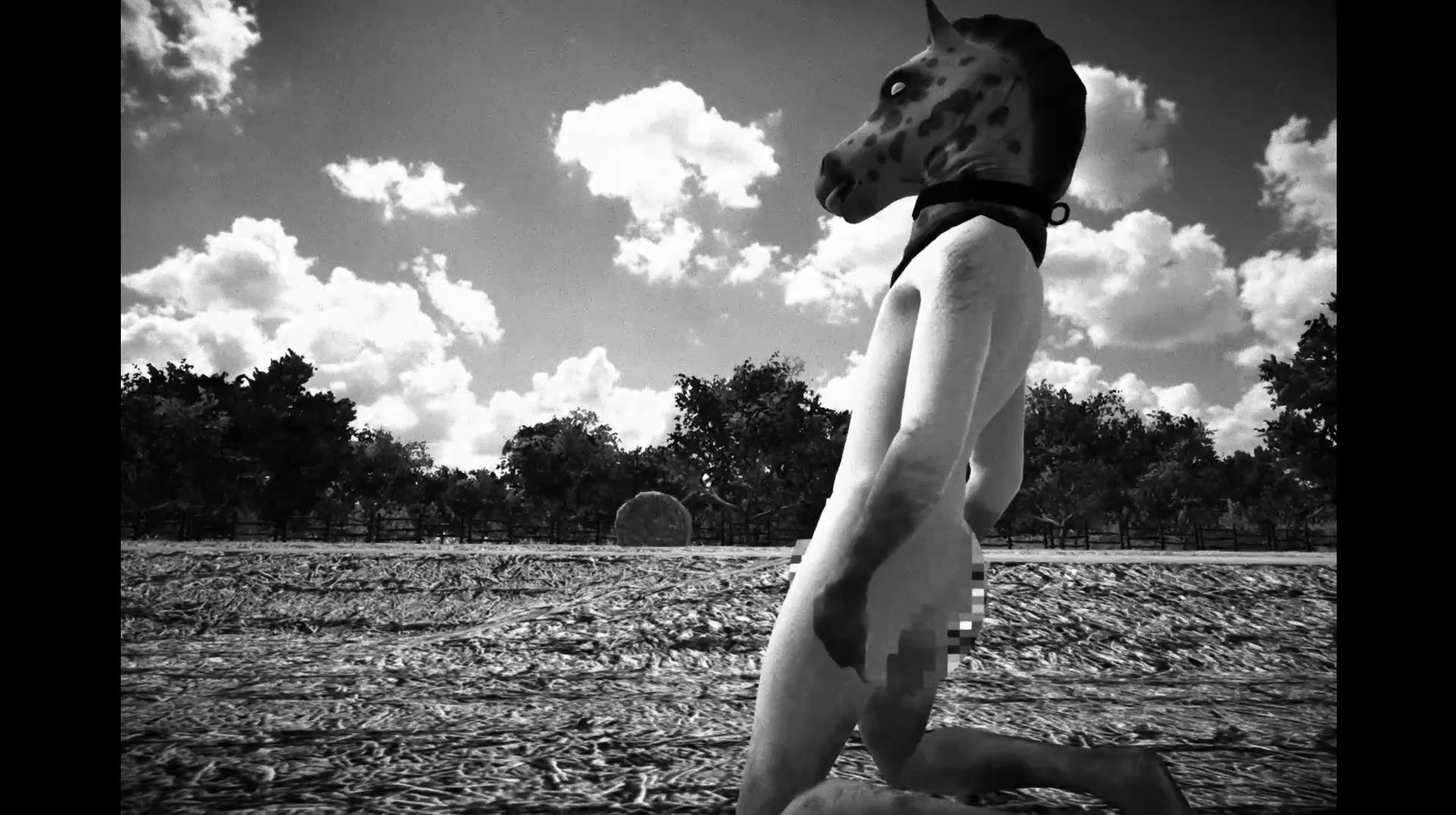
Occasionally you’ll get visitors who treat the horses with the same sort of bizarre normalcy as the Farmer. For example, the Farmer asks you to wash and prepare the horses for inspection one day as a potential buyer is coming to see them. Up to that point, it certainly crossed my mind that Anselmo (and me, by proxy) was the crazy one, seeing something that wasn’t really there, but the buyer plainly knows these are not real horses. What the world outside the farm looks like is kept a mystery, but whether it is like our own or some bizarre mutation of it, the disturbing metaphors of subservience and class are clear as day.
Without disclosing too much detail, the story does lead Anselmo to rebel against the Farmer and (covertly) work to free the horses. The conclusion is suitable for a horror game, with an ending that is bitterly unsatisfying, but in a poetic sort of way. Ultimately, the narrative is a deeply layered one, and whether you walk away from it pondering human, animal, or even labor rights, the underlying experience plays well both as metaphor and straight-up horror.
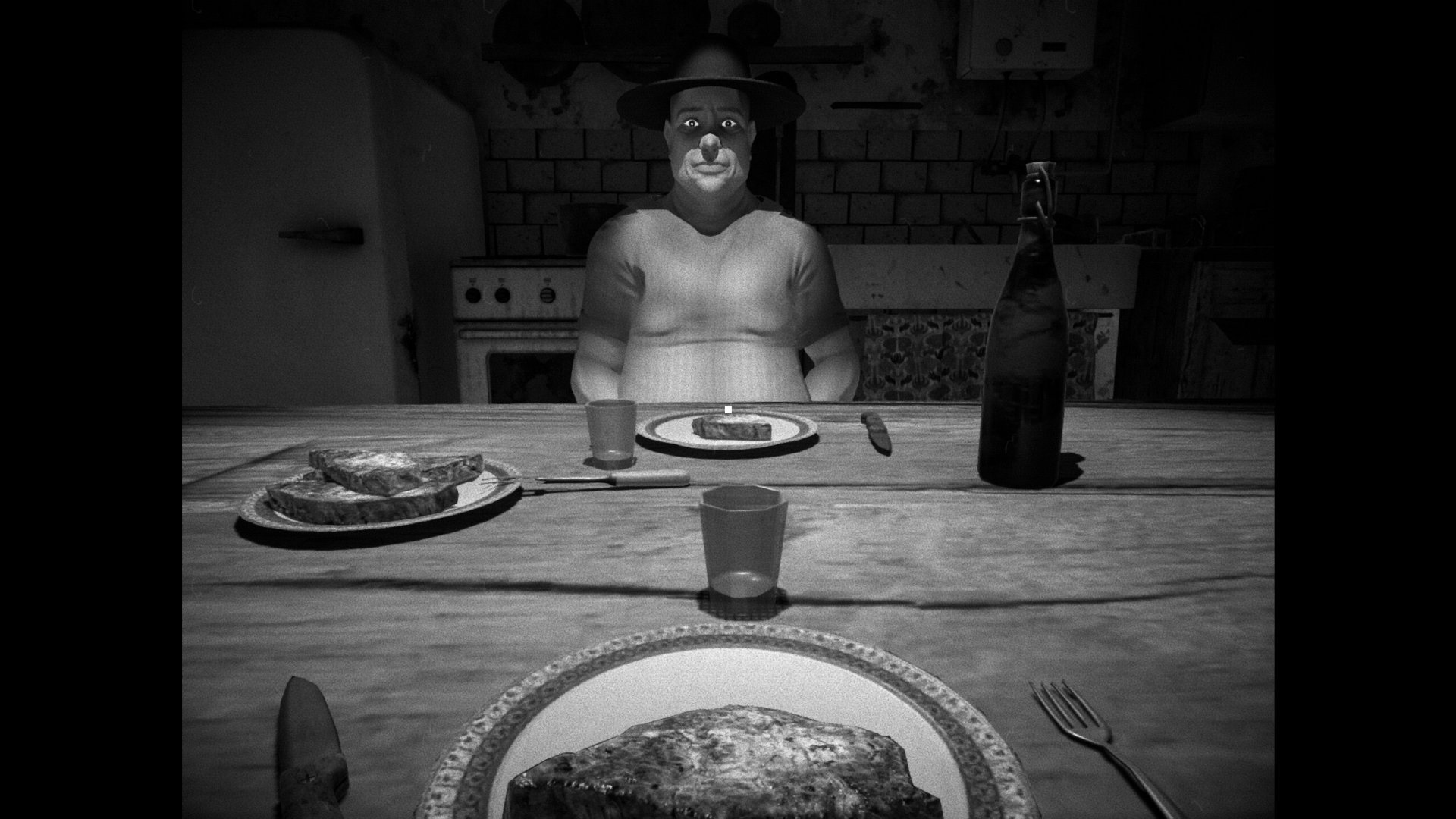
Artistically, Horses plays out like an old silent black-and-white movie. Most of the game is accompanied by the gentle sound of a roll of film looping through a projector to match the grainy filter through which you see the world. When Anselmo interacts with the Farmer or another character, the conversation plays without speech, the characters moving their lips and making facial expressions before the camera cuts to a black screen with text for the actual dialogue. Everything is in the developer’s native Italian, including dialogue cards, but English translations appear underneath. The in-game chore sheet and signposts are also written in Italian, but fade to their English translations when you’re up close.
Music comes into play sometimes, both original tracks and classical arrangements from the public domain. Sound effects are also used to punctuate certain actions like eating, with wet lip smacking and audible gulping as Anselmo and the Farmer consume their meals. Other sound effects are more jarring and bizarre, like cutting a cooked hen to eat, but with each cut being accompanied by a painful “bacaw!” even though the bird is clearly dead and cooked.
Certain actions like drinking milk, watering vegetables, and dumping manure are followed by real live-action video clips. The monochromatic filter looks great, emphasizing both the dark shades and bright sunlight of the farmland at different times of day and creating menacing shadows over the Farmer as he sits at the dinner table, with shade covering his face from the brim of his hat. Whether intentional or not, the black-and-white presentation also serves as a metaphor for the difficult but binary decisions Anselmo must make.
Horses can be played with either a keyboard and mouse or a controller. I played the majority of the game with the former, but for the few horse race sequences I found the controller to be a bit better for the dextrous movements required. The game records your progress automatically at the start of each new day, and though you can make manual saves as well, these too will simply restart you at the beginning of the current day. Upon finishing the game, you can select individual days (or chapters) from the main menu if you just want to replay certain segments.
The game’s release ordeal was something of an adventure in its own right. Prior to launch, Steam informed the Santa Ragione team in 2023 that Horses would not be eligible for sale on that platform. There is a breakdown of events on the developer’s website, but the short of it is that Valve eventually explained that the game contained content involving sexual conduct with a minor. While Anselmo is described as 20 years old in-game, the letter from Valve seems to suggest this was not the case when the game was initially submitted for review, though Santa Ragione claim this is completely unfounded. Later it was announced that the Epic Games Store would carry the game, though they too dropped it only a day before release, citing their own content guidelines about the depictions of sexual acts. The developer again refuted these claims, stating that all on-screen sexual acts are blurred with pixels, and that any others occur off-camera.
Many reports, including from Eurogamer, have chronicled the game’s troubles and alluded to the fact that in 2025, the Australia-based group Collective Shout led a largely successful campaign to remove what they deemed inappropriate content from online storefronts. That’s not to say Santa Ragione’s product was a victim of this content cull directly, but the group’s efforts certainly startled payment handlers like Visa and MasterCard, thus adding to the sensitivity surrounding carrying such an admittedly provocative game.
With all of the controversy surrounding it, I can confirm that Horses is indeed graphic. There is liberal use of blood and gore, as well as (pixelated) sexual acts – both forced and consensual. At no point, however, did I feel that Horses was pornographic. Its subject matter can be hard to watch at times, but its message about power dynamics is clear, and the punishment Santa Ragione have endured in just getting their story to market is disappointing.
Final Verdict
Horses certainly won’t be for everyone, as it can be deeply disturbing, but it also has an engaging, smartly layered narrative that is sure to elicit strong emotions. Your choices may ultimately be inconsequential, and the puzzles are few in number, but the strong art direction and approachable mechanics make it easy to play. It could reasonably be argued that Horses would be just as poignant in another medium, like a comic or film, but as a game it confronts you first-hand and communicates its thought-provoking themes very effectively, and is worth a play (or two) from any dedicated horror fan.
Hot take
Life on the farm can be a chore, but Horses is a smart but thematically grotesque horror experience that will unnerve players and leave them with a lingering unease long after the credits have rolled.
Pros
- Some shocking graphic art direction backs up the game’s disturbing premise
- Emotional narrative forces players to engage with it in disturbing and uncomfortable ways
- Allows for exploration just off the beaten path while keeping goals in focus
- Metaphor of exploitation weaved well between story and gameplay
Cons
- Choices ultimately have little value, negating some replay value
- Few puzzles and relatively little challenge
- Glitches can derail the otherwise well-choreographed horror experience
Drew played his own copy of Horses on Windows PC.

- Advertisement
- Help support AGH by advertising with us




0 Comments
Want to join the discussion? Leave a comment as guest, sign in or register in our forums.
Leave a comment