
The Case of the Catacombs: A Tale from Atruxia review
- 0 Comments

Plenty of entertaining mystery unearthed in this buddy cop visual novel-styled fantasy adventure
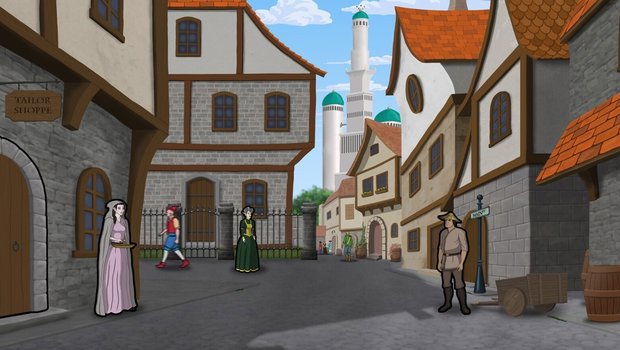
Brexia is the only city in the medieval fantasy world of Atruxia where the five sentient races live in relative peace. It’s here that Tupelo, a green-haired elf maiden, has traveled to in order to become a great detective in the City Guard. Unfortunately, after a year on the job she’s still no better than a beat cop, having failed to solve a single crime. When a missing person case arises that the captain believes is unsolvable, Tupelo bets her career on the fact that she can crack it. Searching both the city and the mysterious catacombs that lie beneath its foundations, Tupelo is joined by (read: conscripts) Keane, a thief who knows the catacombs like the back of his hand but who mysteriously wants to be kept nice and cozy in jail. The pair form an unlikely duo in Magic Moon Games’s visual novel-styled adventure The Case of the Catacombs: A Tale from Atruxia, an easy but well-written, colourful tale running through (and below) the city.
As the tale begins, Tupelo is grousing with her goblin friend Goppo that she never gets any good cases. Captain Throdd sends for Tupelo and charges her with going to the scene of a crime: the theft of a rare necklace from the governess at an orphanage. Throdd only wants Tupelo to take Madam Belladonna Wurmwood’s statement, however. No more, no less. Of course, once there, Tupelo can’t help but start to investigate. In short order she catches the thief, the human Keane, who, living up to his name, is only too eager to be locked away in prison.
Despite this seemingly quick resolution to the case, Captain Throdd is not pleased with Tupelo’s performance, as she went outside the established parameters. But Tupelo is convinced she can be a great detective if given the chance. When it’s reported that famed socialite Dravena Ashes has gone missing, possibly kidnapped, Tupelo insists that she can solve the case in three days and that if she fails, she will resign from the force. With her positive attitude, zealously overwritten official reports, and failure to deliver results, Tupelo is not Throdd’s favourite person. However, after a moment’s consideration, he agrees and only then reveals that Dravena is a flighty member of society who routinely goes missing, only to reappear at a later date with tales of traveling the lands.
Undeterred, Tupelo takes up the investigation anyway, though it seems futile. Her search quickly leads to a dark catacomb built beneath the city. Too much of a maze for the elf, she threatens to release Keane to the streets if he doesn’t help her navigate this mysterious area. As a child, Keane ran with a bunch of street kids who made the catacombs their home, so he’s very familiar with what to expect. He reluctantly agrees to help, and the two set out in search of the missing Dravena.
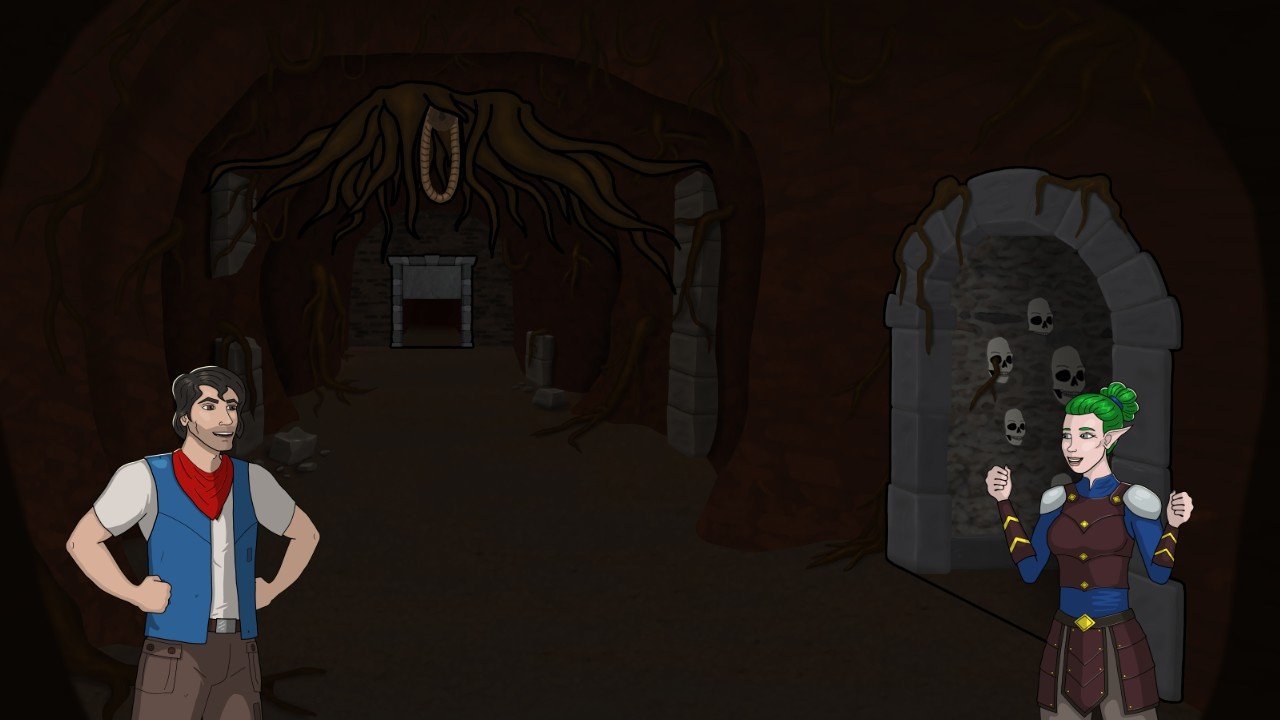
The Case of the Catacombs is a typical visual novel for the most part. Much of the story is conveyed through dialog between Tupelo, Keane, and the eccentric group of characters they meet along the way. During these conversations, stills of the characters are displayed on-screen depicting the emotional context of the lines being spoken. As the main characters, Tupelo and Keane have a wide array of expressions. Whether its Tupelo’s earnestly excited and happy reaction to working on a real case or Keane’s smarmy looks when uttering some light innuendo in the direction of his partner, the portraits are spot-on and infuse the dialog with personality.
Tupelo and Keane are very different, which makes for a good buddy cop duo. They are given plenty of opportunity to banter back and forth to fun and humorous result. This keeps the story bouncing along quite nicely. Even so, the game does appropriately slow down for the occasional heartfelt, emotional moment as the two characters open up about their pasts. The dynamic between the protagonists forms the core of the narrative experience. Both are well-written and an absolute pleasure to be with for the game’s three hours of play time.
The Case of the Catacombs: A Tale from Atruxia

| Genre: | Comedy, Fantasy, Mystery |
|---|---|
| Presentation: | 2D or 2.5D, Slideshow |
| Theme: | Team-up, Missing persons |
| Perspective: | First-Person |
| Gameplay: | Visual novel |
| Control: | Point-and-click |
| Difficulty: | Low |
| Graphic Style: | Cartoon |
The two principals are supported by an array of additional quirky characters. There’s Emeraldo, a rotund gentleman who reported his friend Dravena’s abduction and is prone to crying buckets of tears. His neighbor is Lanne, a giantess whose race supplements spoken language with emotional cues embedded in the types and arrangements of flowers put on display. For example, herbstonnes signify a respectful neighbor, while tulips are the flower equivalent of the middle finger. Then there’s the elf seller Myrtle, who had the ill fortune to be born under a bad moon. Tattooed with a “glif” on her face, other people suspect her of being a liar and thief. And these are just some of the distinctive multiracial characters that populate the fantasy game world.
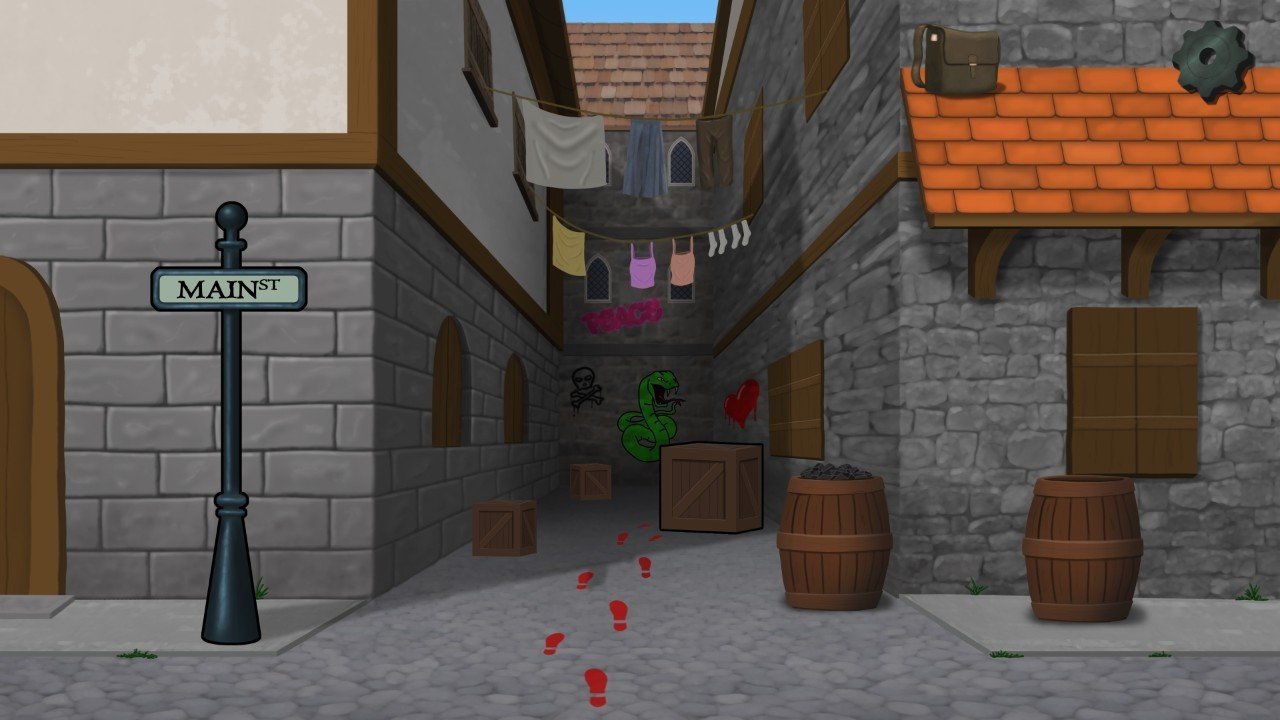
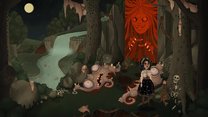
Proceeding through the story is quite straightforward, with no significant player choices altering its direction. The characters typically articulate where they need to go next and what they have to do. Moving about the city to accomplish these goals is done through the use of a quick travel map, which gets more locations added to it as they become relevant. Events in The Case of the Catacombs take place entirely in locales scattered about the city of Brexia. There’s the guard house, shops, stately manors, and the dark titular catacombs themselves. All are rendered in a vivid cartoon style that is pleasing to the eye.
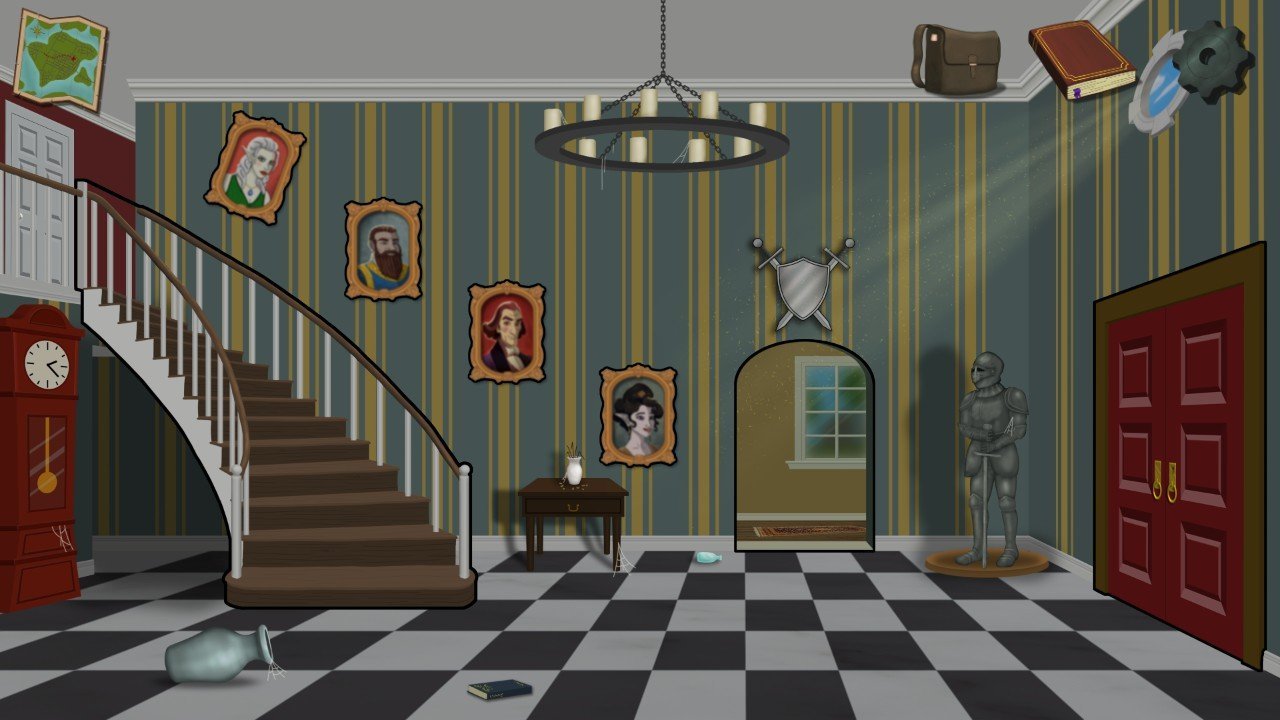
You will do some traditional adventuring, as many locations have a small handful of hotspots that can be interacted with through simple point-and-click. It’s easy to identify these elements as they are given a noticeably thicker black outline than other background details. Rather than gathering items, clicking on most hotspots launches more exchanges of dialog. Occasionally, though, one of the game’s handful of more traditional adventure game puzzles is encountered, such as pulling out a series of books from a bookshelf in the correct order to open a hidden passage. These are few and far between, but they do nicely vary proceedings a bit when encountered.
While there’s never any question about what steps you must take to advance the story, that doesn’t mean the game is completely linear. Tupelo can pick up several side cases as well, such as finding moonicorn statues for her friend Goppo (a moonicorn being a unicorn but coloured to match one of Atruxia’s eight orbiting moons). The most involved of these secondary quests deals with investigating the mysterious Grave Moon Killer, a serial murderer who strikes only during specific phases of the moons. Rather than being detours completely separate from the central narrative, the elements that make up these optional pursuits can be uncovered if you’re paying close enough attention while proceeding through the main storyline.
It’s here that The Case of the Catacombs adds a bit of challenge, as side quests don’t provide the handholding that the main investigation does. And they aren’t just busywork, as solving them causes the final outcome of the story to shift a little. The best of the game’s five endings can only be attained by completing everything in the same playthrough. Assisting with this, all important locations remain available right to the end of the game. This means that you can always revisit places to complete the side investigations before triggering the endgame – no worries about closing optional branches because you missed something early on. Even so, you’re able to return to your favorite parts of the game by taking advantage of the full manual save system that is available. Huge kudos to Magic Moon Games for including this feature in addition to a progressive autosave, something few other developers these days think to do.
Much of the game’s audio impression comes from its music. The soundtrack employs nice jazzy synth loops throughout, with the music changing based on the location and sometimes on what’s occurring in a given scene. It’s never intrusive and captures the sense of light fun that is prevalent in the writing. Filling out more of the soundscape are a number of brief sound effects. Some are just to acknowledge that an action has been performed, such as a swish when backing out of a dialog tree. Others are more functional, like the ripple of water in a pond. Finally, while the game isn’t completely voiced, Tupelo herself narrates the opening and ending cutscenes. These parts are quite brief, but she has a pleasing voice that suits her excitable character. It’s a shame that the game couldn’t have been fully voiced throughout.
Final Verdict
The two protagonists of The Case of the Catacombs make an excellent pairing for an engaging narrative adventure. The street-smart criminal Keane initially takes great delight in razzing the strait-laced policewoman Tupelo for her unwavering optimism and belief that good will out, which frustrates her no end. Through their shared adventure, however, the two form a real bond that benefits from great writing for each role. Short and sweet, this is not a traditional adventure but rather a nice, light, enjoyable tale told well. It has enough side quests that need careful observation to not be wholly on rails, but at the same time, its ease keeps the story moving along at a breezy, pacey clip. It’s a modest debut production for the developers, but with the tagline of A Tale from Atruxia, my hope is that this won’t be the last we see of this fantasy world in general or of Tupelo and Keane in particular.
Hot take
With its endearing and engaging characters – especially stars Tupelo and Keane – The Case of the Catacombs presents a gameplay-lite but delightfully fun buddy cop fantasy mystery adventure.
Pros
- Protagonists make a great buddy cop pairing
- Fun and well-paced story
- Delightful cartoon style
- Catchy jazzy musical score
- Multiple ending variations to discover
Cons
- Would have been nice to be voiced throughout
Richard played The Case of the Catacombs: A Tale from Atruxia on PC using a review code provided by the game's publisher.

- Advertisement
- Help support AGH by advertising with us







0 Comments
Want to join the discussion? Leave a comment as guest, sign in or register in our forums.
Leave a comment