
Gecko Gods review
- 0 Comments

Delightful open-world animal adventure should appeal to the pleasure centers of any player’s reptilian brain
I really, really wanted a pet lizard when I was a kid. I dreamed of the adventures we would go on together – just me and ‘Pecky’ (or whatever; I didn’t think far enough ahead to name it) against the world! My parents (wisely) never did get me one, which is for the best, as they’re kind of high-maintenance. So for me, Inresin’s Gecko Gods is like a childhood dream come true, getting to play as a lizard in the wild instead of owning one as a pet. It’s a cartoon-styled adventure spent skittering across exotic lands, rummaging through ancient ruins, unlocking secrets of the past, and eating as many bugs as you can handle. It’s an awe-inspiring and captivating journey from start to finish, smartly engaging the traits of its scaly protagonist to create an adventure that’s a little bit Zelda, a little bit Tomb Raider, but ultimately, full gecko.
Gecko Gods starts out with a slick animated segment depicting our hero/heroine (I’ll refer to mine as a “he” for convenience) out on a branch, trying to catch some dinner. The branch snaps, sending him plummeting into the sea below, where he floats on the piece of wood for several days before arriving on the shore of a distant island. Greeted by a pair of stone gecko statues guarding an ornate barrier that leads to a corridor tunnelling deep into the side of a mountain, it seems fortunate, if not fateful, that you have arrived at a place that clearly holds your kind in high regard.
After opening said barrier via a switch that, though meant to be operated by human hands, is workable for a smart lizard by grabbing the handle in your mouth and dragging it to the unlocked position, you enter the temple to find it abandoned, and has been for some time. Yet a few fires still burn in urns and torches, suggesting your presence was somehow anticipated. Once you reach the central chamber, four stone tablets offer some explanation of the island and how the temple’s mechanisms function.
Up to this point, the game has been entirely voiceless, but that ends with the sound of ghostly echoes from the ruins guiding you to the secrets of the titular Gecko Gods. At first I was a little disappointed that the game wouldn’t play out entirely without words, leaving you to decipher the mysteries on your own. However, the stone tablets really only act as signposts, guiding you where to go, and the game is otherwise a relatively non-verbal affair.
The tablets push you in the general direction of four distinct tombs, but finding the entrances is still largely up to you. Each tomb has its own puzzle to be solved, culminating in a gong that must be rung. Whenever you complete one of these tombs, a torch will light next to the associated stone tablet back in the main chamber, signifying that you have completed it.
Once out of the temple and back on the island proper, the expansive scope of the game comes into focus. The world is your oyster, and fans of games like Breath of the Wild, or even something out of Cyan’s 3D catalogue, will feel right at home thanks to the breathtaking landscape and the invitation to explore at your chosen pace and leisure.
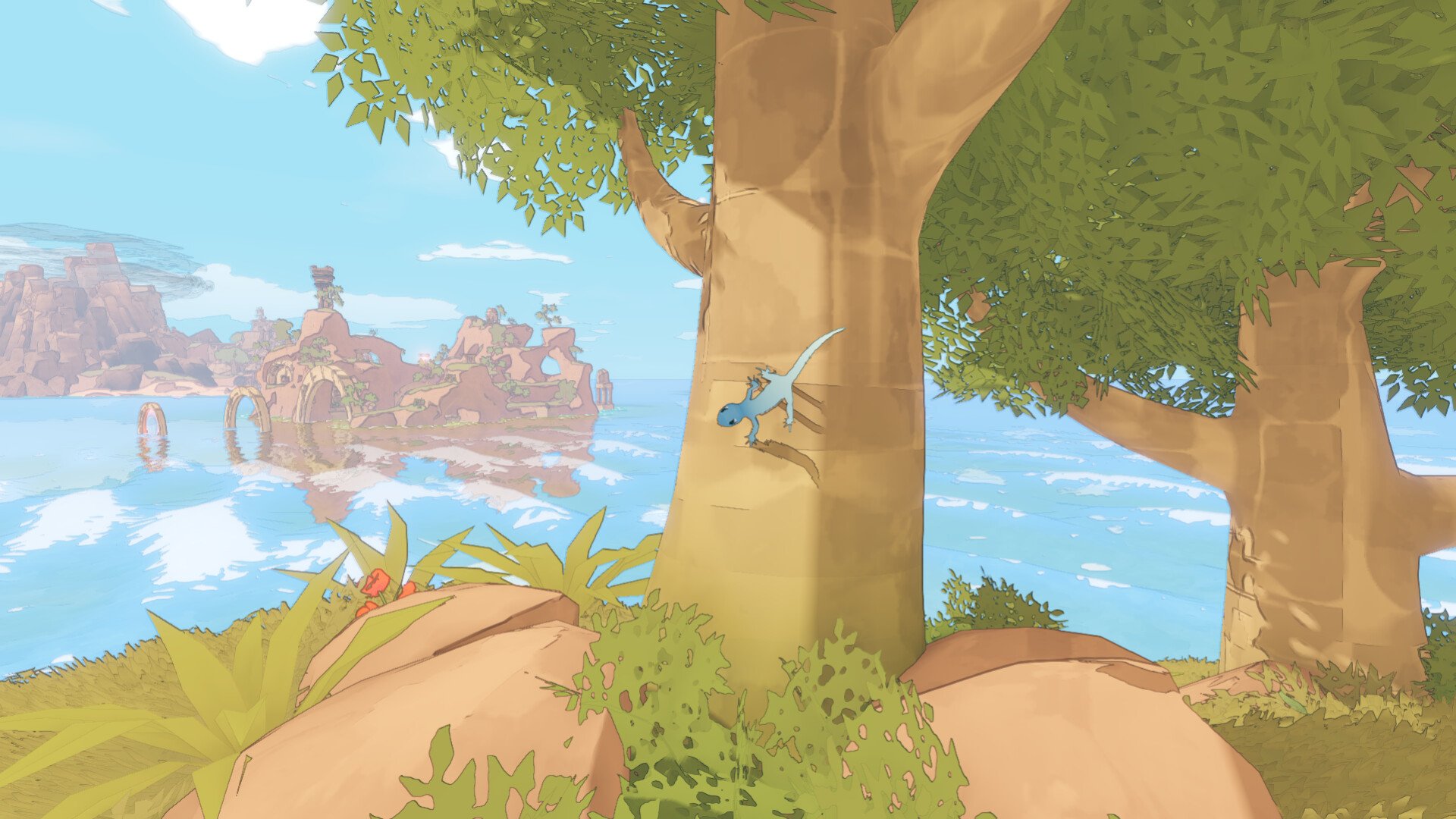
Your gecko’s sticky little paws can take you just about anywhere you can see on the island. You can summit the central peak of a mountain for a view of the area, or scurry through the tall grass, looking for a hole to crawl down. I spent my first few minutes gripping the side of a cliff face before coming upon a ruined pagoda. Nearby I saw a small stone arch with a glowing orange circle within. I crawled through and discovered that it spawned another ring, creating a chain link of rings to follow up and over the structure’s columns until it eventually unlocked a passageway beneath. The game is full of bits of wonder like this for you to find on your own.
While traversing an island filled with infrastructure made for humans as a little gecko is intimidating at first, finding your way around is an absolute delight, and learning how to operate human-built machinery is one of the game’s most immersive aspects. Gradually, it begins to feel as though this place was actually built with reptiles in mind instead of people.
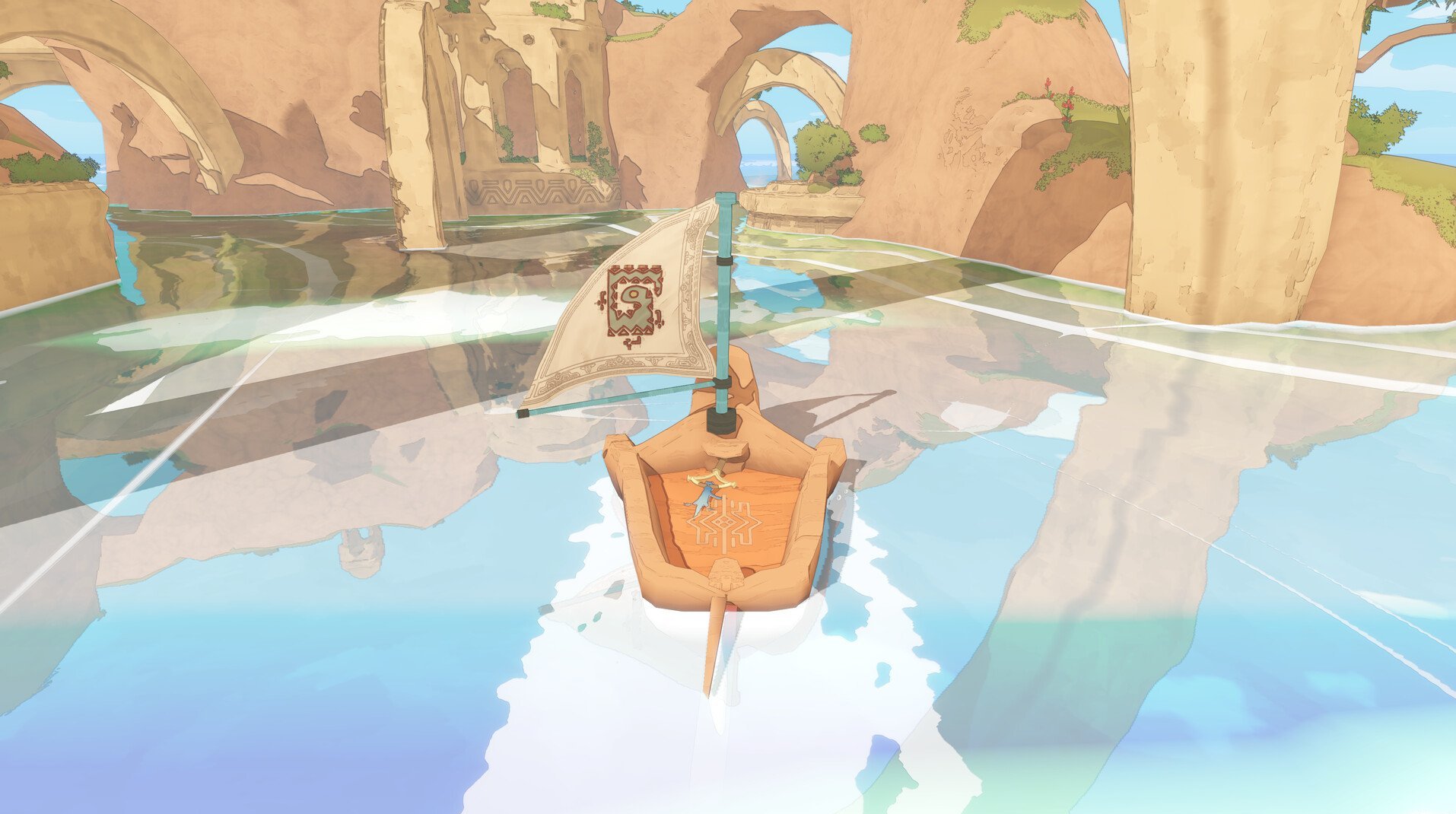
Despite its size, the first island only takes around an hour to complete, but this is merely the beginning. Then, from a cave beneath the island, you can access a gecko-sized sailboat and hit the open sea. Here numerous islands dot the horizon, and you are free to go wherever your cold-blooded heart desires. Some of the islands only hold distractions, but almost all are part of the mainline quest (eventually).
The second island I visited was volcanic. This is actually where the game concludes, but for the time being I explored it for several hours, unlocking any tombs I could find before getting stumped and moving on. While the volcano island follows a similar formula to the first, in that there is a central plaza with stone tablets highlighting the different challenges that need to be found and completed, the other major island (a desert island) is more or less one giant puzzle that needs to be slowly chipped away at. You must have a firm grip on the topography in order to get all of this island’s ancient mechanisms working together. I started out by scouring an abandoned residential district – its structures carved into the mountainside, like Petra – before eventually coming upon several giant mirrors that reflect light across the island. This was my favorite part of the game, feeling like a truly massive puzzle in comparison to the more segmented challenge-room-style nature of the other major areas.
You will need to visit (almost) every island and complete all the main challenges to ultimately access the central volcano and awaken the Gecko Gods in their chamber. However, there are plenty of side activities to engage in as well. Each island has its own unique ecosystem of bugs for the connoisseur lizard, with ancient relics hidden off the beaten path for the art-collecting types. You have a journal outlining all of your known quests (obtained by visiting the related stone tablets) as well as smaller quests that emerge from exploring.
Puzzles come in a variety of forms. Gears are commonplace, forcing you to turn dials in order to open doors or redirect mystical energy through ancient wiring to power different machinery. The game always helpfully pulls the camera back an appropriate distance in these instances, giving you a fair view of what you are changing or maneuvering. There are also platforming sequences, forcing you to dash between moving platforms, slide in between stones, or clear great distances with a well-timed leap and dash combination.
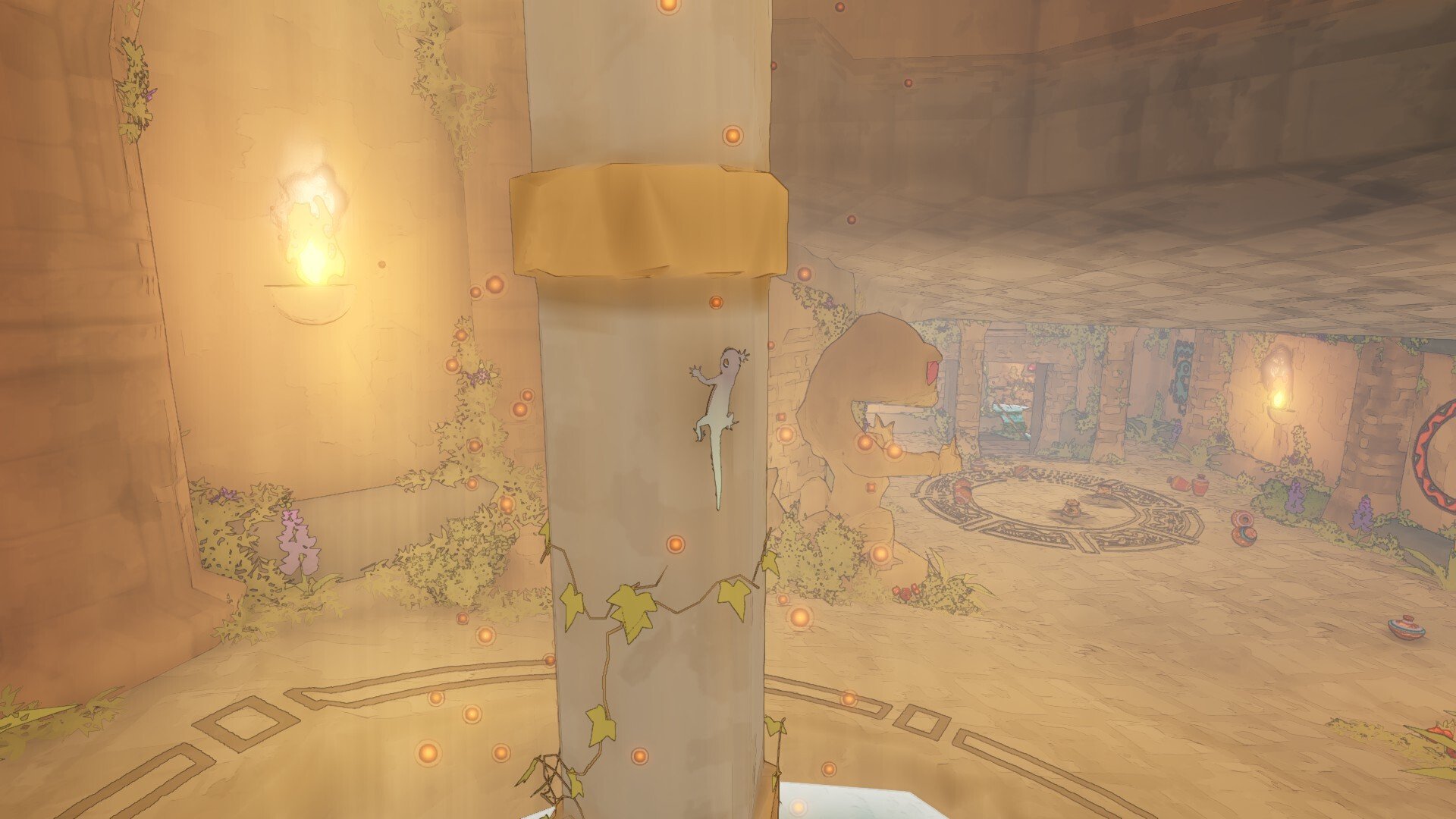
Just when you think you are getting the rhythm of a certain section’s puzzles, Gecko Gods throws an entirely new challenge at you. Pushing around mysterious glowing, magnetic orbs that can stick to metal surfaces provides some great late-game variety, and looking for hieroglyphs on stone walls depicting patterns related to pressure plates is great fun too. You’ll have to raise and lower water levels to access different parts of the ruins, and even outrun rising lava. Though the individual tasks aren’t overly difficult, I did sometimes find myself wandering for long periods of time unsure of where to go. But when viewing things from a different angle, or when sailing off to a new island, I would always find something to do, and it never felt like I was hopelessly stuck.
Occasionally the game will force you into combat to dispatch all of the pot-wearing crustaceans in a room before a gate will open, allowing you to progress. While these crabs dot the islands, fighting can largely be ignored aside from these pre-set points. It’s not overly difficult when required, relying entirely on the gecko’s dash move to knock the invaders around, so I never died during one of these encounters. The gecko does have a health bar, though, represented by the vibrancy of its colouring, which restores on its own over time or by eating bugs. The few times I did die were due to swimming out in the open sea or falling into lava, but the time needed for recovery is rather generous and death never sets you back very far to the nearest checkpoint.
Gecko Gods

| Genre: | Adventure |
|---|---|
| Presentation: | Realtime 3D |
| Perspective: | Third-Person |
| Graphic Style: | Stylized |
| Gameplay: | Action-Adventure, Cozy, Exploration |
| Control: | Direct Control |
| Action: | Platforming |
| Theme: | Animal |
Along with foes, plenty of food and friends are scattered through the archipelago. Birds make homes throughout the islands and, like the stone tablets, sometimes offer insight as to what to do next, like giving a hint as to how to reach part of an island or solve a puzzle (in very general terms). You’ll also encounter the aforementioned bugs (for eatin’) and crustaceans (for fightin’), and overall the islands feel populated and alive, even if long-abandoned by their previous inhabitants.
There isn’t really any character building or overt storytelling. Your avatar never speaks, leaving him a blank slate. It’s more the satisfaction of completing a tomb and witnessing your efforts result in a statue rising out of its resting place, or a massive stone door rumbling open to reveal a new chamber, that provides motivation and a sense of progression. Given the game’s non-linearity, it’s really just a matter of when you happen to experience things and in what order.
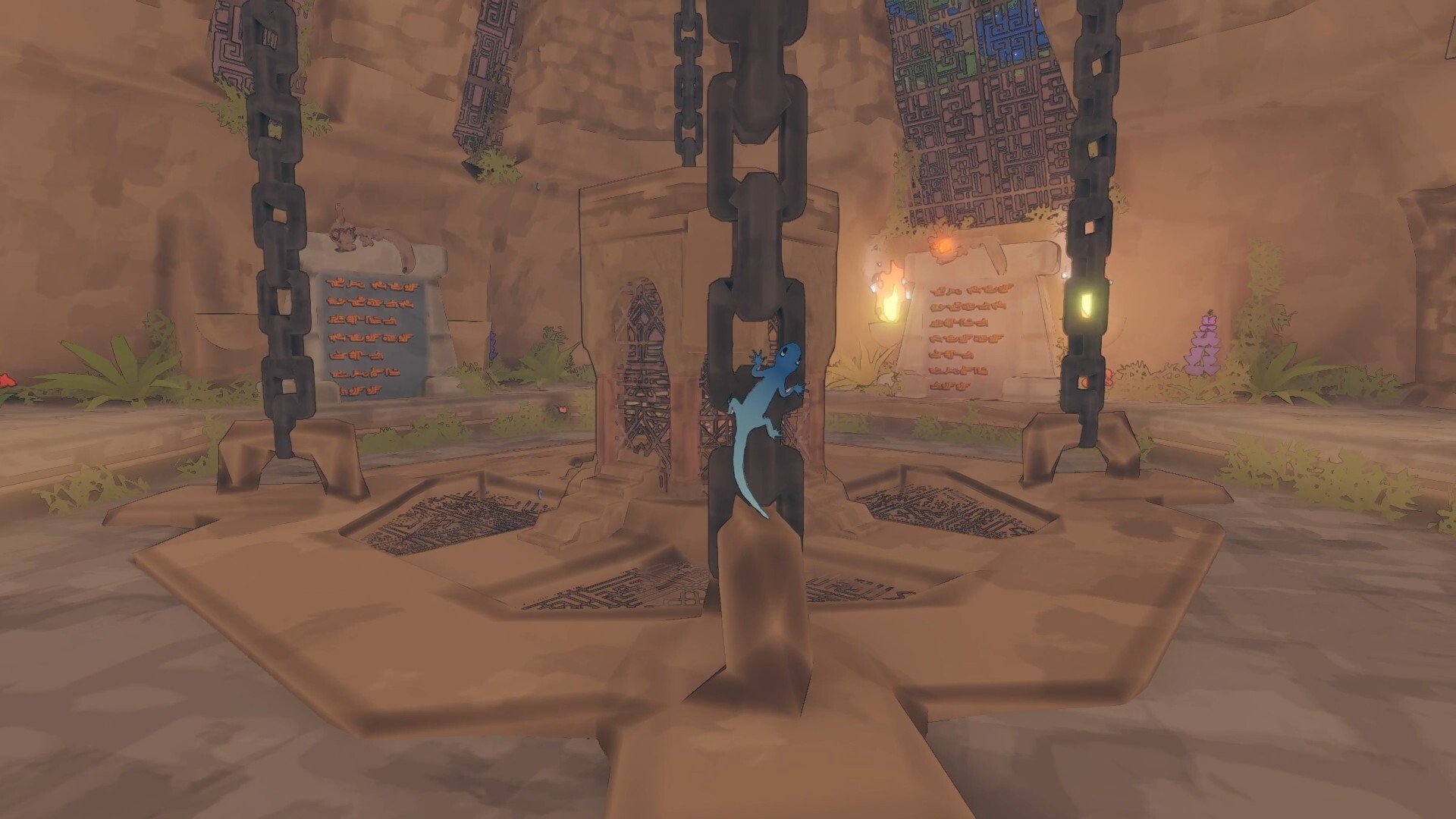
Controls are simple and well-implemented, and the camera does a good job of following your little lizard around. The gecko can run faster and briefly dash to cover ground quickly or be paired with a jump. You’ll stick to the ground naturally, so unlike in most games, hitting a curved surface leading to a wall or ceiling won’t stop you from seamlessly continuing your climb. The controls do readjust as you move from a floor surface to a ceiling surface, and sometimes I found it took me a minute to rewire my brain to the control direction during these changes, but it works well for the most part.
I played with an Xbox controller, and though the game supports keyboard and mouse on PC, it certainly feels as though it was meant to be played with a gamepad. The gecko can clamp hold of small handles (indicated by a shimmering effect) connected to mechanisms, and pressing the ‘grab’ button when no handle is around prompts the gecko to let out an adorable “maaap!” sound.
Killing enemies (and smashing pots) largely isn’t necessary, but doing so rewards you with currency, which can be spent at onyx rock slabs that act as shops to unlock new colour patterns for your gecko. This too is entirely optional, and these new ‘outfits’ don’t grant you any additional powers, but it’s a nice side activity to work towards getting your favorite shade.
No matter your personal hue, Gecko Gods is, simply put, one of the most beautiful examples of the medium I’ve seen in a video game. Though the opening cinematic is a stylized 2D animation, when you actually take control of the gecko the 3D presentation switches to a cel-shaded aesthetic. It looks like a French graphic novel come to life, with watercolour stylings and ligne claire lines forming the environments. The gecko moves convincingly in every way, too, his body slithering as his little legs propel him forward. He’ll even swing his limbs wildly in the air as he falls from great heights.
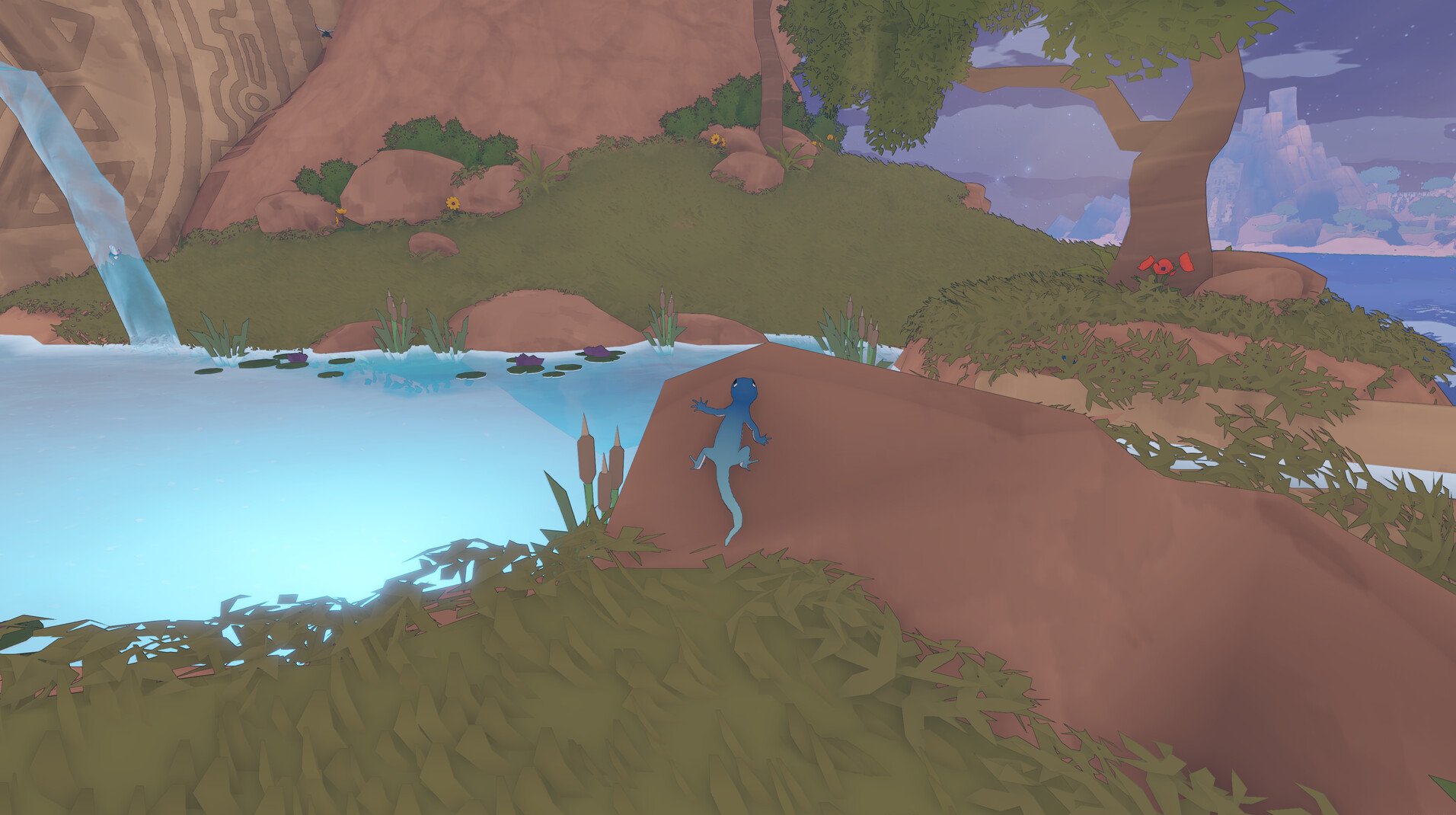
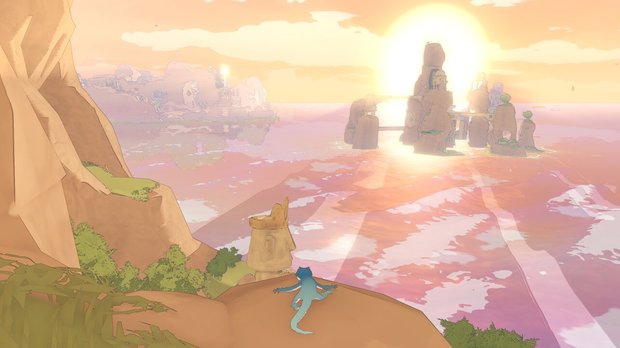
Lighting not only plays a role in some of the puzzles but in establishing atmosphere as well. There’s a fluid day-night cycle, so sometimes you’ll be setting sail at dawn, with the pink glow of the rising sun breaking over the aquamarine horizon, and other times you’ll be scurrying beneath the earth in a tomb, with rays of light disappearing from cracks in the stone as day turns to night. The texturing scales, with finer details disappearing as you get farther away from an object (as in most open-world games with large environments and virtually unlimited view distance) but the graphic design here makes each and every vista look like it’s from the pages of a comic book.
Up close, textures can look a little bland, but the smooth frame rate, animations, dynamic light, and pastel palette mean you won’t spend much time fussing over the little details. Clipping can be noticeable in some instances, too, like when riding elevators and moving platforms, but this is a nitpick more than an immersion break. The hieroglyphs carved into the ruins offer insight into the world of the Gecko Gods, and even if not directly tied to a puzzle or objective, they are a pleasure to find. The glowing jeweled eyes of the statues add a rich contrast to the otherwise weathered look of the outside structures, and show just how celebrated these creatures were to the culture.
The ruins themselves, while perhaps not directly inspired by any one civilization, primarily show remnants of Mediterranean architecture, with some Mesoamerican influence thrown in. Environments are also reactive, with dust plumes of sand kicked up or pots being knocked over as you run, making you feel powerful – or at least a consequential part of the world, even if very small.
The musical accompaniment changes for different locations, and the mix of light string instruments and flute arrangements is great. The desert island theme was my favorite, though each area is thematically scored with its own appropriate composition. Animal voices are conveyed as convincing chirps and squeaks, and audio effects are excellent all around, from grinding stone as ancient doors slide open to the plunger-like sound used whenever you jump.
Your progress is recorded regularly, so it is never hard to put the game down and come back later. It took me around seven hours to finish, but that was with plenty of off-track exploration. Gecko Gods doesn’t really end after the credits roll, though. One of my few complaints is how sudden and anticlimactic the ending is, but after the credits you can take control of your avatar again from the central chamber. However, the main area in my playthrough just replayed the same dialogue scene, and while there didn’t seem to be any glitches in exploring the small section of the island that I did, I got the impression that the developers hadn’t thought too far past this point. I guess I could have kept crawling around, but it felt like there wasn’t much point.
Final Verdict
Aside from the rushed finale, Gecko Gods is a thoroughly enjoyable experience. It’s got a little bit of action to back up its lengthy stretches of leisurely pondering and inquisitive scurrying, so fans of traditional adventures and action-adventures alike will find plenty of love here. It looks and sounds wonderful, and its artfully crafted world of mystery would be enjoyable to explore from any perspective – but the fact that you get to do so as a little lizard makes it that much more unique.
Hot take
There may not be any pistols or tight shorts in sight, but the scaly star of Gecko Gods can raid a tomb with the best of them. This is an immersive, beautiful odyssey blending light action and puzzle-solving, and it’s one of the best games this year.
Pros
- Great mix of exploration, puzzle solving, and light platforming
- Vast open play area made manageable thanks to the well-implemented journal
- Traversing ancient environments built for humans as a lizard is very fun
- Catchy, atmospheric music complements the stunning cel-shaded vistas
Cons
- Some noticeable blurry texture detail and clipping
- Combat is a bit dull (though often unnecessary)
- Ending is abrupt and post-game resumption feels empty
Drew played Gecko Gods on PC using a review code provided by the game's publisher.

- Advertisement
- Help support AGH by advertising with us








0 Comments
Want to join the discussion? Leave a comment as guest, sign in or register in our forums.
Leave a comment