
Kejora review
- 0 Comments

Charming Indonesian puzzle-platformer shines brightly even without a final polish boost
Kejora is the debut game from Indonesian studio Berangin Creative, and this side-scrolling puzzle-platformer is a strong first showing, with fully hand-drawn art and animation, and a well-written story featuring a likeable cast with multiple playable characters. Touching on themes of grief and the loss of innocence, the tale thrusts its three young protagonists into a memorable coming-of-age journey that has a few minor bumps along the way but wraps up neatly in around three hours of playtime.
The eponymous Kejora and her two friends, Jaka and Guntur, live in a peaceful village in rural Indonesia. Approximately ten years old, their time is filled with playing, helping the other townsfolk, and exploring the village surroundings. However, after an uneventful first day, the next day their desire to aid their neighbours leads them to wander into the nearby forest past nightfall, despite being warned to never enter without an adult. They soon discover why when they run into a large shadowy monster, with more of them blocking their path back.
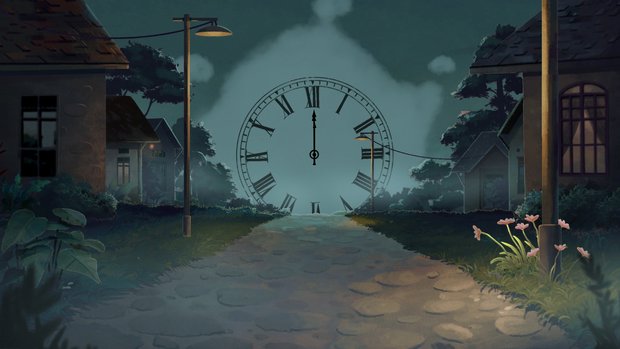
After an encounter with the mysterious and powerful Adhitya, a man from the city with transforming powers granted to him by a nature spirit, the kids find themselves in the middle of a larger conspiracy involving a powerful spellcaster who for years has kept their village stuck in an endless loop of the same day. While the outside world has progressed to modern times with technological advancements like smartphones, Kejora’s village is still trapped decades in the past. Now the young trio are determined to undo the curse before they’re caught and the clock strikes midnight.
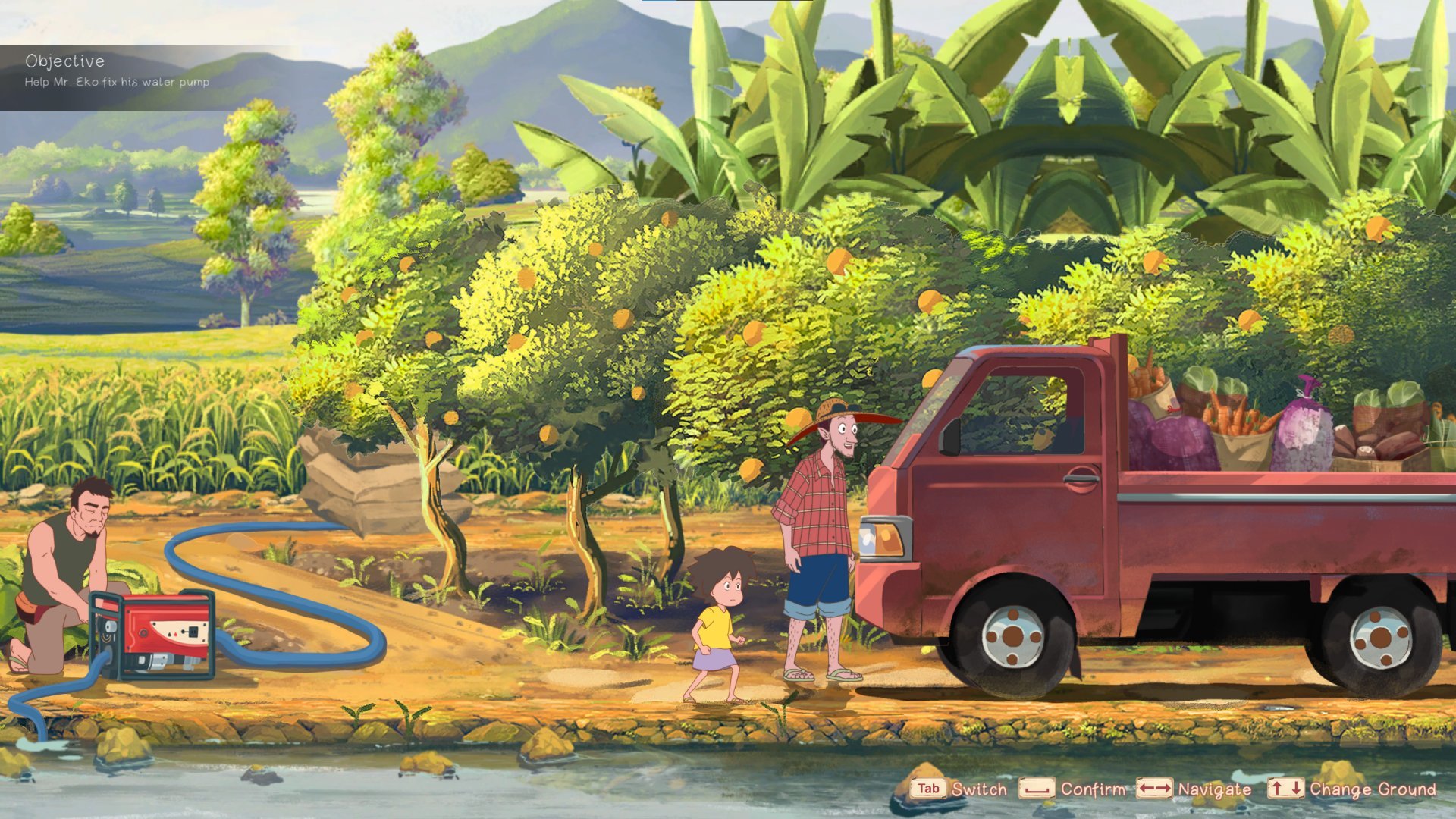
Unfortunately, they can’t just slip past the monsters and return home, or they too will forget everything when the day resets once more. Thankfully, Adhitya is well-versed in magic, and lays out the pieces of the plan: in order for the spell to work, the caster must have two clocks, one on their person, and one in a location high enough that overlooks the village. While our heroes try to discover the identity of the spellcaster, they surmise that disrupting the first clock will draw the caster to them. There’s only one place high enough in the surrounding forest – the old hospital on the hill – so the clock is definitely going to be there.
The story is one of Kejora’s strongest aspects, with most of the action taking place over the course of a single night after a single loop of daytime to establish the background. What I enjoyed the most was how well the three friends’ personalities were fleshed out. Kejora is the leader of the group, and the most headstrong of the three. Guntur is the most reserved, but observant, while Jaka is easily scared but goes along with the shenanigans his friends get up to. There’s no voice acting within the game or its cutscenes, but the dialogue between the trio gives them all distinct personalities.
Around the halfway point of the game, there’s a sudden tonal shift that steers the narrative into a darker place that explores more serious topics. It’s quite abrupt, but handled tastefully, and helps contextualise the villain’s motivations for trapping the village in the first place. There’s a section in which Kejora experiences the spellcaster’s memories, exploring the sadly all-too-common issues of bullying and loneliness in a world that seems so large.
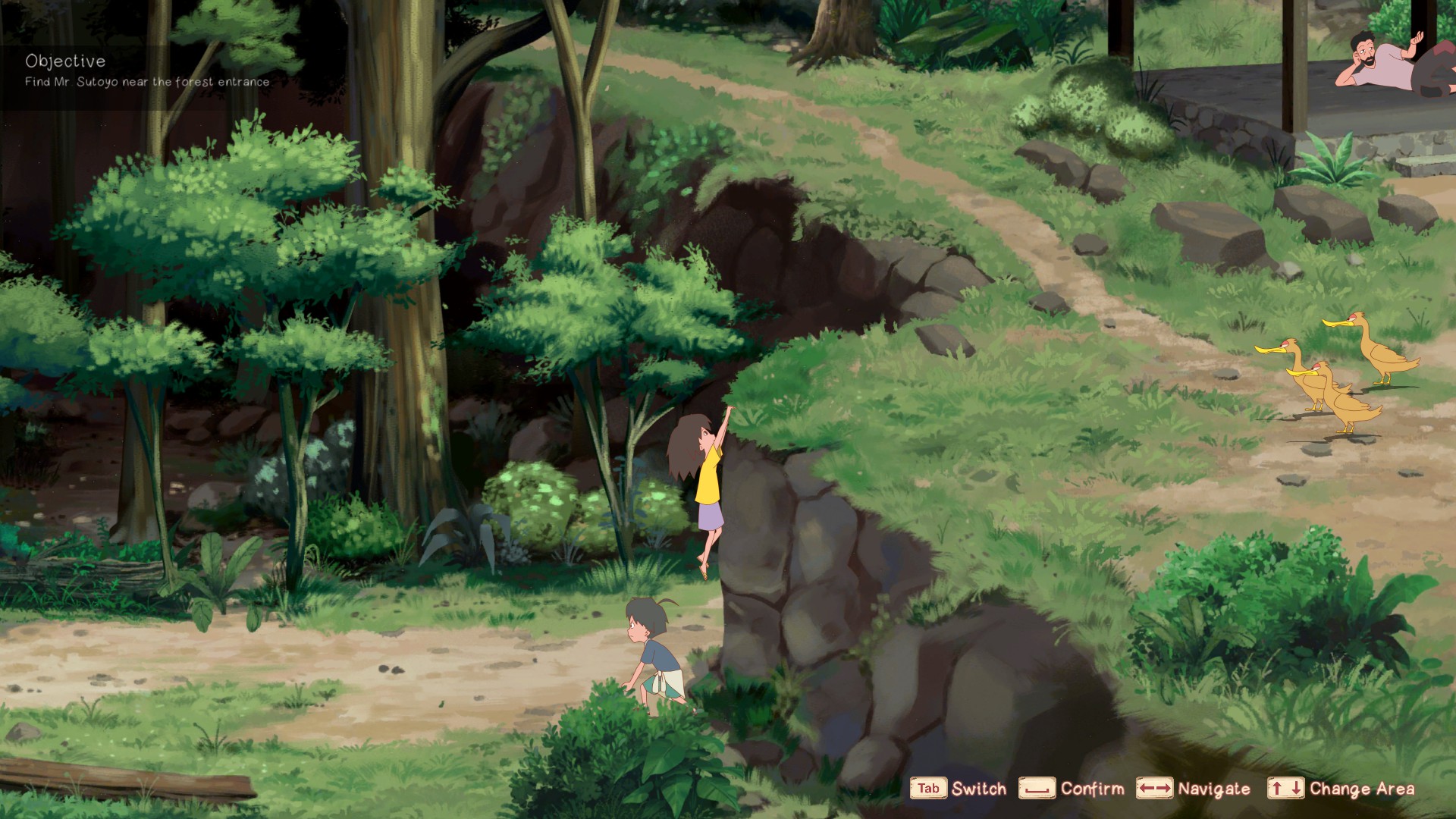
It’s here that Kejora and her friends start to show signs of growing up, and what’s great is that over the course of the rest of the game, there’s a real sense of character development and maturing from all three in a believable way given the extraordinary circumstances they are going through. They are still the same people, but each shows a change in attitude: Jaka becomes more determined over the course of the night, Guntur learns to trust in others more, and Kejora is more empathetic and aware of what’s at stake, compared to before when she was mainly preoccupied with having as much fun as possible.
This is all presented in a hand-drawn graphical style that resembles Studio Ghibli films. Anime-inspired characters have slightly caricatured proportions and hard black outlines to make them stand out against more painterly backgrounds. Over-exaggerated poses like Jaka scratching his head with one eye closed while thinking, Guntur wrapping his arms around his body and shaking when scared, and Kejora’s mouth opening comically wide help to really sell the cartoon cuteness vibe in the opening scenes of the game. This gives way to a darker and more muted palette once the adventure is underway and night falls and the children are stalked by monsters inspired by the Genderuwo from Indonesian folklore – giant, lumbering humanoids with black skin and long arms.
Kejora
| Genre: | Mystery, Science Fiction |
|---|---|
| Presentation: | 2D or 2.5D, Side-scroller |
| Theme: | Team-up, Time travel |
| Perspective: | Third-Person |
| Gameplay: | Puzzle-platformer |
| Control: | Direct Control |
| Game Length: | Short (1-5 hours) |
| Action: | Platforming |
| Difficulty: | Low |
| Graphic Style: | Anime |
Musically, the daytime village scenes are calming and fun, largely made up of piano melodies. What was cool to me, though, was how after the carefree first day when time reset, the music continued to have the same clear themes but slightly changed to incorporate lower notes, hinting at something more sinister. The night-time scenes within the woods feature slower and more distorted piano notes, settling into an eerier mood as the trio evade the dark creatures and navigate their way through caves and abandoned tunnels.
The gameplay can be broken down into two types: stealth and puzzle-platforming. The stealth sections tend to precede the platforming as Kejora and her friends avoid the patrolling monsters. Sneaking is pretty barebones, with you hiding behind trees and bushes while the creatures slowly walk back and forth, while an outline of an eye fills up above Kejora’s head to indicate how close they are to detecting you. If the monsters catch you, they charge towards you as the screen cuts to black and the scene resets. It’s nothing ground-breaking, but it adds some welcome variety.
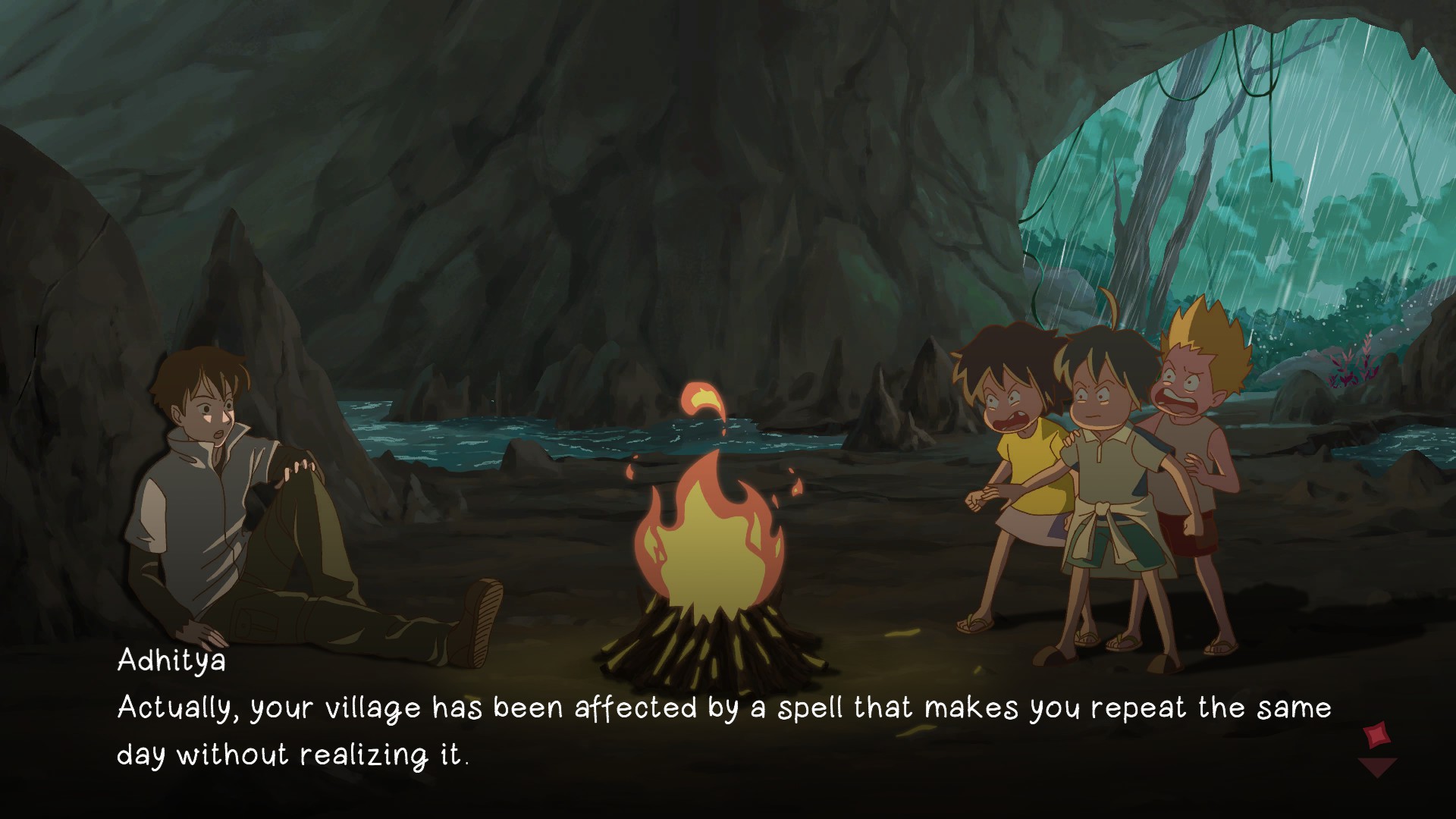
It’s the puzzle-platforming that provides Kejora’s core gameplay. Both Guntur and Jaka have different abilities that can help Kejora navigate the various scenes. Guntur is strong enough to break down rotting wood planks or give Kejora a boost onto higher ledges, while Jaka, who explicitly says he only works out his arms, is able to throw rocks at out-of-reach switches and levers or push stones and boxes for Kejora to climb onto. On keyboard this is all done by hitting Tab and a directional button to summon the specific companion to where Kejora is standing. Kejora herself has the ability to jump, but also can grab onto ledges or items high up mid-jump, making her able to platform certain areas solo.
Most of the platforming involves a lot of leaping and climbing, but not in a challenging acrobatic way. Instead the focus is on the children traversing environments that are slightly too large for them, making the experience accessible for non-action gamers as well. Fair to say? In between there’s an emphasis on finding items to combine together in order to progress, whether creating pitfall traps to slow down the monsters, or finding pieces of a gear mechanism to open a door.
Having three characters makes for some pretty interesting solutions to environmental obstacles, such as using Jaka to push boulders and boxes around to open up a new path for Kejora to go through with the help of a boost from Guntur, or later on in an abandoned factory, where Guntur clears a path for Jaka to throw a rock at a faraway switch to open up the next area. Cooperating in these tasks also further develops the trio’s personalities. I particularly liked the final act, which involves using both Guntur and Jaka in different sections to help take down a large monster. This sequence allows them to use their unique mechanics in different ways and at the same time showcase their growth as characters to stand strong in the face of danger.
It’s mostly entertaining, but my main issue with Kejora lies in one particular aspect of its gameplay, at least when using the keyboard. Whether plucking leaves from trees or setting up a trap for monsters, everything is done by pressing the spacebar. The problem is that the game has two different types of key prompts, either mashing or holding the button down to fill up a circle, with no distinction between the two. The type of task being performed by Kejora certainly doesn’t inform which action is required, as there are sections where both are used for the same form of interaction, such as moving barricades. The only reason I can think of for this discrepancy is to create tension at certain moments, but it was more unnecessarily frustrating to me than anything else, especially because it’s most noticeable when Kejora investigates an abandoned village for clues to the identity of the spellcaster, moving aside collapsed bookshelves to reach new rooms.
This relates to my second bit of criticism, which is that the game feels like it’s missing that final bit of polish. It definitely seems as though Kejora was developed with controller play in mind, and then adapted for mouse and keyboard. Common features like WASD are not useable for movement, and summoning my companions felt frustrating whenever I was a few pixels short of the correct spot for Guntur to offer me a boost, for example. Moving Kejora forward and re-summoning Guntur simply resulted in him spawning in the exact same spot. I only really managed to fix this through trial and error by inching away slowly until I moved enough to trigger Guntur’s boost animation.
There are also some inconsistencies in what pieces of dialogue can be skipped or not, and it didn’t really seem to me like there was any rhyme or reason. You’d think the most important lines couldn’t be skipped to ensure the player saw them, but in fact some story-critical lines can be bypassed but small talk with the villagers can’t be.
Final Verdict
Ultimately, the story is the shining star of Kejora. I really enjoyed how realistic the dialogue was for Kejora and her friends, understanding the gravity of the situation but approaching it with the creativity of children slowly maturing over the course of the game. The writers understood the story they wanted to tell, and they’ve told it very well. Despite a minor lack of polish, the overall experience is fun and relatable while touching on some serious topics beyond the usual magic and mysticism of a typical fantasy adventure. The puzzles are light enough to not leave players stuck, and the inclusion of stealth sections helps the platforming parts not feel drawn out. Overall, the combination of fun gameplay plus a story and cast of characters with a lot of heart makes for a satisfying and enjoyable playthrough.
Hot take
Kejora is like Stand By Me meets Groundhog Day, Studio Ghibli style, in a delightful if slightly unpolished coming-of-age Indonesian puzzle-platformer.
Pros
- Child protagonists are fleshed-out well and feel realistic for their age
- Strong story with excellent character arcs as the themes get darker
- Cute anime-inspired art style perfectly fits the overarching coming-of-age themes
- Different character abilities add layers to the puzzle-platforming
Cons
- Some inconsistencies in skippable dialogue
- Awkward keyboard controls make specific gameplay sections frustrating
Daniel played Kejora on PC using a review code provided by the game's publisher.

- Advertisement
- Help support AGH by advertising with us



0 Comments
Want to join the discussion? Leave a comment as guest, sign in or register in our forums.
Leave a comment