
Midnight Saturn review
- 2 Comments

Nothing out of this world, Cosmic Void’s sci-fi neo-noir mystery makes for a evening of solid entertainment
In the future, humanity has spread throughout the solar system. However, problems still remain on good ol’ planet Earth where Simm, a sarcastic, neo-noir-styled detective conducts investigations at night to make ends meet. Created by Cosmic Void (Devil’s Hideout, Twilight Oracle and many more), Midnight Saturn is a traditional point-and-click adventure that most closely resembles the developer’s Neon Hearts City, though the two stories are unrelated. Here Simm collects items, solves puzzles, and follows clues as he investigates the murder of a woman’s father, uncovers an alien conspiracy, and parlays with a two-headed medium, all within the span of a couple solid if unspectacular hours of gameplay.
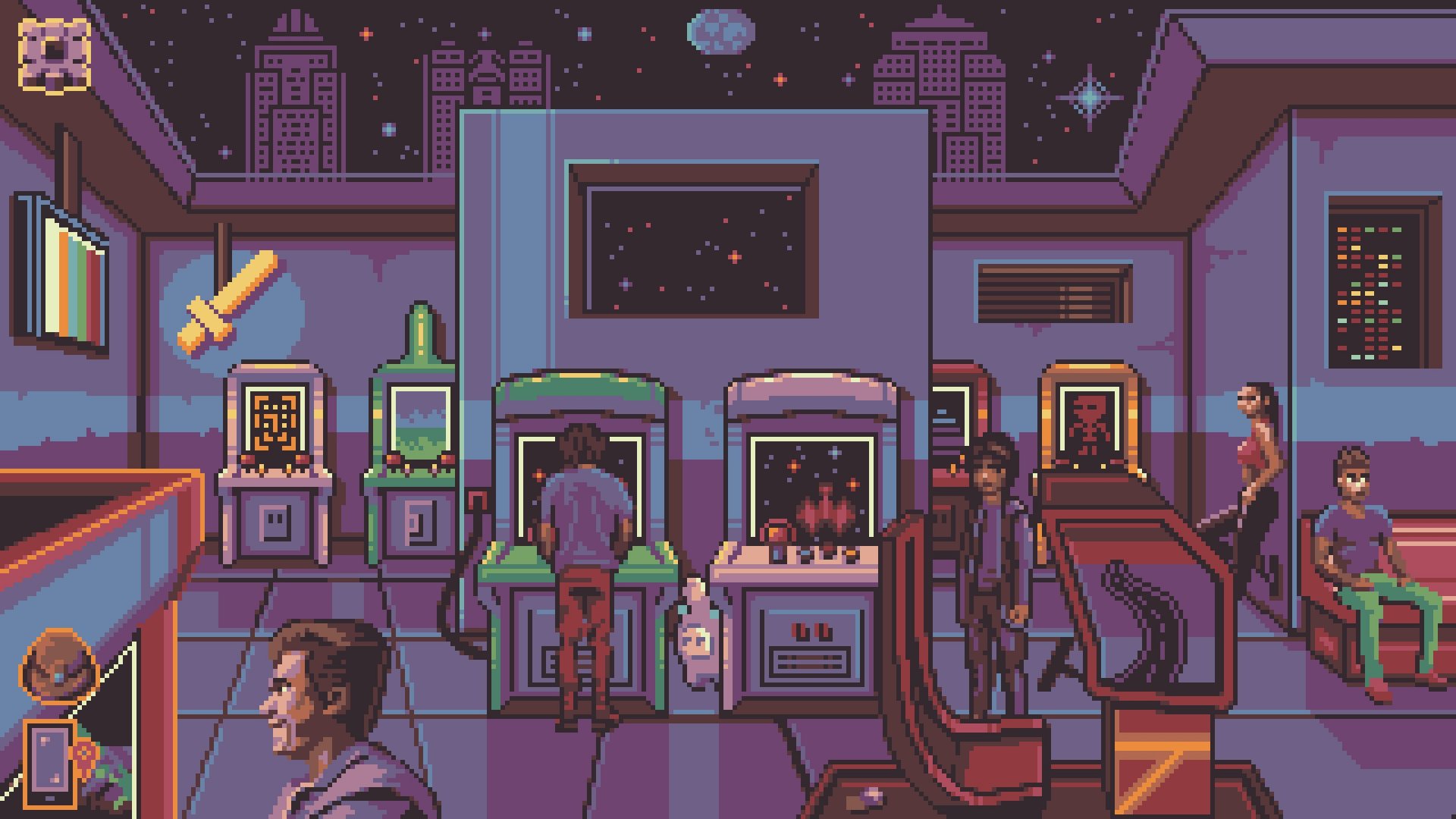
Midnight Saturn begins with Simm arriving at an arcade, where he drops a boatload of exposition about how he’s trying to find Lucy, the daughter of the man whose murder he’s investigating. This begins a trend that holds through the rest of the game. Usually when Simm goes to a new location, he’ll expound at length on the backstory of that place. Similarly, Simm’s world is full of very trusting people as everyone he meets is keen on telling him an anecdote or two about their past. Some of the tales are rather interesting, hinting at a detailed futuristic world that is never shown beyond the handful of locales Simm visits. The stories do feel a little contrived, though, as they are delivered as info dumps instead of emerging naturally through dialog. Although maybe that’s how people in the future talk.
Simm’s investigation is the definition of linear. There is only ever one challenge in front of the detective at any given time, while the tools he needs to solve it are usually in the same location. There are no unfamiliar science fiction gadgets to concern yourself, so it’s almost always obvious how your inventory needs to be employed. This makes for a very easy and very short game, clocking in at just over two hours in total. A couple of times I had to resort to trying every item on everything, but most scenes only have a handful of hotspots, so it’s not an onerous task to experiment. The typical inventory formula is occasionally broken up with some mechanical puzzles, like entering a colour code or a sequence of animal pictures, but these are also quite straightforward and over very quickly.
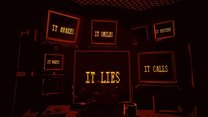
As the story progresses, Simm learns of an alien conspiracy that he believes may be connected to the murder. The aliens – green slimes that graft themselves to people’s brains – are preparing for the “ascent” at the Cathedral of Dawn, a ritual Simm must learn more about. Early on, the aliens are intent on eliminating Simm to stop him investigating. However – and this veers into spoiler territory – when Simm finds the Cathedral of Dawn, not only are the aliens suddenly perfectly fine with him being there, they inexplicably ask him to help prepare for the ritual. This convenient about-face is a big plot hole that’s all the more apparent due to the shortness of the game.
Midnight Saturn
| Genre: | Mystery, Science Fiction |
|---|---|
| Presentation: | 2D or 2.5D |
| Theme: | Conspiracy, Crime solving, Other worlds/dimensions, Whodunit, Aliens |
| Perspective: | Third-Person |
| Graphic Style: | Pixel art |
| Gameplay: | Investigative |
| Control: | Point-and-click |
| Game Length: | Short (1-5 hours) |
| Difficulty: | Low |
During his investigation, Simm interacts most with a psychic medium named Zora. She’s apparently human, other than having two heads, which is surprisingly one of the few things the game doesn’t really touch on. Zora is able to communicate with the dead, which is definitely helpful in a murder case. When Simm finds items that belong to dead people – there’s more than just the murder victim involved here – he can bring them to Zora to contact the deceased, resulting in new leads for Simm to follow. Although it would be too easy if Simm could just find out who the killer was that way, so, of course, the dead never reveal that detail.
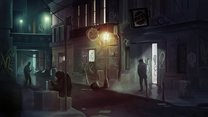
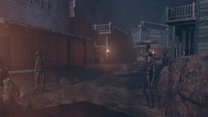
Visually, Midnight Saturn goes for the classic 1990s pixel art look, yet with its dim lighting and limited – mostly grey, magenta, and dark cyan – palette, it more closely resembles 1980s four-colour CGA than 1990s 256-colour VGA. It does give the game a very distinctive look, and the dark visuals are fitting for a story set at night while never being too dark to make out relevant details. Most locations are generic, such as a random street, the exterior of a coffee shop, and an apartment rooftop. Even the more unique ones, like an old wooden sailing ship stranded atop a cliff, are more functional than memorable. They’re containers for doing things in, rather than interesting areas to investigate in their own right. A few locations stretch wider than the immediate screen and use parallax scrolling as Simm walks across them to convey a sense of depth. That walk, though, is one of a scant few animations in the game, the others mostly consisting of characters talking and occasionally picking items up.
The music on offer complements the older feel of the game as well. Each location has its own repeating track that sounds very much like the MIDI tunes of the 1990s. The score is rather muted and a little jazzy, sounding a bit like a cross between Blade Runner and 1930s film noir. Accompanying this is a fully realized voice cast, and the talent does a decent job. While there are no particular standout performances, there are no duds either. The aliens talk through host bodies they’ve taken over, so even they sound like ordinary humans. A smattering of audio effects, like the rustle of a person hiding in the forest or the cocking of a gun, complete the ambient soundscape.
The third-person interface is pretty standard and streamlined point-and-click. Clicking on a character will have Simm talk to them automatically with no dialog choices present. Doing the same with other hotspots has Simm comment on them or interact with them as appropriate. A small backpack icon opens the inventory, within which items can be combined or selected for use in the current location. Below this backpack is a cellphone used to access a map for travelling from one location to another. All this is rounded out with a nice save system. A convenient autosave kicks in when quitting the game; however, you can also record your progress manually in one of six different slots. While it’s not much needed for such a short experience, any game with such a user-friendly system must absolutely be commended.
Final Verdict
Ultimately, this is a game that doesn’t really do much wrong, other than its one major plot hole. On the other hand, it doesn’t really do much to distinguish itself either. The story, puzzles and production values are solidly diverting enough for a couple hours of entertainment, but if there was a quintessentially average game, this would be it. As such, it could serve as an acceptable palate cleanser between longer and heavier gaming experiences. Or, if your time is limited and you need to scratch that classic point-and-click itch without getting bogged down by significant challenge or a time-consuming plot, this could just fit the bill. Neither offensive to the sensibilities nor particularly riveting, Midnight Saturn is what it is: a compact bit of adventuring that’s engaging enough while it lasts but won’t leave much of an impression, for better or for worse.
Hot take
Midnight Saturn combines futuristic sci-fi and film noir sensibilities in a short but perfectly okay detective case that is best described as average in just about every respect.
Pros
- Intriguing world lore to uncover
- Distinctive CGA-esque visuals
- Solid voice acting for every character
Cons
- Relies on awkward exposition instead of natural dialog
- Glosses over a large plot hole
Richard played Midnight Saturn on PC using a review code provided by the game's publisher.

- Advertisement
- Help support AGH by advertising with us




2 Comments
Want to join the discussion? Leave a comment as guest, sign in or register in our forums.
I'm afraid the Final Verdict section sums up every game made by Cosmic Void. For years now I've had the feeling that the NEXT ONE will be their breakthrough masterpiece, but either they don't care that much, or are incapable, or it's just their business model to pump out short, beautiful, just-competent-enough games with themes and graphics that are tempting enough to bag some sales.
Reply
Just finished the game myself. While not an award winning game, it's still a fun short experience. Just like all the rest of Cosmic Void's games.
Reply
Leave a comment