
WILL: Follow the Light review
- 0 Comments

No smooth sailing for this beautiful but unsteady boating adventure that tends to drift off course
A game about a desperate parent’s search for a missing child should keep any player on the edge of their seat. Now, drop that seat into the cockpit of a boat in inclement weather amidst turbulent Nordic seas and you should have the makings of a gripping interactive thriller. Alas, after a promising start that hinted at everything I hoped WILL: Follow the Light would be, the wind was soon taken out of my sails – literally and figuratively – as the game lost focus and developed a serious case of identity crisis. Part puzzle-centric adventure game, part sailing sim, part introspective character drama, this game never quite decides what it wants to be. And while each element shows potential on its own, none of them are strong enough individually for the pieces to cohere into an effective whole. The end result is a game that rises and falls like the ocean tides pulling you along, yet still leaves you feeling all too often adrift.
This is the story of the titular Will, a lighthouse keeper who, like his estranged father before him, devotes far too much time to the job and not nearly enough to his family. Or son, in this case, as it’s soon revealed that Will’s wife has passed away, leaving him to struggle with his grief. Alarmingly, it seems he might lose his son Thomas too, when a terrible storm threatens the seaside town where the two of them live. Will is on duty that night, of course, and after a solid intro sequence in which you must tend to the lighthouse in advance of the approaching weather, you soon find yourself racing against time to get back home to make sure Thomas is safe.
After another short but nicely suspenseful sequence navigating the crumbled remains of his devastated town, Will inexplicably passes out, only to come to a couple days later in a makeshift survivor and rescue camp. Thomas is nowhere to be found, but you’re told that he’s with Will’s father and together they’re making their way to the protagonist’s own lighthouse. All Will has to do is prepare the family boat, the Molly, and follow in their wake.
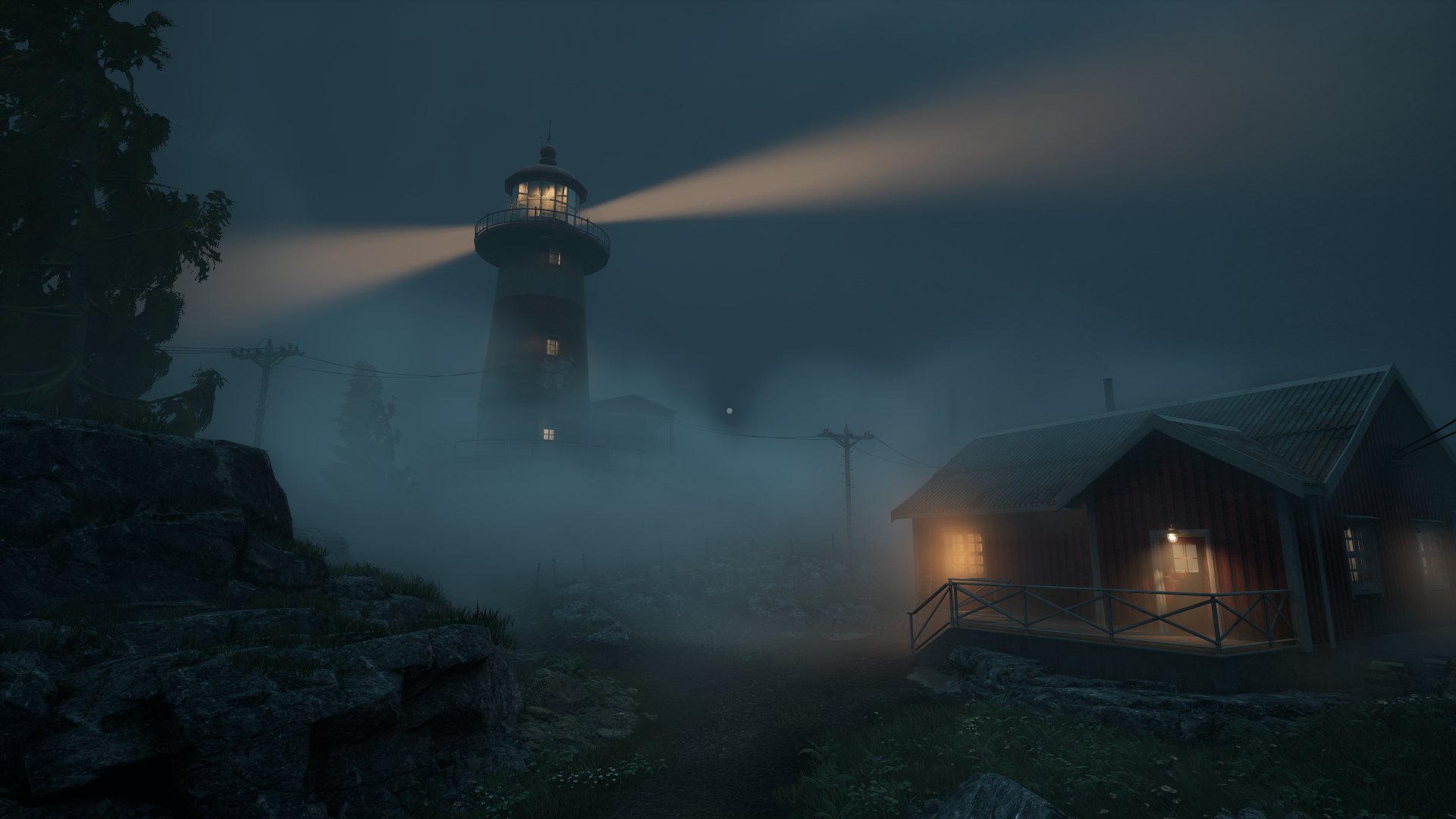
Pphhhsssssshhhh… That’s the sound of a major plot point being needlessly deflated from the hop. Yes, obviously Will still wants to catch up with Thomas, and yes, his father being involved means he will need to grapple with some old repressed feelings of abandonment. But the fact that we’re assured Thomas is safe and sound deprives the story of much of its emotional impetus. From that point on, the pace slows to a crawl (or perhaps to a trawl) as obstacle after obstacle is thrown at Will, who takes it all in disappointingly nonchalant stride.
But okay, Follow the Light wants to be more of a traditional adventure game after all, complete with various tasks to perform and puzzles to solve at numerous stops along the way, from remote rocky islands to curiously abandoned residential neighbourhoods, a train station engulfed in impenetrable fog, and eventually to the frozen, snowy north. And to be fair, this is probably where the game is at its best, or at least its most consistent better. There are a few items to collect but no inventory puzzles per se. Instead you’ll confront a number of code-breaking puzzles with sometimes overly cryptic or hard-to-find clues, several physics-based challenges to redistribute weight or move heavy objects, and make use of a magical multi-coloured lantern to reveal hidden narrative triggers invisible to the naked eye.
Unfortunately, that lantern isn’t the kind you rub for wishes, or I would have used it for some hints. The game boasts of having no minimap or objective markers, offering nothing but an annoyingly persistent on-screen reminder of your current goal, which is always immediately clear anyway. That’s fine for easier games, but some of the puzzles here are under-clued to the point of frustration rather than motivation. Admittedly, I’m not the greatest at puzzles, but I know whether to kick myself after stumbling upon a solution or to gnash my teeth at poorly implemented challenges, and on multiple occasions I found myself doing the latter in this game, when just a little more fine-tuning or a nudge in the right direction would have made all the difference. A couple times I had to obtain an “azimuth” with a compass, which forced me to stop and look up what an azimuth was. Yet even then, I still had no idea how to actually achieve getting one until I bumbled my way to accomplishing the task.
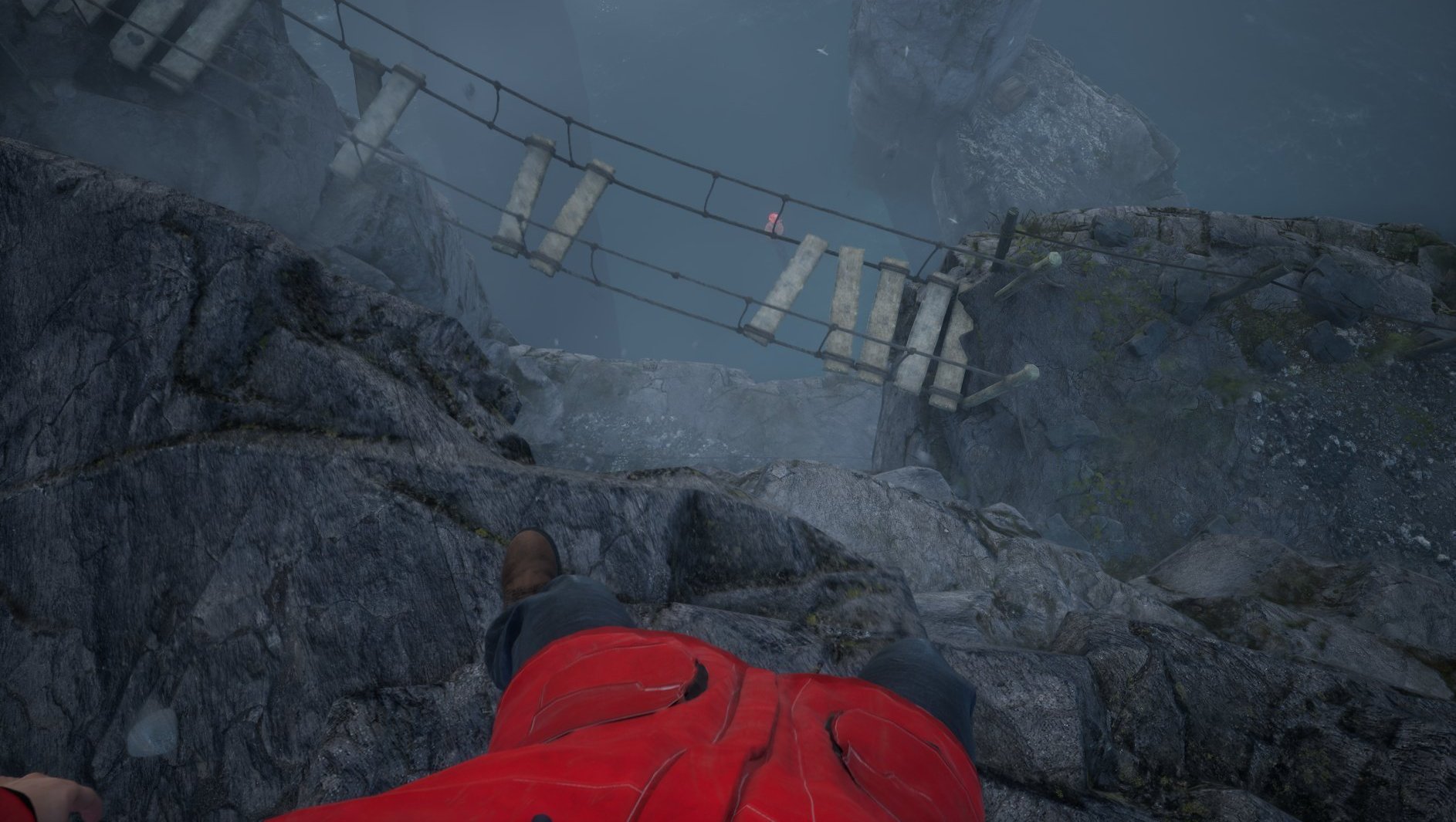
Some puzzles fit seamlessly, like marking coordinates on your map before setting sail, but others feel blatantly contrived. One still flummoxes me even now, relating to warding off an aggressive whale. I understood the concept and what I was supposed to do, but the game is so precisely finicky in its requirements for success, and so utterly stingy in its guidance (even the in-game journal was no help at all) that there is no indication you’re on the right track without doing it just so. Compounding the matter, the only way to know I’d failed was to climb back in my boat, waste several minutes sailing in futile hope, before being rammed by that ornery whale yet again and getting dumped back at the research station. Just for kicks, the worst of too many bugs I encountered occurred here, in which my mouse stopped functioning properly, forcing me to switch to a controller instead. (Both work fine, usually, but I preferred the WASD/mouse combo for the standard first-person, free-roaming navigation, on both land and sea.)
Other puzzles are fine in their own right, but must be completed in a precise sequence or wear out their welcome when repeated too often, such as valve-turning puzzles, aligning curvy signal waves, and piecing together complex objects in a manner akin to building IKEA furniture without any instructions. Perhaps if you’re more mechanically minded, the construction and repair tasks would be more intuitive, but all I could really do was scour the screen with one part or another in hand and look for a highlight indicator to know that is where the piece goes, and only at that particular time. There are mazes to navigate as well, with or without clever tricks for getting through them, and just plain ol’ fetch quests to perform at times (or not; some are optional), involving too much needless backtracking.
WILL: Follow The Light

| Genre: | Drama, Mystery |
|---|---|
| Presentation: | Realtime 3D |
| Theme: | Nautical, Psychological, Family, Missing persons |
| Perspective: | First-Person |
| Graphic Style: | Photorealism |
| Gameplay: | Environmental puzzler, Quest |
| Control: | Direct Control |
| Game Length: | Medium (5-10 hours) |
| Difficulty: | Medium |
Even so, Follow the Light’s puzzles are engaging enough on the whole, just in need of some additional playtesting to find the right difficulty balance. In between solving those, you’ll want to look out for documents, photos, and tape recordings left behind by Will’s deceased wife and others, gradually revealing more of the protagonist’s troubled family backstory. It’s another tried-and-true adventure game staple that conveniently serves its purpose here, but it often struck me as being at odds with Will’s present-day circumstances. There’s a time for reflection, a time for mourning, a time for confronting childhood trauma – but that time surely isn’t when you’re supposedly in a hurry to reach your missing/not missing son.
It doesn’t help that the voice acting is equally laid-back. The actor for Will is quite good in general; he just doesn’t seem sufficiently stressed under the circumstances. In his (actual) shoes I’d have been panicky and angry and terrified in turns, and always ever-so-impatient to get going again, but Will takes everything in easygoing, Sunday afternoon stride. Where that really doesn’t make sense is when Will starts imagining things. That’s not a spoiler; it’s clear very early on that he’s having strange dreams, receiving odd radio transmissions, and seeing things that others do not. Not only does this telegraph where the story is likely going, in a way that deprives the ending of much of its intended poignancy, but it further disconnects you from the protagonist. If seeing smoky-black ghostly figures disappear into thin air isn’t enough to freak a guy out, what is?!
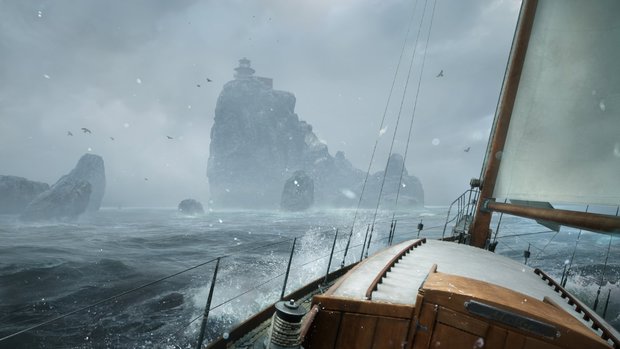
But surely all this is incidental to the real draw of Follow the Light, right? There are lots walking sims and adventure games, after all, but this one puts you in a boat in a raging sea and essentially tells you to sink or sail. That’s certainly what initially drew me to the game. I’m no sailor, but I’ve always been fascinated by the merciless nature of the ocean, and I relished the thought of vicariously confronting the in-game dangers presented here. And I can genuinely say that I felt a rush every time I undocked, the waves rolling and crashing against my little craft, in both good weather and bad. At least to someone who doesn’t know any better, it felt like the closest thing to being there without getting wet.
The problem is that, lone rampaging sea mammal aside, there really isn’t much danger, or even all that much sailing. There’s some very rudimentary boating instruction that comes after your first experience, during which you’ll have probably already experimented with the various cranks, booms and other naval-sounding rigging. But at no point are you required to show any mastery of sailing in various conditions, to the point that the game itself acknowledges it’s all rather superfluous. Several times when heading to a new destination, after a short while you’ll be given the option to skip the sailing sequence entirely, instead heading into the cabin to brew some collectible tea instead. I applaud any developer for valuing the player’s time, but here it seems more of an admission that the payoff is not worth the extra effort.
You will need to navigate certain areas by boat at different times of night and day, and technically you can “die” by, say, crashing into an iceberg, but you’d probably have to try really hard to do so. Yet even here, with so little training in becoming a better sailor, it’s generally easier to just fire up the Molly’s engine. It’s not very fast, but it gets the job done and unless you’re an expert, you probably wouldn’t get there any faster by futzing around with your three sails anyway. One section is in calm water but pea-soup-thick fog, which your lantern is supposed to help you penetrate. Except mine failed to activate just then (and only then), whether due to another glitch or because it lost its charge. There are recharging stations scattered throughout the game (the cost of which is yet another wave signal pattern puzzle), but of course none of them were found on my boat. All I could do was to putter along ever so slowly and listen for the horn of another ship waiting to meet me.
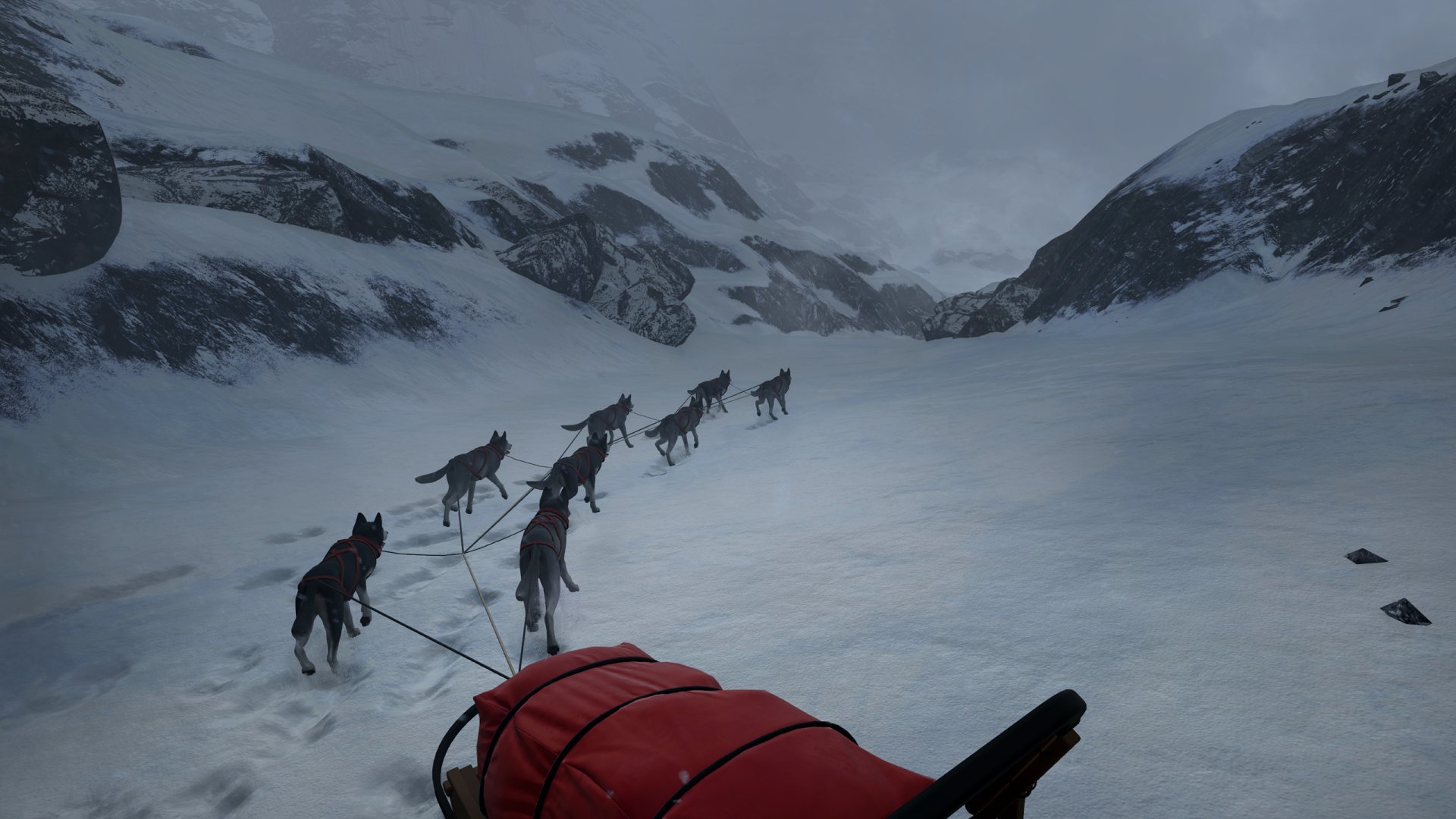
This has to be my biggest disappointment with Follow the Light, not because the sailing sequences are in any way bad, just a massive waste of opportunity to better integrate proper seamanship into a potentially life-and-death gameplay experience. As much as I loved being on the water, it was actually a relief when I ventured so far north that I had to disembark and continue via dogsled for a time. That’s actually a lot of fun and one of the few times the game offers any sense of speed and momentum.
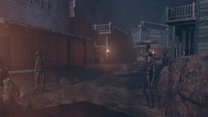
The slower pace does give you plenty of time to admire the view, at least. This isn’t an AAA production, by any means, but it’s often a beautiful game, presented in crisp, relatively realistic 3D graphics. By nature of its geography, it’s not a very colourful one, except when the sun goes down and you’re treated to lovely glimpses of the aurora borealis in various hues. Character models are adequate, if not particularly polished or animated, which could be said of some of the voice-overs for the supporting cast as well. But you’ll spend the majority of your time alone anyway. Wisely, the game holds back on music for long stretches, allowing the organic sounds of wind and water to take priority. When the orchestral score does kick in, it’s used to good effect, rising to sweeping crescendos whenever the moment demands.
It took me about eight hours to complete Follow the Light, but this is one game where your mileage may vary, in more ways than one. Breeze through the puzzles and skip the sailing and you could probably shave a couple hours off, but run into some bugs (which, to the developer’s credit, they continue to patch post-launch), hidden hotspots and dodgy puzzle uncertainty and you could be stranded a while. Adding to that time is a ridiculously unhelpful save system with checkpoints much too few and far between. Several times I exited the game, only to return to find I needed to repeat absurdly lengthy sequences again, even solving some entire puzzles a second time. I take back what I said about the developers valuing the player’s time.
Final Verdict
WILL: Follow the Light really does remind me of the ocean. It’s an up and down experience with intermittent rushes of excitement between extended periods of calm with not much happening. And how much I enjoyed myself seemed as fickle as how the wind blew – sometimes fair weather, sometimes foul. It’s not so much a mediocre game as a highly uneven one that ends up somewhere in the middle. It looks great and sounds good, especially on the water, and you can’t help but feel like a boater (if not a sailor) even with minimal input. For puzzle fans there are some surprisingly head-scratching conundrums, and for story lovers there’s enough underlying character drama to want to see it through to the end. It’s unfortunate, then, that a lack of focus, insufficient guidance and a lot of rough patches result in the whole being less than the sum of its parts. And that’s really a shame, because there’s potential for a great game here that may have found its way if only it had taken a slightly different tack.
Hot take
WILL: Follow the Light’s ambitious mix of sailing, character drama and puzzle-based adventuring shows plenty of promise but often results in choppy pacing and rough implementation.
Pros
- Boating sequences nicely recreate the feeling of being out at sea
- Solid visual and audio production values
- Some surprisingly meaty puzzles to solve
Cons
- Sabotages its own narrative momentum early on
- Sailing proficiency is never a focus
- Some challenges are contrived and/or frustratingly under-clued
- Buggy at launch (though still being be patched)
Jack played WILL: Follow the Light on PC using a review code provided by the game's publisher.

- Advertisement
- Help support AGH by advertising with us







0 Comments
Want to join the discussion? Leave a comment as guest, sign in or register in our forums.
Leave a comment