
Phonopolis review
- 2 Comments

Amanita Design is completely dialed in with a capital new non-conformist puzzle adventure
In a city where individuality has been overridden by a hive-mind sense of communal duty and totalitarian subservience through sound, a low-ranking garbage collector named Felix discovers a set of headphones that breaks him free from the orders and influence of the oppressive regime. And so begins his quest to save the city of Phonopolis before the Leader’s master plan can be unveiled, hailing the end of all free thought.
Phonopolis is the latest offering from Amanita Design, and it is yet another fantastically artful game that combines well-designed puzzles, humour, and a beautiful aesthetic both visual and aural. And yet it’s also somewhat different from anything the acclaimed Czech studio has done before, as it’s presented from an isometric perspective and includes voice acting for the first time, telling a story with overt political messaging that seems all too relevant in our current world. It speaks to the human desire to be free, and explores themes of the individual versus the collective and how power corrupts everyone, but it does so without every sacrificing the fun. I finished the game in just over three hours, but by the time the end credits were rolling, I thought I had spent double that time playing – not because it dragged, but because it packed so much into its limited play time that it felt like a much deeper, longer game.
The dystopian titular city is ruled by the tyrant Leader, who has successfully controlled the populace through the power of scattered loudspeakers that drown out any individual thought and dictates everyone’s actions. The game takes place hours before the unveiling of the Absolute Tone, the Leader’s magnum opus that will deprive every citizen of their last vestiges of self-determination, so there’s no time to lose. Thankfully, our unlikely hero Felix has other ideas in mind, now that he can actually hear his own thoughts for once in his life. There’s a problem, though, as the Leader lives at the very top of the city, and a lowly dustman could never hope to ascend to the streets reserved for the elite Avant-Garde caste. Fortunately, aiding him are three elderly traitors to the state, the only remaining people who remember the time before the oppressive megaphones, who happen to have intimate knowledge of both the Leader and the city’s inner workings.
The story is entirely linear and well-paced, taking place all within the span of a single day, and the themes are clear beneath layers of whimsical fun. The way Felix’s internal monologue describes the state of Phonopolis and the Leader’s goals makes for an easy-to-follow progression of someone trapped within an authoritarian system but questioning the powers that be, ultimately leading to the discovery of what it is to be free. It’s all masterfully done, aided in part by the excellent British-accented voice acting conveying everything you need to know in a concise way before letting you get on with your task.
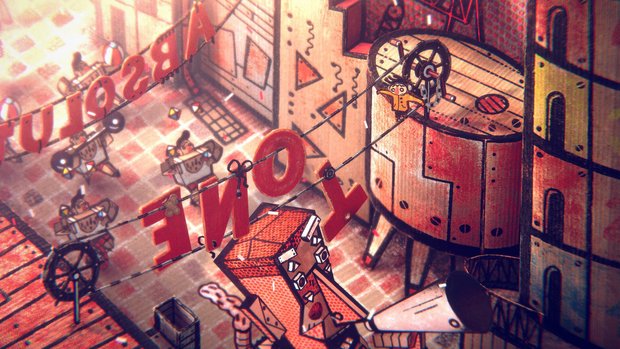
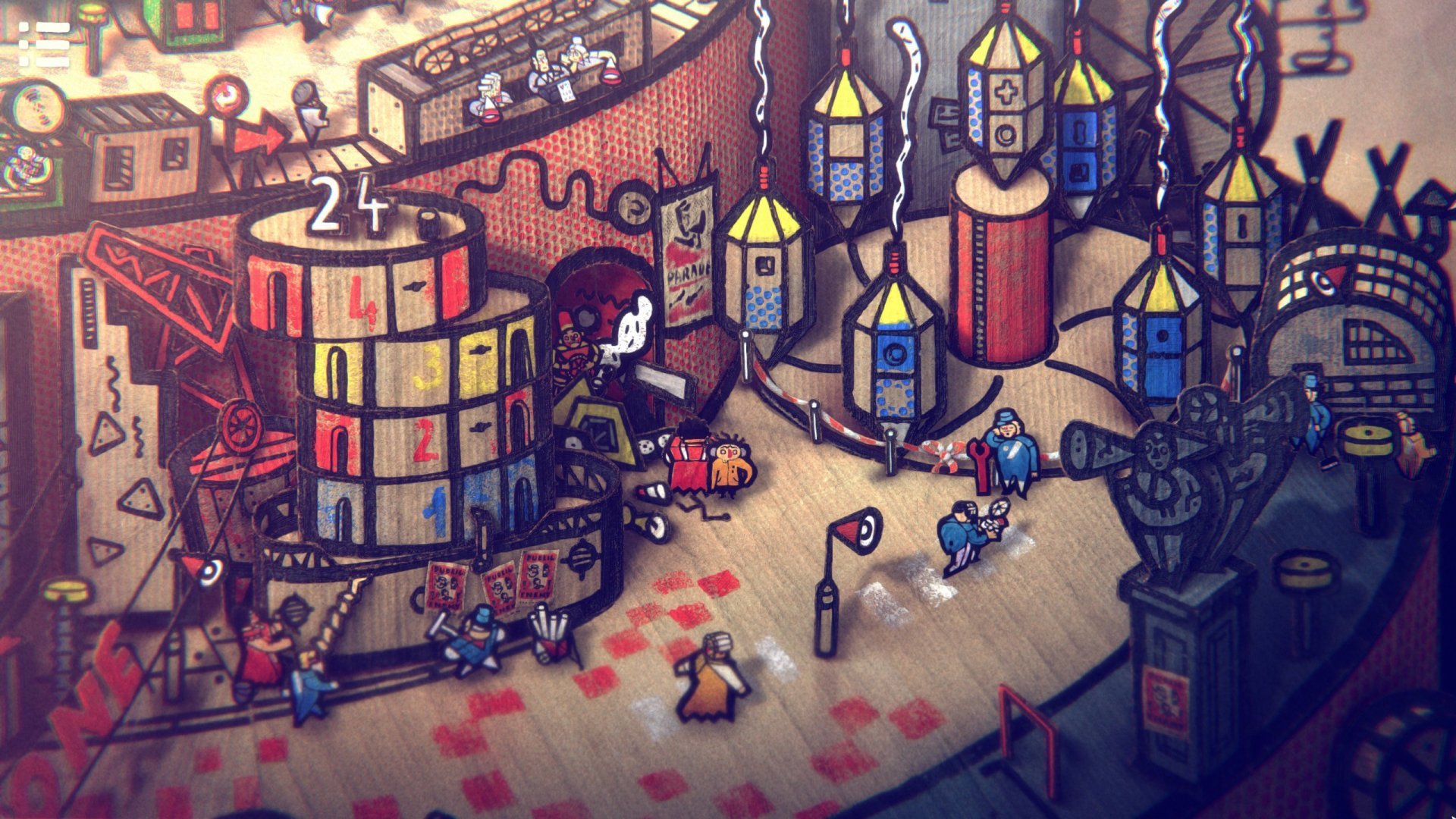
Not surprisingly for an Amanita Design game, perhaps the most striking aspect of Phonopolis is its visual style. What is surprising is that this is a city built of literal cardboard, every single piece of it: the environments, characters, even the visual effects of explosions, fire, and light have all been hand-painted and digitised for animation, giving the game a traditional stop-motion feel.
Each surface looks tangible, with every fold and crease in the corrugation, and lines of paint making up uneven flooring tiles. The hand-crafted sets even go so far as to have imperfections in the cardboard, as if someone accidentally pressed down on it, making it look exactly like someone’s art project. The cute characters help sell the illusion even further, turning with limited frames of animation, as if they were pieces of paper being spun around. And yet for all its cardboard construction, the city feels suitably alive, with characters constantly walking around, going about their day preparing for the parade celebrating the Absolute Tone.
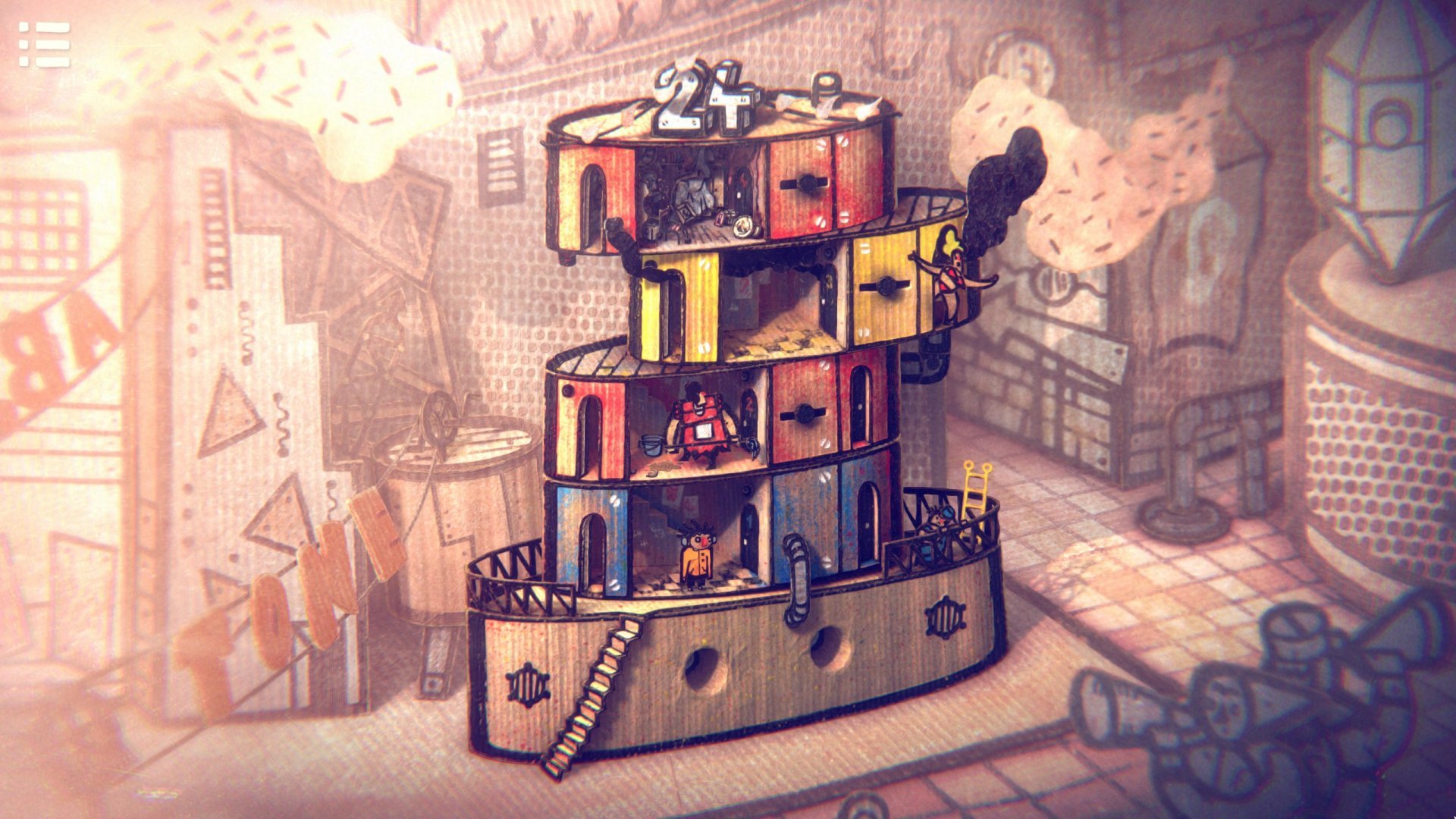
As beautiful as it is, there’s more meaning to the aesthetic than first meets the eye, as the colour palette further reinforces the strict caste system here. The beige floors and walls are primarily raw and unpainted at the lower levels, with only black and white and dashes of primary colours to break up the monotony. In the city’s upper levels, however, the colours progressively increase in vibrancy and variety until the very top where there are no dull browns left to be seen.
Felix’s dream sequences and the natural environments outside Phonopolis, meanwhile, are depicted with oil paints and chalk drawings, representing a stark contrast to the humorous portrayal of fascist architecture within the city walls. The same is true of any images from the Old World, the time before the Leader. Depictions of this period are characterised by everything that modern Phonopolis is not, the hard black cardboard outlines replaced with the smoother blends of paint. The hiding place of the three elders is like a room out of time: everything is painted, traditional rules of perspective are observed, and paint cracks can even be seen on the walls.
Phonopolis

| Genre: | Drama, Science Fiction |
|---|---|
| Presentation: | Realtime 3D, Isometric/Overhead |
| Theme: | Political, Self-discovery |
| Perspective: | Third-Person |
| Graphic Style: | Stop motion, Stylized |
| Gameplay: | Puzzle, Quest |
| Control: | Point-and-click |
| Game Length: | Short (1-5 hours) |
| Difficulty: | Medium |
The difference between the visual styles of the Old World and new Phonopolis nicely parallels the real-world art scene development before and after World War I, with the rise of constructivism rejecting elaborate decoration in favour of industrial assemblages. This style of art was also used in propaganda, and is similarly depicted in-game through the Leader’s various posters. I really like this reinterpretation of historical developments, which shows how the arts can be wielded to control the masses and the dangers of doing so.
This is true of music in Phonopolis as well, which plays a central part in the game’s themes. Felix describes the city as a singular unit that works like a perfectly conducted orchestra – which is to say, at the command of a singular figure. Contrast that with the political rebels who help him on his journey: former highly artistic members of society who composed various forms of music, now forced into hiding and branded as enemies of the state for not marching to the Leader’s tune. This helps further accentuate the political allegory for authoritarian government tyranny that can easily be seen beneath the city’s seemingly light-hearted cardboard exterior.
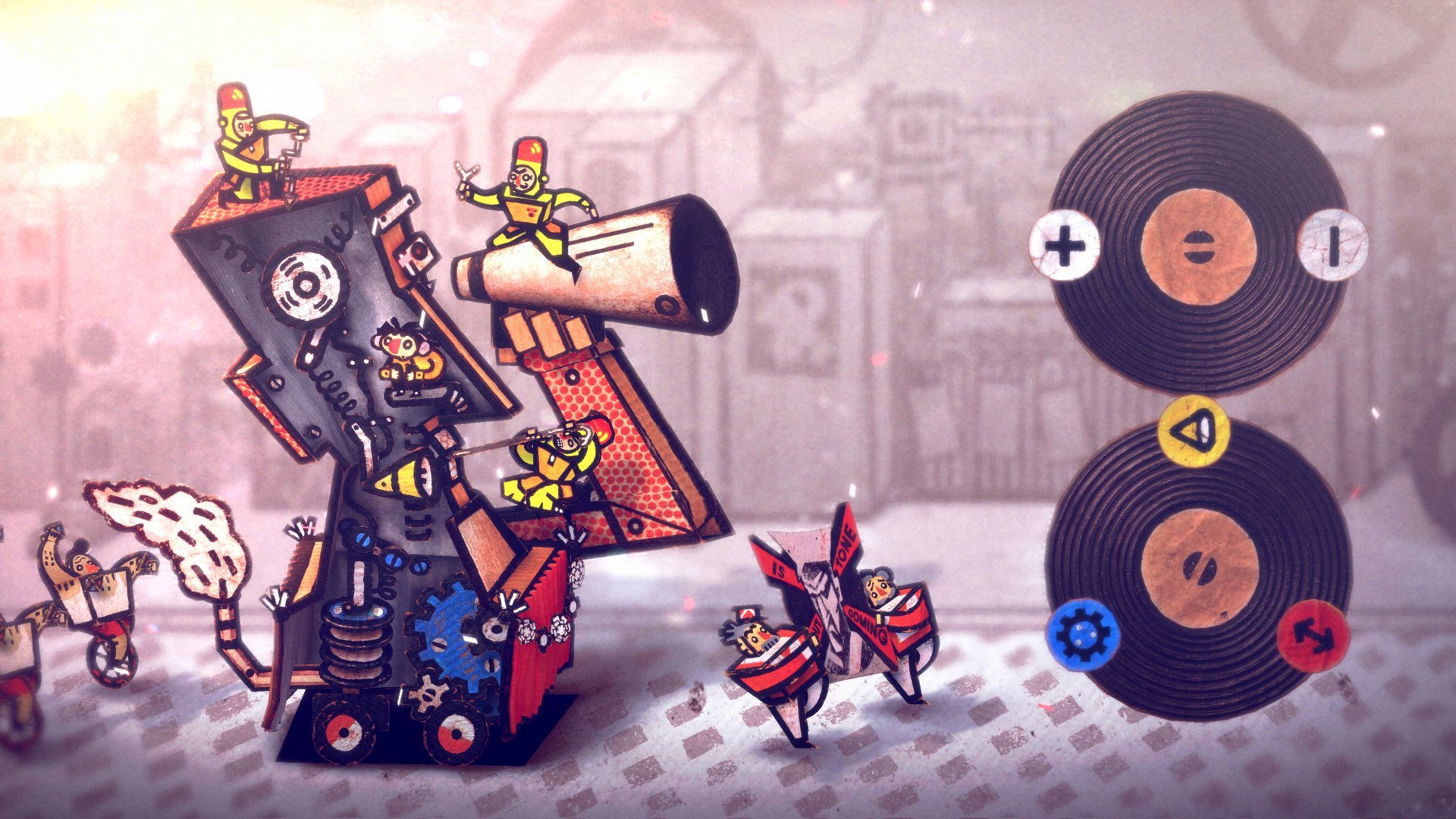
The soundtrack itself is another unique, eclectic one from frequent collaborator Tomáš Dvořák, aka Floex, sparingly but tastefully used. The overworld sequences where Felix navigates the city is usually limited to a soundscape of the hustle and bustle of the many dutiful workers, with musical tracks saved mostly for puzzles and cutscenes. The score nicely complements the action in each scene, with short staccato strings and woodwinds punctuating moments of frenetic energy, while Felix’s dream scenes give way to more melodic orchestral pieces with opera singing.
As good as each element is on its own, it’s the blending of music and visuals to the story’s powerful underlying themes that strikes the perfect balance between thoughtful messaging and humour. The state police use absurdly large vacuum hoses to capture criminals, while the department of bureaucrats Felix says are “hard at work” are all shown to be fast asleep, and one of the puzzles even involves using a faulty loudspeaker to reverse roles in a household to hilarious results.
Which brings us to the aspect of Phonopolis that perhaps deserves the most praise of all: its puzzles. The control interface itself is very simple; left-click for everything, or click-and-drag on movable objects, with hotspots indicated via smart cursor that changes to show where you can walk, interact, or merely observe. You can collect objects but the “inventory” is only ever used to hold a single item at a time that serves to highlight the objective of the puzzle rather than be used as part of the solution.
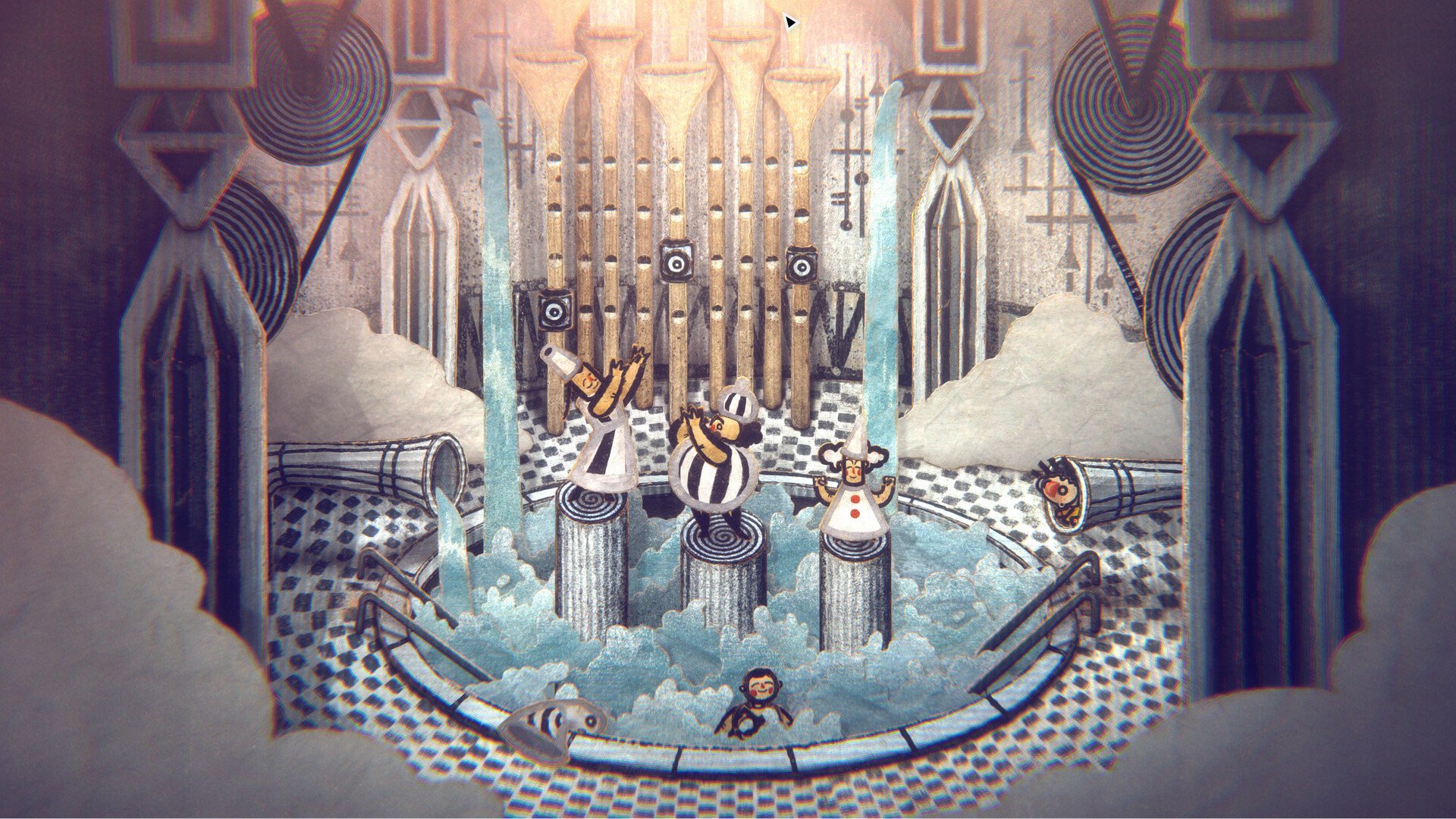
The game weaves its puzzles directly into the environment, signposting interactive elements with target icons for such things as buttons on a console, knobs on a door and ropes to be pulled, all of which come into focus seamlessly as additional steps in a puzzle are completed. The hiding place of the three old rebels, for example, is transformed with hotspots for drawer handles, chains on a cuckoo clock, and parts of a chandelier that must be manipulated in sequence when the time comes to escape the police.
As is customary in Amanita games, objectives are largely unspoken and left to the player to interpret. Everything you need to know can be intuited from Felix’s goals, however, and the blend of humour and aesthetic choices leads to some very creative puzzles and fun interaction with the world. The cardboard aesthetic is used to full effect here, as loose corners of walls can be peeled off to reveal more information, entire building floors are slid side to side like matchboxes, and floors spun around in concentric rings. Some interactions are purely optional, but it’s amusing, for example, to click on the city’s loudspeakers to see the startled citizens leap back to work.
There’s a great diversity within the puzzles. Some involve more elaborate set pieces, with Felix needing to traverse the whole scene to reach his goal while you move pieces of the environment around to clear a path, while others involve simply changing the colour and frequency of shapes to unlock doors. The obstacles are somewhat challenging in difficulty, requiring a bit of experimenting to even know what everything does, but nothing requires great leaps of logic, just an understanding of how the rules work in this world. Solutions can be very whimsical, like sabotaging a police cruiser via remote control, but in Phonopolis they just make sense once all the pieces are in place.
Some favourites of mine include trying to pilfer a costume from the Avant-Garde upper caste, which naturally involves getting them to dance so hard that their clothes fly off, and another that requires having to open and close coloured gates through a security camera system to guide Felix through a bureaucratic maze. You’ll rarely if ever feel like you’re just solving a recycled traditional puzzle, and the tasks reflect a perfect mix of fun, lateral thinking, and just the right amount of challenge that gamers of all ages will be able to play through and have a good time. There’s no manual hint system to access, but Felix will nudge you towards the next step to take after some time has passed.
The game has no manual save option either, but it will record your progress after each room is cleared and offers a scene select option from the menu, broken up into almost every single room. The ending is perhaps one of the strongest parts of this story. The writers stuck the landing extremely well, really highlighting how strong and everlasting these themes are and presenting them in a way that anyone can understand and digest. The outcome feels authentic to the way similar situations would play out in real life, and I’m glad Amanita went with a believable conclusion instead of a more typical fairytale finale.
Final Verdict
Everything works wonderfully together in Phonopolis: sound, visuals, puzzles, story – each of them firing on all cylinders. It’s beautiful, funny, just the right level of challenging, and thought-provoking without being overbearing, resulting in such an amazing game in every aspec that I can really find no fault in it. Even the playtime, while it may be on the shorter side, is so well-paced that it never feels like it is cutting corners or rushing to a conclusion, and the gameplay is so entertaining that there’s never any risk of wearing out its welcome. In some ways, then, this is everything we’ve come to expect from this developer, but just different enough to feel like something entirely new. In other words, a true masterpiece from Amanita Design.
Hot take
Cardboard and constructivism collide in Amanita Design’s masterful marriage of story, puzzles, and hand-crafted aesthetic in Phonopolis.
Pros
- Well-paced story that ends in a satisfying way
- Unique hand-made sets and music blend together to create a distinctive, cohesive world
- Puzzles are fun, varied, and provide enough challenge without being frustrating
- Timeless message explored in interesting allegorical ways
Cons
- So good you’ll wish it were longer
Daniel played Phonopolis on PC using a review code provided by the game's publisher.

- Advertisement
- Help support AGH by advertising with us








2 Comments
Want to join the discussion? Leave a comment as guest, sign in or register in our forums.
I was almost definitely going to get around to buying this one eventually, but this review made me go buy it immediately. So thrilled to hear Amanita knocked it outta the park once again!
Reply
I love myself a good dystopian story (1984 is one of my favorite books). I wasn't sure about this at first, but this review sold me.
Reply
Leave a comment