
Mindcop review
- 0 Comments

Wonderfully quirky cartoon side-scroller is a no-brainer for fans of investigative mysteries
Murder has struck the quiet hamlet of Merrylin Crater Camp, and no-one knows who did it. The victim was blunt and to the point, sure, but never did anything to make enemies out of her colleagues, so is it that straightforward? The nearest police station is an hour’s drive away and the only officer on duty seems as inept as can be, so it’s up to you, the celebrity super-detective known as the Mindcop, along with your assistant partner Linda, to get to the bottom of this unassuming case. Be quick, though, as you only have five days to find the killer before everyone is due to leave the campground behind.
Mindcop is a rather unique entry in the burgeoning investigative deduction subgenre, and it’s a triumph in blending gameplay, storytelling and sound design into a memorable experience. It touches on themes of personal insecurity, unresolved guilt, and letting go of the past while still being a fun game with plenty of humour, both in its writing and in the physical antics of the characters. I finished it in just under four hours, but the non-linear nature of the story gives it quite a bit of replayability that makes up for the shorter playtime. The narrative can unfold in different ways depending on which order you decide to question suspects and what information becomes available. Some plot threads will lead you to interrogate other people involved, while others might be centered around completely different characters, giving you a lot of freedom in how you want to proceed.
Merrylin Crater Camp is a tourist destination built around a giant volcanic rock from its last eruption, affectionately named Bombo. It’s the off-season, however, so the killer can only be one of the 13 staff members still in residence, who all seem to have their own secrets to protect. Unfortunately for the culprit, you have access to the power of “Mindsurfing,” which enables you to peer into someone’s head and surf (literally) the waves in their ocean of memories to unlock repressed thoughts, and in doing so, gain further information about who the killer might be.
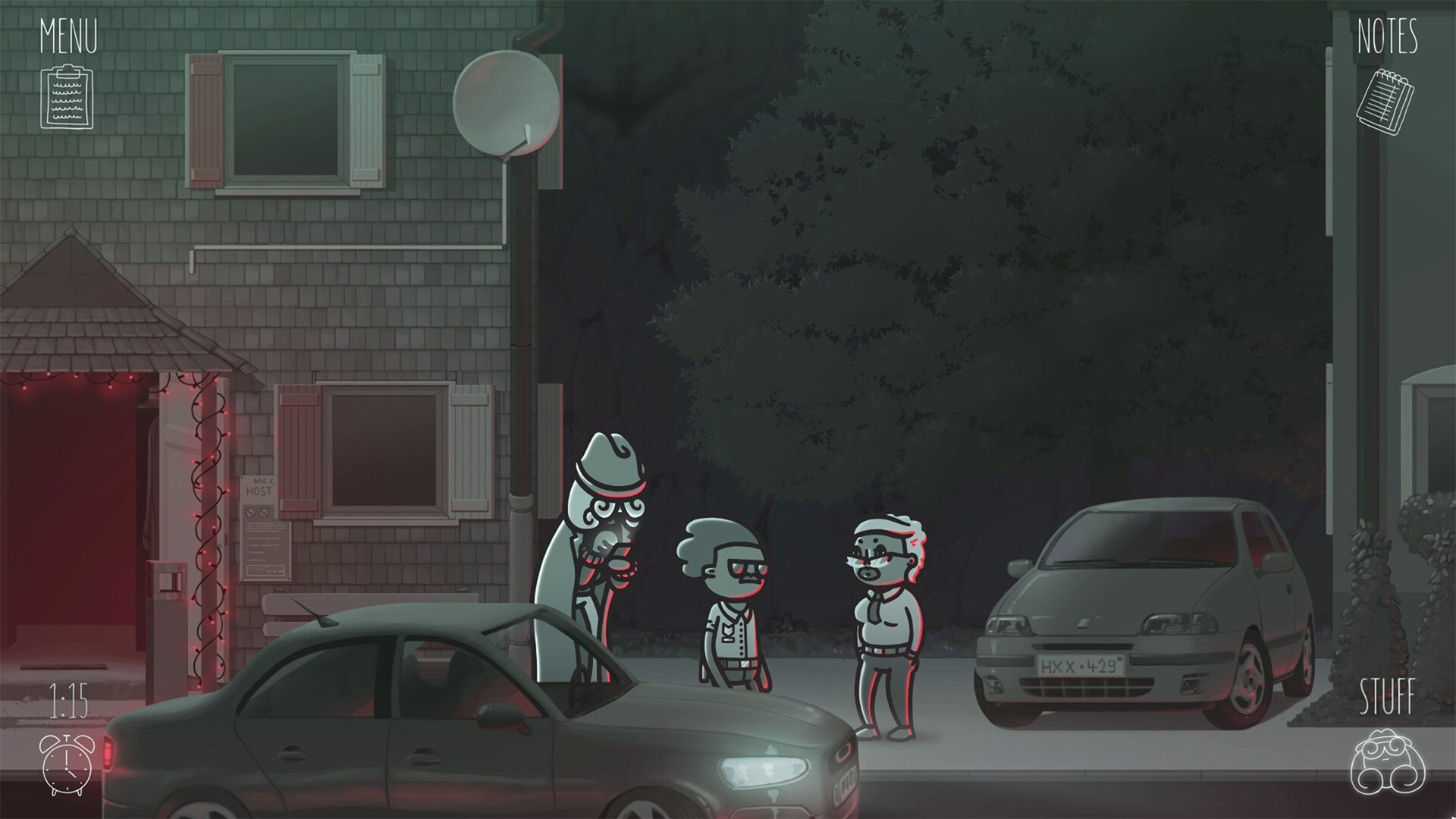
While games with grander narrative arcs like Broken Sword can be described as cinematic, Mindcop is decidedly episodic, both in its atmosphere and design. The lower-stakes environment of a small-town murder with no real overarching story or nefarious plot in the background makes the game feel akin to an episode of CSI. Anchoring the experience by starting and ending each day the same way really gives the impression of binge-watching a police procedural on television. This is further driven home by the small interactions between the protagonists that are never fully explored. There’s a longstanding history between MC and Linda that is only ever hinted at, and the fact that you never get more than passing references to events in the past makes it clear that you’re only being given a brief glimpse into their world.
Gameplay is a mix of investigation and time management, with real-time elements that ascribe a cost to every action. With every person you question, every topic discussed, every object examined, and every new location entered, your daily allotment of investigation time is gradually eaten away. Every day gives you seven simulated in-game hours of detective work, and entering a location itself can take anywhere from 30 to 45 minutes, with additional interaction with each suspect whittling down the time rapidly. The choice is always yours, as a clock icon pops up before selecting an interaction to show you how much time it will take and give you a chance to back out.
Mindcop wants you to prioritise the facts of the case and not waste your time getting bogged down by unnecessary information. Over-investigating or exhausting every possible dialogue option with a suspect is a very real potential danger. At the end of each day, Linda can dig deeper into specific plot points, with many of these taking multiple nights to complete, so there are even more decisions to make in order to ration your time wisely. The story isn’t what I would call complex by any means – the culprit is pretty obvious if you’ve questioned all the suspects – but there are so many threads to pull on that you might feel compelled to investigate further, maybe to the detriment of the case being solved in time.
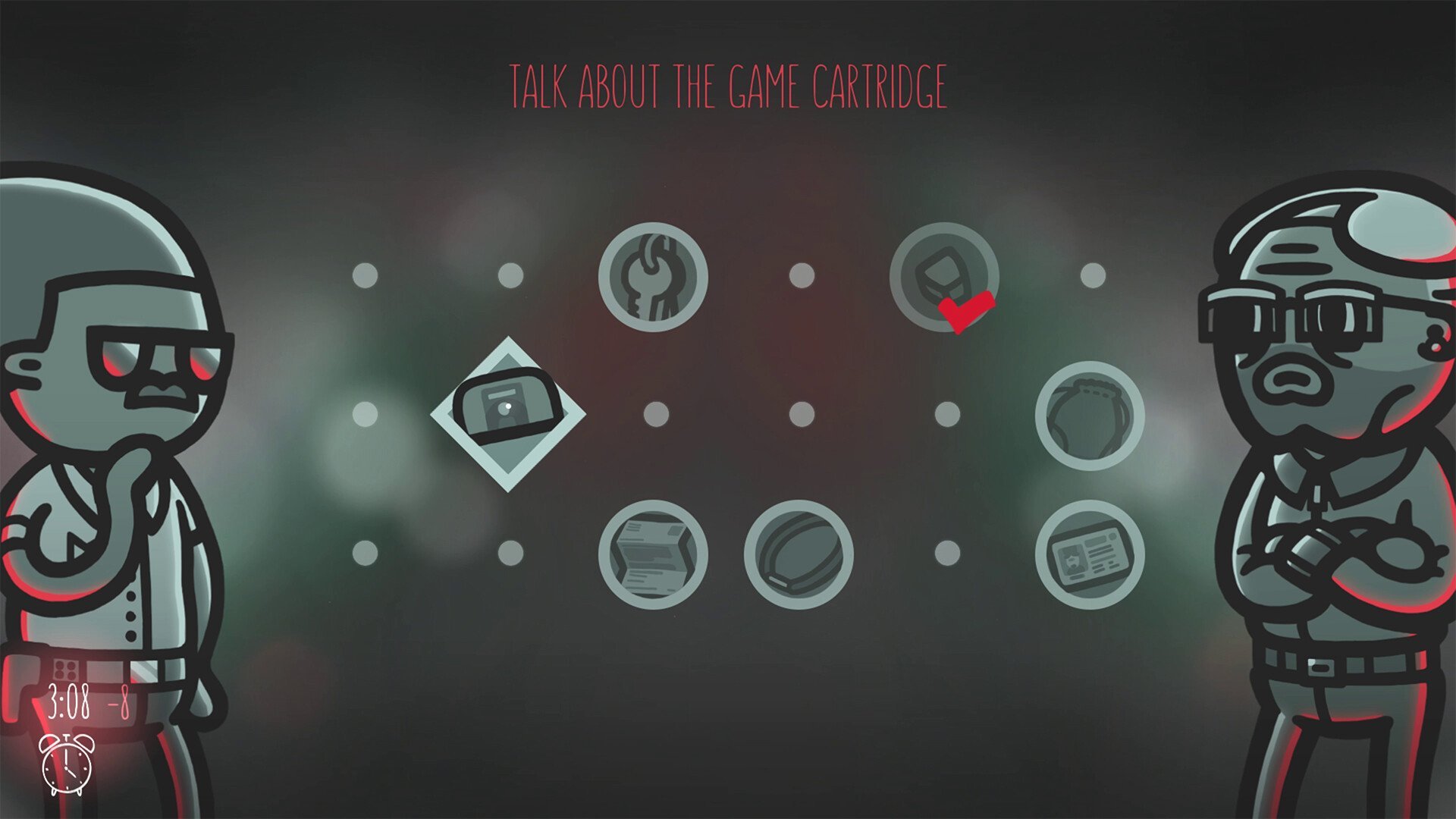
Blended with this time management element is the game’s investigation mode, which is only partially similar to The Case of the Golden Idol and its ilk. You gain more information with each piece of scenery examined, but instead of filling up a word bank, here new topics to discuss with suspects are unlocked if relevant details are uncovered. The presentation in this part is similar to the detective mode in Batman’s Arkham games: the scene turns a darker grey and MC walks in slow motion with possible interactions lit up.
Sometimes you can’t enter certain rooms or open doors in plain sight of a suspect without a search warrant. However, you can only search a house once with a warrant if you want to see what a character is being so secretive about, and can only have one warrant out at any given time. Characters can sometimes react negatively to this, and further attempts to question them may be closed off. I found this to be probably the weakest of the gameplay mechanics, since it is introduced after the other time management elements, creating an even greater urgency to properly ration your hours, and yet it was the mechanic I engaged with the least in my playthrough. Despite this, the emotional impact it has on how characters interact with you makes up for its late introduction.
Mindcop
| Genre: | Mystery |
|---|---|
| Presentation: | 2D or 2.5D |
| Theme: | Crime solving, Psychological |
| Perspective: | Third-Person |
| Gameplay: | Investigative, Minigames |
| Control: | Direct Control, Point-and-click |
| Game Length: | Short (1-5 hours) |
| Action: | Arcade |
| Difficulty: | Medium |
| Graphic Style: | Cartoon |
When interacting with other people, you have the choice of questioning them normally or Mindsurfing them. Mindsurfing is a simple match-three style minigame. MC is displayed on his surfboard at the bottom of the screen, attempting to reach his destination on the opposite side. Filling most of the screen is a square-shaped brain that you can rotate in 90-degree increments. From the top and either side, one to three lanes of coloured Mindbullets start slowly inching to the beat of the music toward the suspect’s brain, creating a tear and leave their mark as Mindclouds when they hit. Your task is to line up the targets to match three Mindclouds in a row in any direction, wiping all three out and extending the timer before the person wakes up. The game allows one free retry on a failed Mindsurf each day, with each subsequent surf costing precious in-game hours.
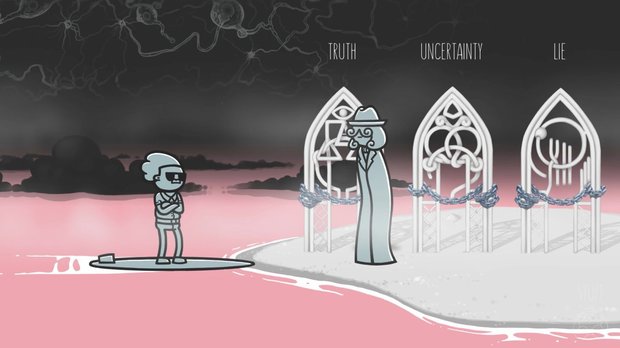
When MC successfully surfs across the ocean onto shore, three doors await: a Truth, a Lie, and an Uncertainty. The Truth and Lie doors depict scenes that are unequivocally true or false from the perspective of the suspect, while the Uncertain door could be either, or a combination of both. This means that some scenes are quite literal memories of the past, while others are more representations of how that character felt in the situation, with certain psychological embellishments. It’s a great portrayal of the various mental states of the characters, their insecurities, and private thoughts, which MC then uses to infer people’s relationships, hidden motives and possible involvement with the case.
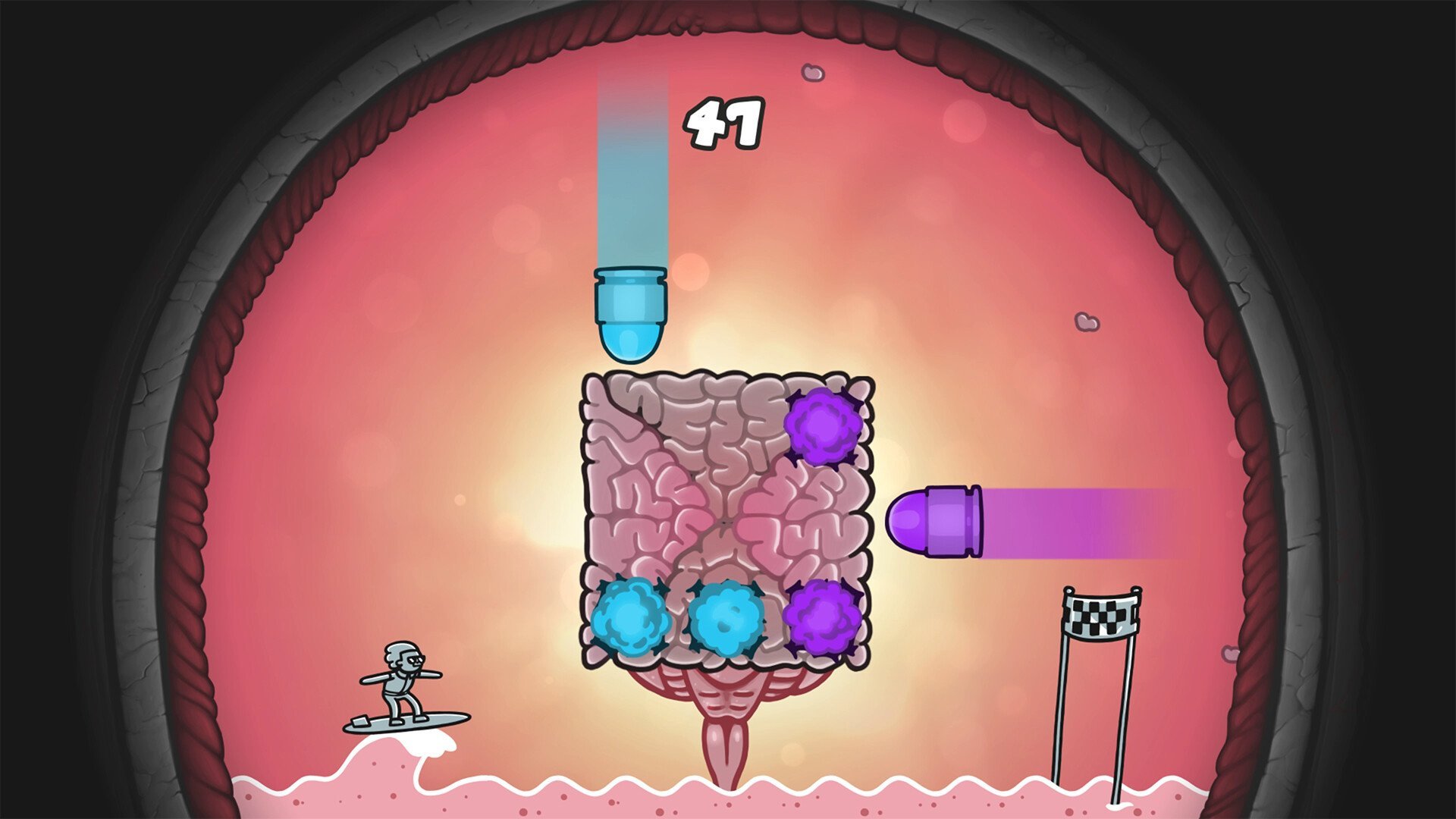
Mindcop is navigated in side-scrolling 2D fashion that supports both point-and-click and WASD movement. Both methods work fine, though the game does give the impression that the mouse is the intended method, as running is only accessible via the mouse. Mindsurfing also has controls for both the mouse and WASD, using either the left and right mouse buttons or arrow keys to rotate the target’s brain.
Worth mentioning are the slew of user-friendly additions within the journal you carry. There are lists of both the topics and items so far that can be presented to a suspect during questioning, a diagram of the street with details on each house, as well as the current location of all characters, which is crucial in an investigation with passing time as a core part of the gameplay. The last section of the journal has all the tutorial screens and Mindsurfing cutscenes saved, which can be helpful in trying to understand the timeline. New information acquired from suspects will cause the journal icon to flash in the corner of the screen, which you can quickly access even mid-interrogation with the press of a button.
Visually, Mindcop evokes a 2D hand-drawn television cartoon style similar to shows like Gumball and Steven Universe airing on the Cartoon Network from the late 2010s, with thick black outlines, noodle-y arms and legs and a caricatured emphasis on certain aspects of people’s anatomy. It’s an art style you’ll either love or hate, and there is a slight disconnect between the brutal murder and serious nature of the story and its more childlike, comfy aesthetic.
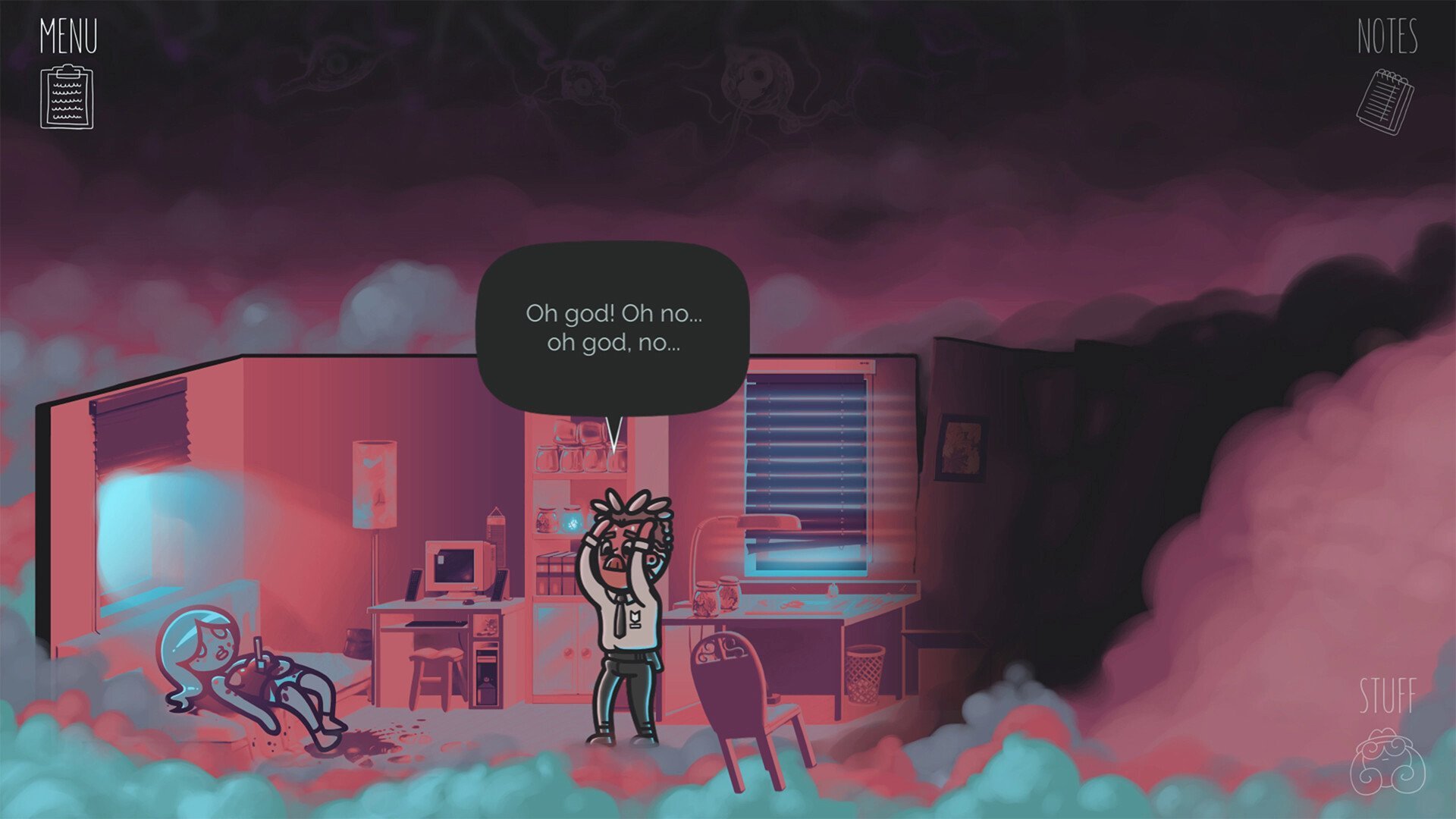
However, this leads to some genuinely funny physical humour that wouldn’t otherwise be possible. For example, Linda is an extremely tall woman, like twice the height of MC, who has to duck to get through doors and also acts as both the inventory and method of fast travel. If you click and hold the edge of the screen, she will pick up MC and sprint full-stride down the street. Similarly, whenever a new item is acquired, a tiny Linda head in the bottom right corner will slowly shove the item down her mouth, and when clicked on, Linda will open up her trench coat to reveal a ridiculously large number of pockets for all the items collected thus far.
The town of Merrylin Crater Camp is fully realised within this distinctive hand-drawn style, with each location, scene, and character feeling cohesive and believable as part of the same world. Everything from the Bombo-branded souvenir shop, to the guest hostel, and even the outdoor scenic views of the mountain’s vantage point are all presented in a very muted colour palette, really hammering home the gritty noir feel of the story. This contrasts exceptionally well with the neon explosion of blues and yellows in the Mindsurfing segments, showing the internal thoughts of each character as a more tangibly vibrant world.
It’s rare for one of a game’s strongest suits to be its music, but Mindcop’s sound design was the first thing that grabbed my attention. Immediately upon my starting the game, synth notes punched through an otherwise silent menu screen. In-game, each day of the week begins with an earworm of a guitar piece that transitions into the diegetic sound of the car radio in the Mindmobile, MC’s self-branded car. This then blends into a soft mix of easy-listening synths, almost like really good elevator music. The score carries over into the interrogation sequences, but here the ambient jazzy noodling becomes sharper and better focused, with more controlled variations. It’s genuinely quite impressive to experience, and really adds to the immersive atmosphere.
Even simple interactions are musical. Mousing over a relevant object is accompanied by a metallic bell that acts as its own auditory hotspot indicator, combined with the sound of a pen clicking with each mouse click. I could envision MC fiddling with his pen when jotting down notes on whatever object I’d decided to investigate further, and each toll of the bell as I moused over a hotspot was like a mental “aha!” moment of discovery.
As much as I adore the overall sound design of Mindcop, the music during the Mindsurfing sequences is what really takes it to the next level. Here the otherwise more chill jazz tones give way to a bombastic disco number; shades of Miami Vice or the first time hearing the opening riff of “The Heat Is On” come to mind. The tonal shift works remarkably well given the circumstances, while also narratively providing a contrast between the outer and inner worlds.
Final Verdict
There are a lot of different systems at play here, yet they’re all jigsawed together into a neat little package to feel surprisingly cohesive. Incredibly well-realised in both its aesthetics and design, Mindcop’s strength of writing, sound, and gameplay make for an extremely compelling experience that leaves little room for improvement. A single playthrough may be a little short, but there’s even some replayability thanks to its thoughtful non-linear narrative progression. There’s no need to Mindsurf me for my opinion: I had a blast with this game and can’t wait to see what MC and Linda get up to next.
Hot take
Immersive, trippy, and nicely varied in its gameplay, Mindcop is a well-paced non-linear whodunit that strikes just the right balance between emotional and hilarious in its gritty murder mystery.
Pros
- Non-linear narrative holds up across various different playthroughs
- Music and sound design are varied and immersive
- Humour is nicely interspersed throughout some otherwise serious topics
- A lot of additional side plot details and stories to uncover
Cons
- Search warrants feel less important than other investigative elements
- Keyboard controls aren’t as fleshed out as the mouse
Daniel played Mindcop on PC using a review code provided by the game's publisher.

- Advertisement
- Help support AGH by advertising with us






0 Comments
Want to join the discussion? Leave a comment as guest, sign in or register in our forums.
Leave a comment