
Whirlight: No Time To Trip review

- 0 Comments

Whimsical time-travel adventure is bursting with beauty and enjoyably colorful conundrums
In 2020, imaginarylab surprised me with Willy Morgan and the Curse of Bone Town, and now they are back with Whirlight: No Time To Trip, a new 3D point-and-click adventure in a similar style with a visual candy store of gorgeous locations, a fun soundtrack, and tricky though not too difficult puzzles. And while its predecessor was a rather short game, this time around we get an immense adventure that kept me questing, laughing and time-travelling for fifteen hours.
You start off playing as Hector May, and later on as artist Margaret Harck. Hector is an inventor in 1960s Verice Bay, an American coastal town with lots of Italian influences, particularly Venice with its lovely canals, gondolas and Gothic, Byzantine and Moorish architectural styles. Immediately I felt a connection with this main character: Hector is not a typical dashing hero but a gray-haired, middle-aged man with a raspy voice and a mismatched outfit that gives him a hippie appearance. He’s your average Joe – or perhaps an exceptional Joe; a sometimes scatter-brained yet often brilliant physicist who wants to make a name for himself with an amazing invention.
Whirlight starts with Hector stuck in a surreal dream, an alien world with references to Dalí and Warhol, featuring a giant frog and weird geysers spouting beautifully animated smoke. There’s an enigmatic glowing butterfly resting in a hard-to-reach place, and through a series of inventory puzzles you have to help Hector get it. Going from screen to screen, finding items in one and using them in another, immediately sets the gameplay expectations for the rest of the story back in the waking world.
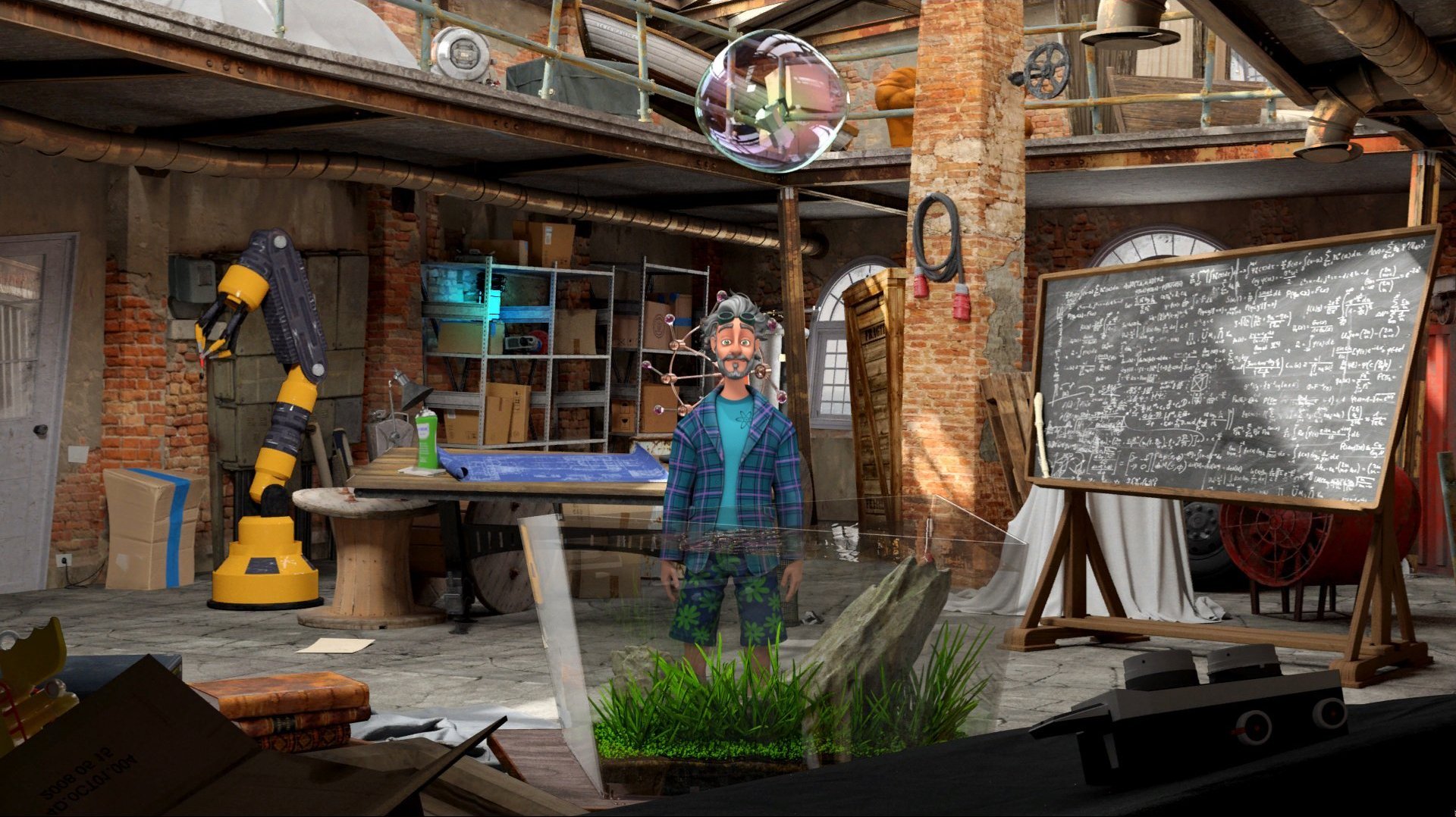
The dream inspires Hector to build a new invention, but it will need to be made from several parts that require exploring Verice Bay to find them all. There are a number of locations in town, like a couple of squares and alleys, the pier, the church, a lookout spot with an old wishing well, a toy shop, and an ice cream stand. Early on you will find a map, which you can use to fast-travel between locations. Not all locations are featured on the map, though; some streets and alleys you will still have to traverse yourself to access more unusual corners of town, like a rooftop terrace and a drunkard’s cardboard home.
Hector can run or immediately use an exit with a double-click of the mouse. Otherwise, searching the scenes is done with a simple one-click interface. Hector will examine and comment on stuff, manipulate hotspots or pick up objects as he sees fit. The right mouse button is used as a hotspot revealer. While generally I hardly use this feature in adventure games, Whirlight has such detailed hand-painted graphics that some key objects are easily missed, so I was grateful for this feature.
As I spent time gathering the necessary parts for Hector’s invention, I noticed that my progress was also rewarded by changes in the environment. A workman is building a stage in one of the squares, and as you continue to solve puzzles, that stage will grow larger and the workman will be attending to other parts of it, until finally it is finished and a speaker is preparing his presentation. Time progresses automatically during this part of the story, and more avenues of inquiry become available as you go along. This often means you need to pay close attention to new clues. Chances are there is someone in the neighborhood you can talk to about any newly uncovered information. Even if you’ve spoken to them before, a previously depleted dialogue tree will show a new topic the next time you try.
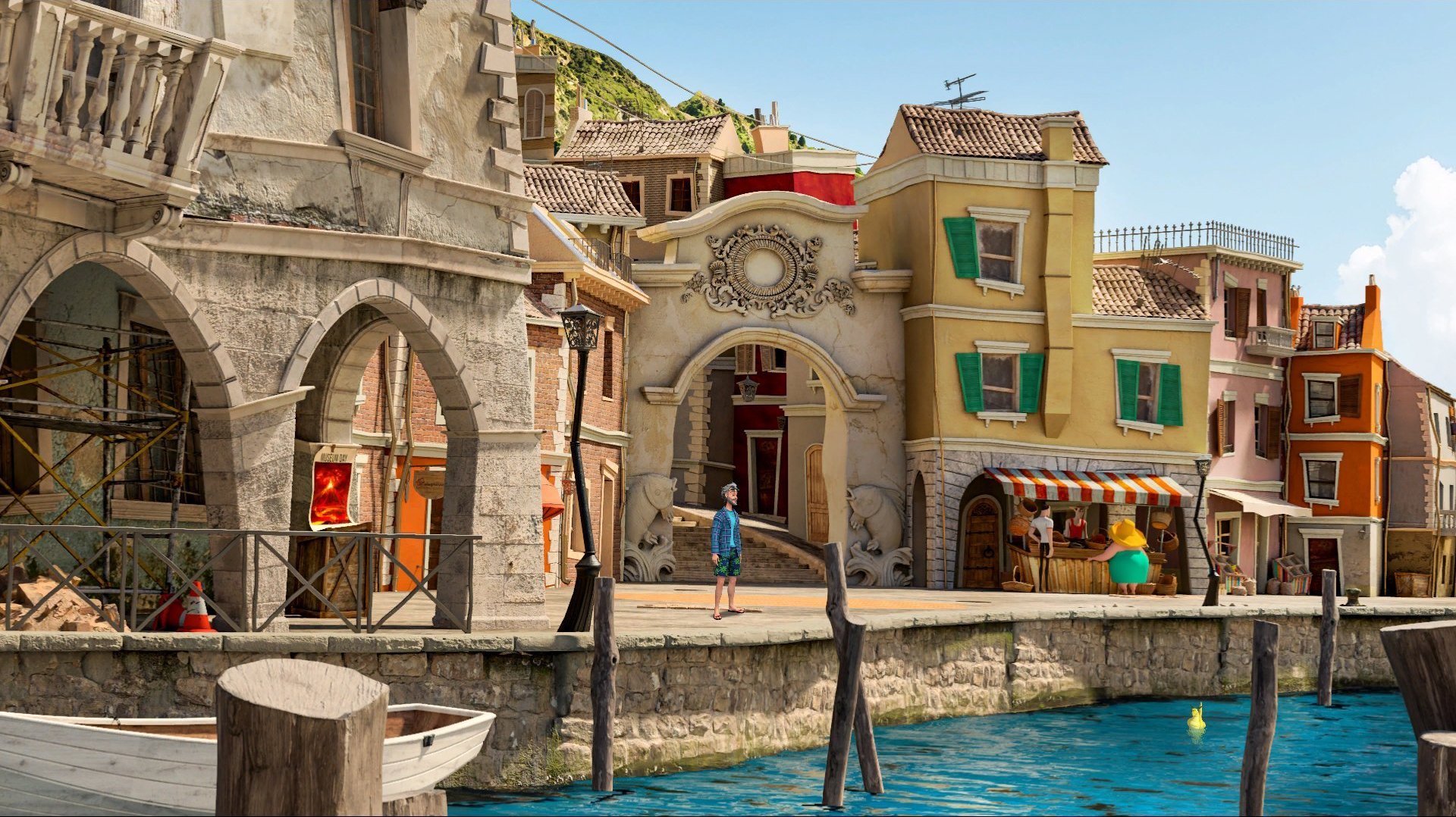
Or you might spend far too long on a particular puzzle when there’s no way to solve it yet. For instance, at one point I found a newspaper I could set on fire, but which only burned for a limited number of screens. I wasted time trying to find something in the vicinity to light, then gave up, continued on other paths, only to find myself returning there later but now with an obvious fuse available. This happens several times in the game, but thankfully there are many leads to follow up on, and eventually you will get back to your original obstacle in a very organic way.
Hector ultimately invents the Light SqueezerTM, which allows him to turn rays of natural light into liquid form. With the light of all colors of the rainbow combined, he can controllably travel through time – though being the goofy scientist he is, he’s not immediately aware of its capabilities. And so he accidentally transports himself to Verice Bay in the 1990s. In this future, you switch to Margaret as the playable character, a local sculptor who is first a reluctant but later an intrigued sidekick who helps Hector figure out how his invention brought him to her era.
Now it’s Margaret’s turn to search all over Verice Bay to collect samples of light colors in order to send Hector back to his own time. This means you will revisit locations you already went to in the 60s, but of course they look totally different now. The toy shop has been replaced with an arcade, the laundromat has become a cinema, and the ice cream stand has turned into a burger joint.
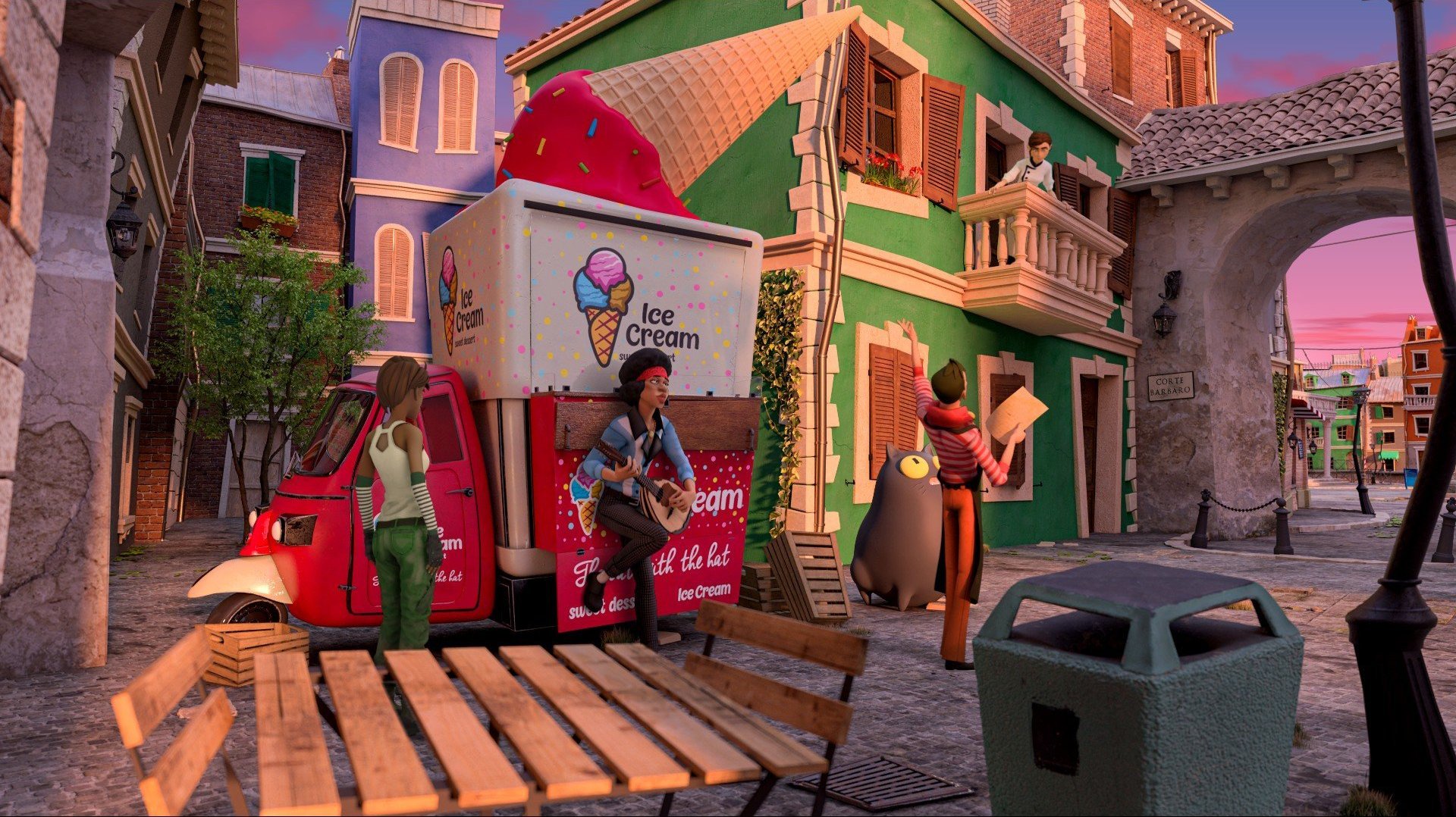
During this part of Whirlight, you will also need to explore the town at three different times of day: morning, evening and night. So not only will Verice Bay’s various locations change with different color schemes, the non-playable characters move around as well. For instance, the security guard will be eating at the burger stand after the museum closes, and there’s a street musician who only plays in the mornings.
You can progress time by going to the cinema, or by letting Margaret play on her computer. It’s your job to figure out the perfect conditions for when to do something, or when to talk to a particular person. I didn’t keep an exact count, but I must have spent at least three weeks in-game until I found everything I needed, cycling through the days figuring out all the puzzles.
Whirlight: No Time To Trip

| Genre: | Comedy, Science Fiction |
|---|---|
| Presentation: | 2D or 2.5D |
| Theme: | Team-up, Time travel |
| Perspective: | Third-Person |
| Graphic Style: | Illustrated realism |
| Gameplay: | Puzzle, Quest |
| Control: | Point-and-click |
| Game Length: | Long (more than 10 hours) |
| Difficulty: | Medium |
On top of some cinematic cutscenes, there are many amazing and fluid animations in this game, usually involving Hector or another character falling down in slapstick fashion. However, barring the occasional exception, inventory item use isn’t included, which is a shame. While the environments are visually stunning, this makes it all the more obvious when something is missing, unfortunately enough. Whenever Hector or Margaret uses an inventory item on a hotspot, or gives it to another character, you can’t help but notice that they seem to be handling empty air.
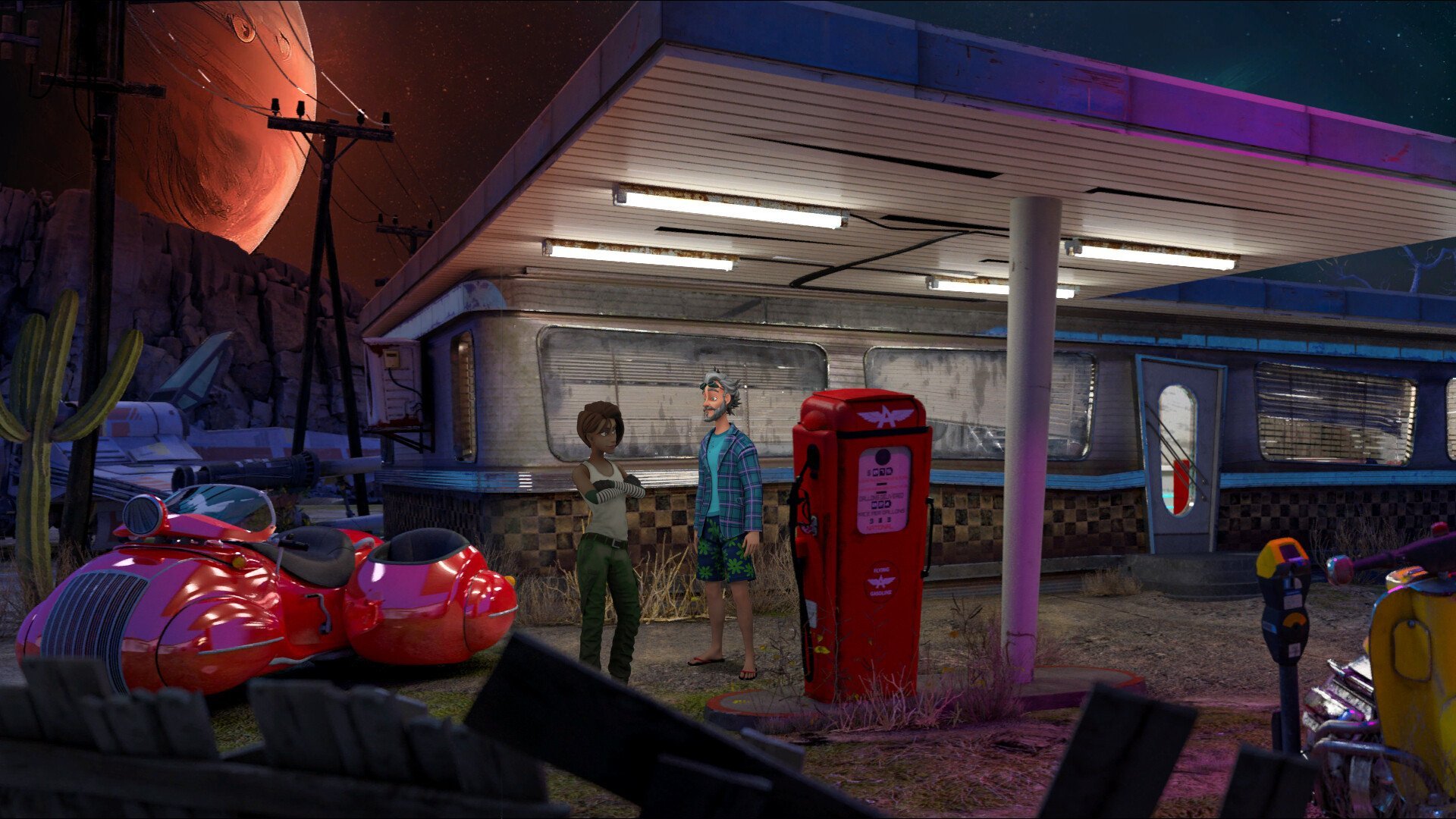
Even after Margaret succeeds in helping out Hector, Whirlight is far from over. In fact, doing so only makes matters worse, as an accident causes them to get separated in time. You will then play a bit more as Hector, then as Margaret, until the two meet up once again. Along the way, Hector gets to explore another one of his dream worlds during a meditation session with a monk in a desert, while Margaret winds up in the not-so-distant future of an apocalyptic Verice Bay in the year 2045. This is when the story gets a bit fantastical, with an out-of-the-blue threat leading to some saving the world shenanigans, which also results in the gameplay becoming more interesting.
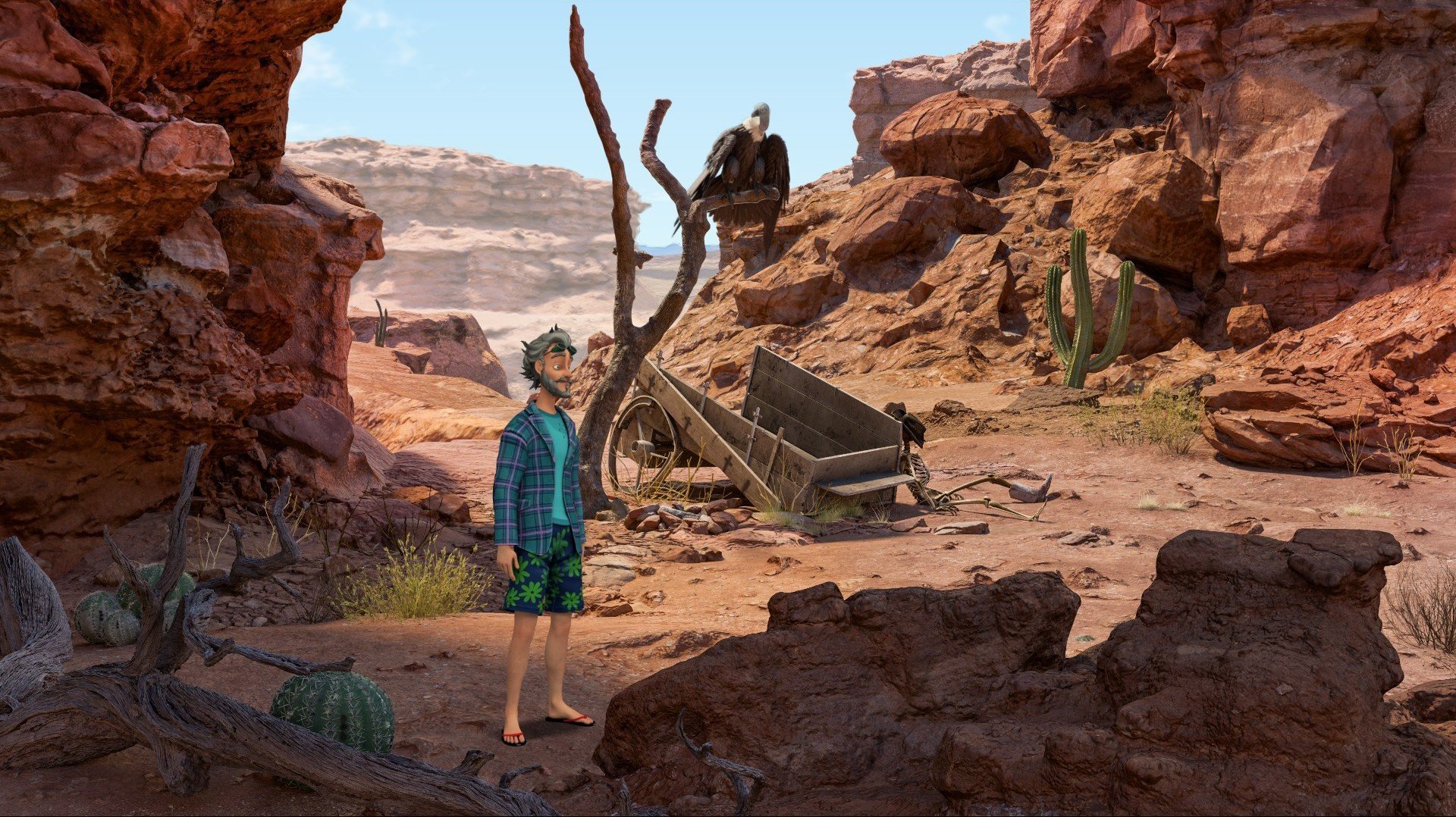
Instead of being stuck in the same era until you have accomplished your main goal, you can now travel freely between more than ten different settings in both time and space using Margaret’s sidecar motorbike. These locations become available one by one as you solve smaller puzzles and find new leads. From then on, you will also have to figure out whether you need Hector or Margaret to perform the available actions. You may even have to exchange inventory items, if one of them picks up something that only the other can use. Margaret, for instance, is handier with a pair of scissors, while Hector is better at wielding a drill. Once an item is in the right person’s hands, it can no longer be exchanged.
If there’s a downside to the dual-character gameplay, it’s that it is more cumbersome to switch between Hector and Margaret than you might be used to from other games. There are no handy face icons in a corner that you can simply click on. Instead, playing as one character, you have to talk to the other, then tell them it’s their turn to take the lead. But talking to each other also offers dialogue choices that serve as reminders of your goals. While not quite an in-game hint system, it is often enough to give you a new idea about how to approach an obstacle.
Experts in time-travel stories might yell “paradox!” on several occasions, though. Hector and Margaret make changes to future environments they already visited earlier, but chronologically speaking, these changes would have prevented them from acquiring the necessary means to travel back in time in the first place. I suggest you not think too hard about it, since attempting to unravel time-travel stories is prone to lead to massive headaches anyway…
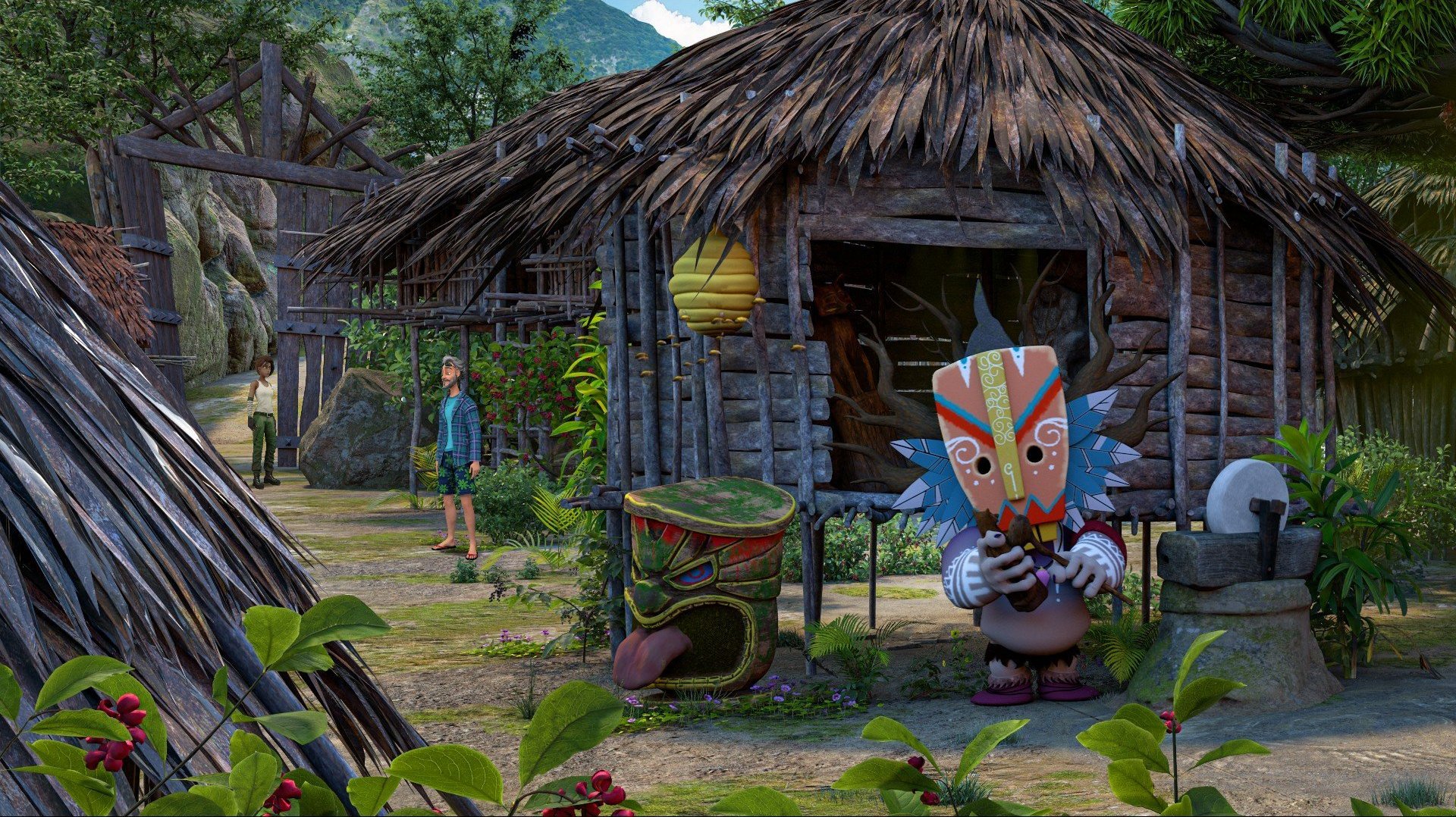
The inhabitants in every time period of Verice Bay, as well as the other unlikely locations you wind up in – like a bar at the edge of space and time, a small Sussex town in both 1815 and 1895, a secret laboratory on the North Pole, and a Mediterranean vineyard – are a joy to interact with and they really liven up the place. There are too many to name, but most important are the Verice Bay shop owners, some cult members and their High Priest, tribespeople from 10,000 years in the past, and Hector’s biggest competitor in the inventor business, Theodore. Every one of them serves a function; what exactly that is might not be immediately obvious the moment you meet them, but it was always fun to see them become more important later on, even after you may have already forgotten about them.
Many of the puzzles revolve around these characters as well. Most of them will have something to trade, be it an actual item or a particular service. You are then sent on a fetch quest for something they want in exchange. Yet these aren’t arbitrary tasks, simply there to throw another obstacle in your face. They always fit the character’s own story. There’s a tailor who will help you if you bring him some fur to make a new coat; a fisherman who will only hand over his rod if you give him some coffee; and a certain dog will only relinquish its toy if you provide some other means of entertainment.
In order to accomplish the main goal in each part of Whirlight, there are dozens of smaller quests to complete first – some even consisting of several layers of their own – before everything comes together in the end. It certainly takes time to play through it all, making the game much longer than I first expected, but I very much enjoyed every minute of it. Everything you have to do makes sense, even if you might have to think about it for a while to reach the right conclusion.
Your inventory appears at the bottom of the screen when you scroll the mouse button up. It can’t be fixed in place, but once revealed, it remains open long enough, usually until you talk to someone and it’s replaced by a dialogue tree, or when you trigger a longer cutscene. I still would have preferred a fixed inventory, though, since there was one occasion when I noticed it actively blocking a hotspot at the bottom of the screen. It’s one of the few nitpicks I have with the gameplay or its mechanics.
A bigger complaint is that sometimes you need to repeat certain actions without being aware it’s possible, or even that you need to do so. For instance, Margaret could refuse to do something at first, or a resident of Verice Bay is reluctant to help you. You might mistakenly think you’re stuck, looking for other solutions elsewhere in vain. Instead, you just need to be persistent and try again, even when there is no indication that might be the case. This cost me lots of time revisiting locations, clicking on old hotspots and trying to use inventory items again and again until I finally returned to the point where I got stuck, tried the same thing a second time and was suddenly successful when I got a different reply.
Even with a few setbacks, there was not a single moment that I wasn’t having great fun. Not only is Whirlight a visual treat, but the music and sound effects are splendid as well. It’s a very cinematic game and thus features a movielike soundtrack, era-appropriate with unique tracks for each location. The 90s are more New-Agey, while the 60s are more traditional; a relaxing guitar tune plays in the vineyard, but the dark apocalyptic future has a more menacing vibe.
Much of the time, Verice Bay is brought to life with the cooing of pigeons and other ambient effects. The crackling of fire barrels was so realistic at one point that I thought my laptop was burning. Through one of the building’s windows you can hear a western movie being played, and everything involved with Hector’s inventions produces a variety of zany cartoonish sound effects.
Last but not least, the voice actors have done a wonderful job, too. Jeffrey Machado plays Hector, delivering the inventor’s mix of focused brilliance and silly improvisation to a T. Margaret is voiced by Larissa Crowe, performed as a more down-to-earth character, resourceful and meaning business. All secondary characters are lovely as well, without any over-the-top accents, simply portraying them as normal human beings with their own wants and desires.
For those who have played Willy Morgan, in comparison Whirlight is a much meatier experience. The overall quality is very similar, with the same charming offbeat sense of humor and fantastic world design, but it’s at least three times as long, with a more fulfilling ending, and the puzzles here can be more challenging (though not so challenging that you need to be a brilliant scientist to figure them out). If you were a fan of Willy’s adventure, you’ll very likely have an amazing time in the company of Hector and Margaret.
Final Verdict
Even if you haven’t played that game, if you love point-and-click adventures with loads of stunning locations, interesting characters and many hours of engaging gameplay, you’ll find Whirlight: No Time To Trip a joy to experience. Its unique graphical style, combining almost photorealistic backgrounds with slanted architecture and more cartoonish characters, depicts many gorgeous settings in various time periods to explore at your heart’s desire. Hector and Margaret’s antics in the past, present and future provide both fun gameplay and a captivating story, reminding me how much fun time-traveling adventures can be. I would have preferred some better signposting at particular times, and it’s a shame that shortcuts were taken with inventory animation. But ultimately these are minor blemishes in a game that will delightfully suck you into its thoroughly entertaining time-hopping vortex.
Hot take
Whirlight: No Time To Trip is a wonderful time-travel adventure filled with stunning production values and loads of puzzles that you’ll gladly get lost in for days.
Pros
- Stunning visuals combining a cartoon style with photorealistic backgrounds
- Two playable characters provide extra gameplay variety
- Lovely soundtrack and voice acting
- Many-layered time-hopping puzzles to keep you busy
Cons
- No signposting for when repeated actions are needed
- Inventory items don’t appear in character animations
Johnny played Whirlight: No Time To Trip on PC using a review code provided by the game’s publisher.

- Advertisement
- Help support AGH by advertising with us








0 Comments
Want to join the discussion? Leave a comment as guest, sign in or register in our forums.
Leave a comment