
System of Souls review
- 0 Comments

Uncomfortably derivative Portal clone handles so poorly you’ll want the lost hours of your life back
In a world where the rich can live forever by having their consciousness transferred into robot avatars, a developer of the system – Logan – discovers that this is exactly what’s happened to him, though he has no memory of what brought him to that point. Now, through a series of Portal-esque test chambers, he must complete increasingly difficult physical challenges to restore his mind. This is how Chaotic Labs drops players into the physics-based challenges of their first-person, real-time environmental puzzler System of Souls. Unfortunately, with an eerily familiar look and sound, humdrum story, and level design that works against the game controls, be ready for an experience that requires a great deal of skill, more patience, and even more luck.
Logan (technically L-064N by his robot designation) awakens/activates in the ION laboratory, the installation where the brain patterns of humans on the brink of death are transferred to machine bodies – if they can afford the procedure. Logan is joined by Aura, an unseen artificial intelligence that serves as a guide through the challenges of the complex. It seems Logan was involved in an accident, but he has no recollection of how he came to be in his current predicament. By completing the building’s various test chambers, he begins to unlock his memories of how he got there.
It’s never made clear how solving Portal-styled physical activities triggers Logan’s memories, only that it does. This is done at predetermined intervals that coincide with solving suites of puzzle chambers all centered around a specific gameplay element, such as the use of buttons to open doors, or chandelier-like anchor points that Logan can project an energy beam towards to swing from à la Spider-Man. After finishing a group of such puzzles, Logan is then presented with a memory download that shows silent FMV flashes of his life leading up to the accident that put him there.
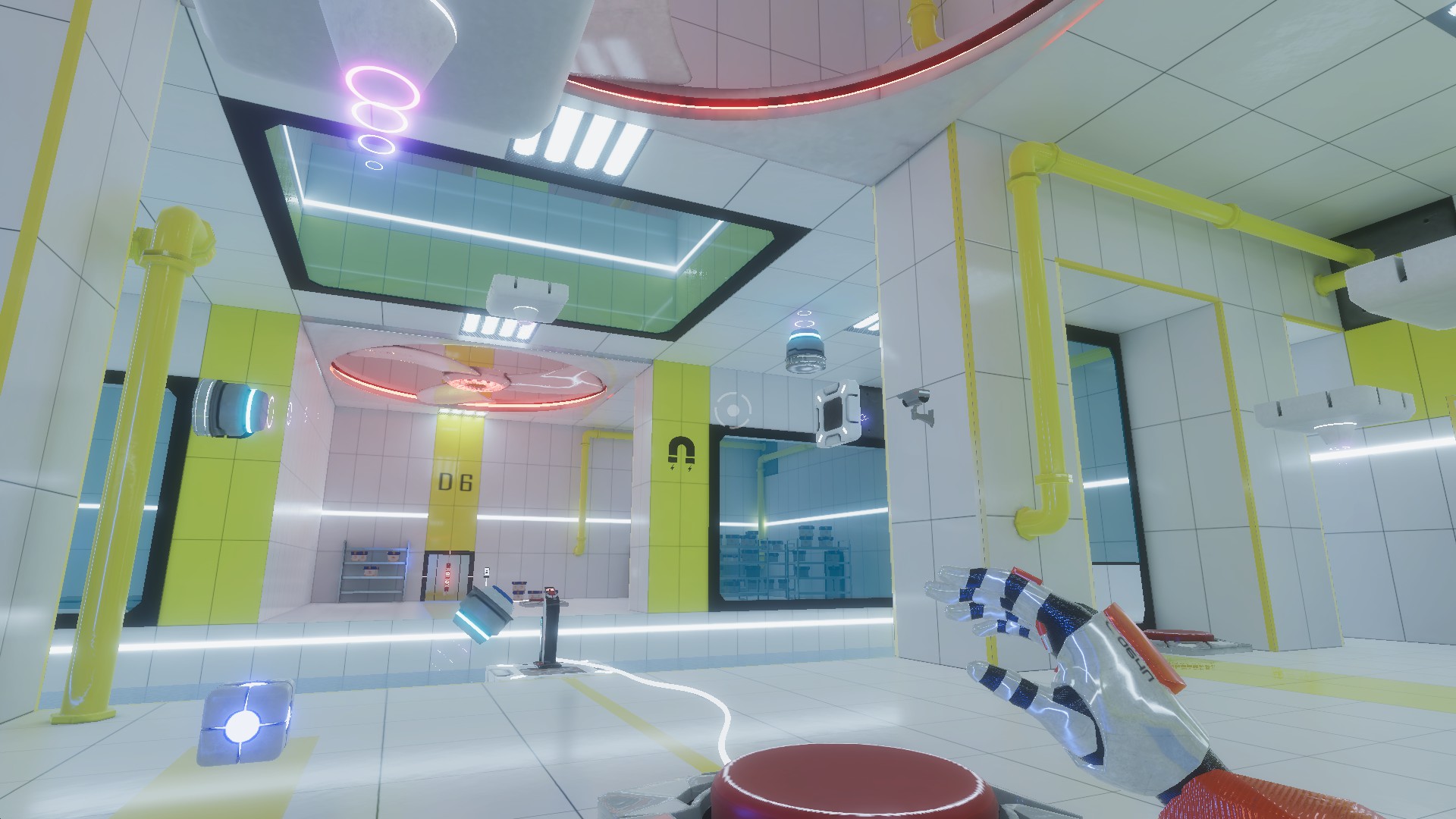
Aura maintains a running commentary through the test chambers and along the hallways that connect them. This would have worked better had the game been voiced, but it plays out entirely in subtitles. It’s fine in between levels, when you’re not focused on trying to solve puzzles, but when a text line pops on-screen to be read during a tricky maneuver… well, for me at least, the puzzle always won out and the line went unread. Not that I felt like I was missing anything. The game is tremendously overwritten and Aura’s condescending tone grows tiresome very quickly. On top of that, the story, such as it is, just isn’t that interesting. Aura continually hints at what happened to Logan, but it’s so apparent that she’s an unreliable narrator that when the “twist” finally comes, it comes not as a surprise but simply another excessive section of a plodding plot. This is definitely a tale in need of a good editor.
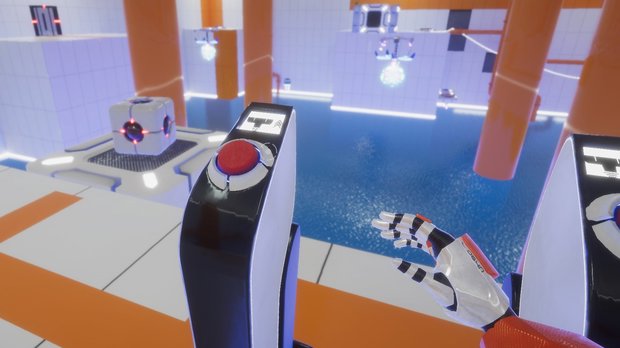
Still, the main draw for any Portal-inspired environmental puzzler is its challenges and the experience they provide. Sadly, System of Souls is far more frustrating than satisfying. It has a good number of clever game mechanics, but their implementation leaves a lot to be desired. As with Valve’s classic, many puzzles here involve grabbing boxes, which the game calls Long and Short Term Memory cubes, and depositing them on various floor switches to open doors, reverse gravity, or activate other bits of machinery. Red boxes need to be approached up close to be picked up, while blue ones can be grabbed at a distance with a sort of tractor beam built into Logan’s hand.
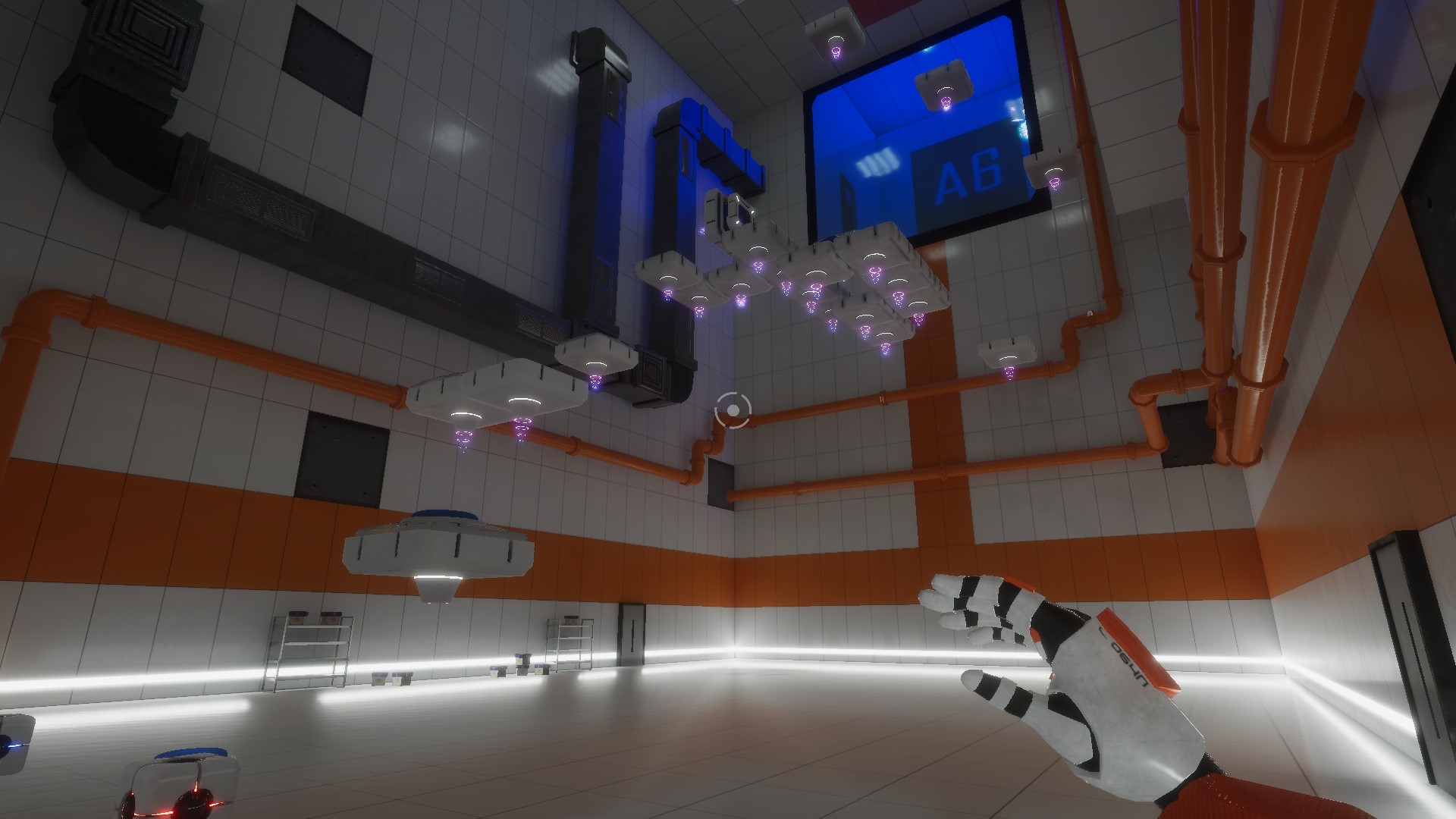
The protagonist gains other powers as he goes along, like the ability to project a tethering beam at anchors mounted in the ceiling. With these, you can swing back and forth and change direction until choosing to release at a certain point. Often, you’ll need to do a series of swings from one chandelier to the next in quick succession. To help with this, another power can be triggered that slows down Logan’s momentum so he doesn’t drop as fast. In a similar vein, he can gain another projecting beam that lets him reduce the movement speed of objects in the environment, which can be useful when a block is dropping from the ceiling and you need to slow it down in order to complete some other part of the challenge first.
This sounds all well and good, and seems like it should allow for great variety in the puzzles. It does that, but the way in which these mechanics are implemented does not work well with the level design. Increasingly, levels demand a high degree of both speed and precision to complete. At one point, you have to hit a button to cause a box to begin to drop behind you, requiring a quick turn to project a slowing beam on the box, to do another quick turn and side step onto a floor button, to magnetize a panel that’s then set into motion, which also needs to be slowed, so when the original box unslows and falls on a panel, a second box drops down and catches on the magnetized panel before it can leave. Whew!
System of Souls

| Genre: | Science Fiction |
|---|---|
| Presentation: | Realtime 3D |
| Theme: | Escape, Technology |
| Perspective: | First-Person |
| Graphic Style: | Photorealism |
| Gameplay: | Action-Adventure, Environmental puzzler, Escape room, Puzzle, Puzzle-platformer, Survival |
| Control: | Direct Control |
| Game Length: | Medium (5-10 hours) |
| Action: | Platforming, Timed events |
| Difficulty: | High |
The problem with sequences like this is that the controls fight you every step of the way. The various beams that Logan shoots from his hands don’t start emitting right away. Instead there’s a short ramp-up period after pressing the physical button on your controller or mouse while you wait for the beam to start, which makes it difficult to get the timing right. Add to that the inherent wobbliness of the rounded-edged boxes and you’re never completely sure if one will land and stay where it’s supposed to, even if it’s dropped by the level itself. Just turning around presents challenges, as no matter how much I fiddled with the control sensitivity, Logan would always keep turning for a fraction of a second after I released the appropriate directional control.
The biggest general problem with the level design, which elevates the frustratingly cumbersome controls to the truly excruciating, is its reliance on an all-or-nothing approach. There are some levels with things like giant fan blades that will kill you outright and cause the level to automatically reset. However, even outside of those, nearly all of the other test chambers force you to manually return to the start of the level to try again if you screw something up. In one such chamber, a new obstacle was introduced: security lasers that set off an alarm when triggered and essentially shut down all the interactive elements of the level until you walk back to the start and press a reset button there.
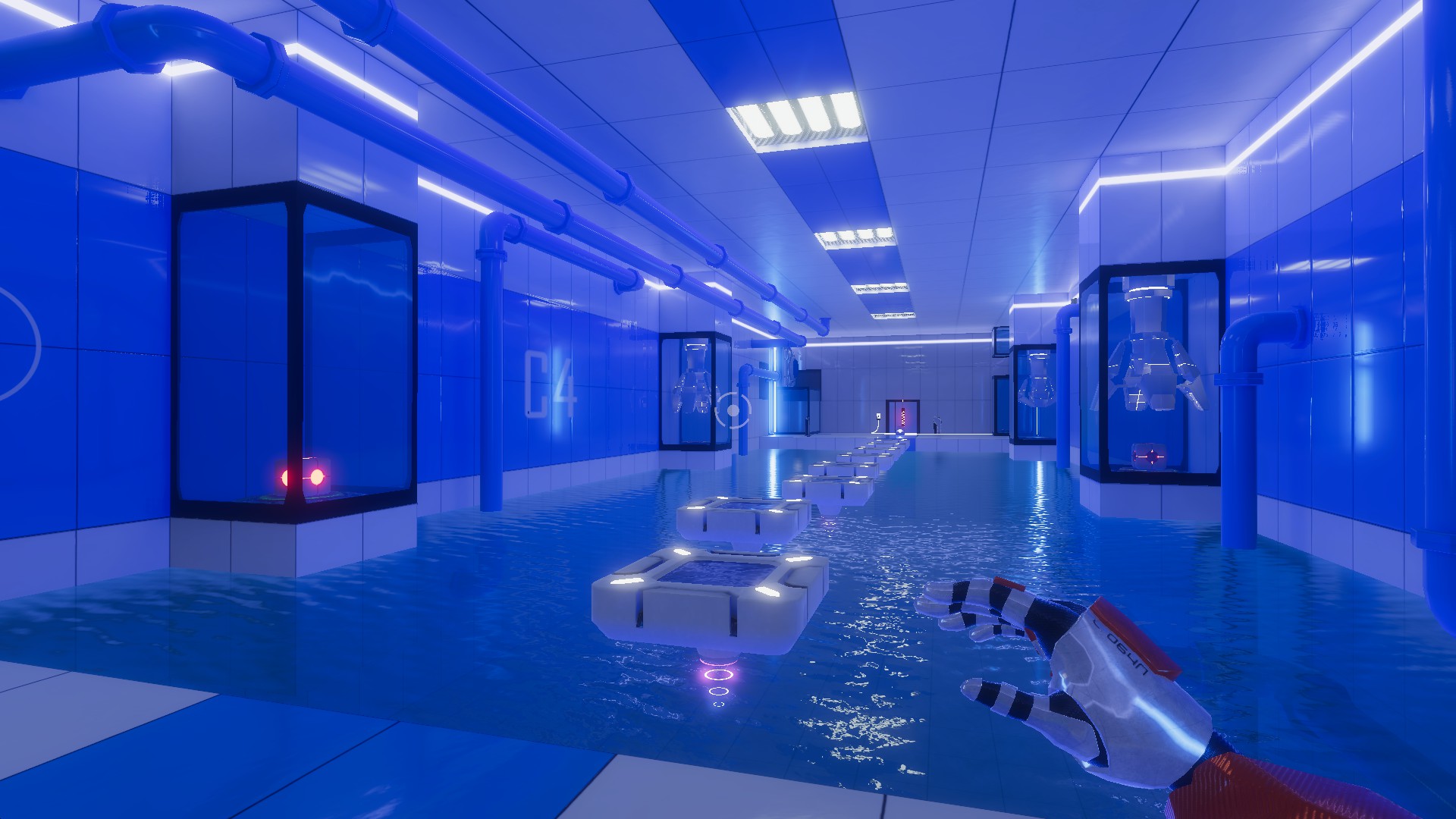
Now, that alone doesn’t sound bad because you’re thinking the introduction of security lasers would include two, maybe three such beams. Instead, the level is filled with them. First you’re faced with a vertical climb, where you have to bounce off a series of inaccurate jump pads to reach a horizontal hallway above. Lasers everywhere. Reaching the hallway, you then have to tractor beam a box with you and then proceed down the hall dodging and jumping more laser tripwires that are now moving. We’re not talking slow movements either. These beams barely give you enough time to get through them. Once you reach the far end, you then free up another box to send back the other way. And you have to go back with it, again dodging all the beams. If you touch any beam at any point, not only do things like the anchor chandeliers you need to swing from shut down, but any boxes you’ve moved disintegrate. Your only recourse is to return to the beginning and try again.
There are seldom safe points in a level – spots where if you screw up one leg, you can return to that point and try again from there. So, on the one hand, you have cumbersome controls that demand you go slow and take your time lining things up, while on the other hand, you have level design that requires you to move with split-second timing to succeed, and even then you often need a great deal of luck that some physics-based element like bouncing off a jump pad doesn’t send you in some unintended direction. For example, one level I repeated over and over because I had to get a perfect swing off a hastily grabbed chandelier. To my human senses and reaction time, I thought I was grabbing and releasing the chandelier with a high degree of consistency. The results proved otherwise, as sometimes I’d be swung right up to the roof, sometimes I’d drop like a stone, and only rarely would I swing to where I was trying to go.
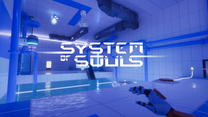
Now we come to the audio/visual part of the program. Though the gameplay can’t hold a candle to its revered inspiration, in both look and sound you would be excused for thinking at times that this was actually Portal. The clinically sterile visuals are like Portal; the echoing, cavernous ambient sounds are like Portal; the electronic, part-energetic, part-ominous music is like Portal. No lie, I had to put screenshots of the two games next to one another just to confirm that a simple asset rip hadn’t been done from one to the other. The boxes, floor switches, pedestal buttons, and even the grid-like wall and floor textures all look eerily familiar. I suspect they’re different enough to avoid any copyright infringement, but it would have been nice to see this game display a visual and auditory identity of its own.
For those that weather the frustrations of playing System of Souls, you are presented with a token choice for two endings. I usually roll my eyes at games that are linear throughout and then throw a single decision in at the end, especially as most of the time those games don’t allow you to save right beforehand. This game doesn’t offer a save, but it does do the next best thing. As you complete individual levels, they are unlocked in a list available from the game’s main menu. This allowed me to replay just the final bit of the game – which is activating a series of four consoles instead of being a full and proper test chamber – to view the alternate ending. Neither finale is all that earth-shattering, but I appreciated that the developers made it easy to see both.
Final Verdict
After seeing the two endings, System of Souls clocked in at about six hours for me. A Steam achievement is up for grabs for anyone who can complete it under three. I wish I could have done so, as instead of feeling a sense of accomplishment at reaching the game’s credits, I felt only relief that it was over. There’s just so little to recommend the experience overall. While there are some legitimately interesting challenges along the way, the frustration factor far outweighs the fun. The problems with its all-or-nothing approach to level design, which requires both swiftness and accuracy from controls that provide anything but, would be enough to stay away. Throw in a dull, predictable story and borderline audio/visual plagiarism, and the impression this game gives is far from a good one. There are much better and more original Portal clones out there, so anyone looking to scratch that environmental puzzling itch would be better served checking out one of those.
Hot take
Level design that demands speed and precision does not combine well with controls that are slow and clunky in the dull, too-much-of-a-Portal-clone that is System of Souls.
Pros
- Variety of elements makes for some clever challenges
- Alternate endings are available without replaying the whole game
Cons
- Slow, imprecise, cumbersome control mechanics
- Most levels must be executed perfectly or else restarted
- Far too derivative audio/visual presentation
- Dull, overwritten story
Richard played System of Souls on PC using a review code provided by the game's publisher.

- Advertisement
- Help support AGH by advertising with us






0 Comments
Want to join the discussion? Leave a comment as guest, sign in or register in our forums.
Leave a comment