
Death at Fleming Manor review
- 0 Comments

Post-mortem dissection reveals a nice blend of deductive investigation and medical mystery
While I was a huge fan of the television hospital series E.R., I never had the ambition to pursue a career in medicine. The sight of real blood would have me more in need of medical attention myself than actually giving it. Never mind the thought of performing the job of medical examiner, forensic pathologist, or coroner having to deal with dead bodies. Doing some digital examining in a good old-fashioned crime scene detective adventure, however, is something I’m always up for!
In SUPERTHUMb’s Death at Fleming Manor, players assume the role of Edgar Whitmore, the new coroner for the fictional division of Cedarvale in the county of Buckinghamshire. Henceforth it’ll be your job to investigate a dozen separate cases that each turn up one or more corpses. They could be accidents, they could be homicides; it’s your job to figure it all out and fill in the death certificates. It sounds gruesome but this is a deduction game, not a horror game. With graphics reminiscent of European comic books and an excellent musical score, you will often have to work hard to put two and two together and determine how each person died. The field work as a detective is more fun than the forensic work in the lab, but together they combine to form an interesting twist on the standard deduction game formula.
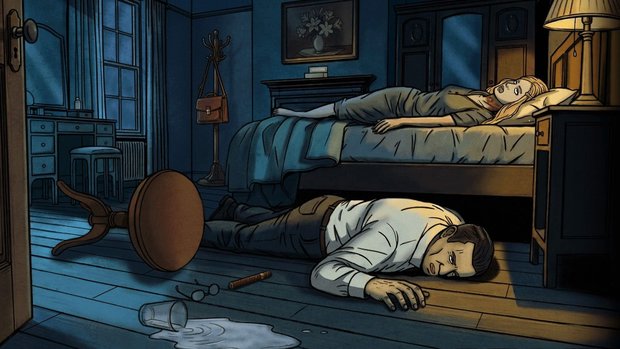
After a short tutorial that explains the basics in the best way for someone to learn – doing the necessary actions first-hand – you settle in at your new office. There each case is displayed as an X-ray, with twelve of them in total. The first X-ray is titled “An Unexpected Accident” and shows someone on a bicycle being hit by a car. Or perhaps vice versa; you don’t know yet, of course! And that is exactly your job: to determine how the victims died for all of your assigned cases.
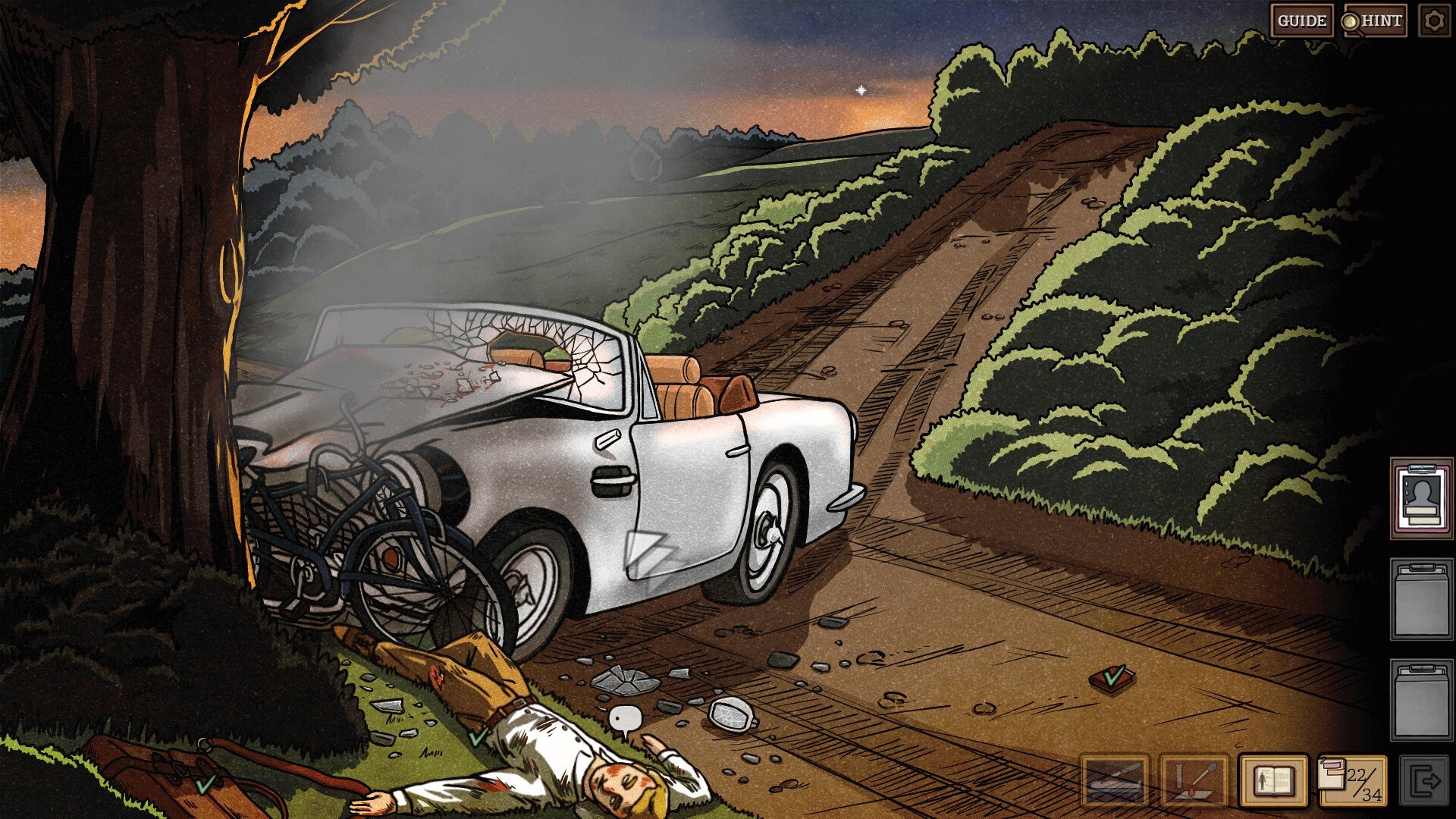
The year is 1959, and you spend roughly three months – from September till November – in the Southeast England countryside investigating a variety of mysteries. They’re all connected in some way to the stately titular manor owned by the renowned doctor Sophia Fleming, who has turned the mansion into a convalescent care home, a type of private hospital where she tends to her patients. Your cases will also take you into the surrounding countryside, a cemetery, a lake, and even a nearby circus, among other locales.
Each setting is beautifully drawn in a vintage ligne claire graphical style with strong lines and colours, combining slightly cartoonish characters and realistic backgrounds befitting the era both in architecture and fashion. The scenes are only minimally animated, some of them slightly disturbingly. You can see smoke rising from a crashed vehicle, for instance, a wounded person squirming on the ground, or a (suspected) suicide victim swinging back and forth on their rope, so be warned if you are sensitive to such imagery.
Points of interest are indicated by shimmering spots, but their clickable areas are often very small. For instance, if there’s a sparkle on a corner of a book on the ground, its detailed information doesn’t pop up by simply clicking anywhere on the book itself; you have to click very close to the sparkling point itself. When you see a small text balloon above someone, clicking the actual person doesn’t work. Instead you have to click the text bubble for a close-up of the speaker’s face and a bigger balloon showing what they are saying. Other objects of interest might have a larger clickable area; it’s all rather inconsistent.
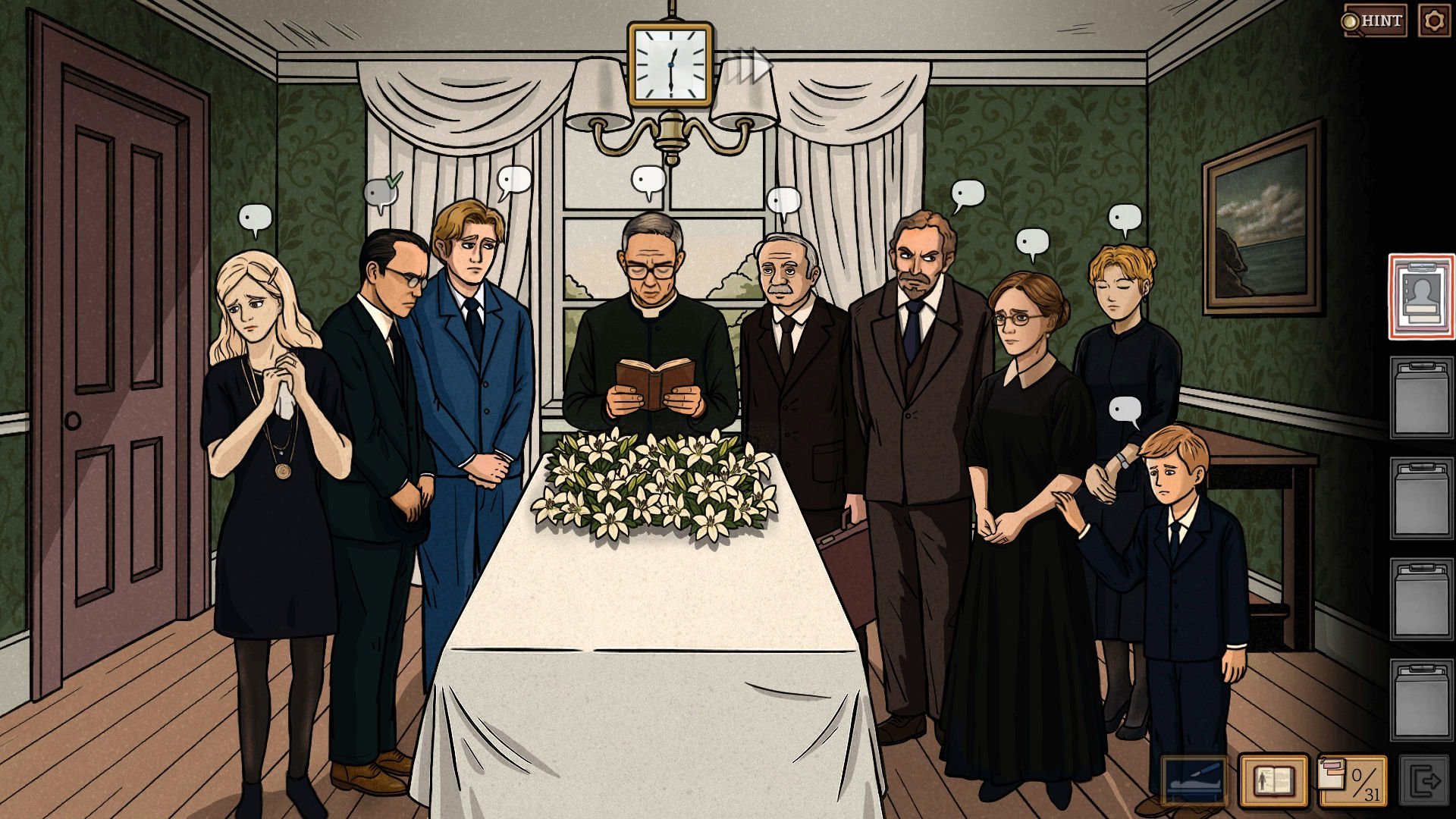
Characters aren’t voiced, with all dialogue text appearing typewriter-style. Thankfully you can adjust the text speed in the settings, as well as completely turn down the annoying sound effect accompanying the letters. A click of a mouse button fills the text bubble up instantaneously, after which you have to click again to advance. If you want to read the text again later when scouring the scenes for missed clues, the entire text is immediately visible.
The lack of voices becomes less apparent thanks to the game’s regal score. Each case has its own theme; mostly piano-based though string instruments are heard as well. There are more classical pieces but also some jazzy numbers; darker themes and lighter ones. The variety makes for a nice mix and each track adds to the general atmosphere of a murder mystery. Some cases contain multiple scenes, allowing you to switch rooms by clicking on the arrows indicating exits, or when travelling farther by clicking thumbnail icons at the bottom of the screen. When moving on foot, a nice touch is the sound of footsteps when you go from one location to another (though your character is never seen).
Death at Fleming Manor has many similarities to the Golden Idol games. Most of the time you witness the scenes only as an observer and have to find clues and underlined keywords in documents to fill in the blanks later on, Mad Libs-style. This requires lots of deduction to sort out names, dates and even the time of day. Often that’s where such games end, but here, once you’ve uncovered every piece of evidence in the field (indicated by a number tally displayed on-screen), you will be transported to the morgue for further investigation.
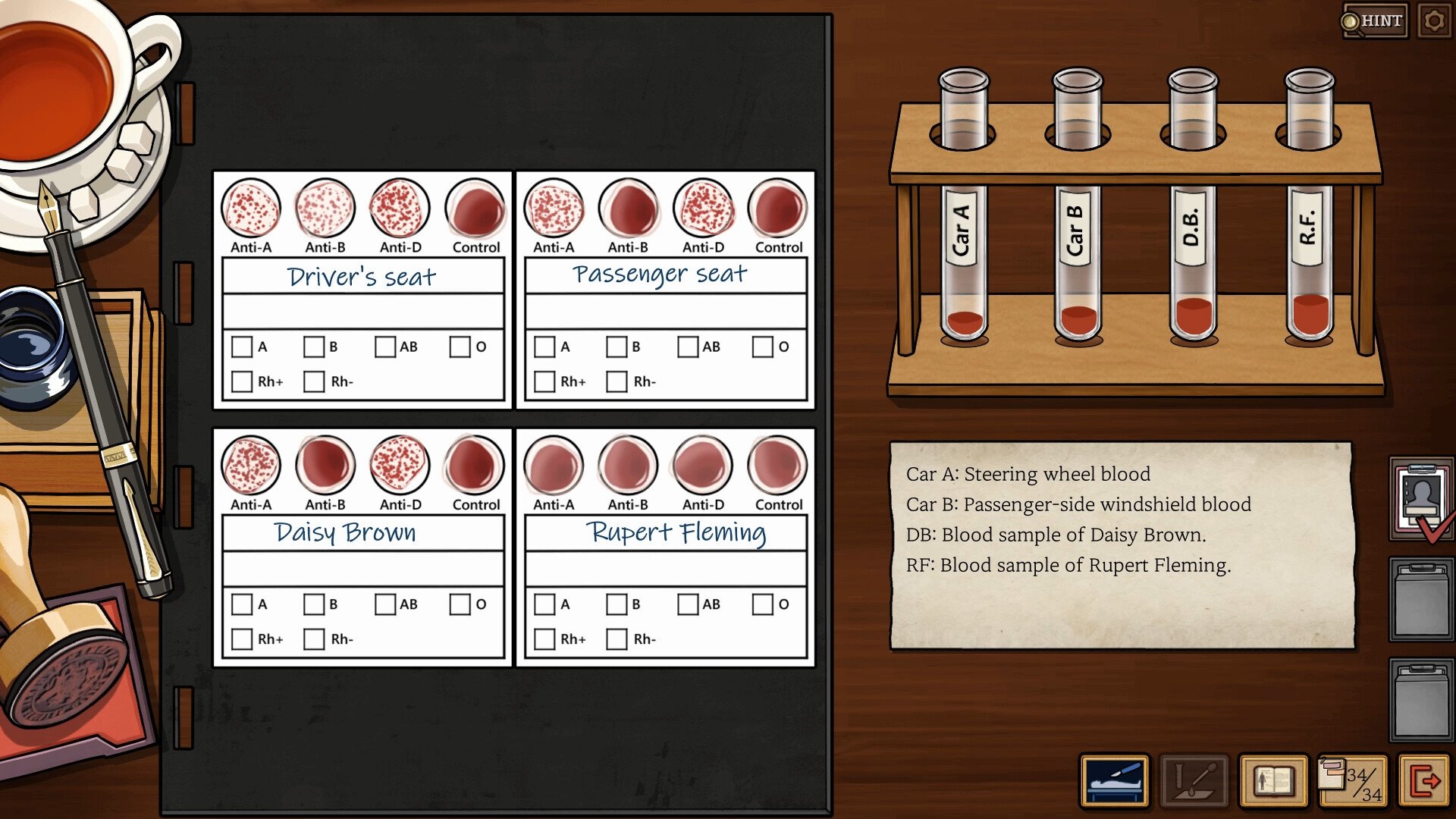
When bodies are returned to the lab, you can check the victims’ injuries and ask the medical examiner Avery about the evidence you’ve found. This often leads to some further laboratory analysis. These tasks take on quite different forms as the storyline progresses, such as comparing blood types and fingerprints. In one case you’ll have to look at an X-ray and indicate which teeth had which injuries after a fight. But there can also be more administrative tasks. You’ll find yourself going over a last will and testament, noting down which heir was given which inheritance. Other times you must compare handwriting to check if a suicide note was really written by the victim, and analyse children’s drawings and tick off the personality traits they reveal.
In order to find and understand the correct medical terms, you really have to browse your textbook. (When you're not a native English speaker, that can be a bit tricky.) Fortunately, there are also diagrams and pictures that help you identify such things as wound types, whether from bullets or snake bites. Even then, if you have zero anatomical background, it's still easy to make mistakes.
Death at Fleming Manor

| Genre: | Mystery |
|---|---|
| Presentation: | 2D or 2.5D, Slideshow |
| Theme: | Crime solving |
| Perspective: | First-Person |
| Graphic Style: | Illustrated realism |
| Gameplay: | Investigative, Deduction |
| Control: | Point-and-click |
| Game Length: | Medium (5-10 hours) |
| Difficulty: | Low |
It’s vital to page through the textbook to search for pertinent keywords, but because it’s available at the start of each case, that means you can browse through it even before investigating scenes in the field. Doing so will effectively spoil your discoveries there, since each case has its own particular “chapters” hinting at what you will encounter. It’s possible to avoid but tempting to take a look ahead of time. It would have been better if the textbook only became available after your initial exploration of the scenes.
Once you’ve thoroughly examined the scenes and all evidence, you can start filling out the necessary documents. This starts simple, with a list of characters to name correctly. Then you will move on to the actual death certificates. Many fields will already have been filled in, while others are up to you. Some fields felt a bit random to me, however. In one case, times, dates and locations will already have been filled in, while for other cases you need to deduce that information yourself. A very peculiar element is that you often need to fill in the current date, which you can only discover by solving a mathematical puzzle, counting back or forward the days according to evidence you have found. (You would expect a government official to at least know what day it is.)
Once you have filled in every blank, you can press a stamp to finalise your document, put it in an envelope and send it off for verifying. Another, larger stamp appears on the outside of the envelope, displaying whether your submission has been approved or rejected and indicating how many mistakes you made. If it’s rejected, one of three sugar cubes is dropped in a tea cup on your desk, and you can try again. Once all three sugar cubes have been used up, you then have the option to reveal which part of the certificate contains the remaining error(s). Or you can just keep trying for yourself, without asking for that special hint pointing you in the right direction.
During my playthrough, I was only able to complete three cases correctly on the first try. In the others, usually I made only one small mistake that was easily corrected. Only in rare instances did I resort to a bit of trial and error, and afterwards it was always obvious how I could have made the right deduction myself. The difficulty level of Death at Fleming Manor was right up my alley, with enough challenge to make sure I didn’t breeze through but not so much as to be frustrating. I finished the game in 10 hours, with each case taking around 45 minutes to a full hour to solve.
To my surprise, you don’t only play as coroner Edgar Whitmore. Some cases are flashbacks, where you take on the role of a different character. For instance, at one point you play as Logan Ashford, manager at Fleming Manor, working triage in a medical camp during the Second World War. Here you need to identify the soldiers and evaluate their injuries to decide which ones need immediate assistance, who can wait a bit before getting treatment, and which unfortunate souls are lost causes.
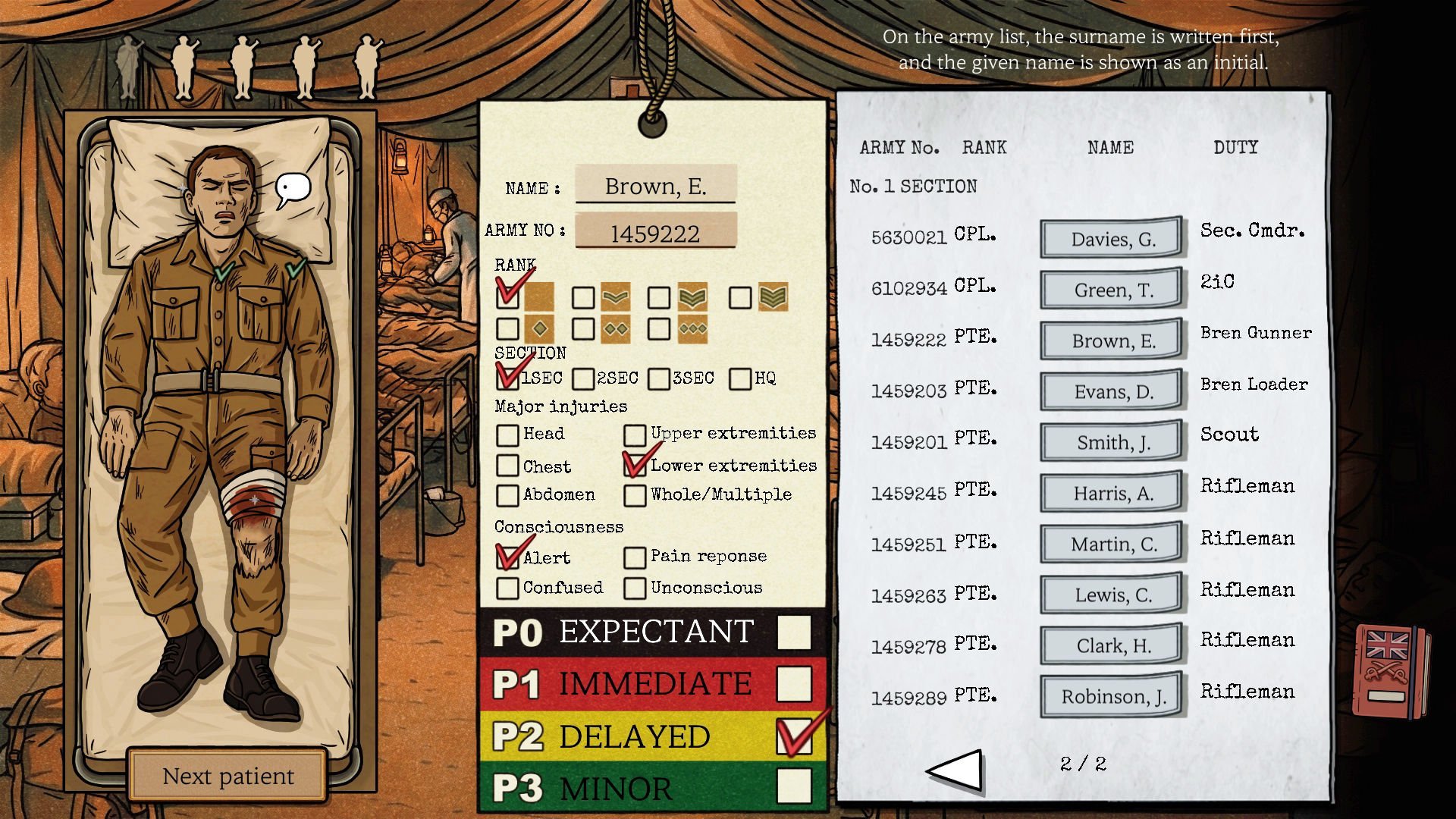
Since you’re actually pretending to be a character in this fictional world rather than simply playing an anonymous observer, several times you will also have to make decisions about how to handle witnesses and suspects, or how to respond in conversations. Sometimes the choice is only an illusion, and the end result will remain the same no matter the reaction of the other characters. But certain decisions matter more, as the game has four different finales to the complete storyline, depending on two very important choices near the end.
I mentioned there are twelve cases in total, but that’s not entirely accurate. The last three are a bit different. “Case” 10 is a very short one, serving as a sort of recap of all previous assignments to make sure you have been paying attention all along. “Case” 11 is the big reveal of the main storyline and gives you a say in how you want to proceed, with all but one leading to a game-over. “Case” 12 is the wrap-up, presenting you with the two situations where your choices lead to one of the available endings.
While I had loads of fun playing Death at Fleming Manor, there were some aspects that could have been improved upon. For instance, during one case you will see an object concealed somewhere, but with no means to pick it up and examine it further. Later on, however, when the main character reflects on what they saw, they will mention that indeed, it was an object playing a very important role. So in this case, the main character was making deductions on their own, without any player input.
There is lots of other handholding as well. While examining the bodies in the morgue, you are meant to be assisted by the medical examiner Avery. In fact, it’s the other way around: Avery will always tell you his findings after having examined the body, and you have to look up in the medical textbook which physiological process might have led to the body’s condition. It would have been more interesting – and perhaps raised the difficulty for those looking for a bigger challenge – if you could actually do the autopsies yourself.
Finally, there are some lab reports you can request, requiring you to leave your desk and then return again to get the results, which you then have to compare once again with the information in your textbook. This too feels like a missed opportunity for more interactivity in having the player actually do the lab analyses themselves.
Final Verdict
Even with a few missing “nice to haves,” Death at Fleming Manor truly charmed me. It's not perfect, but great fun nonetheless. It's more accessible than the Golden Idol games, so I never felt like an idiot while playing, though some deductions require sharp thinking and concentration. While there’s lots of reading to be done, that doesn’t really matter if you are interested enough in the medical sciences that form the basis of a coroner’s job. I also loved the game’s narrative aspects. At first the individual cases seem to be just that, but after a while you’ll begin to notice what links them together. The realization that there’s a bigger story captured my imagination and sharpened my focus, making me all the more determined to figure out what was going on. When the end credits started rolling, the only thing I could think of was that I wanted more deaths!
Hot Take
A little more lab autonomy would have been nice, but with the addition of death certificates, Death at Fleming Manor brilliantly adds medical mysteries to the tried-and-true deduction genre.
Pros
- Determining cause of death lends itself well to the deduction game formula
- Vintage ligne claire graphical style
- Level of medical realism makes the post-mortem investigations feel genuine
- Great variety in investigative methods and techniques
- Intriguing mysteries where things aren’t always what they seem
Cons
- Lots of medical texts and post-investigation explanations might deter some players
- Autopsies and lab analyses could have provided more interactivity and challenge
Johnny played Death at Fleming Manor on PC using a review code provided by the game's publisher.

- Advertisement
- Help support AGH by advertising with us








0 Comments
Want to join the discussion? Leave a comment as guest, sign in or register in our forums.
Leave a comment