
Mixtape review
- 2 Comments

Light on gameplay but big on heart, this collection of teen experiences always manages to stay on track
Man, being a teenager was a wild time. We had all these ideas about what was important in life: how to navigate popularity in school, how to keep up with grades to get into college, how to make something of ourselves in the world, et cetera. Above all else, it felt like our friends would always be with us no matter what. But when people went off in their own directions to chart their own paths, a lot of the friendships we held dear slowly drifted apart. Not always, of course, as some of the people we grew up with may forever be an important part of our lives. But it’s different than when we were kids, thinking that the only thing that mattered is whatever tomorrow brings and experiencing that with the friends we cherish most.
With Mixtape, developer Beethoven & Dinosaur aims to capture some of that magic of being on the cusp of adulthood while reveling in the hyper-specific time in our lives when the late nights under the stars and walks through the forest were our everything. While it focuses more on being emotion-tugging art in motion rather than a “game” in the traditional sense, it’s a captivating experience of three friends living it up on what feels like their last night together on earth.
Set in the mid-90s, Mixtape follows Stacey Rockford and her two best friends, Slater and Cassandra, one day before Stacey is set to leave her small town behind. Tomorrow she’ll be flying to New York to pitch her mixtape to a famous music supervisor in the hopes of becoming her protege. Stacey always has her CD player and headphones on hand, choosing the soundtrack of her life that embodies the emotions and experiences she goes through. For years she’s been getting into trouble with Slater, long-haired and beanie-wearing with a mellow stoner attitude, who has been her best friend for as long as she can remember. Cass, daughter of a local cop and forced into a multitude of afterschool clubs and honor roll programs due to her strict parents, joined them at the start of high school and has since become an inseparable part of their trio of delinquency. With Stacey on the verge of leaving forever, the friends vow to make this the greatest last night of high school ever by attending a massive beach house party with local legendary party-thrower Camille Cole.
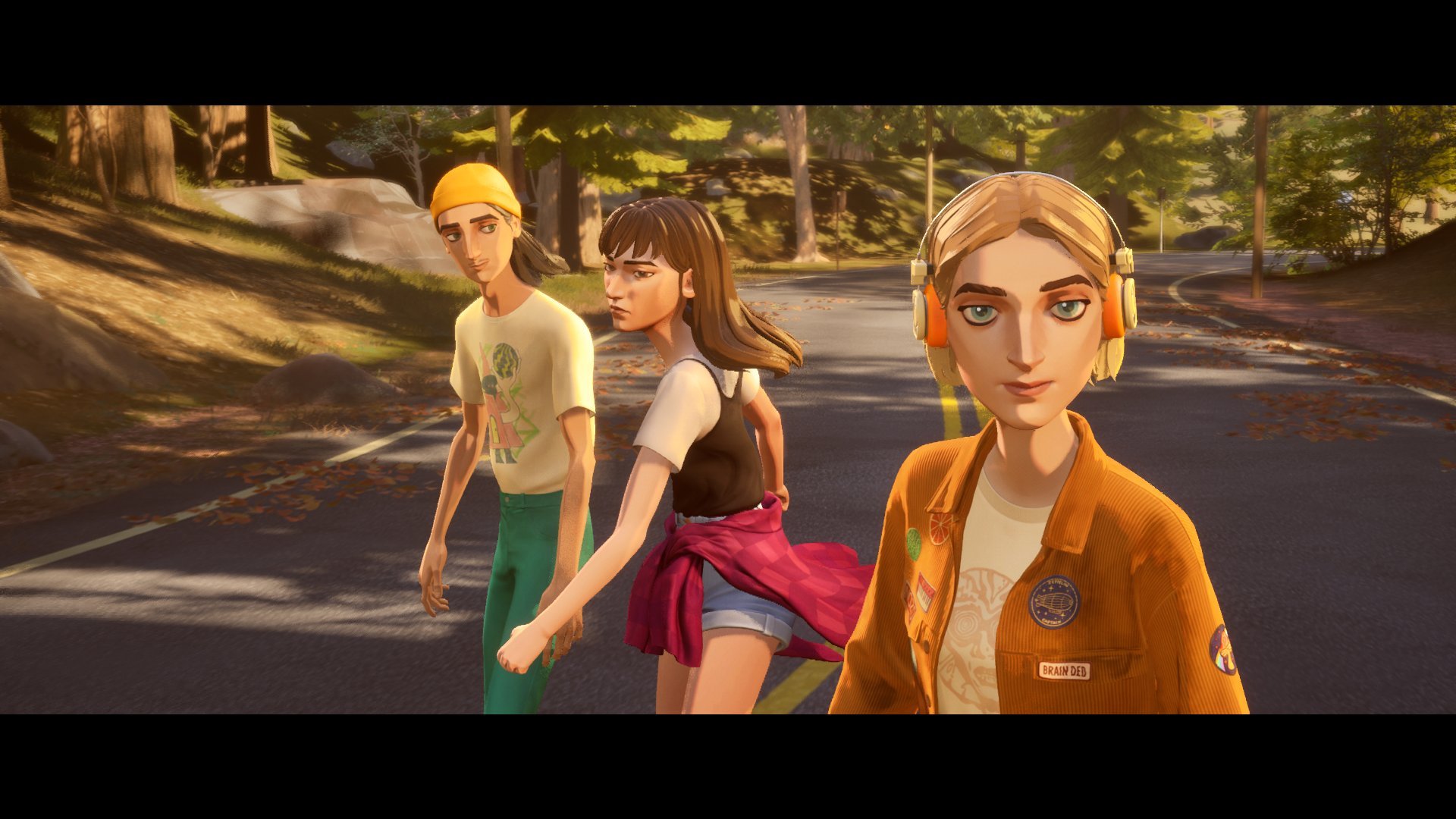
Each character is brought to life with believable voice performances across the board. There’s none of the “adults pretending to be teens” feeling that can come across in many live action teenage stories – everyone here sounds suitably like high schoolers. Slater is a standout with his often hilarious chilled-out musings on the important things in life, such as what is “metal” and what isn’t. Stacey has a surfer-dude-meets-metalhead delivery in her lines, while Cass has a bold, outspoken attitude befitting her wanting to break out from the strict rules her parents (especially her dad) set down for her.
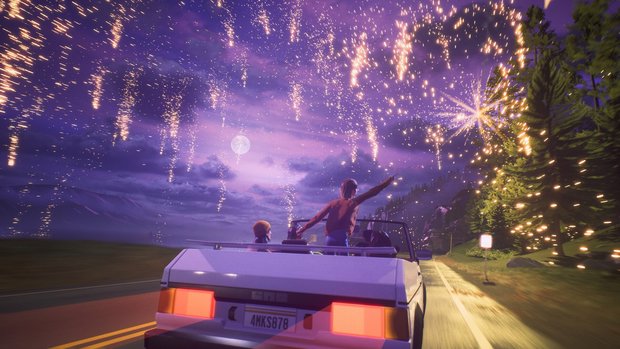
Stacey has curated the perfect set list for every part of this last day in her small California hometown (which she calls “The Big Suck”), and she regularly breaks the fourth wall to talk directly to the player with a brief description of the latest song chosen before the track title and music artist names pop up on-screen. The narrated introduction for each section gives the game the feel of a stage production, as if we are watching a carefully constructed view of events that Stacey is sharing with the player as much as she is living it with her friends. This is further reinforced by the surreal, dreamlike experiences that account for the majority of the game’s playable sequences.
Mixtape can be navigated with either keyboard and mouse or via gamepad (the latter is recommended, as many of the minigames are built around being played with a standard dual-stick control scheme). From the moment the game begins, the presentation is stunning. Characters are presented in 3D but with an almost painterly aesthetic, and animations all play out at an intentionally lower frame rate like the style used in Dispatch or the Spider-Verse films. Music video-styled effects accompany various sections of the game that match the tracks forming the backbone of the experience. Bits of grainy real-world film will pop up in the backgrounds, or psychedelic colors and effects will spin around while mellow guitar strums play out in tandem with the teens flying through the air.
Over the course of Mixtape’s 3-4 hours of playtime, the game progresses in a linear fashion by alternating between small open exploration sections and minigames accompanied by the licensed track Stacey associates with that experience. The first minigame plays out like a simplified Tony Hawk’s Pro Skater, with Stacey and her friends rocketing down a road on skateboards to “That’s Good” by Devo, during which you can perform tricks while maneuvering out of the way of cars driving by. (If you accidentally run into a car or into the side of the road, the screen will rewind a few seconds back with accompanying VHS static lines.) While skateboarding down the hill, every time a “clap clap” plays in Devo’s song in Stacey’s headphones, all three of the teens clap in unison as well, in keeping with the stage play, dreamlike vibe as if all three kids had rehearsed this.
I won’t spoil all of the various scenarios you will play through, but they range from incredibly heartfelt to side-splittingly hilarious. I was dying laughing at the way you experience the immense awkwardness of a first kiss, and I was rolling out of my seat at another section that has you control Slater as he drunkenly stumbles through a video rental store to pick out a triple feature of films while repeatedly assuring himself that he is successfully managing to appear sober to the mortified cashier.
Mixtape

| Genre: | Drama |
|---|---|
| Presentation: | Realtime 3D |
| Theme: | Coming of age, Musical, Relationships |
| Perspective: | Third-Person |
| Graphic Style: | Photorealism |
| Gameplay: | Action-Adventure |
| Control: | Direct Control |
| Game Length: | Short (1-5 hours) |
| Action: | Platforming |
| Difficulty: | Low |
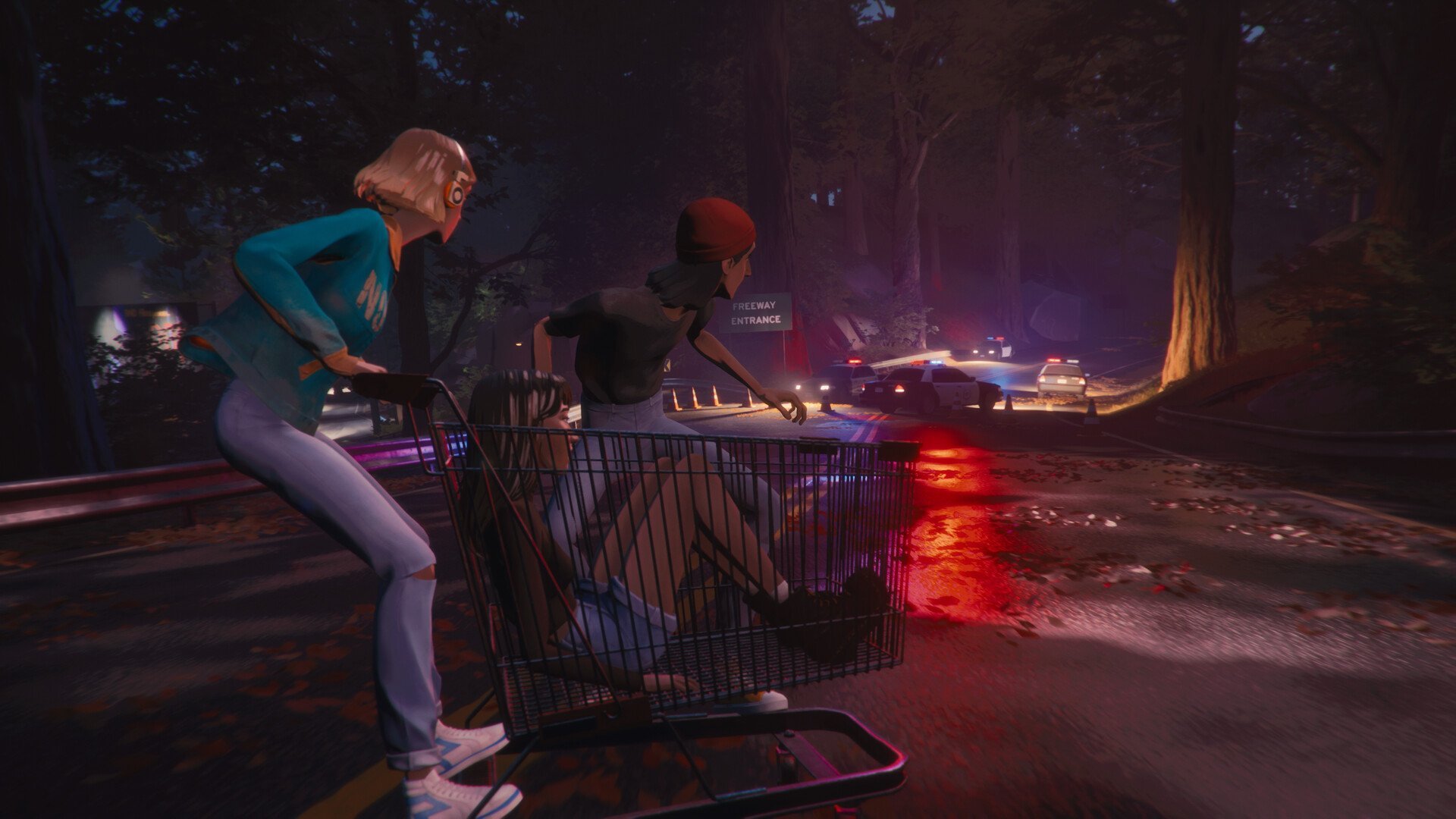
A later section sees the teens running through a large field while “Airwalker” by Bertrand Dolby provides a magical rush of 1960s guitar that literally elevates the teens to the point of them running on air and catching gusts of wind while leaping massive distances. Even a more grounded section like a wild house party being crashed involves the teens having to escape by driving a shop cart away in a high-speed chase with police sirens blaring and cop cars cutting them off at every corner. They’re mostly over-the-top expressions of what these memories felt like to Stacey rather than just showing them as they actually were, and this emotional connection is elevated through her deep association of these events with the different music tracks she assigns to them.
When controlling the kids through the music sequences, the interactions are typically simple, with a pop-up that explains what buttons are needed for that particular minigame. Some are more involved, like one where you have to blow up cars using the awesome power of your middle finger, but others are just tapping shoulder buttons at your leisure to make the teens headbang while rocking out and driving on a highway. It’s not always even a requirement to actively participate in all of the musical minigames, like with one where you’re just floating through a grayscale world where Stacey continues onwards without obstruction regardless of where you move her on-screen.
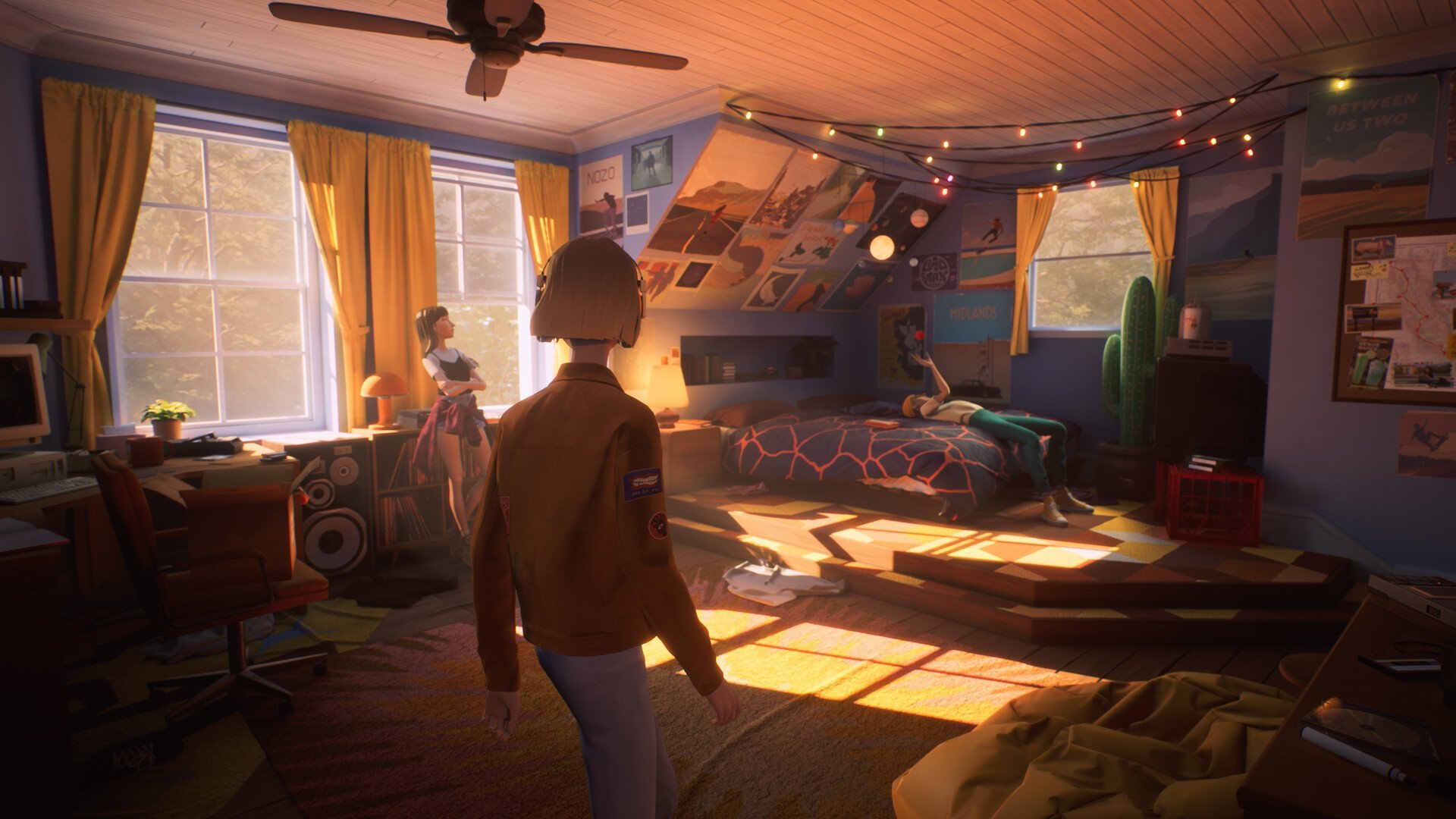
When you’re not playing through interactive music videos, Mixtape’s other playable sections are small, fully explorable spaces (typically one of the teens’ rooms). Here you control Stacey and examine objects that bring up additional lines of dialogue or send you back to various points in her life that relate to whatever you were examining in the present. Navigating the rooms largely amounts to moving around until something becomes highlighted, then simply pressing a button to interact with whatever you’re currently looking at. A collection of Polaroid photographs sends you back to a wild party where Cassandra drank a bit too much, while a detention slip flashes back to the teens covering their principal’s house with toilet paper before one of the friends covers for the others and takes the fall for the act. Every item you examine is impressively detailed with little touches that bring a sense of authenticity, from the scribbled-in map notes left by the trio on their road trip through California, to the Mini-Master handheld console with photo-taking capabilities looking exactly like they were taken by a Game Boy Camera.
Utilizing the minigames, exploration sections, and non-interactive cutscenes together weaves a sensory feast that’s equal parts narrative and musical odyssey. However, even with the variety of lightly interactive activities involved, they are still minigames rather than fully fleshed-out gameplay experiences. It’s impossible to lose or reach a game-over, and even ones with actual hazards like where Stacey is running in an almost 2D platformer style through the neighborhood just slows you down slightly rather than forcing you to replay it. When fully controlling Stacey to look around small environments, you’re not solving puzzles – you’re just checking off highlighted items that appear until there are no more in the room to examine. This isn’t a bad thing, as the game is heavily focused on its story and characters rather than major player interaction, but the lack of agency may turn off those wanting a more active or challenging gaming experience.
Throughout this review, I’ve used “we” a lot when describing the kinship I felt to the antics of Stacey, Slater and Cass. Which brings me to my other main critique of Mixtape: if you didn’t go through anything like the teens are living through, their story likely won’t connect with you and may feel like there isn’t much in the way of stakes involved. This is a tale of growing up and leaving a small town behind, trying to hold on to memories that matter by associating them with songs that elevate these events to a near-mythical status. The teens say dumb stuff, do even dumber stuff, and at the end of the day the conflicts they come up against are largely irrelevant with respect to what’s ahead of them now that they’re out of high school.
But that’s what makes these experiences feel so authentic. For example, Stacey has a burning hatred for a popular girl named Jenny, who also happens to be one of Cassandra’s friends, and it largely stems from Jenny not connecting with music in the same way Stacey does. It’s petty and would be a weak basis for turning someone into a villain, but in high school that was all it took sometimes. The things that seemed important back then might seem silly now, but when those feelings are immortalized in music, they can be a nostalgic snapshot into who we once were.
Final Verdict
Your mileage in this game will vary depending on how much you relate to the shenanigans the teens go through on their journey to live out the greatest night of their lives. As someone writing this in his early 30s, I remember fondly a lot of the stupid nonsense I got up to with friends in high school. We didn’t drink, but we caused all kinds of other mischief, like moving a couch out of the school library just to take a group photo outside with it, or sneaking into a run-down house while joking we’re ghost hunters. Looking back on it now, it could seem like an unnecessary risk to potentially get in trouble with a librarian or receive a stern talking to from a cop for trespassing, but at the time, going through with it with friends felt like it was more important than anything else. Mixtape captures that feeling wonderfully through visuals and song, and while I’m glad I’m no longer a dumb teenager, there’s a special kind of magic in remembering what used to matter most.
Hot take
Mixtape is less a game and more an interactive art piece – and that’s okay! You’re a passenger along for a nostalgic teenage reminiscence in motion, and with its captivating presentation of raw emotional moments it’s a musical odyssey well worth taking.
Pros
- Magical presentation with great production values
- Heartfelt story captures the terrifying uncertainty that comes with growing up
- Licensed music that feels inseparable from the narrative
Cons
- Majority of gameplay amounts to lightly interactive minigames between cutscenes
- Story impact may depend largely on how much it reflects your own lived experience
Sam played Mixtape on PC via Game Pass.

- Advertisement
- Help support AGH by advertising with us






2 Comments
Want to join the discussion? Leave a comment as guest, sign in or register in our forums.
Great review Sam
Reply
"Light on gameplay" It's sad to see this become an increasing trend in adventure games. On the plus side, it's great to see the Hotspot branching out into reviewing movies.
Reply
Leave a comment