
A Storied Life: Tabitha review
- 0 Comments

Beautiful casual entertainment, even if its narrative choices don't pack much emotional punch
Cosy and wholesome house-themed puzzle games always get a ‘yes’ from me when looking for something to play, and I was intrigued by A Storied Life: Tabitha when I saw it being previewed at gamescom 2025. UK development team Lab42 have really tried to shake up the house-packing subgenre and the game does showcase something unique, so it’s a shame that it doesn’t quite hit the mark overall. With confusing plot devices, plus world-building and important context hinging on whether you read the character bios, it can be messy and not as strong narratively as it could. Fortunately, the game has replayability absolutely nailed down, approaches its sensitive themes thoughtfully, and is a lot of fun when choosing which items to toss or keep, all presented in a beautiful watercolour art style.
The story opens with a letter from the titular Tabitha, or Ms Kettlewell as she is referred to in-game, delivered after her funeral. In it, Ms Kettlewell has given the task of clearing her home to you, the unnamed letter recipient. She lets you know it’s a mess and suggests you may wish to keep a few things to remember her by, and to ‘chuck the rest.’ She even proposes the sale of some of her things to facilitate a holiday fund as a thank you before finishing with a parting idiom – ‘don’t rush your life away.’
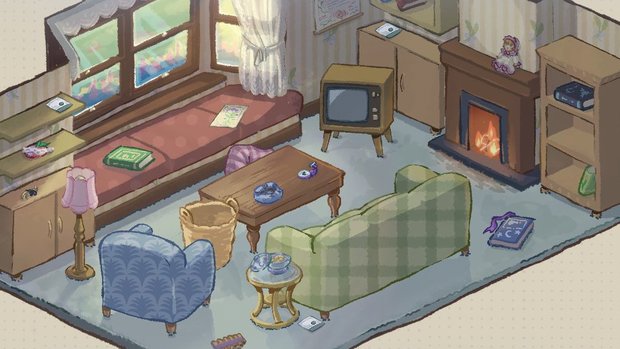
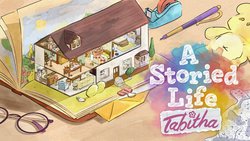
Rooms are displayed from an isometric perspective, and the artwork here is very picturesque. It features a beautiful hand-drawn watercolour style, which feels bright, clear and hopeful, rather than evoking a melancholic sepia-toned nostalgia. The painterly look makes everything seem so cosy, even when dealing with an atmosphere steeped in grief. The way light is used is particularly impressive in this storybook style, with many of the early rooms bathed in natural sunlight streaming through the ornate bay windows and doors.
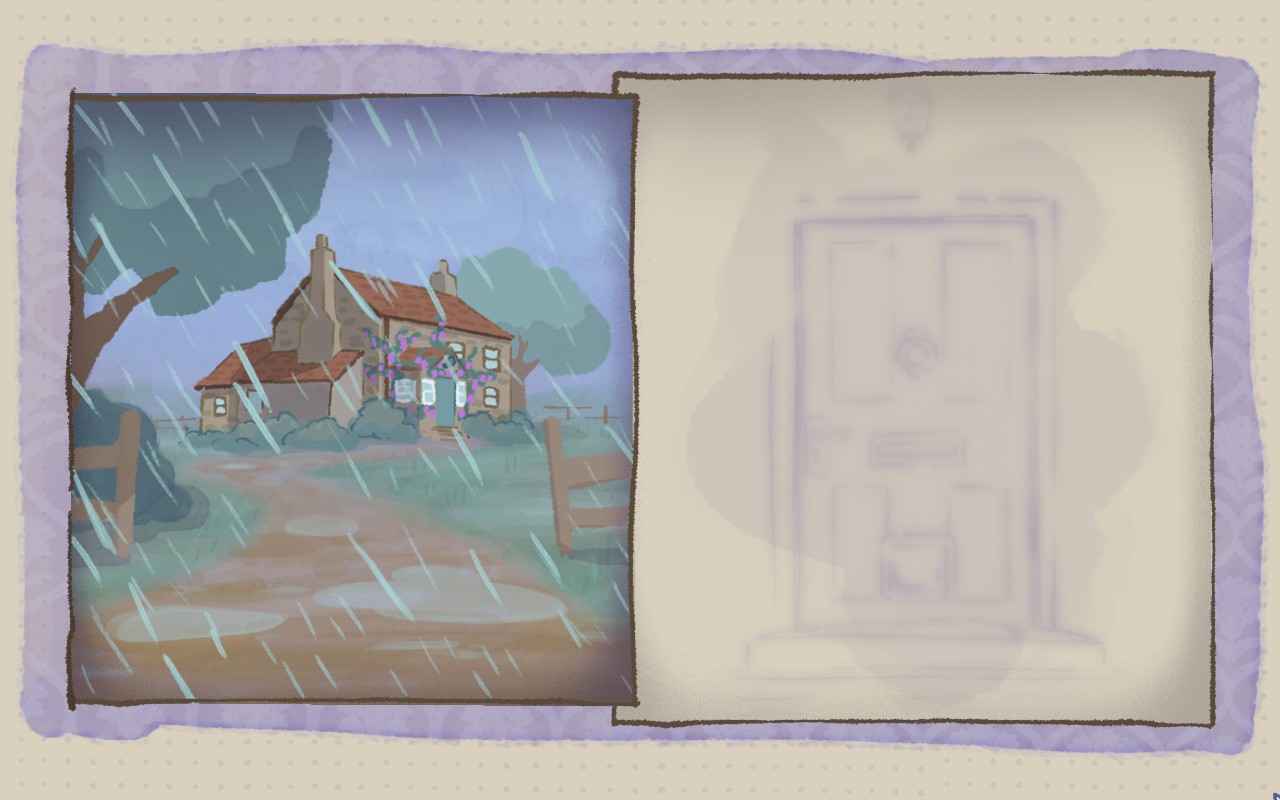
The music in Tabitha is equally lovely. Each room has a different score that comes from a box of vinyl records you pick up in the first level of the house. The tracks are all either English traditional songs like ‘Scarborough Fair’ or well-known classical pieces like Rossini’s William Tell Overture, along with a 1920s jazzy instrumental of ‘All by Myself’ by Irving Berlin. This music really helps complement the game’s light and charming vibe. It makes Ms Kettlewell seem like the sort of slightly eccentric older aunt who would have a big box full of this sort of music on vinyl, so it feels comforting and authentic.
Once gameplay begins, in each room you must pack, auction or recycle every item before the level ends. The tutorial pop-up info offers brief insight into how packing different items may change a narrative outcome, but reassuringly states that there are no wrong choices. On the screen are three icons located at the bottom right: a recycle box, what looks to be a phone or tablet, and a cardboard box, representing the recycle, auction and keep boxes, respectively. Selecting an item from the room holds it firmly in hand, so there’s no need to click and drag, and it can be dropped back in situ if you’re not sure what to do with something yet. Some unpackable objects will need to be moved in order to access other things, and I found this part very fun, clicking on everything in the hopes of finding another one of Ms Kettlewell’s ‘treasures.’
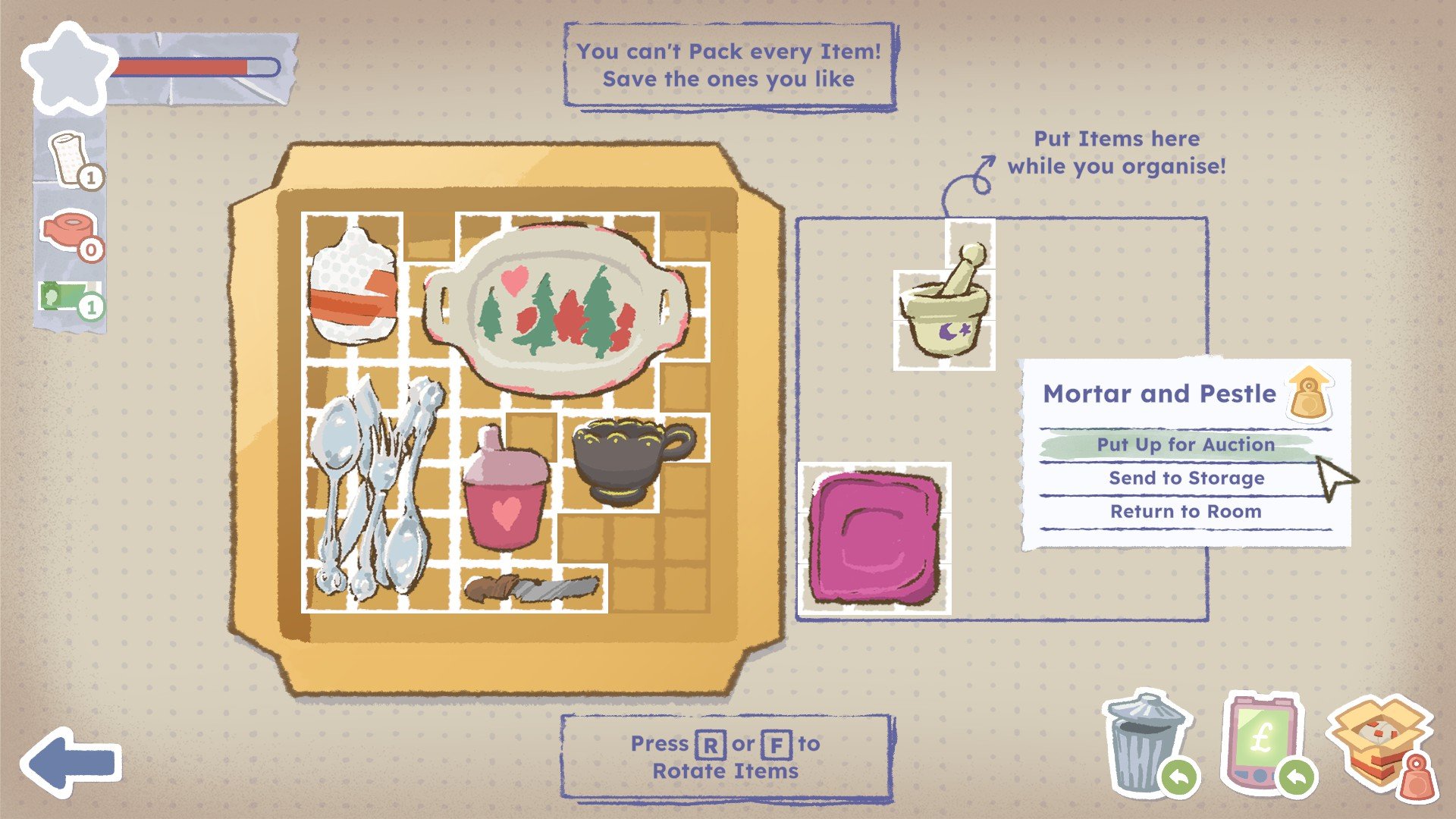
Depositing an item in the cardboard box opens another screen, which has a large square staging area on the right where all the items you have collected are stored, with the opened packing box on the left. The box has an 8x8 grid square inside, so you best believe a large and slightly frustrating part of Tabitha is about inventory management and making things fit according to the space you have. It quickly becomes obvious that this one small box will not fit much, so you need to be creative with item shapes, shrewd with your keepsake choices, and ruthless with your chucking away.
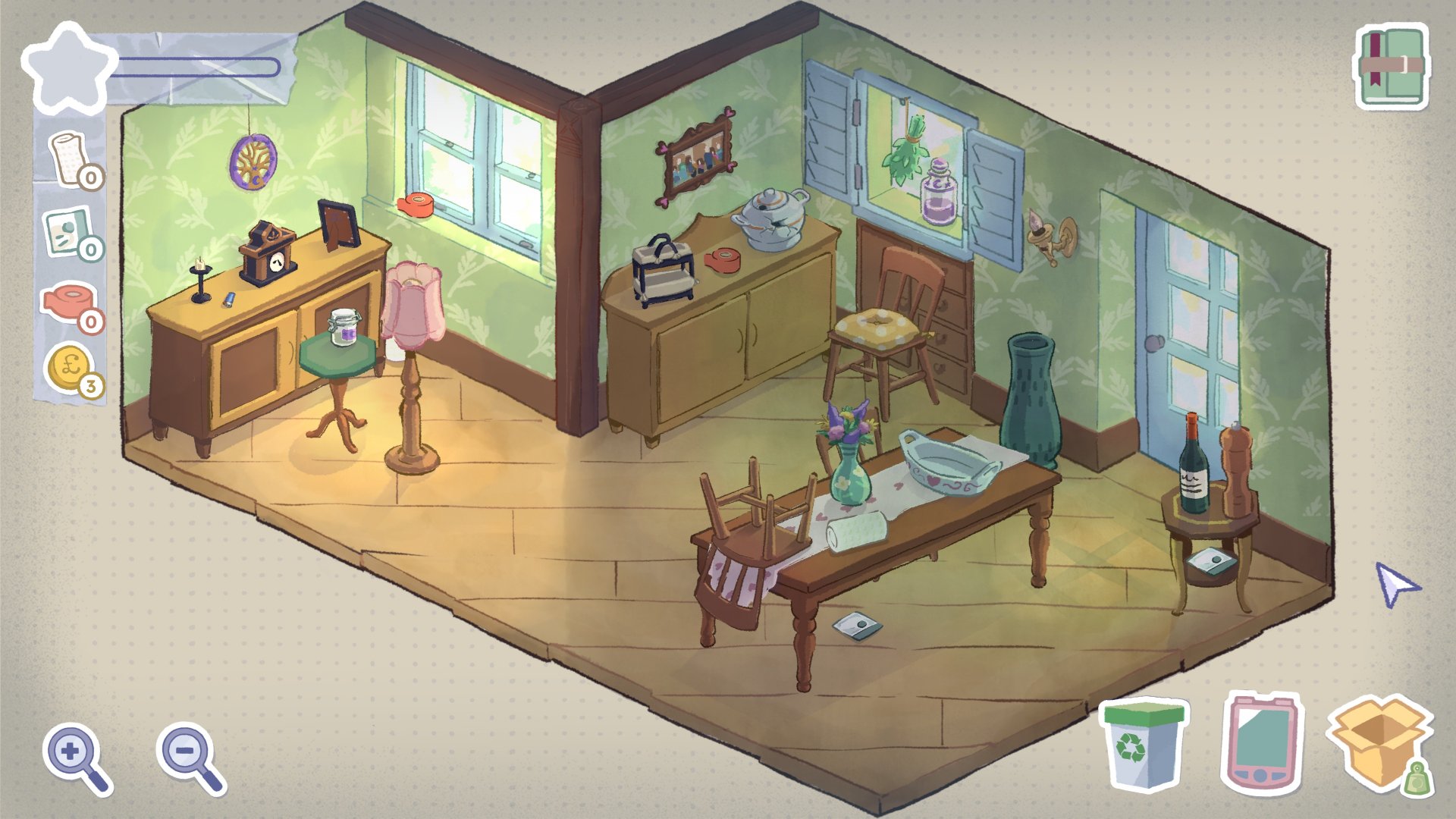
Hovering over an item in the room screen gives a very short description of it, and will sometimes inform you that the item will absolutely not fit in the box, such as a walking stick or umbrella. These do not give you the option to pack them, however much you may want to, so into the recycling box they must go, unless you think they’re worth selling. The items put in recycling can be accessed again at any point before the level ends if you change your mind, but they’re arranged quite haphazardly on top of each other, so if you are looking for something specific, it takes a bit of digging! You can also choose between one to three items per level to be sold at an online auction site, which will hopefully increase in value as the game goes on as more bids are made throughout the auction’s 50(!) days. Don’t make any immediate plans for this cash, though, as it is a cumulative effort that determines what sort of holiday you might be able to take after you’ve cleared the entire house.
Progressing through the chapters introduces a couple of smart new mechanics, like the ability (and necessity) to bubble wrap more fragile items, and the need to reinforce your one singular box with tape should you decide to keep the heavier stuff, which the game will prompt you to, if required. There’s also the ability to fold documents and photographs into envelopes to reduce packing size, and to vacuum pack some soft furnishings to really maximise your space.
The hardest part, of course, is deciding what should be kept, and what should be thrown away. While your relationship with the deceased (if any) is not made clear, the task initially has a real sense of heaviness to it, despite the bright environment and birds twittering in the background. It feels extremely emotional, pawing through the important belongings of someone whilst understanding that it is impossible to keep it all. Unsent letters seem almost too personal to keep, but too callous and significant to throw away. Even an old receipt for a meal can feel melancholic, as it clearly had some sentimental significance to Ms Kettlewell, and it took a bit of time for me to place it in the recycle box.
An old pair of binoculars hanging forlornly by the window made their way to auction in my playthrough, my rationale being that someone else should get the use of them instead of being put in the bin. It’s fair to say that ‘the feels’ are hit hard and fast in the first few chapters, but as I moved through the rooms (there are 17 of them), I became worryingly more cold-hearted, throwing things away and barely registering what they were or what meaning they may have had for Ms Kettlewell, instead scouting for what item(s) might give me the best return at auction.
However, the items you choose to keep do have significance. In Chapter 1, two items that must be kept are an unfinished water-stained manuscript and a letter from a publisher. Ms Kettlewell was apparently in talks with a publishing house to write her life story, which looked promising to them after being sent a proposal. This is where the uniqueness of Tabitha begins to show, as you get the chance to restore the manuscript as you go along, filling in the empty spaces with words shown on-screen.
A Storied Life: Tabitha
| Genre: | Drama, Mystery |
|---|---|
| Presentation: | 2D or 2.5D, Isometric/Overhead |
| Theme: | Psychological, Memories |
| Perspective: | First-Person |
| Gameplay: | Puzzle, Choices matter, Cozy, Resource management |
| Control: | Point-and-click |
| Game Length: | Short (1-5 hours) |
| Difficulty: | Low |
| Graphic Style: | Cartoon |
At the very end of each level, a few pages of the manuscript are displayed on the right, while on the left the items you chose to keep have four words or short phrases underneath them. For example, if you kept the family photo, the words beneath the picture of it are ‘gracefully,’ ‘run with,’ ‘grandchildren’ and ‘scrapbooking.’ The phrases also have differently coloured underlining that directly correlates to their counterparts in the manuscript. That means that only an item word with the matching colour in the memoir can be used in that space.
So far, so straightforward – and dare I say, slightly twee in initially dealing with family and wholesome topics. It gets infinitely more interesting when choosing to keep the more unusual items, like a set of tampered invoices whose associated words are ‘undetected,’ ‘hide,’ ‘sins’ and ‘waiting.’ It becomes clear that Tabitha is giving you the opportunity to take Ms Kettlewell’s story down a very different path than it appeared at the beginning. With at least five clear paths to choose from, it doesn’t take long to figure out that certain items will give you certain words to form a certain narrative. Some of these items, however, aren’t immediately obvious, and a few chapters had me scratching my head wondering which ones would give me more words for the specific path I had chosen.
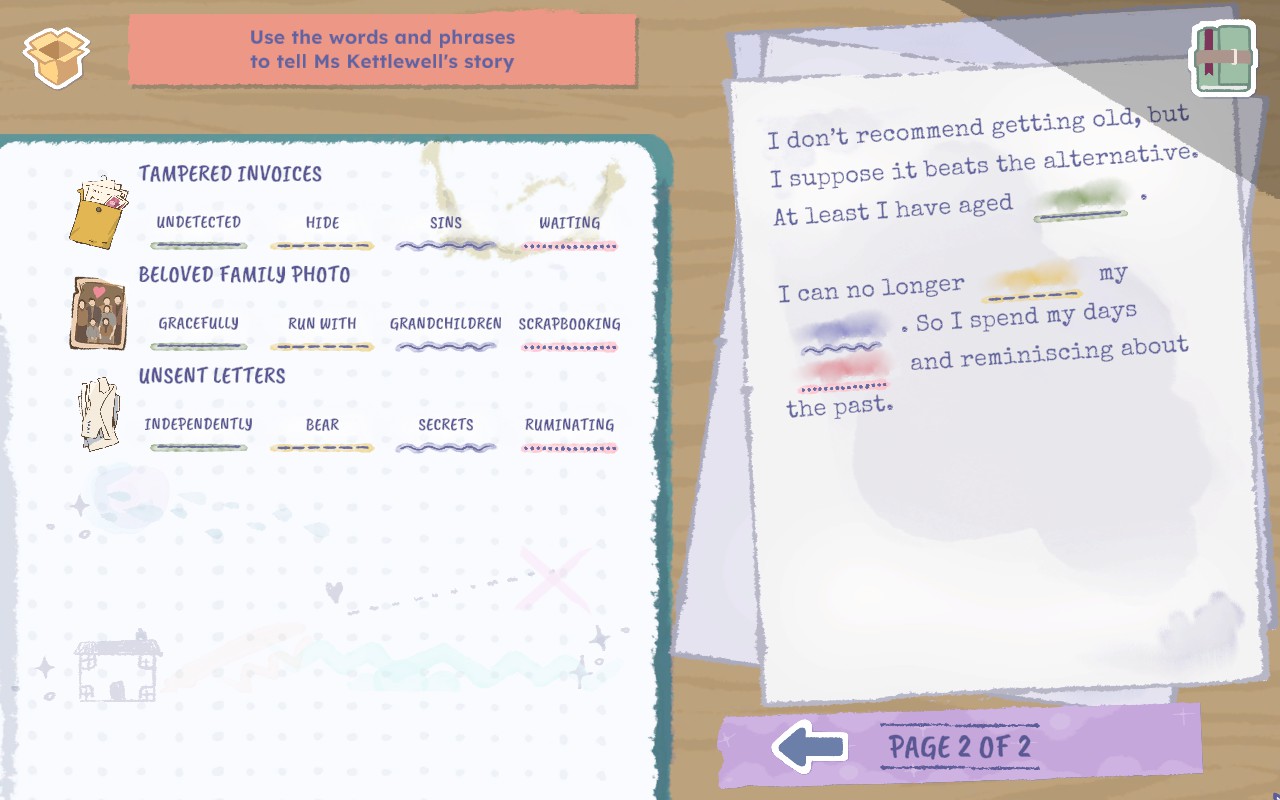
Sometimes the words generated by the items you packed can’t be used in a grammatically correct way. For example, one of the sentences in the memoir was ‘In my younger years, I worked as (blank).’ Because I had decided that the lock of hair I found stashed away was coming home with me, the only word available was ‘alone,’ which I think we can all agree does not work! You can also deliberately select something that makes no sense. On my first try I attempted a chaotic Mad Libs-style playthrough, which netted me a fun Steam achievement. When I played ‘properly,’ however, word discrepancies were less of a problem. Replayability is a major draw here, and you can restart a chapter directly after finishing it if you didn’t get the desired path and want to keep some different items instead. The game gives you a lot of wiggle room and encourages you to play around a lot.
After finishing the accessible pages of the manuscript, the screen will show a small animation indicating which of the paths was featured more. For example, if you’re choosing to paint Ms Kettlewell as a woman with dubious criminal associations (which I may or may not have done!), the animation shows a pair of handcuffs with the sound of gunshots and running footsteps.
A helpful prompt at the top of the packing screen will appear when any items allow for closer examination, as indicated by an ‘inspect’ option when hovering over them. Doing so might reveal a letter found hidden inside another object, for example, which adds an important clue to the particular storyline it relates to. The letter then becomes something that can be packed as well, and therefore the words associated with it can be added to the manuscript. I only found a few such items in the game, though, which is a missed opportunity as they add much-needed context for their respective paths.
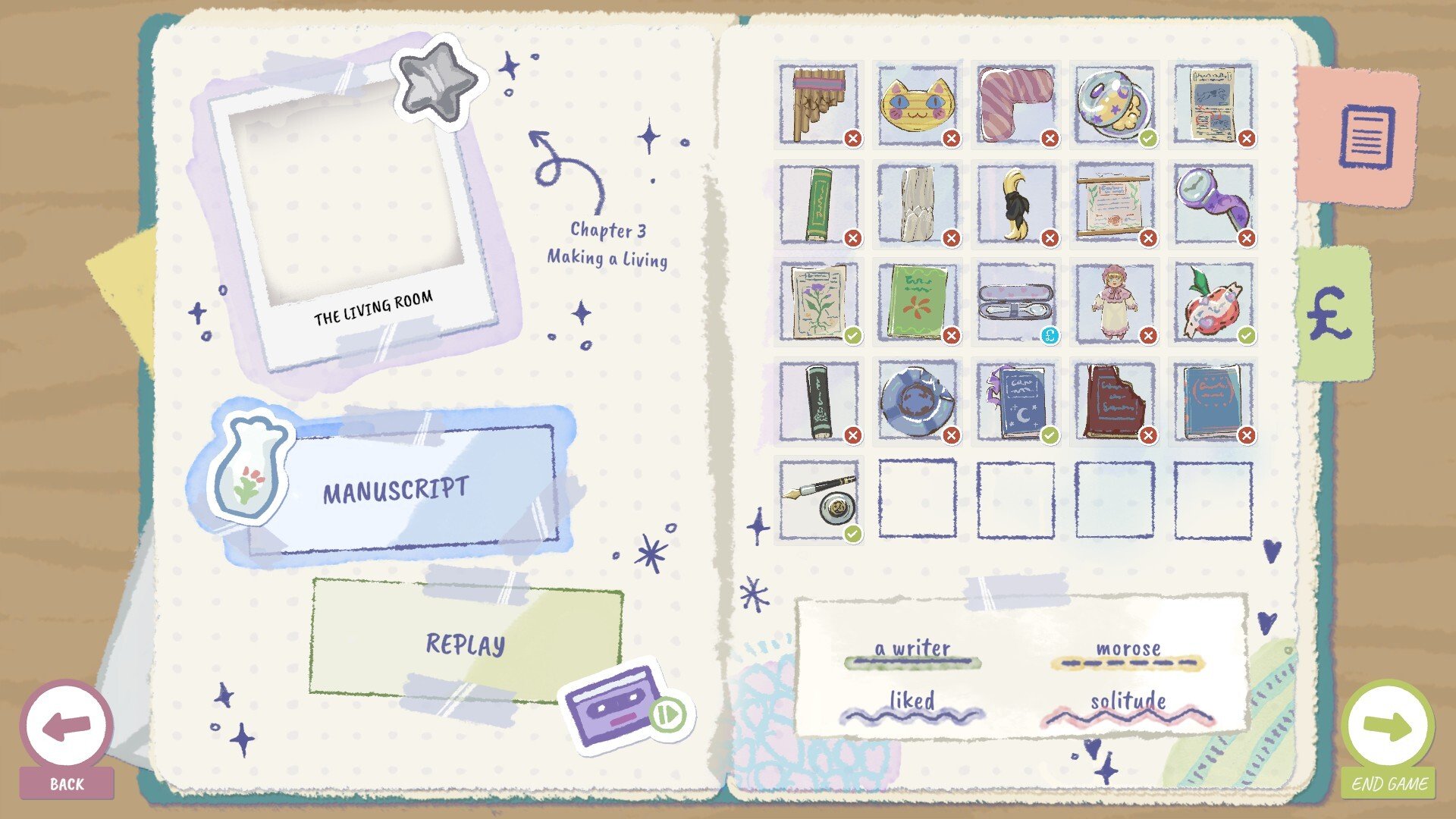
Here’s where the game falters, as certain items are meant to provide information about the other people involved in Ms Kettlewell’s life, painting a much fuller picture of her personal biography. Most things, unfortunately, are given an extremely brief description. A smoking jacket is referred to only as ‘a stylish gentleman’s smoking jacket’ with no further details about who owned it or why it was in Ms Kettlewell’s laundry room. I had to assume it was part of a different story path, so I didn’t end up packing it. On a second playthrough, upon taking the smoking jacket this time, I was given ‘Stanley, my brother-in-law’ as one of the phrases to use in the manuscript, which cleared that up but then left me with more questions than answers. I found myself wondering whether a lot of other things belonged to different people I should have known about. Had I missed all of this?
The answer was yes, as there are multiple different characters referenced throughout, a fact I only discovered when accessing the ‘characters’ tab in the menu about three quarters of way through the game. This lists many people’s names, occupations and associations with Ms Kettlewell, all of which had completely flown by me. There’s a vicar who was Ms Kettlewell’s nemesis, a close friend called Ralph who is a local gossip, and many more. None of this was remotely touched upon in my playthroughs, so I had absolutely no idea who many of these people were or how they affected Ms Kettlewell’s life, other than with a heavy dose of assumption on my part, which left the narrative feeling muddled and vague.
Put simply, if you don’t pack a specific item, you may not ever even learn about the person it’s associated with without referencing those character bios. This seems like a major oversight, because as much fun as creating the manuscript was, the fact that I didn’t have all the necessary context meant that with each chapter I felt myself becoming increasingly detached emotionally from the story. In one of the chapters, Ms Kettlewell’s granddaughter is mentioned specifically by name in the manuscript, so that whole chapter made complete sense to me. I would have loved to see the other characters utilised in this way, introducing them in the story in a more meaningful way.
The interface is simple point-and-click on PC, but the game worked perfectly for me on the Steam Deck. In a couple of playthroughs I racked up a respectable five or so hours, so you’re likely looking at two to three hours per run. With two gameplay modes to choose from – relaxed and cosy (relaxed having no weight mode and infinite packing supplies) – Tabitha definitely ticks the casual box, and the addition of a few accessibility options makes it more inclusive. One of the narration options is ‘Northern English,’ which I certainly appreciated, although there aren’t a lot of opportunities to hear examples of this, as most of the story is conveyed only through text.
Final Verdict
A Storied Life: Tabitha is ambitious in its attempt to put a new spin on the cosy house-clearing subgenre, but it stumbles somewhat in presenting a multi-path narrative experience. There’s no real emotional punch past the first few levels, and the memoir mechanic doesn’t get into the nitty gritty of any particular story paths, although the pair of endings I experienced were enjoyable. That being said, the game looks beautiful, and at the very least you’ll have endless fun boxing and bubble wrapping, potentially destroying or selling someone else’s possessions for the chance of a holiday in the sunshine. Things like optional extra daily mini packing games keep the fun going for inventory management lovers, and some surprising twists and turns along the way are an added bonus to discover. Fans of cosy games will likely enjoy this one, but just remember to check the character journal so you don’t become entirely Machiavellian in your pursuit of packing.
Hot take
A Storied Life: Tabitha is something fresh in the wholesome house-packing subgenre that overcomes some narrative messiness with fun casual gameplay and gorgeous artwork, encouraging replays to uncover anything you may have missed.
Pros
- Beautiful hand-painted watercolour style
- Unfinished manuscript is a fun spin on crafting your own background story
- At least five distinct narrative paths give it great replayability
- Cosy, enjoyable item selection and keepsake packing gameplay
Cons
- Needs more character info shared in-game
- Memoir choices can lead to some incoherent word discrepancies
- Overall narrative can feel messy and confusing, leaving you feeling detached from the deceased’s story
Victoria played A Storied Life: Tabitha on Steam Deck using a review code provided by the game's publisher.

- Advertisement
- Help support AGH by advertising with us






0 Comments
Want to join the discussion? Leave a comment as guest, sign in or register in our forums.
Leave a comment