
The Incident at Galley House review
- 3 Comments

Some impressive enhancements cooked up for a great audio/visual remake of Type Help
In 2025, William Rous released the free web-based mystery Type Help to significant acclaim. In fact, it’s currently rated the second best text adventure of all-time at the Interactive Fiction Database. While I am not as engaged with the IF community as I used to be, I heard enough to want to sit down and give it a spin. However, at the same time I discovered that Evil Trout, publisher of the 2025 enhanced hit remake of The Roottrees are Dead, was planning to similarly update Type Help into a graphic adventure called The Incident at Galley House. I was torn on what to do, but ultimately decided to hold off to play the latter. Whether that was the right or wrong choice, I don’t regret my decision, as Galley House is an addicting, worthwhile entry into the deduction genre.
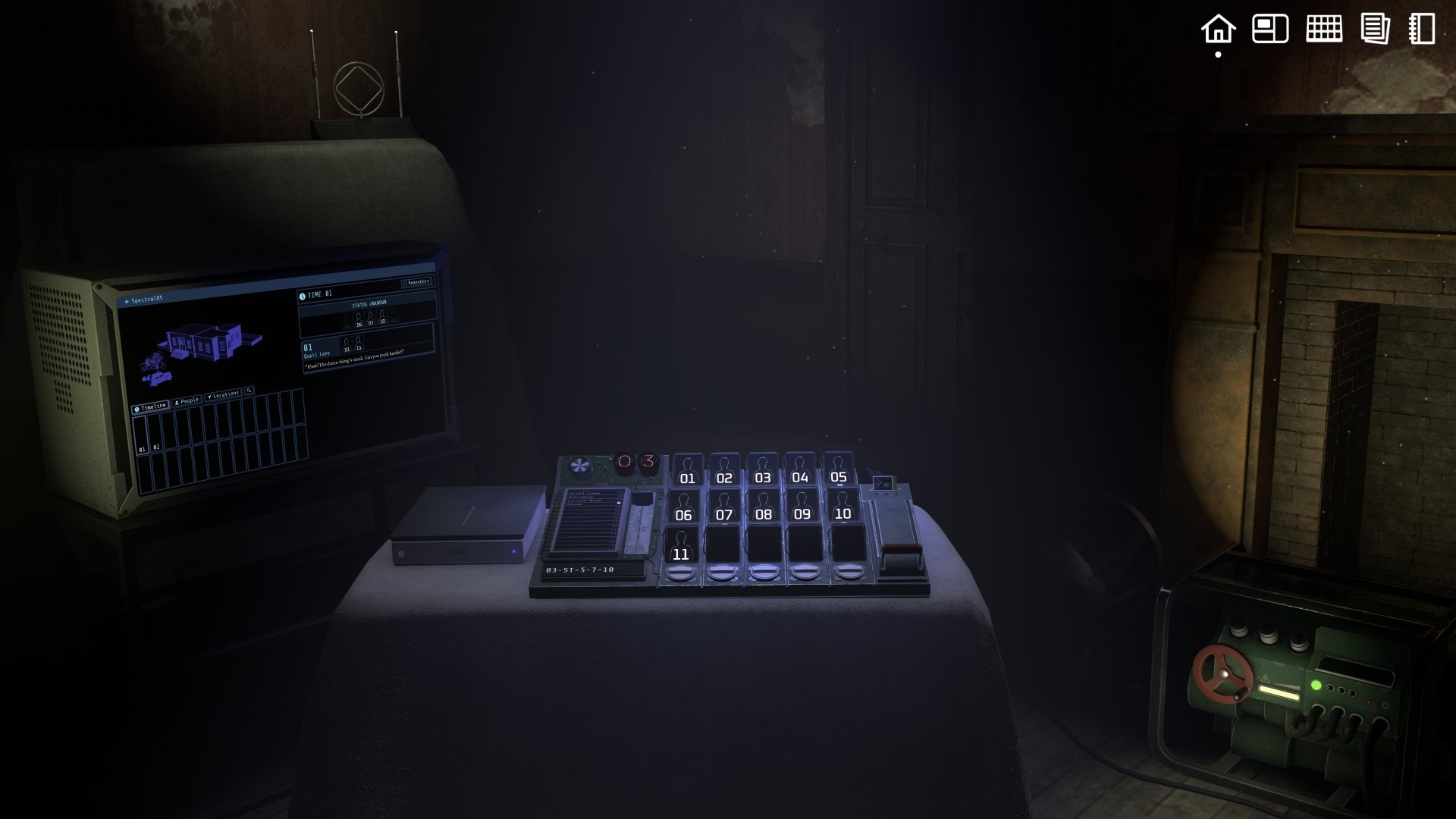
Our story begins as you, Reya Beckon, approach (in first-person perspective) a dilapidated, boarded-up mansion called Galley House, for as yet unclear reasons. It’s 2011, but a newspaper from 1936 is on the porch, the headline referencing an incident here that left many men and women unexplainably dead. Though the door is locked, it suspiciously opens to let you into the living room where you’ll find a generator, a scanner, and a bizarre-looking machine. A brief set of instructions guides you through powering up the generator, scanning your hand to give you an ID card, and a few suggestions for where to start. Apparently this machine picks up audio echoes from the past when death is imminent, allowing you to hear explicit conversations that occurred at the time, while also providing probabilistic visuals based on available public information. You’re assured that the machine is totally safe… with the added disclaimer that the company is not responsible for anything you do based on any hallucinations you’re about to have.
The instructions have you calibrate the machine to import the previous user’s data, though the only knowledge this reveals is that there are eleven people you will be tracking from that fateful day in 1936. Finally, you are prompted to enter location codes given to you for three places: Quail Lane, the Entrance, and the Living Room. Once this is done, you are now ready to start investigating. The first full code (each number and letter fragment represents its own code that combine to form a complete one ready to use in the machine) is 01-QU-1-11. By turning knobs and flipping switches with the click of a mouse, you can enter in this sequence. Pulling a lever then activates your first historical recreation.
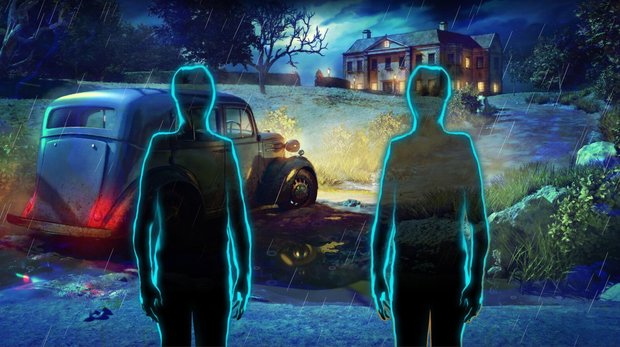
The view switches to a still scene on Quail Lane from 1936. A car is stuck in the mud outside Galley House, and a man is trying but failing to get the vehicle moving. Another man, who presumably works at the mansion, is aiding him. Since you have no idea what either of these men actually looked like, their depictions are represented by simple outlines with their designated numbers, in this case 1 and 11. The scene (of which you are simply a passive observer, unable to move about) lasts about a couple of minutes and ends with the employee directing the stranded man to knock on the front door and speak to Mr. Galley. When it’s done, you return to present day, once again looking at the machine. You’ll then repeat the steps with the other two codes.
Once you’ve seen all three scenes, you will be alerted that the scanner has finished uploading some data and that character avatars are available if you want to assign images to persons one through eleven. Unfortunately, images from another cold case have been mixed into this scanned batch, meaning some of the avatars do not belong to anyone you’ll be investigating. Each avatar comes with a brief description of the person and anything found on their body during the initial investigation by police. Using these clues, you can try to match the avatar to the correct victim so that when you watch future scenes, you will see their names and likenesses. You can also manually type in their name if you think you know it. The game never confirms if the assigned names and avatars are correct, though. While assignment is unnecessary to complete the game (in fact, you can assign incorrect avatars for the game’s entirety with no penalty), it certainly is easier to follow along.
There are still many more rooms for you to discover, each with its own code that you’ll have to figure out for yourself. From here on out, nearly everything you do will be based on deduction, which first includes figuring out what the other numbers of the code sequence stands for. Then, based on information you’ve learned watching the previous three scenes, you must determine what codes will activate additional scenes. For example, a character may announce what room they plan to go to next (e.g. the dining room), so it is reasonable to assume there’s a scene in the future involving them there. But you will likely need more info than that, such as who else is joining them, which may be overtly stated or may need to be picked up from context clues. Once you correctly identify a new complete code sequence, it’s time to enter it into the machine, observe and learn what happened. Rest assured, you can sit back and relax, as you can go back and rewatch each scene as often as you need to.
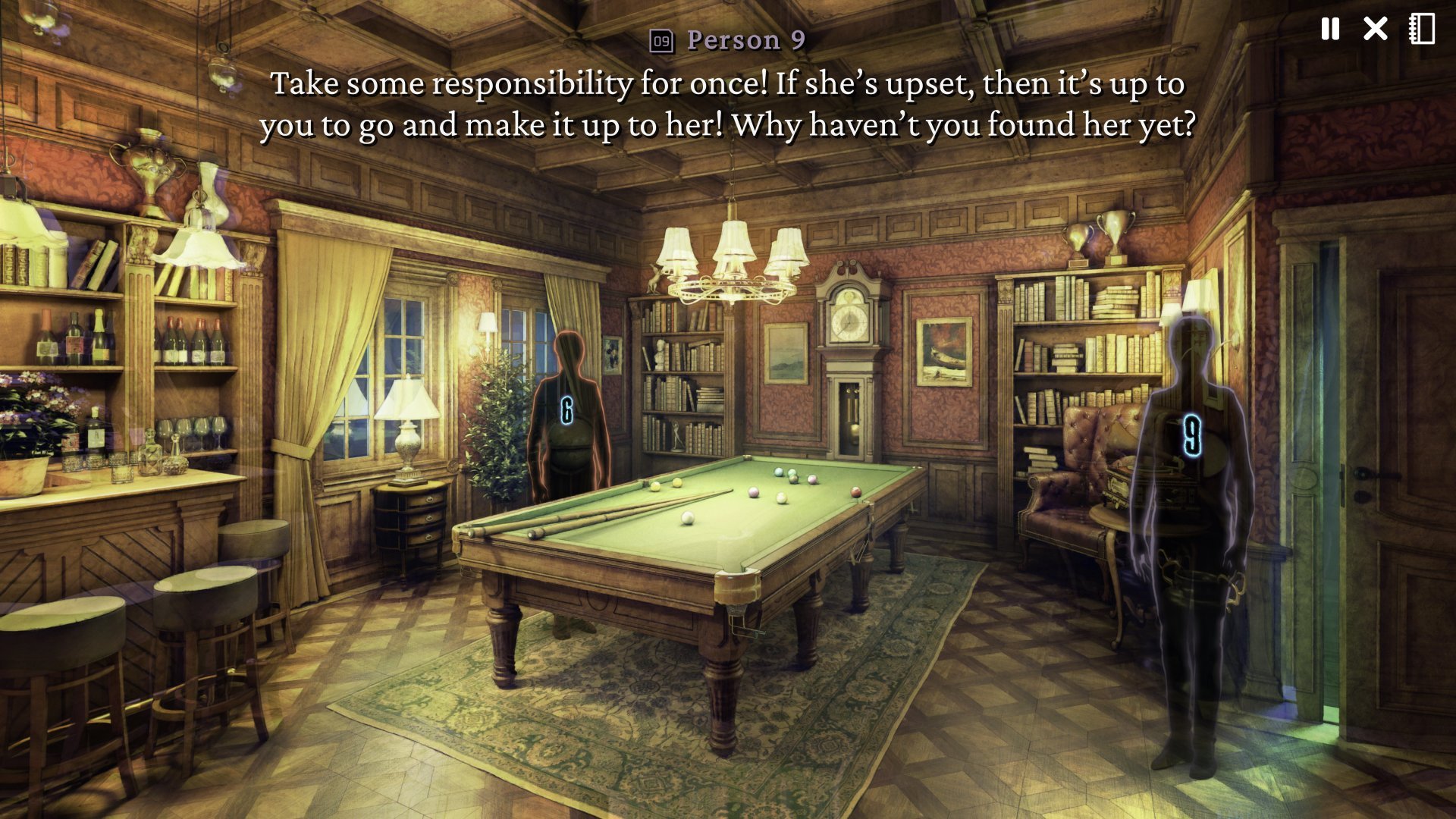
While this may seem difficult at first, there are many quality-of-life features that will help you. First off, there’s a notebook you can quickly access to jot down your own thoughts. While watching a scene, you can pause the audio at any time to assign either a name or avatar to its characters right then. You can also bookmark a spot in the scene so you can easily find that portion of the conversation later. A full transcript (replete with a search engine) of each scene can be accessed without having to watch it all play out again. Perhaps the most helpful feature is that once you witness a flashback scene, there will be a marker indicating how many codes you can reasonably deduce based on information from that scene alone. (Ergo, you know which ones are more important to study.) And if all that isn’t enough, there’s a very well-designed progressive hint system you can utilize whenever you need without penalty.
The timeline is divided into distinct periods and numbered to help you keep track. As the first to occur chronologically, the aforementioned scene where a guest’s car is stuck in the mud is Scene 1. Not only do you have to identify scenes that took place progressively later in the evening, you will also need to uncover scenes that happened simultaneously. With enough first-hand observation or indirect clue connecting, you can account for the whereabouts of all eleven characters during every time slot—while they were alive, that is. It’s no spoiler, given the game’s introduction, that bodies will begin dropping.
The Incident at Galley House
| Genre: | Mystery, Science Fiction |
|---|---|
| Presentation: | 2D or 2.5D, Slideshow |
| Theme: | Crime solving, Time travel, Whodunit |
| Perspective: | First-Person |
| Graphic Style: | Illustrated realism |
| Gameplay: | Investigative, Deduction |
| Control: | Point-and-click |
| Game Length: | Medium (5-10 hours) |
| Difficulty: | Medium |
Your job never changes as you continue to enter in codes and reveal scenes until you’ve learned everything that happened that fateful night at Galley House. However, your assumptions about why the deaths are occurring are sure to change multiple times as this initially confusing but ultimately tightly wound mystery plays out. Many characters seem suspicious, including a bitter uncle who believes the house should be his, a jaded lover who has thrown away her engagement ring, and a jittery son who is hiding a gun in his bedroom.
The mansion itself is richly realized, with vibrant décor befitting the 1930s, including fireplaces, four-poster beds with hanging drapes, opulent vanities, and even a dumbwaiter that connects the kitchen and the dining room. Environments are hand-drawn in an extremely crisp but not entirely realistic art style, as if we’re looking at paintings, not real places. Character avatars (once you assign them) are static, with no animations. If they need to move in a scene, they temporarily vanish and then appear elsewhere in the room. While the graphics are sharply detailed and the models do a nice job exemplifying each person’s traits, the characters wind up feeling like stickers on a canvas, as perhaps befits a virtual machine reconstruction 75 years after the fact.
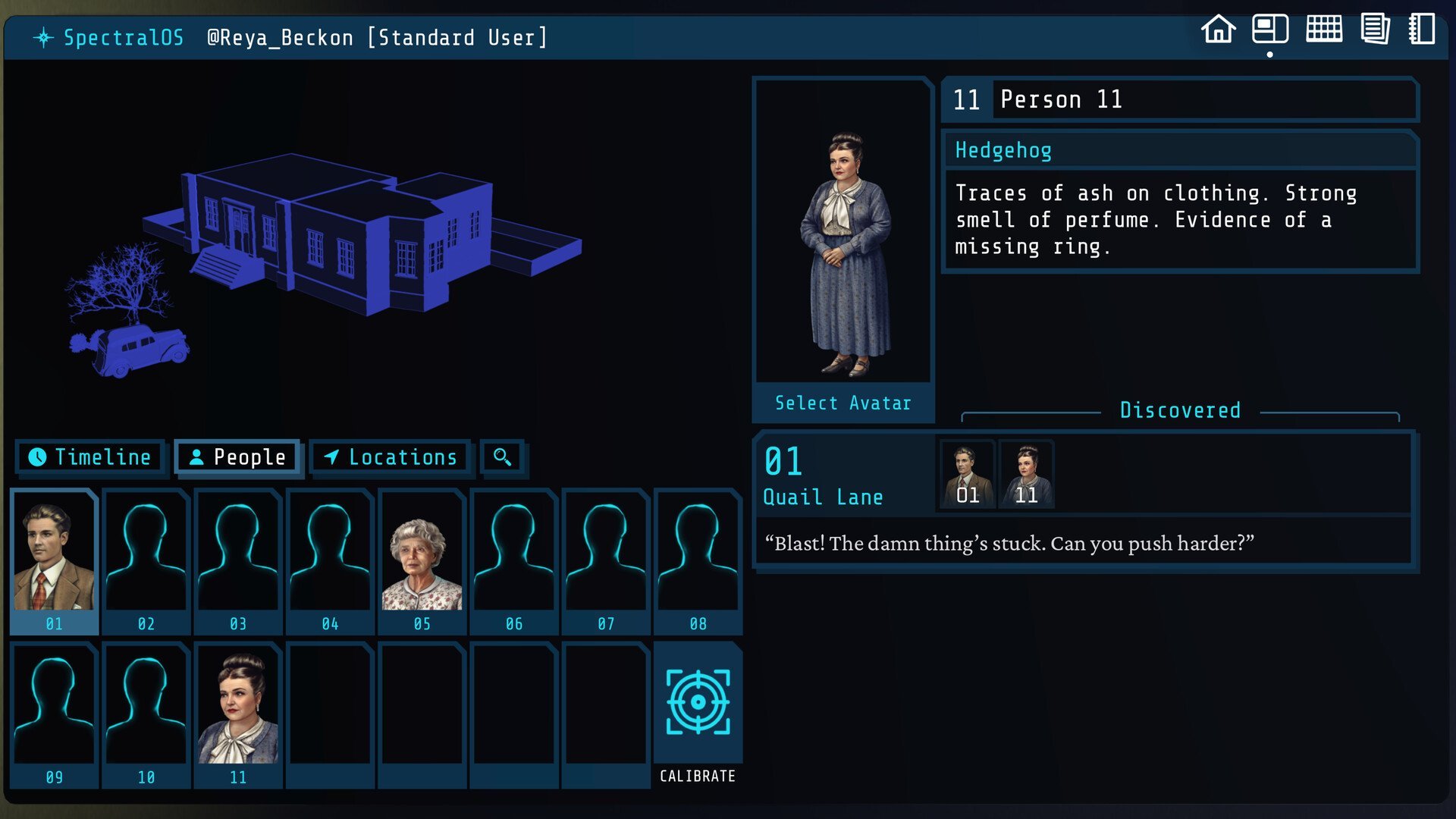
The acting is solid, and each character has a distinct voice—a necessary feature given how many strangers you’ll be getting to know and needing to understand. Dialogue, rather than feeling like a naturally flowing conversation you might hear in media today, feels more like it did in 1930s cinema, with heavy enunciation and exaggerated theatrical projection. But don’t get me wrong; nobody feels like a caricature. The butler isn’t overly stiff or formal and the matriarch isn’t an overbearing harpy. However, when combined with the static avatars, the tension I think I was supposed to feel while playing was mostly absent.
The score features a real song from 1926, while the general background music consists of mostly upbeat ragtime rhythms from a player piano (such a piano also plays a role inside Galley House) as well as simplified arrangements from nineteenth-century classical songs. There are regular, perfunctory sound effects such as shoes hitting the floor, a knife chopping vegetables, and billiard balls cracking into one another. My only disappointment is the underwhelming sound effect for when you correctly uncover a new scene. For those who got a rush hearing the triumphant chime in Return of the Obra Dinn or the three dings in The Roottrees are Dead, I am sorry to say there is no such auditory dopamine delivery system here. When you enter in a code and pull the lever, you hear the static of electricity as the machine powers up, reaching a crescendo that should lead to something glorious when you are correct. Instead, you are rewarded only with a low-key warble as a rippling effect covers the screen to transition to the historical scene in question. While the sound effect matches the visual key, it does not feel like a satisfying payoff.
Outside of deducing each code to access new scenes, there is no actual investigating to be done at Galley House. There is but one ending which will be revealed once you discover that scene’s code, but most players will be hard-pressed to predict where the mystery is going. While you could technically access the final scene at any time, it is not possible to deduce until you’ve uncovered a heavy majority of other scenes first, though you will likely reach the end with several scenes you’ve yet to uncover. Thankfully, after you’ve completed the game, you can easily return to the moment right before you entered the final code and go searching for the others you missed.
While I chose not to play Type Help first, having now experienced both I believe I can safely advise you do so if you enjoy text-only games and are looking for a more visceral, challenging experience. While the transcripts are nearly identical, the original has none of the user-friendly gameplay features present here. Your hand is not held in the slightest, and extensive note-taking is required. I also suspect that the tension would be heightened, as like a good thriller novel, your mind can fill in a lot of the blanks with more terror than production effects are able, whereas in The Incident at Galley House, the spookiest moments impact the characters involved far more than they elicit fear in the player.
For those who have already played Type Help, I can confidently recommend Galley House as well. The remake remains faithful to its source material in all important ways, but I imagine the added visuals and voice-overs will be a nice treat. If nothing else, the lone narrative difference is that this game will not end where you expect. To give any details would be a spoiler, but trust me that a substantial and welcome epilogue provides a much more satisfying conclusion to the original story.
Final Verdict
It took me a swift seven or so hours to plow through The Incident at Galley House. Compared to some recent games in the deduction genre, the challenge is only moderate, especially since in several cases it’s easy to guess-and-check if you get stuck. While I was hoping the mystery would be a bit more demanding, it is certainly difficult to put down once you get started, and all of the quality-of-life features make it easy to keep going. With an intriguing, original story by William Rous and solid production values by Evil Trout, just about anyone will have a good time hanging out with this colorful cast of characters from the 1930s—at least until they kick the bucket, leaving you to figure out how and why.
Hot take
While not an overly challenging entry into the deductive mystery genre, The Incident at Galley House shines as a compelling mystery in its own right, as well as a worthy graphic reimagining of the text adventure Type Help.
Pros
- Unpredictable, suspenseful mystery is fun to unravel
- Deducing the code required to reveal each scene is (mostly) satisfying
- Solid voice acting
- Excellent epilogue that satisfyingly expands upon the original game
Cons
- Extensive quality-of-life features make the game perhaps too easy
- Audio and visual cues for successful deductions are disappointingly tepid
Beau played The Incident at Galley House on PC using a review code provided by the game's publisher.

- Advertisement
- Help support AGH by advertising with us




3 Comments
Want to join the discussion? Leave a comment as guest, sign in or register in our forums.
Dude! You were almost four hours faster than me! Good review, though.
Reply
I played Type Help about 6 months ago and The Incident at Galley House last week. I certainly enjoyed my time with The Indicent. Not many people still play text adventures and Evil Trout did a fine job making the game much more accessible. But they completely changed the backstory with the extra content in the second part of the game. What you called a "more satisfying conclusion" was a major disappointment for me. Clever but unconvincing, too complicated, even convoluted. I much prefer the character @ in the original game and the different ending. When all is said and done, Type Help is the better game by far imo.
Reply
This reminds me of when they make an OK movie adaptation of a great book. Even though it isn't AS good, it raises the profile and makes it more accessible to a wider audience, so it's probably a net positive.
Reply
Leave a comment