
Moses & Plato: Last Train to Clawville review
- 0 Comments

Engaging visual novel will scratch the itch of any mystery fan open to an animal whodunit
Sherlock Holmes. Hercule Poirot. Nancy Drew. These are but a few of the most famous detectives in history who are all known for their infallible wisdom and incomparable deductive reasoning. While capable in their own right, the duo of Moses Wildflower and Plato Palladias are not at all omniscient. And so, in Last Train to Clawville, a new visual novel with adventure game elements from The Wild Gentlemen, it’s your job to guide these two intrepid sleuths to the end of their latest assignment one choice at a time – a case that could well be their last if you slip up even in the slightest. It’s a gripping tale with a touch of humor that had me constantly trying to deduce who did the dastardly deed, and should appeal to anyone who loves a good whodunit – especially if they enjoy anthropomorphic animals as well.
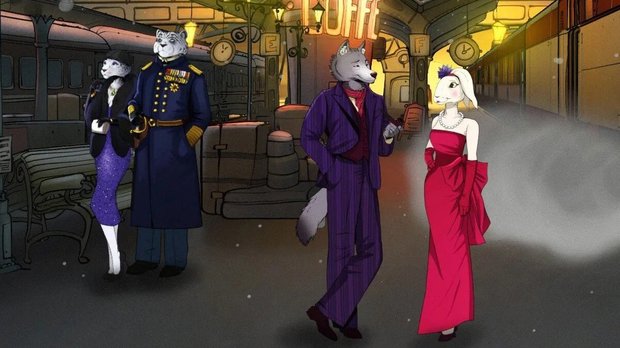
This murder mystery starts out in medias res as we find Moses the fox detective standing over the corpse of Ignat, a snow leopard ambassador, the literal smoking gun in his hand. How did this come to be? Well, cue the flashback as for the next couple hours or so we see what led Moses to this point. He and his feline companion Plato have just arrived in Stowonia, a sort of Russia equivalent in the developer’s larger animal-themed World of Wilderness. They are to meet Ignat as the ambassador travels to Clawville to help broker a peace between the two nations. Thus, our intrepid bodyguards of sorts jump onto the Clawville Express with their charge, a train leading from the frozen lands to the titular capital.
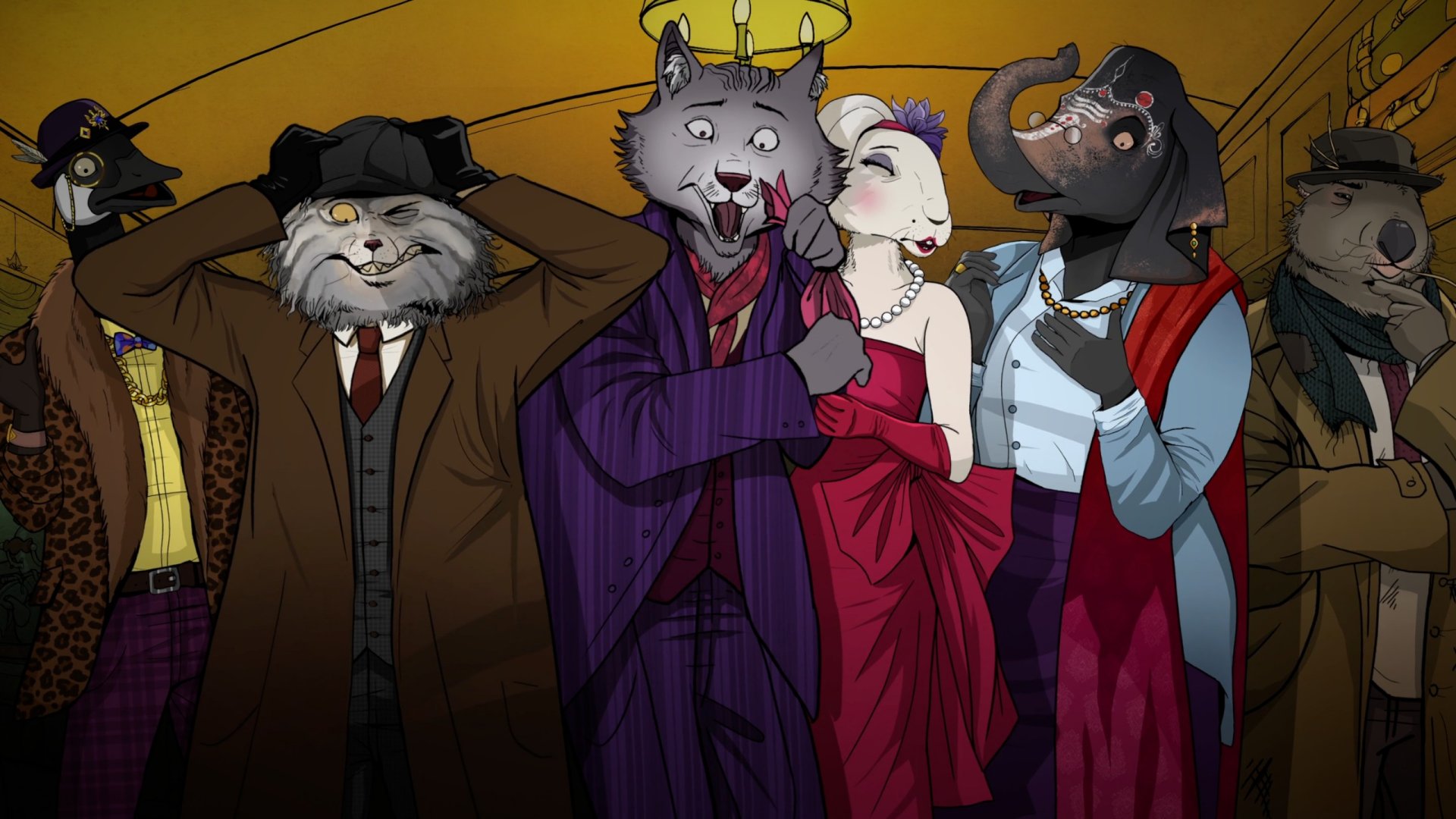
From there we are introduced to several other eclectic characters, ranging from the mysterious wombat vagabond Basil Pesker to the wolf movie star Cassidy Lupus and more. We also meet a water buffalo ambassador from Torogo (a parallel to India and unsurprisingly a colony of Clawville), and his elephant assistant Fahni. The Torogans have no love for the inhabitants of Stowonia after the latter invaded their homeland. In fact, every passenger on the Clawville Express has reason to want to end Ignat’s life.
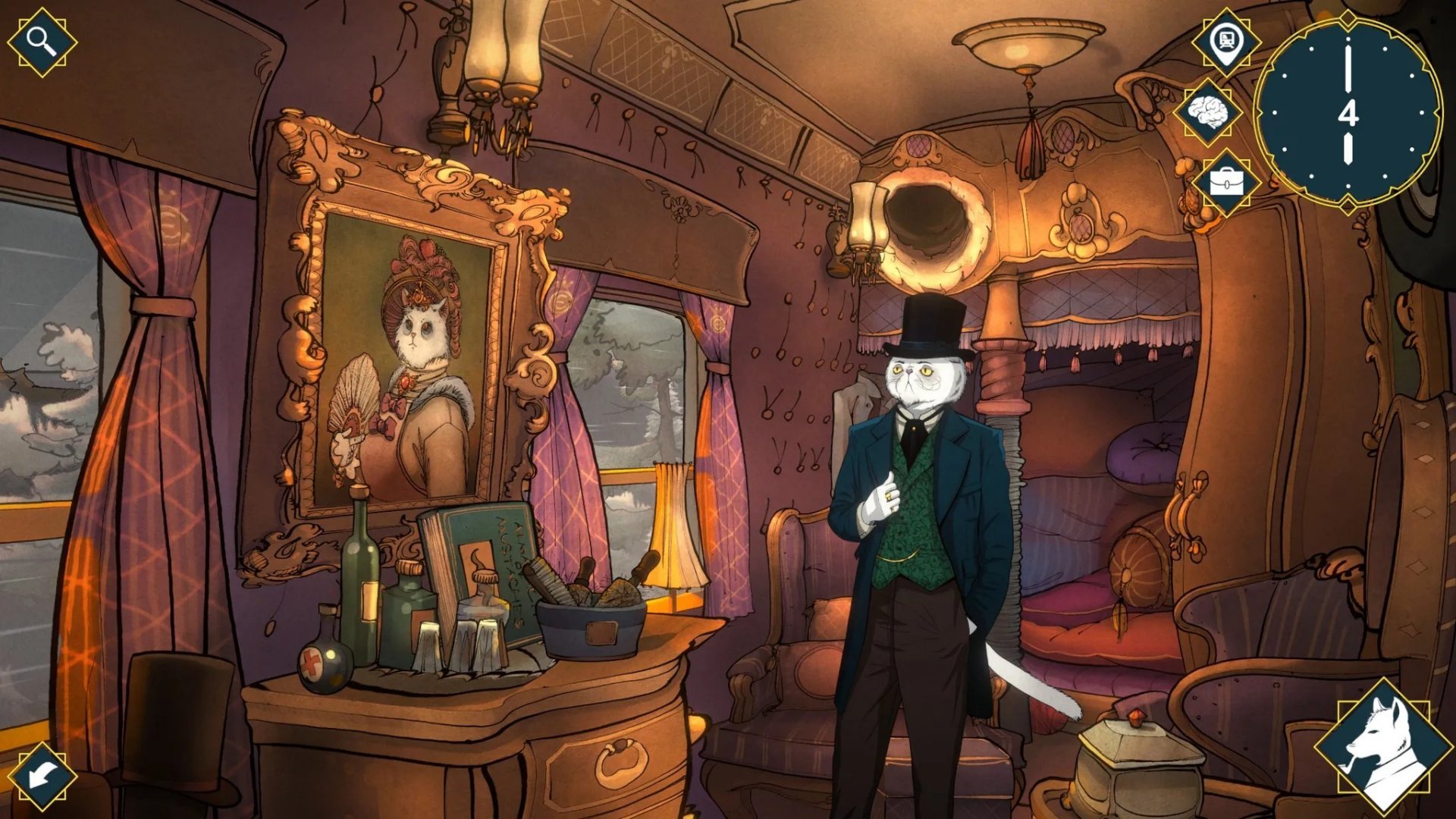
After catching up again in the present, we can start the investigation proper. The train travels from Stowonia to Clawville, stopping in a couple other nations along the way, and it’s up to our dynamic duo to solve the crime and clear Moses’s name before the last stop. This is not as easy as it sounds, but a sharp eye, an attentive ear, and a powerful nose will be enough to let you solve this mystery before the end of the fourth (and final) chapter in this saga. And I mean that literally, as Moses must use all three senses throughout the case. It’s a shame that Plato is just along for the ride as a sidekick of sorts, as it would have been nice to use his skills as well instead of simply helping as a commentator.
The entire game is played with the mouse, with a lot of clicking involved. Sometimes you’ll get to do some standard detective work, panning the camera in first-person view in search of clues that you can click on to inspect. (With an optional hotspot highlighter to ensure you don’t miss anything.) Mostly, though, you’re clicking through dialogue. There are many interrogations and conversations conducted here, as befits a detective story. But while much of Last Train to Clawville plays out as a visual novel, it does so a little differently than you might expect.
The main source of information comes from a form of questioning. When clicking on one of the passengers, you have the option to look at, talk to, ask questions of, and finally interrogate them. Sometimes an option is greyed out, meaning you can’t select it, but otherwise you can choose any of the others. The interrogation option is the last one, indicated with a police shield icon. When selecting that, from what your counterpart says (among other clues gleaned from observation and casual conversation), you can deduce if they’re telling the truth or lying.
If you think they’re not being forthcoming, you can select one of several options detailing what you know about the subject. If you’re right you earn points; if you’re wrong, you lose them. At the end of the sequence, you’ll get a score that ranges from 0-5 stars; the higher the better. The correct deductions aren’t particularly difficult to discern, and for most of these interrogations I scored five stars easily. If you do make a mistake, fear not, because even if you mess up an answer you can retry until you get everything right.
There are two other major kinds of puzzles that make Last Train to Clawville more than a purely VN-style experience. At the end of each chapter, you enter a sort of mental quiz. It’s up to you to answer a few questions, such as what someone was doing at a certain time or their relationship to another passenger. This includes combining sentence fragments with related pictures, such as picking the two characters that have a connection to a particular plot point. Again, you can try as many answers as you need until you get it right. In fact, the game won’t continue until every last one is answered correctly. Again, though, it isn’t hard to make these connections; far from it. While a couple had me stumped for a minute or two, most clicked right into place as long as I kept a mental note of what was going on throughout my investigation.
Moses & Plato: Last Train to Clawville
| Genre: | Mystery |
|---|---|
| Presentation: | Slideshow |
| Theme: | Crime solving, Animal, Whodunit |
| Perspective: | First-Person |
| Graphic Style: | Illustrated realism |
| Gameplay: | Investigative, Visual novel, Choices matter |
| Control: | Point-and-click |
| Game Length: | Long (more than 10 hours) |
| Difficulty: | Low |
The last puzzle type is more traditional adventure game fare. Occasionally you’re given an item whose secrets you need to unlock. A couple, such as opening up a puzzle box (or a “never forget box” as it’s called here) and figuring out the ingredients for an antidote to a mind control drug, were a bit tricky and had me scratching my head at first. The puzzle box required removing parts, sliding others, and replacing each item in a different groove. After I sussed out the solution, getting it open made me feel like I had just unlocked a major secret in the story. Potion mixing involved following the directions on a piece of paper, such as blending different colors together to make another one, but some of the combinations were a bit vague.
As your investigation of the ambassador’s murder progresses, Moses will jot down pertinent facts in his “mind garden,” a sort of repository of clues and notes you can reference any time you’re not talking to someone. These range from a codex of interesting tidbits that have little bearing on the case, to a list of each suspect and who they are, and each clue and fact you learn throughout. There’s a “connections” screen where you can drag and drop various character portraits and link them together by selecting how you think they relate to each other. This one I never used, and never needed to use, though it’s nice to have to follow the evidence as you go along.
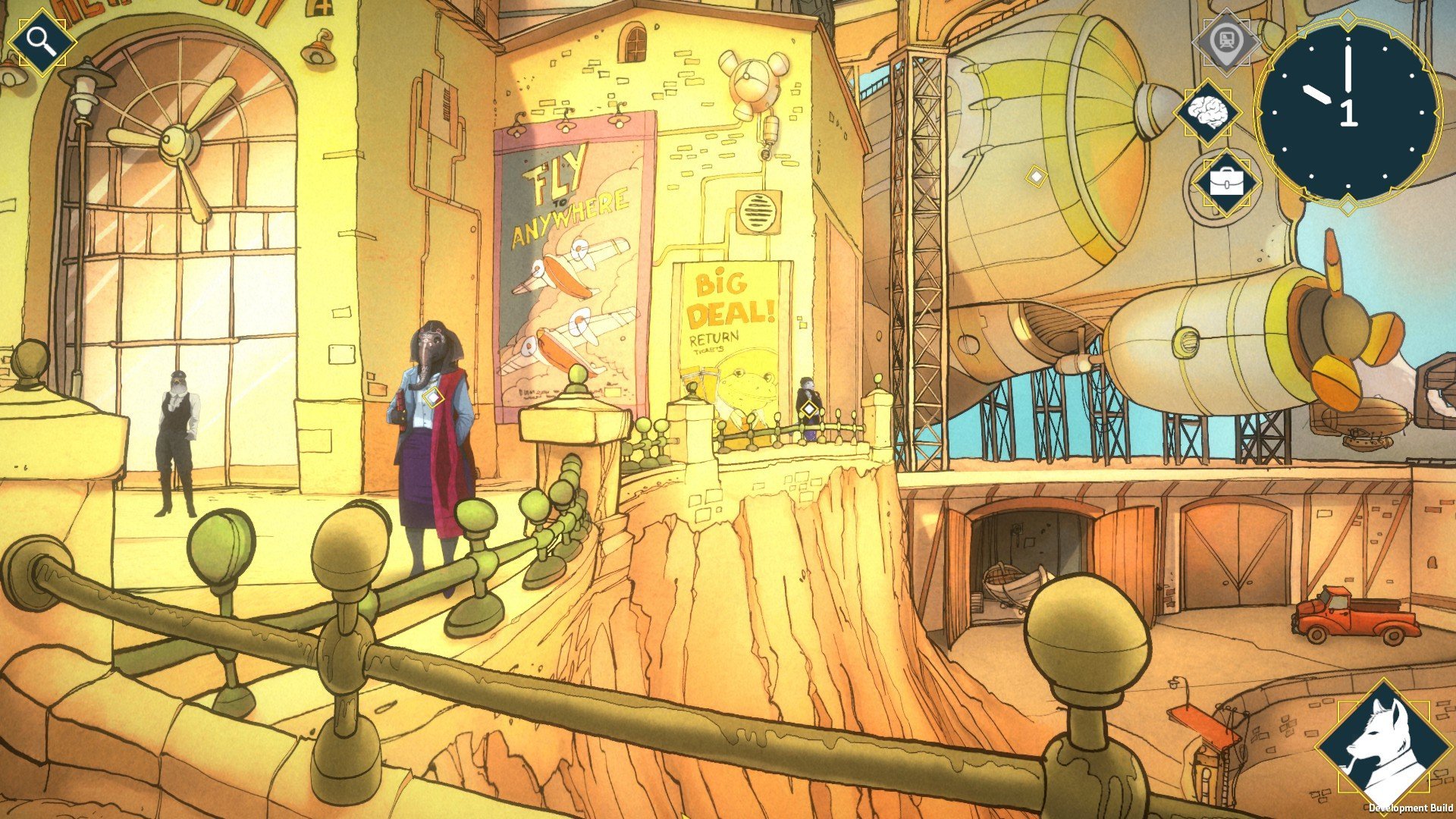
Between talking to the other passengers, piecing together clues and solving puzzles, you have almost free rein to explore the train. You can move between cars and rooms with a map showing who is in what room – just click on where you want to go and you’re there – but you’ll need to take time into consideration. Each time you go somewhere and start talking to someone, a clock icon shows up on the screen, indicating that time will move forward by one “tick.” There are scripted events that happen only at certain intervals, timed to coincide with key investigative points with a number of rooms to choose from in which only a few suspects show up. This limits what you can do, meaning you won’t be able to talk to everyone everywhere, so use your time wisely. These time restrictions felt very much like old-school adventures such as The Colonel’s Bequest.
As with Chicken Police, The Wild Gentlemen’s other animal detective series, Last Train to Clawville is filled with colorful characters, but here the locales are just as vividly hued instead of black and white, from the avian land of Avirya in the mountains to the underwater city of Natuicca, which you’ll get to observe whenever the train stops at its next destination. Everything is drawn like a cartoon, and the world is populated with animals of all shapes and sizes. Avirya, for example, is filled with blimps and other flying vehicles and gives off a sort of steampunk feel.
Each character has a minimal number of exaggerated reactions but they work well, whether it’s Plato giving the occasional purrfect doe eyes when happy or the rabbit starlet Cassandra Faye acting jittery. For those who love anthropomorphic characters, this game is for you. If not, it can be a bit jarring to see four-legged creatures standing on two legs, well-dressed with human-like hands. The most unnerving has to be the fish people, with their piscine heads in water-filled globes atop human torsos. But they’re all so cartoony that although I am a bit arachnophobic, even Pierre, the train’s six-armed spider conductor, didn’t bother me too much.
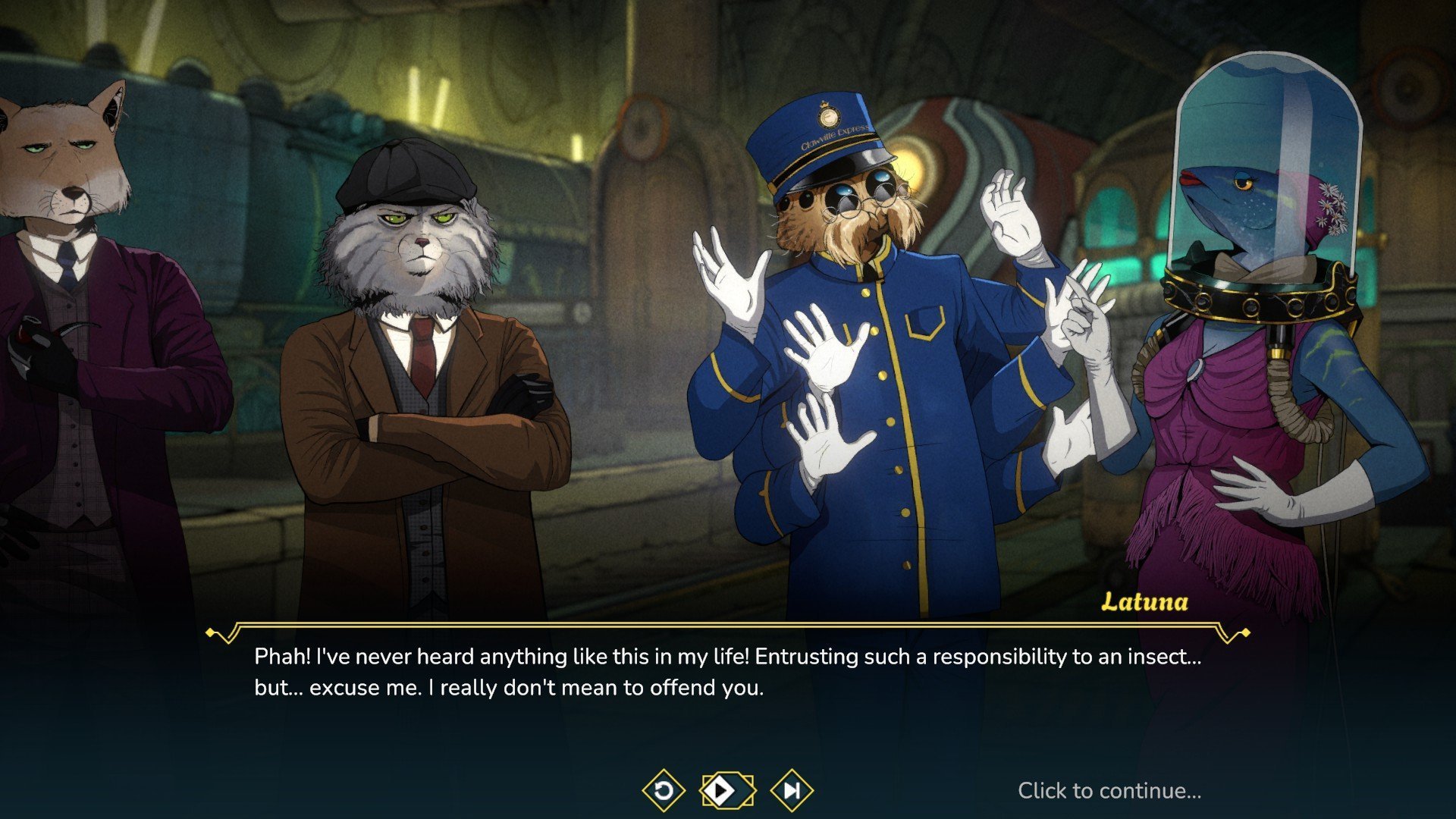
Apart from certain lines being left unspoken, they are otherwise all voiced and the cast are excellent. Each character has their own personality, and the actors do a fine job of bringing them to life. Of particular note is the voice actor for Plato, whose gruff New York accent makes him sound like a snarky, sarcastic feline at times. I also enjoyed listening to wombat Basil Pesker’s Australian accent as he divulged vital information pertaining to the case.
We’re treated to some animal sounds as well, such as the occasional purr, growl, and honk. These aren’t really needed but add a nice touch to remind us that these characters are humanoid but not fully human. If there is one area of the sound design that I didn’t particularly care for, it’s that the music tended to get rather loud at times and drowned out the dialogue. Music plays almost constantly throughout the game, so thankfully there are individual audio sliders you can turn up and down as needed. I’m glad I didn’t lower the volume entirely, as I enjoyed some of the toe-tapping tunes in a score that largely plays out like a detective noir story from the early 20th century.
Both Moses and Plato are excellent investigators and it feels very much like a Sherlock Holmes / John Watson dynamic, but with a much more humorous bent. The two get along so well together, playing off of each other’s strengths and minimizing their weaknesses, that despite the occasional pratfall they are quite competent at their jobs. (Apart from letting the ambassador get killed under their watch, that is.) This stands in stark contrast to the other characters they interact with, who talk about them like they’re second-rate detectives. There are some groan-inducing moments when a corny joke lands flat, but there is plenty of humor between the dynamic duo and the rest of the cast.
For the eleven hours I played, I found myself wanting to keep going to see the mystery through to the end. I am a fan of crime stories, and trying to figure out who I thought the culprit was kept me motivated throughout. I’m always trying to reach my own conclusion before the final reveal, and here I had an inkling about halfway through, having narrowed it down to only a couple suspects. It turned out I was right in the end, which made me happy, but not only didn’t that spoil the second half of the game for me, I’m inspired to go through the story at least once more to get the full details, as not everybody’s personal tale can be finished up in one sitting.
Final Verdict
Overall, Moses & Plato: Last Train to Clawville is an engaging visual novel-plus. This might turn off some players looking for a traditional adventure game, but I enjoyed the story of these two new animal detectives immensely. From the gripping tale of murder and political intrigue, to a nicely drawn and voiced group of eclectic suspects, to a well-written investigation on a train that would be right at home in an Agatha Christie novel, there’s plenty here to both entice and capture the imagination of anyone who loves a good mystery. The cast of anthropomorphic cartoon animals may not appeal to everyone, but they work wonderfully here and make me want to go back and try out the other games in the World of Wilderness series as well.
Hot take
A worthy detective game in the vein of Sherlock Holmes or Hercule Poirot (but with animals), Last Train to Clawville is a compelling murder mystery visual novel that is easy to grasp and will keep you wanting to know more.
Pros
- Engaging murder mystery involving anthropomorphic animals
- Fully voiced with a talented cast
- Eclectic characters with their own unique quirks
- Beautifully drawn cartoon-style artwork
Cons
- Music tends to drown out voices by default
- Not all dialogue is spoken
- The few puzzles can be easily solved
Serena played Moses & Plato: Last Train to Clawville on PC using a review code provided by the game's publisher.

- Advertisement
- Help support AGH by advertising with us







0 Comments
Want to join the discussion? Leave a comment as guest, sign in or register in our forums.
Leave a comment