
NAIRI: Rising Tide review
- 0 Comments

The sequel to Tower of Shirin has even more swell qualities, though many of the same weaknesses too
There are few things worse than an unresolved cliffhanger. Throughout my lifetime of (too much) media consumption, I’ve seen many an IP cancelled before it could reveal the contents of a shocking letter, or where a gunshot came from. For years, I’ve wondered if such a fate would befall NAIRI: Tower of Shirin, a cute and casual 2018 visual novel-styled adventure about an aristocratic girl fighting against a corrupt government that’s turned on her family. In the game’s abrupt ending, a cryptic reveal revved up the plot instead of resolving it, and several characters’ statuses were left unknown.
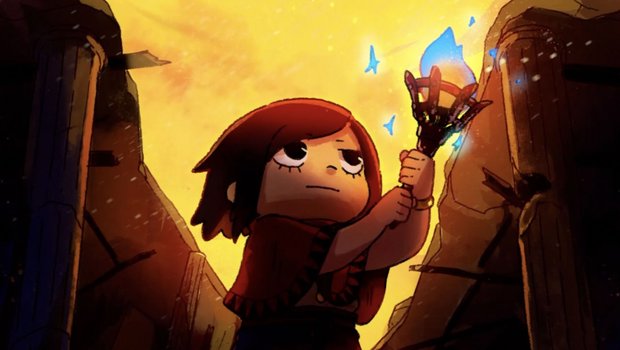
Fortunately the story finally resumed six years later, when HomeBearStudio, the small team behind Tower of Shirin, released its long-awaited sequel, NAIRI: Rising Tide. Though both games share the same main characters, sandy setting, charming art style, and narrative puzzle structure, the upgrades to this second installment are evident. The graphics are more beautiful. There are more in-game features and more puzzles to solve. But Rising Tide is also awash with the same problems that plagued its predecessor, like repetitive gameplay, too much dialogue (with no voice acting to support it), and an even more dramatic cliffhanger than before. Similarities between the games help ensure that Tower of Shirin fans will feel at home, but series newcomers, or anyone who simply forgot stuff in the six years between releases, will be left wandering the desert, confused by Rising Tide’s serialized story and lack of instructions.
Once again you play as the titular Nairi, still on her quest to secretly infiltrate the “Rich District” she was forced to flee, rescue her parents from their wrongful imprisonment, expose the officials responsible, and better understand her latent arcane connection to an ancient civilization, the ruins of which exist directly below the “Oasis City” Shirin, where the series is set. It’s all necessary context to have, but you probably won’t know any of it unless you played the prior game. A 15-minute summary is accessible by clicking a small clapperboard on Rising Tide’s save selection screen, but it’s not labeled as such, so it’s easy to mistake for an ad and ignore it.
Skipping the recap would turn out to be a mistake too, because the resolution to Tower of Shirin’s cliffhanger is nonchalantly tacked on at the very end. Rising Tide’s story actually picks up a few weeks later, and if that’s not confusing enough, after a pair of footprints in the intro slideshow vaguely hint at Nairi’s whereabouts, you start the game playing as someone else, an antagonist from last time named Shiro. And if that’s not confusing enough, after the intro you don’t start playing in the present, but inside one of Shiro’s memories with no indication you’re now in the past. It’s an overwhelming opening regardless of your pre-existing familiarity with the series.
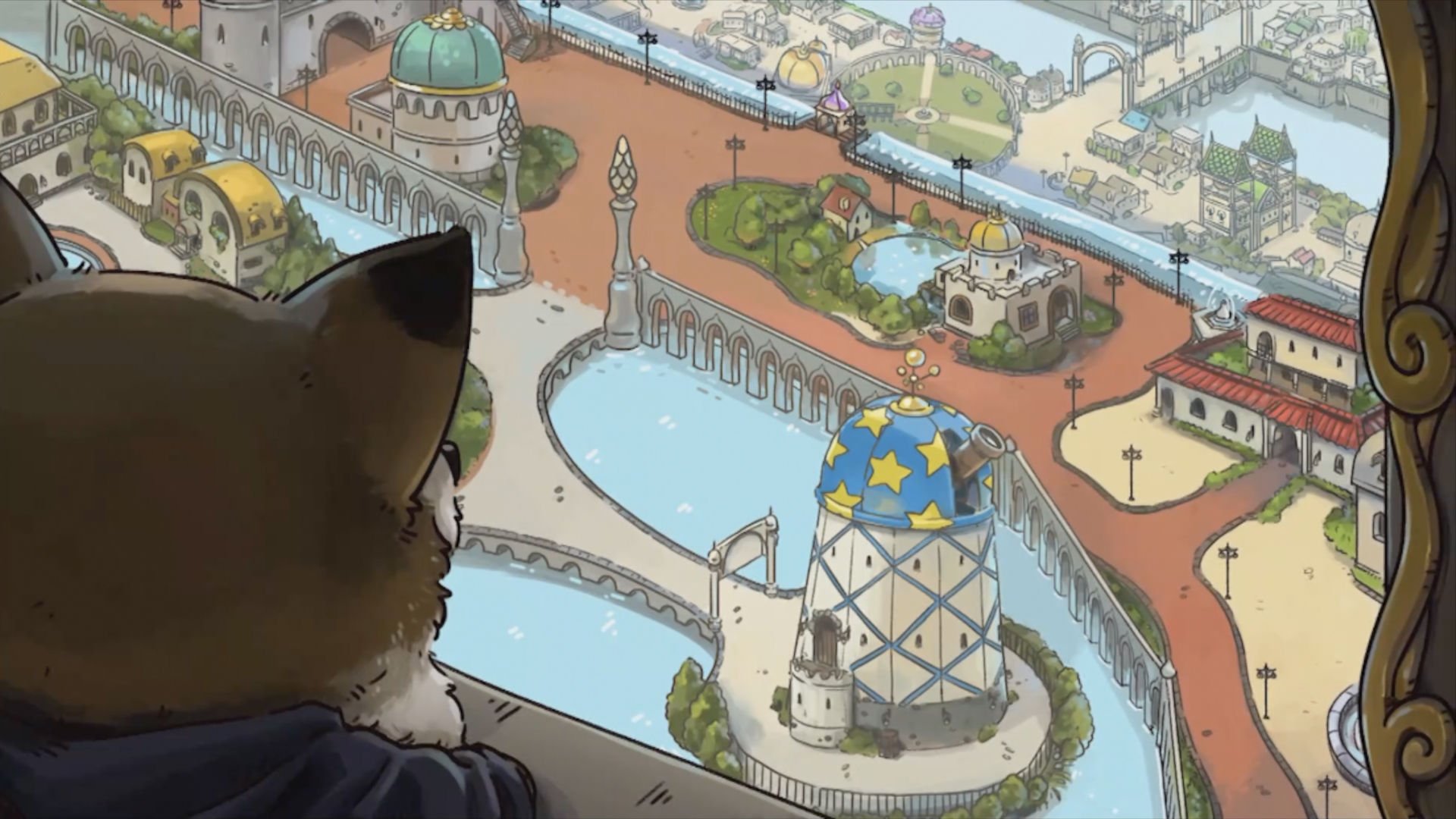
Nairi didn’t even appear on-screen until nearly 40 minutes in, after I’d completed a pseudo-tutorial as Shiro that introduced some of the sequel’s welcome new additions, like vibrant stylized maps, one for each of the game’s six areas, and special equipment that changes how you interact with the environment. Now you can click a grappling hook on strong roots to reach new scenes, or use pliers to open bolted-shut chests in the background. Once Nairi reclaims her rightful role as the playable character, several other new features are gradually unlocked: fast travel, two types of collectible artwork, a compass that enhances maps to show the location of collectibles that haven’t been found yet, and an NPC who sells puzzle hints for the reasonable price of just a single coin. Luckily, the citizens of Shirin drop loose change everywhere – on the ground, in the trees, under bridges. It’s all waiting to be noticed by someone in need, and unlike the first game, it’s all out in the open, so no more systematically clicking every object on-screen in case money is hidden inside.
There are also occasional ways to earn stipends from several characters. As a result, there are more than enough funds available to afford everything available to purchase. The most expensive items are all bonus content anyway, so scanning each new scene for coins is a fun extra challenge, not a necessary grind. It’s never even explicitly stated, only implied, that there’s money to be found, though any self-respecting adventurer will surely notice the coins lying around and get curious enough to click on one. Rising Tide needs more detailed instructions in general. From the startup suggestion about playing with headphones to the hints you can buy, every piece of information is conveyed illustratively. There are no written explanations, and for some mechanics, including ones that are necessary to progress, there are no explanations at all.
That’s particularly frustrating when teaching yourself to use one of the sequel’s new features, a “tool belt” that adds a bunch of extra steps, and an entire interface, to combining items. Confusingly, a few things can still be assembled in your inventory the old-fashioned way, but for the most part, instead of quickly clicking or dragging one object onto another to join them like in typical adventure games (including Tower of Shirin), Rising Tide tries something else: After opening your tool belt and your inventory, you’ll drop each item you want to combine onto the correct spot in the crafting area. Add the “tool” you’re going to use for the job, like glue or a hammer, and pray you did everything right so you don’t have to try again. Though it adds an additional element to inventory puzzles, the tool belt also adds a lot of extra clicks, especially in areas that require multiple dis- and re-assemblies of the same item combinations in order to advance.
At least while you’re doing all this crafting, you can enjoy the game’s excellent soundtrack. A complex score layers woodwinds, strings, percussion, and other instruments that complement the desert setting. The ethereal melodies that play in watery passageways turn bouncy in the busy city bazaar, and mysterious twangy themes accompany your trips through ancient ruins.
NAIRI: Rising Tide

| Genre: | Fantasy |
|---|---|
| Presentation: | 2D or 2.5D, Slideshow |
| Theme: | Conspiracy, Political, Animal |
| Perspective: | First-Person |
| Gameplay: | Puzzle, Quest, Visual novel |
| Control: | Point-and-click |
| Game Length: | Long (more than 10 hours) |
| Difficulty: | Medium |
| Graphic Style: | Cartoon |
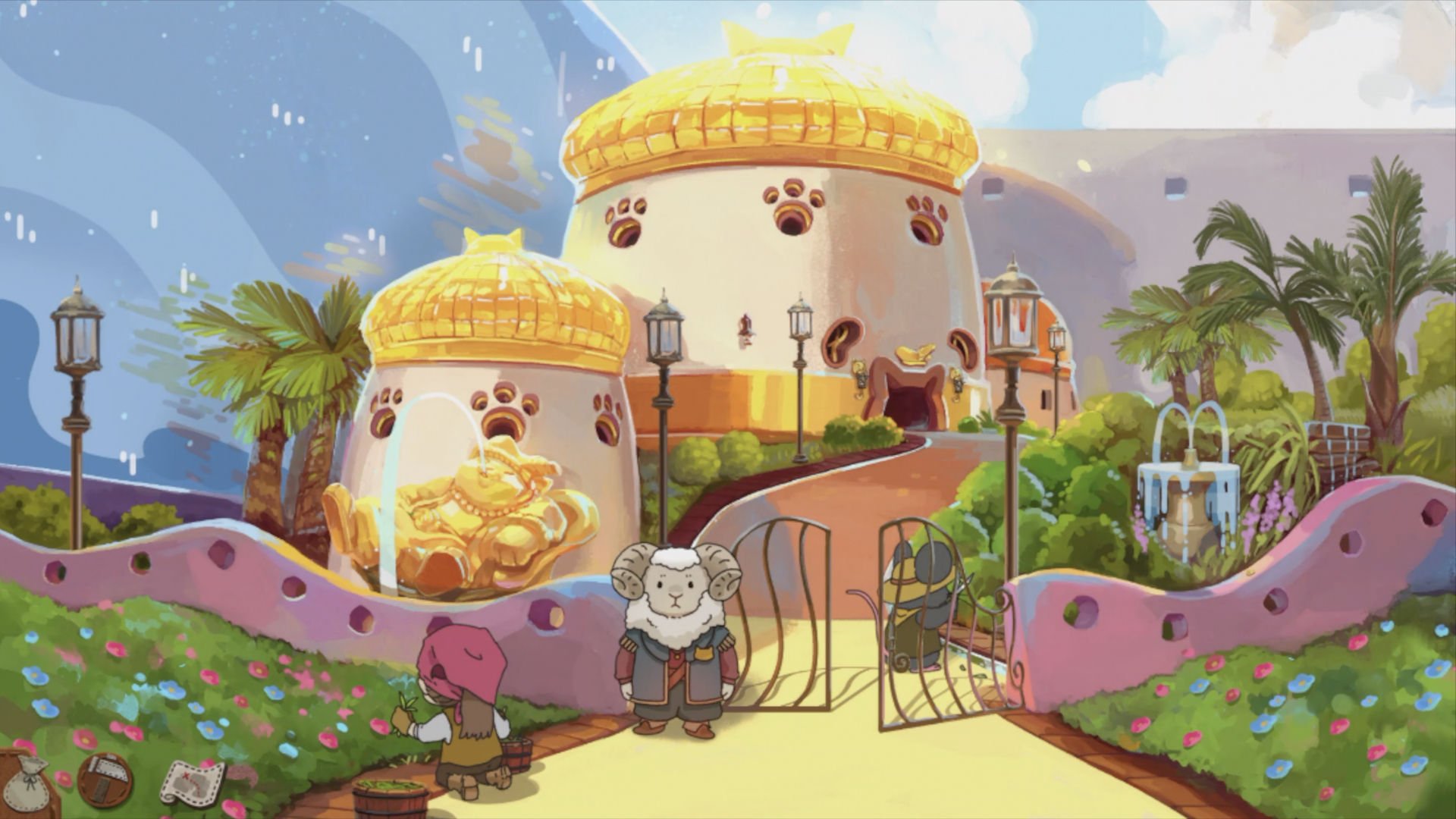
The graphics are just as great. While Tower of Shirin mainly took place in the city’s squalid “Poor District,” where Nairi hid out after her parents were arrested by political rivals in the series’ inciting incident, as she slowly makes her way back home to rescue them, Rising Tide moves onto sparkling baths, ornate cathedrals, prestigious universities, and luxe mansions in better-served neighborhoods, where the city’s middle and upper class citizens live. The 2D backgrounds are hand-drawn, bold, and colorful. From the animated, windswept petals that dance across a royal garden to the dusty light that illuminates a centuries-old tower (after you figure out how to open the windows), the level of detail and depth in each scene is a serious step up from the first game.
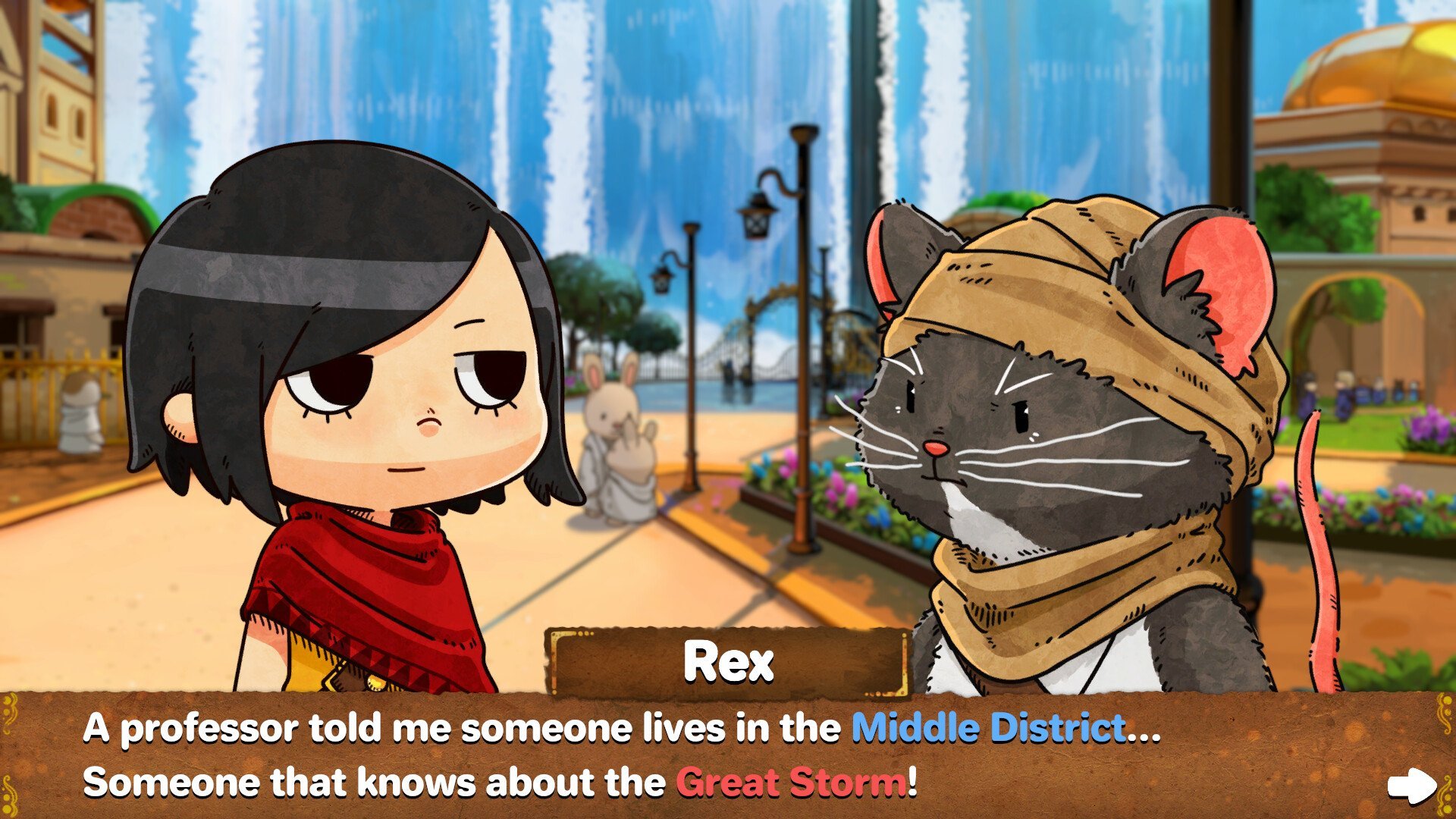
Likewise, the series’ signature cuteness has gotten even cuter! The city of Shirin is as anthropomorphic as ever, with all-new critters to interact with: bear bakers, dog doctors, toucan archeologists, and more. The visual novel portions of the game feature updated versions of the large, chibi-style character portraits from last time. Nairi and her usual sidekicks, Rex the scholarly rat and Sayo the sarcastic girl-thief, as well as the rest of the cast, cycle through a handful of expressions that reinforce their defining personality traits: Sayo makes a lot of scheming faces, and Rex likes to point a knowing finger in the air while he talks.
But as charming as watching humans and animals chat may be, there are too many typos or other mistakes for how much dialogue there is, like missing words, misspelled names, and an instance where Sayo’s character portrait is used while Nairi is speaking. Conversations account for a significant amount of Rising Tide’s content. Of the nearly 15 hours it took me to finish the game, the majority was spent reading dialogue, especially during the back half, where puzzles were so sparse in some sections, I started to wonder if the ones I did encounter were merely mirages. Though the absence of any voice acting presents more opportunities to enjoy the soundtrack as you click through text, it also draws more attention to the errors, and with all that talking, plot points inevitably start to contradict each other, too. After repeated reminders about how important it is to not upset bullies of the royal police force, characters threaten to hit them (or actually do it, even if it’s cartoon violence) multiple times with no consequences.
A lot of the dialogue is skippable, but that would mean missing out on some funny writing: “Fighting for equality…? Well, it sure beats having a coffee-obsessed boyfriend!” Truly, words to live by. You’ll also miss out on most of the story. The prior game introduced Nairi’s newly discovered ability to commune with a lost civilization and heed their warnings about an impending disaster. Though some progress is made in advancing that part of the plot and a few other storylines are also carried over, Rising Tide mainly focuses on related topical themes about the common people’s potential to unite against powerful corruption. While Nairi and her friends search for another character who vanished at the end of Tower of Shirin, they team up with an underground resistance group determined to wrench the city away from the ultra-wealthy. Recruiting people to join the fight is an ongoing side quest. (Turns out, even in an anthropomorphic desert metropolis, the way to get folks interested in a grassroots political movement is by explaining how it could benefit them directly.)
As Nairi’s worldview gradually evolves and she comes to explore important ideas, I started to think of Rising Tide as a great choice for young audiences to learn alongside her. The game’s attitude about affecting change is cheerful and optimistic. Obstacles are easily overcome, and even when the situation seems dire, a handy solution always appears. At least until the ending, when in service of the cliffhanger, a couple of harrowing twists cause a surprising tonal shift. Though I assume everything will work itself out in a few years at the start of the next game (or in the recap for this one), and though I thought the twists themselves were exciting turns, the sudden inclusion of life-threatening, bloody violence in the final act, as well as a flashback to one character’s brutal backstory, might be too distressing for the children I’d been envisioning connecting with the narrative. The rest of the adventure features lighthearted gags like Rex donning a Valley Girl disguise, and a farting duck whose gassiness is critical to progressing through a late-game area. The ending is such a drastic departure from that, it made me reconsider who the target audience is.
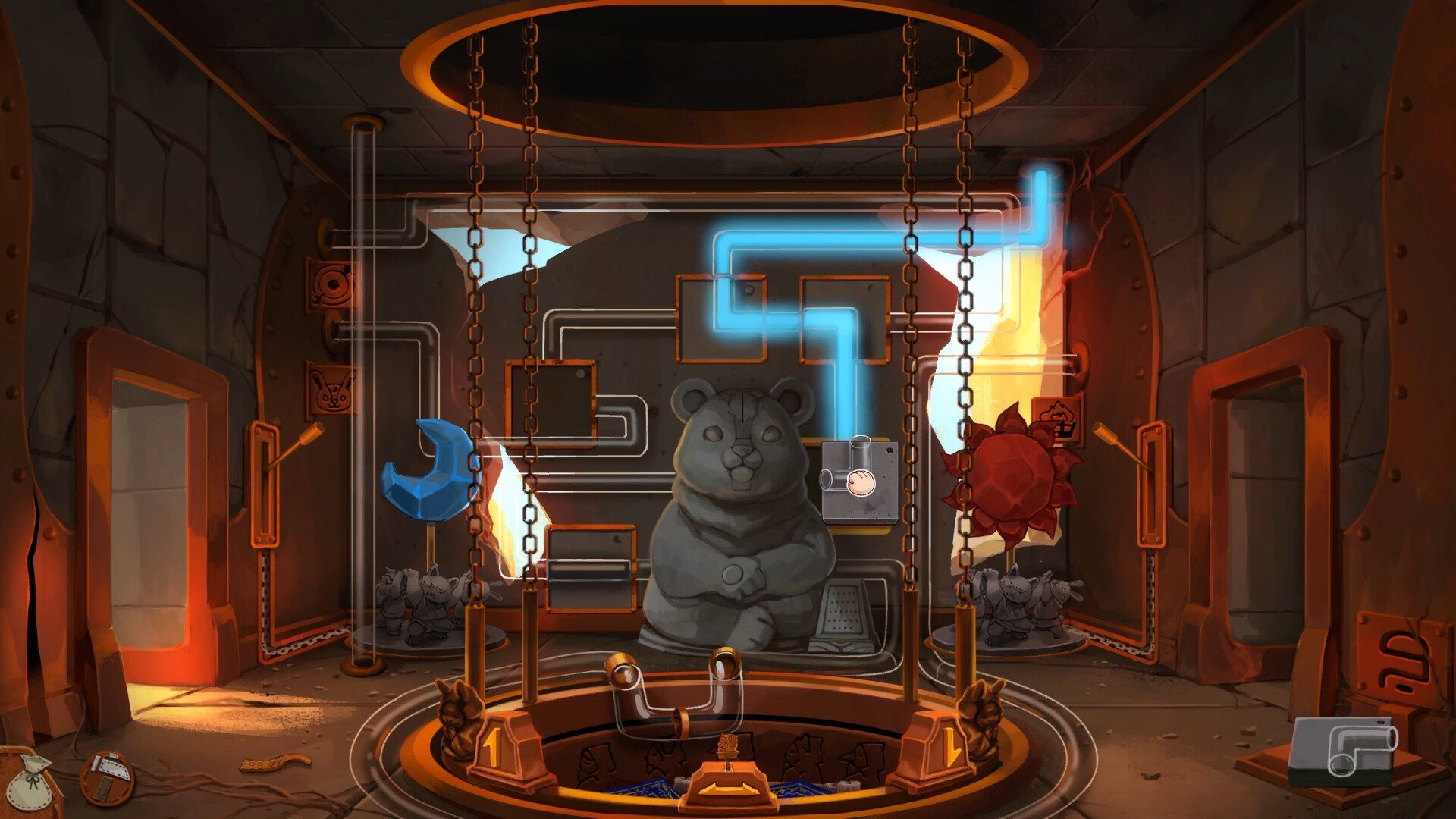
The puzzles had a similar effect. Whenever the gang gets tired of talking, the game turns into a classic point-and-click. As you peruse first-person scenes for gear to collect or puzzles to solve, item pickups are easy to spot and often contribute to fetch quests. There are so many, a character eventually says he’s tired of them. And so was I – if I had a coin for every time someone wanted coffee or a fresh-baked “bear bun” before they’d help me, I wouldn’t have needed to look for any! In addition to simple inventory or environmental puzzles, another common kind is pop quiz-style quick time events, some requiring you to answer questions about Shirin’s history, customs, and government with only a few seconds to choose each response. You’re never taught most of the information beforehand, not even in the prior game, but as long as you don’t bomb, you’re rewarded as if you’d aced it and can move on.
Thanks to its forgiving, familiar gameplay, once again I’d begun to think of Rising Tide as tailored to younger players... Then, several hours in, I entered the first of two large, complicated “puzzle dungeons.” Nearly a third of my total playtime was spent conquering them and the wide variety of tough puzzles within: information recall, spatial reasoning, riddles, pipe assembly, block movement, a thematic take on lights/mirrors, and many more, all interconnected, building upon each other as you work toward completing the dungeon’s main objective: escaping it. Striving for that goal and slowly making progress toward it, one solved puzzle at a time, was a fantastic showcase of the developer’s superb level design skills. I’m already looking forward to replaying the game just to take on the dungeons again (once enough time has passed that I’ve forgotten all the puzzle solutions).
But like the intense ending, the abrupt difficulty spike is at odds with how casual the rest of the gameplay is, and though the puzzle dungeons are expertly done, they also made me question who the game is ultimately for. The ability to bypass them can keep the challenge level low, but this is another feature that’s never taught. Only the most intrepid souls, brave enough to spelunk three menus deep, then click a button they don’t know the effects of, will ever learn about this option. For everyone else, whether you’re a story-first gamer or one who prefers puzzles will determine your relationship with the dungeons. To the puzzle people, they’re like a dip in an oasis, a rejuvenating break within a dialogue decathlon, but for visual novel fans, nonstop puzzling with practically no plot progression might feel like stepping on a cactus.
The overall experience of playing Rising Tide is similar. Depending on your familiarity with the franchise, it could be a long-awaited continuation that (mostly) improves upon the formula, but it’s also a cautionary tale about what happens if you haven’t played the first game already (or remember much of it so many years later). Despite its flaws, for me this sequel represents the former, but I’m a sucker for cute critters dressed in breathable linens so they can beat the desert heat.
Final Verdict
Part point-and-click, (bigger) part visual novel; part cozy anti-establishment adventure, part challenging puzzle gauntlet; wholesome but with a side of cliff-hung violence, it’s tough to pinpoint Rising Tide’s audience other than established fans of the previous game. A serialized narrative with another abrupt ending, no voice acting to enhance the massive script, a lack of clear (or any) explanations about several features, and an overabundance of fetch quests will likely keep this sequel from finding widespread appeal on its own. Still, significant graphics upgrades, new gameplay elements, and more ambitious puzzles are impressive displays of HomeBearStudio’s growth as developers. So if assisting an anthropomorphic uprising in bucking a system that’s rigged for the rich is your idea of a worthy cause, there’s a good time to be had with NAIRI: Rising Tide (ideally after starting at the beginning with Tower of Shirin first). Considering more than half a decade passed between the first two releases, there may be plenty of time to catch up before game three.
Hot take
The follow-up to NAIRI: Tower of Shirin is too self-referential to make waves with anyone not already familiar with the series, but longtime fans will find more of what made them just that in Rising Tide: adorable talking animals, a ton of dialogue, cozy point-and-clicking, and a jarring cliffhanger that leaves room for the next game.
Pros
- New gameplay features like maps, fast travel, and collectibles
- Uplifting story about fighting back against corruption
- Cute, colorful graphics stay true to the series’ cozy roots
- Thematic soundtrack complements the desert setting
- Challenging “puzzle dungeons” are rewarding to complete
- Hints and the ability to bypass tough puzzles can mitigate difficulty
Cons
- Confusing opening skips over the resolution to the first game’s cliffhanger
- No written instructions or hints, and some game mechanics are never explained
- Tool belt crafting feature is cumbersome
- Lots of dialogue with text errors but no voice acting
- Another cliffhanger ending abruptly changes the tone
Lizzie played NAIRI: Rising Tide on PC using a review code provided by the game's publisher.

- Advertisement
- Help support AGH by advertising with us









0 Comments
Want to join the discussion? Leave a comment as guest, sign in or register in our forums.
Leave a comment