
Shuten Order review

- 0 Comments

Mix of visual novel and five distinct gameplay styles comes together nicely in unique supernatural mystery
I love a good visual novel, but my attention span makes it hard to keep my eyes glued to walls of text for extremely long periods of time. No wonder, then, that Shuten Order sounded like a breath of fresh air: still a visual novel at its core, but couched in a variety of gameplay formats, including action, horror, escape room, and dating sim elements, with plenty of great character designs to boot. And yet even with all that, the visual novel element itself is far from short-changed. For better or worse, depending on where you sit on this particular fence, Shuten Order will scratch your literary itch and/or test your patience with hours upon hours of lengthy text sections to experience the full scope of its narrative. Either way, it manages to weave an engaging dystopian sci-fi mystery, even if its “throw everything at the wall and see what sticks” approach to gameplay likely won’t always be a bull’s-eye.
The story centers around Rei Shimobe, a young woman who awakens at the outset to the stark realization that she has no memory of her past. Within mere minutes, however, she is visited by the young Himeru and her middle-aged partner Mikotoru, who claim to be angels sent by God to assist Rei. They explain that the city they’re in is run by a religious organization called the Shuten Order, and Rei is, in fact, a reincarnation of the Order’s Founder, who was killed and dismembered the previous night. In order for Rei to regain her memories and complete her reincarnation, she has only four days to track down her predecessor’s killer, get them to confess, and take their life in turn. Trouble is, the culprit’s identity is a complete mystery.
Really, though, the only possible suspects for the murder are the Order’s five ministers, essentially the Founder’s inner circle and the only ones with sufficient access to him to have done the deed. There’s Kishiru Inugami, the Minister of Justice, who holds truth in absolute highest regard; Yugen Ushitora, the hulking Minister of Health; the diminutive but genius Minister of Science Teko Ion; the Minister of Education Honoka Kokushikan, who runs a prestigious academy within the city; and Manji Fushicho, the Minister of Security who seems slightly unhinged and won’t shy away from violence in order to see justice carried out.
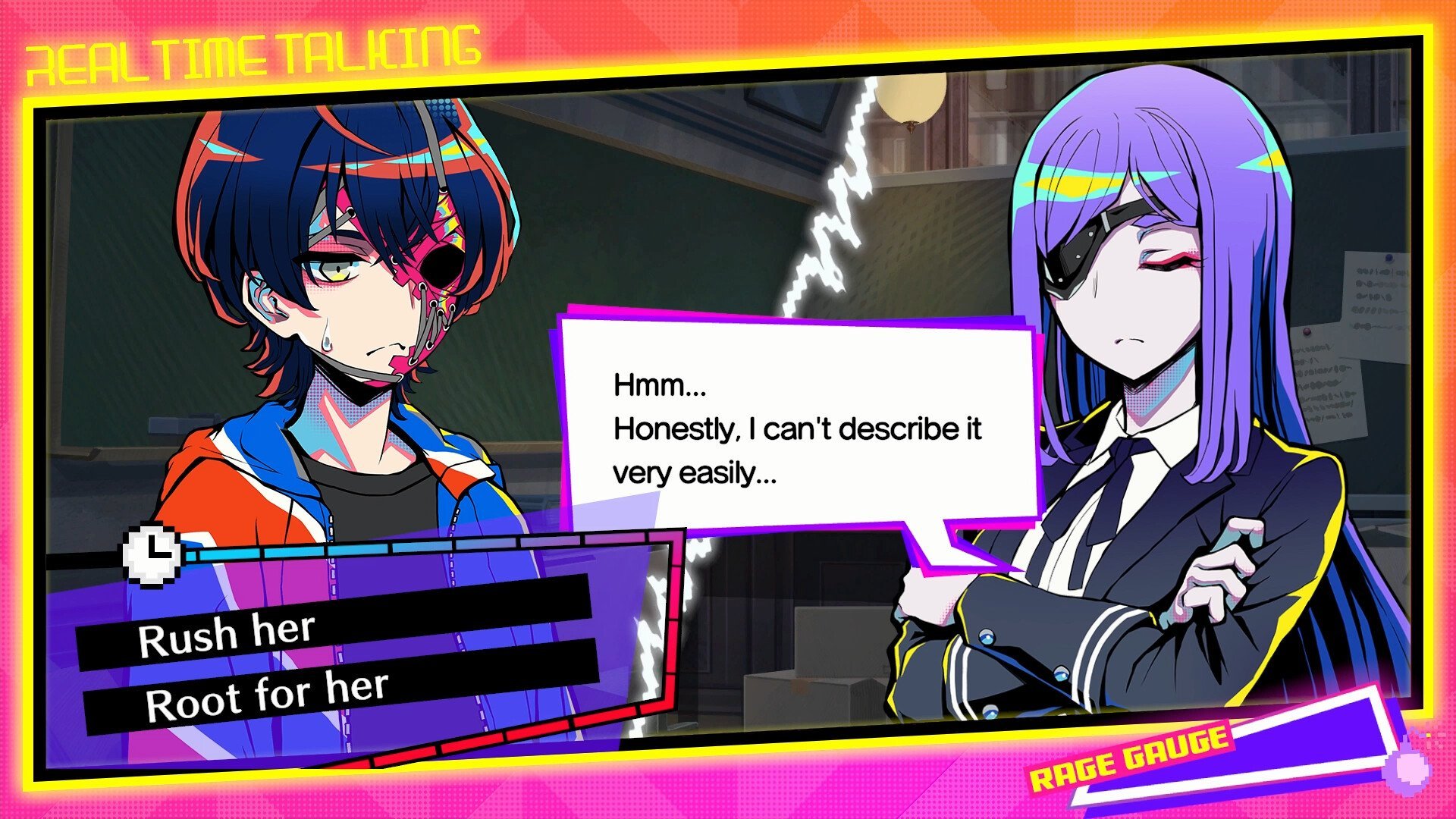
Each of the five must be investigated, in any order you choose, bringing several unique gameplay spins to the traditional visual novel formula along with it. Teko’s segment is fairly straightforward, but spending time at Honoka’s school takes the form of a school-life dating sim, with Rei – who must wear a mask at all times so as not to be recognized as the Founder – becoming entangled with a trio of love-starved and decidedly off-kilter sisters. This involves interacting with the three siblings, be it in simple conversations, triggering story events together, or joining them on excursions away from campus, all to build up an affinity meter representing their love for Rei. Once it’s maxed out, sparks are ready to fly – or at least a confession that may lead Rei further in her investigation. Like some of the other ministers’ chapters, this one is still very much a visual novel at heart, just with some added bells and whistles.
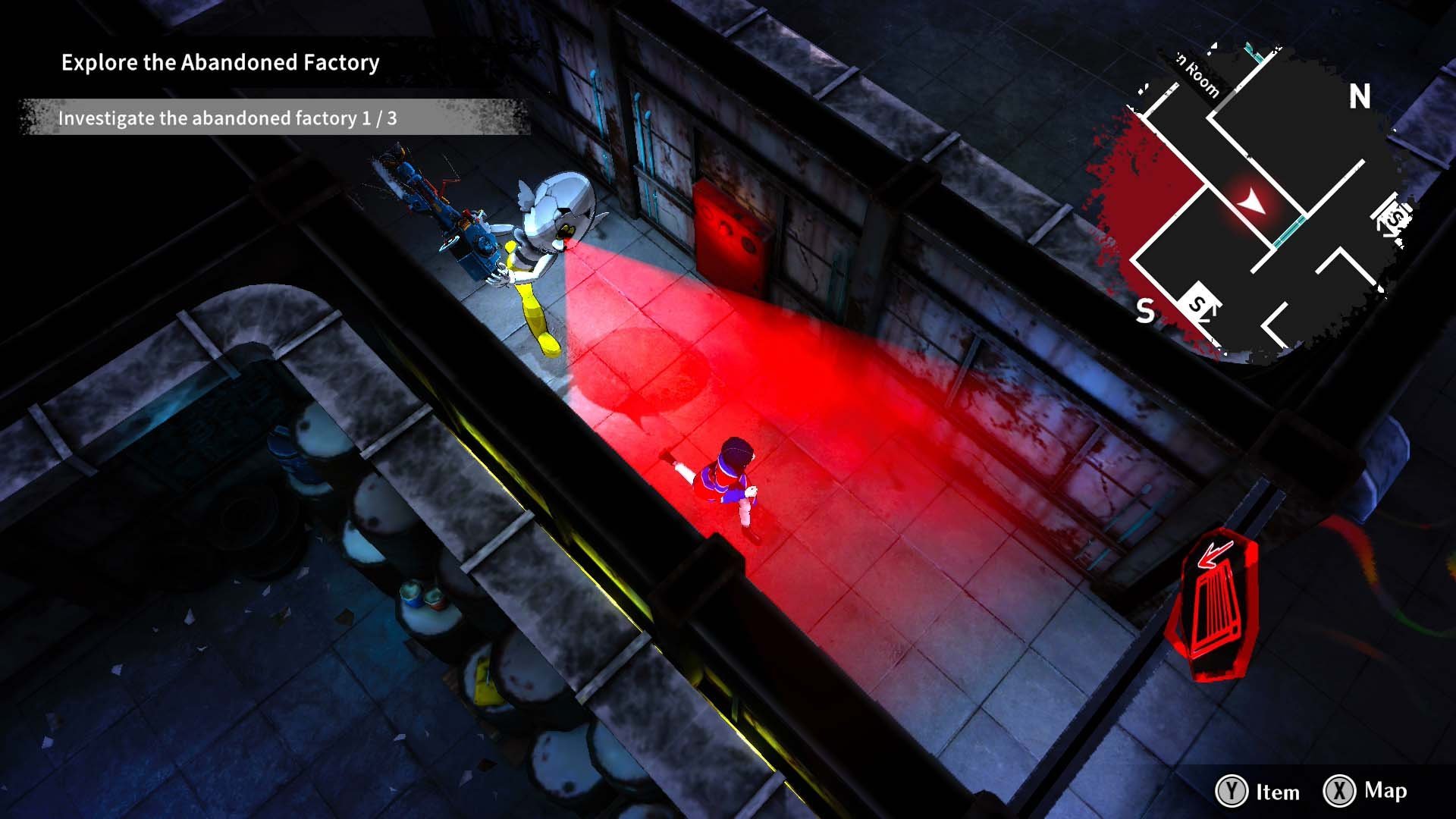
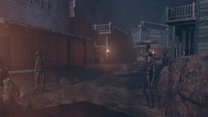
Pursuing Manji Fushicho at the Ministry of Security, on the other hand, soon turns into a stealth-based horror game as Rei is dragged into a hunt for the maniacal serial killer Nephilim. While interactions with Manji herself are still your traditional VN, there are multiple breaks to the narrative where Rei will find herself alone in a dark abandoned building, with a sledgehammer-wielding maniac hot on her tail. Here the perspective switches to an overhead view, tasking you with navigating the facility to accomplish a series of objectives, all while keeping out of the lunatic’s red-tinted vision cone. Should the patrolling Nephilim catch sight of you, the music ratchets up in tension and you’ll need to run for your life, making use of shutters to seal hallways behind you and lockers to hide within until Nephilim loses your trail. Rei is completely helpless, so this is definitely meant for those who enjoy cat-and-mouse survival sequences.
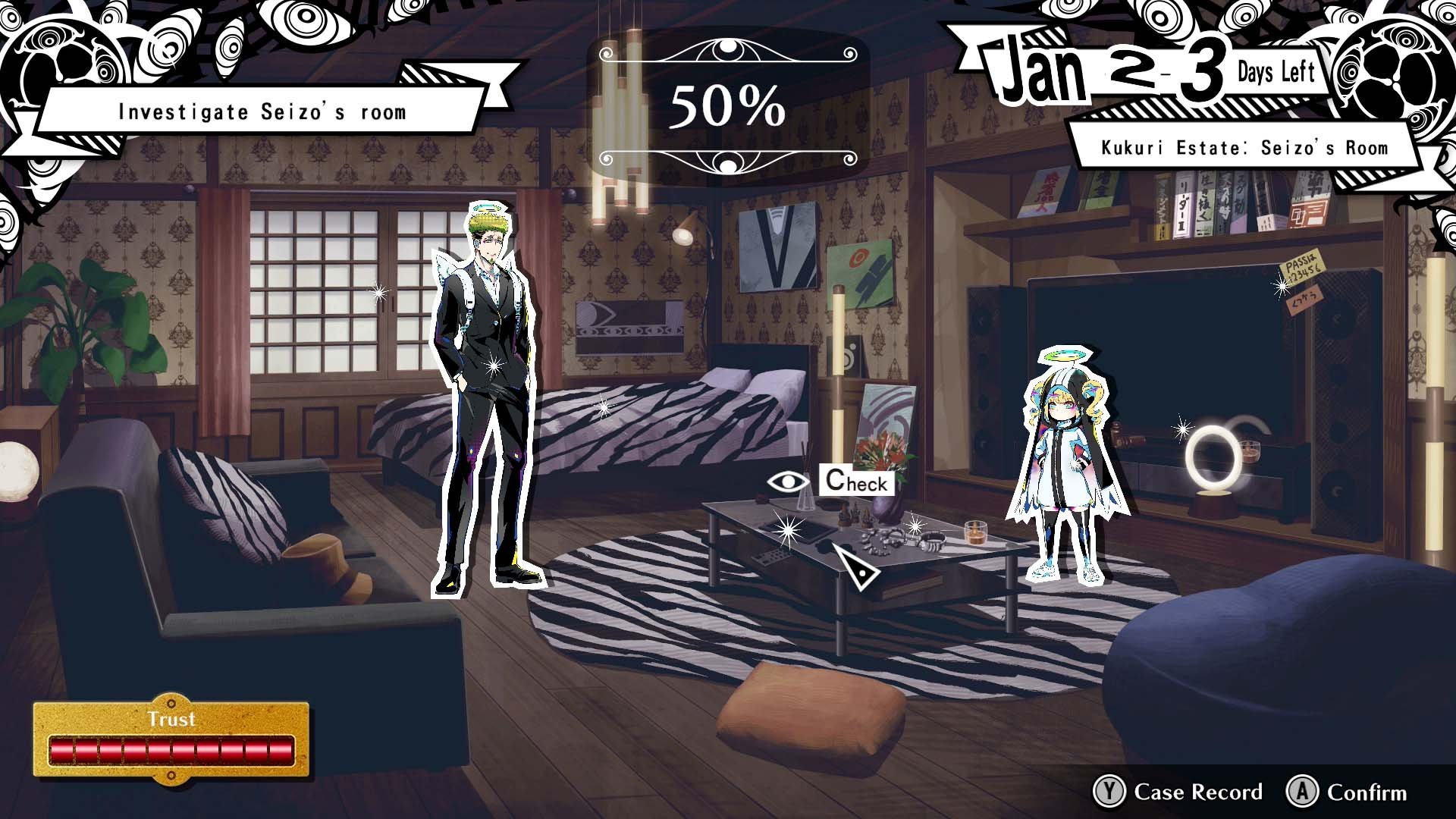
Manji’s chapter is the most gameplay-heavy, with all other routes sticking much more to the VN formula. Accompanying Kishiru Inugami to a posh island manor to clear up a murder plot surrounding a wealthy family’s inheritance plays out very similarly to a Phoenix Wright-style courtroom drama, with witnesses to interview, rooms to search, and statements to contradict. Finally, Yugen Ushitora’s battle royale-style killing game is a series of tile-based mazes that must be traversed in first-person view, though all actual events play out, as usual, in familiar visual novel style. This one does add on a bona fide escape room puzzle near its end, however, with a bunch of locks and codes that must be deciphered in order to proceed.
Each distinct section of Shuten Order features refreshingly unique settings and tones. You’ll even travel to a subterranean land where dinosaurs roam in a chapter that puts far less emphasis on “visual” and more on the actual “novel,” presenting multiple protagonists and branching timelines. The occasional chapter shifts the viewpoint to first-person or an isometric overhead view of Rei and her surroundings, and some exploration sections peppered throughout see you move either Rei or a cursor on the screen and click on points of interest to examine them, but the hand-drawn art style (which the developers refer to as “cult-chic”) is always vibrant and maintains an impressive visual spectacle throughout.
While it sure makes for a catchy marketing hook, the five-pronged gameplay approach has one potential drawback: it is extremely unlikely that all of the diverse styles will appeal to all players. Chances are, like me, you’ll be extremely intrigued by one or two of these segments and either take them on immediately or intentionally put them off to savor last. Either way, the game’s progression will, sooner or later, inevitably take you down some paths that may be less personally appealing but must nonetheless be completed to reach the game’s sixth and final chapter. And since the investigations into each of the five ministers fall into that classic VN trap of taking their sweet time, this translates to potentially many hours spent on gameplay outside of your wheelhouse.
Shuten Order

| Genre: | Horror, Mystery, Science Fiction |
|---|---|
| Presentation: | Realtime 3D |
| Theme: | Paranormal, Romance, Whodunit |
| Perspective: | First-Person |
| Gameplay: | Investigative, Stealth, Visual novel, Choices matter, Dialogue |
| Control: | Direct Control |
| Game Length: | Long (more than 10 hours) |
| Action: | Stealth |
| Difficulty: | Low |
| Graphic Style: | Anime |
Ultimately, though, these variations are largely window dressing for what is still a visual novel through and through. When not hiding from stalking serial killers or lovesick high school girls, there is a TON of narrative to read through and digest. While most of it is central to whichever sub-story you’re currently embroiled in, the game reminds you every now and then that there is an overarching mystery to solve and may drop a few breadcrumbs of information toward that larger goal. However, depending on the order you choose to play through the chapters, the presentation of certain key clues may be awkwardly jumbled or spaced rather far apart. In my case, certain details that could easily have been revealed just an hour or two apart arrived days and even weeks after each other in real time. Fortunately, even with such a long game it wasn’t hard at all to keep track of the various loose ends until the story finally ties them back together at the end.
Allowing only four days to complete Rei’s task presented a few challenges to the writers, particularly with five ministers to investigate and many hours of narrative to uncover. The answer to this problem is that Shuten Order isn’t just a supernatural mystery but a time-traveling supernatural mystery. At the conclusion of each minister’s investigation, Rei’s body succumbs, causing her to die and be reborn back at the beginning of the four-day window, forgetting everything she just learned (this is rectified for the final chapter so that a satisfying conclusion is still possible).
This means that while you, as the player, may start to piece together a few of the Order’s mysteries, Rei spends the majority of the game fumbling around in the dark and is constantly reset back to zero every time the case makes any headway. This is perfectly fine, though, as each investigation reveals unique facts that don’t impact the others. At worst, there are a few times when Rei can’t see the forest for the trees while you yourself are perfectly aware that something you just read doesn’t quite add up.
One concern that did rear its head a few times, though, was that my attention wasn’t always fully engaged, which I can definitely see being closely tied to the game’s design structure. Every chapter wants to be somewhat self-contained, with the possibility that some will land and others won’t. At the same time, there’s the added challenge of keeping the overarching mystery relevant for so long between them. Along with some necessary repetition caused by time resetting, characters also tend to be quite wordy with each other, speaking in the sort of long-winded dialogue that is pretty emblematic of the genre.
And this game has an extremely large cast. Apart from Rei, the two angels and the five Shuten Order ministers, there’s a wide range of supporting characters that are equally memorable. At the Shuten Academy are the three Kokushikan sisters, each of whom Rei would rather steer clear of but is forced to interact with. In another chapter, Rei meets the three adult heirs to the Kukuri Pharmaceutical fortune, along with their households and servants, all of whom play major roles in tracking down the killer in their midst. The Yugen Ushitora killing game, of course, only works with a plethora of other contestants/potential victims to get to know before they are ruthlessly killed off. It’s not all straightforward human characters, either. Teko Ion, the Minister of Science, has a robot sidekick, Arale – basically a sentient metal cube that moves around on plasma tentacles – who has a critical part in the proceedings; while Security Minister Manji Fushicho rides around on a motorcycle adorned with a talking skull.
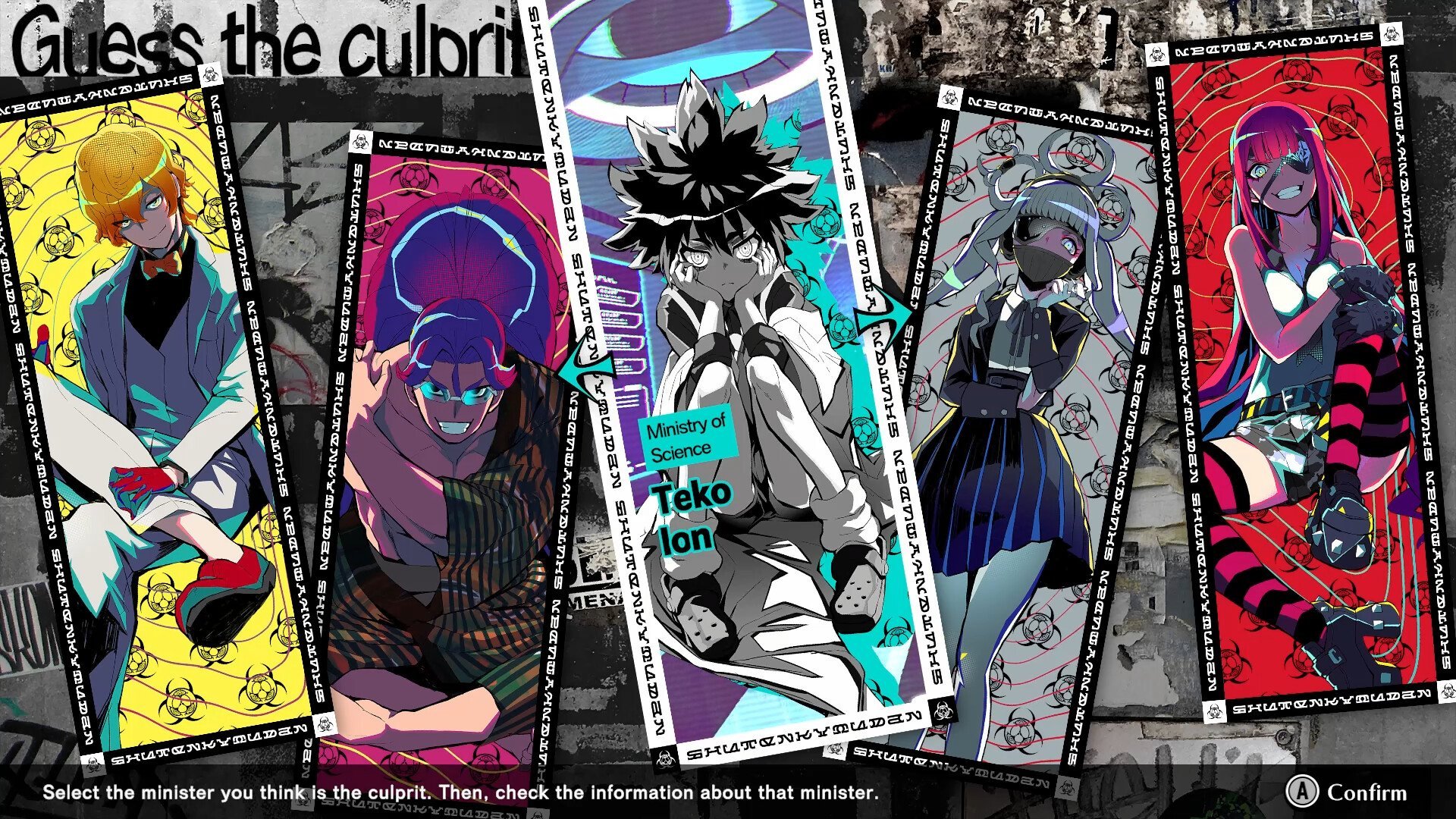
Character designs across the board are fantastic and well detailed, with plenty of large-scale artwork and one-off inserts to showcase them and further flesh out their personalities. The Kukuri siblings, for instance, have harsh faces with downturned lips and not a hint of good humor to herald their detestable nature, while the Kokushikan sisters at the academy all wear an article of clothing that covers one of their five senses, be it an eye patch, a face mask, or headphones.
One thing that really stood out to me is how much visual mileage the game gets out of limited art assets with simple manipulation and just a handful of poses and expressions. Character portraits may animate in basic ways, for example giving a bounce or a jump to complement an exclamation, while scenes are interrupted by comic book-style panels on occasion. It adds quite a bit of kinetic energy using static assets, without a need for much actual animation.
Equally important to the characterizations is the voice work. The game is fully voiced in Japanese, with only bits of omniscient narration and a few minor characters who rank too low to even get character portraits remaining silent. While the performances are very good across the board, the one character I quickly grew tired of was Rei herself, due to her perpetual clueless and put-upon nature. It’s all easily skippable, and indeed enjoying the voiced dialogue does tend to slow down proceedings quite a bit. That alone can easily add many hours to an already lengthy playtime, pushing my total time to more than 50 hours (closer to 75 by the end) before all was said and done.
In a game this substantial, it’s no surprise that the backing music tracks tend to repeat before long. So it’s a credit to Shuten Order that its music doesn’t get tiresome. Most of it pretty much matches the atmosphere of the current chapter – menacing when Rei is in mortal peril, more lighthearted when things get silly, often with an air of mystery – and the compositions have a futuristic quality to them, with synth undertones and robotic and ephemeral instrumentations. The score can usually be classified as “decent to good” and there’s even one particular track that I quite liked, featured in the school romance chapter, which hit an emotional chord as the story reached its climax.
Final Verdict
Shuten Order takes an honest-to-goodness shot at breaking up the inherent monotony of visual novels and their mountains of text. While this puts it in a class of its own, the consequence of featuring so many varieties of gameplay is that it’s virtually impossible to appeal to players equally. And, of course, there is still a lot of visual novel here, so a love for the genre remains a must. For those that have it, everything on offer – from narrative to character designs to voice acting – is high quality and well worth experiencing, so long as you block off a lot of time to get through it all. It may not be the future of the medium, but it is an intriguing experiment nonetheless.
Hot take
Shuten Order breaks up the traditional visual novel experience with a gameplay conceit or two you’ll love, plus a few you’ll likely just need to deal with, to tell a compelling sci-fi mystery with a unique take on the genre.
Pros
- Intriguing sci-fi story segmented into interesting-in-their-own-right standalone chapters
- A plethora of gameplay twists on the traditional visual novel formula
- Fantastic character designs
- Well-done Japanese voice performances
Cons
- Not all gameplay variations are likely to appeal equally
- Can’t seem to escape the drawn-out visual novel wordiness
Pascal played Shuten Order on the Nintendo Switch using a review code provided by the game's publisher.

- Advertisement
- Help support AGH by advertising with us







0 Comments
Want to join the discussion? Leave a comment as guest, sign in or register in our forums.
Leave a comment