
The Supper: New Blood review

- 0 Comments

A scrumptiously wicked recipe is watered down somewhat by leaving the juicier player bits out
No one likes being bullied. Whether it’s being pushed into a locker or being swindled for cash, it sucks to be kicked to the curb. When you’re going through it, it’s easy to imagine how you’d get back tenfold at your aggressor, but calmer heads prevail in most cases. Stewie S. Appleton, the sad lump of a man who stars in The Supper: New Blood, is not such a case, as he’s finally reached the breaking point. A fun premise sees this lovable but pathetic man become a murderous vigilante in deliciously sadistic ways. So it’s a bit disappointing that the game does little to push beyond this starting point, feeling more like a tasty appetizer rather than a completely satisfying feast.
In the original free 2020 adventure The Supper, kindly old Ms. Appleton took sweet revenge on a trio of pirates by poisoning them all one by one before feeding their corpses into her meat grinder. Many years have passed since then, and in New Blood you play as her great-great-grandson. Stewie hasn’t had the best luck in life: he was orphaned in his youth after being kidnapped by a vampire on a carnival ride, and though he was rescued and left with the family manor and remote motel in his grandfather’s will, he’s barely able to scrape by with the meager earnings brought in by the occasional tourist to the small town of Widowport.
After being shaken down – again – by the corrupt town sheriff, Stewie decides that enough is enough. He briefly talks over his feelings with his imaginary crow friend Martin, along with a crude stuffed scarecrow he treats as if it were his “Nana” Ms. Appleton, and decides it’s time to fight back against the bullies who plague the world with their awfulness. And in keeping with his ancestor’s culinary proclivities, the only fate befitting these terrible tormentors is to be brutally murdered and transformed into the evening meal’s main course.
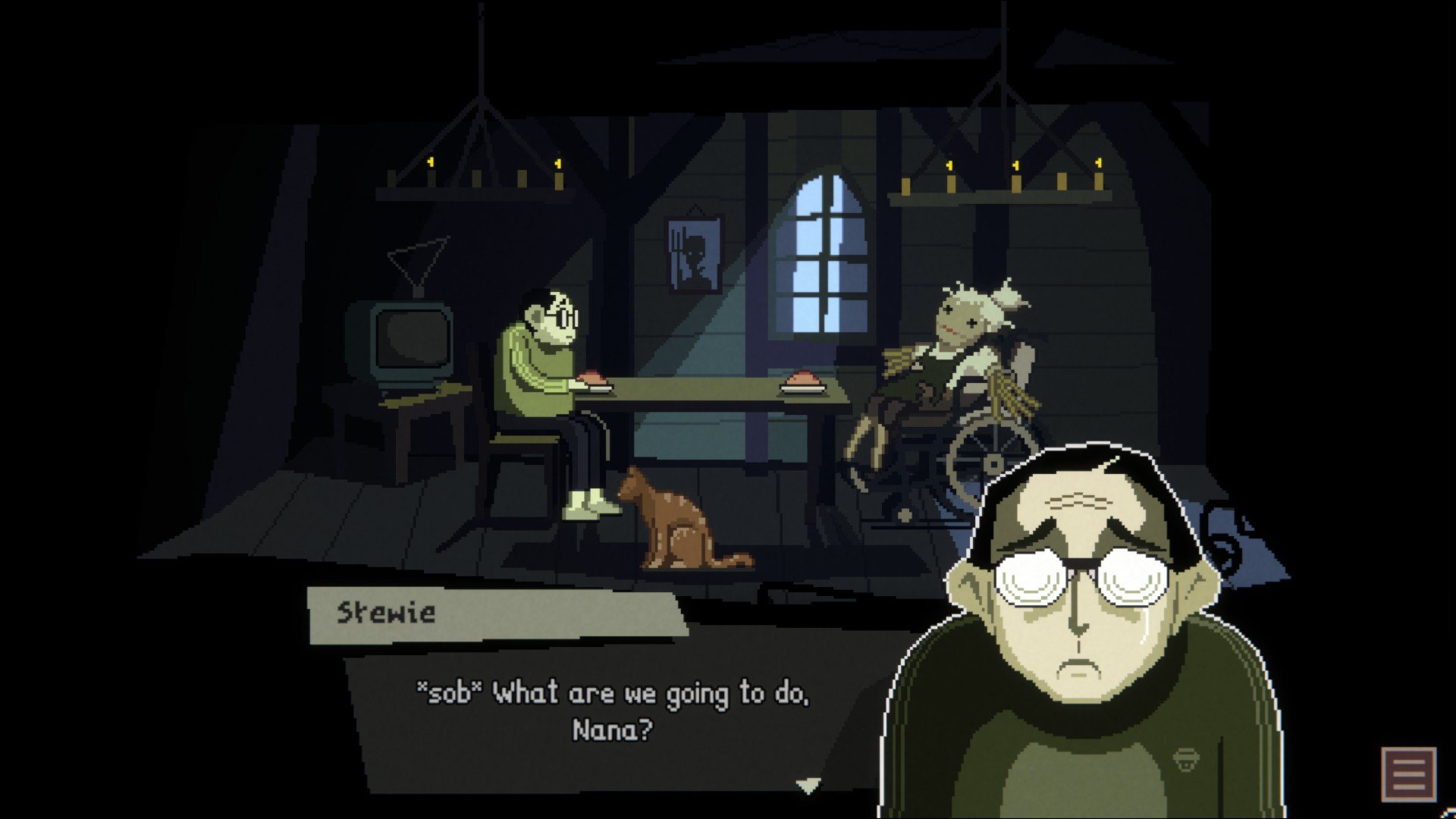
New Blood is a whimsically macabre point-and-click adventure that revels in its over-the-top violence. As the owner of the Twin Sisters Motel, Stewie must observe and judge each guest that checks in to determine if they are a good person or deserving of death. He has plenty of options when a bus breaks down on the road, and all of its colorful characters rent rooms while they await repairs by the end of the week. Other guests sometimes trickle in as well, and each day you get to choose one character to interrogate. To deduce their motives for visiting such a desolate place as Widowport, you’ll use a truth serum Stewie concocts using a cocktail recipe. (Which you can help him do yourself in the playable demo, though it’s not at all necessary.)
Each character can be questioned in any order, but once you choose which guest to focus on, you’ll play through that character’s chapter in its entirety. They’re all very distinct in both design and personality: Miranda is an artist who uses various French phrases and has red paint(?) on her sleeve, while Sebastian appears covered in scars due to his job as a caretaker for the sharks at Red Lake Oceanarium, to name just two. If someone is deemed worthy of judgment, you will be treated to a cartoonish death scene of the individual as Stewie dispatches them in a variety of creatively bloody ways.
Stewie will then use his Nana’s ancient family cookbook to determine the best use of his newly gathered human meat. This will require two additional ingredients, and the voice in Stewie’s head (Martin the Crow) will direct you to explore the town to find the needed items. At this point, you’ll be introduced to a beautifully detailed map of the 90s-era Widowport that shows all of the different places available to visit – including an old light house, a drive-in movie theater, and the ruins of the old district where Ms. Appleton’s Twin Sisters Tavern once stood. Every background is adorned with gorgeous pixel art, with lots of fun touches that make each area pop with personality – such as the pigeon holding a knife in its beak outside the old tavern ruins who wasn’t too happy with the fate of its ancestor in the first game. The design vibe is heavily reminiscent of Maniac Mansion’s, especially during any scene overlooking the Appleton estate and motel.
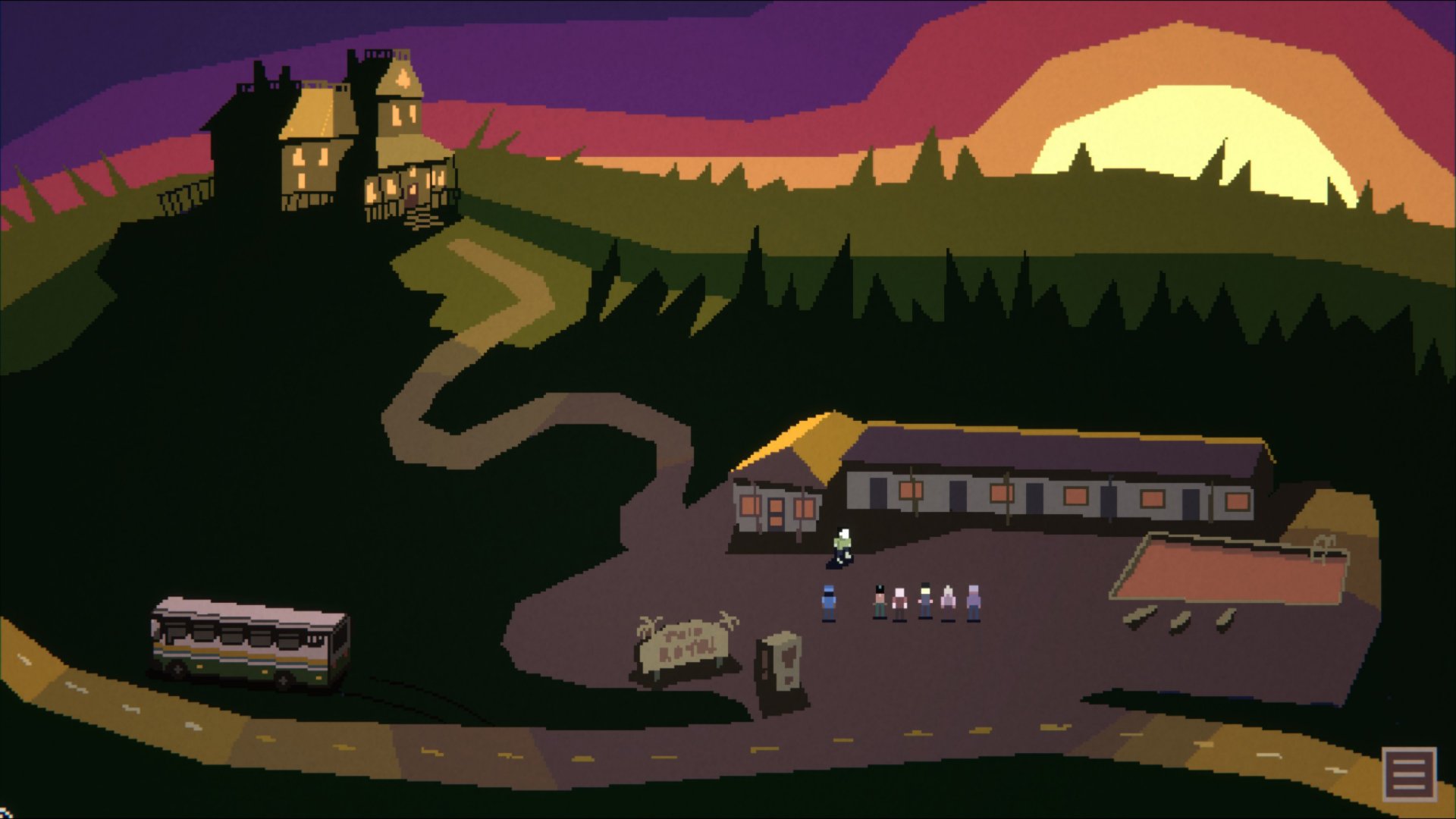
Some scenes are populated with memorable characters that make them stand out, like the old diner having a bizarre moose-headed patron chowing down at a nearby table, or someone sniffing the ground by a headstone in the graveyard to find inspiration for her latest perfume fragrance. It’s a genuine joy to uncover the diverse locales and curious citizens that make up this bizarre town. The characters are all depicted with still close-ups during conversation, and dialogue is accompanied by a grunt or exclamation of audio that suits the tone of their communications. Each person has a variety of facial expressions that change between dialogue screens, as well as having full-body character models within the game world. There is only minimal accompanying music, but the tracks here have a whimsical run-down carnival vibe to them that fit the themes and characters well.
There’s not a lot of animation in New Blood, either. In a traditional point-and-click, you click on the ground or certain hotspots and your character will move around and occasionally offer bits of fun descriptive thoughts on something you’re mousing over or interacting with. Here Stewie is rooted to the spot of wherever he begins on a screen, and rather than moving him manually, you direct him from screen to screen via large arrows leading to the next location. (If no arrow exists, you simply back out to the previous map view).
The Supper: New Blood
| Genre: | Comedy, Mystery |
|---|---|
| Presentation: | 2D or 2.5D |
| Theme: | Psychological |
| Perspective: | Third-Person |
| Graphic Style: | Pixel art |
| Gameplay: | Investigative, Puzzle, Quest, Deduction |
| Control: | Point-and-click |
| Game Length: | Short (1-5 hours) |
| Difficulty: | Low |
Hotspots you can interact with can be highlighted with a right-click, but they are few and far between compared to the number of bizarre background pieces that I desperately wanted to examine. And even when interacting with them while hunting for ingredients, only the ones relevant to your evening recipe will elicit more than an offhand remark. You might find a crate of old onions that yields nothing but a quick comment one night, only to find that the same crate now prompts an entire puzzle sequence the following evening.
There is a newspaper with articles each night that you can access while exploring, and the places you are required to visit are typically referred to in the news columns of that day (e.g. a piece about the old town well on a day you need well water). These short articles have some fun bits of world-building that add to Widowport’s particular kookiness, like an interview with the local homeless man Mr. Peach, or the opening of the new Museum of Mysteries in the town square. I enjoyed reading them in search of clues towards my next objective, but it’s a shame there aren’t more ways to deduce for yourself where to check for ingredients.
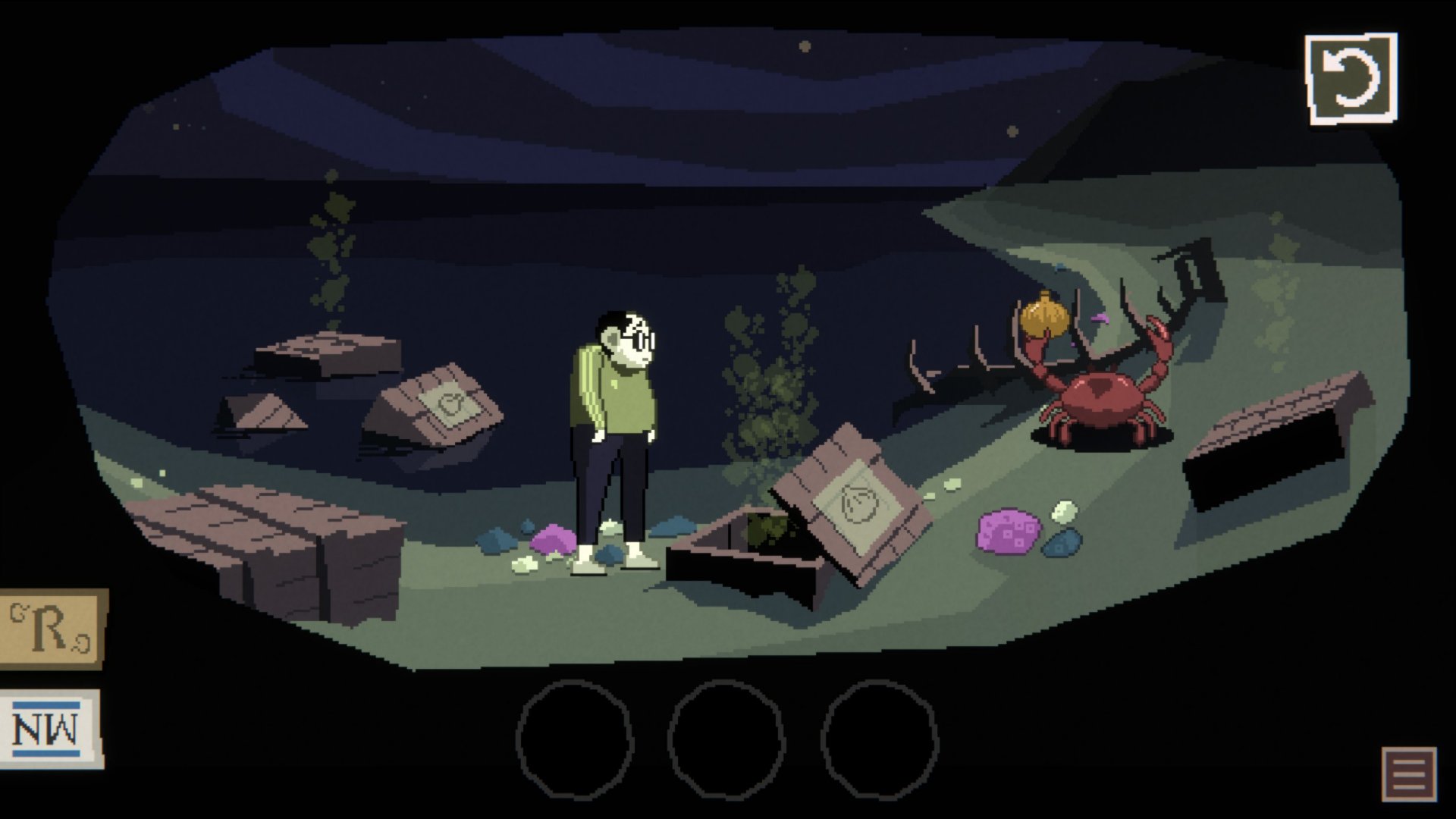
While there is some challenge derived from the puzzles in New Blood, the vast majority are disappointingly simple. As you are traversing Widowport, you have three total inventory slots available. The game will only let you pick up an item relevant to the section you are currently playing through – for example, you can’t take from the aforementioned box of onions on a night when the onion isn’t needed. Because of the very limited number of items at any one time, there was rarely a point where I didn’t know what to do with the ones I had acquired. That doesn’t mean the items aren’t fun to find. One I picked up was a literal scary story, while another was a gator-headed rip-off of some totally radical ninja reptilians. But rather than having to figure out where and when to use them, I kept feeling like there weren’t enough options to really keep me guessing what to do with something I’d picked up.
Even using items is a weirdly clunky affair. Rather than clicking on an object from your oversized, ever-visible inventory and applying it directly to something in-game, you have to first click on a hotspot in the environment and see if it brings up the option to drag and drop an item there. This further limits the number of possibilities for deducing a puzzle solution on your own.
After gathering the necessary pair of ingredients for the evening meal, you are automatically teleported back to Stewie’s home to complete a cooking mini-game. Each ingredient you’ve collected is shown, along with that course’s required body part, and you are given instructions from the recipe book on how to prepare the meal. Perform a task (such as grilling some spicy peppers) and a bar will appear on-screen with a little slider moving side to side. Clicking to stop it in the middle of the bar is the goal, as this means you performed the task flawlessly. But if the moving piece lands outside of the sweet spot, you will fail that section of the meal preparation. (By default it moves quite fast, but there’s an option to slow it down in the main menu.) Once you have completed each task required to prepare dinner, you receive a score out of three stars that determines how well you put everything together...
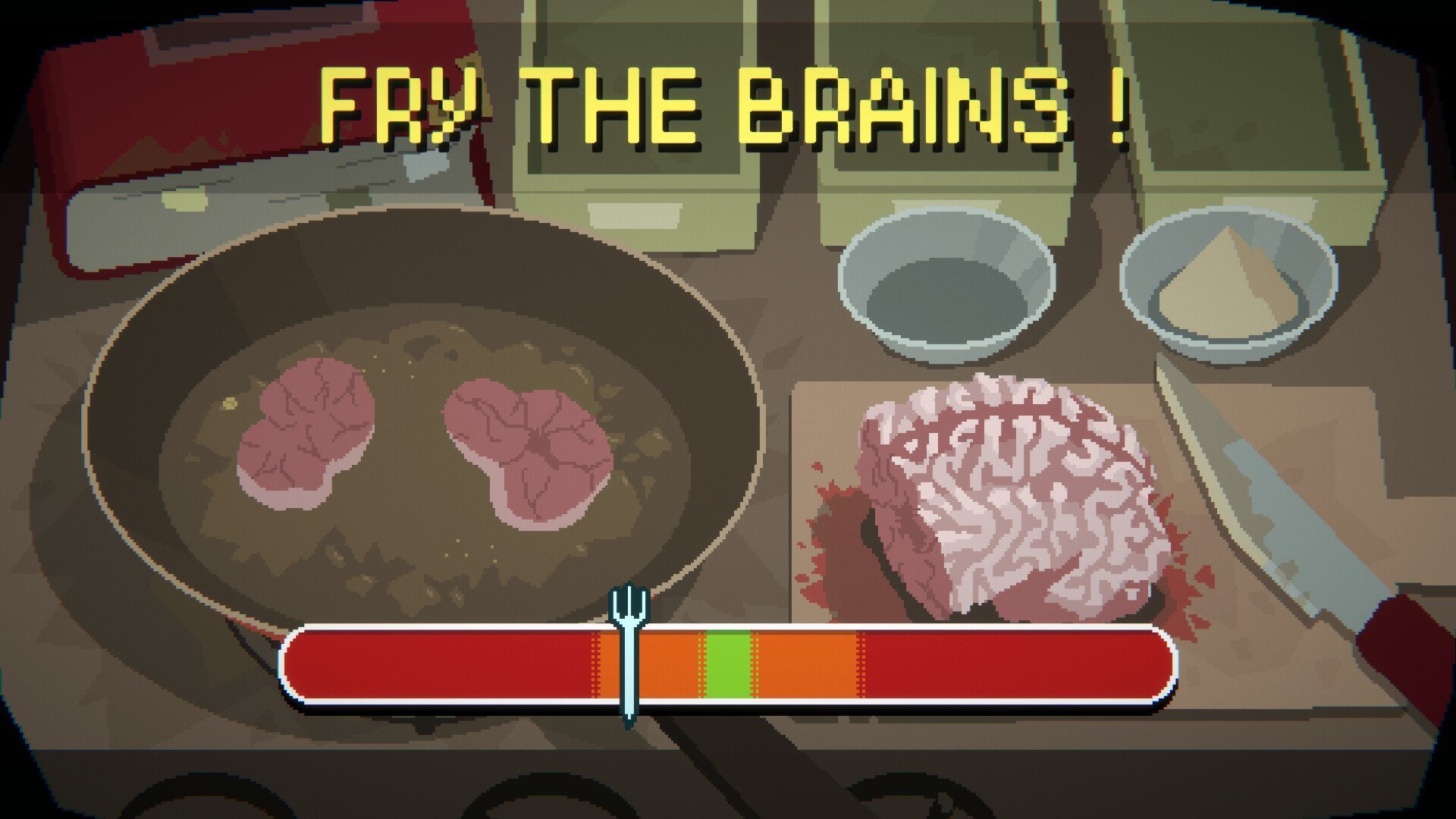
…And it’s all completely pointless, because no matter what score you get, the game continues as if it doesn’t matter. Stewie will make a comment about how well (or badly) dinner turned out, then he will serve it to the scarecrow Ms. Appleton and himself with the same animation regardless. You could serve up the most horribly burnt human meat burger ever created, and other than a single line of dialogue the game will continue without consequence. I appreciate not having to be a master chef to progress in a game where the focus is on pointing-and-clicking, but for such a major part of the game it felt weirdly inconsequential to anything else I was doing.
This feeling extends into other aspects of the game as well. While each guest at the hotel can be tackled in any order, once you choose who to confront there’s little interaction involved in what happens next. Rather than listening to the at-times brutal backstories of these characters and interrogating them with just the right questions, the truth serum causes them to brazenly confess their crimes in flashback cutscenes. No choice is ever required for whether or not someone is worthy of Stewie’s wrath; the answer is obvious and the decision made entirely by Stewie and Stewie alone. The judgment of life or death is experienced solely as a passenger rather than an active role by the player, which is incredibly disappointing.
Nor do you play a hand in carrying out the grisly executions (when merited) yourself. One character gets dunked into the hotel pool while Stewie unloads a tub filled with piranha, while another gets wrapped up in a bag and beaten with a stick. How did Stewie find a tub filled with piranhas? How did he get a grown adult into a burlap sack and tied to a ceiling fan? While I enjoyed these darkly comedic death scenes, I was surprised by how little of the game focuses on these sections and how much of the game is spent procuring ingredients to deal with the corpses after the fact.
Even after dinner is done and Stewie is asleep, there’s one more section to clear: dealing with any residual guilt Stewie feels after murdering a stranger in cold blood. Each night, Stewie will find himself in a big top circus tent where his imaginary crow friend Martin is joined by a unicorn-headed creature named Nico. Their one role in this dream circus is to put on a glitzy game show where Stewie rids himself of any lingering remorse. But rather than having to answer a variety of questions or perform some kind of task, you are merely given a choice from several vague self-help options. One brings down a giant hand to scratch Stewie’s head, which feels so good that he’s able to set aside his guilt and sleep soundly through the night. These are all pretty funny, but again there’s little agency from the player perspective other than making random selections without knowing what they mean.
The gameplay loop repeats the same way for the majority of the game’s 3-4 hour runtime: choose a hotel guest that Stewie will confront after slipping them his truth serum, witness their comedic demise if Stewie deems them worthy of judgment, scour the region for whatever ingredients the cookbook requires, go through the cooking mini-game, serve dinner to the Ms. Appleton doll-thing, then go to bed and enter the dream circus where you deal with your guilt. Rinse and repeat until no guests remain, and you’ll eventually arrive at the ending sequence. The game’s finale has some good moments, and it’s satisfying to see Stewie’s self-confidence grow along with his, um, interesting approach to making the world a better place. But I could never shake the feeling that I hadn’t actually contributed much to how things played out.
Final Verdict
The Supper: New Blood has a delectable premise that I wanted to be invested in, but I left my time in Widowport feeling somewhat let down. Rather than taking an active role in condemning the villains and weirdos that walked through the doors of the Twin Sisters Motel and then participating in their gruesome demise, I mostly watched as events transpired before being sent out with a shopping list for dinner. The world is beautiful to look at with some gorgeous environments and expressive characters, and there’s sadistic pleasure to be had in watching wicked people get their comeuppance, but I constantly felt held back in my role of serving up this particular brand of justice. This is a promising first course, but I find myself walking away hungry for something a little … dare I say it … meatier.
Hot take
The Supper: New Blood has the right recipe for a darkly delicious cartoon adventure, though repetition and limited gameplay opportunities work against its sinister premise, and its campy but fun B-horror shocks elicit diminishing returns long before its last course.
Pros
- Charming pixel art and animations
- Quirky characters and world
- Challenges can be tackled in any order
- Darkly funny writing and death scenarios
Cons
- Repetitive game loop progression
- Lack of player agency during gameplay
- Unsubstantial main story
- Cooking mini-game is essentially pointless
Sam played The Supper: New Blood on PC using a review code provided by the game's publisher.

- Advertisement
- Help support AGH by advertising with us







0 Comments
Want to join the discussion? Leave a comment as guest, sign in or register in our forums.
Leave a comment