
The Jester and the Madman review
- 2 Comments

The commercial sequel to Curse of the Old Gods shows it’s not joking around with a quality old-school slideshow mystery
The DOS era of adventure gaming was an iconic time for the genre. The early to mid-1990s were bursting with pre-rendered slideshow-style games, and it’s a nostalgic treat when we get a brand new one. The Jester and the Madman is a thoughtful iteration of digitized graphic adventures from that time, but with welcome quality-of-life improvements that don’t detract from its authenticity. The plot revolves around a cult attempting to resurrect an ancient Lovecraftian god, and while the atmosphere and characters are well-developed, the overall narrative threads sometimes lack coherence. Thankfully, then, the smart puzzles make it an easy recommendation for those partial to this style of mystery.
The game picks up where its free 2017 predecessor, Curse of the Old Gods, left off. It’s not necessary to have played that game, as the opening cinematic here more or less catches players up. However, some of the characters introduced in the previous game do play a role in the sequel, meaning those who are familiar with it will certainly get more out of the plot. Still, The Jester and the Madman is hardly confusing in its own right, and succeeds in standing as its own adventure.
As with its predecessor, you begin by assuming the role of FBI agent Rick Moreton. Upon his return to New York from the Congo, having foiled a conspiracy involving otherworldly forces, Rick is imprisoned in a small cell in a mental institution. Not surprisingly, his first order of business is getting out and back to work. He soon gets a visit from Chief Officer Sanders, formerly of Homeland Security, who informs him that he will be sending someone to assist him, and a nurse named Holly arrives shortly thereafter. Sympathetic to the agent’s predicament, she helps Rick escape in between tending to her own nursing duties.
Once out of the hospital, Holly reveals that she served in the military before her career as a nurse, proving her worth to Rick and Sanders’ investigation of the cult. Rick and Holly then formulate a plan, with Rick heading into New York City to pursue a lead, while Holly goes undercover as a nurse applying for a job with one of their prime suspects – Dr. Lafayette.
The game switches perspectives between Rick and Holly multiple times, and while they don’t play differently from one another, it does help give the story a more rounded feel, and the cliffhangers in which both characters are left between chapters keep the tension high.
Their combined trail takes players through dilapidated mansions, city streets, and rural farms. But while the first half of the game revolves around rudimentary detective work, like trying to get information out of the locals and searching for clues, the latter half of the game introduces supernatural elements, like mysterious artefacts with magical properties, as the game gradually becomes a full-on supernatural horror story.
The plot is interesting and the twists are good, though some scenarios feel a bit concocted, like when the doctor invites Rick to play a game of chance with him, having already revealed that he knows Rick is out to stop his plans. If you lose this game, Rick’s soul is captured by the otherworldly forces the doctor obeys (prompting a restart from the last checkpoint). If you win, the doctor just tells Rick to enjoy the party going on in his mansion – the exact opportunity Rick needs to foil the doctor’s plans. It’s not an egregious plot hole, but it is rather silly.
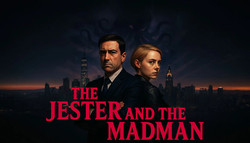
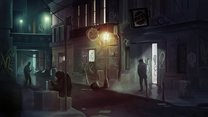
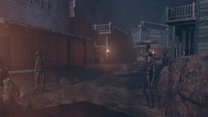
The Jester and the Madman unfolds via a series of still backdrops, just like Curse of the Old Gods, but with a lot of notable differences this time around. Dialogue boxes are now set to the bottom of the screen, as opposed to floating like comic panels in the middle. The inventory is also hidden away instead of being displayed at the bottom of the screen. The biggest visual difference, however, is the graphical style, which adheres closer to a full-colour VGA look as opposed to the washed-out, monochromatic CGA style of its predecessor.
The Jester and the Madman
| Genre: | Mystery |
|---|---|
| Presentation: | 2D or 2.5D, Slideshow |
| Theme: | Conspiracy, Religion/Occult, Team-up |
| Perspective: | First-Person |
| Gameplay: | Investigative, Puzzle |
| Control: | Point-and-click |
| Game Length: | Short (1-5 hours) |
| Difficulty: | Medium |
| Graphic Style: | Simulated realism |
Basic gameplay functions are relatively similar, but here hovering the mouse over points of interest in the image will cause the reticle to indicate an action is possible. A left-click interacts, while right-clicking backs out or cancels an action. Clicking on a hotspot will bring up a circular interaction node, with take, use, speak, and look options potentially available. While everything offers the latter, giving you potentially useful insight into its function, only context-applicable options will be highlighted as well, preventing players from feeling overwhelmed or trying to speak to inanimate things when out of ideas on how to progress, for example. Depending on who you’re controlling at the time, Rick or Holly will comment (sometimes voiced, sometimes just via text) when you interact with something as well, and their commentary often contains valuable information about what you should be trying to accomplish.
The individual environments for each segment are relatively small, consisting of only a handful of screens each, meaning it’s hard to lose the thread of what you are supposed to be doing. On the streets of New York, for example, you begin in front of a locked gate leading to the manor Rick wants to investigate. Down the street there is a bodega and a mechanic shop. With only four screens available to explore, the central goal of getting the gate open remains at the forefront, leaving you to scour the environment for items, and sweet talk your way into acquiring tools needed to break into the house.
Rick and Holly each have their own inventory, which can be brought up by pressing the middle mouse button. From there, objects can be dragged overtop one another to combine, or out of the inventory box for placement in the environment. Some objects can be interacted with directly in the inventory at certain points, like using a cell phone to call a contact, or opening a sealed box.
The standard inventory puzzles often prove satisfying, like combining power tool components to break into the aforementioned locked property, for instance. Other puzzles have you reading books or notes, noting down symbols for deciphering a codex. But while the majority of the game’s challenges come from scouring for clues and items and then determining where and how to use them, The Jester and the Madman contains several other types of diversions. One puzzle early on has you using Holly’s computer to gather GPS coordinates, while another has you stealthily tailing a cult member through a maze via an overhead view. A DOS-style computer command puzzle stumped me briefly, but the sheer variety of tasks over the game’s brief four-hour runtime was wholly welcome.
Death is possible, though it only sets you back to right before the fateful scene. (Saving can also be done manually at any time.) The game uses a score system out of 1740 points. You obtain points by completing objectives, which acts as a handy gauge to let you know how far along you are. I don’t know whether deaths detract from the score, or just prevent you from getting credit for certain actions, but I finished with 1595, so there was room for improvement. That said, the death scenes, whether resulting in a short cinematic or just a still image, are delightfully scary (sometimes even funny) and worth experiencing, intentionally or not.
The game uses short animated sequences (more like a gif animation rather than full-motion video) from time to time. These look great, playing at a low frame rate to mimic the technology of its decades-old inspiration. The rest of the graphics are based on photos of real actors and backgrounds, digitized with the help of AI. This may be a turn-off for some, but due to the slideshow nature of the game, it never becomes a glaringly noticeable issue in-game. (I didn’t notice any anomalies like fused objects or extra body parts!) The look is purposely low-resolution, but not so much that it is hard to tell what things are (The ability to right-click to highlight all points of interaction in any scene further negates the need for pixel hunting.) The interface adheres to this grainy texture too, feeling like a genuine artefact of early 1990s computer displays.
The Jester and the Madman originally launched with AI voices as well, but six weeks later an update was released implementing human voice actors. While the original AI didn’t sound overly awkward, when replaying with the new voices I did notice how few contractions Rick and Holly use in their speech, something that seemed to stand out more with real actors. The voice actors do a fine job, and their inflections are better implemented when reading the script than AI, but the stiffness of the script was certainly more apparent to me the second time around. The game’s MIDI tunes, composed by Bertrand Guégan, are impeccably moody, suiting the otherworldly forces at work as you sleuth your way through unfriendly locations.
Final Verdict
The Jester and the Madman may be a throwback, but it’s nevertheless a highly playable and clever adventure. There are multiple endings (of which I got the bad one – though with unlimited save states, you could certainly figure out a way to make sure you get the optimal ending), and the score system encourages replays. The characters and story are engaging, even if some of the scenarios feel a little too convenient. The script and voice acting are notably awkward at times, but I am glad that the developer opted to rerecord the game with human actors, though the AI-assisted graphics remain. The gameplay has the right amount of variety and challenge for a relatively short runtime, and it’s a thoughtful homage to a bygone era of adventure gaming that just about any adventure gamer should enjoy.
Hot take
The Jester and the Madman is a wonderful homage to 1990s-era slideshow adventure games. The script can be a little stilted and the plot a bit too convenient, but the overarching story and breadth of clever puzzles and challenges make it engaging from start to finish.
Pros
- Authentic stylings of an early 1990s-era slideshow adventure
- Great puzzle variety
- Moody MIDI tracks complement the digitized photo graphics
- Scoring system and multiple endings encourage replays
Cons
- Use of AI may be objectionable to some
- Some scenarios are laughably convenient, betraying the otherwise dark and serious nature of the plot
- Writing and voice acting can be a little awkward at times
Drew played The Jester and the Madman on PC using a review code provided by the game's publishers.

- Advertisement
- Help support AGH by advertising with us




2 Comments
Want to join the discussion? Leave a comment as guest, sign in or register in our forums.
Greets! I just wanted to mention that the developers added a "Full Human Voice-Over Update" on December 1, 2025. "Hello everyone, I'm really excited to announce that The Jester and the Madman now has a full cast of voice actors, replacing the original AI voices. Thanks to the incredible work of Bone13 Productions, you can now experience the game with all the nuance and emotion of real human performances. I wish you all happy holidays, Tim" Here's a link to their Steam update: https://store.steampowered.com/news/app/3893670/view/519731440617783740?l=english
Reply
Yep. The new voice-overs are covered in the review.
Reply
Leave a comment