
Whispers in the West review

- 0 Comments

Multiplayer promise misfires in early cases of Western mystery co-op anthology
The Old West town of Brimstone is under duress. Theft, murder, and blackmail abound and the mayor wants to do something about it. He turns to you and up to three of your friends to solve the crimes besieging his suffering townsfolk. In Infinite Whys’ debut adventure, the point-and-click multiplayer (or solo) visual novel Whispers in the West, your posse will investigate a series of cases – sometimes following leads, many times interrogating random people – to solve whodunit. While poor plotting and underutilized game mechanics put a damper on the fun as currently constructed, the basic bones of a good game are here. With more DLC cases planned for the future, there’s still a prime opportunity for this underwhelming launch effort to make a much-needed course correction.
Whispers in the West is divided into separate cases. The base game comes with a short one-player tutorial and two full investigations; additional cases can be purchased separately, all of which are immediately available from the main menu. As a nice touch, only the game host is required to buy the base game and add-ons. Other players can join simply by using the free demo version. There are some story threads that run through the cases, such as repeated mentions of the railway line coming to town, but nothing significant enough to require playing in a particular order.
You begin each case at the sheriff’s office, where a letter is delivered summoning you and your fellow players (if any) to a meeting, usually with the mayor, to get one or two starting leads. Most investigations take place across three days. When starting, the host can choose to impose a fifteen- or twenty-minute real-time limit for each game day, or remove the time limit altogether, which is recommended for solo play. Each day, the investigators are tasked with discovering one facet of the case. For example, you may need to determine what was stolen from a given location or who a murderer was.
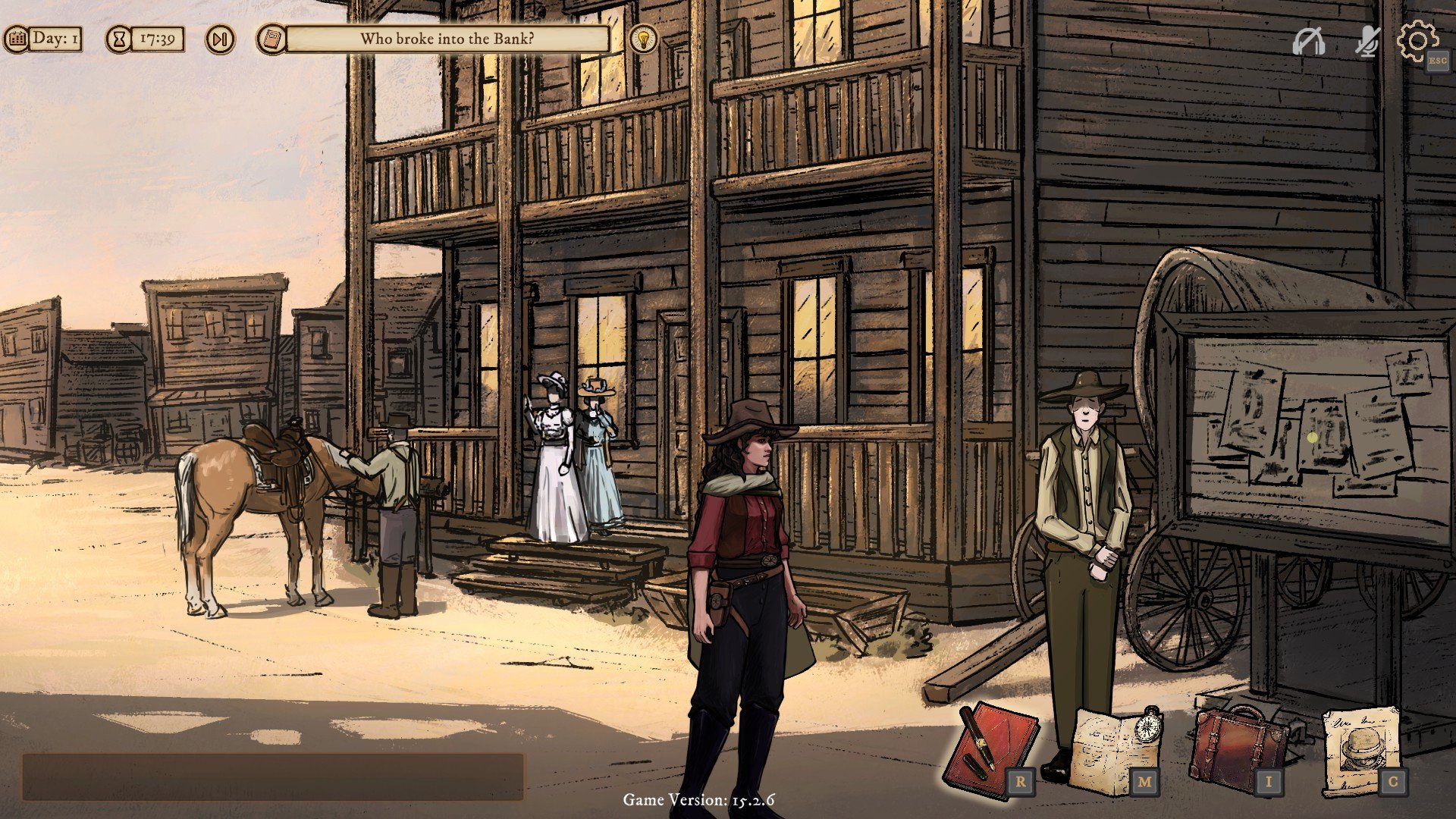
You are given a quiz question at the end of each day, for which the answer must be chosen and submitted from the accumulated suspects or objects relevant to the case. The game automatically switches to this if a time limit has been imposed, although players can vote to end the day early. During these quizzes, you have as much time as you need to discuss what you’ve all uncovered before submitting your answer. This does allow for some cooperation among your group, but it definitely represents a minority of the playing time. Whether your answers are correct is not revealed until after the third day, at which point a final performance evaluation is given, based on things like the number of right answers and the frequency of hints used from the in-game help system.
Investigations are straightforward affairs, consisting entirely of talking to the various townsfolk. Doing so adds key points to your evidence file, which compiles one list of the characters met or talked about, and another list of physical evidence. It’s important to talk to every suspect on each of the three days, even about subjects they’ve already been interrogated about, as they will sometimes arbitrarily have new things to say on different days.
The interface serves the double duty of representing the topics that can be chosen to discuss with suspects, as well as the list from which each day’s answer must ultimately be chosen. The accumulation of characters and evidence will be very familiar to those who have played the Ace Attorney games. In fact, Whispers in the West would be very much like Ace Attorney in how it plays if you were to take out all the fun courtroom bits.
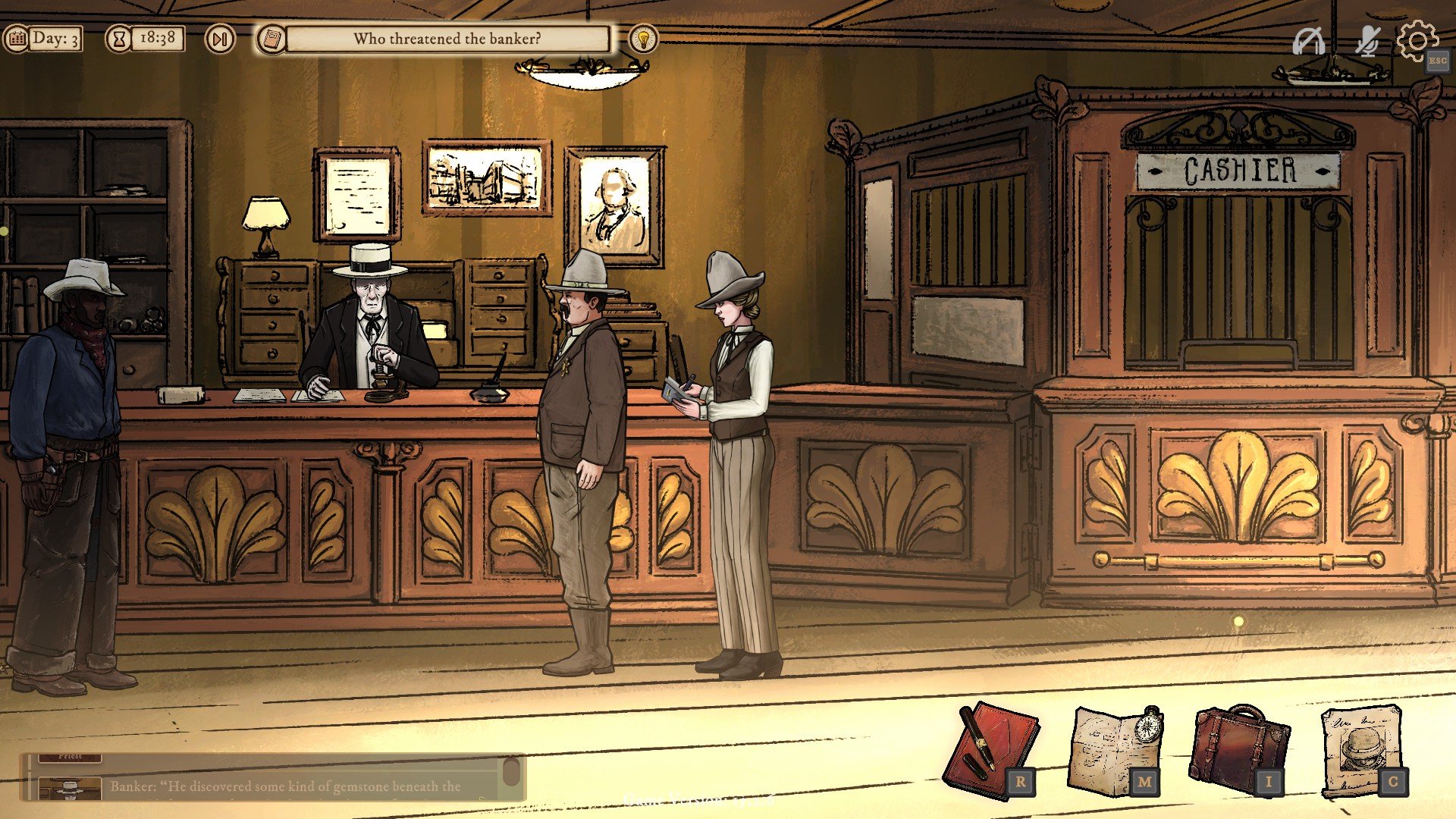
The current cases are pretty standard fare: the theft of a painting, a bank robbery, poisonings and shootings. Most of them involve the game’s stock company of characters, although occasionally out-of-towners show up to add a little something beyond talking to the same old faces. Only occasionally do the mysteries feature any real eccentricity, such as one where the murder victim is revealed to have been killed with an unusual weapon. Overall the stories are fine so far, if not particularly memorable. Probably the most interesting case is in one of the DLCs, which involves a circus coming to town. The troupe has an ornery giraffe who needs to be kept safe by locking her up in a jail cell. This case features several characters from the circus who are given their own custom sprites, so they have a bit more flair than the otherwise generic extras that pop up in other cases. A little more time spent on devising unique scenarios would certainly be welcomed in future downloadable content.
It would also be nice to see more concrete evidence available. Most investigations are “solved” on the hearsay of townsfolk, as rarely do the investigators collect anything substantial. Even the suspects tend to talk vaguely, skirting around the crimes. They might have reason to withhold information, but since you are unable to press them for more details, especially when it seems evident that they’re lying, this results in getting only a general impression of what happened, as opposed to a solid understanding of the events surrounding a given crime.
Whispers in the West

| Genre: | Mystery |
|---|---|
| Presentation: | 2D or 2.5D |
| Theme: | Team-up |
| Perspective: | Third-Person |
| Graphic Style: | Illustrated realism |
| Gameplay: | Co-op, Investigative |
| Control: | Point-and-click |
The mechanics are straightforward enough, so you need never worry about how to navigate the game. All controls are presented as buttons on-screen, along with their keyboard shortcuts. There are indicators for the day and time remaining, as well as buttons for hints, accessing the inventory, checking the quick travel map, offering evidence and asking questions. Far less useful is that even the current version number of the game is constantly displayed across the bottom of every scene.
Although the control mechanisms aren’t hard to grasp, the process of solving cases is a tedious one because you can’t limit your investigations to the logical leads you uncover. More often than not, a case can only be solved by talking to some character that is in no way involved to get the crucial break needed to progress. Take the circus case, for example, where you receive a mysterious note. When someone important turns up dead on day two, it seems obvious that the note holds the key to the mystery. By that point, you’ve had a chance to talk with several suspects – including the “guests” for that episode – and establish the ones that have ties to the victim and the goings on of a circus that has come to town.
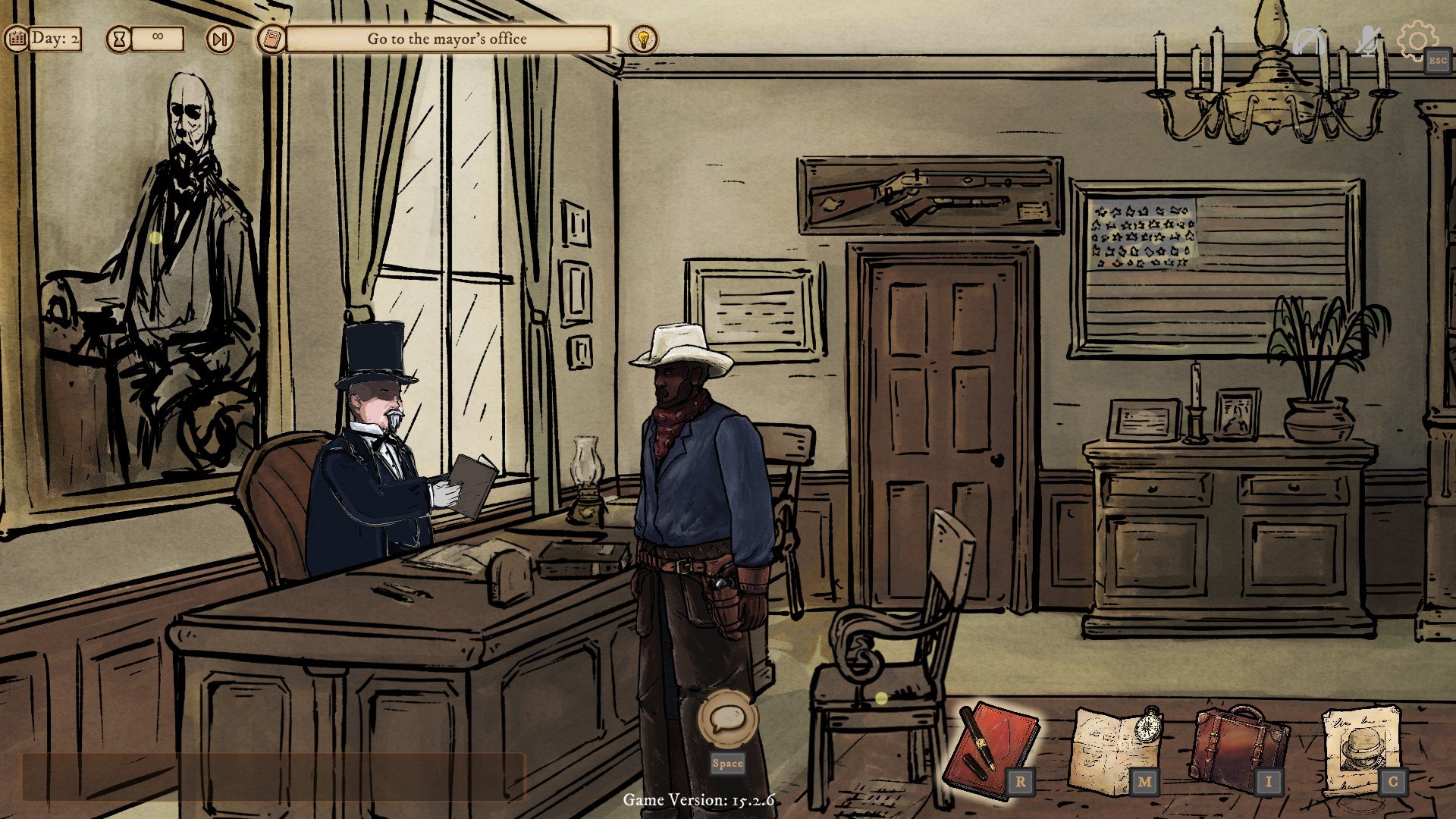
These serve as the starting leads so you’ll wander about, asking the characters connected to the case if they wrote the note. Ultimately, when asking everyone actually related to the case turns up zip, your only recourse is to speak with random townsfolk on the off chance that one of them knows something about it (spoiler: one who is completely unrelated to the case does). This is frustrating, as it reduces solving cases from focused, methodical investigations to nothing more than simply grinding through every available dialog option. Hopefully future stories will have stronger plotting to give players a sense of accomplishment as they follow a deduced trail of bread crumbs rather than taking a shotgun approach.
Once the final day in a case is done, you have one last chance to adjust your chosen answers if you feel you have anything incorrect. After submitting these, the game reveals if you were right or wrong and, regardless of the outcome, gives you the option to watch a final summary of the case that spells everything out in detail. The game determines if you’ve “solved” a case based on whether you have at least two of the three answers correct. This means that you could get the ultimate question of whodunit wrong, but as long as the other two questions are answered correctly, you still pass. Regardless, succeed or fail you are returned to the main menu afterwards to select a different case to play.
Even when you do get the answers right, one chief problem with these resolutions is that rarely is the criminal punished. Murderers are seen walking around in subsequent cases as the game has a small cast and can’t really afford to write anybody out. Sometimes there’s vague hand waving as to why a character isn’t punished, such as a person being an upstanding (read “rich”) citizen with connections; the implication being they’re too powerful to be arrested. Other times, no mention is made as to why a character would escape incarceration. While cases can be played in any order, there are enough continuity story bits spanning the different episodes, such as the revival of a seemingly played-out mine, that there’s a definite chronological order to when the tales take place. In the future, it would be far more satisfying to see the investigators’ efforts come to some positive result, with the perpetrators of crimes suitably punished.
The big selling point for Whispers in the West is that it allows for one to four players to play. Typically multiplayer games get a boost in the fun factor by simple dint of people playing together. These types of games, usually limited to only two players, tend to give one player access to information or locations that the other doesn’t, requiring them to communicate those details between them. This can result in a lot of laughs, as descriptions can sometimes get quite outlandish. (“The symbol looks like a snake if it was run over by a train and wearing a crown around its neck!”) At present, Whispers in the West is not one of these games, as several design decisions have the effect of pushing players apart rather than having them cooperate. The (potentially) good news is that just a few tweaks to the gameplay and a shift in storytelling focus in later cases could easily remedy the issues here.
Take the time limit, for example. When turned on, no one player will be able to interview everyone in town unless they’re a really fast reader (the game is non-voiced). The time limit, in essence, forces players apart to cover more ground. This has the knock-on effect of limiting how much players are communicating with one another during the case, as everyone is mostly busy reading what suspects are saying to them and not focusing on what the other players are saying. If the time limit was dispensed with – even as an option – and the investigations treated like television procedurals, where a team of crack investigators are traveling together or perhaps going off in pairs, it would do much more to encourage increased interaction between players.
This approach would also tie well into the most underutilized aspect of Whispers in the West. Each player has a different skill depending on the character they elect to play at the start of the episode. The sheriff has a badge, which can sometimes be used to get suspects to talk more. The deputy has a forensic analysis kit for examining physical clues in more detail. The outlaw is able to pick locks. And the cowboy has a gun, which… well, neither myself nor my friends found anything special to do with it.
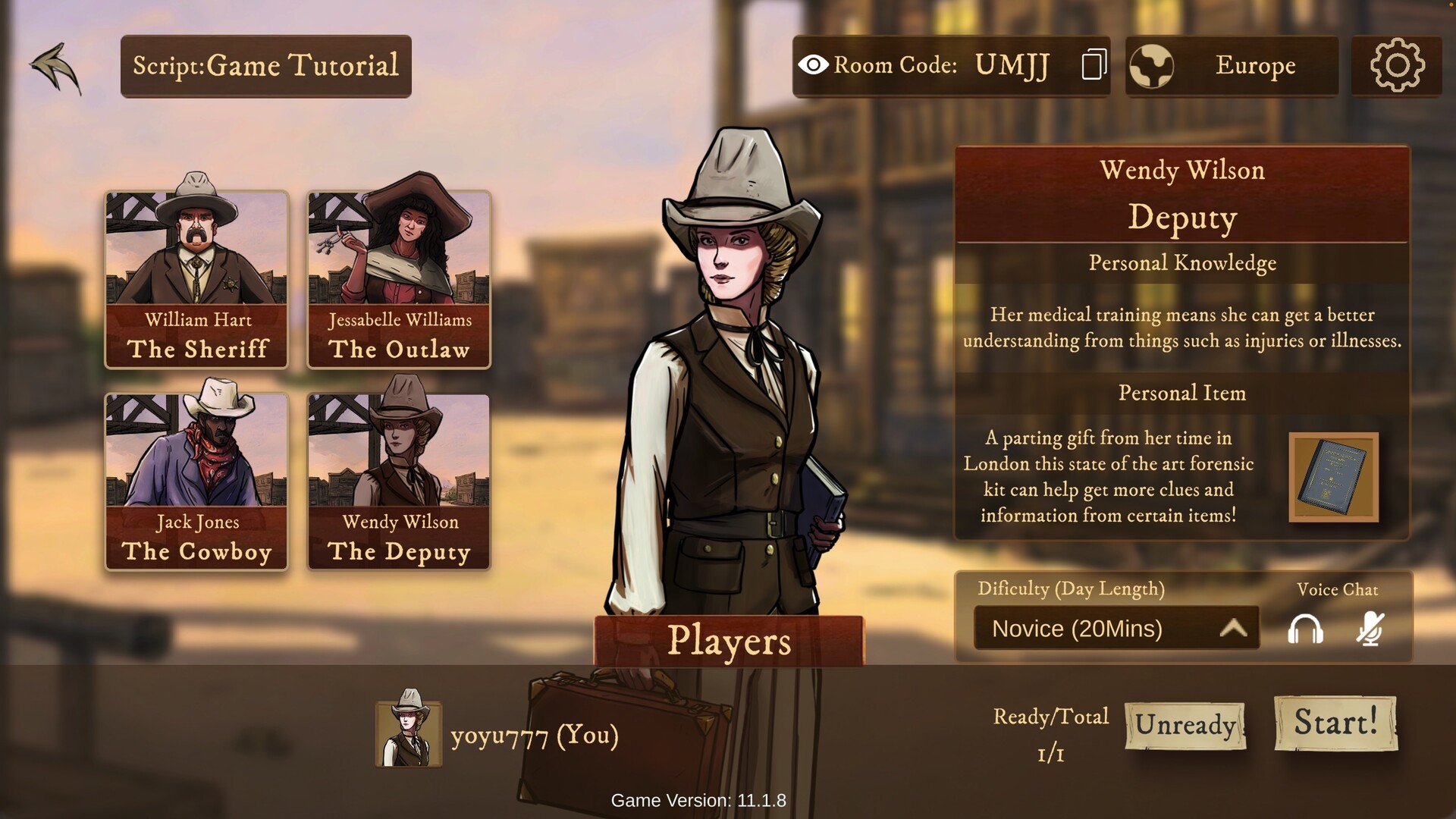
In theory, having these abilities should provide plenty of opportunities for individual players to shine, as they can do something the other players can’t. Hints of this are present. In a nice touch, non-player characters will greet players differently based on the characters they’re controlling, with the sheriff being shown more deference and the outlaw more suspicion. However, in addition to the individualism of the player characters, their skills should also be applicable to working together by pooling them in interesting ways. In practice, though, because the game can be played by as few as one person, it means that none of the cases can depend on a given character’s skill uncovering the make-or-break bit of evidence needed to solve it.
Take the deputy, for example, with her forensic analysis knowledge. One of the DLC cases involves figuring out which of several ingredients at a bar have been poisoned. It’s the perfect opportunity for some scientific analysis, but the deputy isn’t even able to use the ingredients on her forensic analysis kit. Instead the poisoned item must be determined by listening to conversations about the types of drinks people were having and the ingredients that went into them so that the case can be solved using any of the available player characters. This could have easily been corrected, and potentially addressed for upcoming installments, simply by keeping all four characters present in every case, whether there are four players or not, and allowing players to swap to the unused characters at any time during the investigation.
Despite the current weaknesses of the multiplayer aspect, there is one element that made me smile. If two players have gone to the same location – which can easily be achieved thanks to the handy quick travel map – and one of them engages an NPC in conversation, the other player is shown the textual dialog as well. That player is free to move about the environment and try other things while the dialog is ongoing, although they are unable to speak to the same character while the first player is doing so. Then again, I may be alone in my appreciation for this feature, as the friends I played with found it annoying that the character being talked to became locked out from interactions by other players for the duration of the conversation.
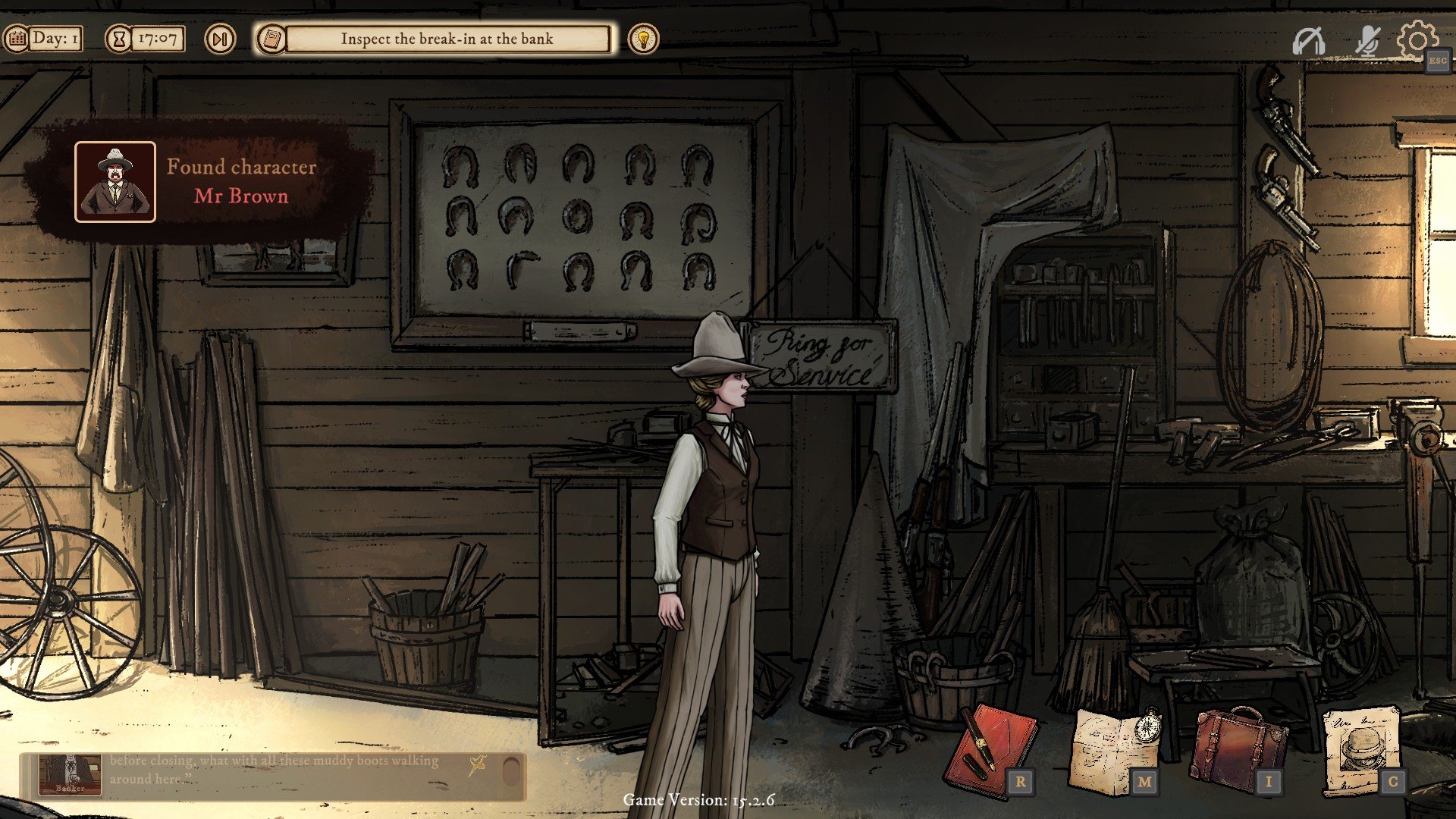
The rest of the game is serviceable, though nothing to write home about. The hand-painted visuals consist mostly of browns and tans to evoke a desert town, old-timey feel. There are a handful of recurring characters like the mayor, the blacksmith, the banker, the butcher, and so on. They each have a name and a token amount of backstory, but they’re more plot devices than anything else. None of them are particularly memorable and I’m hard-pressed to even recall their names. Most are represented by a single sprite, though some have a little animation, like the butcher who is constantly chopping at a slab of meat with a cleaver. Very rarely, a case will introduce a new person or two for that one episode, but for the most part it’s the same standard cast who are available to interact with.
The audio front is quite sparse. Interacting with elements of the interface plays a click to let you know that what you’ve done has been acknowledged. Beyond that, there’s only the occasional sound effect such as the rustle of paper when the sheriff’s party receives a summoning envelope. Perhaps the best element of the game is its music. There’s only a handful of instrumental loops, but they all have a nice Wild West vibe vaguely reminiscent of Ennio Morricone’s spaghetti western scores. You’ll hear one as early as the main menu, which hints at a rootin’-tootin’ adventure that never really materializes.
Final Verdict
Ultimately, Whispers in the West feels undercooked. While the concept of a four-player co-op adventure is certainly commendable, the execution leaves something to be desired. As it currently stands, the game promotes players going off to do things by themselves rather than bringing them together to work on the investigations. Even playing alone, the process of solving cases is unsatisfying given that random, seemingly unrelated characters are often instrumental in making any headway. The lather-rinse-repeat gameplay of grinding through every available dialog option becomes boring very quickly. That said, there are the makings of a fine game already evident. With additional new content planned, there’s reason to hope for improvement from a bit more effort spent on shining up the plots, a greater emphasis on following trails of clues as opposed to random interrogations, and a better utilization of each playable character’s special abilities. Hopefully these factors can be incorporated, as they’d let the game sit tall in the saddle instead of skulking in the underbrush.
Hot take
The promise of up to four-player co-op can’t elevate Whispers in the West above its tedious gameplay, non-logical investigations, and squandered special character abilities, but there’s enough potential on display to hope that the planned DLC cases will rectify these issues.
Pros
- Evocative Western music
- Allows one to four players, of which only one needs to own the game
- Time limit can be changed or even removed
- Seeing other players interact with the environment is a novelty
- NPC responses vary based on which player character they’re talking to
Cons
- No sense of following a trail of clues in the mysteries
- Tediously repetitive investigations
- No consequences for solving cases correctly or incorrectly
- Character specializations are underutilized
- Multiplayer feels like a gimmick
Richard played Whispers in the West on PC using a review code provided by the game's publisher.

- Advertisement
- Help support AGH by advertising with us








0 Comments
Want to join the discussion? Leave a comment as guest, sign in or register in our forums.
Leave a comment