
Thimbleweed Park review
- 1 Comment

Ron Gilbert and Gary Winnick brilliantly thread the old-school needle once again
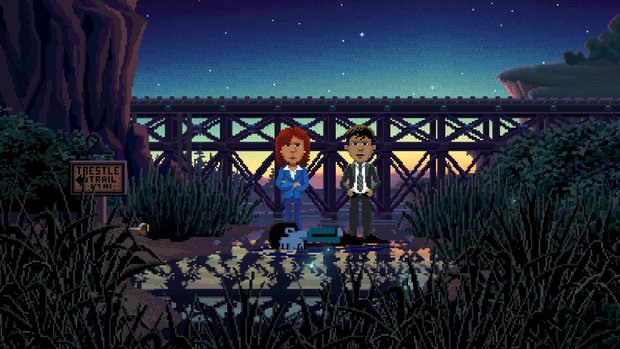
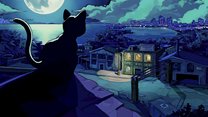
A street light flickers. A padlock holding a chain gate rattles in the breeze. A bullet hole punches through a city sign. A sloshed drunk sits drinking whiskey by the bridge near the river. This is Thimbleweed Park, population 81 … err… 80, the titular setting for Ron Gilbert and Garry Winnick’s first joint creation since their seminal Maniac Mansion back in 1987. Thimbleweed Park is the story of five characters involved in a murder mystery, and it brings to mind a quote from former British Prime Minister Winston Churchill: it’s a riddle wrapped in a mystery inside an enigma. The game feels like a love letter to the genre’s early classics, but beyond mere fan service, it’s a substantial, immersive adventure in its own right that should appeal even to a larger modern audience.
I say there are five playable characters, but truthfully there are six. Boris Schultz is a German investor visiting Thimbleweed Park, but his role is primarily to help introduce the game mechanics before becoming the victim of the aforementioned murder. Poor Boris is killed soon after you complete the first puzzle, but by then even those who are unfamiliar with the now-famous SCUMM verb interface will have a firm grasp of how to approach the remainder of the story. The verbs available to use are the same as those used in the early Lucasfilm/LucasArts games, so there will be no learning curve for long-time adventure fans and it’s simple enough to pick up quickly for those new to this style of interface. Moving the mouse over things of interest will allow you to walk to them via a left mouse-click, or look at it via a right-click without having to select a verb first.
Angela Ray is our first main character, a serious and rather humourless FBI agent who has been sent to Thimbleweed Park to investigate Boris’s murder. Everything seems to be a bother to her, and it’s obvious from the outset that she would rather be anywhere else, and certainly not assigned to work with her new partner. Antonio Reyes is the wide-eyed and eager junior agent and a sharp contrast to his grizzled senior partner. Both characters appear to be influenced by Mulder and Scully from The X-Files, although the roles are reversed, with the senior Ray being the sceptic and the newbie Reyes more open to the supernatural.
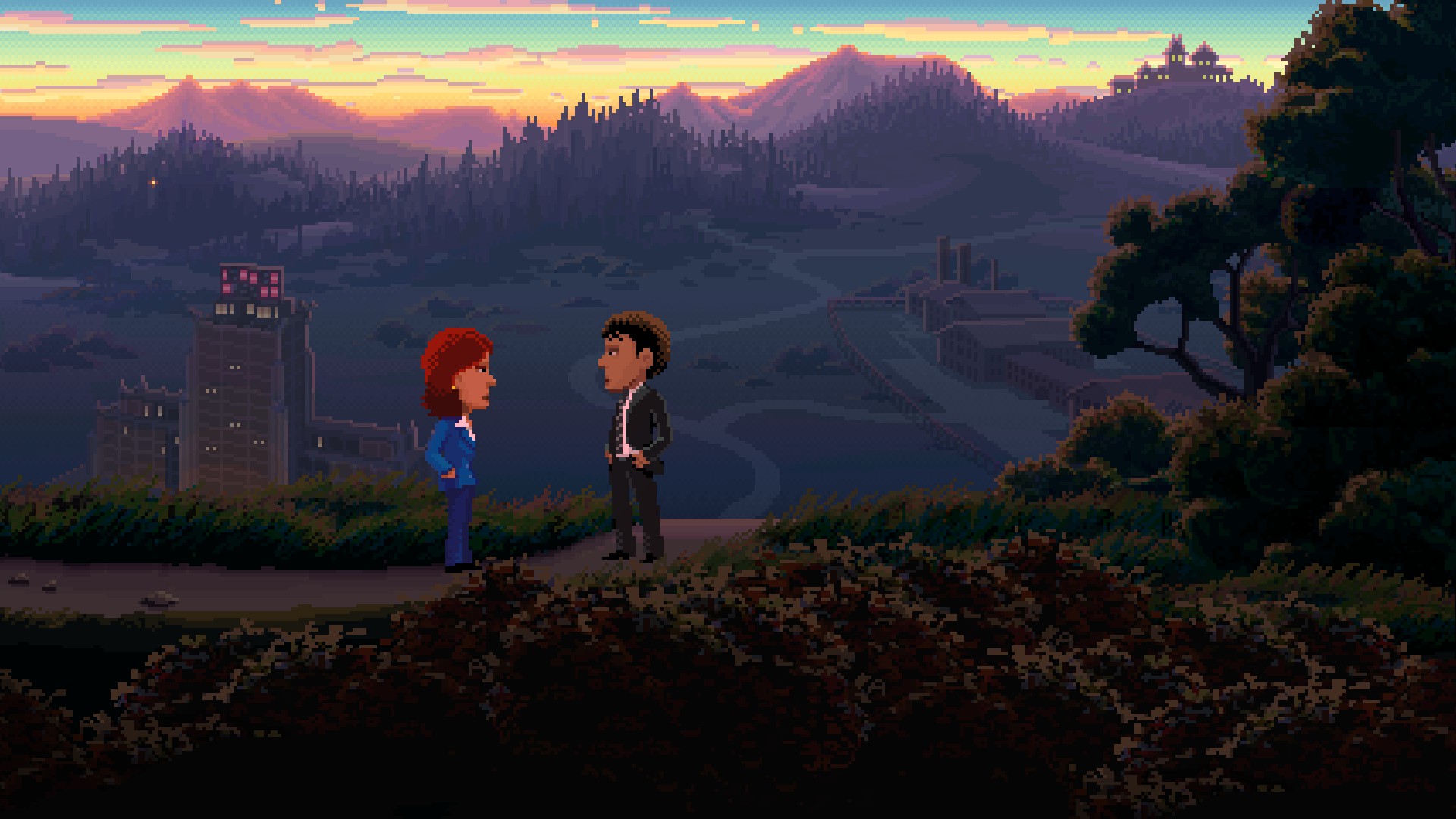
Delores Edmund, the daughter of Franklin Edmund, who owned the Thimbleweed Pillow Factory and the Edmund Hotel, is another character you’re able to switch to once she has been introduced by simply clicking her portrait in the top-right of the screen. Being the offspring of one of the most prominent families in town, it was expected that she would inherit the family business, but her real passion lies with computers – specifically as an adventure game designer. The fourth playable character, whose identity I’ll leave players to discover for themselves, is introduced via flashback just before their death, but continues to be playable in present-day ghost form, which changes the verbs available.
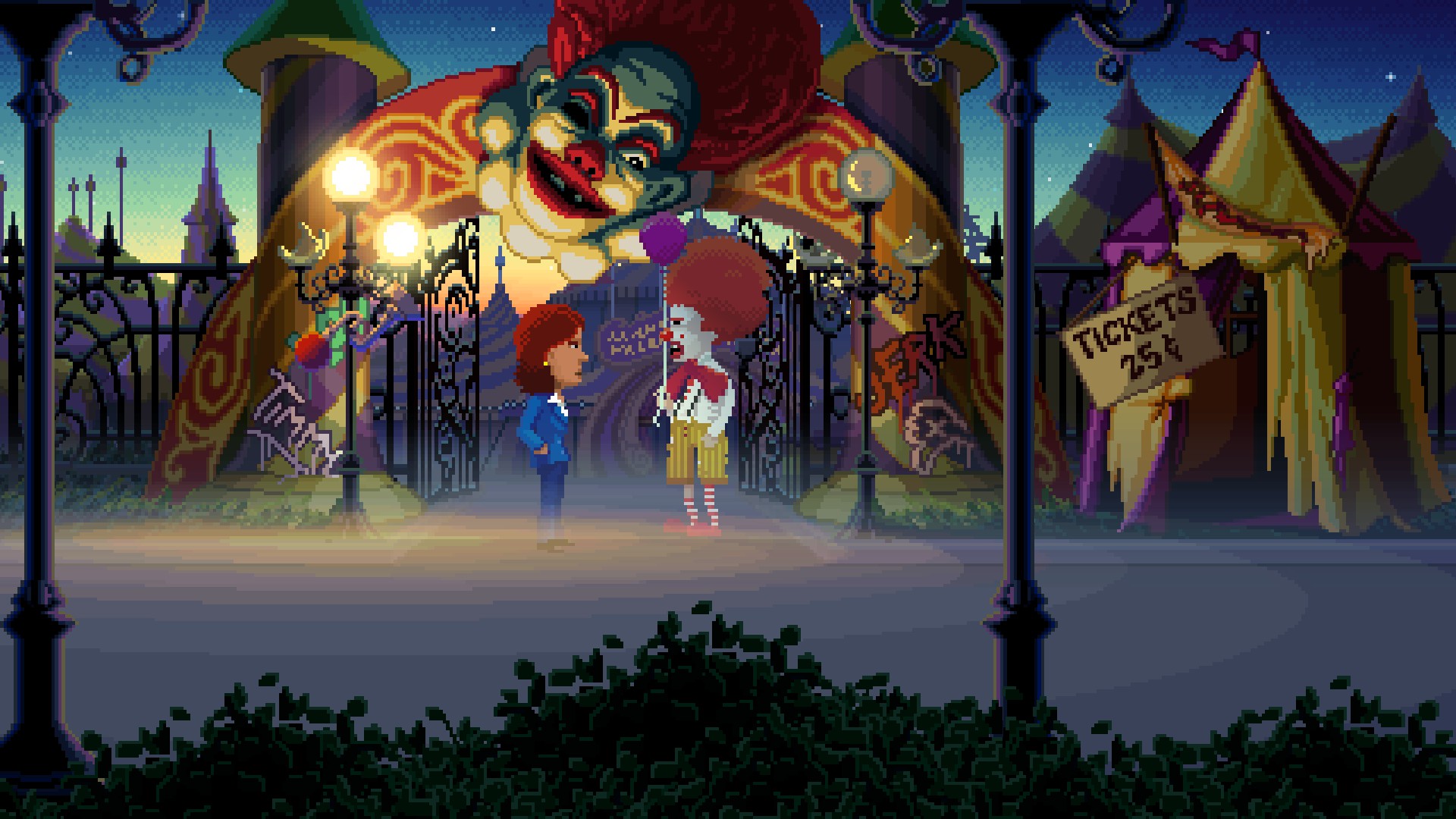
The final playable protagonist is possibly the most eccentric and downright strange characters in an adventure game, Ransome the Clown. Ransome is an insult clown who can’t remove his makeup and was cursed to spend the remainder of his life in the old circus. He’s sad. He’s angry. And he swears. A *Beeping* LOT. But his rants are humorous and one of the comedic highlights of the game. You don’t actually see or hear the profanity of course; it’s covered by a well-placed *Beep* (unless you purchase the “Ransome Unbleeped” DLC, that is). Ransome is a suspect, like everyone in Thimbleweed Park, for the murder of Boris, and like everyone, he has his secrets.
It’s a joy being able to switch between these characters at any time (for the most part). Each one has their own unique personality, so your interactions with other people changes depending on who you’re currently controlling. This multiple protagonist approach forces you to think not only about how to solve the puzzle you may be working on, but also which protagonist is the best option for achieving success. Some of the puzzles require you to use more than one, like Ransome and Delores working together to move a trampoline, to achieve the desired result. Each of the puzzles makes sense, within the zany context of this world, and with inventory able to be shared between characters, it really makes you think about the best solutions.
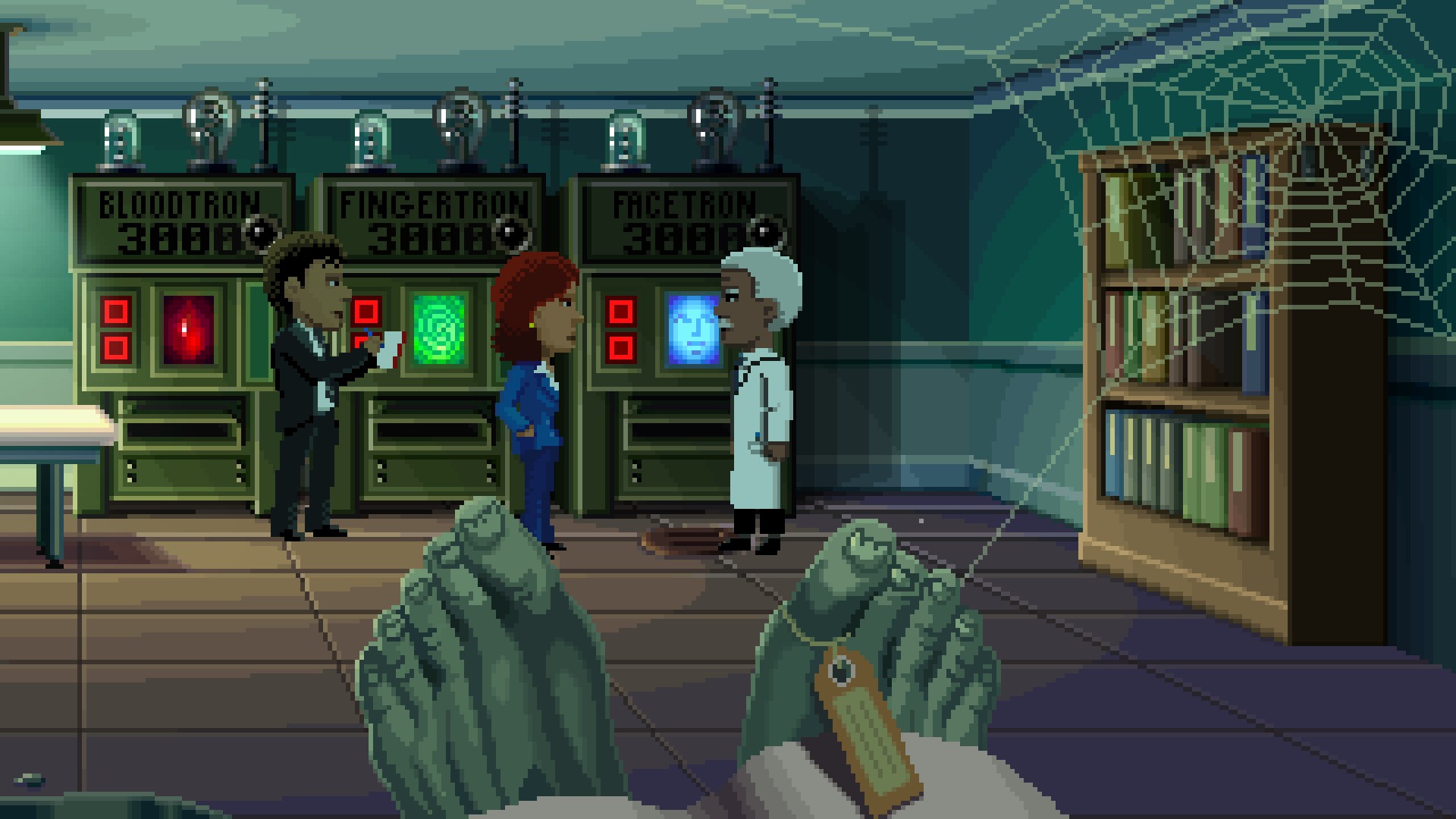
What isn’t explained is why these characters would choose to work together, other than the fact that you have the ability to control each of them. While it makes sense for the two FBI agents, there is no in-game reason given for why all five characters are willing to help each other. It’s certainly not a case of small-town hospitality, as the once-thriving municipality is now mostly deserted, and the few remaining people who have stayed are a strange lot, to say the least. Even characters like the sheriff, who seems unusually determined to hinder the murder investigation, and his “unrelated” identical twin, the coroner, who looks suspiciously like the sheriff, the only difference being that the sheriff affixes “a-reno” to his sentences, while the coroner uses “a-who.”
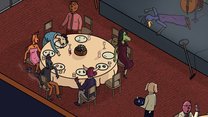
You might also run into the local conspiracy nuts like brothers Brett and Chet Lockdown, or one of Ransome’s former circus workers named Joe, while Natalie, who works for the Nickel News and is decidedly unhelpful in the investigation, puts all of her efforts into gaining a Pulitzer Prize. These and more eccentric Thimbleweed Park denizens seem suspiciously guarded at best, and outwardly hostile at worst, and every single one of them has something in their background to uncover over the ten-plus hours it takes to journey through this game.
While there are enough inventory puzzles to keep things interesting, this is a game whose progress is firmly rooted in dialog. Conversations with the colourful array of townsfolk allow you to select from three or four responses, and each of them is tailored to the character you are currently controlling. Ray, for example, is very matter-of-fact and quite pushy in her questioning, while Reyes can be a bit more friendly and relaxed. The foul-mouthed Ransome, as you’d expect, is a bit more blunt. The ghost character, while having the ability to talk with other spirits, also has the option to zap, which is useful for manipulating electric devices, as well as wail and moan, which have some rather amusing results.
The distinct personalities of the characters, playable and otherwise, are really brought out by the high-quality voice acting. Which is good, because if there’s a small gripe it’s that you can’t click through dialog if you’re a fast reader. Major locations have their own musical themes that set the mood. The mansion and forest are given a mysterious atmosphere, for example, while the opening song really stands out with its 80s soft rock vibe, heavy on the guitars, drums and bass guitar, as befits a dying town on a lonely stretch of highway. The sound effects add welcome ambience, with wind blowing in the background, chains rattling on gates, and doors opening and closing enhancing the sense of immersion within this world.
The town of Thimbleweed Park is made up of a couple of main streets, filled with colourful and interesting places to visit like the S&D Diner, the Quickie Pal convenience store, bus station and sheriff’s office, although there are plenty more buildings you simply can’t access because they’ve closed up shop. The presentation of these locations, and the surrounding countryside, is somewhat reminiscent of the time in which the game is set, late 1980s, although modernized with beautifully drawn pixel art backgrounds with perfectly matched character animations that wouldn’t have been possible back then. A particular highlight is the use of parallax scrolling, where the foreground elements move at a different speed than those in the distance, which gives the world a real sense of depth. You may see this a lot, as although you’ll obtain the ability to fast-travel via a map, there is still a lot of walking back and forth through the same locales that becomes frustrating.
While there aren’t any puzzles that are too strange or illogical to work out, this is a very unforgiving game that you will only be able to solve if you pay close attention to everything around you. If you are finding the puzzles too difficult, however, there is an option to play the game in casual mode, which simplifies a lot of the obstacles and allows you to concentrate on the story, though you’re unable to change between casual and hard modes once you’ve started playing.
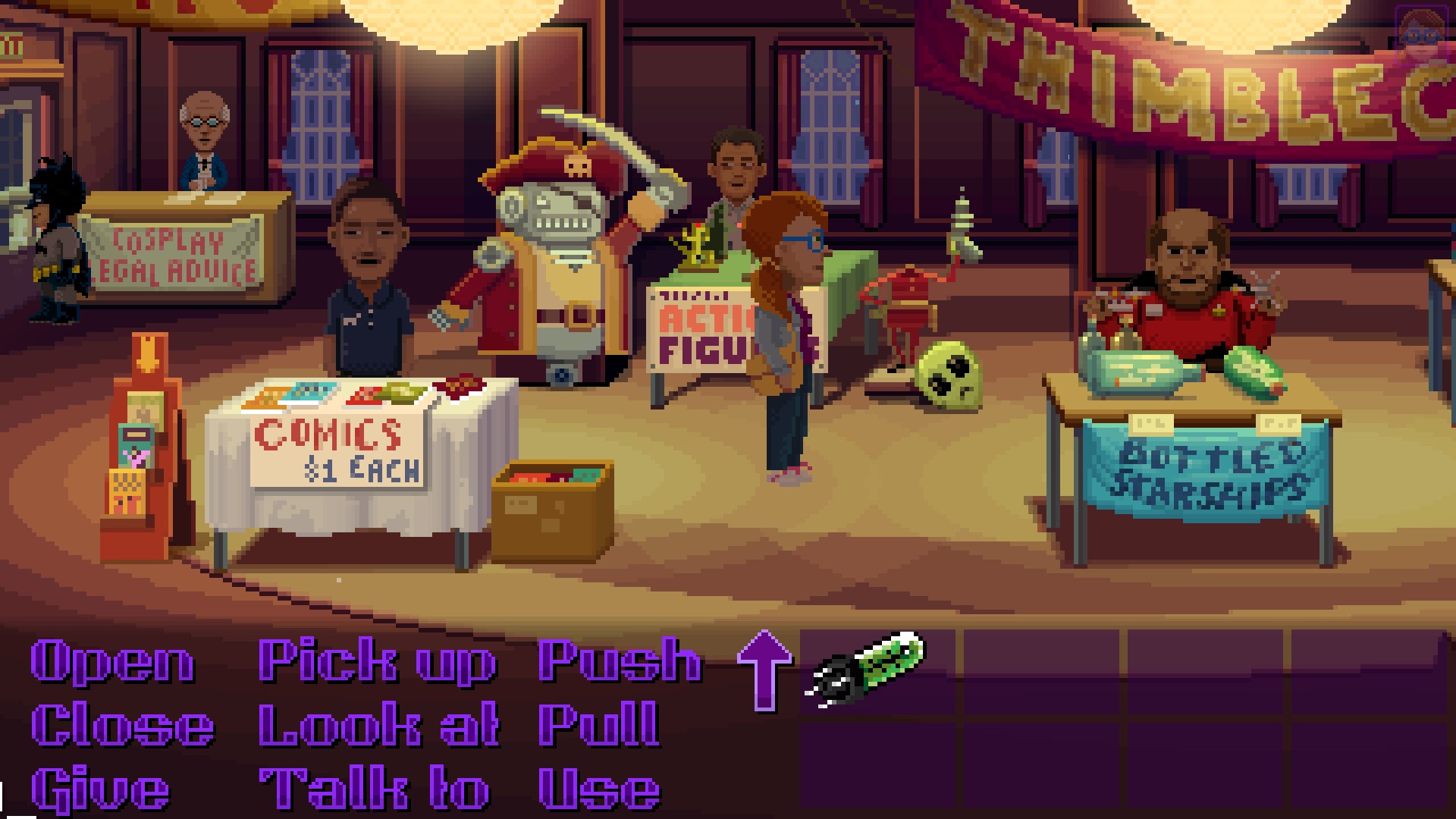
In either mode, another great addition is that each protagonist has a to-do list you can access at any time. This list tells you what that person is currently working on but doesn’t give any clues as to how to progress. There’s no hotspot highlighter that I could find, but in a fun nostalgic touch, there is a hint line, reminiscent of those money-hungry phone lines that LucasArts and Sierra once operated, which you can call in-game for plenty of tips on how to proceed. Like the to-do list, this is a nice addition that adds a modern sensibility to a classic-looking game.
Thimbleweed Park is filled with fourth-wall-breaking gags and pop culture references, including fun nods to the LucasArts classics. Some are subtle, like “G loves E” scrawled on a wall, while others are more in-your-face, like the costumed Pigeon Brothers talking directly to you to assure you there are no dead-end, no-win situations in the game, or Delores picking up a broken bottle and saying that if this were a Sierra adventure, she’d be now be dead. Looking through Delores’s belongings is a perfect showcase for late-80s nostalgia. Return of the Jedi posters adorn her bedroom wall, while her library holds books like The Lord of the Rings, The Hitchhiker’s Guide to the Galaxy, and the fictional Pointed History of Point and Click Graphic Adventures.
Although entirely irrelevant to completing the game, there’s something about an option to select (through a checkbox in the settings menu) whether all the toilet paper in the game is displayed as over or under, with the game actually changing the graphic depictions depending on your choice, that just appeals to my sense of humour. Such a fun but trivial thing really highlights how much the creators care for every detail of their game.
The downside to the many gag references is that there are so many of them that they tend to distract from the story, and sometimes they feel like they’re only there because they CAN be. The developers obviously realise this, though, as there is an option in the settings menu to remove the in-jokes. I left them in for the purpose of this review, but otherwise I might not, because this game is not meant to be a full-fledged comedy. Ultimately it’s a serious murder mystery, albeit with plenty of chuckles to lighten the mood, like the fact that bodies don’t decompose, they pixelate.
You might have gathered by now that Thimbleweed Park is a bit of a weird and twisted game, and you’d be right. It feels like a cross between an episode of The X-Files, with its supernatural elements scattered throughout what appears on the surface to be a typical FBI murder investigation, and Twin Peaks, with so many twists and turns that your head could easily start spinning. The central case may be a homicide, but it’s really not as simple as that, as your investigation will turn up more and more mysteries to solve.
Everyone in town has an agenda – in fact, everyone you play has an agenda, and each one turns up a new thread that you want to pull to see where it leads. What’s really going on with the fire at the pillow factory? Was Chuck Edmund really the benevolent do-gooder he appeared to be before his death only a few days earlier? And of course, there’s the matter of all the ghosts hanging around the hotel. However, even with the many story paths to follow, they all end up coming together in a satisfying conclusion that will answer at least most of your questions.
Final Verdict
Thimbleweed Park has been advertised by its creators as “like opening a dusty old desk drawer and finding an undiscovered LucasArts adventure game you’ve never played before,” and that is somewhat true. It would be fair to say that if you enjoyed Maniac Mansion and The Secret of Monkey Island, you’re almost certainly going to like this too. But it should also appeal to more than just devoted LucasArts fans thanks to a great story with unique and well-developed characters, set in a memorably distinctive town. This isn’t just a nostalgia-fueled walk down memory lane, but a unique adventure that is sure to keep you interested from start to finish.
Hot take
Far more than just a retro throwback to the early SCUMM days, Thimbleweed Park is a great murder mystery with so many interesting story threads and oddball characters that you will gladly accept a little excessive backtracking to reach the very end for answers.
Pros
- Story has many twists and turns that hold your attention
- Excellent backgrounds and animations in a modern-but-nostalgic pixel art style
- Diverse array of characters with excellent voice acting
- Option to simplify the puzzles if you just want to get into the story
Cons
- Jokes are a bit too frequent and self-referential unless switched off
- Backtracking through the same locations becomes tedious at times
Shawn played his own copy of Thimbleweed Park on PC.

- Advertisement
- Help support AGH by advertising with us



1 Comment
Want to join the discussion? Leave a comment as guest, sign in or register in our forums.
I enjoyed my time in Thimbleweed Park, and I agree that the game is too self referential at times, it also felt like the devs had an axe to grind with the old game companies.
Reply
Leave a comment