
Lorelei and the Laser Eyes review
- 2 Comments

Surreal arthouse-style adventure rewards serious focus with a rich interplay of narrative and puzzles
Lorelei and the Laser Eyes is most certainly a puzzle game in every aspect. Never mind the myriad of brainteasers you’ll encounter; the narrative itself is cryptic and laced with symbolism. Even the in-game instruction booklet teases enigmas as it outright tells you that the game “requires knowledge of real-life systems like the 24 hour clock, Roman numerals, Arabic numbers, and other such like concepts” and encourages you to “play in a quiet and dimly lit environment with pen and paper at hand” for the intended experience. Of course I had to follow through with these instructions, and I finished my playthrough with a strong sense of satisfaction, poignancy, and a notebook that looked like a Lovecraftian tome of incomprehensible ciphers. If you’re willing to put in the attention and embrace a mystery that won’t ever be completely answered, this game is an immensely rewarding experience.
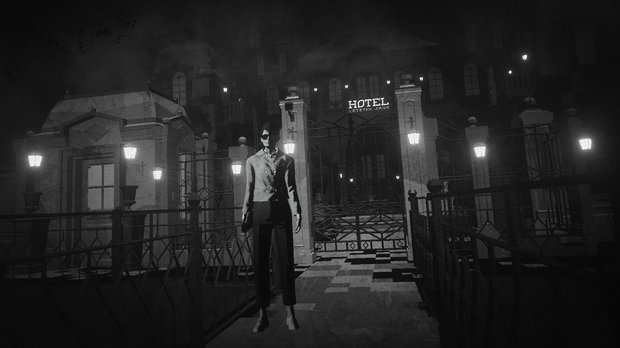
It is 1963, somewhere in Central Europe, and an experimental artist named Lorelei Weiss has arrived at the Hotel Letztes Jahr to collaborate with filmmaker Renzo Nero on a project. It is also clear that, in some way, the hotel contains the answers to a past that Lorelei has forgotten. With little instruction other than to “find the truth,” Lorelei must traverse the hotel and its surroundings to assist Renzo in the creation of his masterpiece and uncover what happened in this place where the past and the present collide, split, and fragment.
There’s no linear story to play through; rather, you’ll have to reconstruct the sequence of events yourself from snippets of Lorelei’s memories, various documents, and ghostly encounters around the hotel. Further complicating your attempt is the fact that the game is often vague in regard to what moments are meant to be taken literally. Characters speak in a strange, embellished manner. Art may possess more than metaphorical power, a supernatural kind, but the distinction is never clear. Every element adds yet another mystery to the pile.
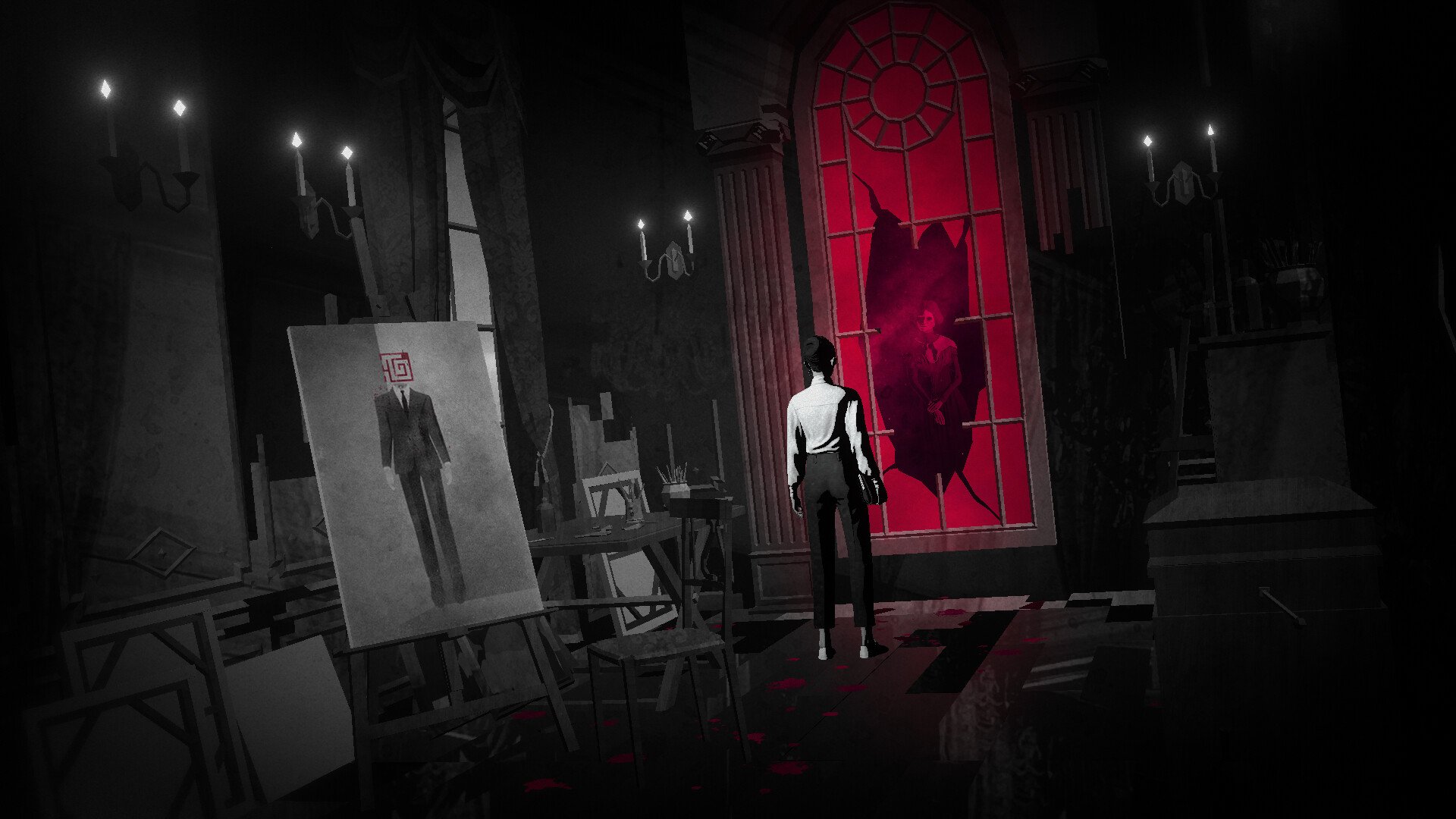
The curious nature of the hotel and Renzo’s eccentricities hint at the intrigue to come, but Lorelei and the Laser Eyes’ style is what immediately grabbed me. Though the graphics are pretty minimalist, the grayscale palette is striking. Combined with fixed camera angles, stark shading, and low-poly geometry, it achieves a very retro aesthetic that still feels displaced from any particular time period. The look is cohesive, yet becomes uncanny through its vagueness: the hotel itself appears antique but there’s a gachapon and PlayStation-style video games lying around, while Lorelei sports a 1960s beehive and sunglasses.
The developer, Simogo, cites the work of David Lynch as a key inspiration, and it definitely shows. Most notably, in the paranatural moments when the cracks of the world surface, a vivid red punctuates the scene: a maze, a broken window, a cryptic symbol. One thing this game does very well is paying homage to its influences while still distinguishing its own identity. You’ll pick up on plenty of nods to film and old-school gaming, but these read more as love letters to the forms rather than cheap references. The cutscenes resemble silent films, as there is no voice acting, only subtitles accompanying the grainy stills of the characters. These stylistic choices make the game feel like an arthouse film, the kind of film we soon learn that Renzo also creates. The shocking, disturbing, exceedingly surreal kind.
Most often ambient noise and environmental sounds fill in the background: Lorelei’s clicking footsteps, the digital whirring from computers, and electric distortions. Music from record players scattered around the hotel fades out as you move between rooms. It’s very eerie and can feel a bit like a horror game as you wait for something terrible to break the silence. The developers utilize this atmosphere superbly to maintain a sense of mystery as you explore. Otherwise, nondiegetic music is typically reserved for tense or otherworldly moments. The tracks are ethereal yet subtle, with a lot of lounge influence befitting a swanky hotel.
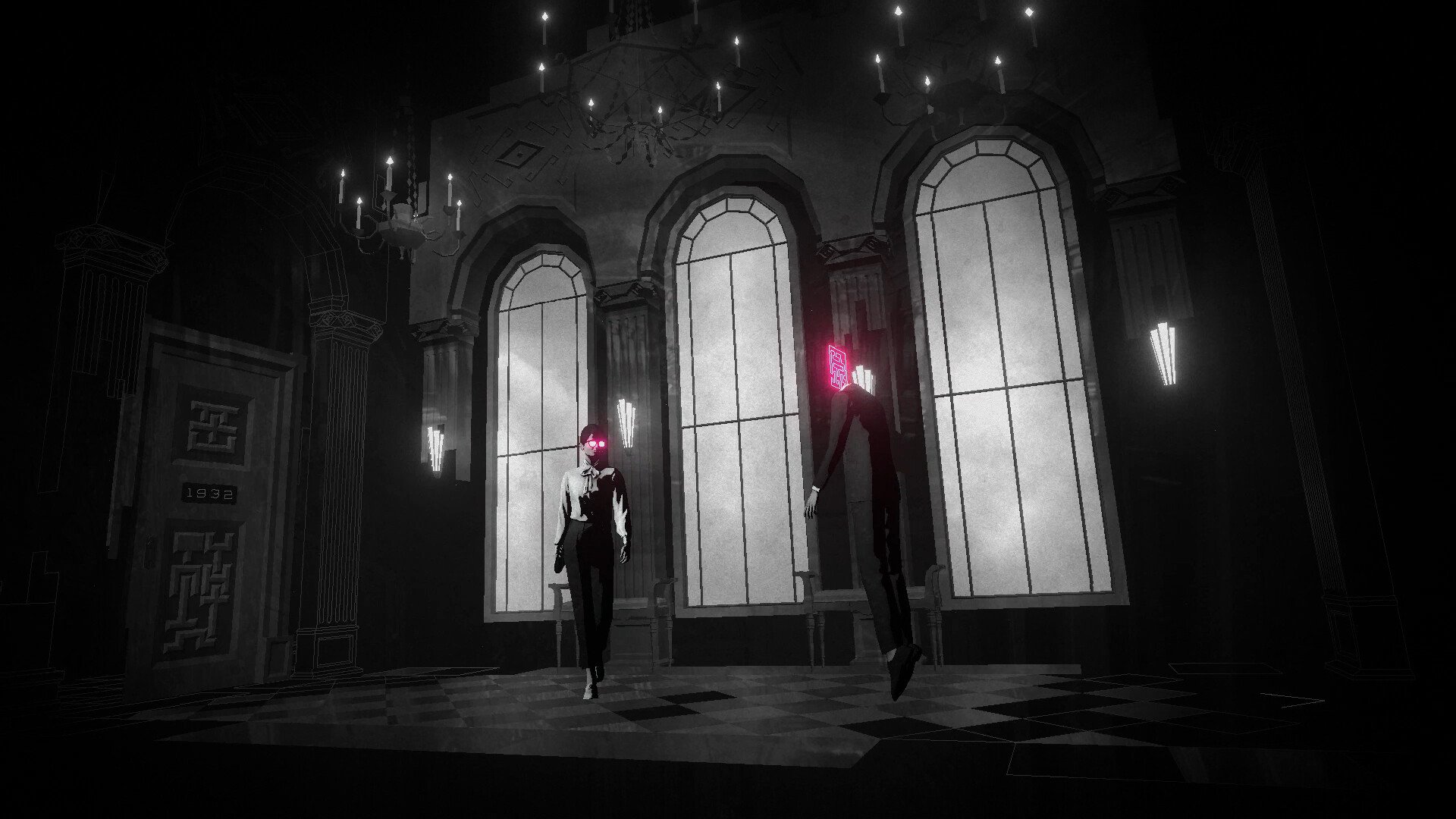
True to its experimental sources of inspiration, Lorelei and the Laser Eyes plays unlike most video games. It uses a third-person perspective with movement controls and only one input. The one-button control scheme completely worked against all of my muscle memory. Essentially, every single button on your controller or keyboard functions as a universal interact command. There is no dedicated back button, which means that if you want to close a menu, you will have to manually navigate to the on-screen “exit” option. If you want to reread a specific document, you’ll have to scroll through a series of submenus to reach it. This also means that you cannot quickly back out of puzzles that you’re unable to solve; you instead have to go through the motions of entering an incorrect solution in order to exit.
Unfortunately, while these unintuitive controls do seem to be a way of deliberately invoking the arthouse films this game emulates, the choice feels too needlessly frustrating to justify its existence. Another minor annoyance in the controls is just how slowly Lorelei moves. Sure, you can have her chug espresso to your heart’s content so that she’ll run, but it’s something you have to go out of your way to replenish. In a game where exploration is so crucial, these little things stick out just enough to feel irksome.
Lorelei and the Laser Eyes
| Genre: | Mystery |
|---|---|
| Presentation: | Realtime 3D |
| Theme: | Art, Psychological, Surreal, Amnesia, Memories |
| Perspective: | Third-Person |
| Graphic Style: | Illustrated realism |
| Gameplay: | Puzzle, Walking simulator |
| Control: | Direct Control |
| Game Length: | Long (more than 10 hours) |
| Difficulty: | High |
The Hotel Letzes Jahr is fairly open from the beginning, and you’re free to tackle many of the puzzles in any order that you like, though some require the completion of others first. I imagine that for a first-time adventure gamer, Lorelei and the Laser Eyes could be quite intimidating. Almost immediately, you’re dropped into this massive environment full of different locked doors, puzzle rooms and interactive objects, with little to no direction provided. It’s also not always clear which puzzles are locked behind prerequisites, beyond just the overwhelming size of the hotel. Its scale isn’t mere set dressing either, as the game boasts over 150 puzzles, though not all of them need to be completed in order to finish.
This proves to be a mixed bag, however. Some puzzles are truly unique or take advantage of the scope to feed into much later puzzles. A few challenges cleverly utilize multiple rooms, allowing you to simultaneously complete two areas. But the game is equally bloated with overly repetitive puzzles that only serve to pad out playtime. Because of the nonlinear progression, it feels apt to compare the game to a very large escape room. There’s a good variety of conundrums on offer here: logic puzzles, code-breaking, pattern recognition, and spatial navigation. While the task may seem daunting at first, the instruction booklet from the beginning isn’t entirely accurate – all of the information you need is available somewhere in the Hotel Letztes Jahr. Throughout the game you’ll acquire a ton of different letters, books, notes, and scripts that provide clues to unraveling the puzzles and story. The difficulty comes from the sheer number of puzzles and wealth of information to uncover. It’s all about figuring out what details you need to match with which solution.
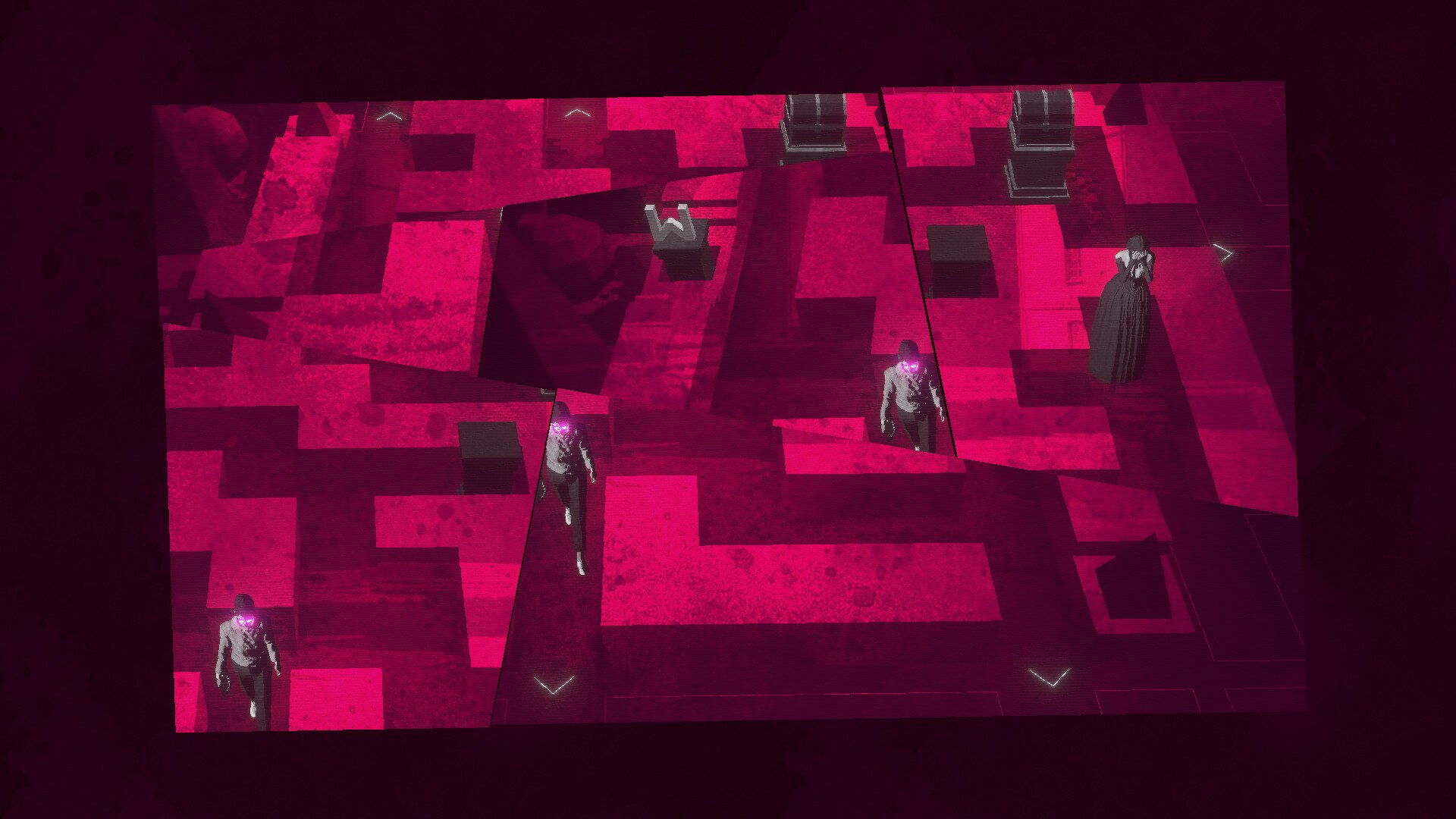
Fortunately, you don’t have to copy information for later use (albeit with one exception that the game will clearly mark for you). Lorelei’s photographic memory essentially functions as a record of every document you find for easy reference whenever necessary. But you’ll definitely need that pen and paper to test out various solutions. The lightbulb moments I got while sifting through my notebook ramblings, drawing loose connections, turning the page to view a symbol from a different angle, made me feel like a mad genius.
I should mention that Lorelei and the Laser Eyes does not have a hint system of any sort, possibly due to the fact that many of the puzzles use randomly generated numbers. Though you’re able to call Renzo for “advice” at any point, he only responds in bizarre idioms which are hilarious but completely useless. The main roadblock that I ran into was being unsure if I was even able to complete a puzzle yet, or if further exploration was required first. This can lead to you running in circles sometimes looking for a missing item or exhausting every document for nothing. The few times I found myself with no clue how to proceed, I would consult a guide specifically for the puzzle prerequisites.
The gameplay is its strongest when it leans heavily into the avant-garde artistic sensibilities. Interpreting perspective sculptures into code, solving “magic word equations,” and naming the paintings of Four Horsemen of the Apocalypse tie well into the artist and occult themes and require creative thinking.
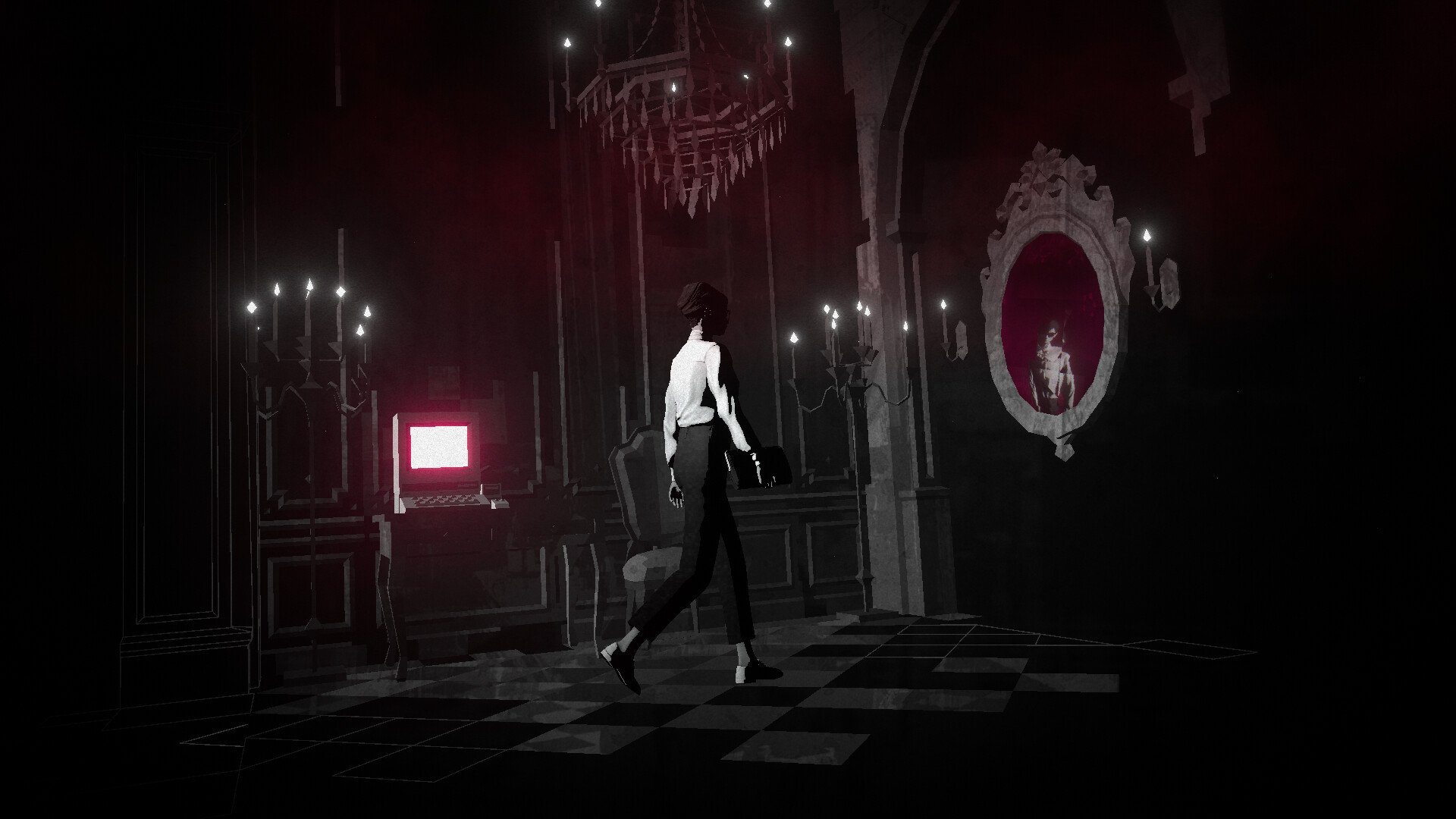
The LASER-I puzzles, on the other hand, succeed largely through their atmosphere alone. Remember those PlayStation-esque games I mentioned? Booting up each of the LASER-I game consoles allows you to play a series of in-universe video games that essentially function as warped representations of Lorelei’s memories. With their low-poly models and tank controls, these games are clear homages to the early Resident Evil and Silent Hill titles and are positively dripping with eeriness. Their lower resolution embodies the muddled and liminal nature of memory, turning Lorelei’s reflection on the past into something akin to horror. The solutions to the LASER-I puzzles are also very clever in how they ask you to interact with this in-universe art form, utilizing the distinction between the “real world” of the hotel and the world of art within it. I emphasize this puzzle because of how much I wish there were more like it. It’s so wonderfully weird and meta, an element that is present in the narrative but often lacking in the gameplay.
While the majority of puzzles are consistently satisfying to complete, the vast number of them means that, inevitably, there will be some disappointments. Amongst some truly great puzzles are others that either directly hand you the solution or overstay their welcome. Besides basic interaction, there aren’t any particular mechanics that the game builds on over time, which means that gameplay can grow repetitive pretty quickly. Slowly working through a series of nine different puzzle boxes becomes tedious by the fourth. At some point during your playthrough, you’ll also realize how many of the puzzles are solved by inputting one of a few specific names or dates into a lock. At first, recognizing this pattern might feel rewarding, especially if you’ve been paying attention to the story. Unfortunately, by the end of the game, the appeal of the formula has worn off as there is very little done to expand upon it.
The story, however, consistently maintains the intrigue and creativity that the puzzles can lack. The central mystery revolves around Renzo Nero’s obsession with creating “real art” and Lorelei’s forgotten past. With such a small cast, every rare interaction within the sprawling hotel feels all the more meaningful as the grand mystery takes a very personal turn. While difficult to say much more without spoiling the game, the David Lynch influence is clear in this aspect as much as the art direction. A large part of the narrative experience involves uncovering all the details yourself through fragments nested within the environment and dreamlike sequences. Similar to the puzzles, the story unfolds in a nonlinear manner, and each piece is another clue to ponder as the web grows increasingly intricate and knotted. Yes, it can be confusing. And yes, that’s part of the fun.
Lorelei and the Laser Eyes manifests its theme of artistic interpretation as it asks the player to treat the narrative as its own distinct puzzle. Fiction and reality blur through stories-within-stories and distorted memories. You must untangle the timeline as events from both the past and the present overlap at the hotel. It’s always unclear if people are speaking of the supernatural literally or as a metaphor. If you allow yourself to engage with the narrative on its own terms rather than seeking a confirmed “truth,” it will be floating around in your mind well after you complete the game.
Final Verdict
As someone who absolutely loves weird art films, Lorelei and the Laser Eyes succeeded for me by beautifully synthesizing its gameplay and art direction with its narrative. The story itself is the most satisfying puzzle of the game, elevated by a haunting ambience and distinct visual style. Sadly, many of its individual puzzles lack this creativity and are overly simplistic or repetitive. Couple this with an unintuitive control scheme and the game can become tedious to work through at times. However, even on their own terms, there are enough memorable challenges and twists to easily overshadow these issues. In its own tangled and strange way, this game reminds you that art is magic and rewards you for affording it the same laser-eyed focus.
Hot take
Even with some design choices better left on the cutting room floor, Lorelei and the Laser Eyes deserves consideration for its surreal mystery and some truly creative, thematically rich puzzles. For those who don’t mind a side of the avant-garde with their video games, it’s an experience well worth untangling.
Pros
- Memorably surreal story for players to unravel
- Stylish graphics create a unique identity
- Challenging puzzles encourage creative thinking
- Engages deeply with themes of artistic truth and creation
Cons
- Awkward controls cause unnecessary frustration
- Large number of puzzles means that many are repetitive
- Story might be too esoteric for some
Ida played her own copy of Lorelei and the Laser Eyes on the Nintendo Switch.

- Advertisement
- Help support AGH by advertising with us








2 Comments
Want to join the discussion? Leave a comment as guest, sign in or register in our forums.
My wife and I used to play Blue Prince together, but gave up after 100+ hours and 65 in-game days when it was obvious we wouldn't be able to unlock all its secrets even WITH a walkthrough... Would Lorelei be a good alternative?
Reply
If you liked the out of box thinking In Blue Prince but want something more tightly contained, then yeah I would say so. Several puzzles are optional, but in general they're the ones that don't have lore hidden behind them, so you won't feel compelled necessarily to tackle them. And with the exception of the game's final puzzle, a walkthrough can make quick work of everything in a couple minutes. I certainly did not spend anywhere near the time that I did on Blue Prince.
Reply
Leave a comment