
Dimhaven: The Lost Source review
- 0 Comments

Excellent puzzle-intensive game from the creators of Quern shines brightly in many of the same ways
It’s 1984, and young Emily Ravenstone parachutes into the former island resort of Dimhaven in search of her uncle Zack, who has gone missing there. What she finds, however, is a more mysterious secret than she could possibly have imagined. Reaching the heart of that secret requires patience, attention to detail, and logical and deductive reasoning to overcome a series of clever and fiendish puzzles in Zadbox Entertainment’s first-person 3D adventure Dimhaven: The Lost Source. With a wide variety of mental challenges and a charming neo-retro graphical look, there’s much to admire here for fans of the great classic puzzlers of the past.
After a less than smooth landing in Dimhaven’s drop zone (why they don’t have a normal dock is never addressed), Emily immediately begins the task of getting to know her environment. To do so, she must find ways to repair and use a plethora of machines, as well as solve the many puzzles that have been laced throughout the area. During the landing, she loses her passport, which proves a challenge at the automated customs machine that bars entry to Dimhaven proper. She doesn’t know it yet, but much of the equipment and architecture on the island was designed by one Kalman Vosh in the 1800s. The clichéd eccentric genius with a penchant for puzzles, Vosh made sure to incorporate enigmas and obtuse controls into everything he built.
Emily makes her way inland, working towards the Raven Nest, a mansion that Vosh designed for his friend, Emily’s great-great-grandfather Oscar Ravenstone. Along the way, she learns more about Vosh, Oscar, her uncle Zack, and a mysterious undertaking that they all became obsessed with to the point of madness. Its roots trace back to the legends of the Valati, humanity’s earliest known civilization which left stories and runes behind on Dimhaven related to the Dimming – a solar eclipse that strikes the island every forty-eight years. Even more puzzling is what all of this has to do with modern-day Voltacrest, the energy company that contracted Zack, an archeologist, to look into it. A shady stranger by the name of Charles, who may or may not have been Zack’s friend, is also lurking around keeping an eye on Emily’s progress.
With so many mysteries to investigate, one would be forgiven for thinking they’re the driving factor of the game. However, being very much in the spirit of the Myst series, as well as Zadbox’s own 2016 hit Quern: Undying Thoughts, Dimhaven’s main allure is actually its puzzles. When first starting, players are even given a heads-up that “This is a difficult puzzle game with little to no handholding.” And indeed, challenges are exactly that: challenging – and they rely not only on paying attention to notes and clues scattered within the environment, but also basic external knowledge such as the correct operation of a vending machine and payphone.
There is a fantastic variety of puzzles on offer. Some are fairly standard, such as reorienting and piecing together the fragments of a picture or solving various codes and patterns. Others are logic-based, like one that involves arranging variously shaped mechanical pieces within an electrical box based on strict rules of which pieces are allowed to be next to one another. Some, like a puzzle revolving around how and where an elevator moves, take real advantage of being in a 3D environment where it’s important to picture the spatial relationships of objects with respect to one another. Still others dip into mathematics or the application of Boolean (true/false) logic. There’s even one puzzle, easily overlooked but critical to solve, that requires shaping a key within the in-game inventory.
Most of Dimhaven’s challenges are logical and fair. However, if any pose a particular problem, the game’s inventory screen also grants access to a hint system, which provides progressively more detailed clues. I used the most general level of hints a handful of times, not so much for solving the puzzles but simply to confirm I was looking in the right place, as it’s not always apparent what pieces you should be focusing on at any given time.
There was one puzzle I had to use all available hints for, and even after completing it I’m still not sure why the answer is what it is. The puzzle involves figuring out where people were sitting at a table for a birthday party. When you get close to the table, the game suddenly puts up imaginary blue walls that hem you in as questions fade in and out on them (“Who?” and “Where?” and the like). It’s the only puzzle sequence in the entire game that locks you into one small, constrained spot until you solve it, so I wouldn’t be surprised if many people struggle with it as I did. (Or maybe I’m just hoping I’m not the only one not clever enough to solve it.) There is also a retro-styled arcade mini-game, a side-scrolling space shoot 'em up that may look daunting but comes with a bypass exploit for the observant explorer to discover.
With the number of puzzles – and consequently notes, patterns, and other hints in the environment – it’s good to stay organized and keep track of things. You’ll definitely want a pencil and paper at hand. Fortunately, there is also an in-game camera to take photos that you can refer back to later. Each picture is stored in a photo album you carry with you. From there, photos can be personally annotated with sketches and text labels in different colours. The configuration settings indicate that a map should be available by pressing M, but that never worked for me. Even so, navigating the environment was straightforward enough that I never found myself needing it. What did work was the full manual save system with a bonus autosave on top, though there’s never any fear of dying or losing significant progress.
Dimhaven: The Lost Source
| Genre: | Mystery |
|---|---|
| Presentation: | Realtime 3D |
| Perspective: | First-Person |
| Graphic Style: | Photorealism |
| Gameplay: | Puzzle, Exploration |
| Control: | Direct Control |
| Game Length: | Long (more than 10 hours) |
| Difficulty: | High |
| Theme: | Missing persons |
The game does a good job of ramping up the difficulty as it goes along. Partly this is due to the puzzles themselves getting more intricate, with more elements to deal with. Partly it’s because the geographical spaces within which puzzles are set get bigger and bigger. Thankfully, as you progress, earlier areas become inaccessible once you’re done with them, so you don’t have to worry about backtracking to places you’ve already left behind. For example, once you pass customs upon your arrival and get your travel visa for the island, there’s a time jump as Emily hikes to a nearby village. Once there, you can’t return the way she came because that section of the world is locked off. Later on, armed guards even show up to block your path back to previous areas. They’re not dangerous, they just serve as walls stopping access to places you have no reason to return to anyway.
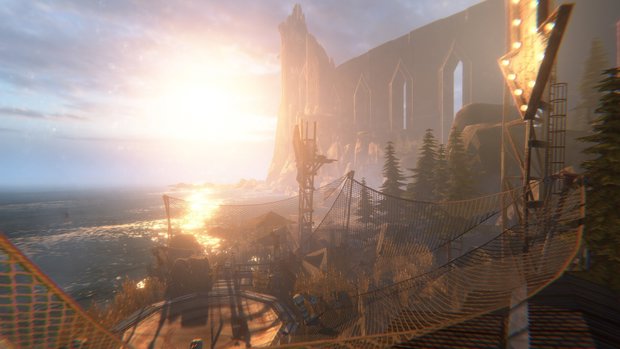
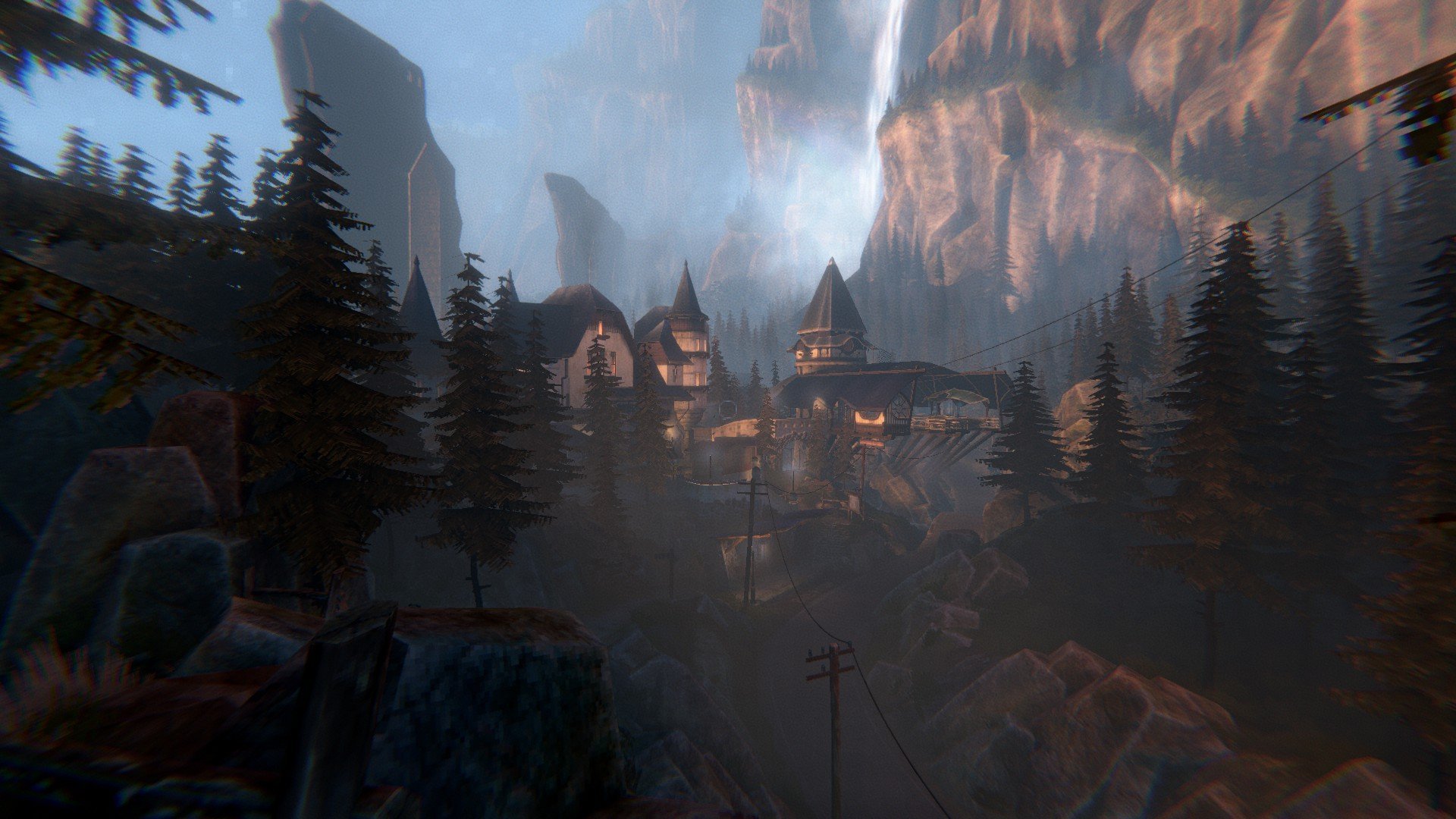
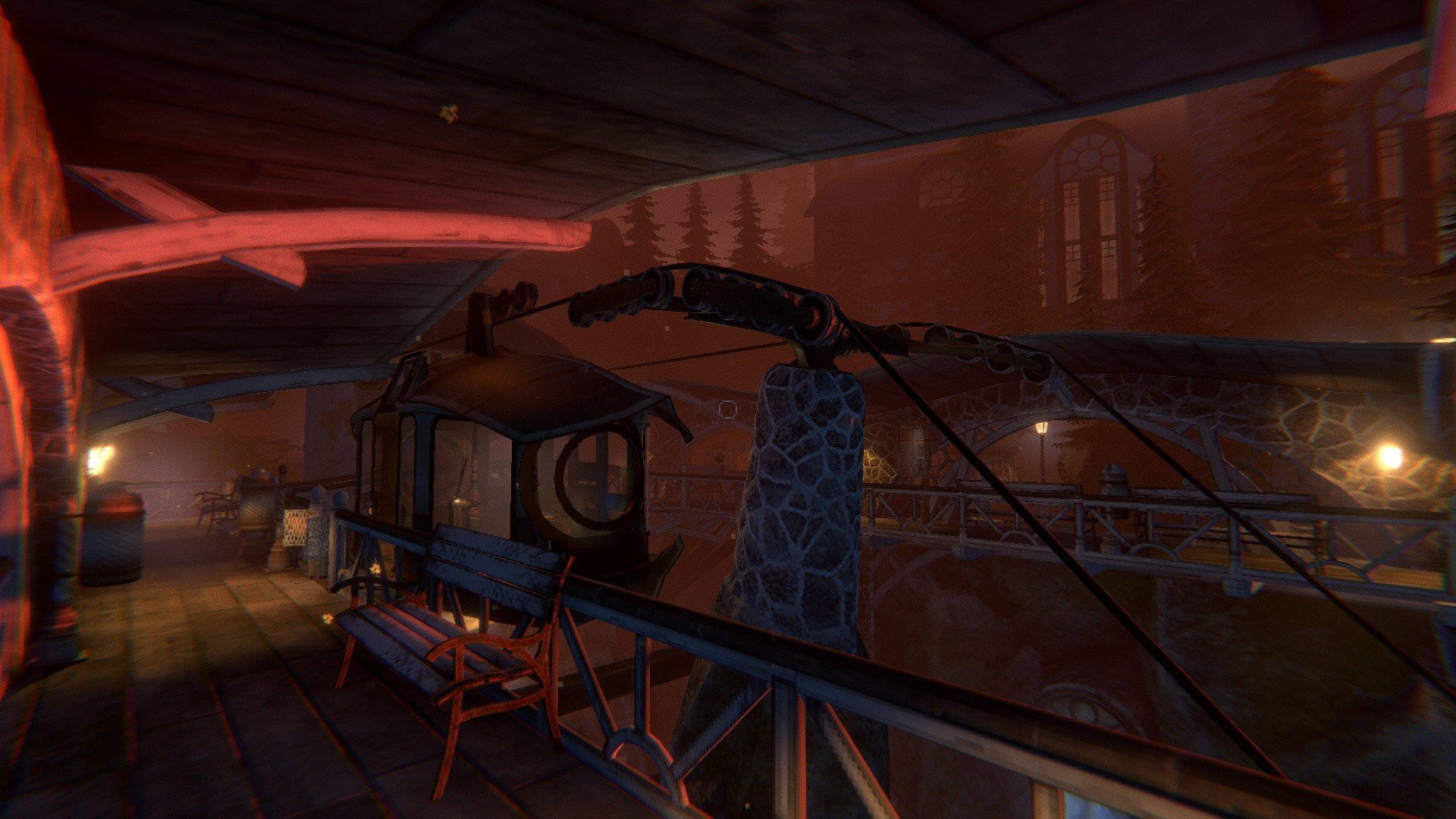
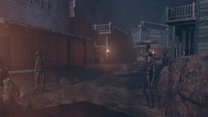
From the landing zone, you make your way to the small, run-down town of Kishvar, with many closed shops and seemingly only one remaining resident, Lars, who needs help getting power turned back on. Achieving this leads the way to a gondola that takes you further up the mountain in the center of the island, getting ever closer to the Raven Nest. Along the way there are some stunning views of the surrounding scenery. A setting sun bounces golden light off the ocean, signposts, machinery, and ornamental metal fixtures. A dense forest hugs the human-made structures. Cascading waterfalls peek through the foliage here and there. Birds majestically take flight at your approach, sometimes with a shriek and flurry of feathers. It’s easy to see why this island was chosen as a tourist destination before falling on hard times.
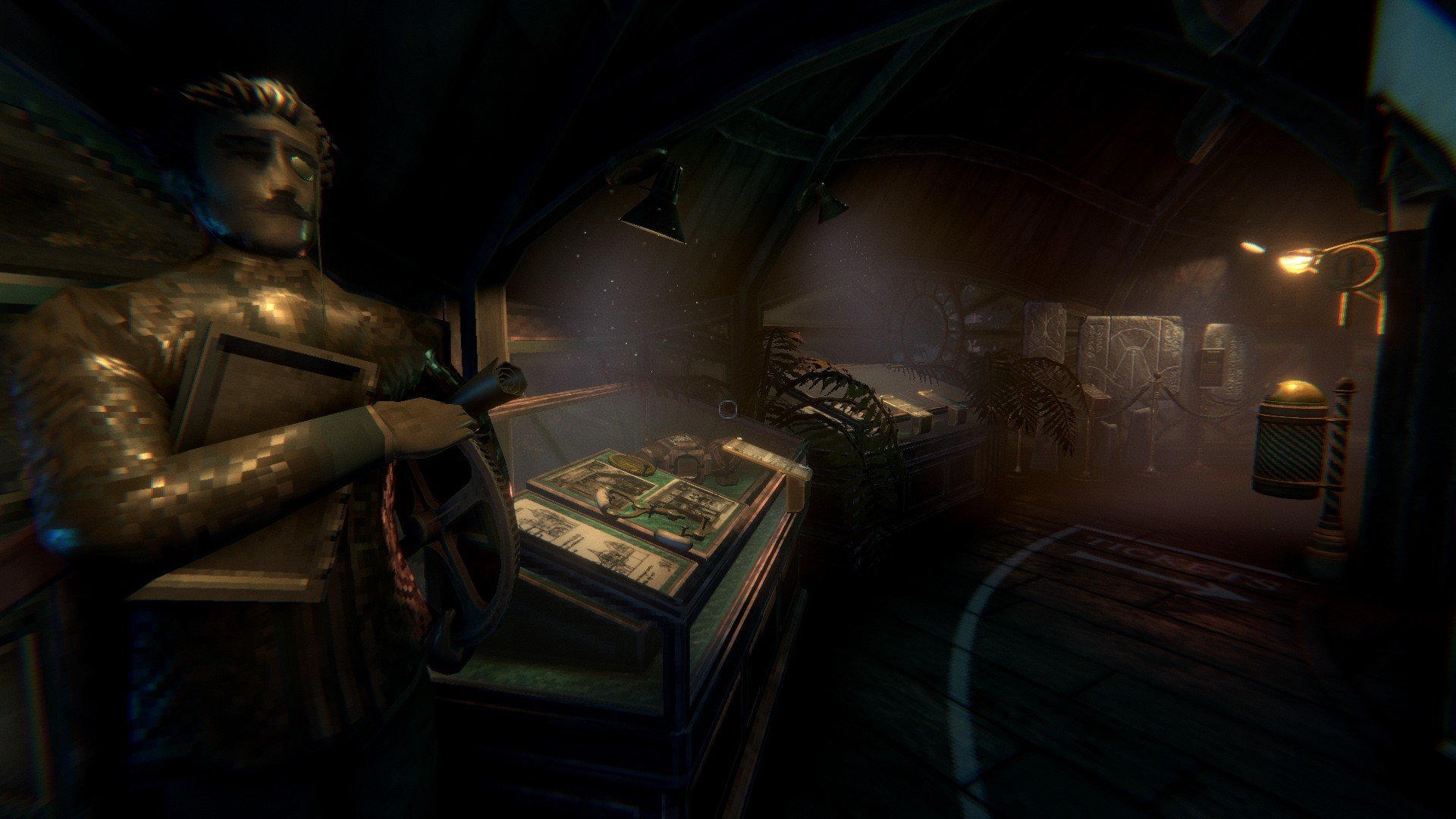
Dimhaven is fully 3D, complete with game controller or keyboard/mouse controls, and makes use of modern lighting techniques. However, the texturing of the environment employs a charming and intentionally implemented pixelized look. It’s like taking the beautiful pixel artwork of the great games of the 1990s and applying it to reasonably detailed 3D objects of today. The effect is one that feels both polished and lovingly handmade.
Great attention has also been paid to the soundtrack, with atmospheric instrumentals complementing the lovely visuals. It can be misleading at times, though, such as when you wander through a darkened cave. There the music takes on a sinister tone with a serial-killer-lying-in-wait vibe that never materializes. The world is also replete with sound effects. Whether it’s the cawing of angry crows, the crashing rush of waterfalls, or the chug and clank of the various bits of machinery you have to set in motion, there is a rich audio presence during your journey.
While Emily’s travels are mostly solitary, she does bump into the odd other fully voiced individual, each of whom is portrayed quite well. Occasionally Emily is given some dialog choices in conversation, but I never got the impression it made a difference to the story which options were selected. These rare in-person exchanges are supplemented by audio recordings left behind on cassettes. These tapes detail Zack’s research into the Velati runes and his questioning of why an energy company like Voltacrest would care about such ancient writings.
Not that you’ll spend much of your twelve or so hours of play time dwelling on the story with so many fine puzzles demanding your attention. It’s great that the puzzles are so weighty, but it does mean that the narrative suffers slightly. Not because it’s bad in any way, but because the puzzles are almost all standalone challenges instead of evolving organically out of the narrative to help propel it along. As such, they chop up and diffuse the focus of the mystery itself.
Similarly, I found the ending didn’t quite measure up to the fantastic experience of getting there. After hours of excellent puzzle solving, the final challenge forgoes logic with a task involving the manipulation of dials to try to match sound frequency patterns on an awkward visual display. With no real way to think your way to the solution, you’re left twiddling the dials until you hopefully get the pattern close enough. The ultimate reward for doing so, the climax of the story, is a bit disappointing in its own right. There are some big reveals at the end, but Emily and the other characters involved are all rather blasé about them, and a couple of the game’s central conflicts are simply hand-waved away.
Final Verdict
Like the developer’s previous game, Dimhaven: The Lost Source is a puzzle lover’s dream. With one or two noted exceptions, the quantity, quality, and variety of challenges are all top-notch. And while the island of Dimhaven is now a bit run-down, its former glory is continually evident in its charming and enticing visuals. Supported by equally excellent audio, the game provides a great atmosphere within which to confront its many well-designed enigmas. While it doesn’t quite stick the landing – the final proverbial landing, that is – everything else is first-rate to that point, so those looking to exercise their brains will definitely get a great workout here.
Hot take
Clearly inspired by classic puzzle adventures, Dimhaven drops players (literally) into an engaging, fantastical, eccentric seaside resort full of head-scratchers, atmosphere, and a family mystery to unravel.
Pros
- Great variety of puzzles
- Challenge difficulty ramps up well
- Charming pixelized 3D visuals
- Atmospheric musical score
- Progressive hint system
Cons
- Trial-and-error final puzzle
- Story ending is anticlimactic
Richard played Dimhaven: The Lost Source on PC using a review code provided by the game's publisher.

- Advertisement
- Help support AGH by advertising with us




0 Comments
Want to join the discussion? Leave a comment as guest, sign in or register in our forums.
Leave a comment