
Venice After Dark review
- 0 Comments

Plenty of lovely sights and sounds in this intelligently designed mystery in Italy’s famed island city
Ah, Venice… I have always wanted to visit. It almost happened years ago, but then I threw out my back. I don't know if I'll ever go there now, the opportunity feeling like a thing of the past with the modern experience now marred by mass tourism. Thanks to adventure games, however, we can travel the world and virtually travel to famous places without leaving our gaming chairs!
Of course it’s not really the same, but in Venice After Dark, by German developers Sebastian Grünwald and Weltenwandler Designagentur, we get to explore the mysteries of this lively and beautifully hand-drawn Queen of the Adriatic in a captivating narrative-driven adventure that ends up offering much more than first meets the eye. The game took me quite a bit longer to finish than anticipated, as I was busy interacting with other people, gathering items, and solving a variety of puzzles, some of which nearly broke my brain. In the process, I learned a lot about the science behind optical and aural illusions for good measure.
You play as Aiko Kyeon, a “useless internet millennial,” as she is called by the first person she meets after arriving at the train station. Aiko is in Venice with her floating AI assistant Thea – that’s right, AI, but don’t balk yet! Artificial intelligence may be a very important part of the storyline, but every aspect of this game shows a distinctly human touch behind its creation.
Thea is the prototype of a talking AI device that is scheduled to be put on the market any moment now. But Aiko, the lead programmer on the project, doesn’t quite trust her employer ArtifiCell. She suspects her boss of wanting to use this new and powerful system for nefarious purposes. There are even rumors the technology has already been sold to the military branch of the government. So Aiko grabs Thea and flees to faraway Venice to figure it all out.
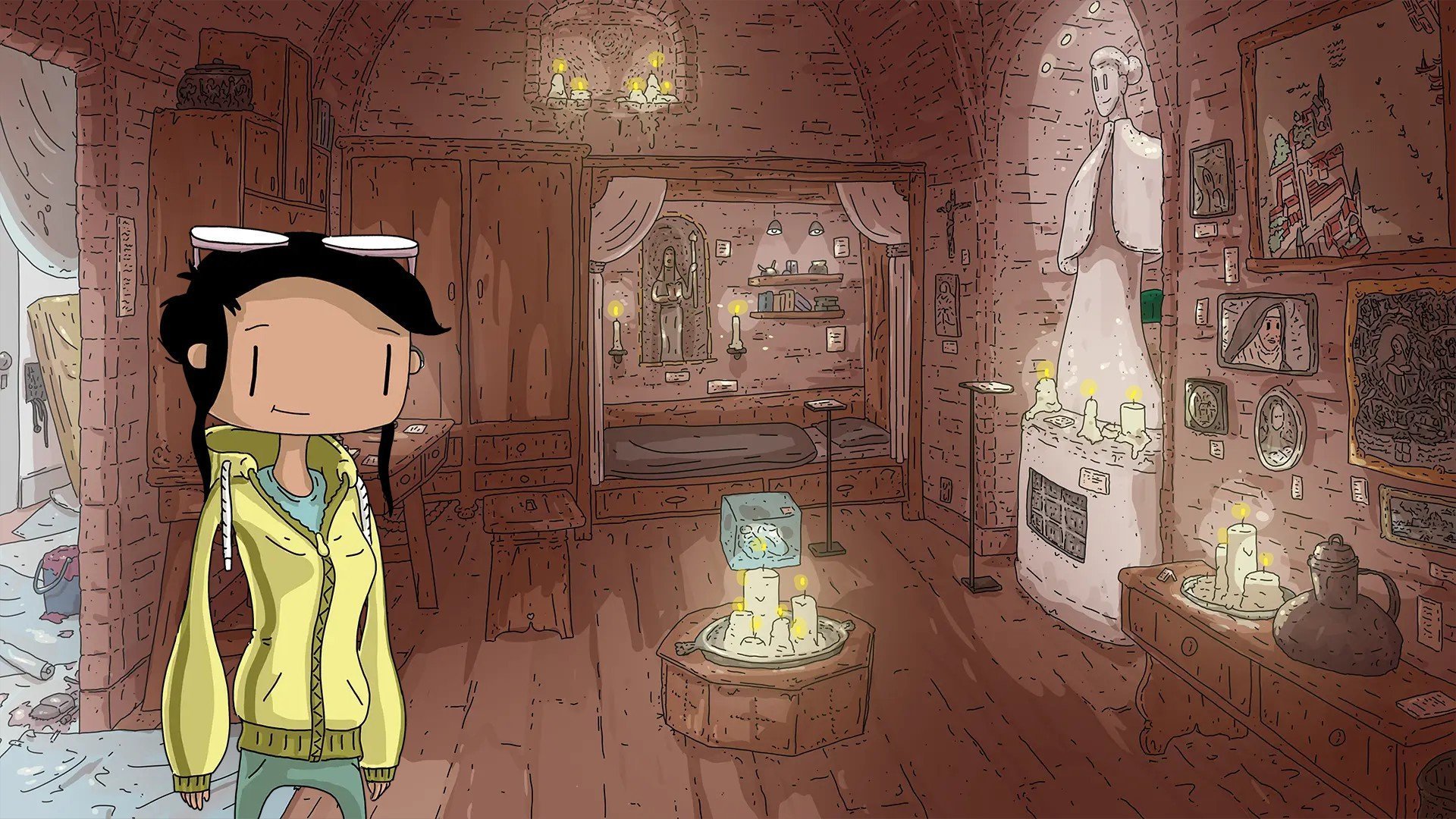
Once Aiko arrives in Venice, though, strange and seemingly supernatural events begin to occur that raise even more questions in her mind. A mysterious, centuries-dead nun appears to be haunting the hotel Aiko is staying at, though rather than being a malevolent spirit, the ethereal sister even steps in to save the protagonist’s life at one point. Then there are signs that the nineteenth-century miller Giovanni Stucky, after whom the hotel Molino Stucky is named, had some secrets of his own. For Aiko, and the player, there are plenty of things to investigate.
The soundtrack of Venice After Dark is surprising. It doesn’t rely on clichéd Italian music like the mandolin and accordion. Instead it’s ambiently cinematic, with heavy orchestral influences. It’s mostly heard in the background, but becomes quite epically filmic during mysterious or suspenseful scenes before turning lighthearted again for the more humorous interactions.
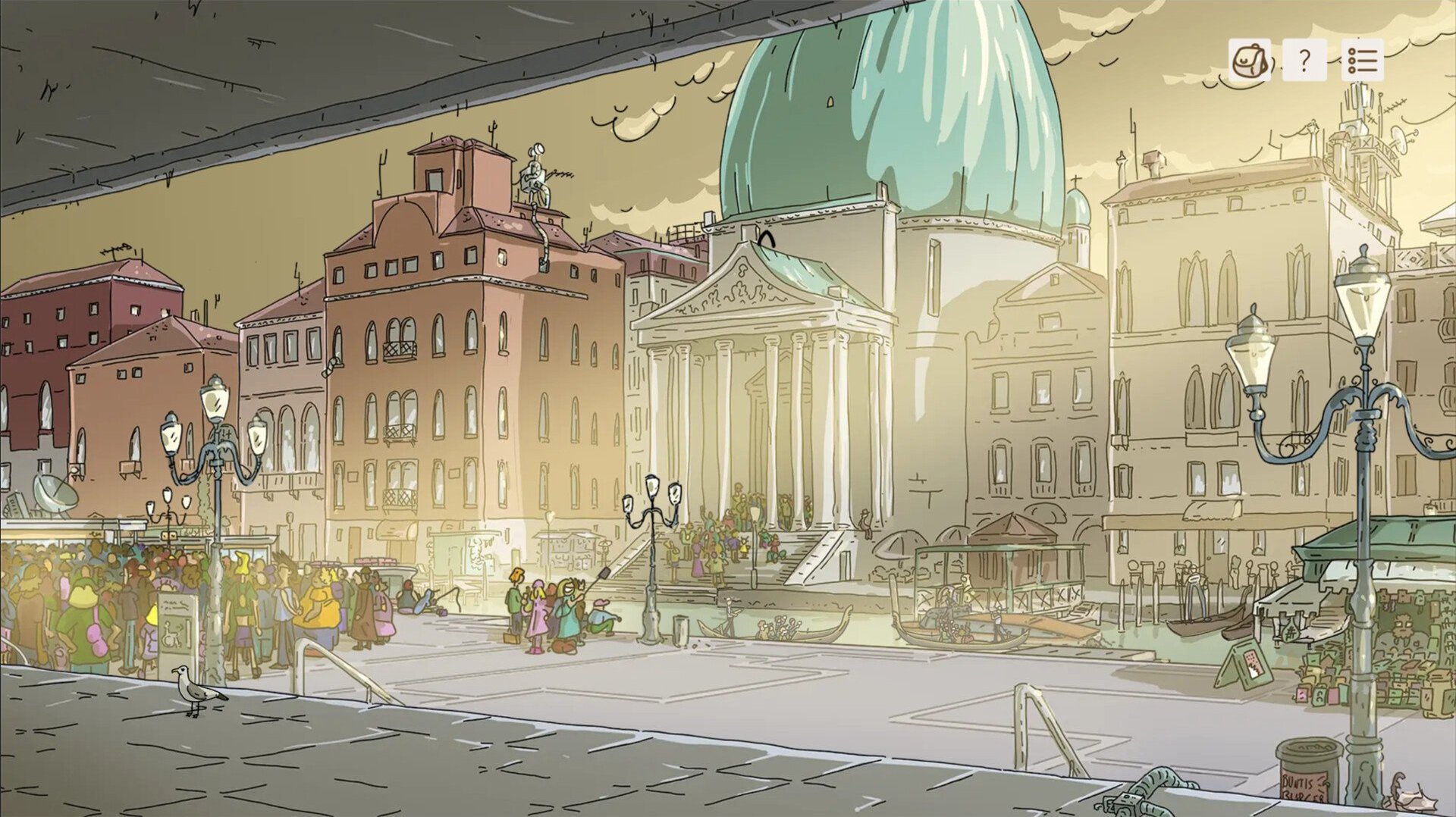
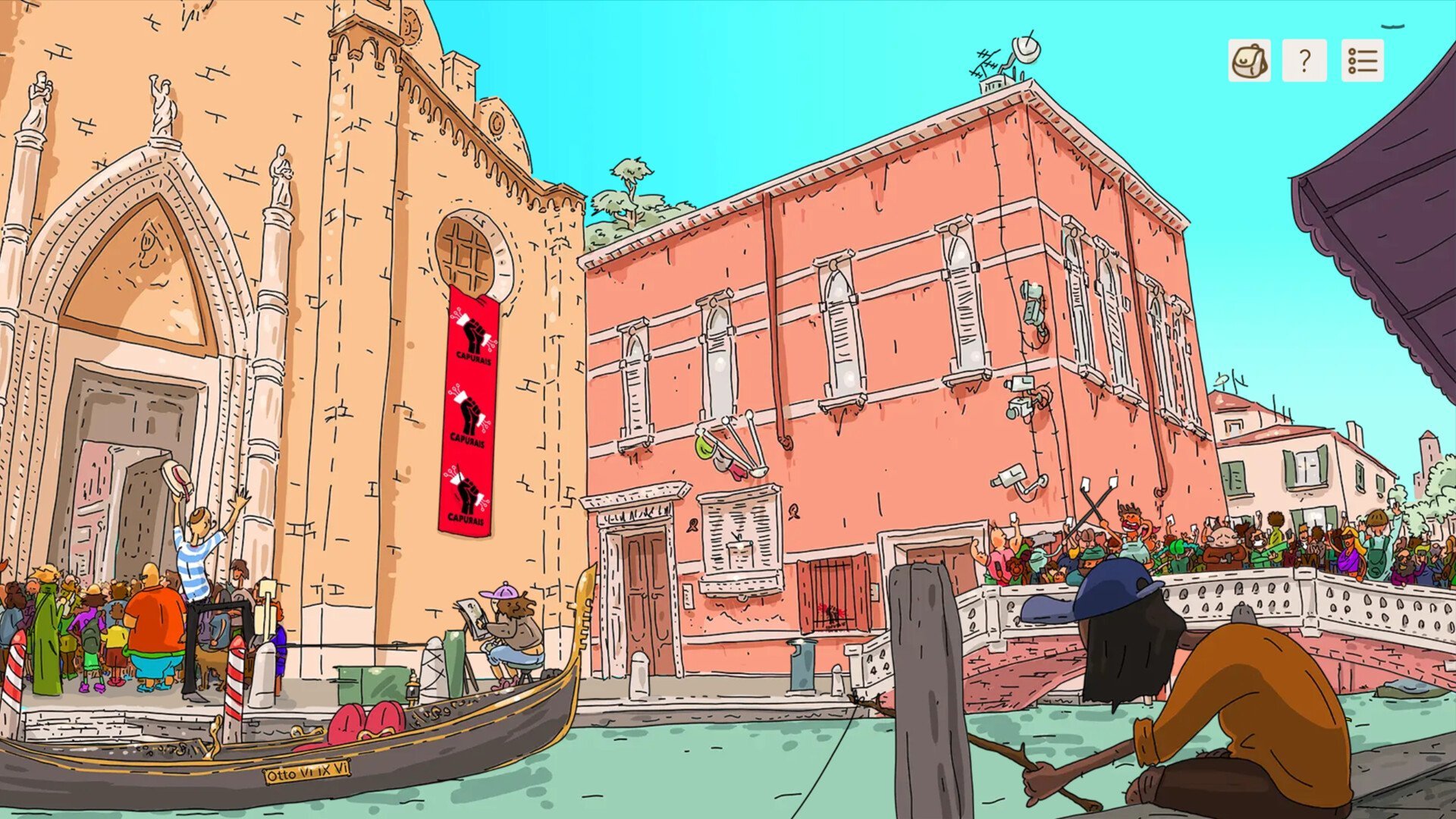
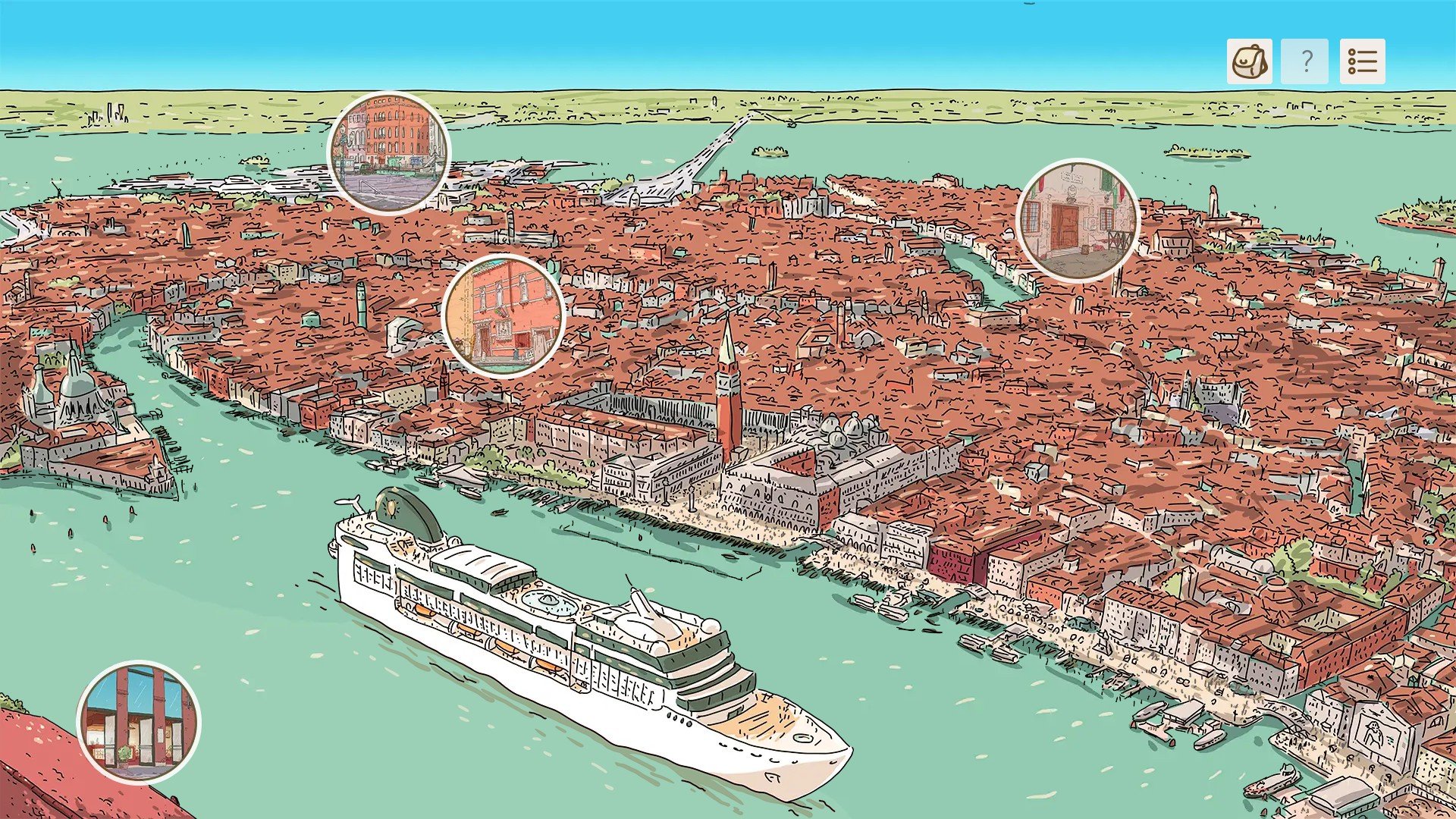
Venice, of course, is a gorgeous city, and its digital counterpart here is likewise a work of art. All locations are beautifully hand-drawn. There aren’t many of them – the square at the train station, the hotel, a carabinieri (police) station, the city archives and the island of San Michele – but they all have a soft pastel look in different color palettes to suit the dynamic weather cycle, from rainy to misty, and from sunny daylight to nighttime. There are several different versions of each scene with varying groups of tourists quietly muttering in the background, and everything is brought to life with dozens of small animations and subtle sound effects, giving the impression you’re actually walking around a living city.
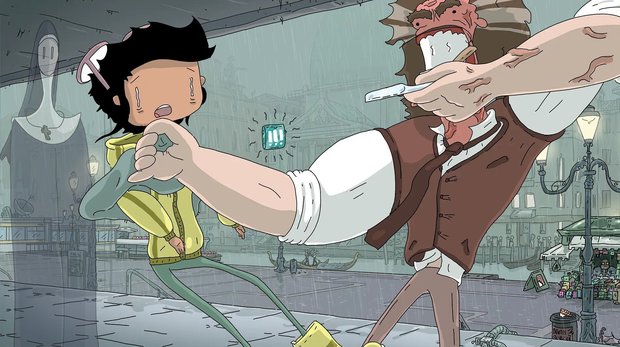
The 2D art style is simple and stylized, like a comic book, with a detailed design of Venetian backgrounds and quirky cartoon characters whose most recognizable feature is their lack of a nose. Aiko reminds me of Finn from the cartoon show Adventure Time, with her thin limbs and hood, though she sometimes puts on a pair of huge round glasses that cover half her face. Thea is a turquoise floating tablet, a constant companion that pops up to comment on her own. (You can’t talk to her whenever you want.) In some areas, though, Thea can’t join you because she’s unable to move over vast bodies of water. I assume she runs on the same technology as the hover boards in the Back to the Future movies.
Aiko can try talking to random tourists, though they never have anything worthwhile to say. However, there are a handful of key characters to interact with: Pietro, a fisherman, set up behind Aiko’s hotel; Jakobo, a nerd working in the city archives; Viola, a very small policewoman; and some other locals like a kiosk owner, a gondolier, a photographer, and a monk. These characters stand or move about in their respective scenes, but slide into the foreground from the side whenever Aiko engages them in conversation. Since you navigate the locations in first-person, you only see Aiko when she appears in the foreground as well, whether to comment on something or talk to other characters, visual novel-style. During conversation, characters have a range of expressions with animations switching between them, sometimes in comically dramatic fashion. Jakobo even wears a t-shirt featuring a three-headed monkey that mimics his emotions.
All characters are fully voiced with top performances that give them appropriate cartoon personas while simultaneously being careful not to push them into caricatures. The voice work nicely fits the visual depiction of the characters’ emotional states, making conversations flow very naturally. Most noticeable is the chemistry between the British-accented Aiko and Thea. This is important because they have the most lines together, and are often responsible for many a funny moment. I played with English voice-overs, but there’s also a German version.
Each major character you meet in Venice becomes their own dialogue topic, meaning you can ask everyone about everyone important. This way you can uncover new information to use to your advantage in further conversations. There’s never (or rather, almost never) a rush, as in-game time progresses only when you make discoveries, either by talking to people or solving puzzles. Eventually this results in a new time stamp at the bottom of the screen when you next switch locations, alerting you to the fact it’s now later in the day, and characters might have changed positions or have new things to say.
Venice After Dark

| Genre: | Mystery, Science Fiction |
|---|---|
| Presentation: | 2D or 2.5D |
| Theme: | Cultural, Crime solving |
| Gameplay: | Investigative, Puzzle, Deduction, Choices matter, Narrative |
| Control: | Point-and-click |
| Game Length: | Medium (5-10 hours) |
| Difficulty: | Low |
| Graphic Style: | Cartoon |
There’s more to this game than a visual novel, however, as it plays like a traditional slideshow-styled point-and-click adventure the rest of the time. The crosshair cursor is context-sensitive, changing into a magnifying glass when you can examine something, a hand icon when you can pick something up, a text balloon when you can talk to someone, and an arrow when you hover over an exit. The spacebar works as a hotspot revealer, and you access your inventory through a backpack icon in the top right corner, alongside two more icons: one to ask for hints and another to access the main menu.
Our little kleptomaniac protagonist has no problem picking up stuff she doesn’t have a particular use for yet, like a miniature spear from a statue in her hotel room. However, the inventory is only there to look at the items you have collected in your travels if you wish, as you don’t have to combine or even manually choose what to try on hotspots. When Aiko has the needed object in her possession, she will automatically use it when you next examine its related hotspot. For example, if you’ve found a box of matches, when Aiko interacts with an oil lamp to light it, the cursor will effectively change into a matchbox. Or during conversation, an item might be mentioned in a new dialogue topic so Aiko can offer it to people for trade.
As you start up Venice After Dark, you can choose between three difficulty levels. With “Young Doe,” Thea will assist with your tasks by automatically solving the puzzles for you if at first you don’t succeed, and the in-game hint system is always available. There are also no text parser challenges requiring you to manually type in a name when searching a database. With “Clever Fox,” the parser puzzles are enabled and hints can only be accessed when you’re stuck. After you have tried solving a puzzle on your own, Thea will ask if you want help, but will wait for your prompt before solving it for you, giving you extra chances to try it again. Finally, “Old Hare” has the player do everything on their own – no help whatsoever.
Of course, yours truly chose the Old Hare mode for his playthrough, but you can always switch the difficulty level as you play. And to be honest, there were a couple of instances where I was tempted to do so. The puzzling is quite traditional, and most of the time I was able to solve them on my own. In the first chapter, for example, you have to gather several pieces of glass, hidden all over Venice. Some you can simply pick up, others will be given to you, yet others will require a bit of thought to acquire.
But there are also some tricky logic puzzles with rules I never did find within the game itself. One involves connecting colored cables to the correct sockets to cause a short circuit, which I had to pretty much brute-force. Once completed, I still didn’t get the logic behind it, though I was informed the solution was linked to the system of additive color models – an instruction I didn’t even understand being my only clue. Another puzzle has you pressing the correct number of colored tiles in a mosaic to activate an ancient power line, for which you have to be very observant of your surroundings. There are also a couple of slider puzzles and code machines that weren’t as hard and were a lot of fun to figure out.
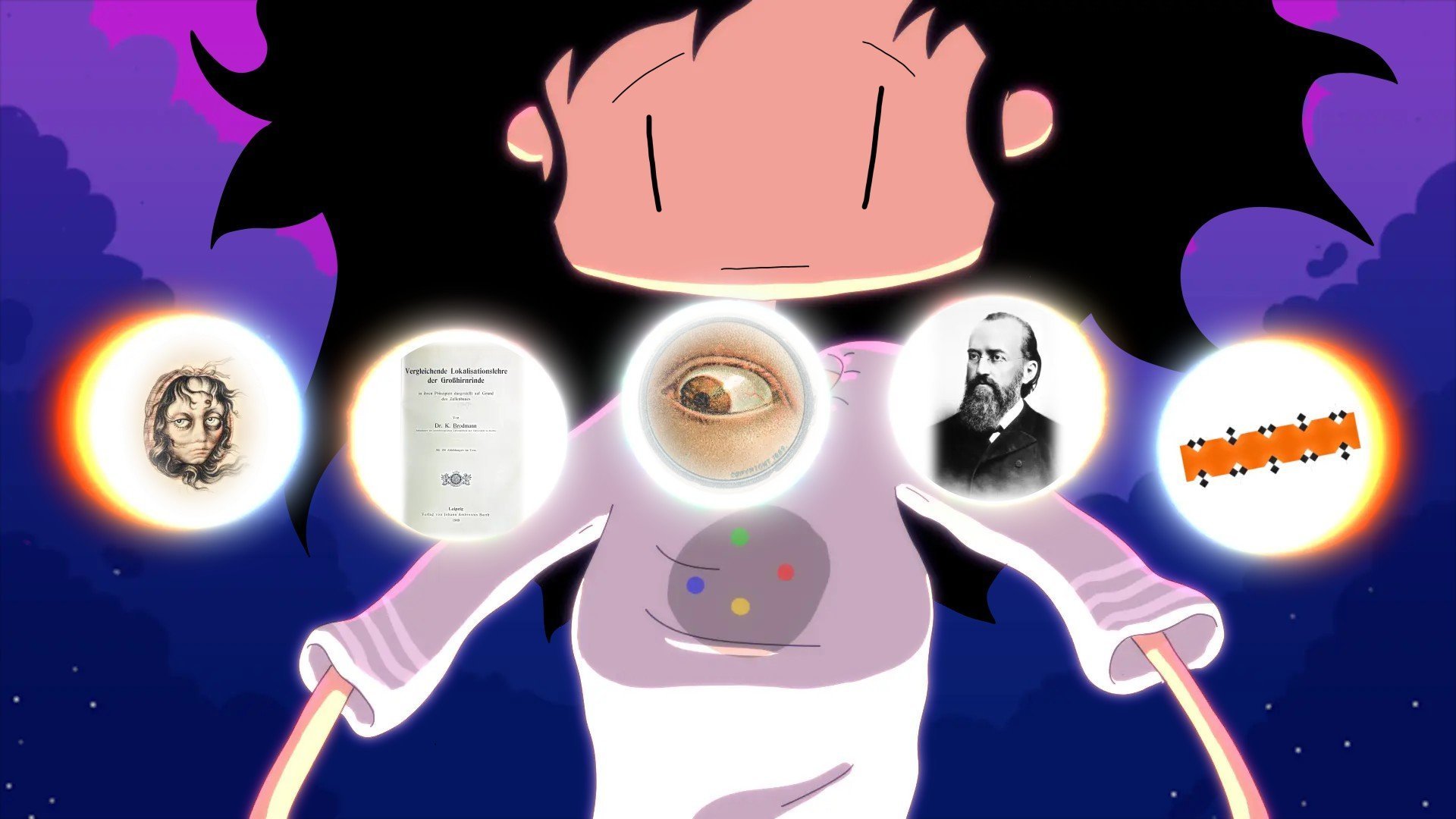
Perhaps the puzzle I struggled with was supposed to hark back to a sequence about optical illusions earlier in the game. These illusions are detailed during a kind of dream sequence on the first night. The second night, a similar piece of edutainment explains everything about aural illusions, which requires headphones. Here you have to do a series of tests, several of which I recognized from having encountered them in real life once; others were first-timers for me. In some you have to listen to different tones and answer whether they are truly different, or if you hear extra tones, or if certain rhythms come in different speeds or not. While personally I found these sequences fascinating, especially because of the scientific explanations behind the illusions, I can imagine them coming across as too passive for some, as it can feel a bit like sitting in a classroom, or shopping for a hearing aid. It takes a long time, as well, for the narrative importance of these “lessons” to become apparent.
However, your test results do count – together with some other decisions you make during conversations – toward which ending is suggested to you by the game’s algorithm. You even get to see a short flashback montage of those moments. Venice After Dark has three possible outcomes, but you are still totally free to choose which one you want. And since the game allows manual saves, it’s easy to go back and see all three endings consecutively. At the end of my playthrough, I actually chose a different ending than the one suggested to me, and although bittersweet, I was quite satisfied with it. After watching the other two endings, my initial choice did indeed feel like the most natural conclusion to the story. The others actually seemed disappointing to me.
The scenes leading up to that final decision, on the other hand, are a bit out of this world. Without spoiling too much, they most resemble a boss fight requiring some quick reflexes, though the outcome will always be the same whether you are good at it or not. The Venice setting is also thrown completely upside down, giving the whole atmosphere an unexpected sci-fi/fantasy vibe. While fully understandable considering the story being told, I found this turn of events rather upsetting, because I had enjoyed traipsing around this historic Gothic city so much and was sad to see the narrative direction change so abruptly.
There are a grand total of one hundred achievements you can track in-game, which add plenty of amusement. Most of them unlock automatically during the flow of the conversations. For instance, Thea loves to quote movies, so every time you choose a dialogue option that inspires the AI, a new quote and thus achievement pops up. If you are a movie buff like me, you will definitely get a chuckle out of Thea suddenly saying “We’ll be back” in a suitably thick accent when you can’t immediately get a straight answer out of one of the secondary characters.
Final Verdict
I spent nine hours taking the vaporetto from one beautiful location to another and back again, encountering several eccentric yet loveable, well-voiced characters to help me uncover the mysteries of Venice After Dark. The supernatural elements kept the journey interesting, and I even had fun performing those visual and hearing tests. I wish I could have selected my own inventory items instead of Aiko automatically doing it for me, and I wasn’t fully sold on the abrupt late-game change in direction and final ending sequences. But the developers clearly put a lot of heart into this game, filling it with fun characters, a fair amount of puzzling, and a story exploring the pros and cons of using artificial intelligence in our society today. Overall, I enjoyed my time in this cartoony version of Venice, so much so that it succeeded in rekindling my desire to visit the city myself one day.
Hot take
Exploring Venice After Dark is a visual and puzzling treat combining a supernatural mystery with the debate around artificial intelligence.
Pros
- Beautiful hand-drawn backgrounds
- Lots of animations and variety of scenery
- Three difficulty levels to tailor the challenge level
- Compelling supernatural story linked to the AI debate
- Great comedic chemistry between the excellent lead voice actors
- One satisfying ending of three total
Cons
- Acquired inventory is used automatically
- Unclear logic behind a certain puzzle
- Late-game narrative change leading to two unsatisfying endings of three total
Johnny played Venice After Dark on PC using a review code provided by the game's publisher.

- Advertisement
- Help support AGH by advertising with us






0 Comments
Want to join the discussion? Leave a comment as guest, sign in or register in our forums.
Leave a comment