
The Mermaid Mask review
- 0 Comments

Third Detective Grimoire mystery goes swimmingly, surpassing even the loftiest of expectations
The Detective Grimoire series began inauspiciously enough with a free Phoenix Wright-inspired browser game in 2007. Now largely unplayable and considered non-canonical by its creators at SFB Games, it nonetheless led to a crowdfunded commercial entry in 2014. Subtitled Secret of the Swamp, the follow-up found its fair share of fans, though it was undeniably rough around the edges. It was only in his third outing, 2019’s Tangle Tower, that the crimson-bouffanted sleuth truly came into his own. Its intriguing mystery, bevy of memorable characters, and jaw-dropping art and music made that game a resounding success, and the elevation of Swamp’s Sally Spears to co-lead produced a double act for the ages.
When the latest entry, originally revealed as The Mermaid’s Tongue, was announced in 2023, players were anxious to see whether SFB could produce something on the same level. Three years later, I can say that they didn’t: rather, by nearly every metric, they made something better. The new Grimoire game—rechristened The Mermaid Mask, in keeping with the series’ love of alliteration—takes and builds on nearly everything its predecessors did well while tossing out or improving on what they didn’t. It’s a beautifully crafted step up for a franchise that was already well-regarded, marred only slightly by a couple impenetrable puzzles and (for now) recurring bugs.
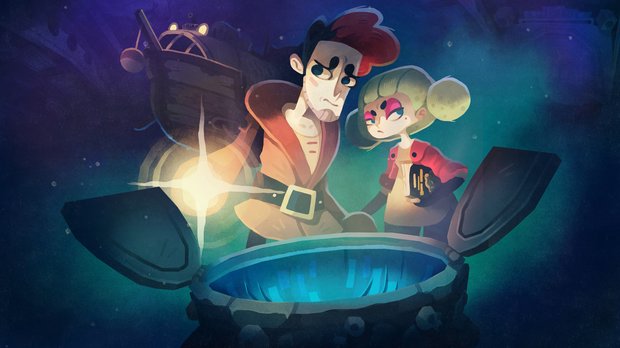
As The Mermaid Mask begins, Grimoire and Sally are bunked down on the floor of the abandoned Stonetop Inn in the decrepit port town of Silkwirm-on-Sea. They’re waiting for the arrival of the semi-legendary Mortuga Submarine, whose new captain, Sinthia Seafoam, has asked their help solving a murder that’s happened on board: that of the previous captain, Magnus Mortuga. All signs point toward him having been alone in a locked room when his throat was slit, but aside from some mysterious scratch marks in a nearby cauldron, there’s no sign of any murder weapon.
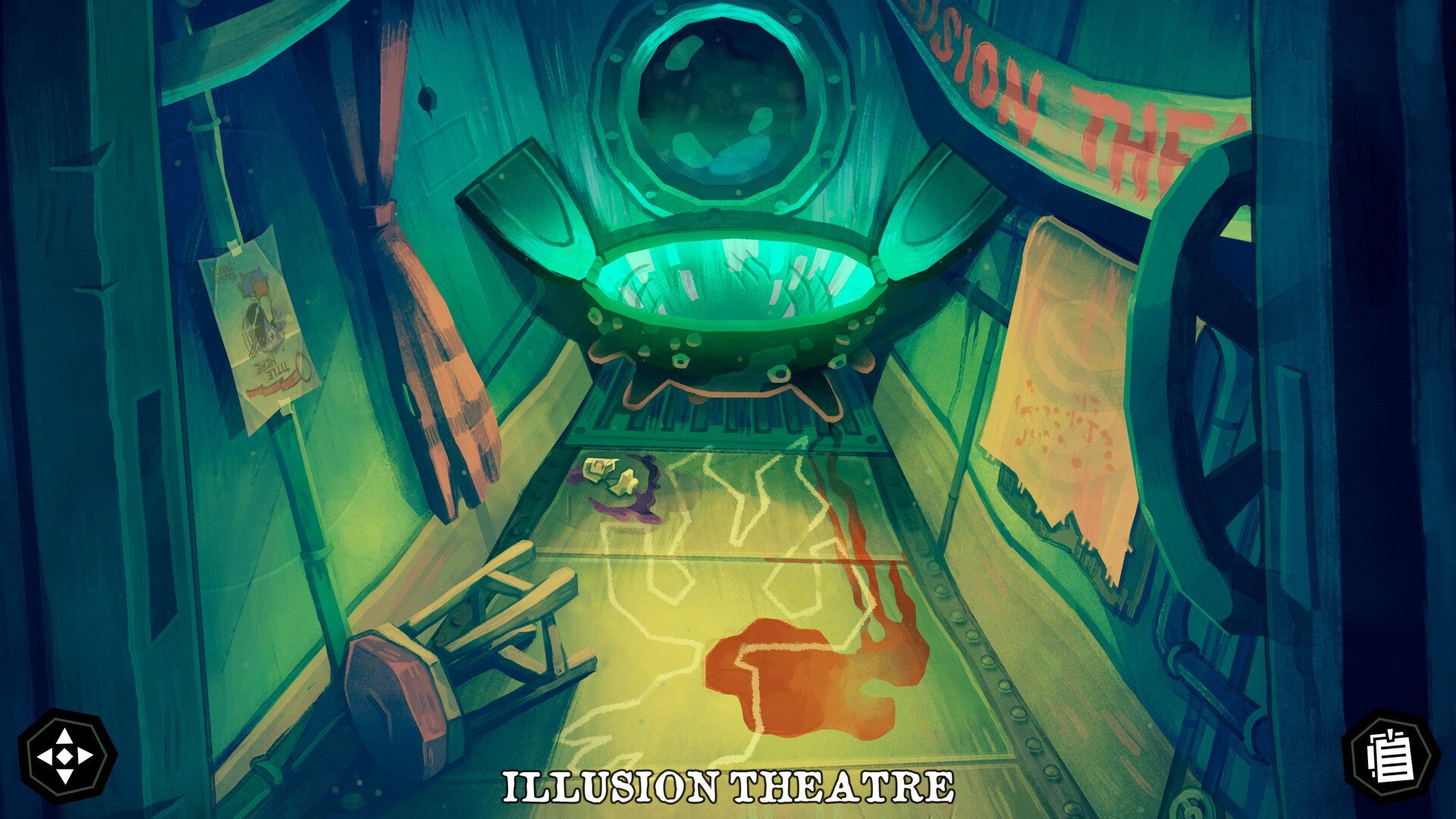
Such an intriguing demise is fully in keeping with the late Captain Mortuga’s life and legacy, about which almost nothing was known for certain. Regarded as an enigmatic recluse in his native Silkwirm, Mortuga had been a renowned seafarer before abruptly packing his things and retreating into obscurity aboard his vessel, which he parked beneath the waves from that day forward. Stories and rumors about him have circulated for years: that he was cursed to live forever at sea; that he wasn’t entirely human; that some dark and terrible secret lurked in his past. All anyone knew for sure was that he wasn’t talking.
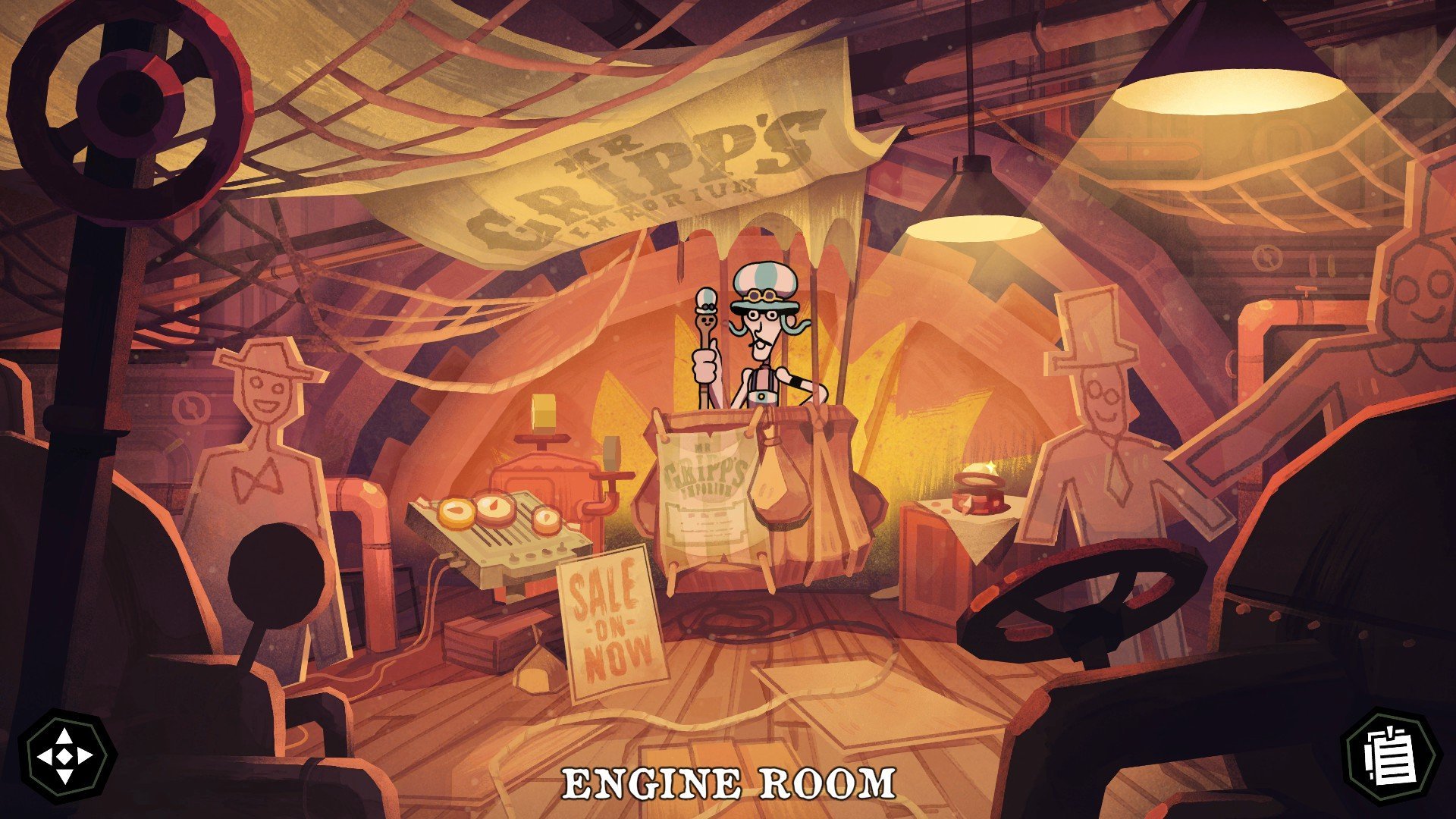
Aloof as he was, Mortuga wasn’t alone, having gradually accumulated a crew of misfits and oddballs aboard the sub. There’s Zacharias Zephyr, the “Dream Doctor,” who conducts oneiric experiments in a makeshift lab; Madam Tadpole, an imposing diver who’s more at home in the water than on land; Godrik Gripp, a possibly deranged salesman and would-be explorer whose best friend is a stick; and Symmetry Silkmoth, an orphaned young stage magician who fled to the sea to escape her heartless guardian. There were also the passengers he’d agreed to take on more recently: J.D. Wirman, an author researching his next book; Dirk Dansom, the actor contracted to star in the film of whatever Wirman produces; and Mariana Moon, explorer and world traveler, who appeared on board shortly before the murder. Teenaged Captain Seafoam, Mortuga’s successor and daughter of the sub’s original builder, is certain one of these seven is the killer—unless, of course, she’s just saying that to cover her tracks.
The Mermaid Mask plays much the same as the previous games, and especially Tangle Tower. You operate from a static first-person perspective, functionally acting for both Grimoire and Sally. There are no hotspots indicated, meaning you’ll have to click around to see what’s germane to your roughly twelve-hour investigation, but the background art is so beautifully detailed that you’ll never have to pixel hunt for anything; if you’re meant to notice it, you almost certainly will.
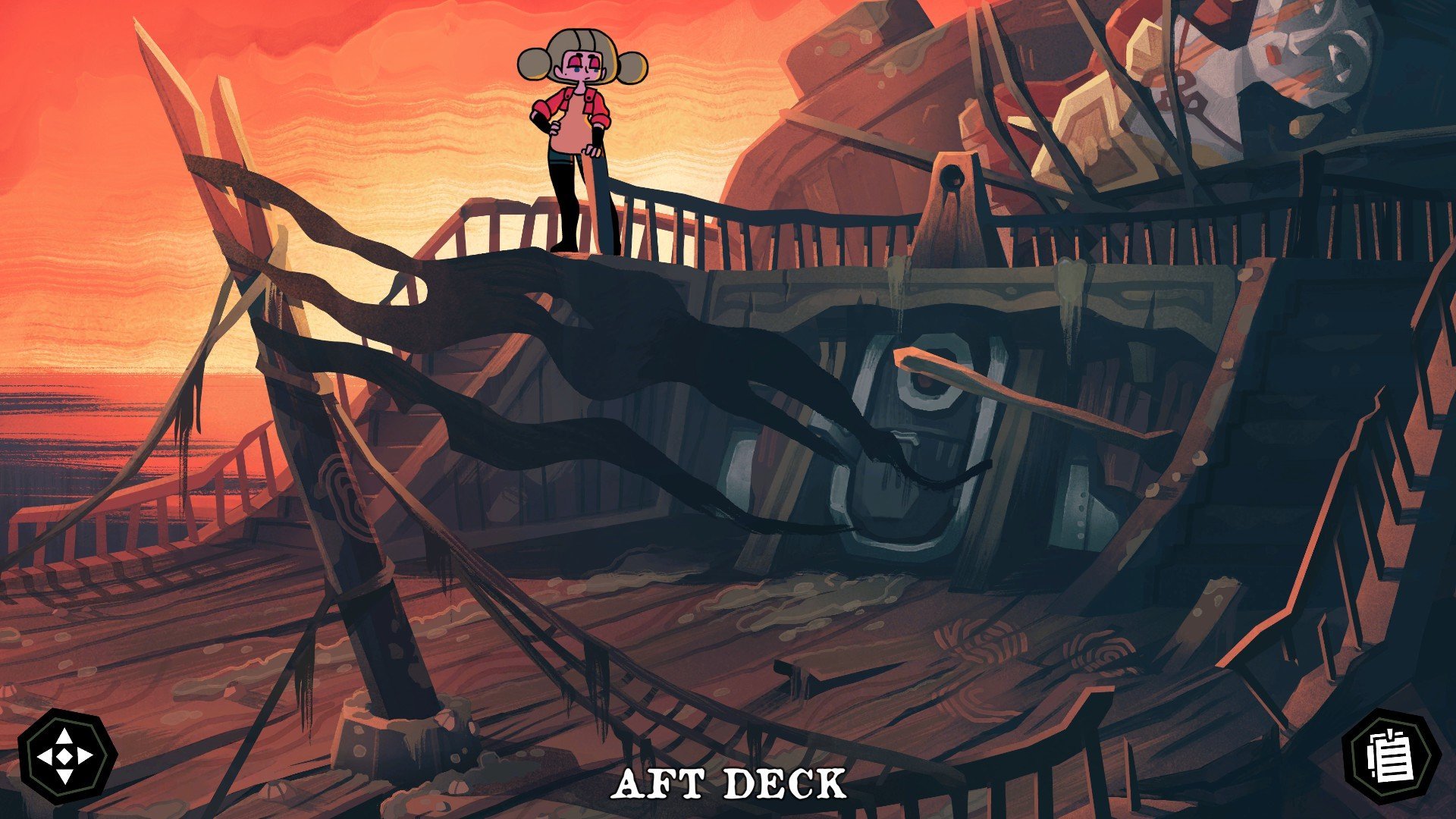
Clicking anywhere in a given environment prompts Grimoire and/or Sally to describe what they see, and usually to playfully banter about it. If there’s nothing to say about the specific point you clicked on, they’ll default to describing the room itself. A button will pop up when you can go in for a closer look, either to examine a piece of evidence more closely or to access one of the game’s numerous complex lock puzzles. You move using a compass button, which brings up a map showing all the rooms you can click to explore.
As is standard for the series, you don’t have a traditional inventory. Instead, you carry a list of clues that you can access at any time, with each entry containing what you know so far about the object in question alongside a rotatable 3D model. (There’s a separate tab to keep track of your suspects in much the same way.) To solve the murder you’ll have to discuss your findings with the others on board, asking about each item to parse out what everyone knows. You’ll have to be thorough, as you never know who might have the missing piece of information you’ll need to proceed.
Clicking a character opens the visual-novel-esque dialogue menu, where the vast majority of the gameplay will play out. On the main hub you’ll see a few broad topics to discuss with them, which you can click as many times as you’d like to review an exchange after you’ve heard it. There are also buttons to access your clue and suspect databases in order to discuss each entry. As in Tangle Tower, each suspect has a “Suspicion” tab that remains locked until you’ve gathered enough information to confront them with any secrets they might be hiding.
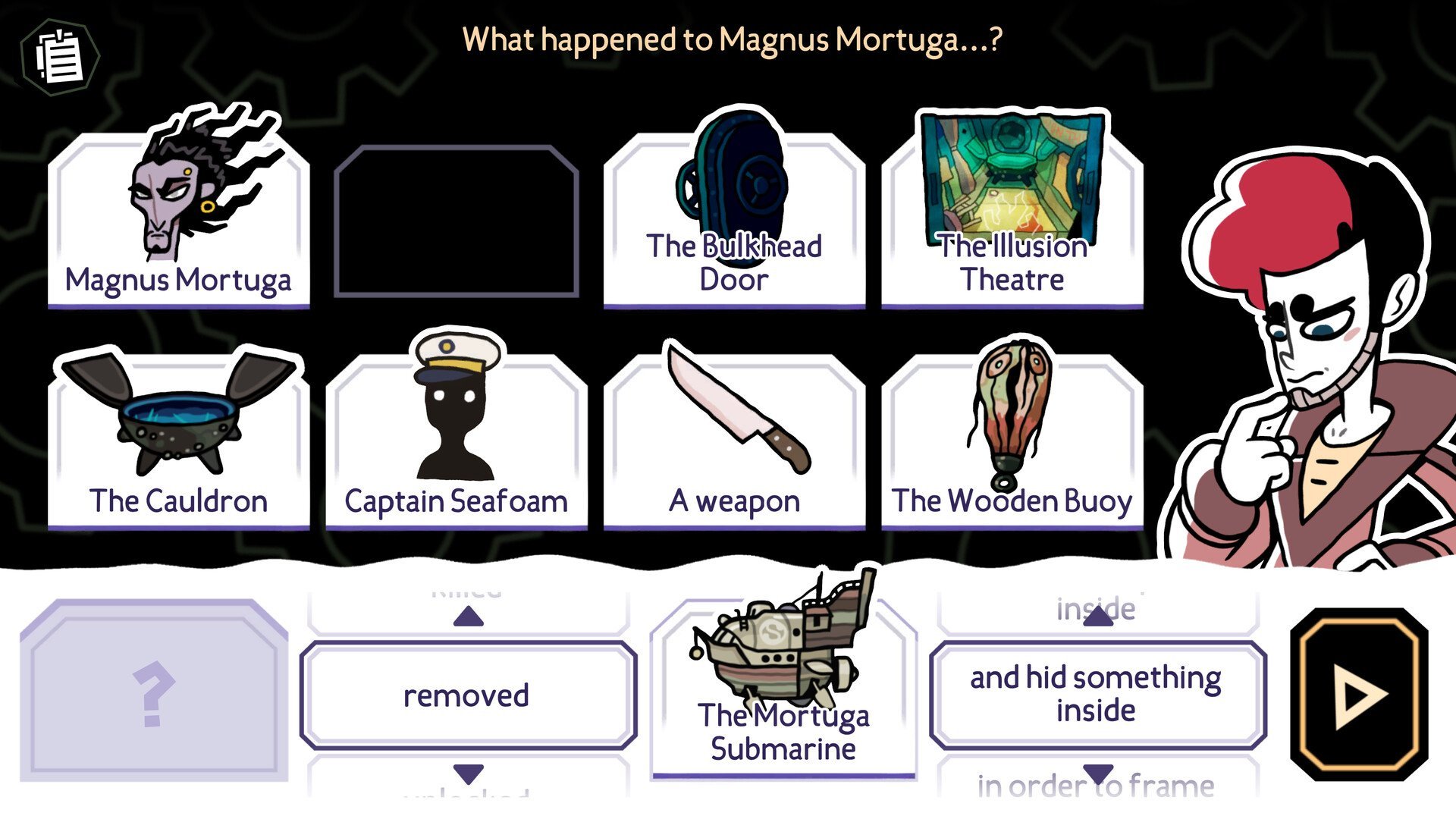
Also returning are periodic opportunities to construct hypotheses for Grimoire or Sally. Sometimes you’ll do this by selecting from a short list of specific guesses at a point in conversation, where choosing the wrong one simply prompts one detective to gently suggest the other think again. At others a prompt will appear asking you to fill a blank with the appropriate clue: “Mortuga was killed with ______” for instance.
Most often, though, you’ll have to complete a statement using a list of component parts: a handful of nouns representing objects and characters (e.g. “Mortuga,” “the bookcase,” “the control room,” etc.), and two groupings of subordinate clauses to complete the sentence (e.g. “was blackmailing somebody,” “was for keeping bananas fresh,” “because there were no fresh towels.”) Most of the options, of course, are red herrings, but it’s rarely obvious which; you’ll have to think carefully about what you know. Get everything in the right order and your characters will discuss their findings; get something wrong and they’ll point you back toward the drawing board while subtly indicating whether you’re close to the mark.
The Mermaid Mask
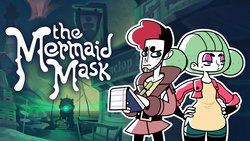
| Genre: | Comedy, Mystery |
|---|---|
| Presentation: | 2D or 2.5D, Slideshow |
| Theme: | Crime solving, Nautical, Team-up, Whodunit |
| Perspective: | First-Person |
| Gameplay: | Investigative, Puzzle, Deduction |
| Control: | Point-and-click |
| Game Length: | Long (more than 10 hours) |
| Difficulty: | Medium |
| Graphic Style: | Cartoon |
The third tranche of puzzles consist of elaborate locks and other mechanisms you’ll have to solve through logic. These, too, are much in keeping with the previous games, whose puzzles sometimes earned comparisons to the Professor Layton series. These usually involve figuring out how to arrange a series of pieces: little ships on a grid representing the sea, for example, or several compasses that behave differently to one another.
Most of these are solidly challenging brainteasers, with solutions you can deduce if you pay careful attention and observe all the details. There were a handful, though, where I couldn’t figure out what I was expected to do no matter how long I looked at them. There’s a hint system of sorts—each time you submit a wrong answer, Grimoire and Sally will discuss what they know about how the puzzle works in greater detail—but the occasions when I resorted to it left me saying “Never would have figured that out” instead of the hoped-for “Ohhhhh, of course!” These were the minority, thankfully, and most of the others were a pleasure to solve. Still, they were among the few notable bumps on an otherwise smooth road.
Another such bump is the game’s menu, which is bugged from a few non-fatal but frustrating directions. The first is that the button to access it has a habit of disappearing entirely if you spend a few hours playing, necessitating a force-quit if you want to stop for a while or access the settings. The game autosaves frequently, so while I never lost progress as a result, it remained an inconvenience.
Without the menu, for instance, you can’t turn off the game’s auto-hints, enabled by default. These cause Grimoire and Sally to pop up and let you know where and when you’ve gathered enough information to unlock a new room or line of questioning, which I found intrusive. They also place markers on your map letting you know when new points of interest are available. Thankfully you can toggle these off…or rather, you could, if the buttons to do so actually worked. I found, however, that no matter how firmly I pushed the slider in the 'Off' direction, the requisite nudges and pointers kept right on coming. I thus had to live with hints I neither wanted, needed, nor enjoyed.
Even so, these were quite honestly the only dull spots in The Mermaid Mask’s facade, which is positively gleaming otherwise. It certainly doesn’t come as a surprise, of course, that the team behind Tangle Tower have produced a game full of gorgeous art and animation, or with pitch-perfect voice casting for its characters, or with infectiously catchy and evocative music on nearly every screen. What’s so breathtaking about The Mermaid Mask is just how unique and different it manages to feel from what came before, all while maintaining an unmistakable stylistic continuity. Though it’s obvious just from looking and listening that this game shares DNA with Tangle Tower, there’s no doubt that this game is its own entity.
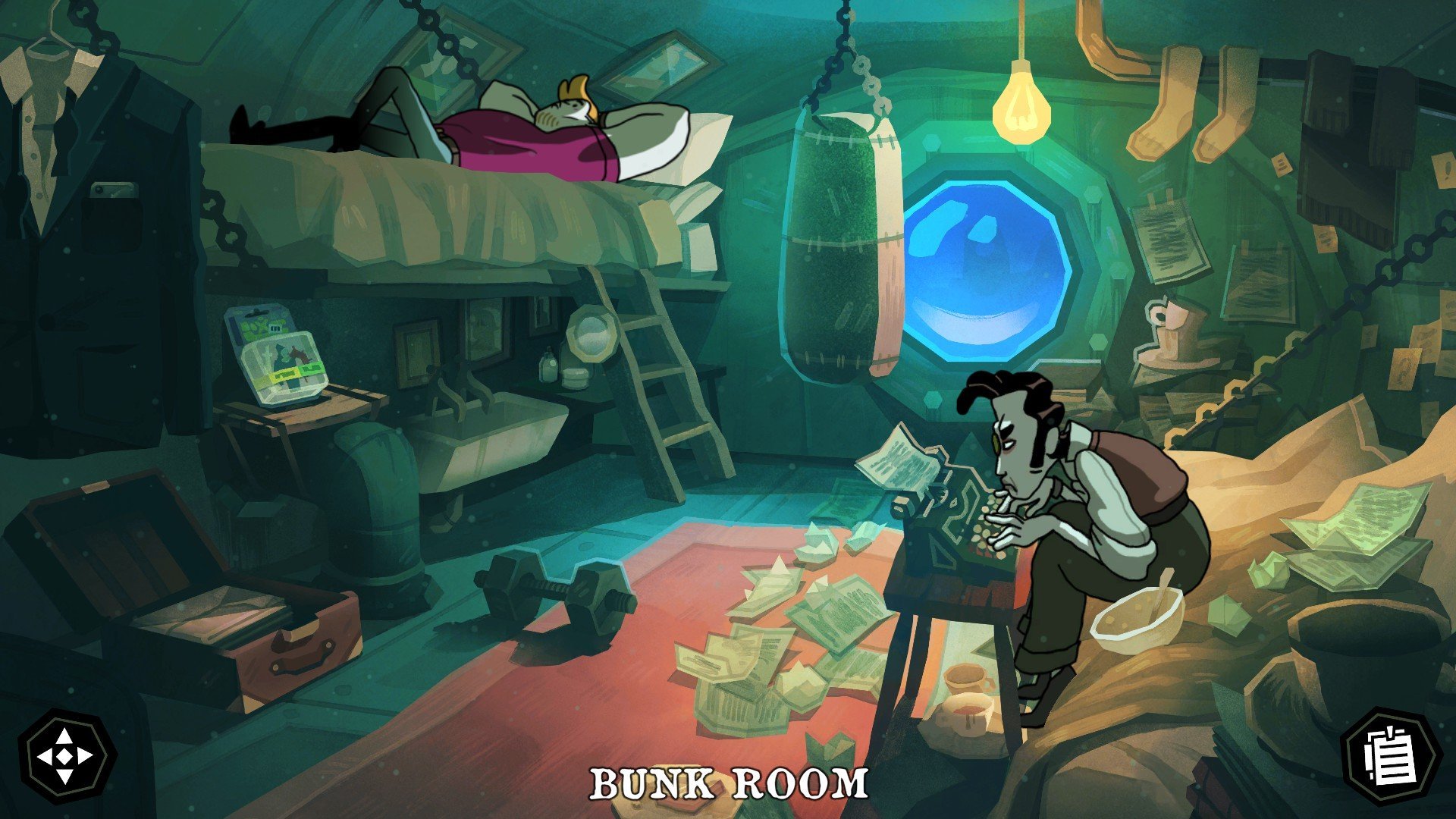
The characters, for one, feel like the kind of people we could have run into among the previous game’s Fellow and Pointer families, while also being totally unlike anybody we’ve seen before in a Grimoire game. They’re all portrayed with great depth and subtle characterization; even those who seem at first to cleave tightly to familiar archetypes, like the know-it-all writer Wirman and the hunky actor Dirk, prove more complex and nuanced the longer we spend with them. There are places where the developers could have opted to “play the hits,” as it were—teenagers Sinthia and Symmetry, for instance, might easily have been positioned as stand-ins for Tangle Tower’s fan-favorites Fifi and Poppy—but they always opt instead for something new, exciting, and unexpected.
This is all helped by one of the most superb voice casts I can remember encountering in a game. Each actor so fully embodies their character that it’s impossible to picture anyone else in the role. Edwyn Tiong and Amber Lee Connors are as good as ever as Grimoire and Sally, imbuing the characters’ wry banter with the genuine warmth and quiet regard of old friends. Connors especially takes her character to places we haven’t seen before, granting us in moments of high emotion a glimpse at the depths behind the laconic face Sally shows the world.
The newcomers, too, are uniformly excellent, to the point that it’s hard even to isolate standouts to praise. My personal favorite was the moony Symmetry Silkmoth, whose highly mannered speech is written in poetic meter; The Biggleboss Incident’s Justine Leah Hince brings her to life with just the right mix of starry-eyed innocence and otherworldly theatricality. To pick just one other, Alex Bankier does an impressive job in two roles as both the batty Godrik Gripp and the sourpuss J.D. Wirman. He plays the latter so that you can’t help but sympathize with his ongoing struggles, no matter how unpleasant he acts toward you, while the former speaks of his own quasi-reality with such gusto and Quixotean enthusiasm that you almost come to believe his stick, Cornelius, will answer his questions.
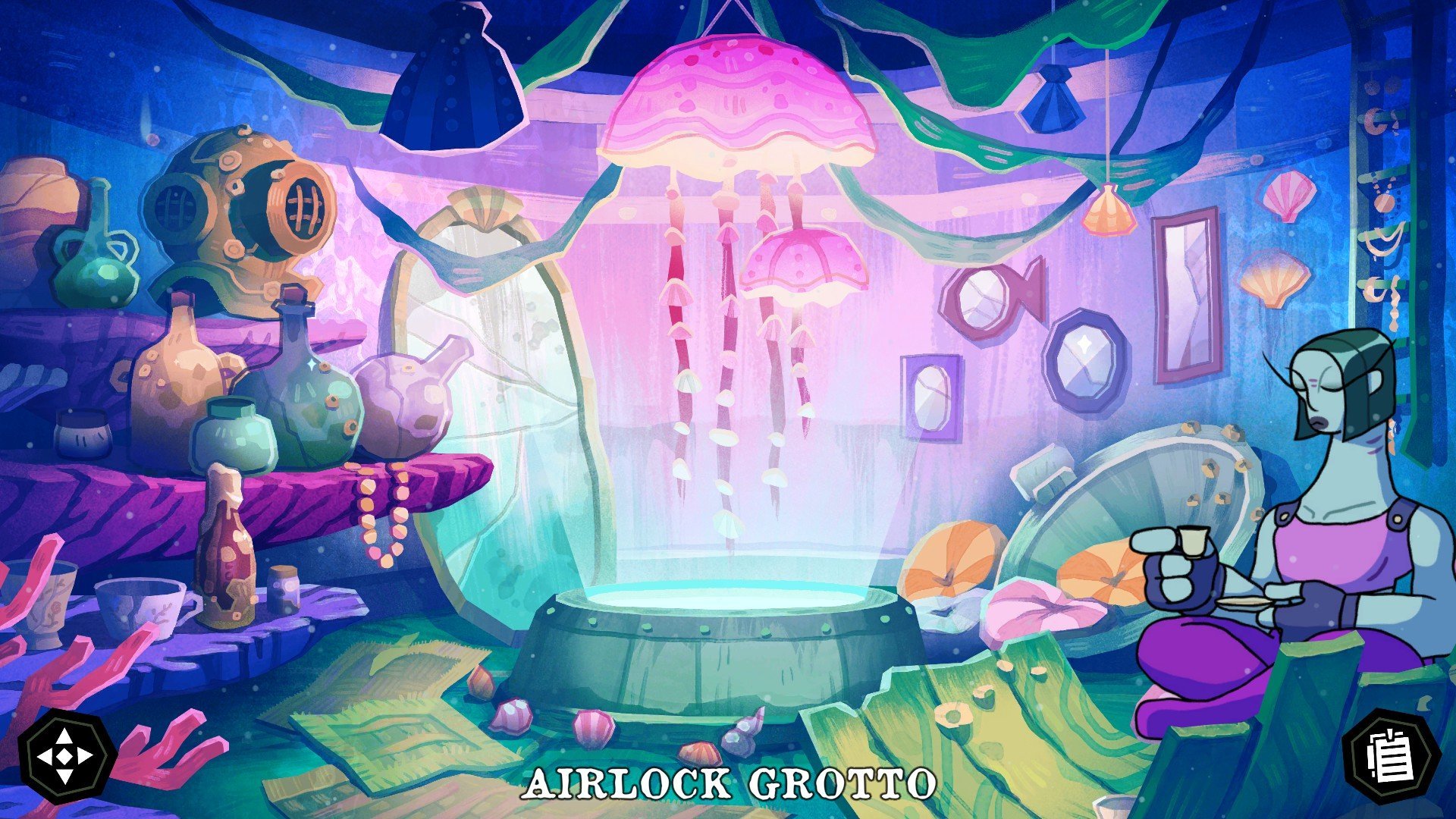
Composer Raphael Benjamin Meyer, who scored the previous games, returns for The Mermaid Mask, as do the musicians of the Budapest Art Orchestra. Faced with the unenviable task of following up his own marvelous work on Tangle Tower—arguably one of the best adventure game soundtracks of this century—Meyer and the orchestra have achieved the seemingly impossible, not only equaling what came before but at times surpassing it. Each character’s musical theme is perfectly tailored to the moods and motifs associated with them: young Captain Seafoam’s song, for instance, is a rousing maritime piece promising adventure and high spirits on the bounding main, while Mariana Moon, rambler and raconteur, gets a piping reel befitting tall tales told by guttering firelight. The standout to me, however, was Gripp’s theme, a bouncy, freewheeling carnival tune that all but begs the listener to step up and peruse his wares; days after finishing the game I’ve been unable to stop whistling it.
There are around twenty rooms to explore, most of them appropriately nautical: a mess hall; an engine room; a dank and gloomy bilge. Each of these has a piece of ambient music suited to its attendant mood, as do many of the slider/lock puzzles. The environmental tracks tend to be understated and contemplative, adding an air of melancholy and understated menace to the dark corners of Mortuga’s house of secrets. An eerie droning chant recurs throughout, so that an unseen presence seems at times to be observing you. Tracks that play over puzzles connect to their theming, such as a spectacular sea shanty with mumbled nonsense lyrics for a sequence involving pirate figurines. Mixed in with all the new material are a few familiar motifs, as well, helping to create a sense of continuity with Grimoire and Sally’s previous outings.
While connections are there to the earlier titles, The Mermaid Mask is functionally a standalone game. Newcomers should have no trouble following the story from beginning to end, and any critical callbacks are given enough context that one can usually fill in any blanks. That said, though each entry is its own beast, the developers are clearly (if subtly) advancing an overarching metaplot as the games progress, and I found the experience richer for having played the whole series. While Mask does little to wrap up the handful of dangling story threads from Swamp and Tower, taken together they appear to be building toward something larger on the horizon. Whether or not you recognize any of that, though, this particular game’s story succeeds on its own merits.
For all it pays frequent homage to those earlier titles, The Mermaid Mask has patently learned from their missteps. Tangle Tower, though much beloved, has received criticism over the years for the abruptness of its ending and a solution to its central mystery that seemed to fall apart the longer you thought about it. Mask isn’t likely to receive similar complaints; its narrative is carefully and thoughtfully constructed from beginning to end, and the ultimate solution flows organically from your discoveries as you play. (And no one has to be in two places at once for it to work.)
Final Verdict
The Mermaid Mask is the rare third entry in a series that not only lives up to the audience’s hopes for it, but exceeds them. It’s neither compelled to fix what isn’t broken nor content to repeat itself, and while it respects both its predecessors and its fans’ regard for them, it’s more than willing to do things its own way. Those who’ve been meaning to check out the Detective Grimoire series can start here if they like, and enjoy the best it has to offer, while returning players will be delighted to find new heights awaiting them. Excitingly, the table is set for further adventures if the developers choose, and hard as it may be to imagine them surpassing what they’ve achieved here, you won’t ever catch me saying never again.
Hot take
The Detective Grimoire series reaches a new apex in The Mermaid Mask, which first equals and then outshines its beloved predecessors in nearly every way that matters.
Pros
- A captivating mystery story full of engaging characters in an interesting and unique setting
- Voiced to perfection by an outstanding cast, with the returning leads as good as ever
- Truly sublime orchestral soundtrack
- Art and animation just as good as the previous game’s
- Ending feels earned and well-constructed
Cons
- Some puzzles don’t explain their premise well enough to deduce how to solve them without hints
- Irritating bugs related to the menu and the auto-hint system
Will played The Mermaid Mask on PC using a review code provided by the game's publisher.

- Advertisement
- Help support AGH by advertising with us





0 Comments
Want to join the discussion? Leave a comment as guest, sign in or register in our forums.
Leave a comment