
Cthulhu: The Cosmic Abyss review
- 0 Comments

Easy to lose yourself – and perhaps your mind – in this deeply atmospheric Lovecraftian thriller
H.P. Lovecraft is well known for his disturbing tales of eldritch horror, and we have seen many iterations on his work since his death. Although not a direct adaptation, Cthulhu: The Cosmic Abyss is the latest in an ever-growing stable of video games based on Lovecraft’s famous Cthulhu Mythos, and it certainly does not disappoint in the macabre and sanity-eroding terror department. What starts out as an investigation into a missing person transforms quickly into a surreal, horrific tale of cults and the threat of raising what must not be. This is a game not for the faint of heart, or the impatient, but if you dare to venture into its depths, both literally and figuratively, there’s plenty to enjoy – and be terrified of – here.
In this game, you play as Noah Williams as he and his partner Elsa investigate the home of Mei, another member of their organization that searches out things that go bump in the night. It’s the year 2053 – a time of vastly increased occult activity – and this prologue introduces the major elements of what we are in for, both in terms of setting the tone and establishing many of the controls and mechanics used throughout. This includes an advanced AI in the form of KEY – essentially a disembodied voice in Noah’s head – who helps you out by providing information and logs anything you find along your travels.
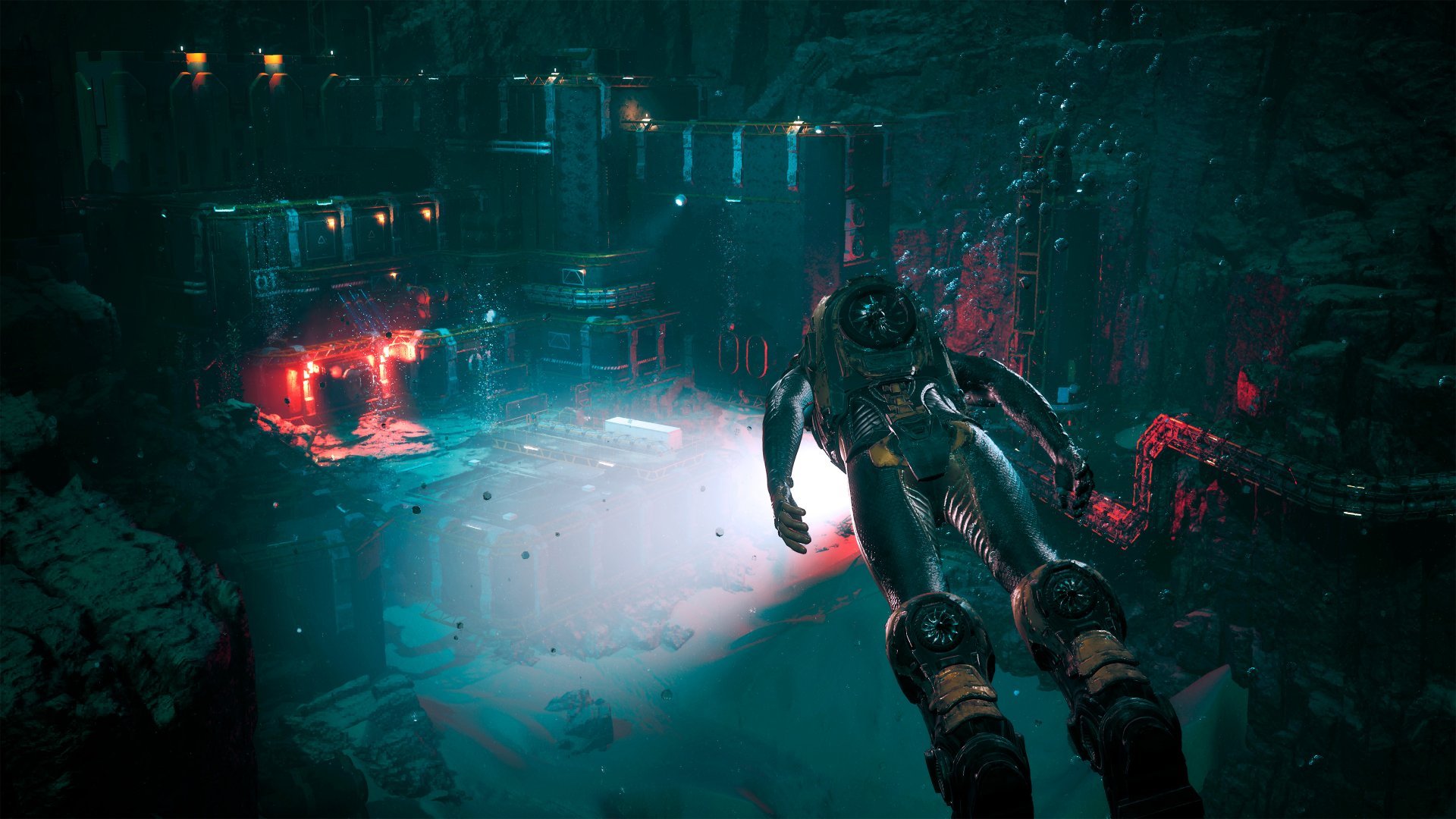
The prologue offers a lot of hints that a man named Andrew Marsh is doing more than just mining gases in the Pacific Ocean. But all that is quickly swept aside after discovering Mei has gone totally cuckoo bananas. We soon find out why when Noah inadvertently opens a portal to another dimension where the Elder God Cthulhu’s sunken city resides. He and Elsa get sucked in, but Elsa is able to push her partner back out before being trapped on the other side. Some time afterwards, our intrepid hero, having seemingly put this traumatic experience behind him, finds himself diving deep underwater to a hydrogen mining plant owned and operated by Marsh. It’s not outright stated that he’s related to the Marsh family out of Innsmouth, Massachusetts, but there’s definitely something fishy going on. (In fact, there are a lot of references to Lovecraft’s most famous tales in the game – this is just the tip of the proverbial iceberg.)
After discovering more clues about the occult ramblings of Marsh, Noah leaves the facility to navigate an underwater maze. Currents make travel difficult, but when Noah finds a way through it, he ends up at a Cyclopean temple. This huge house of worship at the bottom of the ocean looks like it predates human civilization – perhaps created by the Deep Ones, Lovecraft’s fish-like creatures that reside under the water, as the design and motifs are clearly beyond the understanding of mortal man.
From there the tale of awakening the titular old squid face himself starts to unravel. Through investigation we discover that Marsh is dead set on bringing Cthulhu to the human world to wreak whatever madness he has in store for us. And so Noah sets out to beat the cultist to R’lyeh, Cthulhu’s sunken city, and save the world, which proves to be quite the wild and eerie ride.
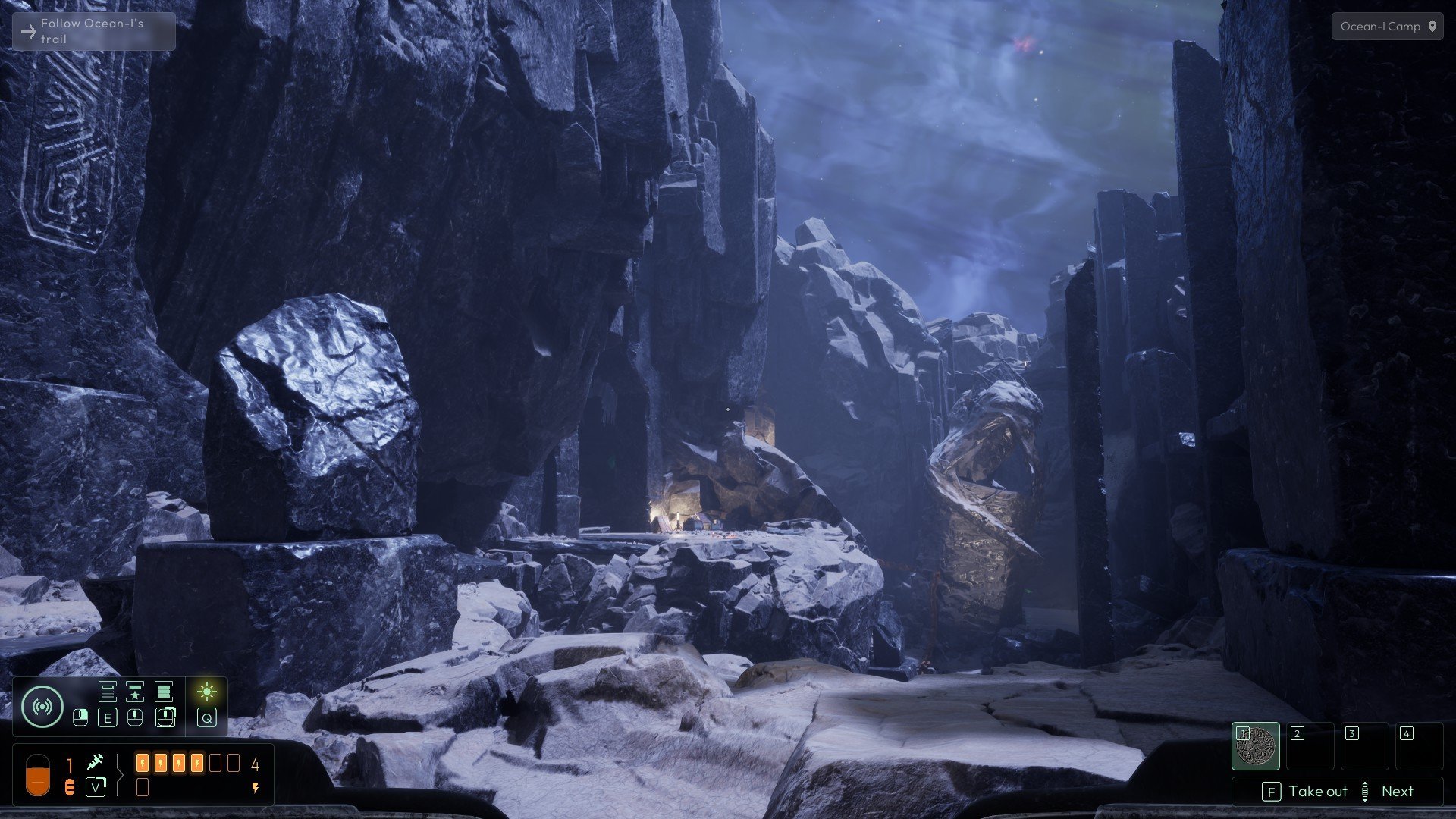
The Cosmic Abyss is a first-person, free roaming adventure game that can be played with either a controller or by navigating using the WASD keys and the mouse to look around, with additional keys to run, jump, turn your flashlight on or off, and pick up items that go into your inventory. You can use items you are holding on the environment, opening up paths that were previously blocked, but you can only carry up to four objects at once. You can drop them almost anywhere, however, and can retrieve them any time during the current chapter, so there’s no risk of losing something you require to move forward.
While on land, walking is what you would expect in this type of game. Underwater, though, you can swim or walk, depending on if you’re floating or stomping along the ocean floor. For anyone who’s tried to walk on the bottom of a swimming pool, the sluggishness here will seem familiar. Thankfully there is a sort of turbine or jet attached to Noah’s suit that allows brief periods of “fast swimming” and it recharges pretty quickly. Swimming accounts for as much as half of your playtime, as there are a good number of underwater spots you have to traverse even on landlocked areas.
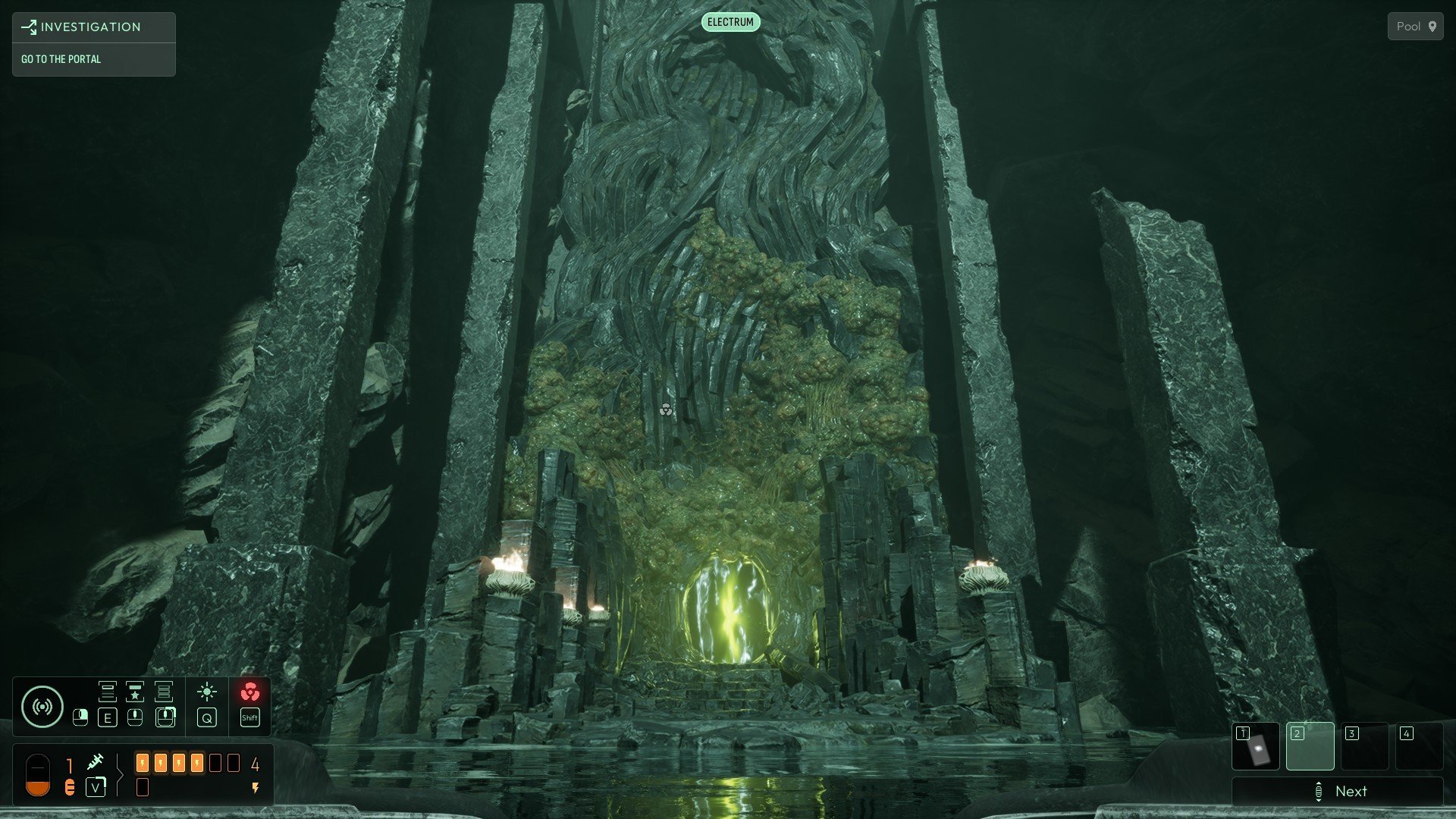
While these elements are fairly traditional for a modern adventure, the game has others that push it beyond standard genre fare. Noah comes equipped with a sonar on his diving suit. You can send out a ping from it with the right mouse button, and you can discover various frequencies in your investigation, including detecting the harmonics of various minerals and other substances found throughout each chapter. Once you’ve done that, you can open a menu for these frequencies and select one or more to create a pattern recognition. Then you can hit the sonar and anything that matches those frequencies shows up as a yellow icon in the area, which makes it handy to easily spot what you’re looking for. As you progress, aside from common (and not-so-common) rocks, you can look for DNA samples from otherworldly beings like Shoggoths, Deep Ones, and the Great Race of Yith (creatures well known from Lovecraft’s stories).
There is an energy resource you need to carefully keep an eye on, but this only depletes when you analyze an object by opening up a “clue window” at the cost of one energy point. You might be tempted to conserve your energy instead, but analysis will reveal more clues that help you in your investigation. You can replenish your energy by harvesting some weird fungal growth you find and injecting it into your suit. Fortunately there are a lot of fungus spots so you shouldn’t have to worry about running out too quickly. There are even other fungi that enable you to increase your maximum energy limit.
The Cosmic Abyss doesn’t have a sanity meter like many horror games of its ilk. Instead, certain events cause your corruption level to increase or decrease based on your decisions. Some just happen automatically, such as bearing witness to things man was not meant to know, but there are “low corruption” and “high corruption” paths through most of the chapters. These paths account for things like choosing between figuring out a beast’s path by analyzing and following its trail (low corruption) or by assembling a totem to stop the current in the maze near the temple (high corruption). It’s unclear to me exactly how this corruption works, as I tried my best to keep this level as low as possible, but I’m pretty sure it’s meant to affect Noah’s state of mind. Aside from destroying “evolutions,” the only practical thing that I could glean from the corruption level is that it helps determine how the game ends.
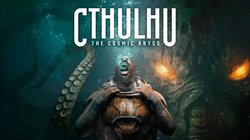
Cthulhu: The Cosmic Abyss
| Genre: | Horror |
|---|---|
| Presentation: | Realtime 3D |
| Theme: | Monsters, Psychological, Lovecraftian, Underwater |
| Perspective: | First-Person |
| Graphic Style: | Photorealism |
| Gameplay: | Investigative, Exploration |
| Control: | Direct Control |
| Game Length: | Medium (5-10 hours) |
| Difficulty: | Medium |
Evolutions are categories of abilities you can unlock by finding glowing gem-like items scattered throughout each chapter. By opening up the evolutions screen, you can see and select which you want to equip, either to help enhance your existing abilities (like the sonar and energy levels) or to juggle your corruption levels better. You have limited slots to fit them into, however, and each evolution takes up a number of slots. You can increase this total number by finding obelisks in the environment.
I was only able to unlock a few, but they are not really necessary to finish the game; they just make it easier. I used my evolutions to slow my corruption and to potentially regain energy used when I analyzed something. As your personal corruption increases, however, your evolutions can also become unstable and you risk destroying the ones you have equipped, making them unusable. I lost a couple due to overuse.
As an investigator, you also have access to the Vault, which is essentially a mind map. Each chapter contains many bits of information that you can pick up and look at, and by examining them closer, you’ll get more data. By reading carefully, and linking them in the mind map, with time you can piece it all together. This will eventually lead to the solution for moving forward. The Vault also includes questions to answer by connecting the dots. For these, you just drag one of your clues to an empty purple circle, and if it matches, it links. If it doesn’t, it’ll tell you and you can try again.
Perhaps surprisingly, if there is one area where I really struggled, it was the puzzles. While the game starts off relatively simple to understand, once the action gets going, I found myself wandering for what felt like hours, not making any headway. In particular, I had no idea how to get through an underwater maze without seriously corrupting myself. There are a few other tricky areas as well, such as figuring out how to set a certain pattern on a cube near the end of the game based on clues from Yith tablets. Getting through this puzzle took more time to solve than I’d care to admit, but I eventually made it to the end.
There are two main modes to play through this game. The default is Investigation Mode, which does not hold your hand at all. You can also choose Exploration Mode (my choice), which shows you how many clues are left to find per chapter. There are other options that you can toggle on or off too, even in the middle of a playthrough, such as not consuming energy when you analyze something, an option to reduce corruption gain, and a persistent sonar that makes your pings last longer.
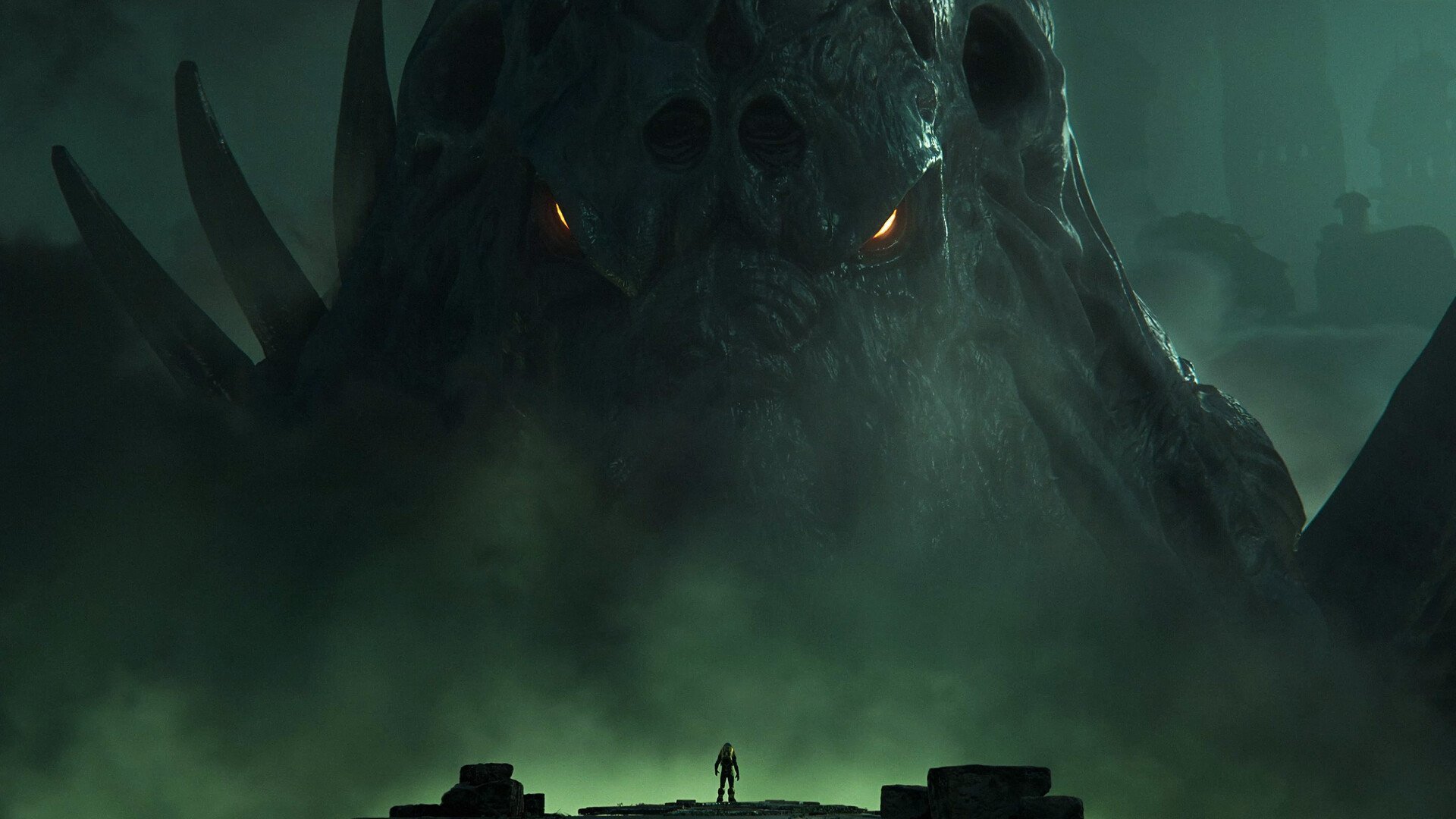
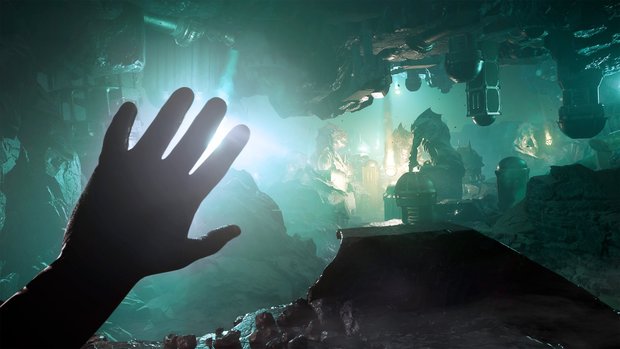
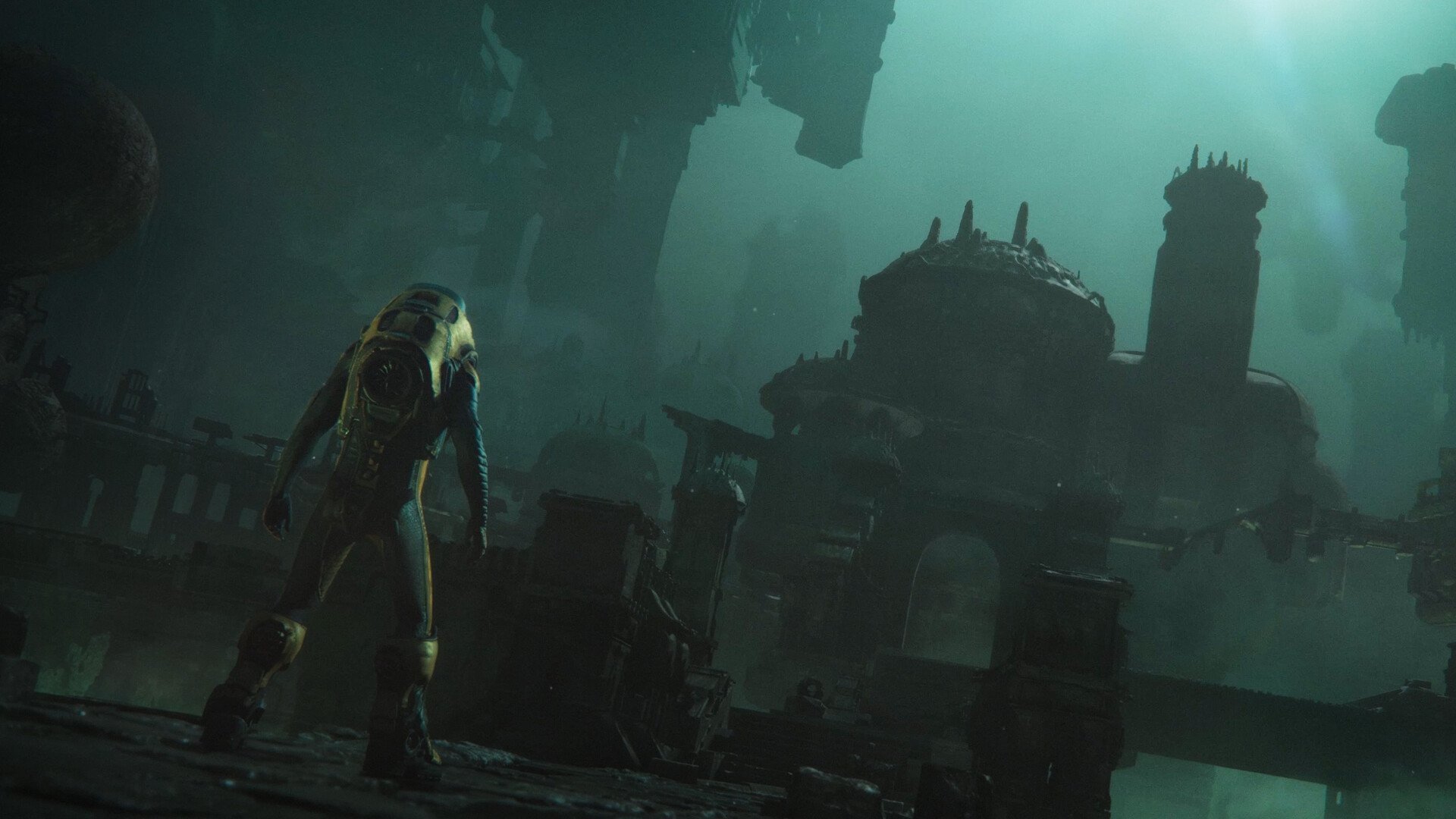
As you might expect of a deep-sea Lovecraftian horror, the game is very dark, both in terms of lighting and mood. This is an experience full of deranged architecture, what appears to be pus-filled sap nodules, and other macabre details. The odd inclusion of otherworldly beings, such as a jump scare with a Deep One and a nasty conglomeration of eyes and tentacles, just adds to the nervous tension enveloping an already maddening locale. While some of these disgusting and disquieting elements can be found in the human realm, the most disturbing are found in the other one, and especially R’lyeh. The 3D graphics are unnervingly realistic, and I often found myself both in awe and unbalanced by the twists and turns of the sunken city. The disorientation and expansiveness put me on edge, which is to be expected from a setting so inspired by H.P. Lovecraft’s stories.
The soundscape further enhances The Cosmic Abyss’s eerie nature. From the squelching of tentacles to unearthly groans and growls, it really feels like you’re in a nightmare realm. The music is suitably creepy and conveys the feeling of dread and sanity-eroding evil, further bringing the solitary existence of our troubled protagonist to life. I found myself looking quite literally over my shoulder and turning around to blood-chilling noises without any apparent source.
The voice work is uneven, with some lines sounding a bit flat and emotionless, but where it really shines is when we come across the hysterical ramblings, screams and blubbering of Marsh’s former employees, now doomed expedition members who have been indoctrinated by their boss. Some you find alive, if only barely, like a lone man tied to a sacrificial altar. Most of them are experienced only through audio logs found littered around each campsite left by the cult, and even the occasional video presentation by Marsh himself. And in this horrifying place, even Noah has his moments of ultimate dread.
As did I. The journey through Cyclopean ruins and unearthly realms felt genuinely creepy and had me at the edge of my seat plenty of times. The ending itself, while rather abrupt, manages to feel like a fitting finale for fans of the occult, with a major choice that will decide the fate of all mankind. You can easily see both outcomes by loading up the last checkpoint (there are no manual saves here) and skipping through the repeating dialog, but there’s still some replayability here thanks to the corruption system. I focused on trying to keep to the “low corruption” path in my playthrough, but by embracing the dark side, I’m sure there’s even more nastiness in store for Noah with a maxed-out corruption meter, with consequences leading to still more endings. I only played through the game once, but I am curious what would happen if I took the full plunge into madness.
Final Verdict
It took me a little over ten hours to get through the game, though a large chunk of that was trying to figure out what I was supposed to do and how to do it. Mixed in with a little frustration, however, is a rich, haunting atmosphere that compelled me to keep moving on. The game successfully conveys the feeling of encroaching madness in a world that is as far from Euclidean as anything can be. Several locations even defy the laws of physics, which, while disorienting, is a fun way to mess with the player’s head. You don’t need to know Lovecraft to be immersed in this story, but there are plenty of nods to his works here, including a major plot point involving the Great Race of Yith and the appearance of a Shoggoth hybrid. Either way, Cthulhu: The Cosmic Abyss is far from a perfect game, and yet despite its lack of adequate guidance at times, it’s a worthy addition to any fan of H.P. Lovecraft’s tales of the strange and terrifying.
Hot take
Its puzzles may leave something to be desired, but Cthulhu: The Cosmic Abyss legitimately feels like one of Lovecraft’s dark stories experienced first-hand.
Pros
- Darkly atmospheric story with plenty of nods to Lovecraft’s famed mythos
- Haunting sound and music
- Thick sense of dread pervades every corner
- Lots of lore to find in documents, scans, and audio logs
- Corruption and energy systems add to both the gameplay and storytelling experience
Cons
- Puzzles can be tricky to navigate with little guidance
- Uneven voice work
- Mind map has little investigative function beyond storing clues
Serena played Cthulhu: The Cosmic Abyss on PC using a review code provided by the game's publisher.

- Advertisement
- Help support AGH by advertising with us






0 Comments
Want to join the discussion? Leave a comment as guest, sign in or register in our forums.
Leave a comment