
SpaceVenture review
- 0 Comments

Finalized spiritual successor to Space Quest is plenty of fun but still leaves loads of room for improvement
After many trials, tribulations, and other equally bold-sounding words beginning with “t,” the time has finally arrived. Forged in the fires of creation at the behest of two guys and many supporters over countless hours and multiple release dates, Space Quest Sev… uh, I mean SpaceVenture is done – for real this time! Since the initial Kickstarter exclusive release in 2022, there have been notable improvements in frame rate, save functionality, and various other components. But while these fixes and tweaks undoubtedly polish up the experience, they also shine a spotlight on certain elements that were just plain bad rather than bugged to begin with. Regardless, it’s still worth the buckazoids, especially for Space Quest fans eager to play a new game from the legendary Two Guys from Andromeda after a nearly thirty-year hiatus, as SpaceVenture manages to provide an entertaining adventure game experience overall, despite its various drawbacks.
For those who haven’t played either its Kickstarter-exclusive or Early Access releases, SpaceVenture is the story of a “normal” day in the life of a sci-fi space plumber named Ace Hardway and his robotic dog Rooter. Ace starts off the day de-clogging pipes gunked up by an extraterrestrial tentacle mutant before hopping from planet to planet in a spaceship cobbled together from various junk for galactic escapades. Throughout the 6-8 hours of playtime, you’ll help Ace search out rare minerals to run a literal crap-powered energy source on his ship, piece back together a broken pump system for a couple famous Andromedans, and unravel a plot involving a virtual reality gaming console created by a genius baby man (or man baby?) with an overbearing AI mother.
There is a main plot that ties things together, but the story is more a series of loosely connected scenarios rather than a focused overarching narrative. This isn’t a bad thing by any means; the Space Quest games were known for their throw-everything-at-the-wall-and-see-what-sticks mentality when it came to story content, and it works just as well in SpaceVenture. This is a game that emphasizes minute-to-minute experiences rather than racing to some epic conclusion, and the creativity on display with the variety of humorous situations Ace finds himself in is a major highlight.
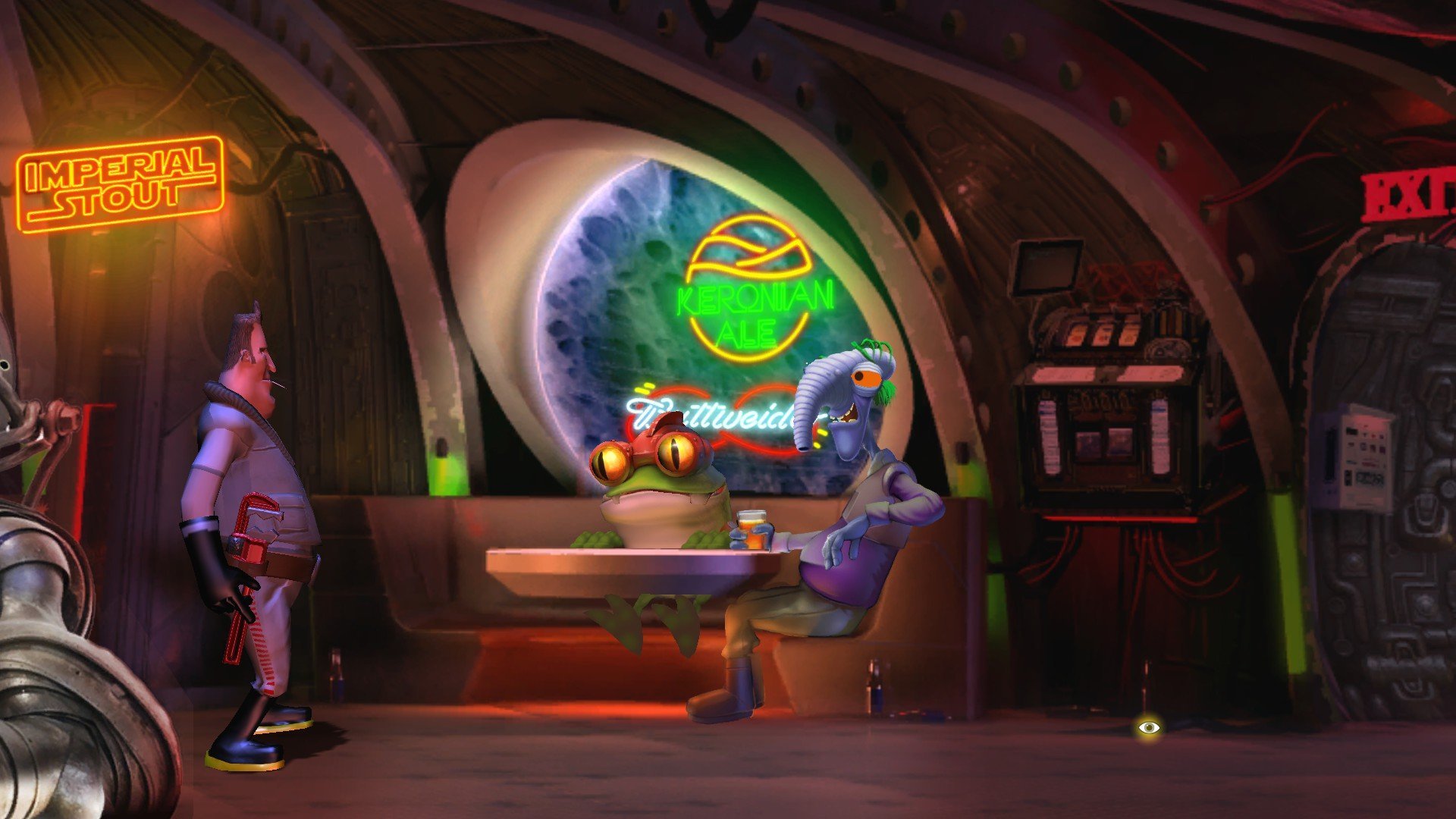
SpaceVenture is a character-driven adventure from start to finish, and there’s an enjoyable cast of weirdos to interact with (with one major exception – more on that later). Peppered throughout each area you visit are various supporting characters of all shapes and sizes: the lovable, balding blue-trunk-nosed Nurb shares a drink with Ace to go over his troubles, while the mysterious shape-shifting Veronica shows up fairly late but quickly becomes a favorite with her confident secret agent vibe, to name just a couple standouts of many.
The entire voice cast brings their A-game, with excellent performances from Ellen McLain as the downloadable Alexa-like AI app iMom, and especially Ed Kelly’s impressive impersonation of the late Gary Owens’ famous narrations, first debuted in Space Quest IV. While it’s hard not to think of what could have been if Owens himself had once again delivered this sarcastic wit through disembodied omnipresent narration, Kelly does the role justice with a truly side-splitting performance.
While the voices behind the characters are top-notch, the same cannot be said about some of the models those voices pop out of. Many supporting characters only ever appear in 2D, and they are gorgeously depicted. Even with only slight body movements and mouth animations during dialogue, it feels much more natural than the majority of interactions with the main cast, most of whom are presented as fully 3D models. When these characters start speaking, things get weird – and not in a fun, zany sci-fi kind of way.
I first played SpaceVenture during the Early Access period when the frame rate was capped at 30 frames per second. This made the video look choppy, but playing through the finished version at 60 fps revealed that the cap was masking something under the surface: some of the jankiest facial animations I have seen since early CGI in the late 90s. While it was a bit of a distraction at the lower frame rate, it’s impossible to ignore in the smoother video presentation, with 3D character mouths moving around in impossible directions while bending and twisting in ways that’d make a ventriloquist blush.
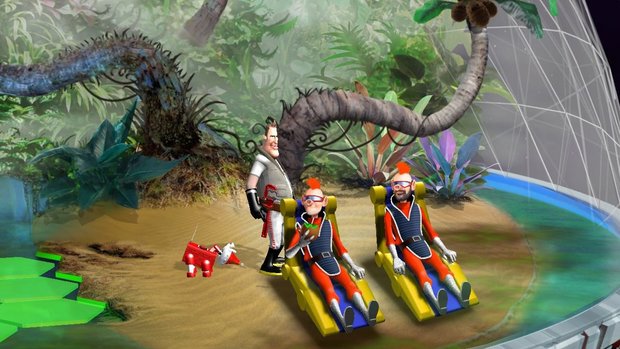
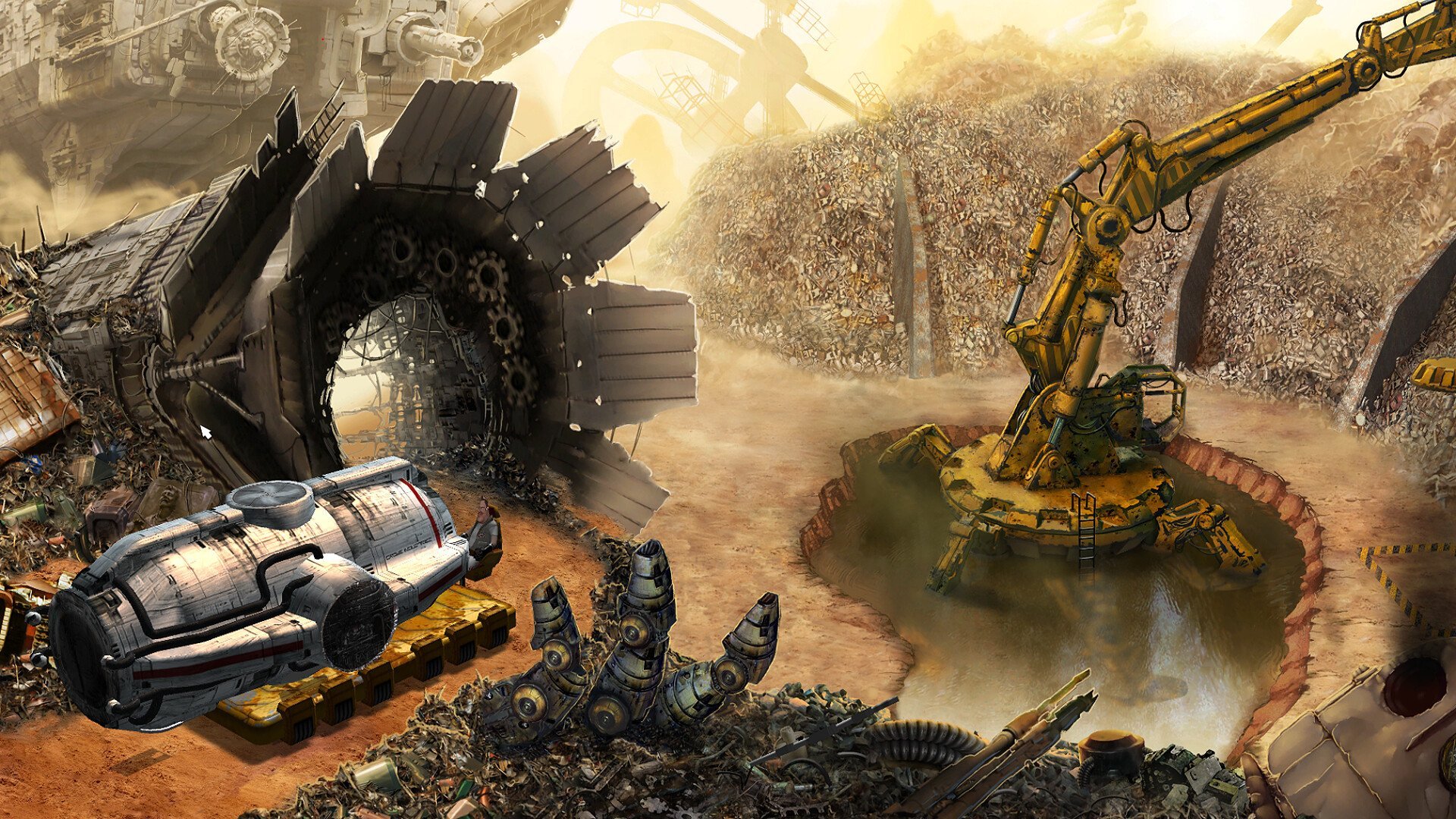
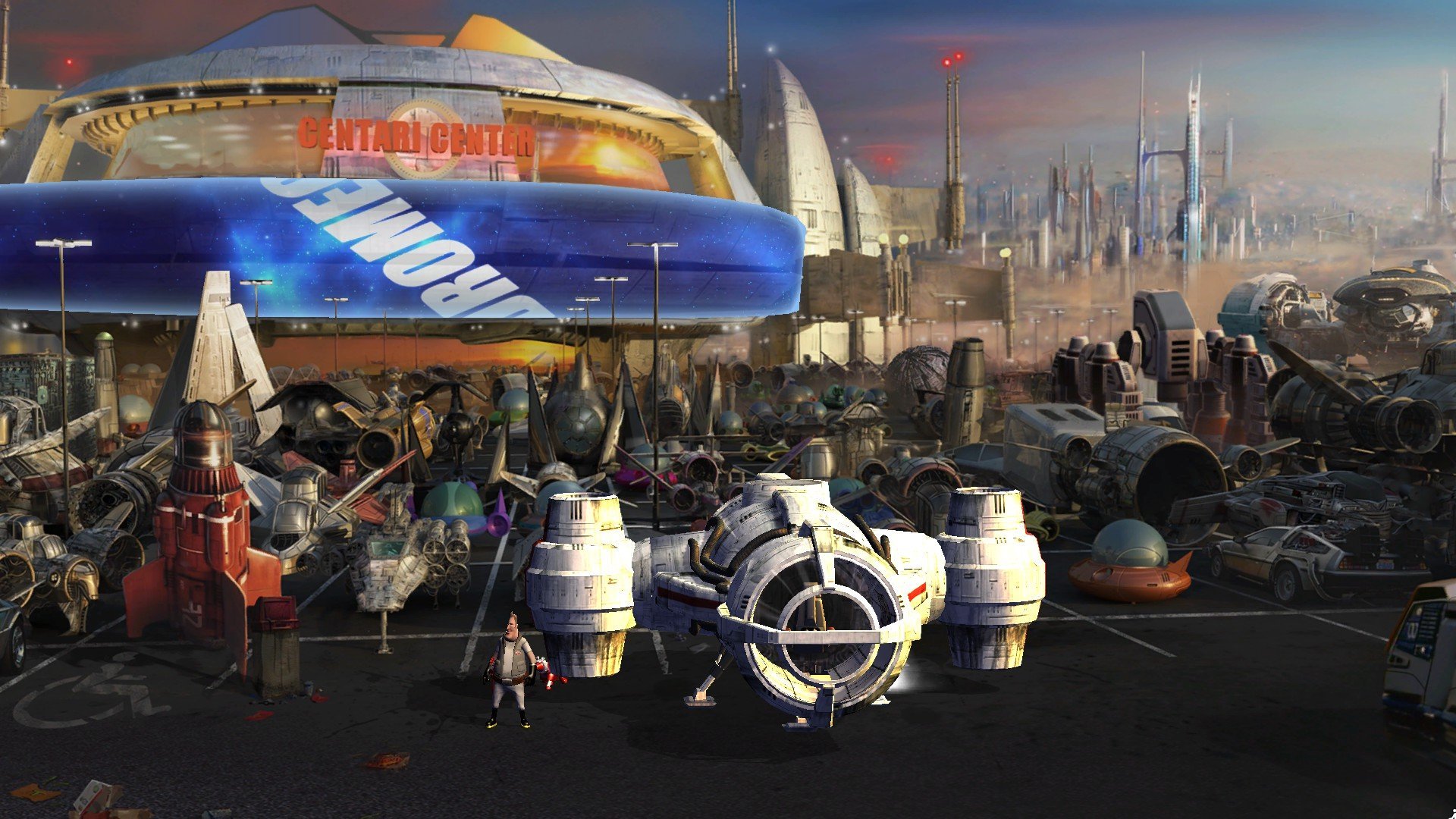
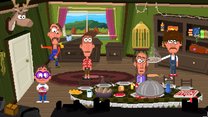
The beauty of Mark Crowe’s 2D art is further highlighted in the static backgrounds and details of the areas you explore. The Dominion Estates biodome where the Two Guys live in luxury housing is filled with palm trees, a small beach, and a waterfall, and it all gives off a tropical paradise feel before you even notice the Andromedans lounging and sipping cocktails out of coconuts. When you first arrive at the Andromecon parking area, there are countless different spacecraft in every direction to show just how far-reaching the event is for the nerds of this galaxy. There are lots of fun little details too: The junkyard and Nurb’s Bar are both packed with Easter eggs from Space Quest and various other sci-fi media, and they’re naturally woven into the scenery without being too distracting. (The head of a certain Iron Giant in the junkyard and a neon pixelated Roger Wilco-themed beer sign at the bar were a couple of my personal favorites.)
Accompanying Ace’s adventures is a fantastic soundtrack by Ken Allen of Space Quest IV fame (among other classic Sierra titles). The bold title screen track brings a majestic flair to booting up the game, and various musical styles are utilized throughout, depending on the scenario. Upon arriving at Dominion Estates, an upbeat jingle reminiscent of 50s Americana perfectly matches the tone of the cookie-cutter dome houses that all look the same in every direction. A parody of “Bad to the Bone” plays when Ace is pulled over from the space highway by metallic police officer Quicksilver. At the galactic fast food joint Taco Nova, Ace is accosted by singing animatronic chili peppers with an over-the-top serenade until he manages to figure out how to shut them down. It all feels suitably “SpaceVenture” in its own unique brand of quirky sci-fi craziness.
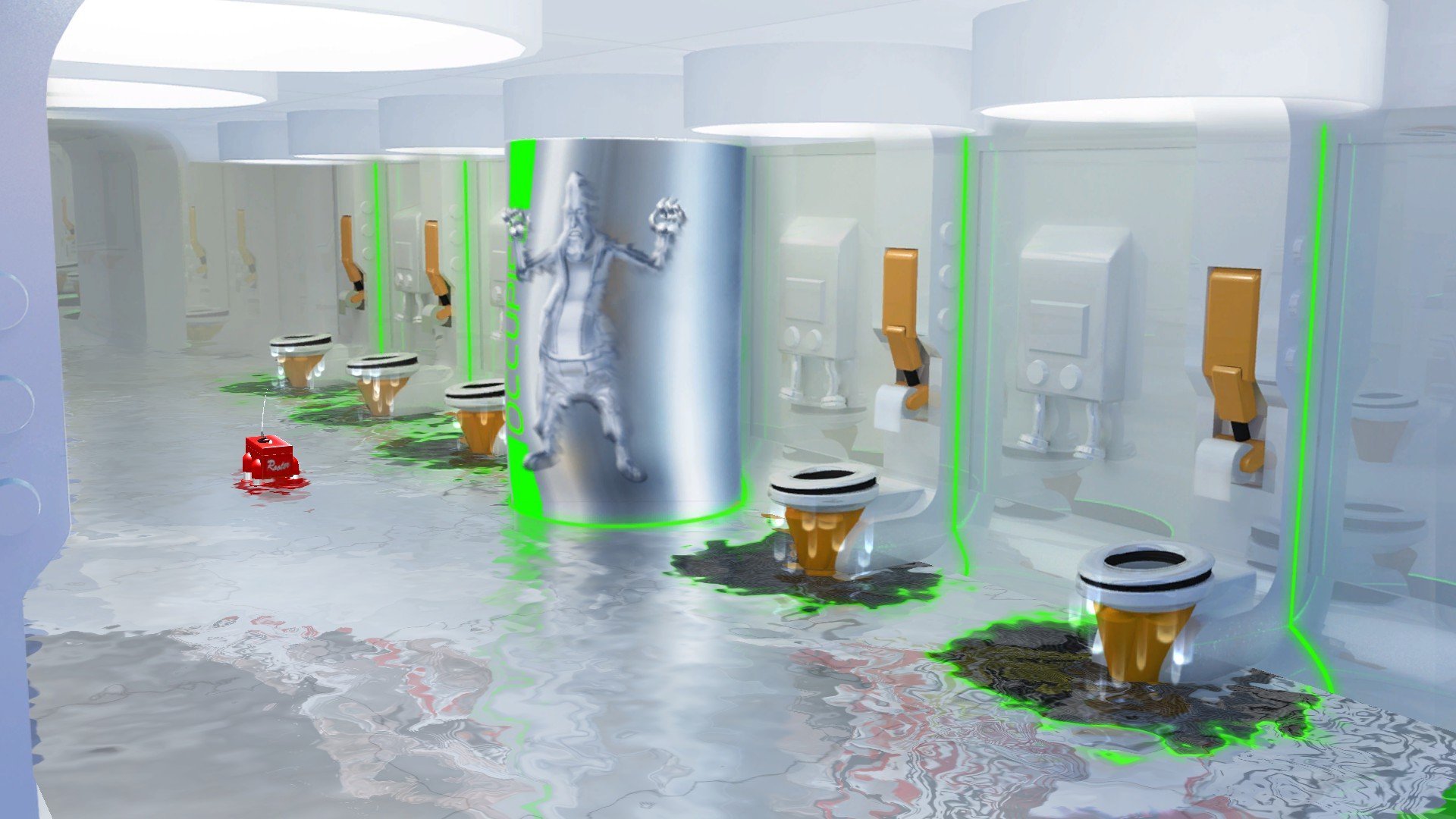
When playing this game as a classic point-and-click adventure filled with inventory obstacles, it’s often a blast. Puzzles largely hit the sweet spot of tough but fair, with solutions that never feel too outlandish in their item combinations. Utilizing a refreshing smoothie in a non-consumable fashion or gliding over a watery cesspool with the help of a hoverboard are the kinds of scenarios that feel just the right level of wacky. Rooter adds an additional layer to the puzzle solving, with his extendable nose and multiple forms being used in a significant number of circumstances. Talking to Rooter will turn him into a portable box that Ace can pick up and set down, while Rooter’s head can be removed to use its drain snake and drill. Some areas have you control Rooter on his own, during which you can use his extendable nose to manipulate objects in the environment and access areas Ace can’t.
Hotspots can be a bit difficult to discern from environmental details, however, as the cursor changes color so subtly when mousing over something interactive that it’s not easy to tell when the change even takes place. Everything is controlled via mouse, and you select the appropriate cursor from its available modes via an icon wheel brought-up with a right click. This has all the standard options you would expect from a Sierra-inspired title (walk, look, talk, etc.) You can also cycle through the cursor options with the mouse wheel, if preferred. This mode selection has to be handled before you click on a hotspot, rather than a verb wheel interface that’s prompted when interacting with it. If you want to examine something but are currently clicking around with the walk cursor, then you will have to switch over to look before even clicking on whatever it is you’d like to examine.
SpaceVenture
| Genre: | Comedy, Science Fiction |
|---|---|
| Presentation: | 2D or 2.5D |
| Theme: | Conspiracy, Other worlds/dimensions, Savior |
| Perspective: | Third-Person |
| Gameplay: | Puzzle, Quest |
| Control: | Point-and-click |
| Game Length: | Medium (5-10 hours) |
| Difficulty: | Medium |
| Graphic Style: | Cartoon |
Along with the standard inventory menu, which can be brought up from the cursor wheel, you also have a separate menu designed to look like a smartphone with various apps. This is where the save and load options are, as well as a to-do list that gives some general information regarding your current task. It’s not a full-on hint system, but it does provide a small idea as to what you should be doing. (If that’s not enough, there’s a full Sierra-style hint guide on the developers’ website in case you ever get stuck on a puzzle.)
Outside of the basic stuff, various other apps are available on Ace’s phone, many of them tongue-in-cheek parodies of real-world apps (such as “Fuber,” the galactic variation of “Uber”). Having a large variety of apps available for purchase is an enjoyable bit of world-building, but there is little indication of which apps are actually required to download and which aren’t (I ended up downloading them all, because there’s really no reason not to). The ones that are there just for show will endlessly update, but some of the ones you do need also appear as endlessly updating until they are required to progress. The “Booty Sniffer” app for Rooter isn’t even available on the app store until Ace meets up with his massively mustachioed buddy Scraps.
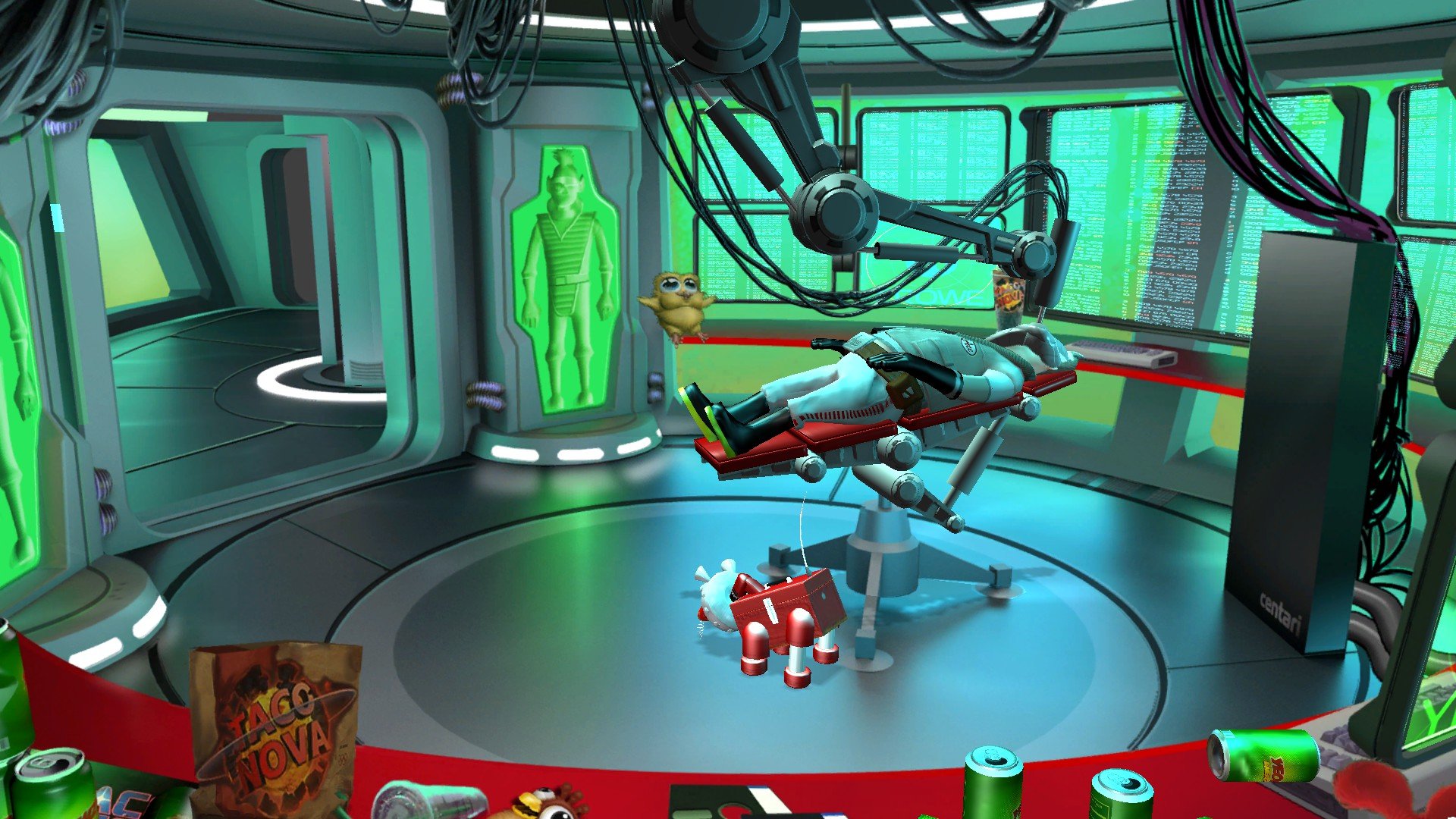
Some legwork feels intentionally drawn out, the biggest offender being the junkyard section where Ace is getting his ship back together. You find each piece of the ship individually through a simple crane game, but rather than getting all the pieces at once and returning them to the garage to be worked on, you have to drive each piece back on a hover loader one at a time, only to be taken back out to the junkyard automatically after dropping one off. What you aren’t told, and have no reason to believe, is that you have to go back into the garage to use the welder robot there on each section of the ship to actually repair it – again one at a time, with no indication you have to walk out of the scene and re-enter each time for the robot to complete installation. Numerous steps could have been cut (and far better feedback added) for the sake of better game flow, but instead an extra thirty-plus minutes of frustration were added just to pad out play time.
While the standard point-and-click interface may have some minor issues, the bigger problems rear their head whenever SpaceVenture asks you to do pretty much anything that isn’t a direct-click action. One of the first objectives is to open an airlock door, and immediately you have to click an object and drag it – and it feels terrible. Even worse, there are a significant number of sections with these controls throughout the game. The cursor immediately disappears when you clamp down on the hotspot, and no matter which direction I moved the mouse while dragging, it seemed like the game had a mind of its own.
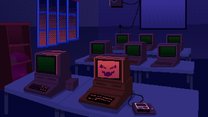
Unfortunately, the painful click-and-drag controls are not the worst part. Each time I started getting into the groove and having a great time with the sci-fi ridiculousness of Ace’s adventure, it would be interrupted by a mini-game. And every single one is a chore to play. One requires you to control nanites pushing around pieces of Rooter’s brain circuitry for repair, but the motions feel floaty and lacking any weight. Once Ace gets his ship, you fly between locations on a space highway in 3D space using the same mouse-only controls, but the movements are incredibly twitchy and hard to keep steady. Then there is an entire section where you play as Cluck Yegger (standing in for Space Quest’s Astro Chicken) in a spoof of Five Nights at Freddy’s. While it’s visually impressive, it just isn’t fun to play and it breaks the momentum significantly.
Thankfully, for any section of the game that isn’t specifically controlled via pointing and clicking (not including the click-and-drag tasks, which unfortunately are still required), you have the option to skip it entirely. This does include the ship flying sections, which is a godsend when you have to travel between planetary coordinates. With how disruptive and un-fun they all are, I could find no reason not to bypass them outright whenever I was given the option. It’s unfortunate that so much time and effort undoubtedly went into the creation of these sections, but it would have been better for them to be shown as short cutscenes that flesh out the game world rather than full-fledged mini-games.
Compared to the Kickstarter-exclusive and Early Access versions, I am happy to report that this version is significantly less buggy, with a functional save system that works like you’d expect. If you record your progress from the menu, you’ll reload the game from the same exact spot you saved from – no longer from when Ace first enters a room. This is great for exploring the many ways Ace can die horribly in SpaceVenture, as there are plenty of humorous scenarios in which he can meet his maker. The autosave will still reload at the start of the scene before Ace’s demise, but if you save manually right beforehand, you can just continue from the spot where Ace stood. It’s a fun way to enjoy the many brutal deaths available without the frustration of losing significant progress because of an ill-timed button press.
That isn’t to say that SpaceVenture is bug-free, even now, as unfortunately I still experienced numerous small technical hiccups. Upon first entering the escape pod, Ace repeated himself twice in a row with the same already-repetitive audio recording of “Well, that went well.” Some voice lines were cut off in the middle of dialogue, and some descriptions were missing voice clips altogether. The frame rate dropped significantly during a physics-based puzzle in which Rooter was dragging parts of a broken pump down to Ace, and with the rest of the game running so smoothly, it was incredibly jarring. There’s nothing game-breaking, but I was surprised that after years of testing there were this many small issues still present.
Bugs can be fixed, but there is one part of SpaceVenture that is irreparable: its main character. I really wanted to like Ace; I thought he would grow on me over time or at the very least grind my gears less. Unfortunately, that doesn’t happen, and I just couldn’t stand him. Unlike the loveable bumbling idiot Roger Wilco, Ace just complains about everything and comes off as a grumpy old geezer. Maurice LaMarche does a fine job voicing him; I just didn’t find myself connecting with Ace at any point and kept finding myself fruitlessly wishing that Roger would hop in and bump him out of the way for the rest of my spacefaring journey. Ace’s trademark “Yahtzee!” felt out of place, and his apparent love of video games seemed really forced in order to connect him back to the main plot involving virtual reality. And while I enjoyed many of the supporting characters, it was always in spite of Ace rather than because of his presence.
All of that said, the bonkers sci-fi world and silly writing kept me coming back for more. Like Ace’s ship, the experience can feel a bit cobbled together, but it’s the sum of its parts that makes SpaceVenture worth playing. You never know what’s coming next, whether it’s escaping the bowels of a massive sandworm or “borrowing” a burger and fries from a certain sleeping space janitor. I wasn’t often falling out of my seat laughing from the insanity on-screen, but there were very few areas that left me without a smile on my face.
Final Verdict
SpaceVenture’s final release is definitely improved over the versions that came out before, but with it comes the realization that the game at the center of the experience was flawed to begin with. There’s a lot to love about it: the 2D presentation is great, the voice cast and music are fantastic, and there’s plenty of nods to Space Quest for longtime fans to geek out on. But the enhancements, while welcome, also serve to make the downsides that much more apparent. The click-and-drag interface still barely works, the (fortunately skippable) mini-games actively bring down the quality of the experience, and no amount of fine-tuning will ever be able to make Ace Hardway an enjoyable character. As a massive fan of the Two Guys' classic Sierra series, I had high hopes for SpaceVenture. And there are indeed parts that I enjoyed immensely, which should make this a game worth playing for any fellow fan of Roger Wilco’s misadventures. But like a pile of scrap, you’ve got to sift through some of the refuse to get to the good stuff.
Hot take
After years of incremental improvements, the final release of SpaceVenture is a fairly entertaining experience tailored especially for Space Quest fans that’s still plagued by a significant number of unfortunate caveats.
Pros
- Fun scattershot approach feels like a natural continuation of Space Quest
- Great performances from the entire voice cast
- Fantastic soundtrack with a variety of musical styles
- Enjoyable inventory puzzles that balance outlandish cartoon logic with grounded solutions
- Gorgeous 2D backgrounds and character stills
Cons
- Ace is a grumpy, unlikeable protagonist
- 3D character models have extremely wonky animations
- Throwaway mini-games and non-point-and-click sections are all pretty terrible
- Some clunky interface navigation
- Still buggy, even if the issues are minor
Sam played SpaceVenture on PC using a review code provided by the game's publisher.

- Advertisement
- Help support AGH by advertising with us





0 Comments
Want to join the discussion? Leave a comment as guest, sign in or register in our forums.
Leave a comment