
Aarik and the Ruined Kingdom review
- 0 Comments

The presentation is cute, but this short and simple puzzler doesn’t do much to build on its gameplay potential
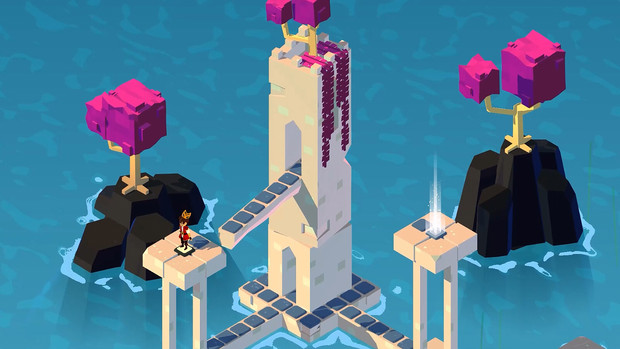
During the early days of Xbox Live Arcade, one particular game more than almost any other stole the spotlight for me and still lives on favorably in my memory almost a decade-and-a-half later. That game was Fez, a laid-back puzzle-platformer that asked the question of what would happen if a character in a 2D world suddenly became aware of the third dimension. While Fez isn’t the only game ever to blend 2D and 3D sensibilities, it’s the one that came to mind when I first saw Shatterproof Games’ Aarik and the Ruined Kingdom – a game that resembles Fez’s shifting of perspectives so closely that it’s hard to imagine the development team didn’t draw at least some inspiration from it. But while Aarik has some similar gameplay concepts and zeroes in on similarly zen vibes, it’s far too brief and easy to have anywhere near the same staying power.
Aarik is a young prince in a kingdom that – you guessed it – has fallen to ruin. With the help of a magical crown, he is able to shift the world around him between several different isometric angles, causing objects at varied heights or distances from one another to line up and connect. With this power at his fingertips, along with other abilities he acquires along the way, Aarik sets out to find and rescue his mother, herself on a quest to rescue the struggling kingdom.
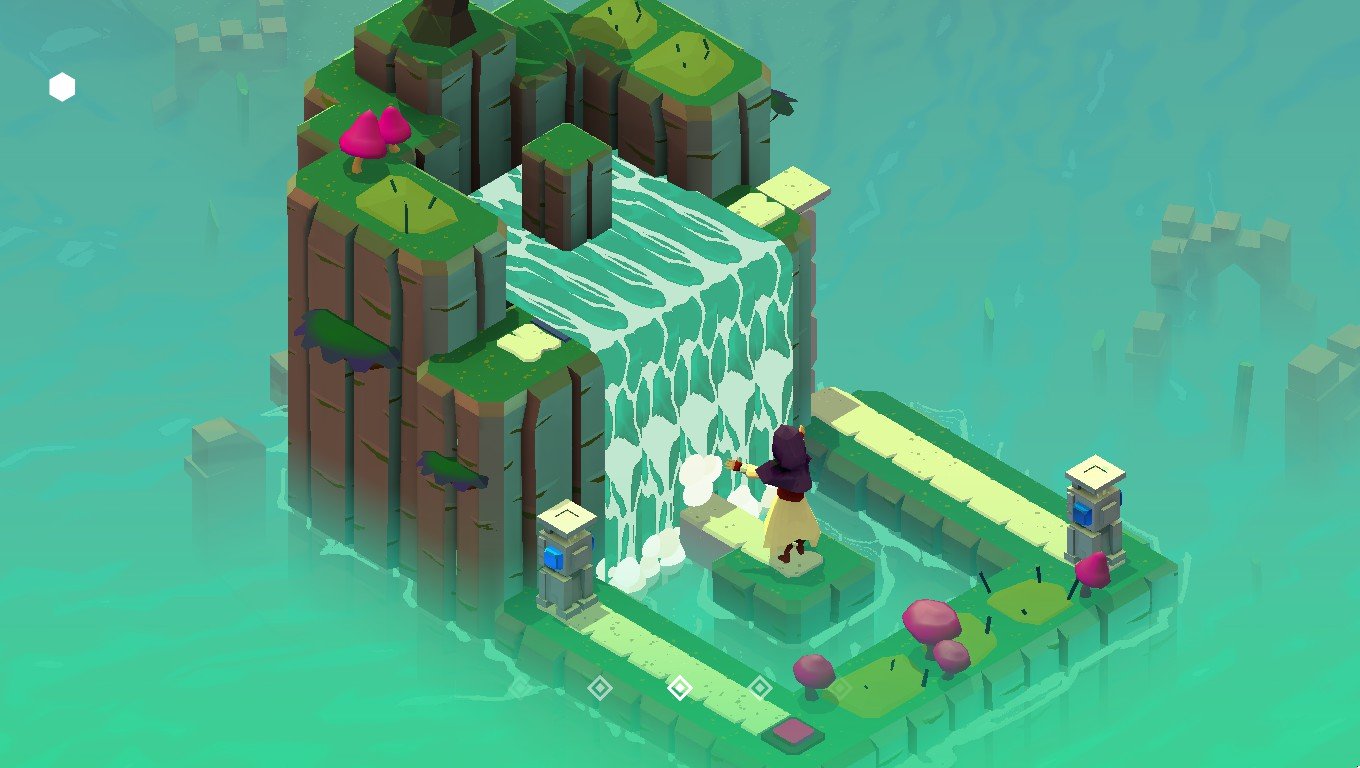
In order for Aarik to make his way through a variety of small-scale puzzle levels, you must manipulate and rotate the environment through 90-degree perspective shifts, lining up previously separate paths or pieces of architecture to create newly connected roads and bridges for Aarik to traverse. Two towers standing at opposing ends of a crumbled bridge, for example, can be joined together by shifting the perspective so that the remaining stonework jutting out of one seems to touch the other, allowing Aarik to scurry across the seemingly reconstructed pathway.
Each of the game’s thirty-odd levels functions like a self-contained puzzle box of sorts, small enough in scale to easily spin the camera’s viewpoint around it in a circle. On PC the simple control scheme utilizes left-clicking the mouse to move Aarik, while right-clicking rotates the environment, making this a game suited to one-handed play. Some levels consist of two or three of these mini puzzle islands in succession, with warp points allowing Aarik to move from one to the next with the camera following.
Aarik and the Ruined Kingdom
| Genre: | Fantasy |
|---|---|
| Presentation: | Realtime 3D, Isometric/Overhead |
| Theme: | Magical, Rescue, Savior |
| Perspective: | Third-Person |
| Graphic Style: | Stylized |
| Gameplay: | Environmental puzzler |
| Control: | Point-and-click |
| Game Length: | Short (1-5 hours) |
| Difficulty: | Low |
The goal in Aarik and the Ruined Kingdom is always to guide the young prince to the exit tile, at which point you’ll move on to the game’s next map and repeat the process all over again. In addition to the perspective-shift gimmick, Aarik will gain access to a handful of additional abilities that impact the environment in unique ways, while particular stages may also include challenges like shifting the environment to guide water to a predetermined location, or using systems of levers and switches to raise, lower, and otherwise rotate parts of the level.
There are some slight environmental variations beyond the cosmetic changes as dense forests give way to island-like outcroppings of rock rising out of the ocean, which in turn lead to arid deserts or boggy marshlands. Each biome brings with it a new ability for Aarik to utilize. Early on, for instance, Aarik gains the ability to repair certain broken-down objects and constructions, easily identified in-game by a bright-red color coding. Later powers include telekinetically moving certain blue-colored statues or automatons, or causing some individual objects in the level to rise or fall.
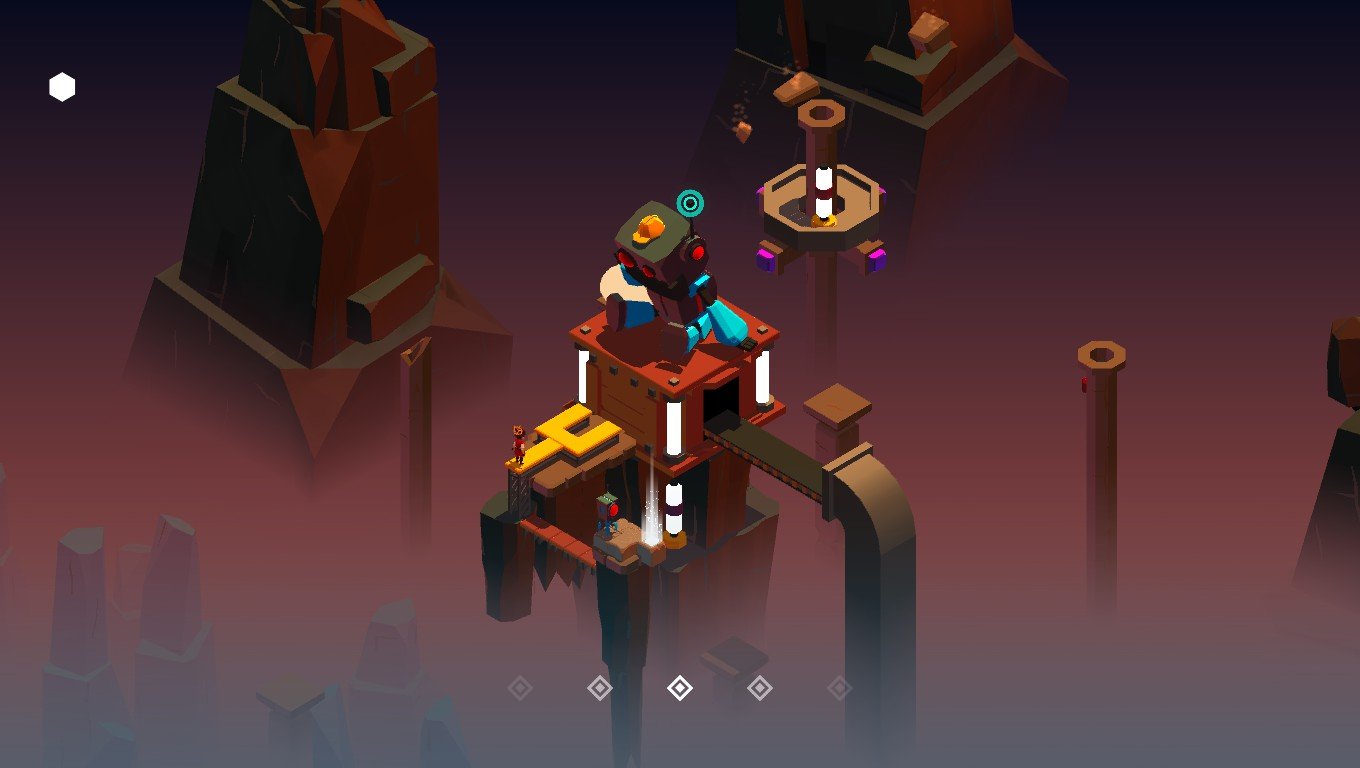
Still, despite these obvious attempts at infusing some variety into the puzzle-solving, there’s very little meat on the game’s meager bones: stages are generally brief and can be completed in extremely short order, with the entire experience only taking me around two hours to blast through. A final half-hearted attempt at injecting a bit more longevity to the proceedings are the optional secret crowns – one per stage – that can be collected by clicking on them, though most of these are very obvious to spot by simply rotating the camera around a stage once or twice. Only a handful are hidden in clever or out-of-the-way places.
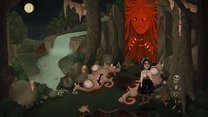
It all looks nice enough, as the game sports a charming, low-poly cartoonish art style, with vibrant colors keeping things cozy and casual throughout, even if the larger world is often little more than a suggestion made by a few pieces of background art and distinct color palettes for each region. In fact, “casual” is the name of the game here, as there are no enemies for Aarik to encounter or time limits to contend with, and most puzzles can be solved with just a handful of mouse clicks. Music is unobtrusive, with only a few tracks providing low-key, if pretty, musical accompaniment to fill the short runtime.
Without much actual dialogue – and none of it voiced save for a few hums and gasps – the game does continuously remind you of your larger objective, with short playable interludes between worlds allowing you to control the queen for a few moments at a time. As she makes her way onward, she’s always just a few steps ahead of Aarik as he tries his level best to close the distance between them. These segments, while brief, provide the sense that Aarik is catching up every time he makes it to a level you navigated the queen through only minutes before.
Final Verdict
Shifting isometric camera perspectives to create paths through otherwise inaccessible stages is an intriguing gameplay concept, and the additional special abilities seem tailor-made to expand the experience for clever environmental puzzling. However, unlike the thoughtful levels of the Monument Valley series, it would seem Aarik and the Ruined Kingdom is meant to appeal to casual or especially younger gamers; its brevity and lack of credible challenge won’t hold much lasting appeal for more experienced players. Still, if nothing else, it’s hard to deny that the game’s collection of puzzle scenes provides a charming and relaxing way to spend a couple of hours. It certainly won’t satisfy a craving for a meatier experience, but even if you don’t have young ones to entice, with tempered expectations and a suitable sale price, one can do worse than take the brief sojourn to Aarik’s kingdom to save it from ruin.
Hot take
Its premise is as easy to connect with as its charming presentation, but Aarik and the Ruined Kingdom never quite capitalizes on its potential, choosing instead to walk the path of a rather simple and woefully short puzzler aimed at casual or younger gamers.
Pros
- Cute, colorful graphics look lush and vibrant
- Music is pretty, and never has to worry about overstaying its welcome
Cons
- Low difficulty won’t induce any endorphin rushes
- Blink and you’ll mi… (Too late; it’s over already)
Pascal played Aarik and the Ruined Kingdom on PC using a review code provided by the game's publisher.

- Advertisement
- Help support AGH by advertising with us







0 Comments
Want to join the discussion? Leave a comment as guest, sign in or register in our forums.
Leave a comment