
CARIMARA: Beneath the forlorn limbs review
- 0 Comments

Unique, unsettling but extremely short card-based fantasy investigation folds its hand just when you’re all in
In CARIMARA: Beneath the forlorn limbs, you play as the titular creature, a mute, goblin-like being whose job it is to exorcise restless spirits. Named for a sorcerous figure from Norman folklore, the Carimara communicates with his clients using a deck of enchanted cards. If he wants to ask about something, he produces a card bearing that object’s image. By necessity, then, the Carimara leads a solitary life, forced to concern himself always with what can be seen and touched. He can ask about a person, but not how they feel. When his job is done, it’s time to move on again.
Much like its silent protagonist, CARIMARA the game is short and to the point, with a main story you can finish in under an hour. In that time you’ll explore an ominous and intriguingly realized fantasy setting full of interesting characters and frightening beasts entangled in a surprisingly elaborate mystery. Unfortunately, it ends so quickly that it feels more like an extremely promising tech demo or proof-of-concept than a complete work that stands on its own.

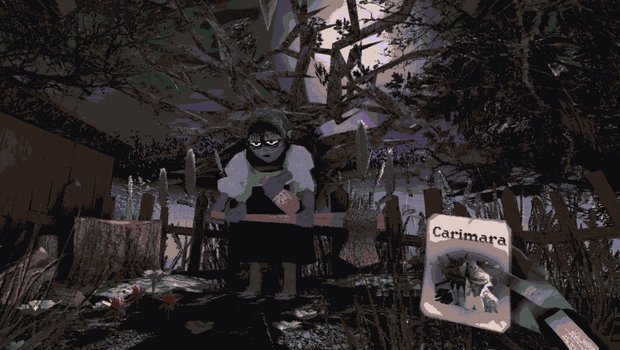
The game begins as the Carimara arrives at a lonesome cottage in a dark and marshy woodland, responding to a “Help Wanted” notice. The cottage belongs to an old woman named Violet, who finds herself plagued by a restless spirit called a “forelore” that’s moved into her cellar. The atmosphere is hardly welcoming; there’s something uncomfortable about Violet’s grin when she first sees you, and the number of sackcloth dolls she has hanging by their necks from the ceiling seems…excessive. Still, you’re not here for the ambience or the company; Violet has summoned you to banish the forelore, which means helping it remember who it was in life and how it died. Only then can it move on from its subterranean purgatory.
You view the game in first-person, using WASD to move freely through the 3D environments and the mouse to interact. Since a Carimara’s detective skills are only as good as the cards he carries, your first order of business is to find some. Approaching an interactive character, object, or bit of geography causes it to glow softly, letting you know you can click it; doing so adds the corresponding card to your deck, which you can then refer to in conversation. You won’t have too much ground to cover while searching for topics: the cottage itself consists of an open-plan floor, an upstairs loft, and a deep cellar with several winding passageways, while out front is a small, penned-in yard. You’ll eventually learn how to bypass the fence, but nearly all the accessible terrain is visible from behind it.
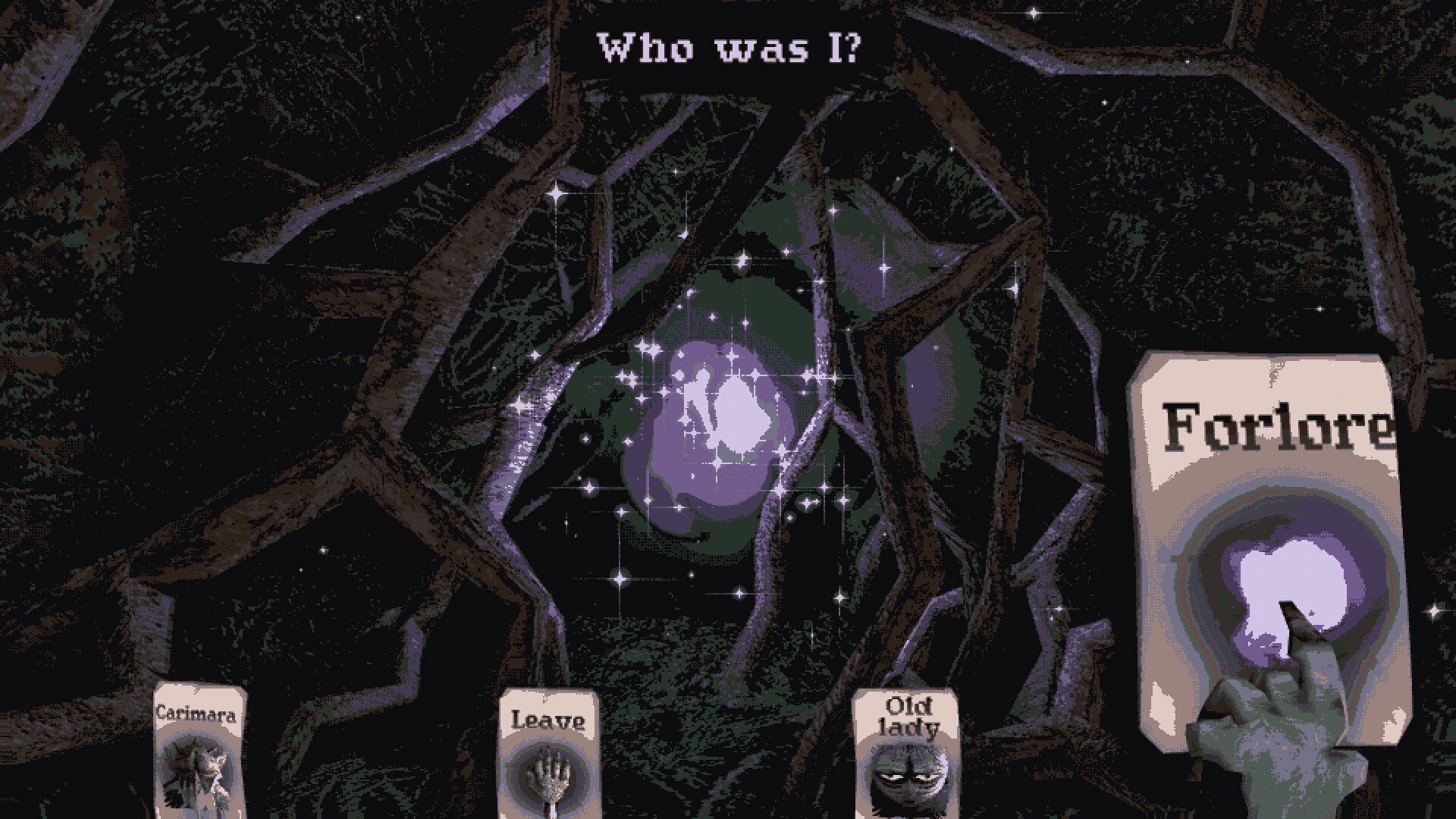
While Violet lives a solitary life, she’s not alone in the forest. Most prominent of her woodland neighbors is Pansy, a talking owl who frequents the front yard. She’ll speak to you, since you’re (probably) too big for her to eat, but her presence has persuaded those critters farther down the food chain to keep out of sight. You’ll have to do a bit of investigating to see if any of them will help you. When you see a character, you’ll initiate conversation the same way you gather cards. Clicking on them when you see their glowing aura prompts the Carimara to spread the cards out so you can select a topic. Once a character has said all they can on your chosen subject, that card will darken, though you can click it again to have them repeat themselves.
You’re free to approach the forelore in the cellar at any point to try to solve the mystery. Providing the wrong answers will drive it into a frenzy, which causes the Carimara to faint in terror. Violet then drags you back upstairs to recuperate in a makeshift cot she’s assembled for you. (Why does she keep following you down there? And what’s up with all those freaky statues she has in storage?) Each time you wake up you’ll find your surroundings have changed in small ways—Violet may be busy with a different household task, for instance, or Pansy may not be where you saw her last—and pursuing new details may open up more avenues of investigation. (To prompt these scenery shifts yourself, you can also click the pillow Violet’s laid out for you to nap.)
CARIMARA: Beneath the forlorn limbs

| Genre: | Fantasy, Horror |
|---|---|
| Presentation: | Realtime 3D |
| Theme: | Magical, Myth/Folklore |
| Perspective: | First-Person |
| Gameplay: | Investigative |
| Control: | Direct Control |
| Game Length: | Short (1-5 hours) |
| Difficulty: | Medium |
| Graphic Style: | Low poly |
Though you can’t actually die, the oppressively eerie atmosphere seems almost to promise something worse in store. The purposefully limited color palette befits the tale of a haunted cottage in the deep dark woods, all foggy grays, swampy browns, and bruised purples, while the blocky, low-poly graphics lend a feeling of irreality to everything you see. The sound design, too, is like something out of a bad dream: the minimalistic score sounds like it’s played on a busted hurdy-gurdy, while voices come out gravelly and distorted, as if the characters are speaking around a throatful of muck. (There are subtitles for a number of languages, but spoken dialogue is all in muffled, gurgling French.)
Character models are exceptionally expressive, belying the graphics’ seeming simplicity, and if the surroundings are unsettling, the people are doubly so. Even ostensibly friendly characters resemble storybook monsters: eyes are wide and staring, and mouths brim with nasty-looking teeth, so that a pleased grin feels just as threatening as a snarl. The designs are novel and creative, with even small details adding depth to the setting and its inhabitants. Instead of the expected bird feet, for instance, Pansy the owl props herself up on a pair of humanoid hands, and if you observe Violet around the house you’ll notice she has four fully functioning arms. Nobody you meet seems to consider either feature worth remarking upon.
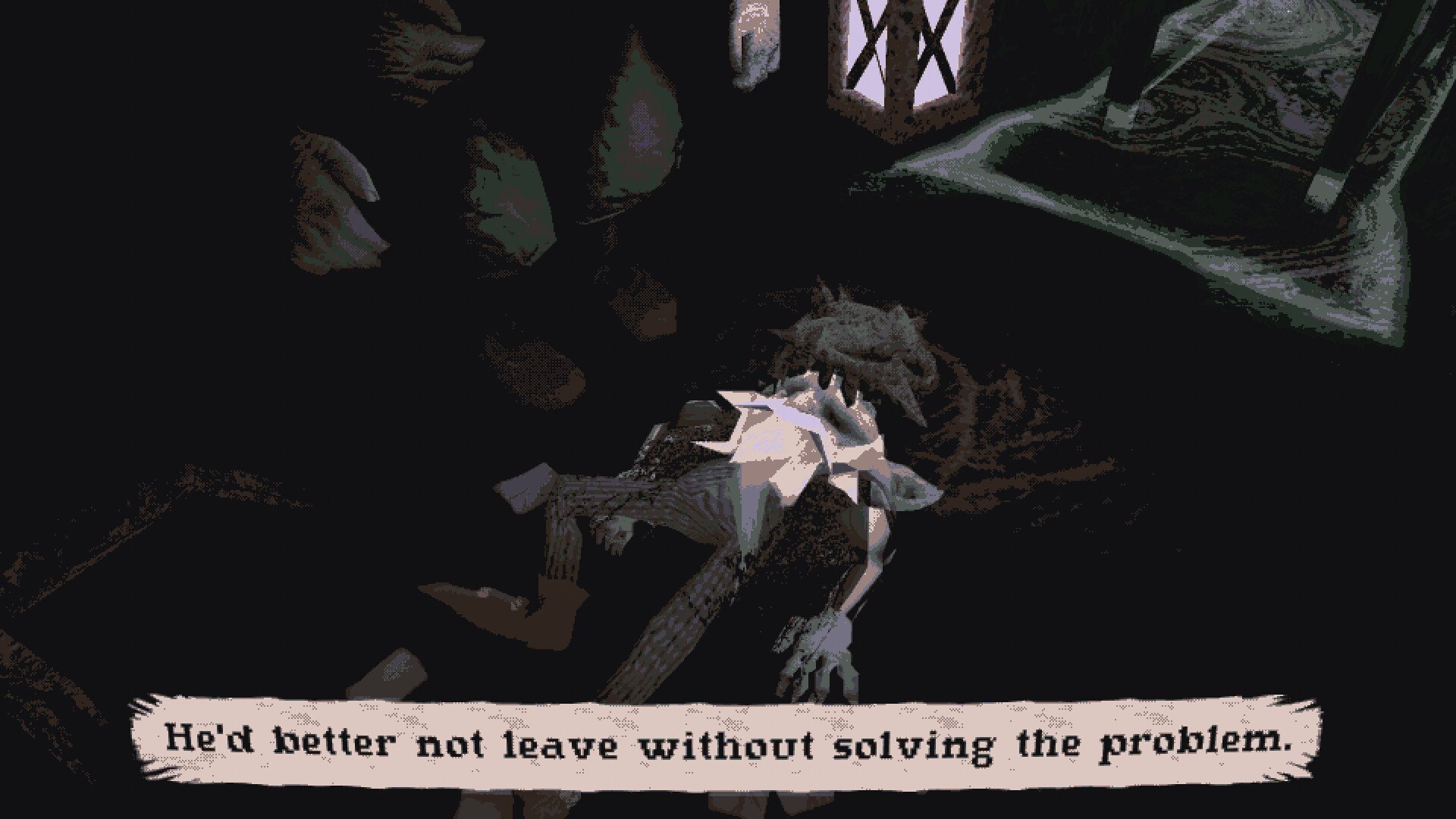
All this stylization can be a lot to take in, but it doesn’t get in the way of actually playing. You might wonder at first glance what something is, but the interface is such that you won’t have trouble finding it to click on. Your primary focus is on locating pertinent cards and using them to ask the proper questions. On the rare occasion when you have to do something directly in the environment, the magical nature of the Carimara’s cards lets you use them in place of the items they depict.
While the focus is on conversation, you shouldn’t mistake CARIMARA for a challenge-lite visual novel. Bite-size it may be, but this is a dyed-in-the-wool detective game, and its central mystery is complex enough that you can’t easily brute-force your way through it. Uncovering the solution requires careful observation of your surroundings, paying attention to what people say, and making connections. You might even want to take notes of your own, as the game won’t do it for you.
Paying close attention can also yield other rewards. For such a small game, CARIMARA has some surprising secrets to uncover, and the clues pointing toward them are subtle and easily missed. If you don’t keep your eyes open, you might not even realize there’s more to do than you’ve been told. These bits are all optional, with one only available after you’ve finished your first playthrough, but uncovering them broadens the scope of both the game and the story. Even so, tracking them all down still only adds about twenty minutes onto a very brief playtime.
CARIMARA’s premise, presentation, and mechanics are all rich with promise. Unfortunately, just as everything feels most poised for greater exploration, it ends. There’s so much seeming depth in what we see and do that it comes as a major disappointment to discover how little there really is under the surface. Without time and space to properly explore, all the gestures toward a larger world and a deeper purpose to what we’re doing function as little more than elaborate set dressing, even with the optional secrets. The story of Violet and the forelore is complete, self-contained, and complex despite its brevity, but with so much more teased it’s jarring to realize how short a leash we’re actually on. While thought and care clearly went into developing this setting, what we get feels more like a postcard advertising a destination than the place itself.
Final Verdict
As a demo or proof-of-concept piece, CARIMARA: Beneath the forlorn limbs would be a tantalizing and perfectly portioned introduction to these characters and their world, but as the sum total of what we can do there it feels frustratingly truncated. A post-credits message from solo developer Bastinus Rex expresses a desire to tell more stories about the Carimara, but unless and until those materialize, what we have is a little over an hour of promising, somewhat barebones material. That said, if the existing material wasn’t good in itself, it wouldn’t be disappointing to get so little of it. The card-based, inventory-as-dialogue system is a unique device, and allows for an interesting twist on the detective genre within a strange and original fantasy-horror setting. Aesthetically, creatively, and mechanically, this is a project that practically begs for a more substantial follow-up, but even if we don’t get one, I won’t regret the brief time I spent with it—save to lament the taste I’ve developed for a dish I might not find again.
Hot take
CARIMARA: Beneath the forlorn limbs is an attention-grabbing introduction to a strange and original fantasy world that features an engaging spin on the detective genre, but our time there is so brief that it’s hard to come away fully satisfied.
Pros
- Tells an interesting and well-constructed story in a short amount of time
- Low-poly graphics with limited color palette make for a creepy atmosphere
- Appropriately unsettling sound design
- Straightforward but versatile card-based investigation mechanic
- Surprising number of secrets that reward thorough exploration
Cons
- Small playable area and incredibly short playtime leave the unique and original setting feeling underutilized
- Hints toward something larger and deeper that we never really experience
Will playd CARIMARA: Beneath the forlorn limbs on PC using a review code provided by the game's publisher.

- Advertisement
- Help support AGH by advertising with us







0 Comments
Want to join the discussion? Leave a comment as guest, sign in or register in our forums.
Leave a comment