
Caravan SandWitch review
- 1 Comment

Repetitive quests in this otherwise pleasant, low-stakes driving expedition may leave you wondering “Are we there yet?”
The idea of a small, personal science fiction story rather than a big dramatic one appeals to me, because not everything needs to be about end-of-the-world drama. Sometimes it can just be about going back to a place you left behind and discovering that it’s kept moving on without you. Add to that more intimate experience the setting of a slowing dying world created with beautiful 3D visuals, and all the boxes seem ticked for Caravan SandWitch to be a relaxed exploratory experience with a strong sense of place and a gentle narrative focus. For players looking for something quiet and leisurely, what’s offered here may be enough. It’s a shame, though, that the low stakes are so low that the repetitive gameplay never picks up any speed, which is ironic for a game where you’ll spend much of your time behind the wheel.
The game has a great but simple premise. You are Sauge, a young woman who returns to her home planet of Cigalo after years away because her sister Garance has gone missing. Towns here now feel half-empty, machines are held together with temporary fixes, and most of the people you meet talk about friends and family who have already left for good. The result is that there never really feels like there’s any sense of urgency in Caravan SandWitch. Besides finding your sister, which doesn’t even seem that pressing (a couple of the characters you meet think she’s already dead), there really isn’t much else that drives you along – besides your trusty, upgradable vehicle, that is.
The story unfolds slowly through conversations and everyday jobs. Sauge helps people repair equipment, deliver supplies, and check on remote sites, often under the pretext that these tasks will lead to information about where her sister went. Along the way, you start to piece together what life on Cigalo has been like since you left. It’s been hard, like an oil-drilling town whose oil has run dry, the remnants of people staying only because they felt that someone had to. Others chose to go, and the contrast between the two sisters is at the core of the narrative as you find out more about Garance and her decision to stay while Sauge departed to build a life elsewhere.
Most of the gameplay revolves around driving your van across Cigalo, opening up the map, and completing small, practical jobs for the people who still live there. These tasks are usually straightforward, and although they’re not classified in-game, they fall into a few categories. The first is infrastructure and repair. A large portion of your time is spent on these, especially early on. You’re asked to travel to remote communication relays or utility installations to check their status or to bring them back online. These jobs often involve little more than reaching the site and interacting with a console, but they reinforce the idea that Cigalo is held together by constant maintenance and in pursuing them you’ll learn how to navigate this fading world.
Another category is retrieval and delivery work. You’ll recover lost drones, tools, or cargo that were abandoned in the desert, or move supplies between settlements because transport networks have broken down. There are also exploration-based tasks that exist simply to justify travel and reveal new areas by scouting locations that haven’t been visited in years, or to see whether certain areas are still usable.
Early in the game, these errands feel meaningful because they push you into unfamiliar areas and reward you with new scenery and small story details. In one scenario, Sauge is asked to find someone’s father who hasn’t returned home; in another she is asked to transport parts to a remote outpost because the people stationed there don’t have a functioning vehicle. The problem is that over time the structure remains largely unchanged: drive out, interact with something or someone, then return.
Many of the quests are loosely linked to your overall mission of locating your sister, although progress is often gated behind helping people first. Completing a job might unlock a new conversation, a message, or a clue about where Garance has been. Narratively, this makes sense because information on Cigalo is only given when someone trusts you, but mechanically, it means that even important story leads are advanced through the same task structure as everything else.
As you talk to characters in various settlements along the way, multiple objectives are given to you all within a short span of time, and you’re free to tackle them in almost any order. There’s no time pressure, no failure state, and no penalty for ignoring something while you work on something else. Yet having several similar tasks active at once can make them blur together. When all your objectives boil down to “drive here and interact with something,” it can be hard to remember which ones are meaningful and which are just more errands to run. After a while, they felt more like a delivery system for information instead of engaging gameplay.
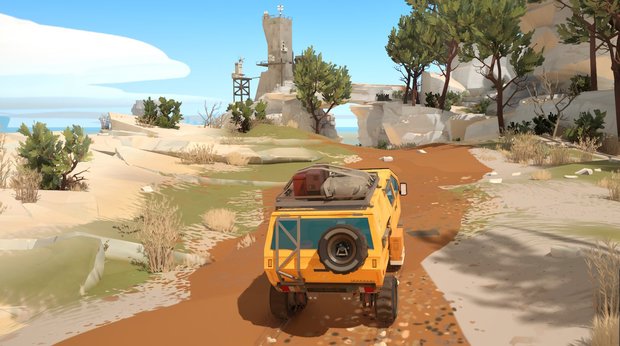
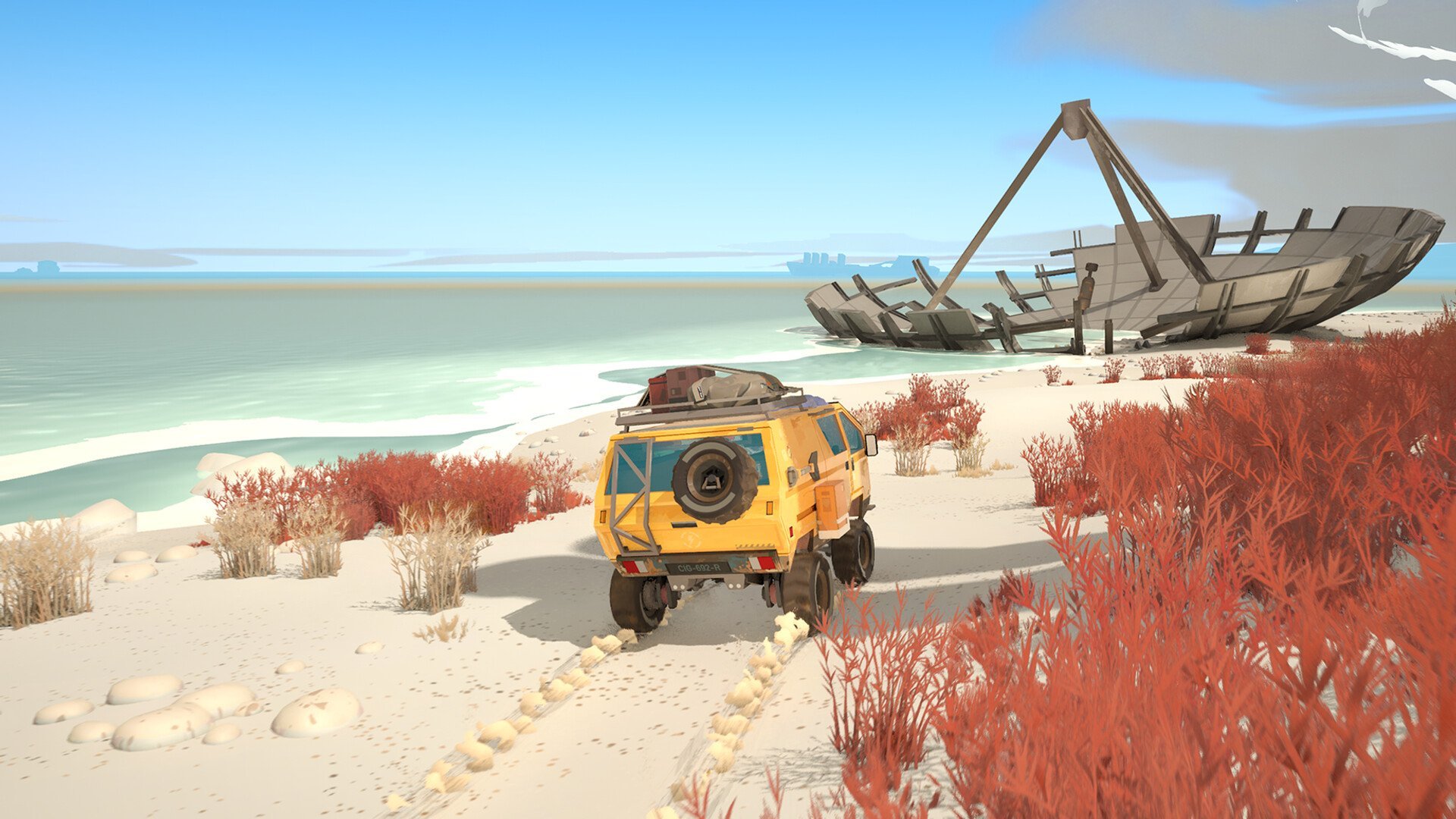
With all this travelling around, driving is the backbone of Caravan SandWitch as almost everything you do involves getting behind the wheel and setting off across Cigalo’s dusty roads and open terrain. Your van handles in a deliberately weighty way. There isn’t a great deal of acceleration and turns are wide, with uneven ground slowing you down. As you learn the landscape and unlock tools like the scanner, movement becomes smoother but it never becomes fast or very responsive, and terrain navigation is where driving matters most. Hills, rocky paths, and narrow passes force you to think about approach rather than speed.
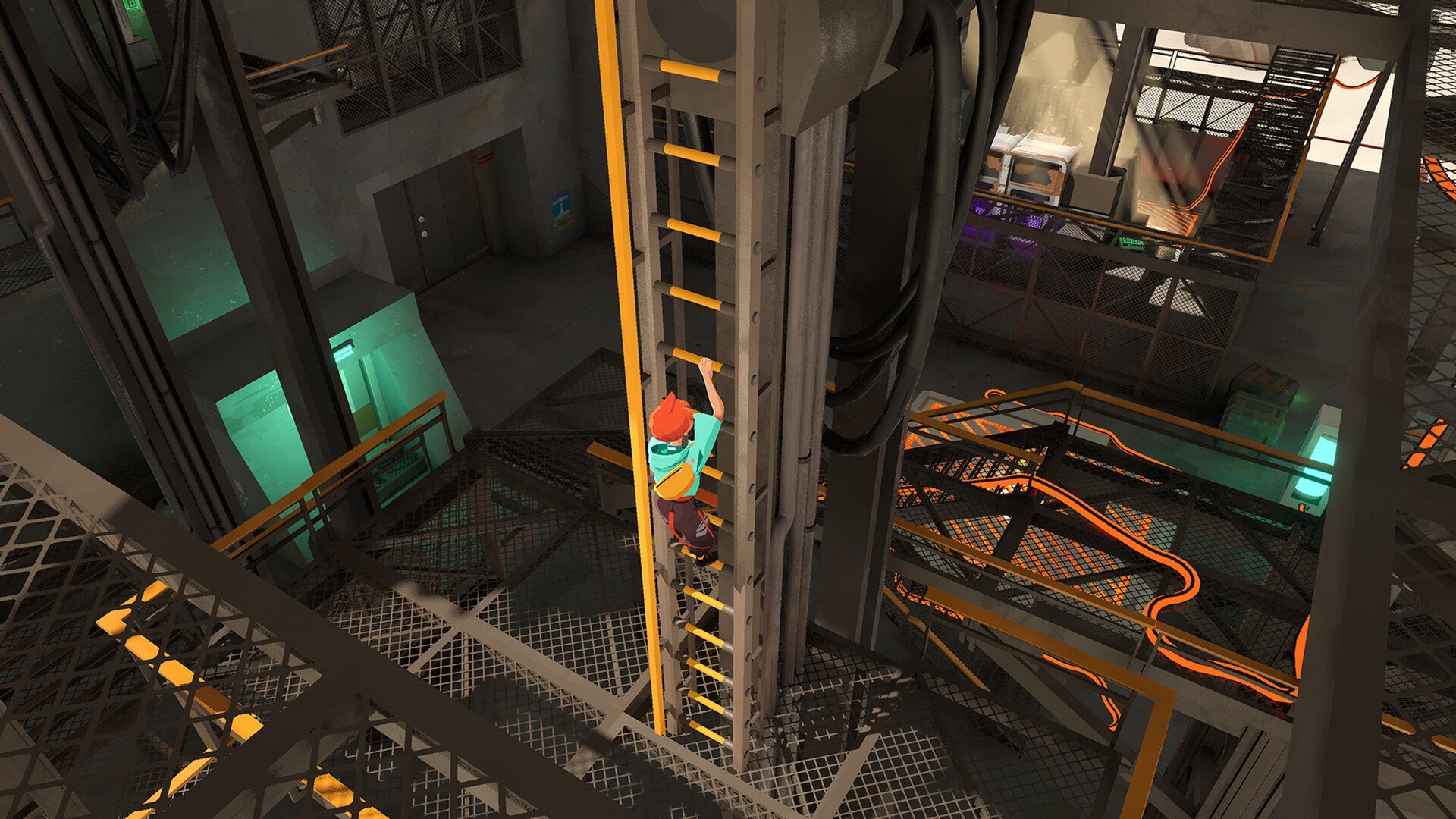
The scanner is one of Sauge’s key tools because it helps you locate points of interest across Cigalo. When you activate it, which you will do every time you receive a task, it will point you towards locations, equipment, or signal jammers. When the landscape is unfamiliar, scanning gives you a sense of direction without fully holding your hand. Still, you might pick up a signal and realise it’s coming from behind a ridge or tucked away in a hard-to-reach area, so occasionally you’ll need to park and continue on foot or use climbing tools to reach a destination.
Unfortunately, as the game opens up, the scanner too becomes more routine. You scan, see a marker, drive toward it, and repeat. Like many systems in Caravan SandWitch, it remains useful but quickly becomes monotonous. There is a larger map you can access, and fast travel becomes available once you’ve been to a location, but most objectives still require you to drive at least part of the way there, so while it mitigates the repetition somewhat, it doesn’t bypass it entirely.
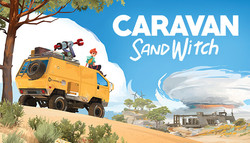
Caravan SandWitch
| Genre: | Adventure, Mystery |
|---|---|
| Presentation: | Realtime 3D |
| Perspective: | Third-Person |
| Graphic Style: | Stylized |
| Gameplay: | Action-Adventure, Environmental puzzler, Quest, Cozy |
| Control: | Direct Control |
| Game Length: | Medium (5-10 hours) |
| Action: | Platforming, Driving |
| Difficulty: | Low |
| Theme: | Post-apocalyptic, Missing persons, Vehicular |
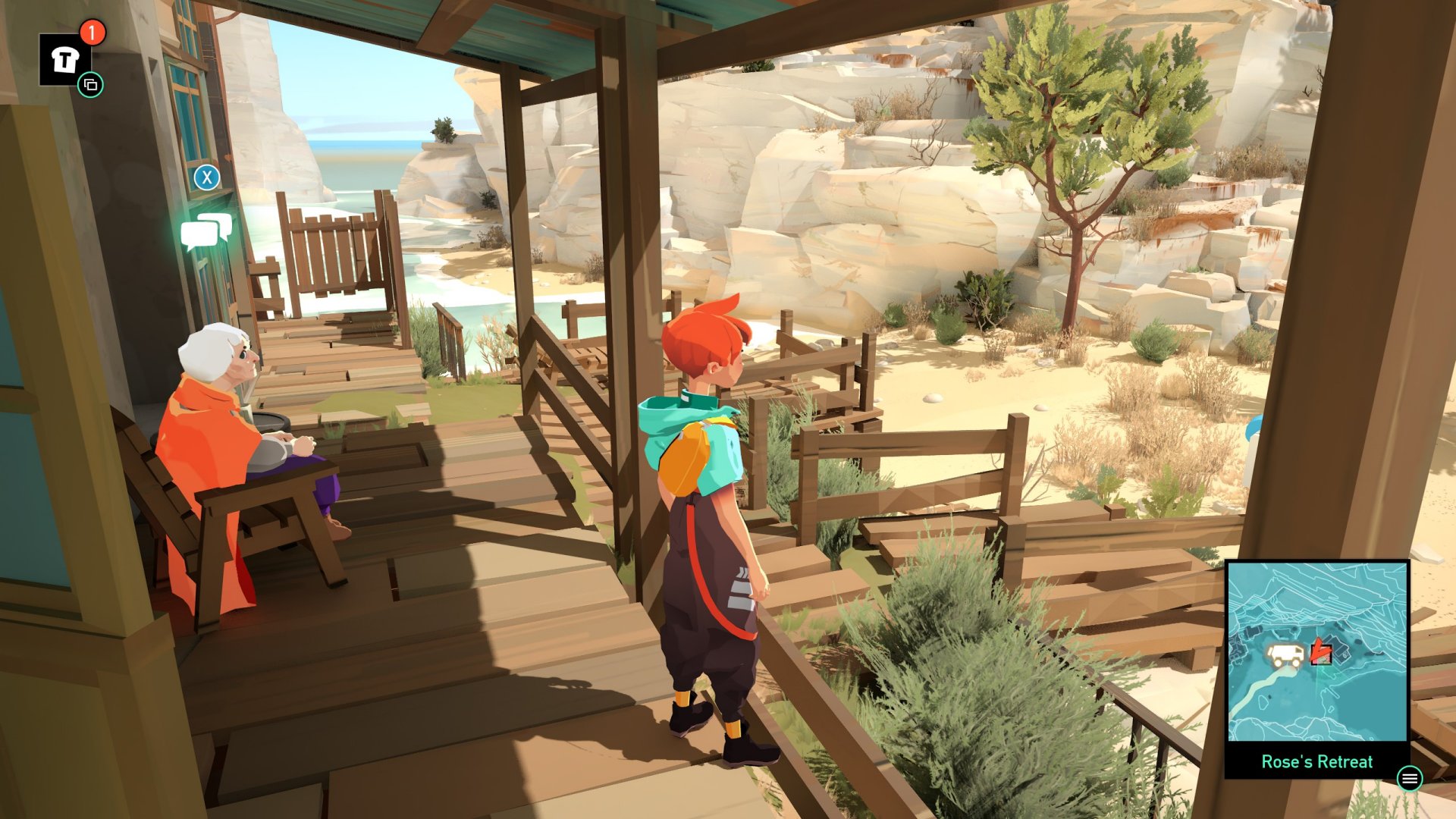
Driving and walking are both simply achieved either with a gamepad or the WASD keys for movement, with additional driving options for acceleration and breaking. Mouse movement rotates the camera, which is a very natural combination when walking but has a certain clunkiness when driving that doesn’t feel natural at all. You have access to both a quest log called the Toaster, which has a text message feel to it, and an extremely streamlined inventory. After you collect an item, you use it in the environment the same way you do any interaction: pressing the E button. No selecting the inventory item needed here first. A useful minimap displays on-screen that helps keep you oriented, whether you are driving or walking.
Where Caravan SandWitch shines is in its world-building. The first place you visit, Estello Village, is Sauge’s hometown. Metal structures show signs of rust and wear. Equipment looks reused and repurposed rather than newly manufactured. You’ll see cables running between buildings, generators placed wherever they’ll fit, and machinery that works but clearly isn’t in ideal condition. The colour palette leans heavily into warm yellows and muted oranges, giving the town a sun-bleached look that matches the surrounding landscape.
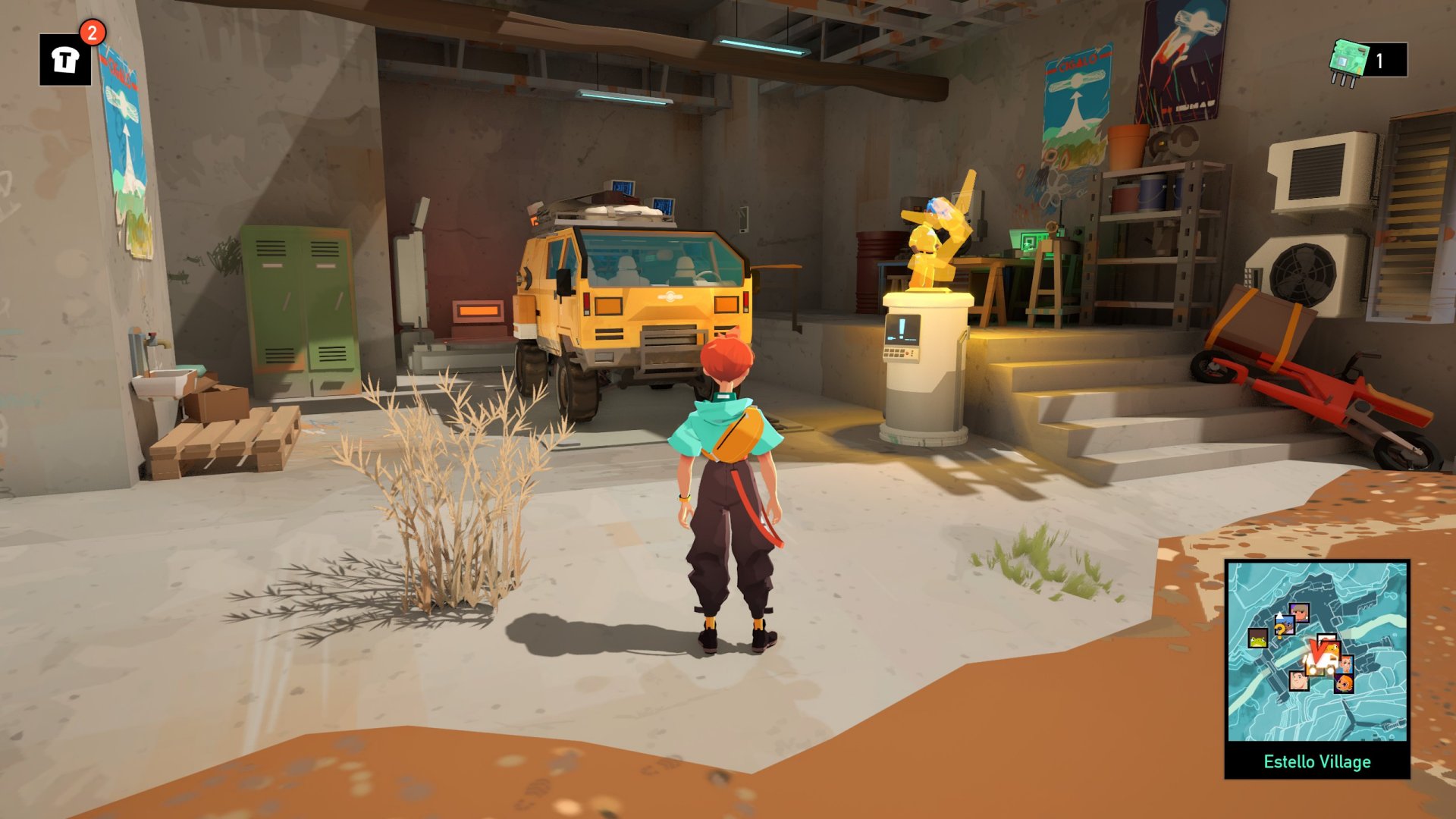
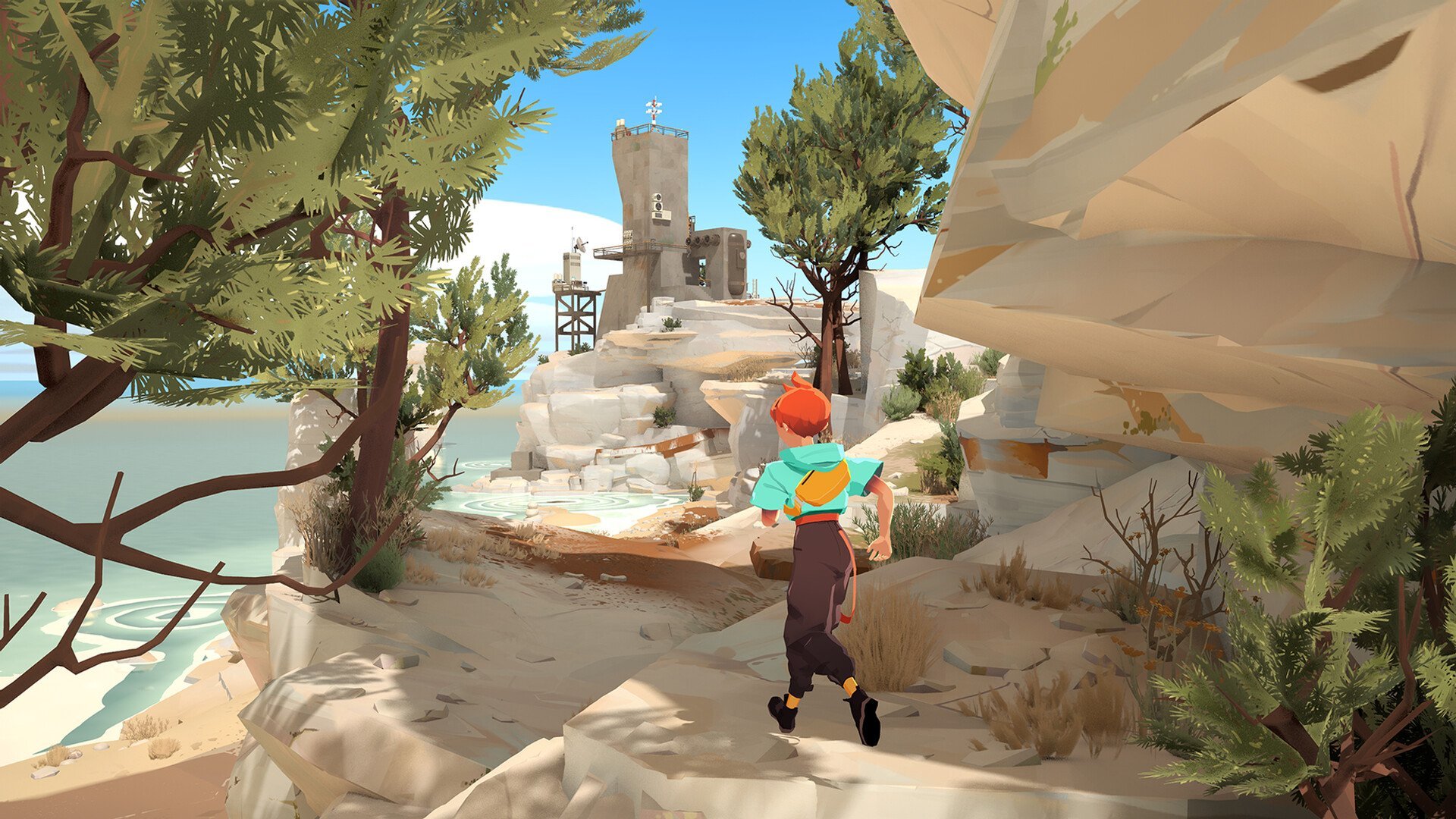
The theme of slow decline is consistent as you travel farther and encounter more open, striking landscapes. Think hot, dry wilderness areas like you might see in Western movies. Textures are clean but restrained while the overall style leans toward clarity rather than complexity. There is not much variety to the fully 3D environment, but that’s not a bad thing because the world that developer Studio Plane Toast has created is a rough and rugged one. The natural landscapes depict desolate rocky terrains, while the buildings and other constructions lean very heavily into concrete and metal. There are some areas that stand out, such as valleys with water and green trees, but the most striking difference is on the space station at the start of the game, cool with sharp whites depicting a technologically advanced future that contrasts nicely with Cigalo.
Another strength of the game is its soundscape. The way music is implemented – or not – really adds to the atmosphere. As you explore remote outposts or abandoned locations, there is little to no accompaniment at all, the soundtrack often dropping back entirely, letting silence take over. For long stretches while driving across open terrain, you’re often left with only environmental sounds: the hum of the van, wind moving across the landscape, the crunch of dirt and gravel beneath your tyres. When the score does fade in, it is soft synth tones or maybe some gentle guitar music, the latter used very effectively in Estello Village.
There is little voice acting, used only for the occasional greeting or key moments. Such limited use can make interactions feel a little uneven. You’ll sometimes hear a character speak a brief line, then immediately you’re switched back to reading text for the rest of the conversation. It’s not jarring, exactly, but it does undermine immersion in those moments. The acting quality itself is reasonable, though there is a tendency to over-enunciate.
The characters you meet are a mixed bag. Just as the planet is tired and almost-but-not-quite worn out, so are the residents. You’re introduced to a small group of locals like Yucca, a friend of Sauge’s sister who believes Garance is missing at best, dead at worst; Rose, an elderly woman whose vehicle you help repair after she crashed it; and Clémentine, Safran, and Olivier, a family you spend some time with getting re-acquainted. The ongoing theme of Sauge having abandoned those still living here is always prevalent. Some people you interact with are angry or disappointed you left them behind, while others are happy you’ve returned. As a whole, the characters are an eclectic group that should be interesting, but end up rather bland.
This blandness is a result of the dialogue. There are options during conversation, usually between a serious answer and a sarcastic response, yet none of them seemed to make much difference beyond some altered lines. When talking to Rose about Garance, the choices are to explain why Sauge has returned, or to breeze over it and claim it’s not important. Yet the response to the second option is only an extra bit of dialogue from Rose, encouraging Sauge to open up about her feelings, before returning to the same conversation you would have had if you selected the other option instead.
As well as feeling like your choices don’t really matter, it all sounds formal and stilted rather than engaging. Instead of someone casually asking for help, for example, the dialogue can come across like a direct translation of another language’s sentence structure. When explaining why they it, they often state things in a very functional way that feels more like instructions than natural speech. This is especially noticeable during task-related conversations. When someone asks you to do something, they frequently spell everything out explicitly. Characters will restate information you already understand, using formal phrasing that doesn’t quite match how people normally talk. It’s clear what they mean, but it doesn’t always sound natural.
There are also moments when emotional lines feel oddly neutral. There is a heartfelt scene towards the end of the game in which a back-and-forth between Nèfle and Sauge is very personal and intimate, yet the conversation transitions with Nèfle saying, “It's a hard pill to swallow, but I need you to go in the receptacle.” It gets the point across – Nèfle needs you to do something – but everything is so overtly literal that it feels like a translation, which wouldn’t be a surprise as the developers are based in France.
Final Verdict
What Caravan SandWitch does well is present consistency. The world, tone, and mechanics all align with the same calm, low-pressure vision. Nothing feels out of place or poorly implemented. The problem is that I rarely felt engaged on a moment-to-moment level. Parts of the experience are enjoyable, but before long very little stands out and once you realise everything is some kind of a fetch quest, with the same basic formula of driving to a location and interacting with something to achieve it, it’s easy to lose interest over the course of the eight or so hours it will take you to finish. The dying world of Cigalo is drawn beautifully and a pleasure to explore, and it’s refreshing that your goal is not to actually save it. It’s just a shame that the repetitive gameplay experience ultimately lets it down.
Hot take
Caravan SandWitch is a calm, atmospheric journey that’s pleasant to play, but held back by repetitive tasks and a lack of momentum.
Pros
- Beautiful 3D backgrounds to explore by foot and van
- Excellent use of sporadic background music
- Well-designed world-building for a planet where everything feels like it’s winding down
Cons
- Continual fetch quests with very little variety become tedious
- No stakes or sense of urgency
- Character dialogue can be stilted and formal
Shawn played Caravan SandWitch on PC using a review code provided by the game's publisher.




1 Comment
Want to join the discussion? Leave a comment as guest, sign in or register in our forums.
I need play the game
Reply
Leave a comment