
Missile Command Delta review
- 0 Comments

Explosive reimagining of the arcade war games classic finds new life with welcome adventure elements
I was born in 1987. Going to school in the 1990s, I never had to practice hiding under my desk in the event of an incoming nuclear attack, nor did I ever see my parents exchange worried glances as Walter Cronkite revealed the latest concerning intel involving the Soviet Union. The Cold War was, for me, ancient history. Yet as I write these words, the doomsday clock sits at 89 seconds to midnight. Now, at 38 years old, I must confess I am more worried about war than ever before.
Even if I didn’t recognize it at the time, I recall having this feeling once in my childhood when I discovered a game called Missile Command. The premise was simple: you had six cities under your watch and three missile turrets to defend them. You had to make split-second decisions, prioritizing which enemy missiles to strike first and with which turrets. It was an addicting experience, but also a genuinely unnerving one. Sometimes, if you hadn't planned well enough, you would have to make the call to lose a city in favor of saving another. And when you lost all of your cities, a foreboding roar would crackle over the speaker and the screen would strobe, punctuating your loss. Though a basic concept, it showed me for the first time how hard it would be to combat such an attack, and what buying time to continue the fight could cost.
Now decades later, Atari has revived Missile Command for a new generation with Missile Command Delta, but it’s a fairly different experience. It still features a tense and satisfying warfare system, but it sheds its predecessor’s arcade design in favor of narrative and puzzle elements, as well as a more strategic turn-based system for defense. It’s got a well-written story, with an immersive (if easy) escape room formula tying it all together, managing to elicit the same sense of youthful ignorance and budding fear I felt in playing the original.
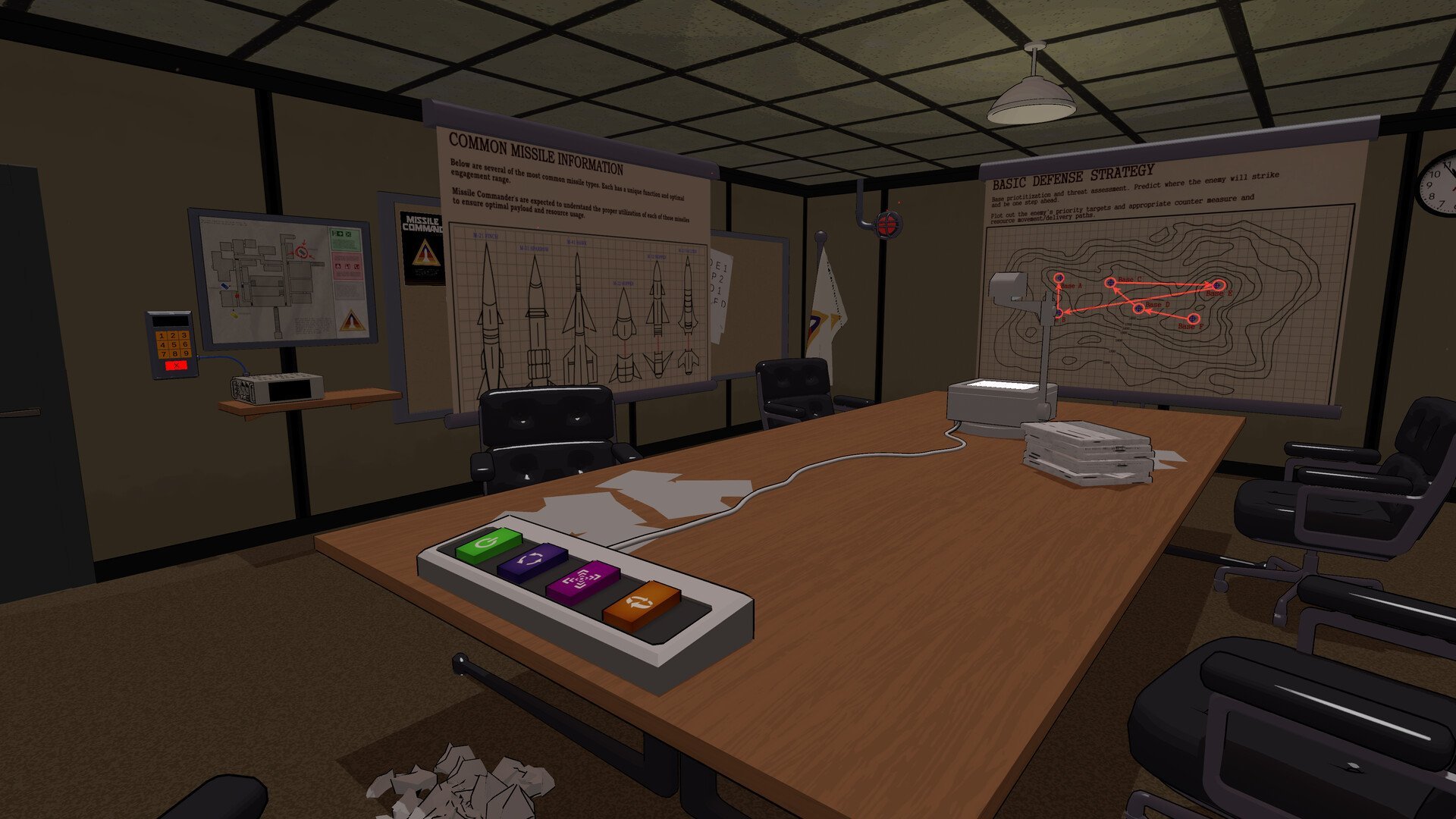
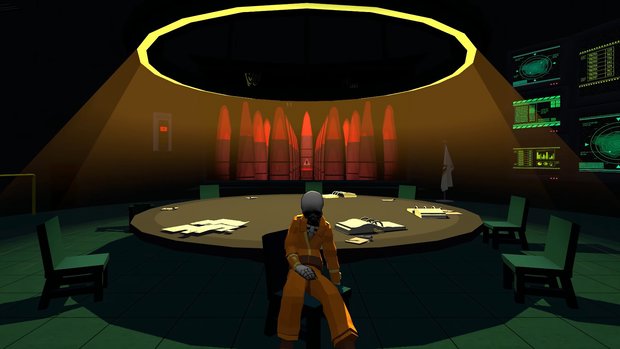
Delta begins with a brief prologue set sometime in the past, with players assuming the role of a (nameless) Army cadet training on the latest missile defense technology of the time. There are no flags present, nor is the country you are from ever mentioned, negating any direct real-world Cold War parallels somewhat. Your efforts are overseen by the silhouette of your superior standing behind tinted glass in the room above as you are directed to different terminals, learning about the missile defense system.
After this brief introduction, the game fast-forwards to the current day when you take control of Skye, a young woman in her last year of high school. She and her friends Victor, Marta, and Adel decide to have a final hurrah before school lets out, so they head to an abandoned bunker for a party. The four of you sneak in successfully, setting out your sleeping bags before exploring the old building, reveling in the ancient computer technology, crew quarters, common rooms, and forgotten documents you find there.
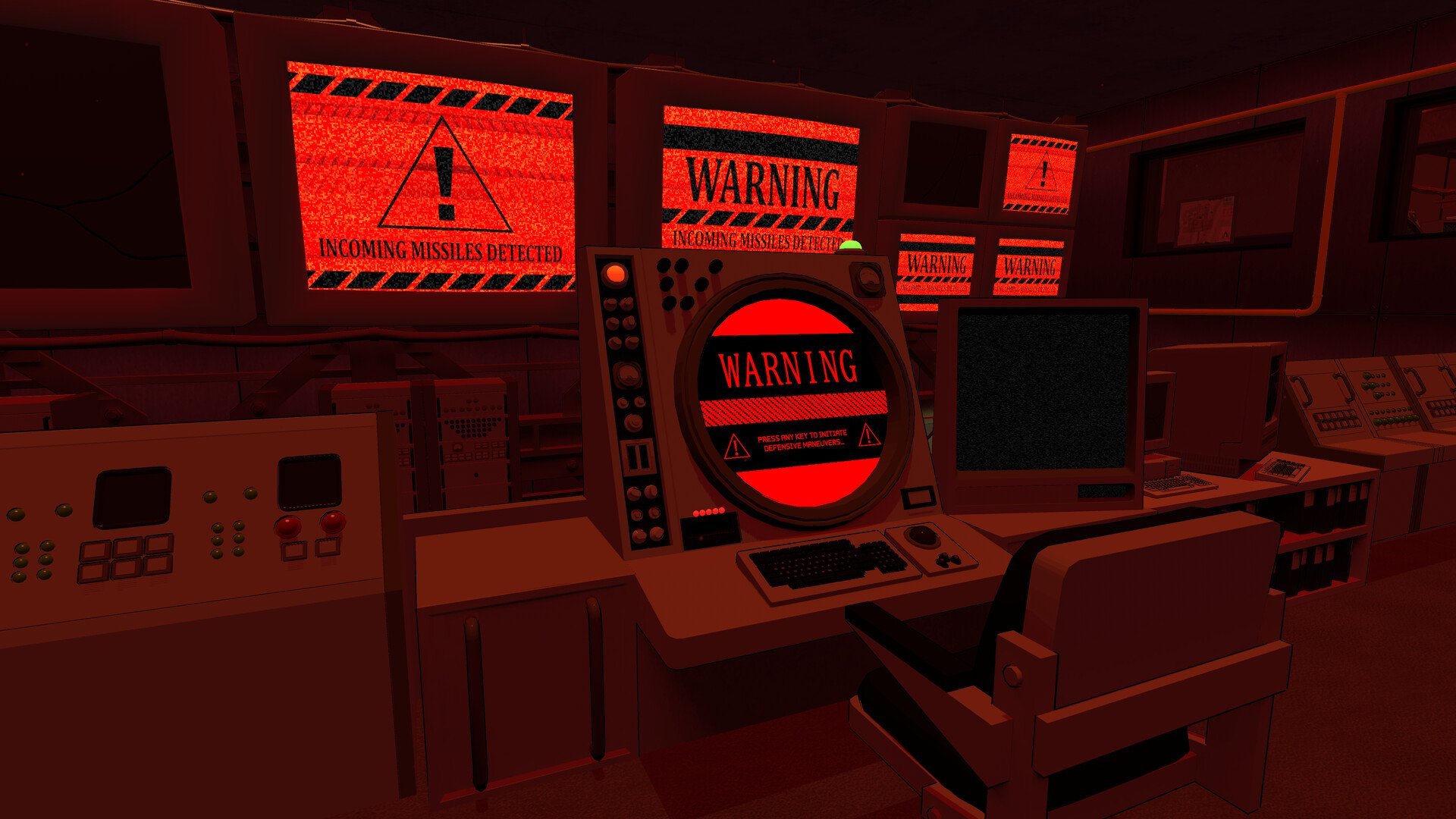
Unfortunately, shortly after Skye restores power to the bunker, an alarm goes off. The entry hatch seals shut and the computer systems turn on, indicating an attack is about to occur. Skye takes hold of the computer and deters the attack, much to her friends’ amazement. However, now stuck underground, and with all communication seemingly cut off, the group wonders whether the attack was real, and what the state of the outside world may have become.
Delta takes place over the course of a week; each day’s chapter has you explore more of the bunker and talk with your friends. These dialogue trees have an impact on your relationships, with Skye able to “max out” friendship levels with Victor, Marta, and Adel depending on how you respond to (or ignore) them. The trust Skye garners from her friends plays out more in the cinematic and narrative results of the final day than actually affecting the gameplay route, but it’s nevertheless an immersive angle, making the experience feel less lonely and bringing into focus the stakes at hand. As the days progress, without giving too much away, it turns out the bunker extends far deeper than the initial area you encounter, and more characters join the cast along the way.
Most days follow the pattern of exploring the bunker for new clues or areas before having to once again combat an enemy missile attack via the computer terminals. You may need to achieve goals such as finding a hidden generator handle in order to activate the power, balancing the flow of energy via binary switches. Other challenges have you acquiring new equipment, like a screwdriver or rope, to navigate the bunker's degraded and oblique infrastructure.
Each day takes place in a relatively self-contained section of the bunker, and with a journal listing your objectives, it’s never hard to figure out what needs to be accomplished. I did find myself wandering aimlessly from time to time, but after rummaging through drawers and cupboards or speaking to Skye’s friends, progress came easily enough.
The variety of puzzles presented throughout the nearly ten-hour campaign are enough to hold your attention, and unravelling the secrets of the bunker is highly rewarding. But while the escape room-style challenges of Delta are fun, most experienced adventure gamers will likely find them elementary. Several puzzles had me momentarily scratching my head, including a door lock code related to clues found elsewhere, and a circuit breaker consisting of several turnable knobs, but none of them are so difficult that they halted my progress for long.
There is an inventory tab, but items are used automatically when interacting with the appropriate hotspot in the environment. The game doesn’t clearly say when an item is used, however, which threw me for a loop when expecting a set of drawers to open with a newly acquired key, only to realize that I’d already opened them without any notice or fanfare.
Missile Command Delta
| Genre: | Mystery, Thriller |
|---|---|
| Presentation: | Realtime 3D |
| Perspective: | First-Person |
| Gameplay: | Simulation, Exploration, Minigames |
| Control: | Direct Control |
| Game Length: | Medium (5-10 hours) |
| Difficulty: | Medium |
| Graphic Style: | Simulated realism |
| Theme: | War |
Bonus material related to the story, like notes left behind by the bunker’s former inhabitants, can also be found in your travels, along with punch cards for different missile systems. Much of it is optional, but the branching story segments add some potential replay value. You are forced to make a choice on the fifth day that affects the game’s outcome – at least slightly. Delta utilizes a manual save system with three slots, so theoretically you could save right before the big decision and then reload from there if you wanted to make a different one. However, you’d have to know it was coming (which I did not). And even that wouldn’t take into account the smaller decisions made along the way, so to really reshape the story differently, you’d be better off starting the game over from the start.
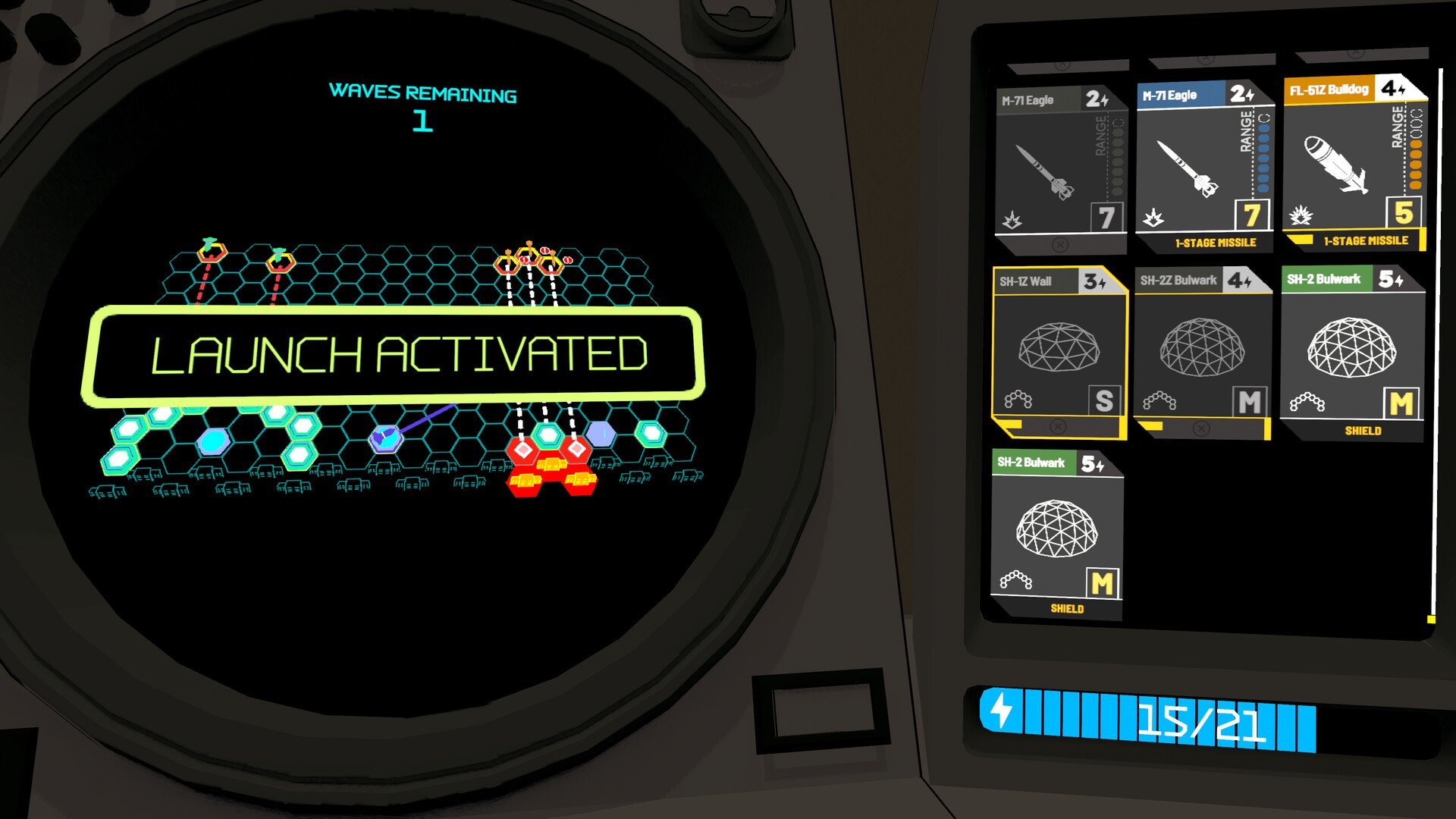
Though the majority of your playtime will be spent exploring and solving puzzles in the bunker or chatting with NPCs, the main crux of Delta is its missile command system. The war games scenarios play out on computer terminals displaying a hexagonal grid on the left side and your defense options on the right. The grid typically has the cities laid at the bottom of the screen, interspersed with the player’s turrets – just like the original. However, this is not an arcade game. Rather, it is a turn-based strategy game that plays out like a puzzle, sort of like Battleship meets chess, but with cards.
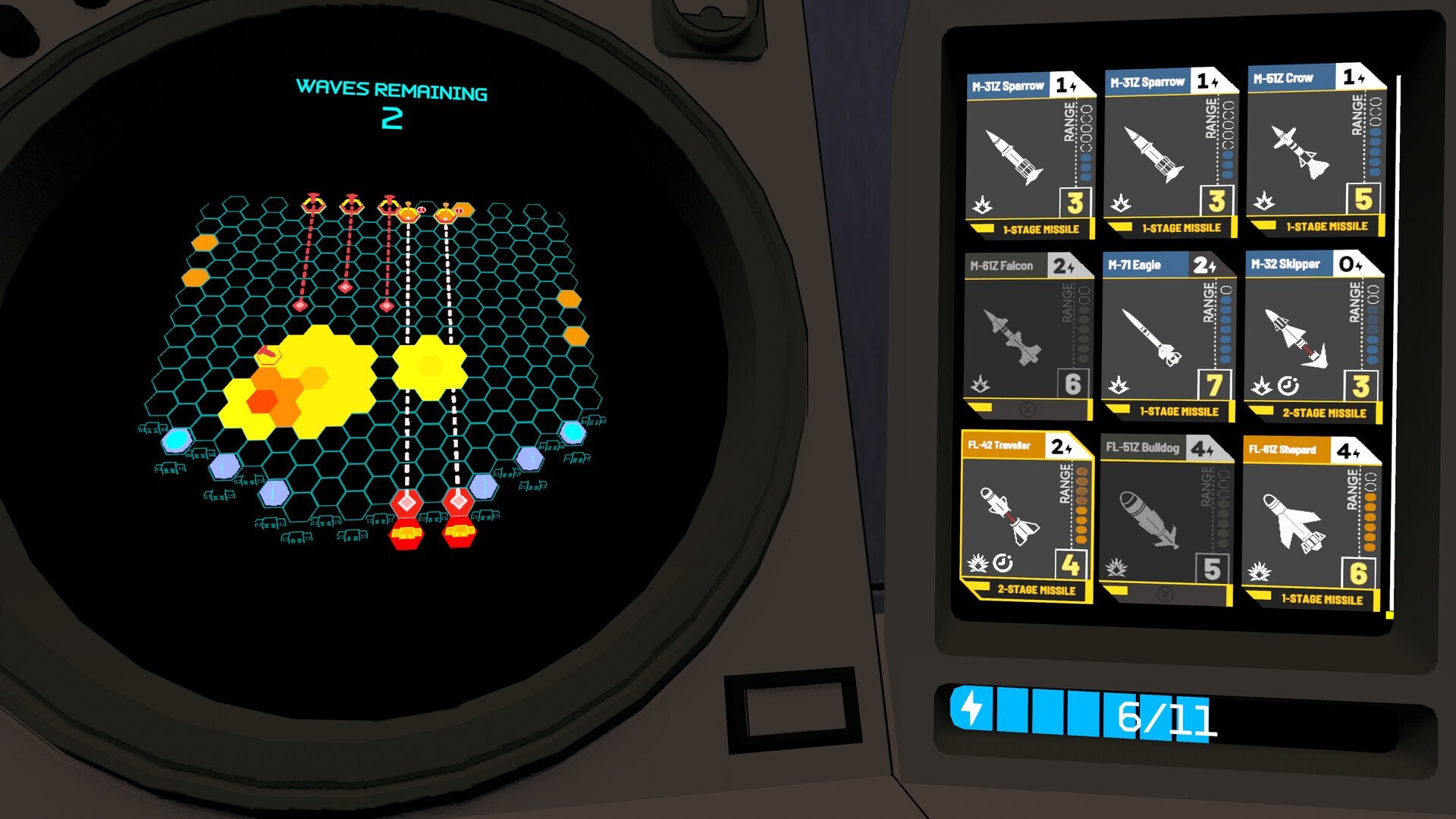
Your arsenal consists of cards representing missiles and other defensive weapons. Each card shows the associated range and explosive radius, along with how many resource units it uses. The computer displays the enemy missiles’ travel direction (where they are aimed and how many waves [turns] before they hit) along with how many additional waves of missiles are coming. Your goal is to launch your missiles in the direction of the enemy attack, either hitting their incoming missiles directly or catching them in the explosion radius, eliminating them from the board.
The game plays out in turns, with your missiles moving before the enemy’s, allowing you to plan your defense sequences accordingly. Unlike in the arcade original, taking damage is not an option here. All settlements must be defended. Losing one city to a missile strike results in a game over, and you are booted back to right before the attack started (thanks to Delta’s generous checkpoint system).
While the first few days are basic missile versus missile scenarios, later on more explosive warheads that have a longer lasting effect are introduced, their explosion radius staying on the grid for multiple turns. Defensive lasers and turret shields also come into play, needed to combat the enemy’s more advanced missiles, which are unaffected by the first generation of defenses you’re provided.
All these attacks require training, so each day you’ll visit training terminals throughout the bunker. These are much like in the prologue chapter, introducing you to different enemy missile types and new defensive weapons. There are typically three training terminals introduced per day, and they must all be completed before the story moves forward. If you lose a scenario at a training terminal, Skye simply stands up, but you are free to sit back down and try again as many times as you like.
These terminals challenge you to use as few resources as possible in defending against enemy attacks. Completing a terminal within or below the allotted resource limit results in you “acing” your training. You have the option to use supplementary resources in the form of cards you either find around the bunker or earn from completing other terminals. The more cards you have to choose from, the easier it is to ace these terminals, though that’s not to say they’re ever easy. You need only successfully complete a terminal in order to move on, but to ace them takes a considerable amount of study and experimentation. Typically these training terminals are harder than the actual attack they are preparing you for. In my playthrough, I only aced a handful of the practice terminals.
The actual missile attack scenarios occur either at the start or end of the day and have no resource limits (aside from the pool of cards you are allotted), and may even have resupply sections, giving you more cards if you survive past a certain wave. The first few days of enemy attacks are fairly easy to repel, but learning all of the different missile types and how/when to use them on the board is overwhelming at first. However, the game does a great job of easing you into its system, and before long I was able to work out strategies and think several turns ahead. The final challenge of the game absolutely pushes you to the limit, though, as you have to manage multiple screens at once with a heavy barrage of enemy fire, representing a considerable spike in difficulty.
I played Delta on the PlayStation 5 and controls in the missile command game are simple, with one button used to select a weapon from your arsenal before you are given the choice of where to place and aim it on the board, ending your turn. Controlling Skye in the bunker is easy as well. She can walk, run, and crouch in free-roaming 3D, with the interact button used for just about everything from opening doors and drawers to talking to another character, sitting down at a command terminal, and using items from your inventory. At one point you’ll obtain a flashlight that can be toggled on and off with the press of a button. I did find the default camera sensitivity assigned to the right analog stick a bit much when I first started playing, but this can be adjusted in the menu.
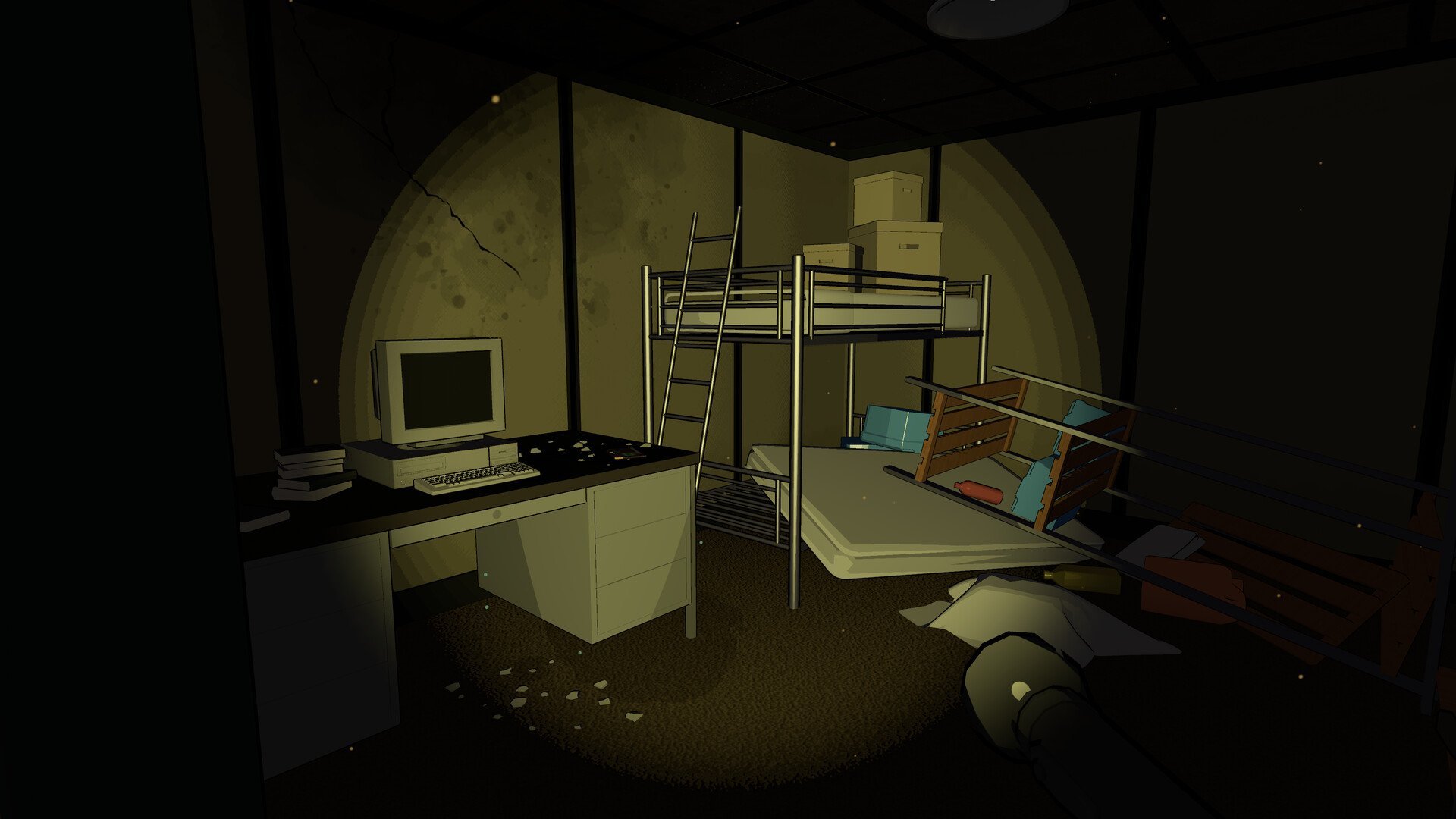
The main bunker area is designed using cel-shaded visuals. Though they convey the dark, dank nature of the bunker well, it’s never so dark that it's frightening. The neon vector graphics of the computer terminals contrast nicely against the grey concrete and wood panel decor of the bunker, making it feel like a genuine artefact of the past with its chunky retro tech and heavy industrial look. The lighting effects with Skye’s flashlight work fine, though they do tend to highlight the game’s simple visual style. Characters too are blocky, low-poly models, and while they look and animate okay with their limited repertoire of movements in conversation, they simply stand still, at attention, when not being interacted with.
There is no voice acting in the game, but the “blip” sound that accompanies the text in the dialogue boxes acts as a substitute, and the overall audio effects are well implemented. The missile command scenarios utilize appropriate explosion sounds when missiles hit. (Basic MIDI effects might have been more technically accurate for the computer systems in question, but undoubtedly less impactful.) The quiet eeriness of the bunker as you descend one of its metal staircases, or the blaring alarm signalling an incoming attack, are suitably suspenseful. Music, though subtle, typically accompanies gameplay, with harsh drum beats scoring the action of a missile defense scenario, and quieter, haunting tracks playing as you explore.
Final Verdict
Missile Command Delta smartly weaves a coming-of-age drama with the frightening prospect of a Cold War suddenly turned hot, pulling a group of naive kids into a terrifying scenario. The ending is great, and whether you’re someone who lived through the Cold War or not, its message is sure to land. The exploration and puzzle elements are simple yet engrossing and fun, but the real challenge lies in the missile command game proper. You’ll certainly need to enjoy these sorts of deck-building strategy games in order to appreciate this one, and even for those who do, the final challenge is a sharp increase – maybe a bit too much so. Still, overall this is a thoughtful combination and reworking of genres, both mechanically and thematically, showing there’s a lot of potential in this niche approach to war gaming.
Hot take
Missile Command Delta is a successful reinvention of the arcade classic, resurrecting the fears of a Cold War turned hot for a new generation. Its turn-based deck building system has the depth strategy enthusiasts will demand, while the exploratory adventure segments, though not overly challenging, tie the scenario together in an immersive and memorable manner.
Pros
- Thematically interesting perspective of teenagers engaged in missile attacks
- Good balance of dialogue, puzzles, and strategy gameplay
- Branching narrative and board game-esque design allow for replayability
- Simple cel-shaded visuals create an immersive retro-tech infrastructure
Cons
- Difference in difficulty between adventure segments and missile command can be steep
- Character models and animations could use more work
Drew played his own copy of Missile Command Delta on PlayStation 5.

- Advertisement
- Help support AGH by advertising with us






0 Comments
Want to join the discussion? Leave a comment as guest, sign in or register in our forums.
Leave a comment