
MOLE review

- 0 Comments
Unnerving personal narrative ensures this descent to the depths of the earth is never boring
In June 1989, a world record was achieved in the Kola Peninsula, located in northwestern Russia. A scientific drilling into the earth’s crust produced the deepest man-made hole ever dug, reaching a depth of about 12,200 meters. The culmination of almost twenty years of work, it was intended for a series of thermal, seismic, geophysical and geological observations and experiments. Deep as it was, though, it still failed to reach its intended final depth of about 15,000 meters due to rising costs and equipment breakdown.
As the protagonist of MOLE, a psychological horror game by Off Black Creations, you only have to descend about three-quarters of that distance. Still, that is very, very deep underground in a giant, rickety crew-piloted drill. What could possibly go wrong? Over the course of about 3 to 5 hours of gameplay, the answer comes as expected: everything. But as you venture deeper underground, it becomes clear that this is not just a physical journey but an emotional one as well. As the game unfolds within its confined environment, its real strength lies not in conventional horror but in the bleak and relatable human story beneath it.
MOLE takes place in a 1980s Soviet-style world where a mysterious catastrophe known as the “Matryoshka Incident” has made life on the planet’s surface increasingly unpleasant. This event is never fully expanded upon, but a mysterious subterranean signal referred to as the “White Rabbit” with a frequency close to human brainwaves begins causing hallucinations and madness wherever it reaches. Affected people hear the voices of departed loved ones instructing them, simply, to “dig.” To find out what caused it and discover the signal’s origins, the Strata mining company sends a four-man crew aboard an enormous drilling vessel, nicknamed “The Mole,” on a journey nearly 8,700 meters beneath the surface – the second such expedition after the first ended in unexplained failure.
You play as Viktor Kaminsky, a 43-year-old single father. Being an ace “geonaut” (the underground equivalent of an astronaut), he accepts the job offer to pilot the Mole in order to cover his debts. But the expedition soon becomes a much more personal journey for him. Viktor is still dealing with the death of his young son, Petro, and before long his memories and grief begin to affect his perception of reality. In trying desperately to locate the signal, Viktor becomes convinced that the “white rabbit” can bring his son back to life, and he will not let anything, or anyone, stand in his way. Unfortunately, the deeper he goes, the harder it becomes to differentiate between what is really happening aboard the Mole and what is only imagined inside Viktor’s head.
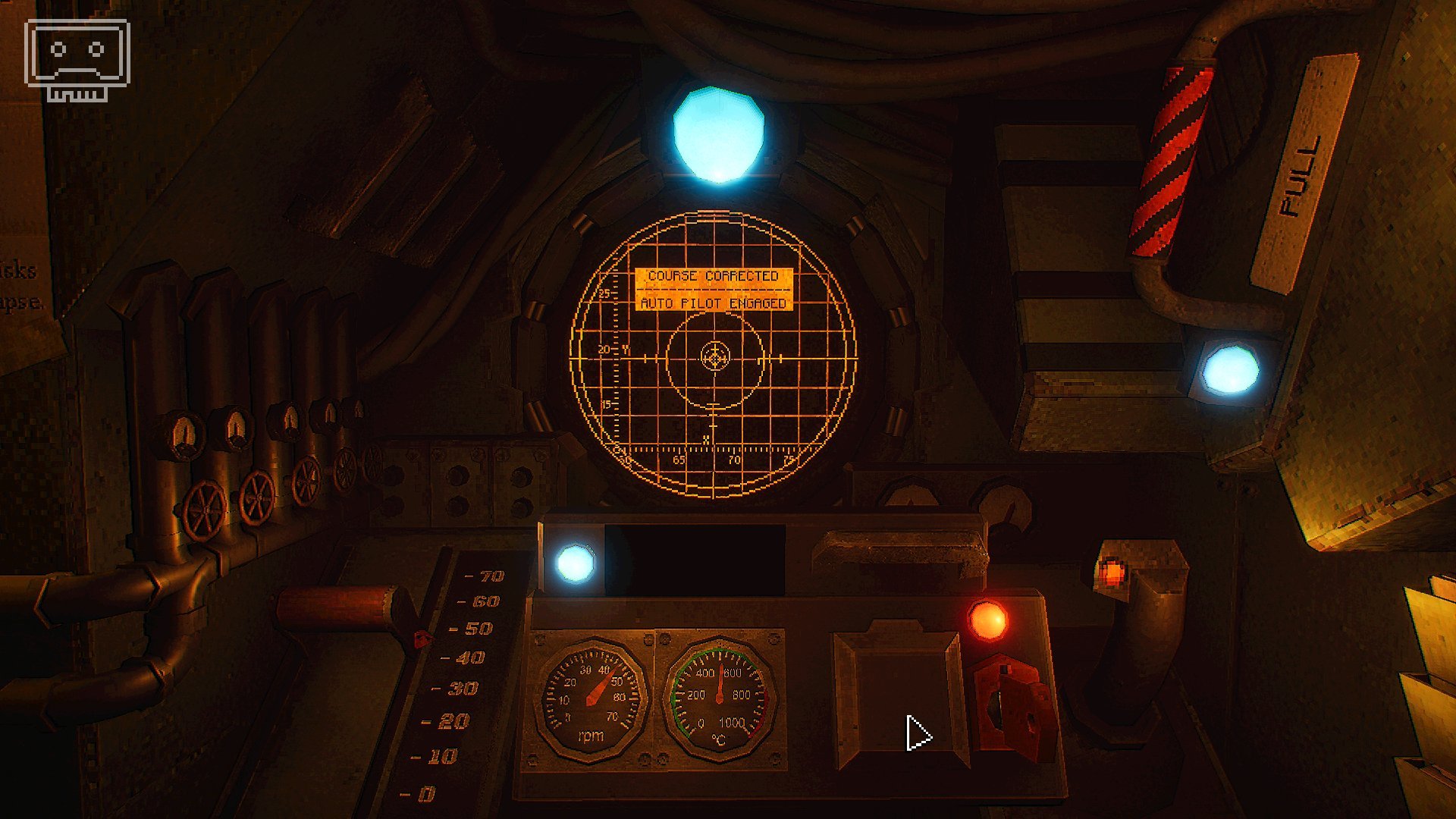
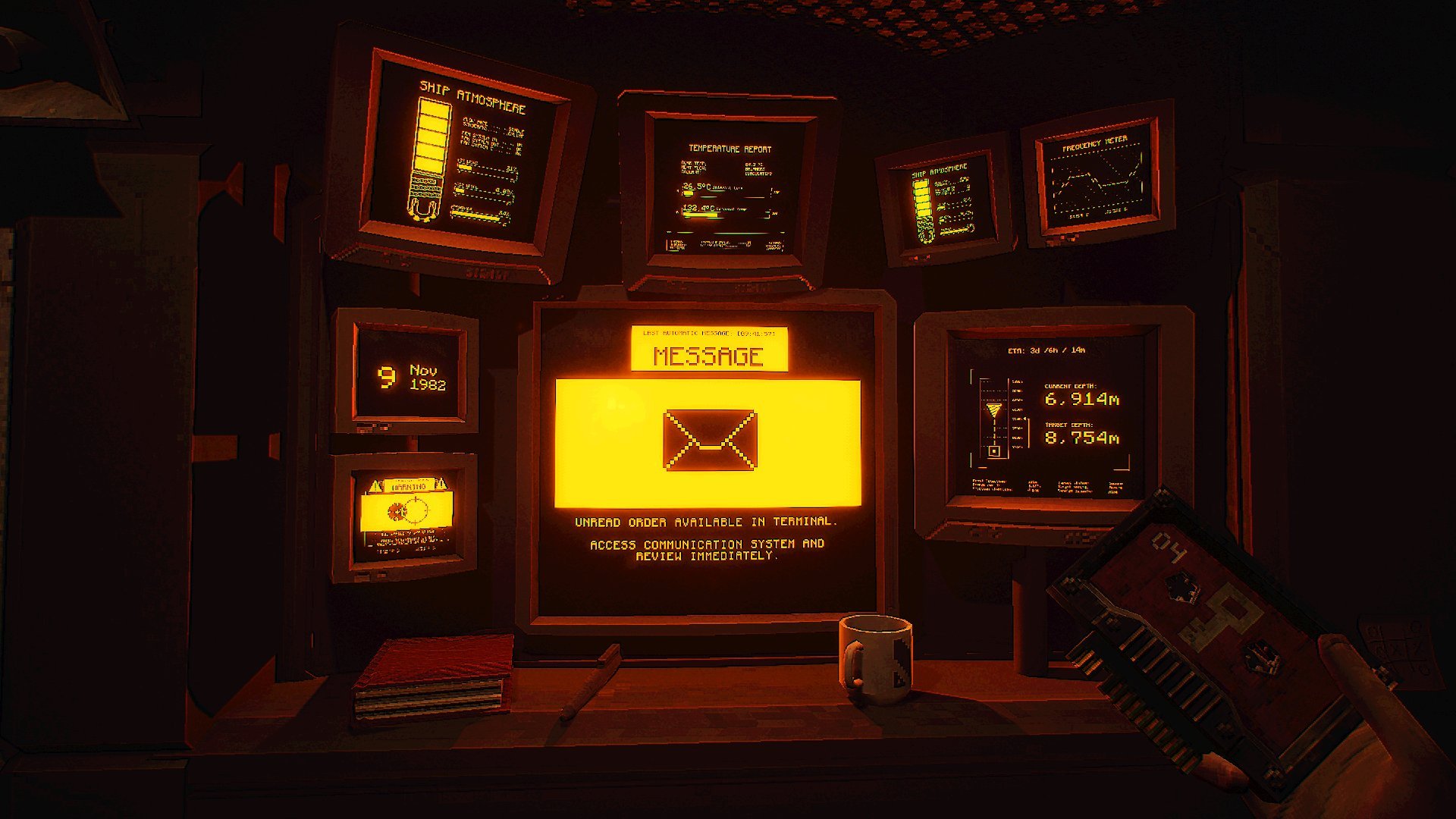
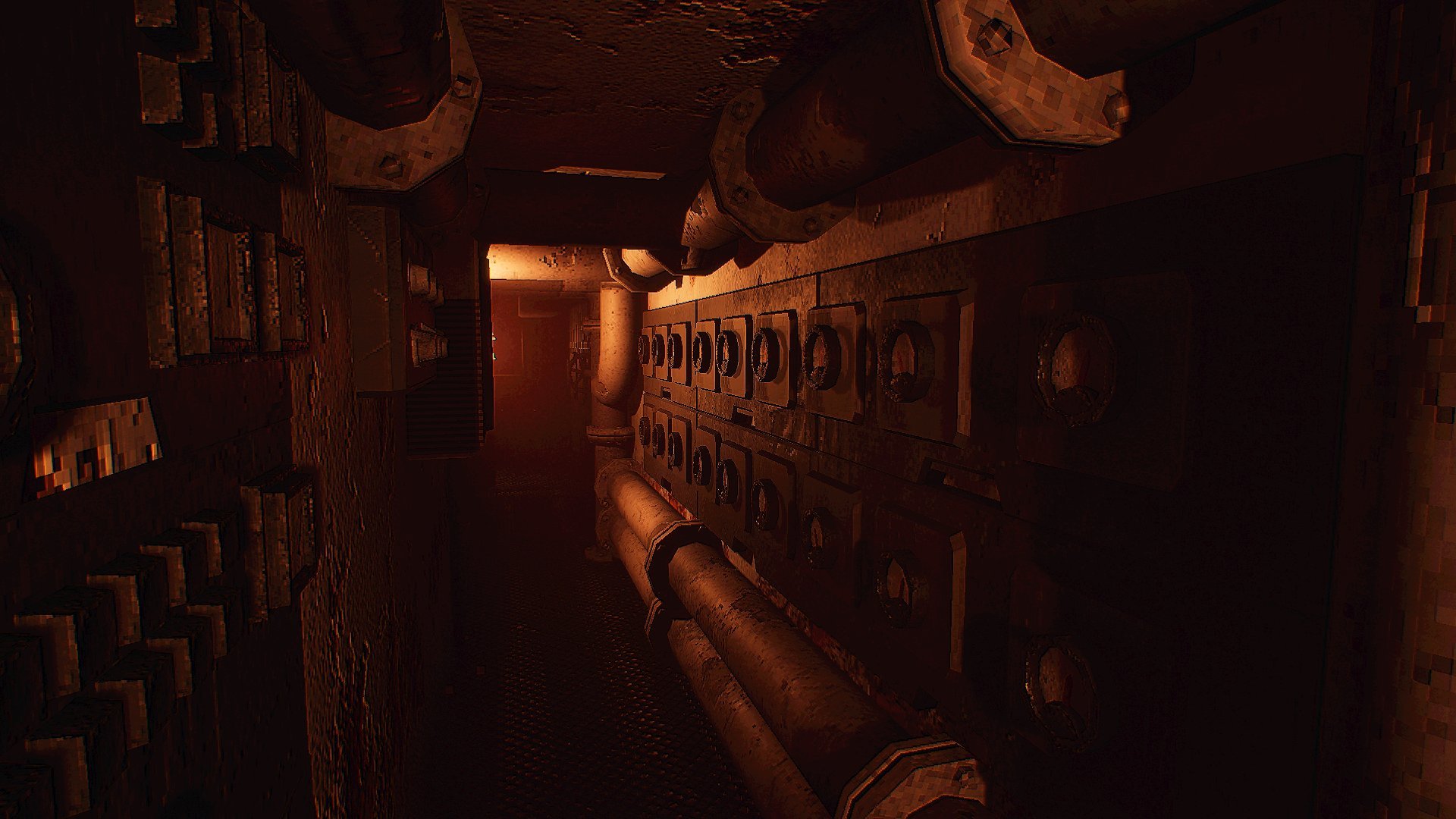
MOLE’s lo-fi 3D graphics feature a retro-futurist 1980s aesthetic based on contemporary industrial design of the time. Most of the strictly functional environments are dimly lit and tinted reddish to sepia-toned, full of exposed pipes, metal corridors, heavy security doors, chunky machinery and utilitarian control panels. The technology inside the vessel is purely analogue, with yellowish-orange text on CRT monitors, pixelated command screens and user interfaces, manual controls and old-fashioned switches and buttons. Nothing looks particularly sleek or modern. Instead, everything feels old, bulky and slightly unreliable, as if it was built decades earlier and has been kept running through sheer determination. It all adds up to the unnerving feeling that this machine is on the verge of becoming obsolete, or most probably has already passed that point.
Special mention goes to the cassettes, one of the staples of 80s technology. They are used throughout the game for navigation, access control, data logging, and mission updates. These tapes are the medium through which you interact with the Mole’s systems. For example, one of the main tasks is adjusting the drill’s coordinates through a series of steps. First, seismic and radar readings are recorded onto a cassette at one terminal. The data is then transferred between consoles across the cockpit before finally being inserted into the navigation computer, which interprets the readings and allows you to set the course. One cassette serves as your security tag, enabling access to certain rooms, and you cannot exit your own without it. This time-consuming technology becomes both an obstacle in later stages of the game, and a challenge during timed emergency sequences. Cassettes even extend to the main menu as well, which requires you to select one and insert it into a simulated old PC terminal simply to start or load the game or access its options.
The story starts out with you waking from a dream sequence to the sound of chirpy 80s music. In the near-total darkness, a blurry red light is visible. As you turn off the alarm clock and flick the light switch on, you’ll experience one of the game’s more noticeable features: claustrophobia. Your room is nothing more than a windowless, tiny metal cabin. Even after you exit through its heavy safety door, you find yourself in one of the many cramped, narrow corridors you’ll be navigating throughout most of the game. You cannot lose your way, at least, since there are maps and guiding signs everywhere, including on individual doors.
Played from a first-person, free-roaming 3D perspective, MOLE’s movement is controlled by gamepad or a keyboard. The latter utilises the standard WASD scheme and the mouse for panning the camera and performing interactions such as pulling levers, entering coordinates or operating phones, terminals and other instruments.
The narrative takes places over four days. Each of them begins with the same routine: wake up, get updates from HQ, then proceed to navigate the vessel according to the most recent geological conditions like soil temperature, density and location of magma pockets. These are simple recurring tasks that on one hand make for repetitive tasks and puzzles. On the other hand, they perfectly convey the sense of the grinding routine of operating an underground drilling machine.
The soundscape adds to the workmanlike feeling. Most of the time it consists only of an abstract layer of low electrical hums, wheezing compressed air, and remote operating machinery, with occasional sounds of jolts and vibrations from the Mole’s constant movement. Music is present mainly during Viktor’s dreams and memories, during which it is emotional and evocative. For instance, there is a sequence in which Viktor is following a white rabbit through a hole, then crawls through underground rock tunnels only to find himself struggling to keep from drowning before ending up on the floor of a partially flooded chapel. The score, which is at first dreamy and mysterious, gradually changes tone to convey the appropriate level of dread before finally transitioning to church organ music to perfectly fit the location. One of the things I liked about this sequence is the fact that the music changed so much but I didn’t notice it at first because it blended so well with the visuals.
In addition to Viktor, there are three other crew members aboard the Mole who were hesitant about Viktor joining due to his fragile mental state. As Viktor becomes obsessed with the signal, mission administrator Stepan Adamenko grows concerned that he is becoming unstable and violent. Geologist Yosep Hrytsenko, who discovered a way to stabilize the signal with certain crystals, becomes increasingly worried about the entire crew’s worsening condition due to their exposure to the signal, but especially Viktor’s obsession with it. Finally, Engineer Bohdan Pluzhnik is tasked with maintaining and repairing the vessel, making sure its mechanical systems, equipment, and life-support systems continue working during the descent.
MOLE

| Genre: | Horror |
|---|---|
| Presentation: | Realtime 3D |
| Theme: | Psychological, Repair |
| Perspective: | First-Person |
| Gameplay: | Environmental puzzler, Simulation, Survival |
| Control: | Direct Control |
| Game Length: | Short (1-5 hours) |
| Difficulty: | Medium |
| Graphic Style: | Lo-fi |
The language spoken throughout the game seemed vaguely Slavic to me – maybe Polish or Russian – but it didn’t really sound like anything I recognized. There’s a reason for that, as according to the developers the language was invented especially for MOLE. This is in keeping with the game’s claim not to represent any specific country. The “language” menu does not change the spoken dialogue, but enables a change of subtitles.
Apart from PA systems coldly blaring messages such as: “Engine failure detected. Immediate repair is required” or “No valid waypoints. Acquire new coordinates from the laboratory,” there is relatively little voice acting anyway, but what is present is consistently good and relatable. Most of the dialogue comes through phone conversations between Viktor and Adamenko, whose performances convey concern, caution, and growing unease as the situation aboard the vessel deteriorates. Although the limited amount of talking among the crew means the voice acting rarely takes center stage, it does add emotional depth to the characters when necessary.
The puzzles are an integral part of the experience. There isn’t a single one added simply for its own sake, instead feeling as if they all stem naturally from the story, even from the character of the drill vessel itself. They are mainly mechanical, like operating navigation controls, running a geological survey system to determine the best course for the vessel, manipulating a crystal to reveal the frequency a radio should be set to, discharging an underground torpedo, or simply replacing burnt fuses in a fuse box. They all add up to one mission: keep the Mole operational and continue your journey deeper underground. The solution to many of them lies in careful observation of your surroundings. The answers are all in there with you, whether in the form of charts, daily memos, or phone calls from your colleagues.
There are some quick time events as well. These appear later in the game, so by then you will already be familiar with the locations and know where you can find anything you need. That’s a good thing, as the QTEs include escaping a demon who is (hopefully) a figment of Viktor’s sub-conscious, and trying to save his son from a burning building.
As you can imagine, MOLE tackles some heavy subject matter, most of it woven into Viktor’s past: the immeasurable grief of a parent following the death of a child, and coping with the ensuing depression, emptiness, and feelings of personal guilt. The story also touches on issues of faith, suicide, mental health, and, ultimately, the question of corporate loyalty and the responsibility companies have towards their workers. This issue emerges when Viktor learns about the gap between the promises Strata made just to get him to do the company’s dirty work, and the grim reality of what they actually intend to deliver.

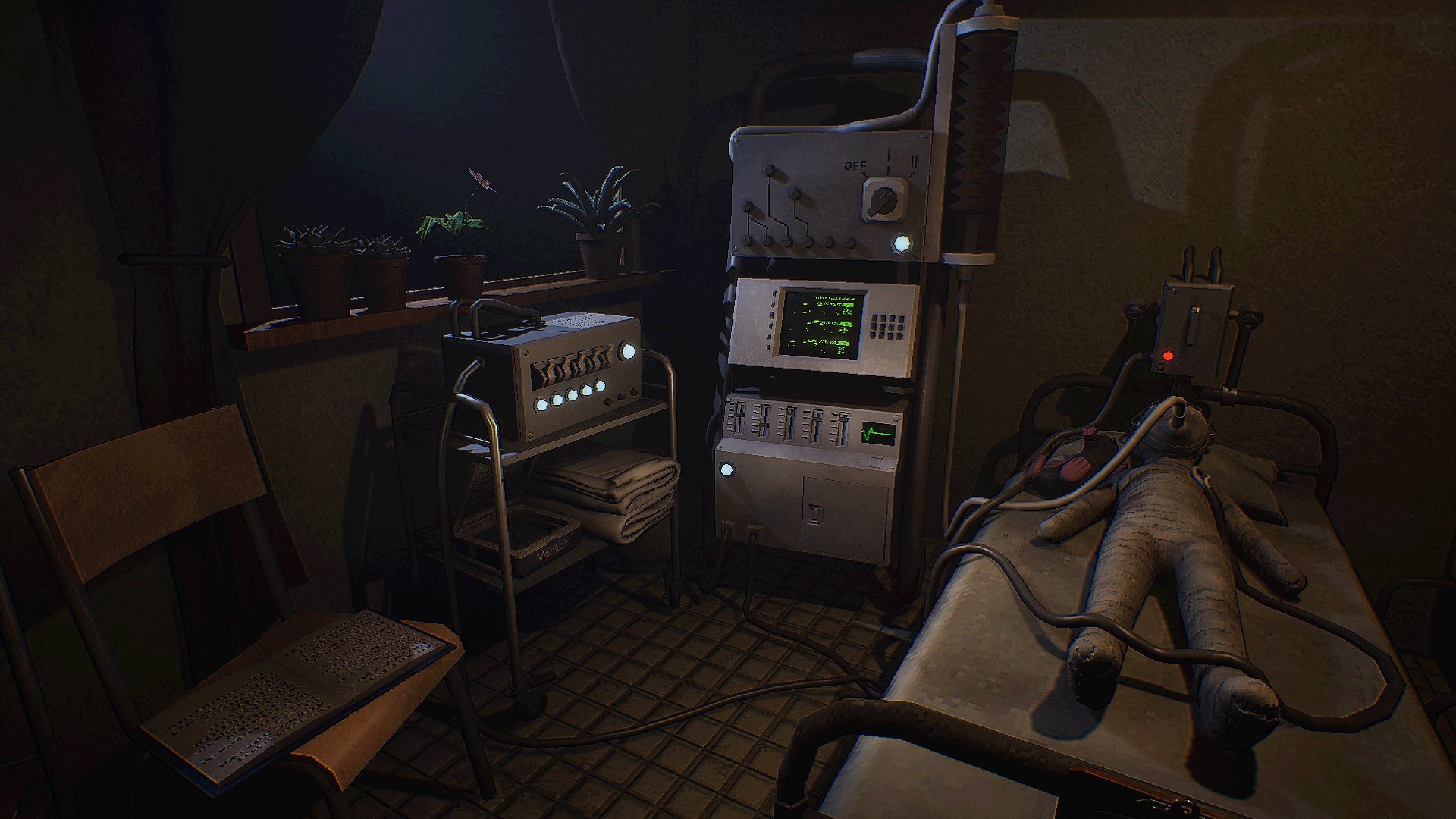
The line between the real and the surreal is crossed back and forth several times, in such a way that no matter which side you’re on at any given point, events flows naturally as if there is no real difference between them. Some of Viktor’s memories are also integrated. For example, he receives a phone call that transforms into his memory of the call to the hospital where he learned about his son’s critical condition. It is a cold, bureaucratic, mechanical conversation with an automated service that is more interested in the required payments than in the persons involved. Once this conversation is finished, you find yourself back in the cramped Mole office.
Another instance is when Viktor exits the navigation room, presses a button and an elevator door opens, leading him to the same hospital where his son is struggling to breathe through heavy bandages. Elsewhere there are rows of daisies marking your way to the engine or torpedo room. They appear suddenly and seem real, only to have disappeared later when you return to the same location. There are also cryptic messages that appear on the Mole’s computer screens, such as “bring us together,” “it waits,” and “no one is coming.”
Although MOLE is very much a horror game, its horror is more psychological and atmospheric than based on constant jump scares or killer monsters. It is the severe confinement and growing mistrust of each other that creates much of the tension between the crew. And indeed, before long it becomes clear that no one is safe. The game slowly gets more disturbing as you descend deeper underground, with unsettling details like the near-constant shaking dials in the corridors. Such tangible fears are compounded by scary psychotic episodes that may or may not be real, though the danger certainly is, returning you to the nearest automatic checkpoint if you meet an untimely demise.
A lot of the horror comes from Viktor himself. His memories, guilt, grief, and worsening mental state become part of what you experience underground, making it hard to be sure what is really happening or is only in his mind. Either way, as you venture deeper, the vessel grows more claustrophobic and unnatural while the supernatural events and Viktor’s personal trauma become more connected. The fates of Viktor’s crewmates form another part of the mystery, but instead of investigating directly, you’ll learn what happened through recordings, documents, and clues around the vessel. There is only one ending, but it is a clever and surprising one. I won’t spoil it, but suffice it to say that it neatly ties together the story of the signal, Viktor’s personal narrative and the fate of the missing vessel.
Final Verdict
MOLE is a gripping psychological horror experience that proves you don’t need constant action or cheap jump scares to create genuine tension. Its uncomfortably confined setting, mechanics, eerie sound design, and trauma-driven narrative work together to create a game that is both distinctive and memorable. The retro visual style adds plenty of character, while the game’s willingness to let you figure things out for yourself makes every malfunction and discovery feel rewarding. Some routine puzzles can become repetitive, and certain horror elements lean on familiar genre clichés. Thankfully, it delivers where it matters most: atmosphere, immersion, and storytelling. It’s not a flawless game, but keep digging and you’ll find a confident and creative one.
Hot take
As a journey to the innermost strata of both the earth and a troubled soul, MOLE is a surprisingly personal, densely packed and effective horror experience.
Pros
- Unique setting inside an underground drilling vessel
- Puzzles are logical and emerge naturally from the environment
- Claustrophobic atmosphere and fitting soundtrack create an immersive, emotional experience
- Unravels a complex, sometimes painful, human drama
Cons
- Some work-based puzzles are repetitive by nature
- Operating retro computer systems can be a bit tedious, especially during QTEs
- Entire vessel is a cramped maze
Eran played MOLE on PC using a review code provided by the game's publisher.

- Advertisement
- Help support AGH by advertising with us








0 Comments
Want to join the discussion? Leave a comment as guest, sign in or register in our forums.
Leave a comment