
Crushed In Time review
- 0 Comments

Pulls as much creative puzzling goodness as it can from a gameplay mechanic that isn't entirely flexible
It’s a daunting prospect to follow up a masterpiece. Draw Me A Pixel struck gold in 2020 with There Is No Game: Wrong Dimension, a deliriously inventive satire of the adventure genre, the development cycle, and videogaming itself, built around the conceit that it absolutely didn’t want you to play it. Its mix of keen metatextual puzzling, hilarious gag-a-minute writing, and kitchen-sink approach to design led it to be hailed as an instant modern classic. Naturally, questions soon followed about what was next for the French studio, but it would be five years before any hint materialized.
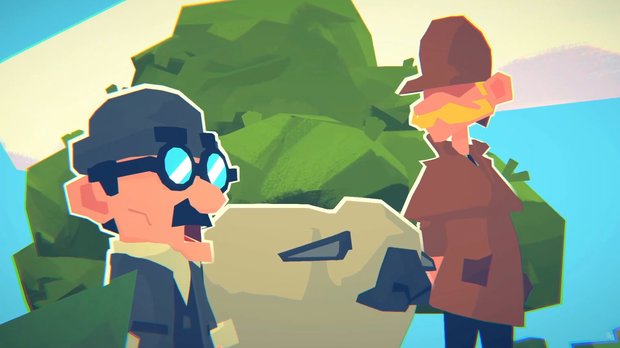
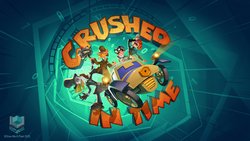
The answer finally arrived with the announcement of Crushed In Time, a spin-off adventure centered on none other than Sherlock Holmes and Dr. Watson, two of Wrong Dimension’s most memorable characters. That game saw the famed duo forced to come to terms with the fact that they were not, in fact, real people, but fictional characters in an incomplete video game. Crushed In Time follows them on their very own adventure to solve the mystery of what went wrong in their development, and to correct it if they can.
The real mystery, of course, was whether the follow-up could live up to its beloved predecessor, and the solution, it turns out, is more complicated than a simple yes or no. Crushed In Time is endlessly charming, gorgeous to look at, and buzzing with the kind of barely restrained creative energy one would expect from lead developer Pascal Cammisotto. The voice cast is wonderful, the score is rousing and cinematic, and the laughs are many and frequent. Where it stumbles is in the integration of its central gameplay mechanic, which is meant (and sometimes manages) to allow for new and inventive approaches to puzzle solving. It’s surprisingly versatile and undoubtedly novel, but a complete mismatch for the material on hand, introducing tedium, repetition, and twitchy quick time events into what’s otherwise a lovely time.
Crushed In Time begins not so much by breaking the fourth wall as by smashing it and selling it for parts. We open in the halls of the Draw Me A Pixel headquarters, just as the company’s latest title starring Holmes and Watson is launching to the public. No sooner has the game hit the market, however, than the reports start rolling in about bizarre NPC behavior and a persistent bug that’s preventing players from getting anywhere. If someone can’t figure out what’s gone wrong, the review-bombing is sure to start any minute. That’s where you as the player come in, presumably representing some hyper-stressed QA worker. You’ll have to click the Holmes & Watson icon to launch the game and get to the bottom of what’s gone haywire.
Thus begins the game-within-the-game, which naturally opens at 221B Baker Street, as the great detective and his trusty sidekick are greeting the new day. The game’s afoot the moment the morning post arrives, as Dr. Watson receives a letter from a woman named Emma expressing a fervent desire to see him again—despite the fact that, so far as he can tell, he doesn’t know any such person. On top of that, the letter appears to defy the very laws of physics, floating upward to cling stubbornly to the ceiling and resisting attempts to bring it down. Holmes insists there’s a rational explanation, but the doctor immediately suspects something much stranger.
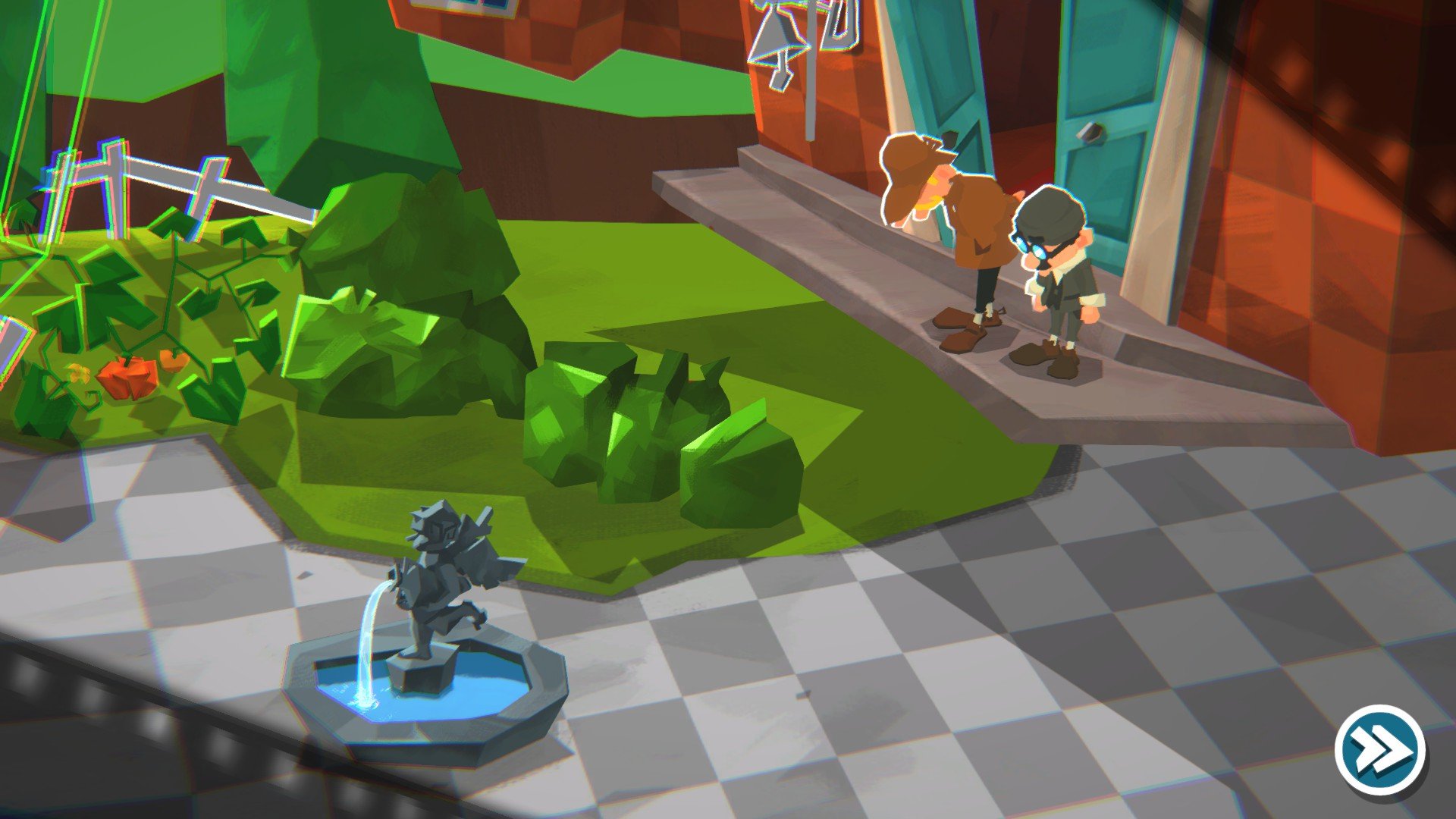
Visiting the return address from the envelope leads only to more questions. For one, there’s nobody named Emma in evidence; secondly, there’s something undeniably off about the manor’s sole apparent resident, who introduces himself as Mr. Emmett Placeholder. Before Holmes and Watson can conduct a thorough investigation, however, the mysterious Mr. Placeholder turns the tables, producing a strange device from his jacket, hopping into Holmes’s beloved motorcar (the Sherlock-o-Motive), and then vanishing in a flash of light with a final remark about traveling to “Alpha 1.0.”
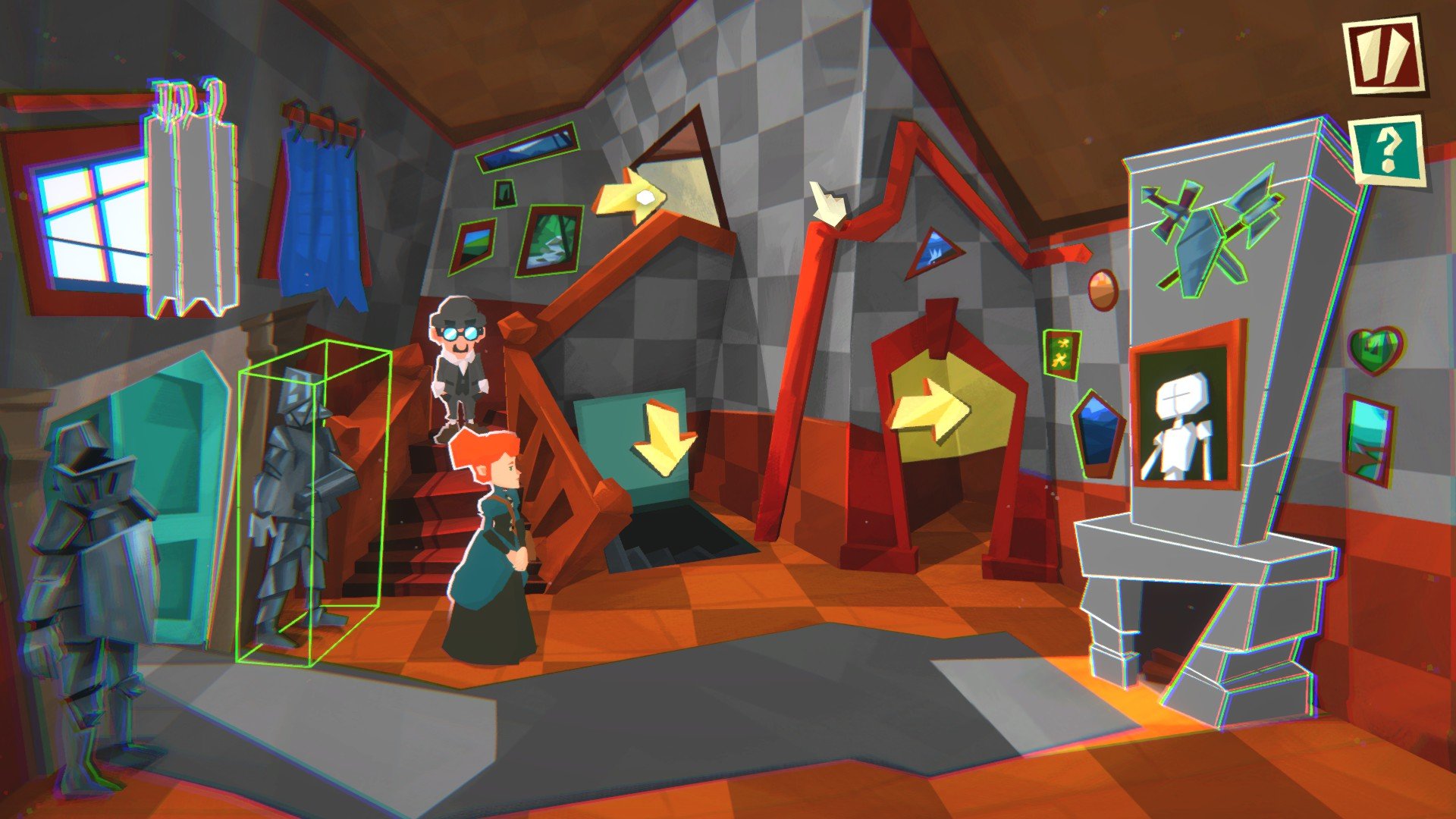
Holmes, of course, remains certain as ever that a mundane cause must exist for these apparent miracles. With Watson teetering precariously on the knife-edge of an existential crisis, the great detective searches the house for a way to follow Mr. Placeholder. His efforts finally lead the pair to Emma Files, the manor’s real owner and a capable woman of science, but an unfortunate side effect of Holmes’s nosing around is that all three are sent plunging haphazardly through what they assume are the corridors of time and space. Unbeknownst to them, all the alternate realities, strange dimensions, and seemingly unfinished worlds they’re about to navigate represent earlier versions of the software you’re trying to debug, which is all the world they’ve ever known.
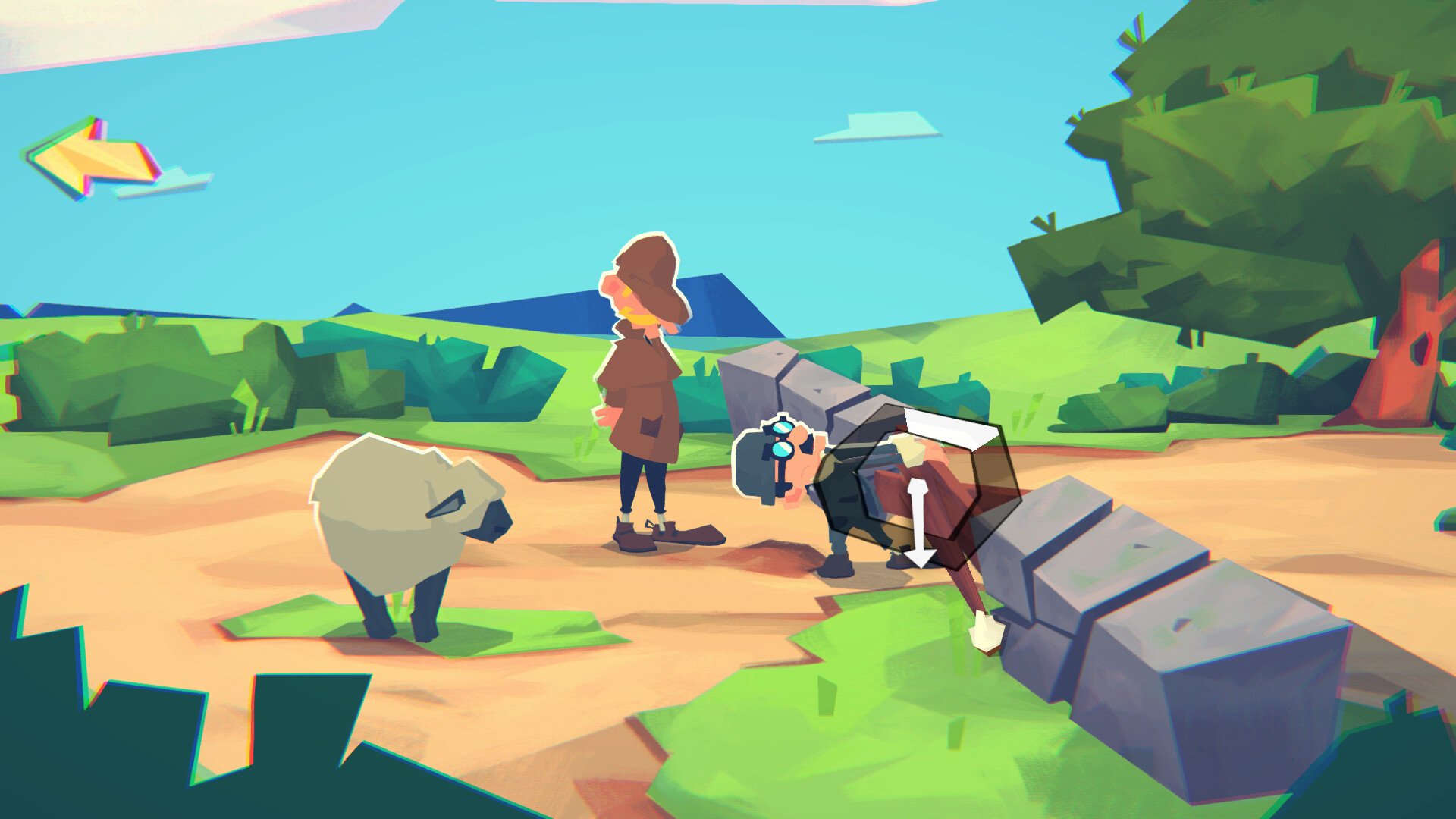
As the player, you don’t control any of the characters directly; rather, you’re an omniscient observer who can alter and interact with the game world in ways its inhabitants don’t seem to detect. It’s thus your job to poke, prod, and manipulate objects, landscapes, and characters to engineer your desired outcomes. You’ll do this entirely via a mechanic the developers have half-jokingly dubbed point-and-stretch. Instead of simply clicking and releasing a button to select a hotspot, as in a traditional adventure game, here you’ll click, hold, and pull your cursor in a given direction. This causes the object in question to stretch like elastic, snapping forcefully back in the other direction once you let go.
To its credit, Crushed In Time mines a surprising amount of variety from its single physics-based conceit. While most puzzles center on rearranging the environment to help Holmes, Watson, and Miss Files achieve some immediate goal, the way to do that is rarely obvious at first glance. “Pointing and stretching” turns out to encompass a much broader range of actions than you might think. Sometimes you’ll have to move small objects from one place to another, stretching them one way to send them flying in the other, for instance, or launching them upward from the floor so they land on a table. (When more precise aiming is needed, a dotted line appears to show the object’s trajectory.) You can tug on parts of the environment to change their position, as when you stretch a door outward to open it or pull on a windowshade to draw it aside. Shaking unsteady fixtures lets you knock them over, change the way they’re facing, or dislodge some loose element.
Since you can’t move the characters freely, you’ll have to use your stretchy power to persuade them to do it themselves. If you yank on someone’s face to give them a good smack, they’ll scurry off elsewhere to avoid whatever hit them. (The hyper-rational Holmes tends to accuse Watson of slapping him while he wasn’t looking, while the doctor is quick to suspect a ghost.) With no “Look at,” “Use,” or “Talk to” verbs, you’ll have to ensure the characters and their surroundings are positioned in such a way that they see what you want them to.
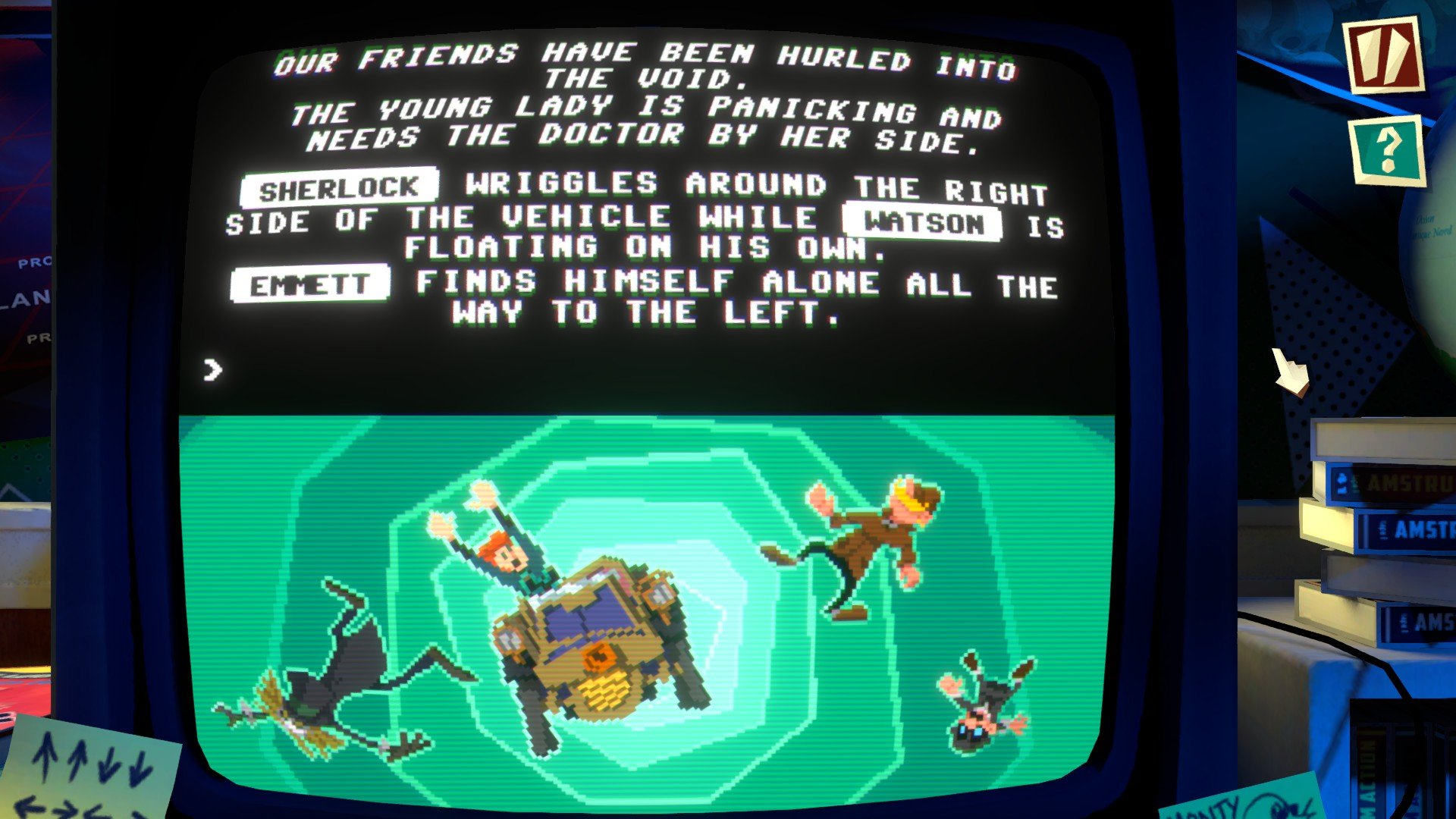
New and unexpected utilities continue to present themselves as the game goes on and you find yourself in different versions of Holmes & Watson. One sequence is set in a Commodore-era text adventure, with a block of narration describing the action alongside a static image reflecting what it says. Here you’ll have to pull words from out of the text and rearrange them in the ensuing blanks, altering the sentence’s meaning to change what’s happening in the picture. Another takes place in a Game & Watch-style handheld and sees you pulling a vehicle from side to side to avoid falling objects. Still more segments deploy the point-and-stretch mechanic to mimic rhythm games, platformers, mobile apps, and even turn-based RPG combat. There’s a hint system in case this all gets too overwhelming, which lets you request progressively more detailed nudges in the right direction (without ever being told the solution outright).
Crushed In Time
| Genre: | Comedy, Mystery, Science Fiction |
|---|---|
| Presentation: | 2D or 2.5D |
| Theme: | Adaptation |
| Perspective: | Third-Person |
| Gameplay: | Environmental puzzler, Quest |
| Control: | Point-and-click |
| Game Length: | Medium (5-10 hours) |
| Difficulty: | Medium |
| Graphic Style: | Cartoon |
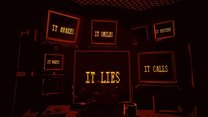
Numerous detours aside, you’ll spend most of your time in a “camera’s-eye” perspective mimicking the traditional third person, with clickable (and stretchable) hotspots scattered around the screen and exits marked with arrows (which, again, you’ll have to stretch to activate). The environments themselves are as varied as the stages of game development. In addition to the polished Victorian-era London and surroundings of the game’s “1.0” version, you’ll have to navigate different stages of the project’s life cycle, including a monochrome realm full of blocky temporary assets, a simulated animation program, and an ultra-high-res “remaster” representing the characters’ future.
No matter how unfinished a given area is meant to look, the art is all excellent. While the visuals in “1.0” are all 3D, they effectively capture the skewed cartoony aesthetic that Peter Chan and Larry Ahern brought to games like Day of the Tentacle and Sam & Max Hit the Road, translating it so smoothly that it might have been warped in from some alternate reality’s LucasArts of the early 2000s. If you’re disappointed by the move away from Wrong Dimension’s 2D pixel art, take my word that the point-and-stretch mechanic absolutely requires three dimensions to work—but also, this is gorgeous work in its own right.
Unsurprisingly for Draw Me A Pixel, the rest of the game is just as polished. Kurt Tomlinson’s sweeping orchestral soundtrack is remarkably diverse, switching gears at a moment’s notice to accommodate whatever new reality the characters find themselves in. At some points it evokes the bombast and pulse-pounding energy of a film score by John Williams or James Horner; at others, the precise-yet-subtle symphonic accompaniment that undergirded classic Warner Bros. cartoons. There’s also a standout rhythm sequence set to a ripping electronic track by the group she.
The voice work is likewise excellent, with Robert Paterson and Daniel Francis-Berenson returning from Wrong Dimension as Holmes and Watson, respectively. They prove themselves more than up to the task of carrying a whole game on their shoulders, striking an able balance between bringing two of literature’s most recognizable characters to life and putting their own spin on them. Paterson imbues Holmes with the expected droll wit and stiff-upper-lip delivery, while letting a bit of childish petulance creep in when he doesn’t get his way. Francis-Berenson’s Watson, on the other hand, is a perpetual bundle of nerves, trying and failing to hide his fears and frustrations behind his brusque, grumbling baritone. Mary Jane Wells and Steven Kelly round out the main cast, turning in delightful performances as Miss Files and Mr. Placeholder, with the latter doing double duty as Holmes and Watson’s conspiracy theorist neighbor, Mr. Wilhelm.
The script, as one might expect from Cammisotto and company, is one of Crushed In Time’s greatest strengths. The jokes come fast and furious, and even when they’re not laugh-out-loud funny they’ll usually provoke a smile. Holmes’s great strength, we learn, is less that he’s a sublimely observant detective and more that he’s almost supernaturally overconfident. He’s so convinced of his own genius that he can construct in seconds a post-facto justification for why he’s personally responsible for any positive development that’s occurred nearby, and maintains his unflappable demeanor by simple virtue of ignoring anything that might disturb it. This leads to hilarious situations in which an exasperated Watson all but begs an unconcerned Holmes to notice that their world seems to be falling apart, while the latter blithely insists that it’s all perfectly explicable if one factors in the after-effects of a thousand-year-old tornado.
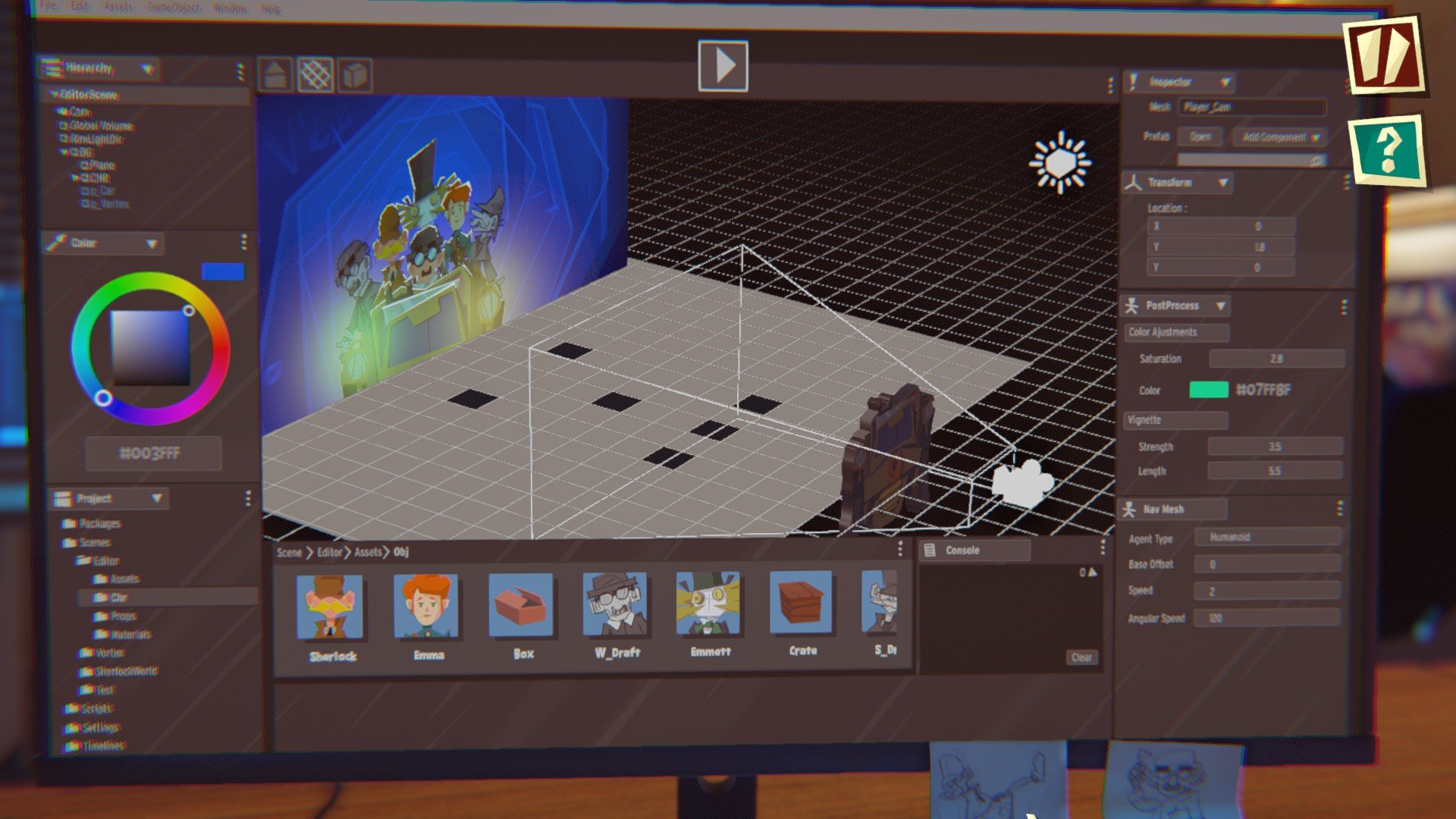
There are frequent punchlines (“My sweet baby!” Holmes exclaims upon the theft of his automobile, prompting Watson to reply “Stop calling me that!”), absurd scenarios (such as the repeated appearances of flat, poorly drawn versions of the characters held over from the testing phase), and elaborate slapstick sequences centered on the point-and-stretch mechanic. Of the latter, the most memorable is a series of puzzles in which the player must direct Holmes’s use of a rudimentary vacuum cleaner to first grab and then launch a barely willing Watson at objects in the environment.
Funny as it is, the vacuum sequence also highlights one of the game’s biggest problems: namely, that it’s prone to crossing the line that separates effective running gag from beating a dead horse. The vacuum puzzles are fun, with Watson’s protests eliciting chuckles, and the required combination of spatial awareness, environmental observation, and lateral thinking allows for some satisfying solutions—all of which nonetheless loses some of its luster somewhere around the halfway mark of the thirty separate instances necessary to proceed.
On its own this would be a case of diminishing returns, but it also takes place during a part of the game featuring a vast number of Watson clones who communicate entirely by screaming. (It does make sense in context. Mostly.) This too is funny at first, but it just…keeps…going, recurring over and over for approximately two of the game’s eight hours. The constant screaming becomes first tired, then unwelcome, then excruciating, especially if you’re playing with headphones. Spaced out effectively, this gag could have worked a handful of times; I’d say the game trots it out closer to a hundred, if not more. The only thing preventing me from hitting the mute button was my sacred duty as a reviewer, and the fact that I would have used enough force to break my keyboard.
Unfortunately, if there’s one part of the game that most wears out its welcome, it’s the point-and-stretch mechanic itself. In isolation the idea is sound, and allows for a surprising number of variations. The problem is just how limiting it feels in a game about smashing through the borders of reality to traverse a wide range of game genres, concepts, and graphical styles. Your entry into each new setting brings with it a sense of boundless potential and a wondrously playful feeling of “Ooh, what’s this?” that quickly fades as you regain control, replaced by the realization that, cosmetic differences aside, the new portion plays basically the same as everything that came before it. Holmes, Watson and company may be undertaking an anarchic journey through realms of unlimited possibility, but you, the player, are stuck doing what comes to feel like the same thing, over and over again, with slight changes to the paint job.
There are many places where the developers seem to have struggled to figure out a way to apply the point-and-stretch principle directly to the environment, and opt instead for timed sequences, dexterity challenges, and quick time events that feel so generic they might have come from a kit. The goal, presumably, is to make you feel like you’re doing something, but stretching and releasing a hotspot inside a three-second window is no more stimulating than clicking one would be, nor is spinning your mouse or controller joystick in a little circle. For a game that takes such pains to make it seem at all times like anything and everything might happen to its characters, there’s rarely any doubt about what your own next steps will feel like.
The biggest problem is that Crushed In Time never finds a way to justify centering this specific game around this signature mechanic. There’s no doubt the developers prove that point-and-stretch is versatile enough to carry a game, but what, when you get down to it, does it actually have to do with this one? It doesn’t flow from the premise: the characters never say anything about their suddenly protean world feeling elastic, for instance, and there’s nothing unusually or even notably stretchy about them or anything they’re doing. The stars, after all, are two of the most well-known figures in all of literature. If we’re not going to be joining them in any detective work, we should at least feel like what we are doing makes sense in context—otherwise, why are we doing it?
Final Verdict
Such a disconnect between material and presentation might have been fatal in other hands, so it’s a testament to the developers that it merely reduces what might have been a fantastic time into “merely” a nice one. A few days after finishing the game, my memories are still mostly of laughing, enjoying the scenery, and marveling at the depths of imagination Draw Me A Pixel have once again plumbed. If the ideas here don’t necessarily work together—or even at the same time—they still mostly work, with a few that could move the adventure genre in interesting directions if explored further. Whether or not that happens, though, Crushed In Time is a charming, funny spin-off from a studio that continues to swing for the fences, and it’s no stretch to say so. (Sorry.)
Hot take
Though not as groundbreaking as its predecessor, and with a gameplay mechanic that never quite justifies its prominence, Crushed In Time is still a funny, entertaining and wonderfully produced adventure through the bowels of game development alongside lovable cartoon versions of Holmes and Watson.
Pros
- Gorgeous visual design, brilliant voice work, and a soaring soundtrack
- Funny script with charming central characters
- Brimming with creative ideas and unexpected permutations on its central concept
- Finds as much to do with its point-and-stretch mechanic as possible
Cons
- Can’t stop that mechanic from feeling repetitive and samey as time goes on
- Timed sequences, quick time events and the like feel bland and uninspired
- Some sequences go on far too long
Will played Crushed In Time on PC using a review code provided by the game's publisher.

- Advertisement
- Help support AGH by advertising with us





0 Comments
Want to join the discussion? Leave a comment as guest, sign in or register in our forums.
Leave a comment