
The Tragedy at Deer Creek review
- 0 Comments

Chilling, artful mystery flows out of a nineteenth-century Alaskan ghost town
The Tragedy at Deer Creek impressed me when I played its demo at AdventureX in London, so I was glad when I could dig into the full game and finally discover what terrible incident had actually befallen this small northern town. Sparrowland’s Swedish brothers, Mikael and Andreas Norberg, together with a friend, Máté Mrsan, have crafted an intriguing story about a photographer travelling to the Alaskan frontier to document an abandoned post-Civil War settlement. What follows is a short yet chilling mystery filled with inventory puzzles and information gathering, all wrapped up in a comfy winter cloak of unexplained, supernatural phenomena.
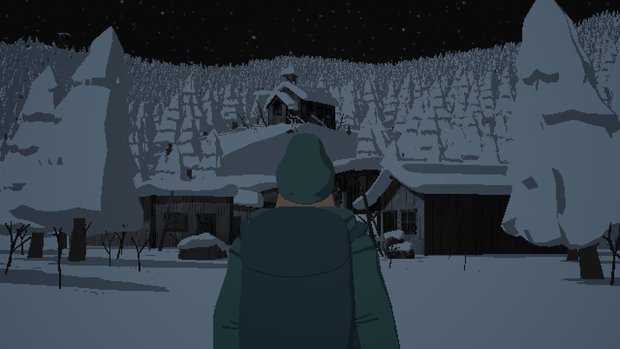
Charlotte Gray has photographed her share of ghost towns, and her latest assignment has brought her to the frozen forests of Alaska. History tells of a logging camp here called Deer Creek, built after the American Civil War by a group of settlers hailing from all over the States, each looking to start a new life for their own personal reasons. This camp was later abandoned inexplicably, and Charlotte has flown in to capture the place in a series of photos.
Surprisingly, all original wooden buildings are still accounted for: the blacksmith’s, the refectory, the foreman’s quarters, the laundry, storehouse and so on. Everything inside is amazingly well-preserved, and even stranger is that it seems the residents simply disappeared into thin air, in the middle of whatever they were doing, leaving everything behind as is.
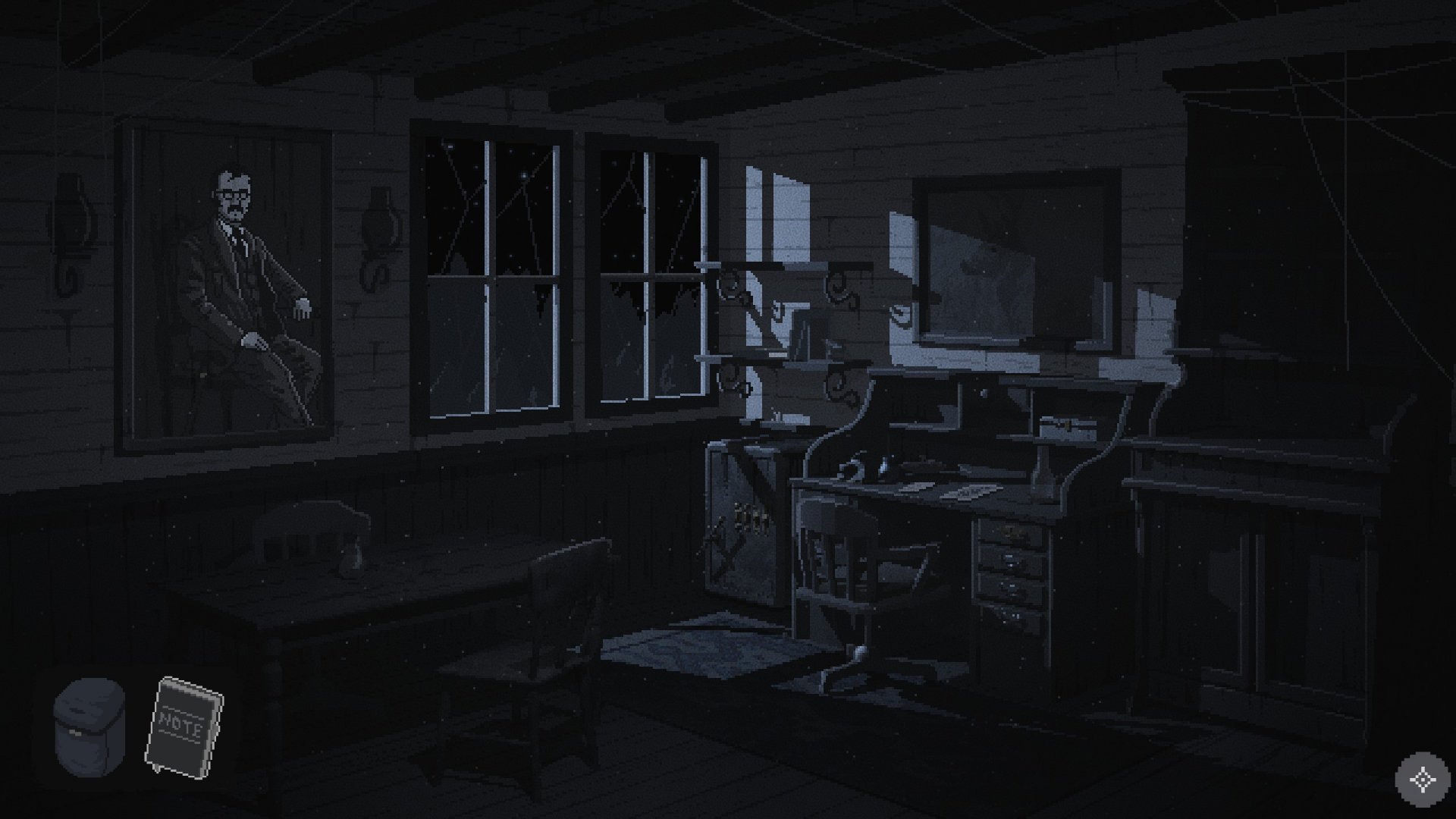
You explore each location as Charlotte from a first-person perspective in a traditional point-and-click slideshow gameplay style. In the settings, you can choose to have the hotspots labeled or not. When you hover the target cursor over one, it turns into an eye if you can only examine the object in question. If you can examine and manipulate it, a two-fold menu pops up, in which you can click either of the options. This design choice feels like a step back from how user interfaces have evolved over the years. I prefer it when you can use one mouse button to examine and the other to manipulate, and the right mouse button isn’t used for anything here.
Within the locations, Charlotte can move in closer to examine, for instance, a desk cluttered with paraphernalia specific to that building’s function, or equipment like a furnace or a crane you need to get back in working order. These close-up scenes are even more detailed than the general, more panoramic views of the rooms, and hold most items serving a purpose later on.
It was a bit frustrating at first when Charlotte refused to pick up anything, which your average adventure game protagonist usually doesn’t have a problem with. When she arrives at Deer Creek, Charlotte doesn’t want to alter the past. She is there to observe only, to photograph the camp without disturbing anything. It's only after she has stumbled upon some mysteries, faces an obstacle and actually has reason to gather helpful items that she will put aside her principles and finally add to her inventory. Eventually you will need to use all the items that trigger a hand icon, so if you don’t have a photographic memory, my advice is to make a list of them and their location, so you don’t need to search the entire camp a second time.
Sometimes you need to observe an acquired item up close before Charlotte is able to use it appropriately. You do this by clicking the “Examine” button situated at the bottom of the inventory. Actually managing the inventory is a bit trickier than you might be used to as well. If you want to use an item in the environment, you just click it and the inventory closes automatically. If you want to use it on another inventory item, however, first you need to click the “Combine” button, then select the desired object and move it over to the target item. I kept forgetting this and regularly left the inventory unintentionally, holding an item I couldn’t use anywhere.
You are notified of new objectives with a pop-up, but they’re also written down in your notebook for handy reference. These will usually tell you to further investigate a particular place, or at least gain access to it. Goals in Deer Creek include finding your way through the snowy woods following a list of directions, bringing the smithy back to life, recreating a constellation in a special locking mechanism, and devising a grappling hook to enter a hard-to-reach place.
The Tragedy at Deer Creek
| Genre: | Mystery |
|---|---|
| Presentation: | 2D or 2.5D, Slideshow |
| Theme: | Paranormal, Missing persons |
| Perspective: | First-Person |
| Graphic Style: | Pixel art |
| Gameplay: | Puzzle, Exploration |
| Control: | Point-and-click |
| Game Length: | Short (1-5 hours) |
| Difficulty: | Low |
Most inventory puzzles revolve around unlocking doors, drawers and hidden compartments. At one point you need to pick a lock, and there’s a music puzzle where you have to program a music box for it to give up its secrets. The item-based puzzles are easy enough, if you remember where everything is located, while some logic/mechanical puzzles will require a couple of attempts. Even so, the game is more focused on pulling you into the story than challenging you with difficult conundrums.
The cursor changes into two footsteps if you can move ahead to a new scene or zoom in for a closer look, and into a returning white arrow at the bottom of the screen when you can go back. Charlotte automatically takes a photo of each new place you enter, which is added to the notebook (its icon, along with that of her backpack, available in the bottom left corner of the screen) with a description of it. There are fifteen photos/locations to collect in this way. Besides Charlotte’s photos, you can find older black-and-whites hidden throughout the camp, showing the former residents of Deer Creek in their everyday lives. These pictures you collect in a separate section of your inventory, next to the regular items, plus any documents you find as well.
Documents won’t immediately pop up for you to read when you discover them. You have to open up your backpack, choose the document folder and then click on the piece of paper of choice to see it up close. Even then they are illegible, but when you examine them Charlotte will read out loud what’s printed. As you gain access to more locations, you will also find logs, journals and diaries describing life at the camp, information about its people and the events that occurred there. Their appearance is different from regular letters and notes; these journals are divided into sections, each bearing the name of another Deer Creek resident, with information you can read yourself while Charlotte narrates it all aloud.
Through these journals, you learn about the history of Deer Creek and its people: the settlement’s foreman, Thomas Adams, and his wife Mary; siblings Hank Grady the handyman and school teacher Linda; the Millers, a hard-working couple performing all kinds of jobs; Mr Barnes the blacksmith; Mrs Evans the cook; and several more.
Only two characters are voiced, and the main character Charlotte is performed well enough. There’s a slight pause after she finishes talking before the on-screen text goes away or changes to the next line, but you can simply click the text away faster. From the past, the foreman’s wife reads aloud from her own diary in cutscenes between days that Charlotte spends in Deer Creek, with banjo music playing as a testament to the times. You often hear background effects from her era as well, such as the sounds of the settlement’s construction as she writes about their arrival and building the camp. The voice actor has a bit of a foreign accent, and her performance is of a lesser quality than Charlotte’s, with unnecessarily long pauses at commas.
Elsewhere, your exploration of Deer Creek is accompanied by esoteric music and serene piano chords, often combined with the howling wind. Snow crunches underfoot whenever Charlotte ventures outside, and her footsteps resound on the indoor wooden flooring. Each time you solve a particular puzzle, you hear a subtle rewarding jingle, like small bells twinkling in the distance. And speaking of footsteps, I appreciated very much the visual footprints in the snow leading to already visited locations. This is both realistic and provides you with a “been there” reminder in case you save to exit the game – brownie points for a manual save system next to the autosave! – and return later.
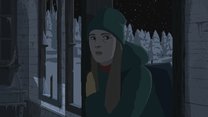
The game’s nighttime palette casts a bluish sheen over everything, next to lots of brown, grays and whites in an almost monochromatic aesthetic. Only the occasional fire and Charlotte’s yellow gloves in cutscenes break the desolation with a bit of warmer color. But despite being dark and deserted, Deer Creek is a very inviting place that you just want to explore to discover its secrets among the many visual and aural details. The environments are depicted in hand-crafted pixel art, though not the nostalgic chunky kind you might usually associate with this. There’s a realism to the locations, as if you are moving through a rendition of a series of photos actually taken by Charlotte herself.
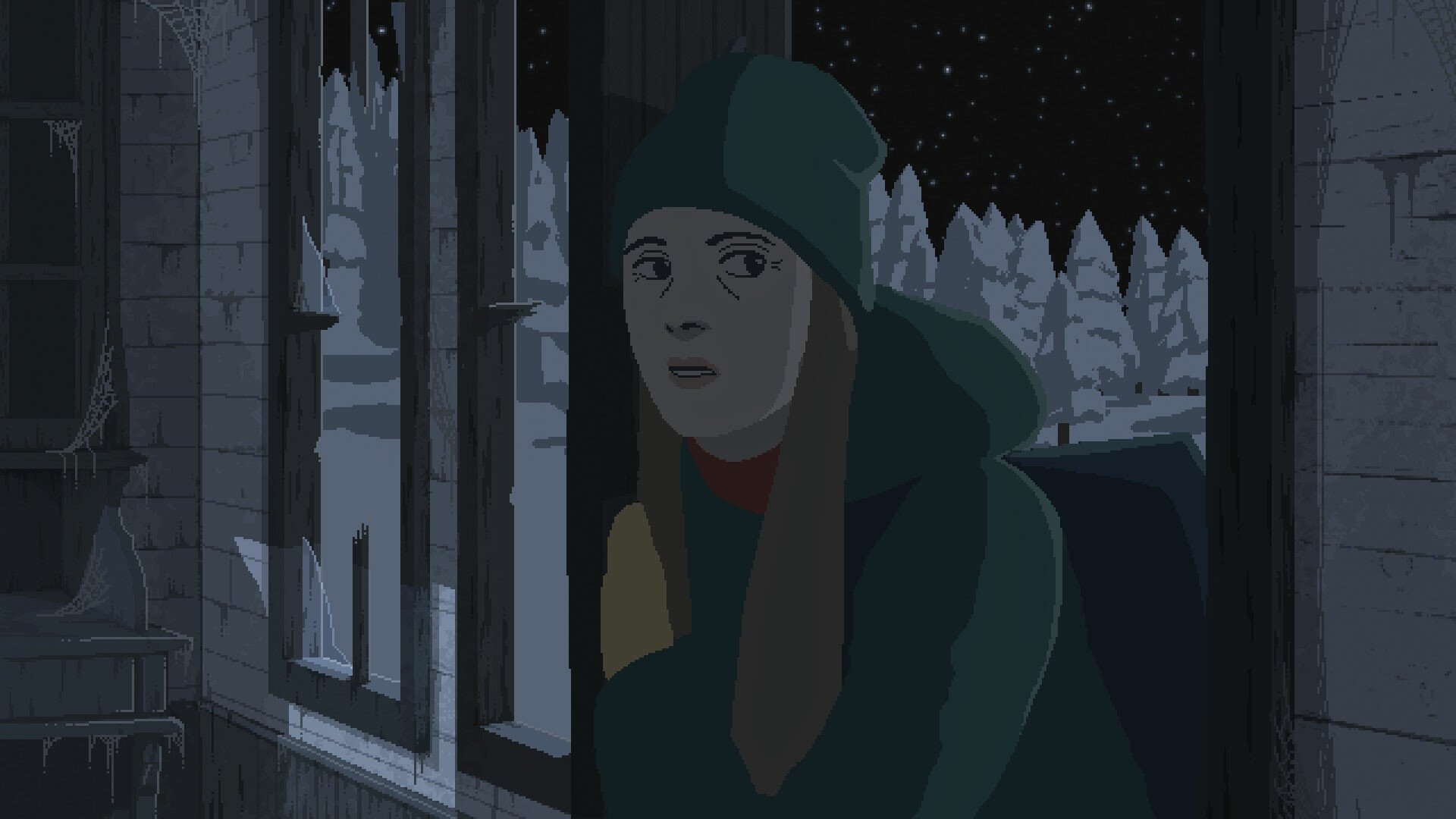
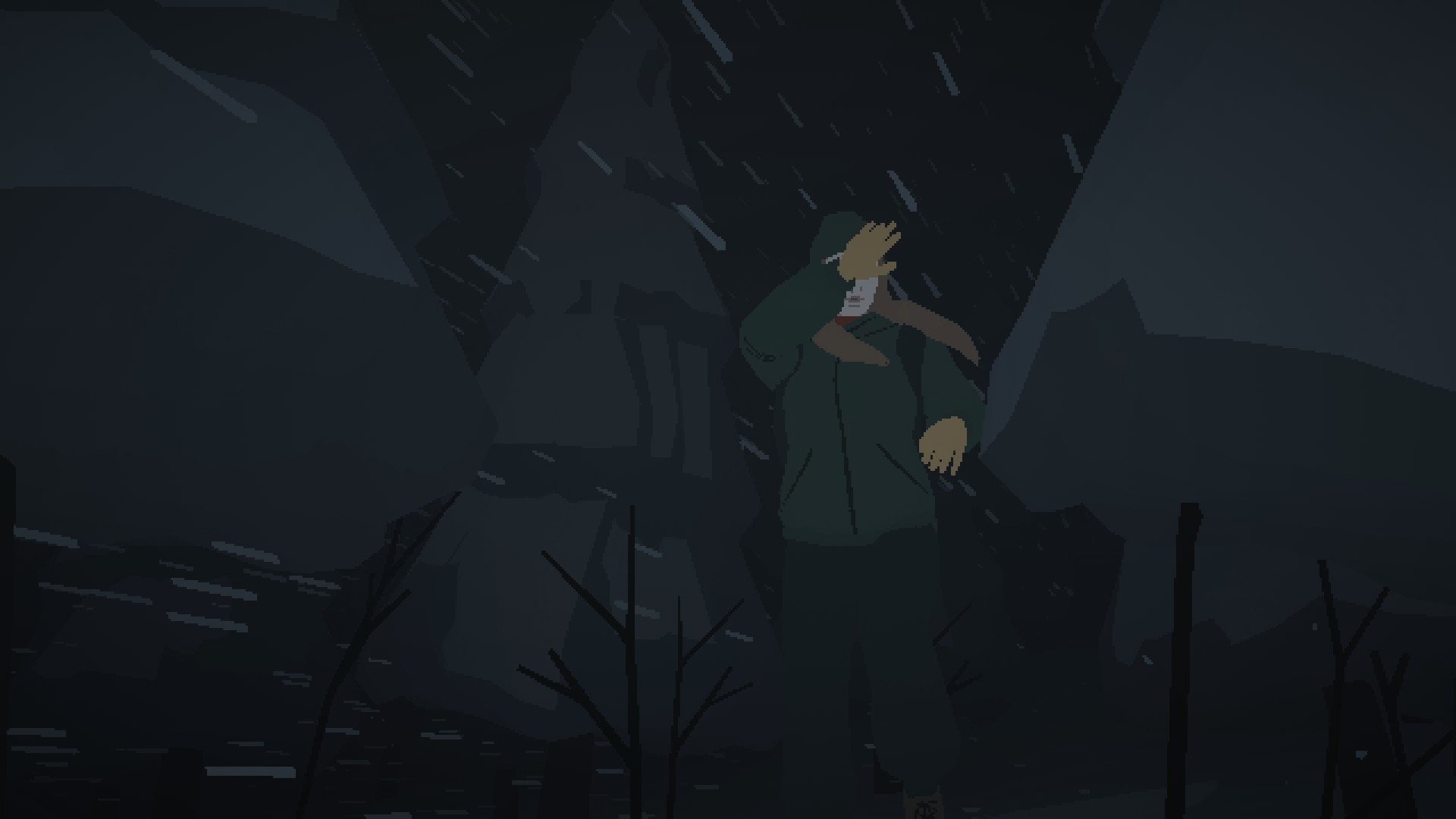
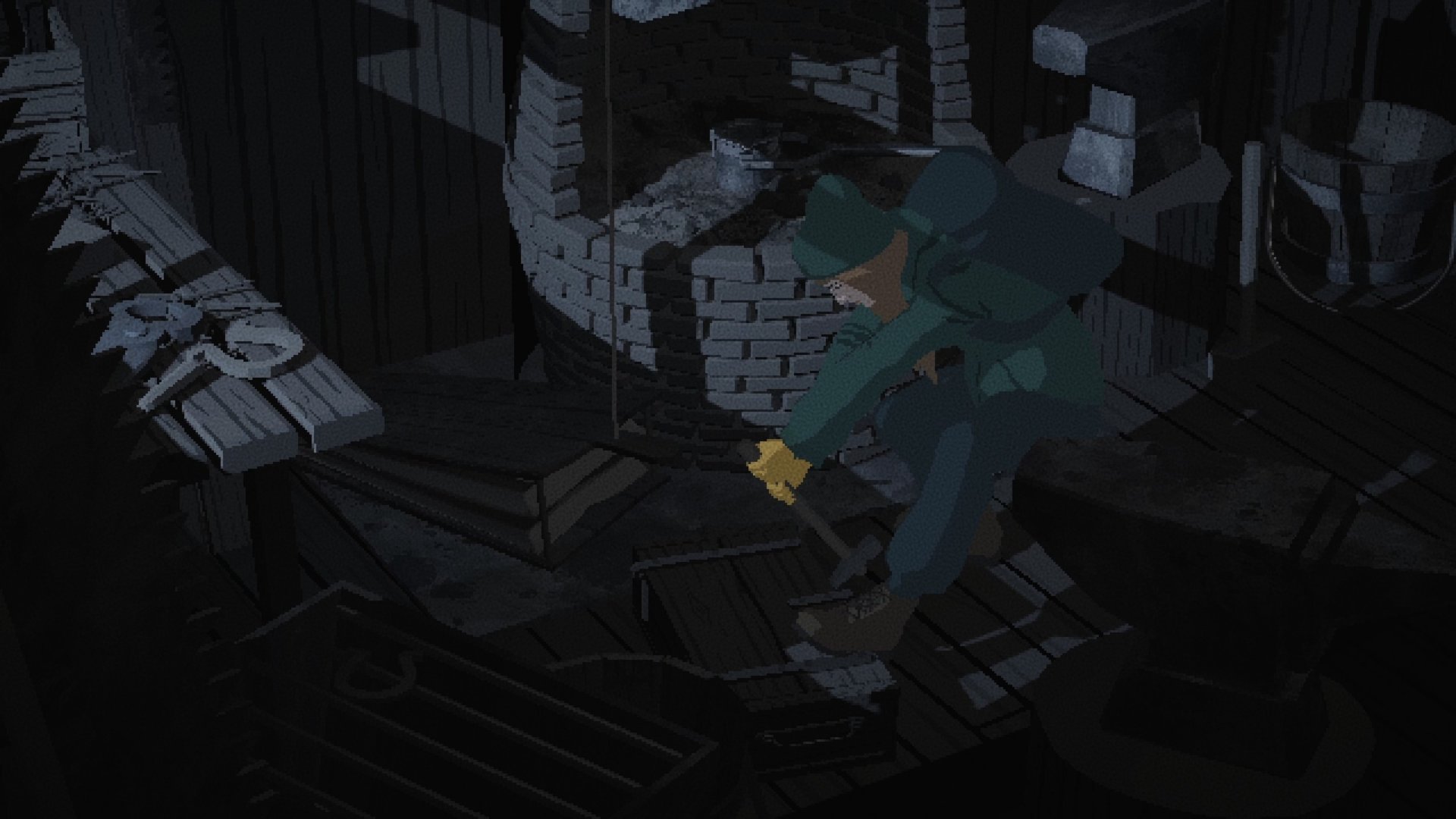
The highlight of The Tragedy at Deer Creek’s presentation is its cinematics, in which you see Charlotte performing one action or other, like opening a box, walking through the woods, or taking a photo. There are many of them, and it’s like watching a series of clips from a movie. Charlotte’s three-dimensional appearance in these resembles rotoscoping without actually being rotoscoped, and there’s an almost filmic quality to the animations. Each one gives a feeling of progress through this four-hour story, and it’s a great contrast to the first-person puzzle-solving gameplay. My only gripe with them is that the character animations are still a bit slow, even though the frame rate has improved somewhat since the demo.
The combination of a first-person gameplay with third-person cinematic cutscenes works wonders to identify with Charlotte as she turns from a simple observer wanting to document the past, into a concerned human being hoping to find the truth about the tragedy that befell the residents of the old Deer Creek settlement. But there’s a peculiar atmosphere hanging around Deer Creek. After her arrival, when Charlotte goes to sleep and wakes up the following day, a starry sky still covers the abandoned settlement in what seems to be a perpetual night. Strange footsteps other than Charlotte’s will appear as well, both in the snow and inside buildings, as if someone is still living there. Reflections in mirrors and shadows in the dark seem to indicate ghostly presences as well.
That’s as far as the story goes with these elements, however. Not every strange occurrence in The Tragedy at Deer Creek is explained, though you will definitively uncover what actually occurred back in the late 1800s. Eventually, Charlotte reverts back from a doer to an observer, as a long expositional cutscene brings the game to an abrupt end, without any resolution to the more supernatural elements Charlotte has witnessed.
Final Verdict
But even without every question answered, the story behind The Tragedy at Deer Creek will compel you to keep slowly uncovering new layers by solving puzzles and finding documents and diaries left by the vanished nineteenth-century settlers. While the user interface feels a bit old-fashioned, and the challenge level might leave some gamers wishing for more, the presentation is beautifully bleak and pulls you immediately into the sadness of the story. I very much enjoyed my few hours spent in this ghost town, and my heart fell when I had to leave, wanting to find out more about its history and the people who once lived there, and the events that followed the tragedy that befell them. But my job there was done, and I guess some mysteries are better left buried in the past.
Hot take
Though questions are left hanging, The Tragedy at Deer Creek rewards thorough exploration of its abandoned Alaskan settlement with stunning visuals, haunting atmosphere and diverse puzzling.
Pros
- Many visual and aural details make the nineteenth-century setting feel like a real place
- Gorgeous cinematic cutscenes give personality to the main character
- Great balance between inventory and logic/mechanical puzzles
- Organic, slow-burn discoveries of Deer Creek’s history keep the story interesting
Cons
- User interface feels a bit old-fashioned
- Not every strange element is explained or even addressed
Johnny played The Tragedy at Deer Creek on PC using a review code provided by the game's publisher.
- Advertisement
- Help support AGH by advertising with us





0 Comments
Want to join the discussion? Leave a comment as guest, sign in or register in our forums.
Leave a comment