
Creepshow review
- 0 Comments

Nails the franchise look and sound but its short length and simplicity may scare some players off
There’s something at once eerie and comforting about telling horror stories with your friends, perhaps whilst sitting around a campfire or in a candlelit living room on Halloween night. They remind us of our humanity and make us question what it would take to lose it. Or maybe they just gross us out. Movies, shows, and games take these frightening fictions and run with them, scaring us through film or in pixels. A natural evolution of campfire storytelling, Creepshow has been a movie (plus sequels), a comic, and a TV show, and now it’s finally a game (based loosely on the show). Whether the game version lives up to the best of its forerunners is the question, and my answer is: not quite. While it follows the franchise’s short anthology formula and has much to love atmospherically, it unfortunately falls flat in its storytelling and mechanics.
This iteration of Creepshow, by developer PHL Collective, is an opportunity for the series to put fans directly into the action. In this point-and-click adventure, you play through three original episodes – two main stories and an overarching meta-narrative. You start out as Danny, a nerdy American teenager in the ’80s who’s exploring a derelict mall with his friends. After making an eerie discovery in the basement, you’re transported into the pages of a Creepshow comic book story called “Metamorphic Love,” wherein you play as a guy who loves his wife almost as much as he loves his pet bugs. Following that up is another tale called “The Toll Keeper,” putting you in the sleek black shoes of a priest in Ireland who’s sent by the diocese to clean up an old ruined church. After that, it’s back to Danny for everything to be wrapped up nicely – or is it?
Danny’s story is the framework that holds it all together. He arrives at the abandoned mall with a flashlight, his backpack, and three companions to search for clues to his father’s death. His dad was a sheriff who perished while trying to save people in the fire that burned down the mall, and he was the epitome of a hero in Danny’s eyes. His friends, for the most part, don’t seem too excited to be there. They’re two-dimensional stereotypes of ’80s teen movies: the goth girl Mel, the cheerleader Liz, and the jock Jack. Mel is the only one sympathetic to Danny’s desperate search, while the other two alternate between teasing him and complaining. I’m not sure if “friends” is even an accurate term to describe them. Classmates, maybe? Anyhow, this narrative feels thrown in almost as an afterthought to provide a vehicle for the other two stories, and is so full of cliches that there’s hardly anything interesting to speak of.
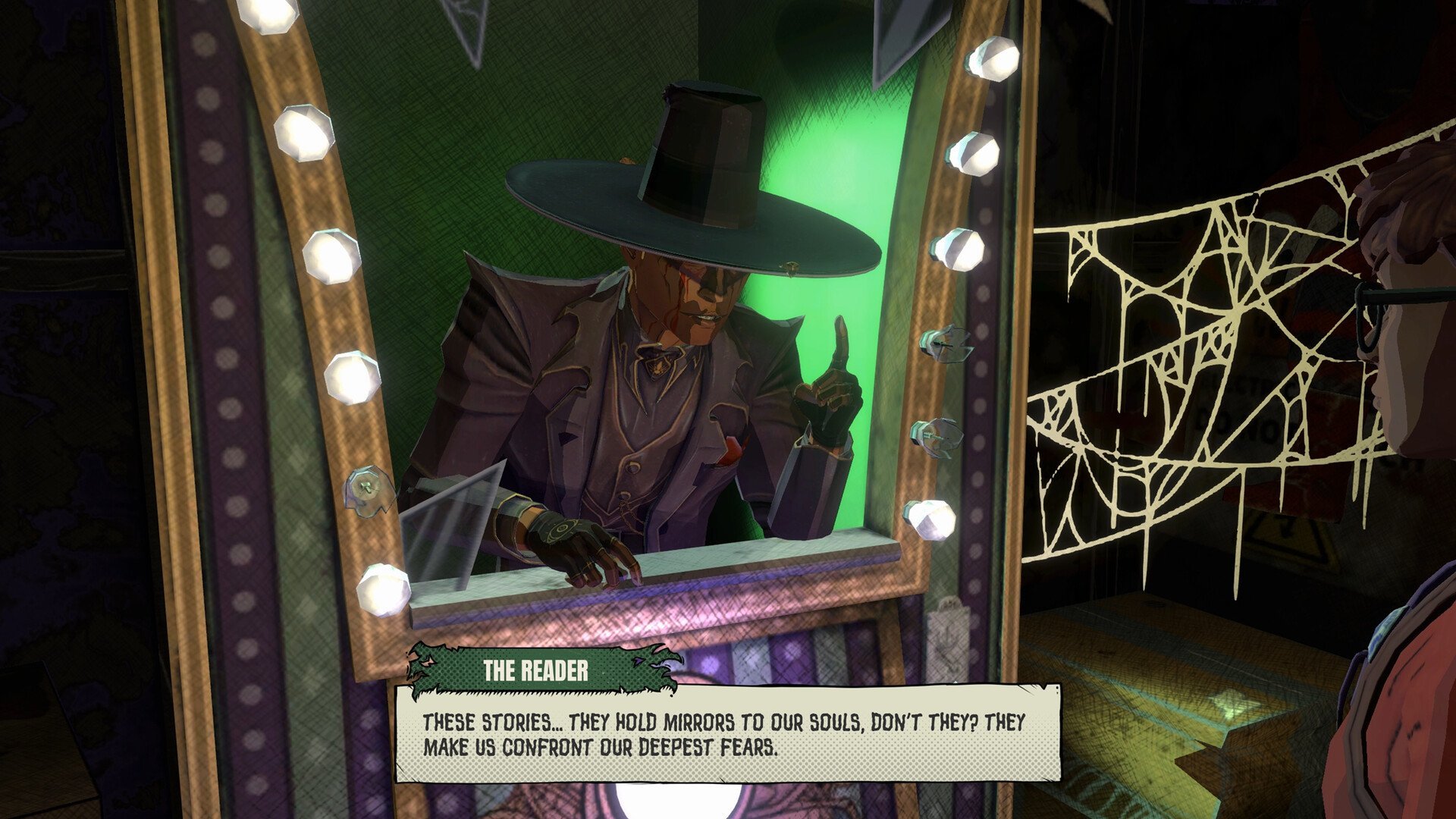
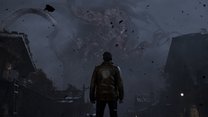
After an accident causes Danny to fall into the basement, which apparently once housed a comic book store, you'll encounter The Reader, a bloody animatronic fortune teller who’s come to life. The Reader asks you to give him stories in exchange for help getting out of the dark and dank basement, so you must look around until you find two intact comics. But why is the mysterious animatronic so obsessed with stories, anyway? What do the comics have to do with Danny and his search for his father? Are these questions ever truly answered? You’ll have to play to find out.
Both of the episodes that follow have potential but are too filled with tropes for their own good. “Metamorphic Love” follows a down-on-his-luck guy named Andrew, who’s caring for his terminally ill wife, Laura, and has an unhealthy obsession with insects. Humor combined with gross-out body horror makes it a fun gorefest at times, but it feels too derivative of Kafka’s The Metamorphosis and the 1986 film The Fly. The ending is also marred by the characters’ awkward animations and stilted dialogue.
You spend most of this episode going through Andrew’s daily life. The story follows him through one week, during which you’ll perform the same tasks every day: make food for Laura, feed your pet bugs, wash your face, put on suitable clothes, and go to work. This consists of simply clicking on objects to use them, and playing a minigame where you put together hamburgers for restaurant customers based on their order tickets. I found the daily tasks to be annoyingly repetitive, but there is some nice variation in the fast-food minigame that allows for a few effectively horrific moments.
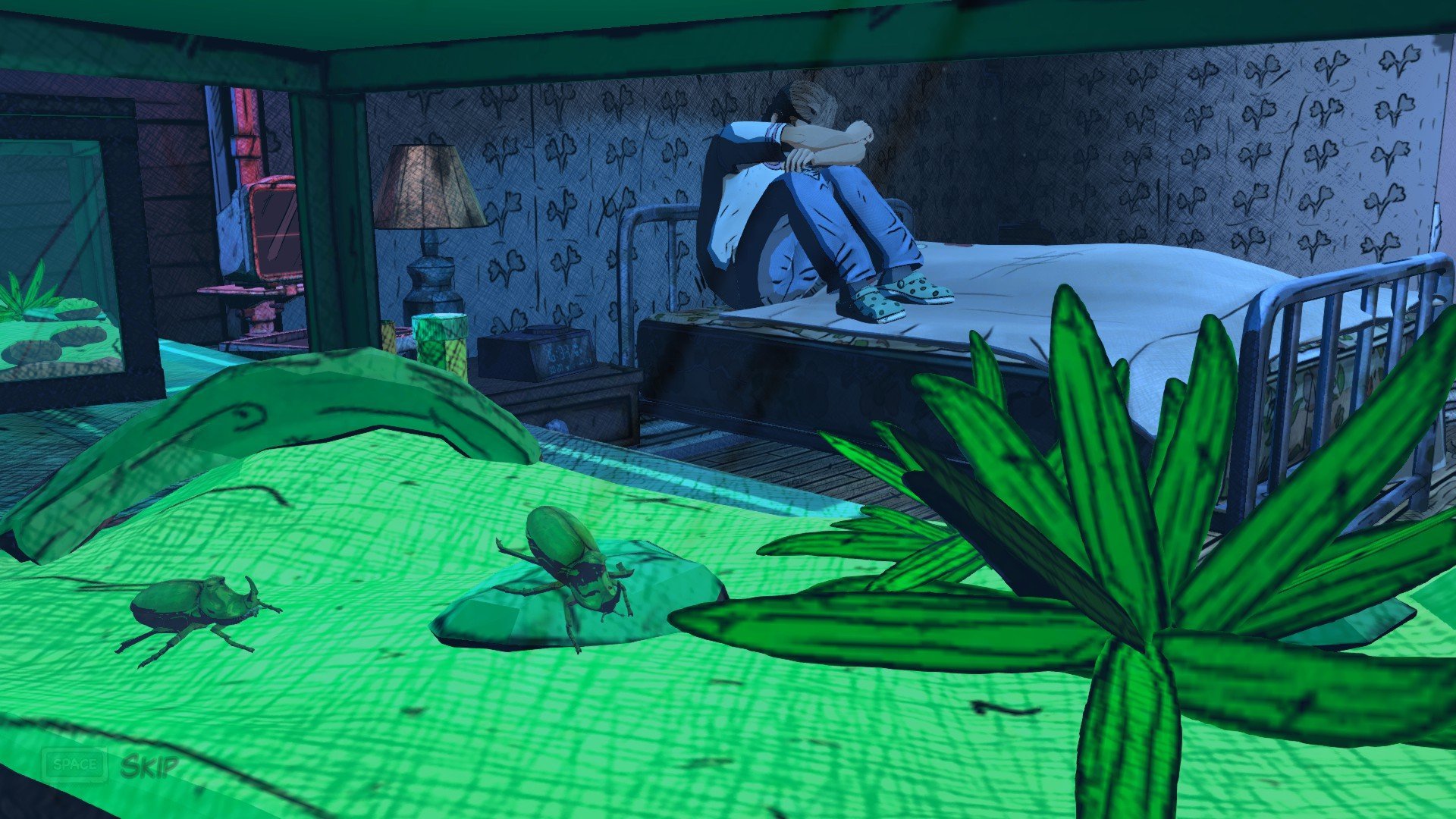
I ran into quite a few bugs in this episode – and I mean game design bugs, not Andrew’s pets – which hindered my overall enjoyment of it. Interactions with items were a bit glitchy, with dialogue boxes that would flicker up and be gone in an instant so I couldn’t read them. I tried to interact with something in the fridge before I was supposed to, and not only did it spoil the upcoming surprise, but it also had the flickering dialogue box and wouldn’t let me do anything with it, leaving me wondering why it was there until I was finally meant to interact with it. One of the objectives said to “remake dinner for Laura,” echoing a previous objective I’d already done, when I was supposed to be making her breakfast for the first time. It yanked me right out of the experience.
“The Toll Keeper” is much subtler in its horror, but it too doesn’t quite stick the landing. It’s a tale about blind faith, greed, and the conflagration of the two that brings to mind folk horror classics like 1973’s The Wicker Man and 2015’s The Witch. We don’t get to spend enough time with it, however, for it to go to the same lengths that those films do with their horror imagery. Once again, you’re mostly performing mundane daily tasks, this time following the disgraced Father Torosian as he cleans up a church that’s been left to crumble from disuse. You’ll click or use the keyboard to sweep dirty floors and solve easy puzzles where you’re rotating pieces and fitting them together to repair a broken banister or patch up a hole in a stone wall.
Creepshow
| Genre: | Horror |
|---|---|
| Presentation: | Realtime 3D |
| Theme: | Paranormal, Adaptation |
| Perspective: | Third-Person |
| Gameplay: | Puzzle, Exploration, Minigames |
| Control: | Point-and-click |
| Game Length: | Short (1-5 hours) |
| Difficulty: | Low |
| Graphic Style: | Simulated realism |
This section had the more challenging puzzles of the two, but they’re optional. See, you can find three “creep pieces” throughout the game, one in each episode, and the relatively harder puzzles lead to them. I took the extra time to solve them because I wanted the challenge, and I discovered that they each unlock a different “visual mode” you can apply to the game, making it look like old-school pixel art, a classic black-and-white film, or a retro VHS with scanlines. The puzzle for Andrew’s creep piece is fairly simple, needing only a little extra exploration of his home and workplace. Father Torosian’s piece requires you to solve three puzzles, two of which involve riddles that had me scratching my head for a while, trying to piece together environmental clues and make sense of the cryptic instructions given. Without these optional puzzles, though, the game would be a breeze to get through.
Creepshow plays like a standard point-and-click adventure but with 3D environments. Each area has a fixed camera angle, and you can move around freely, giving the experience a classic survival horror feel. There’s a sprint button, although it’s not really needed for any story or gameplay purposes; it’s just there if you want to move faster. There’s a menu where you can view your inventory, the collectible creep pieces, and any notes you pick up. “The Toll Keeper” requires the most reading, while the other two stories are extremely light on notes – I only found one in “Metamorphic Love” and none in Danny’s section. You’re given objectives in each story that you can press Tab at any time to view, but sometimes they’re a little insulting in how much they hold your hand. The game is linear enough without telling me exactly which part of the room I need to look in to find an item, thank you very much.
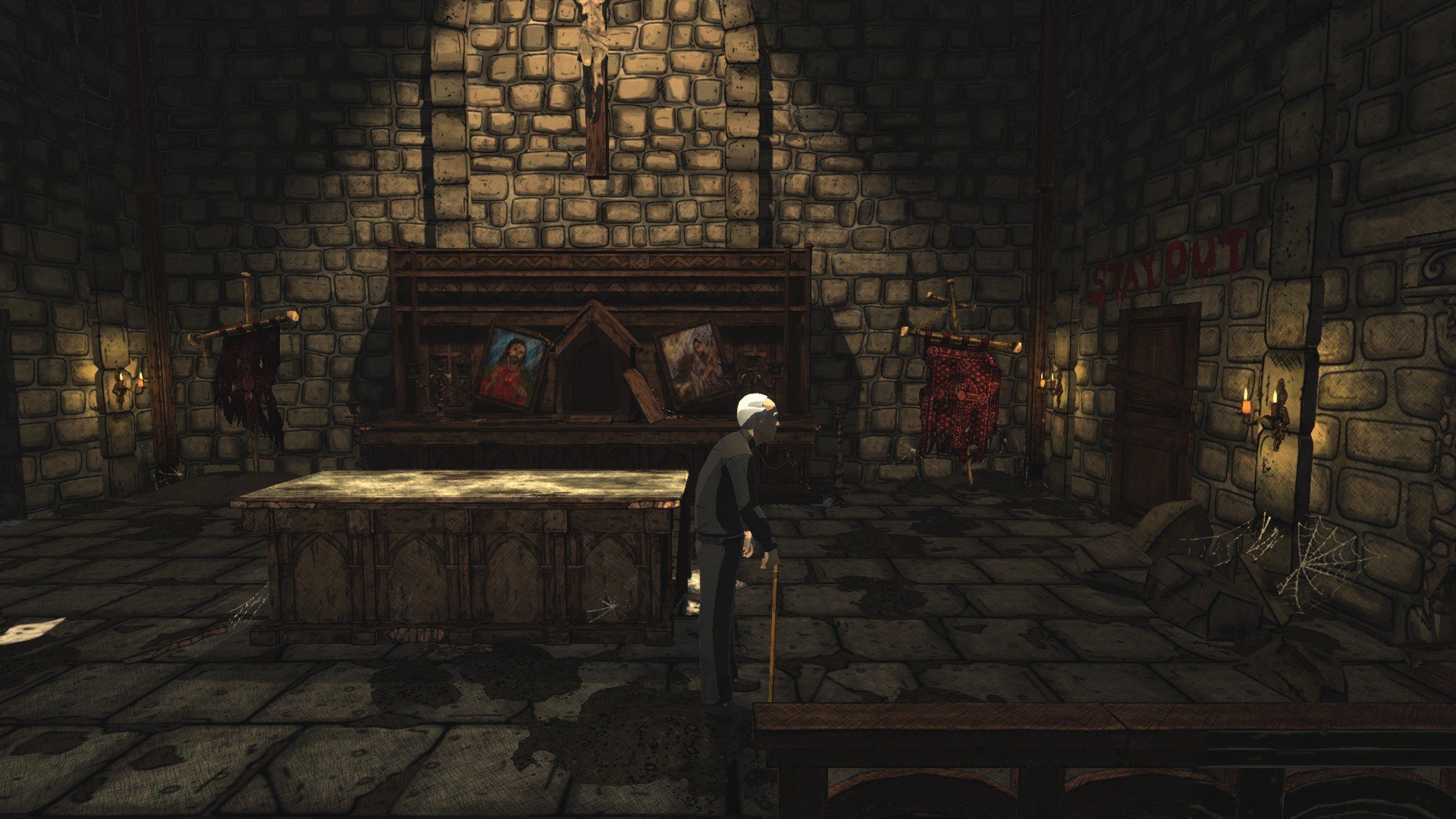
There isn’t a hotspot highlighter, but the environments only require minimal exploration and an icon will pop up over interactable items as you move close to them, so I never had any issues figuring out what I was supposed to be doing. It’s worth pointing out, however, that there is a long road to nowhere in “The Toll Keeper.” If you follow the path to the left of the church, you’ll continue for quite some time until you reach a fallen tree blocking your way forward, and that’s it. I found nothing to pick up or interact with upon scouring the area. You can simply walk and walk until you can’t walk any longer. I was enjoying the Irish seaside atmosphere and the melancholy piano music, so I didn’t mind the trek so much, but you might want to avoid it if you prefer making better use of your time.
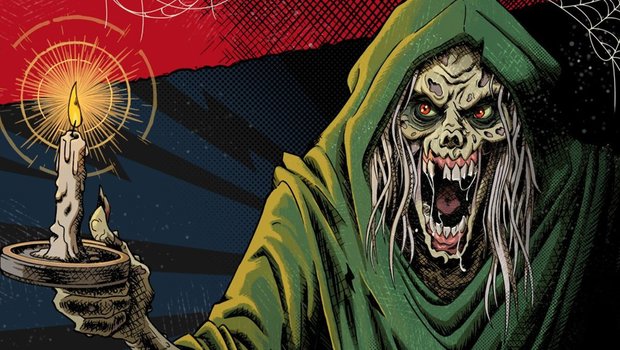
In its original iteration, Creepshow was an homage to horror comic anthologies like Tales from the Crypt. The eponymous Creep even looks eerily similar to the Cryptkeeper of Tales fame. Because of this, a staple of the franchise is its comic book art. In the original 1982 film, directed by George A. Romero and written by Stephen King, each story was introduced with comic panels that slowly transformed into live-action scenes. The TV show, developed by Greg Nicotero for Shudder, would continue that tradition and take it a step further by including mock advertisements for horror products that were promoted in the comics. Creepshow the game goes even further by including cel-shaded comic-style art throughout the three stories it offers.
This comic book appearance is one of the highlights of the game. So much visual flair exists within Creepshow as a franchise, and it’s utilized to great effect here. Each screen, whether in a cutscene or in the gameplay itself, looks like a comic book panel. Dialogue boxes appear with stylized frames and lettering. Sound effects are often accompanied by bold, flashy onomatopoeia, such as the word “Dinggg!” when ringing a bell. Lighting is portrayed in intense yellows and sometimes reds. And each episode ends with a beautiful full-page illustration, like a variant cover done by a special artist.
The characters are all voiced, and successfully so. The actors have done a fantastic job bringing players into each character’s world and convincing us of their motives and emotions. The Creep himself cuts in with snide interjections here and there, as well, reminding us he’s watching it all with his usual macabre delight. The audio goes a long way toward making Creepshow so atmospheric, with sound effects that bring the stories to life, and sparse but chilling ambient music. I appreciated all the skittering and squelching in “Metamorphic Love,” and the beautiful contemplative piano melody that played at the beginning of “The Toll Keeper” helped to paint a scene that I wanted to stay in for a while.
While atmospheric sound is absolutely one of this title’s strong points, unfortunately it’s one of the few it has going for it in terms of actual horror. “Metamorphic Love” isn’t designed to be particularly scary, being more reminiscent of the original 1982 film, with campy touches that give it a B-movie feeling. It even has a couple of funny moments that had me grinning. The problem is in its pacing. You spend most of the episode performing dull tasks, so most of the horror gets crammed into the last few minutes and doesn’t feel earned. And because we just don’t get to spend enough time with Andrew, Laura, and the bugs, the attempt at humor combined with body horror is compromised. Where the short format works in film and television, it’s an obstacle here that gets in the way of effective chills.
The slower pace of “The Toll Keeper” would have been a great opportunity for creeping dread, the kind that builds to a terrifying crescendo. Again, though, nothing really happens while you’re going through the motions of rebuilding the church. The game is too focused on having you do your tasks to bother with scaring you. So nothing much happens, and in the end, the episode proves to be more of a parable than a horror story, and without much in the way of humor in its place.
Final Verdict
Creepshow is the skeleton of a good game. Atmospherically, the two main episodes are successful, but they ultimately feel like disappointing echoes of stories we’ve already heard plenty of times before. Some annoying technical issues remain, and the game is light on both horror and puzzles. What’s more, it only took me about four hours to complete all three tales, and I was intentionally moving through them slowly to take in every detail. I was hoping for more from a game with such a legendary franchise behind it. Maybe the developers are planning more episodes in the form of future DLC, and I hope they are because as it stands, Creepshow the game is in serious need of more meat on its bones.
Hot take
Creepshow looks and sounds the part, but it fails to live up to its storied past with short episodes that don’t pack a punch and have too many bugs (and not the creepy-crawly kind).
Pros
- Colorful graphics that evoke the franchise’s comic book history
- Eerie sound effects and chilling ambient music
- Fantastic voice acting puts you in the characters’ shoes
Cons
- Generic stories aren’t especially horrific
- Puzzles are few and far between and don’t pose much of a challenge
- Repetitive gameplay can feel boring
- Quite a few bugs on release
Alyssa played Creepshow on PC using a review code provided by the game's publisher.

- Advertisement
- Help support AGH by advertising with us


0 Comments
Want to join the discussion? Leave a comment as guest, sign in or register in our forums.
Leave a comment