
Lost & Found: A This Bed We Made Story
- 0 Comments

Short, tidy spin-off mystery is fun for snoops if perhaps a little too smooth sailing
I’ve never been on an ocean liner, but I have been on three cruises, twice in Norway and once in the Mediterranean, and cruise ships are not just about luxury and decadence anymore. In these days of mass tourism, these vessels are floating resort hotels accommodating all walks of life. I absolutely loved it, especially the vastness of the surrounding waters when out at sea, no land in sight, walking the decks and staring out at the absolute nothingness, feeling very tiny as a simple human being.
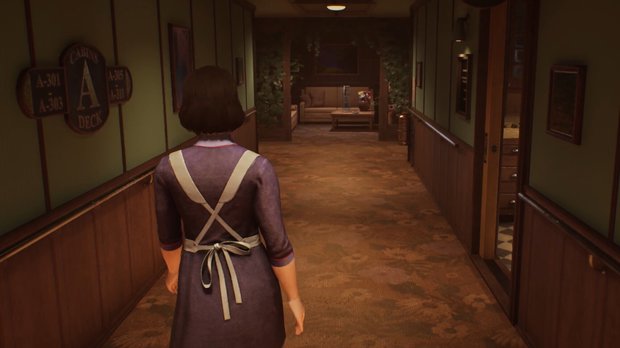
As settings for adventure and narrative games, passenger ships likewise fascinate me. Such as in Lost & Found, a short spin-off sequel to Lowbirth Games’ 2023 murder mystery This Bed We Made, exchanging its predecessor’s 1950s hotel with a 1960s boat, the Orpheus. Once again you play as Sophie Roy, who has been hired not only to clean but also to provide guests with the occasional drinks and deliver telegrams while scouring for evidence of a brand new mystery. It’s only a two-hour experience, but with (shortened) improved production values and actors’ performances over its already impressive predecessor’s. The clue-gathering is still fun, and although the actual case pretty much solves itself, there’s a final deduction element for which you need to pay close attention to all the information you’ve encountered along the way.
The current mystery Sophie faces isn’t a murder investigation, but an elusive thief. Random items have been disappearing recently, belonging both to guests and staff. Considering Sophie’s history as a successful amateur sleuth, her boss asks her to look into the matter discreetly, in an attempt to avoid a scandal for the company. And so Sophie has to employ her snooping skills once more to locate the stolen items in one of the passengers’ cabins and thus identify the culprit.
The headlines of newspapers scattered throughout the cabins and corridors write about the Vietnam War and Harlem protests in August 1964, by which point Sophie has been working on the Orpheus for a month already. The ship has just left Italy and is crossing the Atlantic toward New York. Being so long away from her home in Montréal, Sophie is missing both her mom and her newfound partner whom she met at the Clarington Hotel, the setting of the first game – at least in my playthrough.
When you start Lost & Found, if you’ve played This Bed We Made you can choose to carry over your choices from the first game concerning your love interest, if you have one; whether you were incarcerated for tampering with evidence; and if you were promoted by the manager at the end. However, this is not done automatically: you manually have to click the available options, and it’s not so easy to remember when you experienced that particular story more than two and a half years and many games ago.
Alternatively, you can let the game choose for you, which is of course especially important for newcomers. It will then pick the most optimal version of the story, though the developers insist there is no one canon and this sequel has been designed to fully take into account all alternatives. Essentially, though, this just means that those choices don’t really have any weight, and except for a couple of details, the story here always plays out the same way.
During this transatlantic voyage, Sophie has been made steward for all uneven cabin numbers between 301 and 311. This means making the beds, tidying cushions, cleaning stains, emptying ashtrays – yes, 1960s people still smoked indoors – clearing coffee cups, wine glasses and serving trays – all similar jobs as in This Bed We Made. This time, however, you are also in charge of delivering telegrams and serving drinks. But with only six cabins to tend to, one of which is unoccupied and thus inaccessible, there isn’t all that much to do, so – in contrast to real life – I was actually happy when I encountered something that needed cleaning.
You will find dirty towels to drop down the laundry chute, but you will also need to replace them with fresh ones. You must make the beds, simply by selecting the sheets and then dragging them across the bed, sometimes searching for the pillows first. Toilets and baths might need a good scrubbing, done by moving the cursor back and forth across the discoloration in a type of mini-game; same with stains on carpets.
Whether or not you’re good at your chores doesn’t really impact the story. Do them perfectly, however, and you will unlock an achievement for each element of the job. If you’re mainly paying attention to finding the thief, it’s easy to miss one or more of those housekeeping tasks. If you want to hunt for those achievements, just make sure you’re thorough before heading back to the break room for the final scenes, because you won’t be able to return to the cabins afterwards.
You will personally interact with only a handful of characters, though several others are referenced while rummaging through their belongings. There’s the ship’s manager and the piano player, but it’s difficult to explain who the passengers are since it’s part of the game to discover that on your own. There’s a man aboard alone, two women travelling together but staying in separate cabins, and the other two cabins are registered to husband-and-wife couples. You only meet the women, but they all have a very genuine feel to them, and are excellently voiced to make them sound even more authentic.
Rather than simply reusing what came before, Lost & Found charmed me with its improved graphics. The characters have smoother and more detailed facial features, creating more depth in their personalities as a result. There has been more attention paid to lip syncing too, which now appears more natural, less wooden. I noticed it was demanding a lot of my graphics card, though, since my computer ran hot and its ventilation got very loud.
I really liked the cutscene cinematography. The camera angles, character positioning, and the blurring of backgrounds or foregrounds are all done very artfully and give the game the allure of a movie. There’s gentle piano music to accompany the visuals during the cutscenes, but no score when you’re in control of Sophie, except for the occasional radio playing period-appropriate music in a cabin as you walk by. Even those are turned off by the occupant once you are able to enter the cabin and talk to them.
My only gripe with the presentation is that it lacks a sense of actually traversing the ocean due to the limited locations and external views. The cabins and corridors, while richly furnished and filled with examinable items, could just as easily have been in another hotel. The only portholes are in the break room, where you spend minimal time at the start and end of the story. And even there, the artwork and wave animation look disappointingly dated and are missing a more realistic water texture.
Once again, the action plays out as a third-person exploration and investigation game. You control Sophie and the camera either by the keyboard/mouse combo or a gamepad. The user interface is the same as in the first game. Get close enough to a hotspot – indicated by a little circle on top of the items – and it will trigger a case-sensitive menu pop-up, mostly to open, move or inspect. The latter takes you to a close-up of either an object or document, or the top of a desk or the inside of a locker, where you can then nose around more thoroughly.
Also similarly to the first game, Sophie will often have thoughts concerning the investigation, which you can hear with a click of a button. Another button grants you access to a complete overview of any information you have already gathered: a list of clues, handily sorted by location, with a complete transcript of any document you might have encountered; profiles of the other characters; and finally a general progress report, though this one is very minimalistic and unlikely to serve much purpose unless you restore the game after a long time away and need a general idea of what you’re supposed to be doing next.
Lost & Found isn’t really divided into chapters, but there is a straightforwardness to it all that leads to intermittent messages whenever you have accomplished a major task. This linearity also restricts you in that not all cabins are immediately free for you to explore. For instance, you may need to wait for a telegram to arrive, which makes the related passenger leave their room. However, this telegram only comes after you have searched some other rooms first.
There are a couple of puzzles to solve but they are very straightforward. One merely entails finding a hidden key, while another has you searching for the code of an alphabet lock. At least the final puzzle is the most interesting of all: once you have found the stolen items, you have to return them to their rightful owners. But who are they? You will need to check all the information you’ve discovered about the passengers to drop the items in the right cabins.
There’s a personal motivation to identify the thief, since Sophie’s favorite colleague has also been robbed, so you’re not just snooping for snooping’s sake. Along the way you also learn the backstory of some passengers, which can pull on the heartstrings. As you move from cabin to cabin, though, it becomes obvious where the story is leading without much effort needed for the truth to be unveiled. Thankfully, returning the stolen items to the right passengers needs a bit of deduction to find the connections between the people and their belongings.
With only a two-hour length, a manual save system might not seem that important, but I’m one of those adventurers who prefer to be able to exit a game whenever necessary and resume precisely where I left off. Since Lost & Found only has an autosave function, there was one occasion when I had to redo part of the game. Thankfully, each time the game autosaves it creates a separate save file. Some conversations also have dialogue choices leading to different paths, such as whether or not to reveal the identity of the thief to your manager, so at least this way you don’t have to start the game from scratch again if you want to see a different outcome.
But to be honest, these branching options have no real influence on Lost & Found’s conclusion. The final dialogues will be slightly varied, but Sophie will always wind up in the same situation, even if you fail to return the stolen goods to their rightful owners. More interesting is how the developers might handle any future installments, should there be one. The ending certainly hints at this possibility, yet where this will take Sophie depends not on your actions in this game, but rather on that love interest (or not) in the original This Bed We Made. It’s a curious approach, because unless the developers do enforce one as canon, they will have to create three different storylines in three different settings. But that’s a bridge to cross on a hypothetical future journey.
Final Verdict
Snooping in adventure games has always been a favorite pastime of mine, and Lost & Found certainly scratches that itch once again. While it only takes a couple hours to explore all the cabins on board the Orpheus, I was completely immersed by the beautiful cinematography of the cutscenes and the performances of the voice cast. There’s not much challenge in catching this high seas thief, and it’s a shame that any choices you make, or even how well you clean the cabins, doesn’t really seem to matter in the end. But the story is certainly well-written and the main puzzle is a rewarding little deduction exercise. Whether or not you’re already a fan of This Bed We Made, this is a short but fun encore that will make you wish it was a much longer cruise and leave you eager to see where Sophie Roy could end up, as teased in the finale.
Hot take
Player choices won’t have much influence on the outcome, but snooping around where you shouldn’t is as appealing as ever in Lost & Found, the short but graphically enhanced spin-off of This Bed We Made.
Pros
- Snooping galore!
- Authentically voiced characters
- Cutscenes have beautiful cinematography
- All clues discovered are fully detailed in the notes
Cons
- Missing the sense of actually being at sea
- Choices have no real impact
- No manual save system
Johnny played Lost & Found: A This Bed We Made Story on PC using a review code provided by the game’s publisher.

- Advertisement
- Help support AGH by advertising with us








0 Comments
Want to join the discussion? Leave a comment as guest, sign in or register in our forums.
Leave a comment