
Best Served Cold review
- 0 Comments

Delivers a nice cocktail of bartending, visual novel-styled conversation and light deduction work
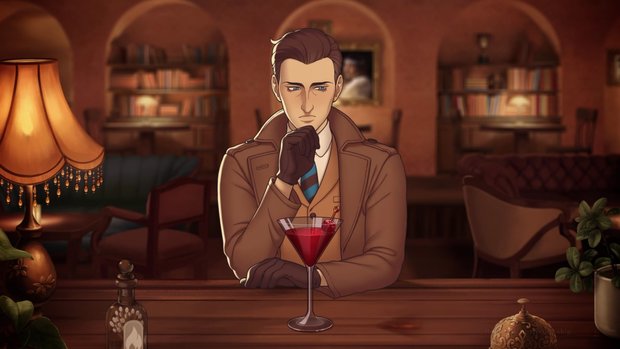
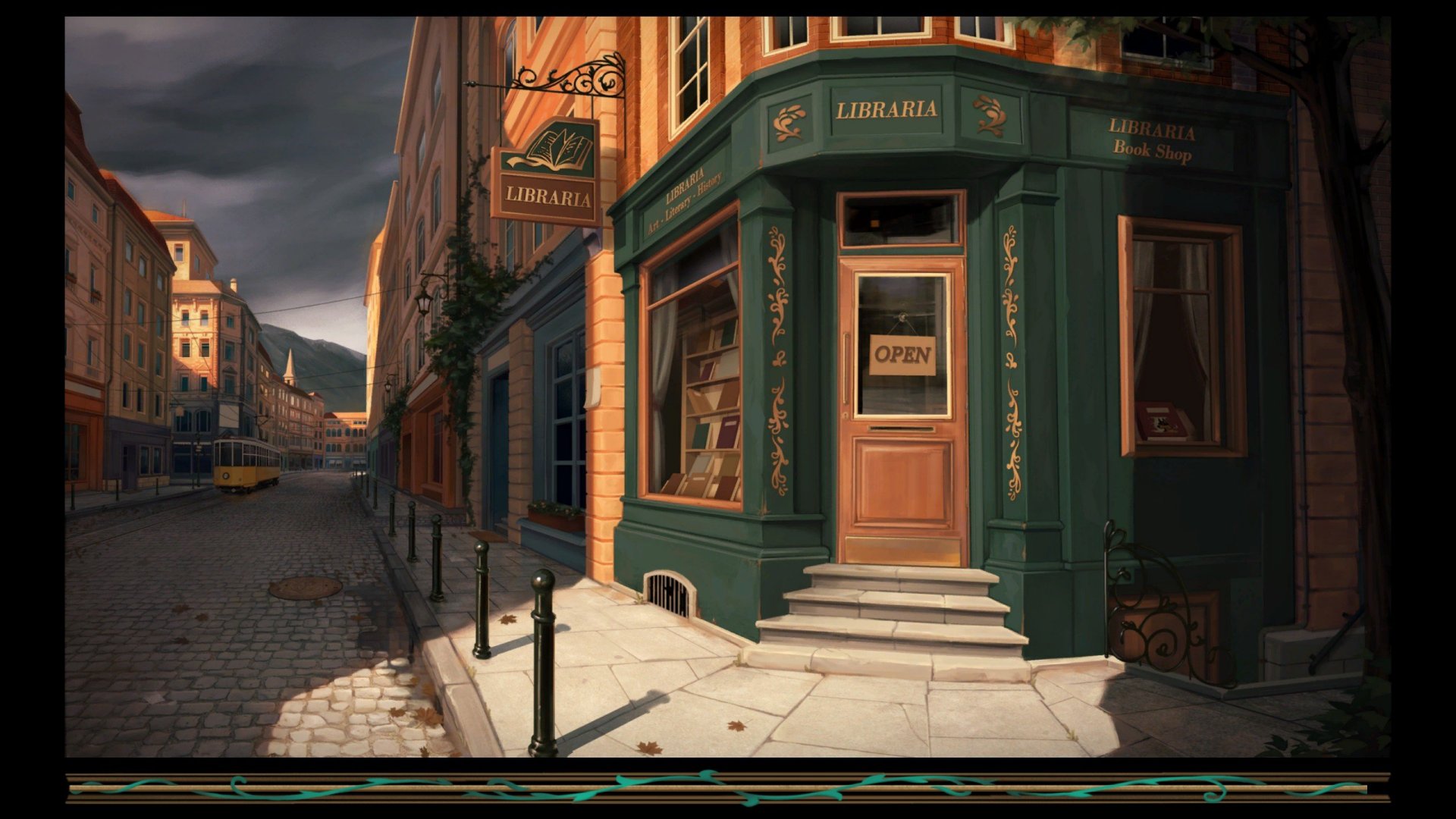
Best Served Cold takes place in a speakeasy hidden under a bookstore in the nation of Tsara, in its capital city, Bukovie. It’s 1929, and apparently Tsara has been daft enough to follow the example of the US in prohibiting alcohol. You’re the speakeasy’s bartender, but early in the game, Detective Mertens of the Bukovie police enlists you to talk to your customers to help uncover clues in a murder he is investigating. What follows is a well-designed, solidly written mystery deduction game blending visual novel elements with a decent cocktail-making minigame, though its languid start and interface tedium can make it an acquired taste.
There are five crimes to solve in total, although the first, “Episode 0,” is really a tutorial for the game, and also sets up a plot twist revealed in the final episode.
In terms of gameplay, there are several things going on here. First, there’s conversation with your customers coupled with the drink-making minigame, something players of games like Coffee Talk or VA-11 Hall-A will be familiar with. Second, there’s the detection aspect of the game, in which you try to learn information from your patrons as you talk to them, and then “present clues” to other characters to get their take on things, potentially uncovering other interesting details about the people with whom you’re dealing. You end the day by clicking on a bell on the bar, mostly because some of your customers have gone home, you’ve explored all available options with the remaining ones, and it’s time to end things and see who shows up on the next day. You then return to your apartment, where you have a pinboard on which you can connect clues to each other, potentially revealing even more clues.
Your apartment also has a bed, which you click to move onto the next day. Also, a cat. Yes, you can pet the cat.
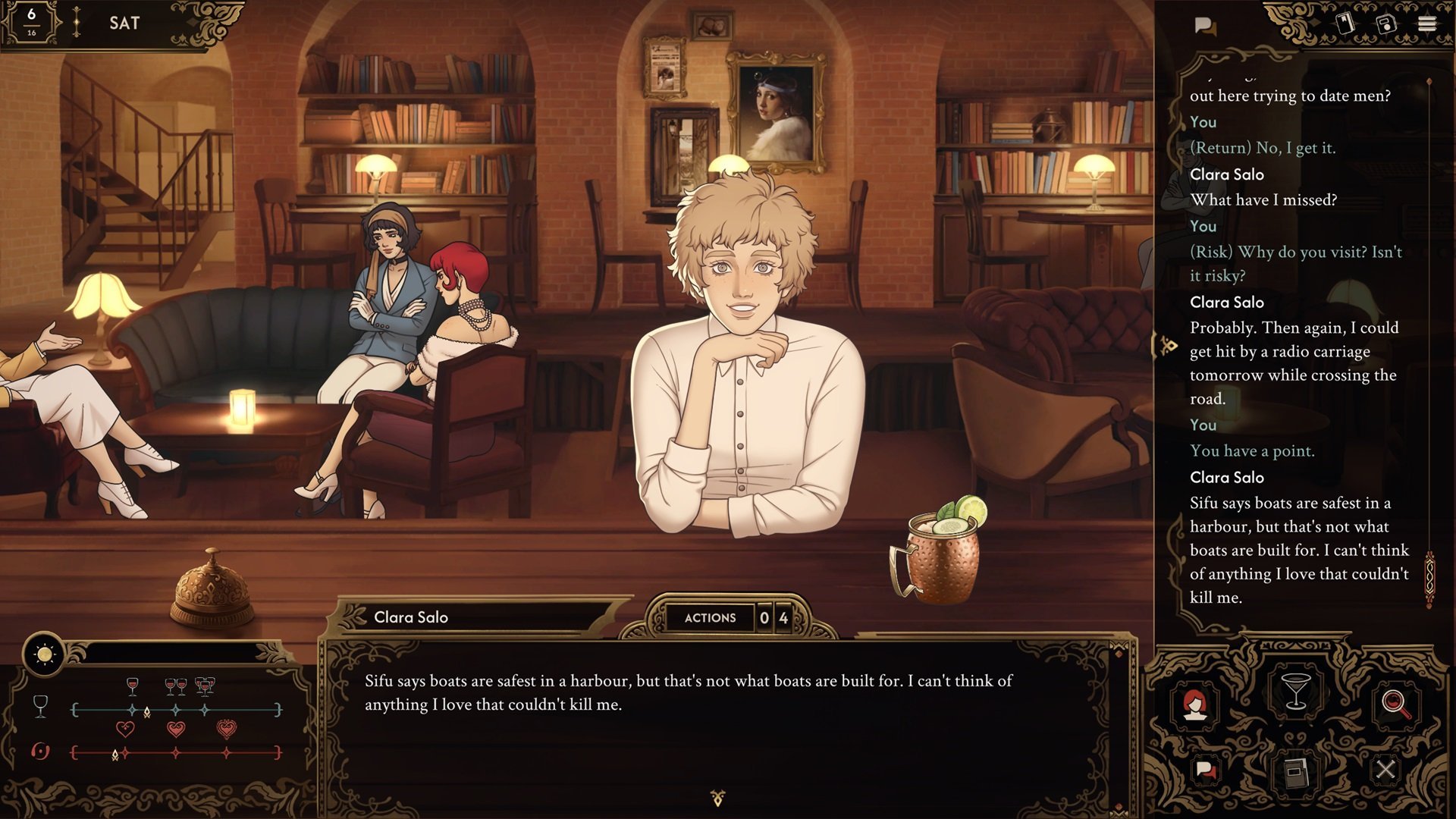
When you select someone from the background to invite them up to the bar, a menu of ten possible beverages appears. As it happens, each character has between one and three preferred drinks, and it’s worthwhile to try to discover which ones are their favorites, for two reasons. First, making someone a drink they like increases their affection for you, which can unlock new conversational options. Secondly, you can typically present only one or two clues to a character each time you encounter them, but serving any drink increases this by one, and serving a favorite drink by two. Interestingly, the menu changes over the course of the game, so even if you’ve identified one favorite, it may no longer be available later. Most characters have a “What kind of drink do you like?” dialog option, so that helps (“Oh, make me something sweet and dark with a citrus element”), but it may take you several days to identify a new favorite. (You can only make one drink per customer per day.)
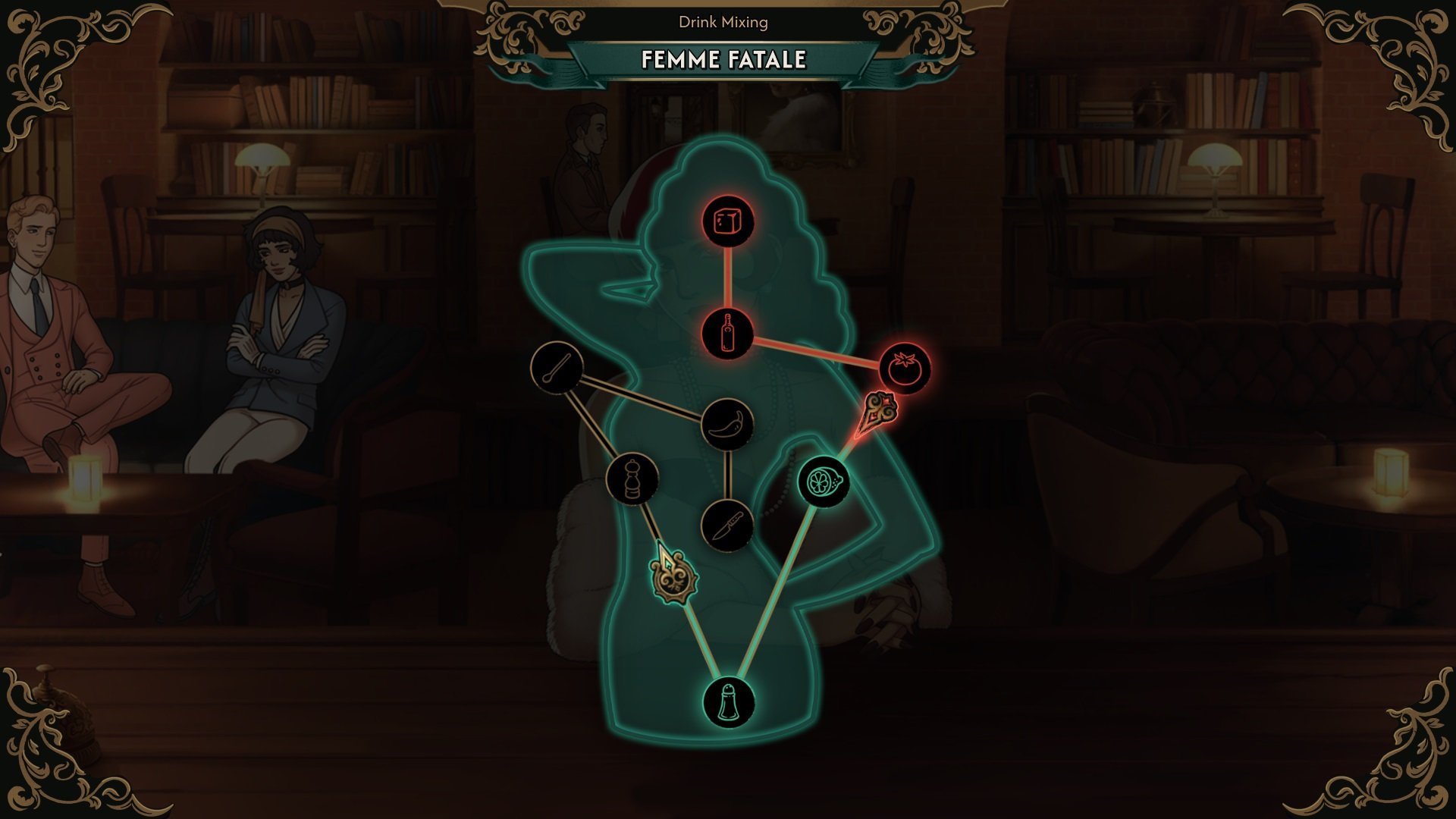
The drink-making minigame is moderately fun, albeit it doesn’t really have any resemblance to actually mixing cocktails. A blue oval appears, with a blue image representative of the drink’s name within it (e.g., the “Copper Bullet” has a bullet design). Overlaid on this is a series of nodes in a particular shape. An arrow starts at one node of the shape, and you have to swipe your mouse around to follow this shape like a game of connect-the-dots. (Alternatively, you can use a thumbstick, since the game has console versions and the PC version supports a controller, but I played with mouse-and-keyboard.) Shortly after you begin, a red image starts to follow your arrow around the shape; you must guide the arrow to the final node quickly before the red image catches up with you. If you fail, you make a bad drink, the character you are talking to gets into a “bad mood,” you don’t get to present additional clues, and their affection for you falls.
Once you’ve played this a few times, it’s quite difficult to fail. Not impossible, but the “moving your mouse in the next required direction” system is pretty forgiving, and precise motions are not required. The main thing to keep in mind is that you must keep your pointer within the blue oval; if you get nervous and move it outside, your arrow does not progress (until you yank it back inside the oval), so it’s possible to sabotage yourself by playing too nervously. Keep calm, focus on where you need the arrow to go, and you’ll be fine.
Mind you, sometimes conversational gambits require your partner to be in a bad mood, so you’ll want to make them a crap drink. Easy enough. Symbols on dialog choices like this display an icon, with mouse-over revealing the requirements, so it’s pretty easy to figure out how to progress – e.g., I need to increase their affection for me to a higher level (making them favorite drinks helps, but so do conversation options that flatter or please them); or they need to be in a bad mood; or they need to be really drunk, so to unlock this option I need to make a strong drink, not one of their favorites.
Another way to screw up, by the way, is to make someone a drink that’s too strong. When you start to prepare a cocktail, a bar appears that shows you what makes that person tipsy, drunk, or inebriated (capacities vary by character). If you inebriate them, they go home, with no further opportunity to talk or present clues. I screwed up one investigation because Father John kept asking me to make him something strong, and I took him at his word, losing out on several opportunities to interrogate him.
Best Served Cold

| Genre: | Mystery |
|---|---|
| Presentation: | 2D or 2.5D, Slideshow |
| Theme: | Crime solving, Psychological |
| Perspective: | First-Person |
| Graphic Style: | Illustrated realism |
| Gameplay: | Simulation, Visual novel, Deduction, Dialogue |
| Control: | Point-and-click |
| Game Length: | Long (more than 10 hours) |
| Difficulty: | Low |
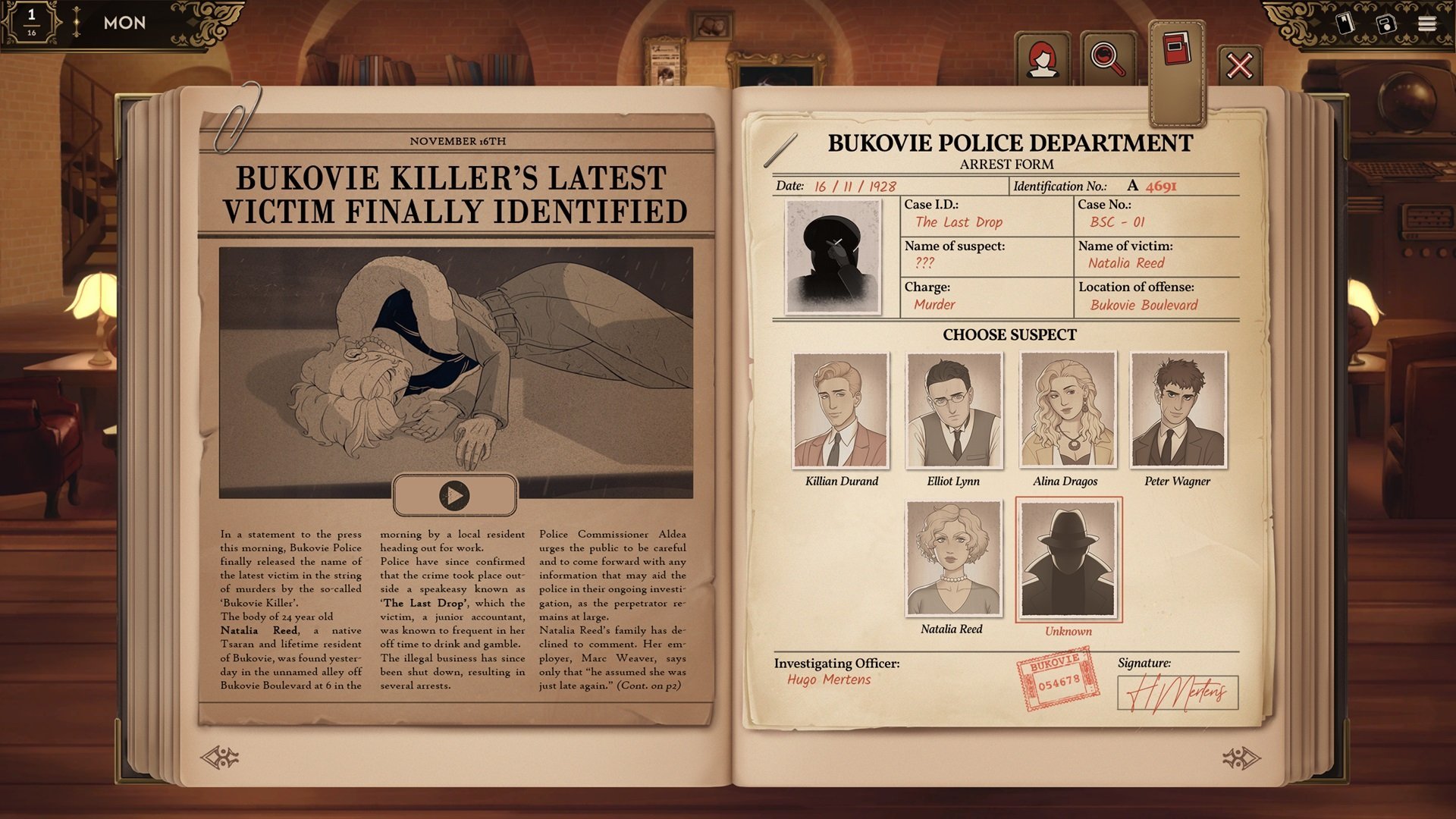
Clues you uncover through conversations appear as cards in the “Clue” tab of your notebook, but only at home with your pinboard can you identify connections between them by drawing lines from one clue to another. Thus, for example, a character may attempt to confess to a crime (in order to protect someone else), but other clues prove that they were not even at the scene of the crime at the time it was committed, invalidating the confession. When you draw clue connections, you either get an error beep, or a new clue (“False Confession,” say). Any target clue you’ve tried to draw a connection with in the past is grayed out, so you can, in fact, brute force this; try everything with everything. But it’s more satisfying to try to solve the puzzle logically.
Each investigation lasts 16 days, and on the last day you are required to present your conclusions. If you’ve done well, you’ve uncovered several suspects. For each, you may have identified their motive, opportunity – and for all but one, an alibi. If you haven’t uncovered all clues, this does not halt the game; the police don’t have enough evidence to make an arrest, you don’t get the related achievement, but oh well, on to the next crime.
The characters themselves vary widely, in terms of age, gender preference and expression, and dialog style. The owner of the speakeasy (and its masking book shop) is an older gentleman of somewhat rightwing views despite his defiance of prohibition; there’s a gay couple from very different class backgrounds, a non-binary character, and strong implications of female relationships as well. (This is, by the way, not anachronistic for the period; certainly, the Jazz era had largely heteronormative expectations, but spaces open to gay and lesbian people were common, at least in larger cities.)
Conversing with the characters through the available choices and learning more of their backstories (automatically logged in your journal as you uncover new things about them) is one of the most engaging aspects of the game. Dialog is unvoiced apart from some opening narration, but this didn’t bother me at all. The writing is pretty good; characters do have diverse personalities and speak differently. One oddity is that, in the final episode, dialogs include romance options, which feels like an unnecessary bolt-on to the game; it has no effect on gameplay, nor does it add meaningful emotional resonance. (Romance options are not gender-determined, not that your bartender character’s gender is ever disclosed; the protagonist is never portrayed visually.)
The graphics in Best Served Cold are appealing in a well-drawn 2D visual novel sort of way. There’s practically little animation, but each character has several images that vary by their emotional response, with dialog choices swapping from one to another. There are only the two locations (bar and home), but since the cast of characters varies from day to day, this does not feel repetitive. The artwork and character dialog impart a strong sense of the Prohibition era. Clothing styles are obviously well-researched, and some characters evince an almost palpable sense of dread about the likelihood of a forthcoming war.
The music is varied enough not to become jejune, but it is very much along the lines of lounge music – maybe not inappropriate to a bar setting, but this is the Jazz age, after all, and I think an opportunity was missed by not playing into a more jazzy approach. There are audio stings as well – a cocktail shake during the drinks minigame, a ding when you ring the bell on your bar (which signals closing time for tonight), a few others.
The mysteries themselves are varied and interesting, most but not all involving a murder, with the motives of the culprits twisty, taking some time to tease out. There’s also a gentle difficulty ramp over the course of the game. In the first case, you already know all the suspects, and in the final one, you have no idea who might be involved at the start, and need to uncover suspects even before looking for motives and opportunities.
There is one thing that annoyed me over the course of the game, however: the glacial pace of even routine functions. Let’s say I’ve exhausted options with a character and want to end the conversation. Fine, there’s an “end conversation” button. Does that end the conversation? No. Here’s how it works:
Click end conversation (click one). Game says “Do you want to end the conversation?” No is not an option, but you have to click through (click two). You have a dialog choice, something like “I need to get back to work,” with something like “Continue” (don’t end conversation yet) as an option. Click three. Conversational partner says something like “I’ll let you get on with it then (click four).
From the moment I clicked the “end conversation” button, it was obvious that, you know, I wanted to end the conversation. And if for some reason I wanted to engage this character again, they’re sitting in the bar and I can click on them to talk anew. So why did it take four clicks to end the damn conversation?
Cumbersome interactions are true in other ways, too. For instance, I click “Make a drink.” Click one. I ask, “Would you like a drink?” Click two. Character says, “Yes, please.” Click three. I make the drink (minigame). Drink appears by the character; they say something like, “Looks great!” Click four. Now I’m finally back to the conversation/clue presentation game. Okay, the minigame in the middle is a necessary part of gameplay, but this took me four clicks when it could have taken one. Maybe two, to back out if I opt to.
Now, this might be more forgivable if the dialog ever changed. But while it does vary by character, it’s the same thing, every time with a particular character. I’m not learning anything new, encountering new dialog: nothing. It’s just delaying gameplay for no obvious reason.
Sorry, but this is kind of a lousy player experience.
Final Verdict
Best Served Cold is an interesting amalgamation of a visual novel and detection game through bartending counter service, customer conversation, uncovering and connecting clues, and assisting the police. Its character design, visuals, and audio are appealing, and the mysteries it asks you to solve are well conceived and produce interesting stories. The Prohibition-era setting also is also intriguing, so it’s a shame that the player experience is marred by occasionally tedious design elements that could have been improved to remove friction. I have to admit that its slow pace put me off, but it is strong in terms of art, writing, and mystery design, so those who prefer an extremely relaxed pace may like it more than I.
Hot take
It’s sometimes defeated by its slow pace, but Best Served Cold melds mystery solving, visual novel-style conversation, and bartending in a stylish Prohibition-era setting in an interesting way.
Pros
- Twisty mysteries to solve
- Diverse and appealing characters with pretty good dialog
- High-quality 2D graphics
- Interesting Prohibition-era setting
Cons
- Somewhat awkward and sometimes tedious user experience
- Romance aspect feels bolted on, not part of actual gameplay
Greg played Best Served Cold on PC using a review code provided by the game's publisher.

- Advertisement
- Help support AGH by advertising with us







0 Comments
Want to join the discussion? Leave a comment as guest, sign in or register in our forums.
Leave a comment