
Shadows of the Afterland review
- 3 Comments

Stupendous spectral adventure where crossing over breathes life into a grand mystery
Dying sucks. At least, so I’ve heard. An end-all, be-all finale to life tends not to elicit warm fuzzy feelings. In the case of developer Aruma Studios’ Shadows of the Afterland, however, death isn’t just an entryway into a vast new world unlike anything imaginable, it’s a necessary step in the cycle of rebirth and discovery that leads towards uncovering our true self. The problem is that you’ve arrived before your appointed time, and something fishy is going on. This creative and beautifully designed point-and-click adventure is a mesmerizing supernatural whodunit, and an ongoing bout with mortality is well worth attempting to wrestle back your place among the living. The twists and turns of this tumultuous tale shine bright with a memorable cast of ghostly characters that bring their unique world of death to life.
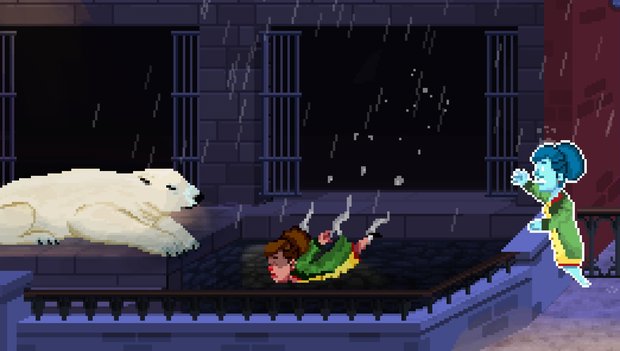
Shadows of the Afterland begins where most stories end – with your demise. It’s the year 1960, and Pilar Cuevas is living in Madrid, Spain under the brutal dictatorship of Francisco Franco. Pilar was visiting the city zoo, same as any other nightly trip to see the caged tiger who has long been her trusted confidant. But when a mysterious force pushes Pilar’s spirit out of her body, she is forced to watch in horror as her body leaps gleefully into a bolt of lightning before tumbling away into darkness.
You next arrive as Pilar – but not Pilar – in a strange welcoming center staffed by floating blue humanoids taking down information from new arrivals materializing through the massive vortex-like portal from which you too emerged. When asked your name, instead of Pilar, you recall your name as “Carolina,” a police officer from the year 1988. Instead of Pilar’s voice, Carolina’s voice comes out of the specter you now inhabit. Even your personality is completely different – once you glide through that portal, you are Carolina, except that to outward appearances you still look like Pilar (if a slightly different hue than before). Now it’s up to you to figure out why you’re experiencing memories from a not-yet-born cop from nearly thirty years in the future while stuck in a dead woman’s spirit incarnation, and possibly unravel a conspiracy that could change the afterlife forever.
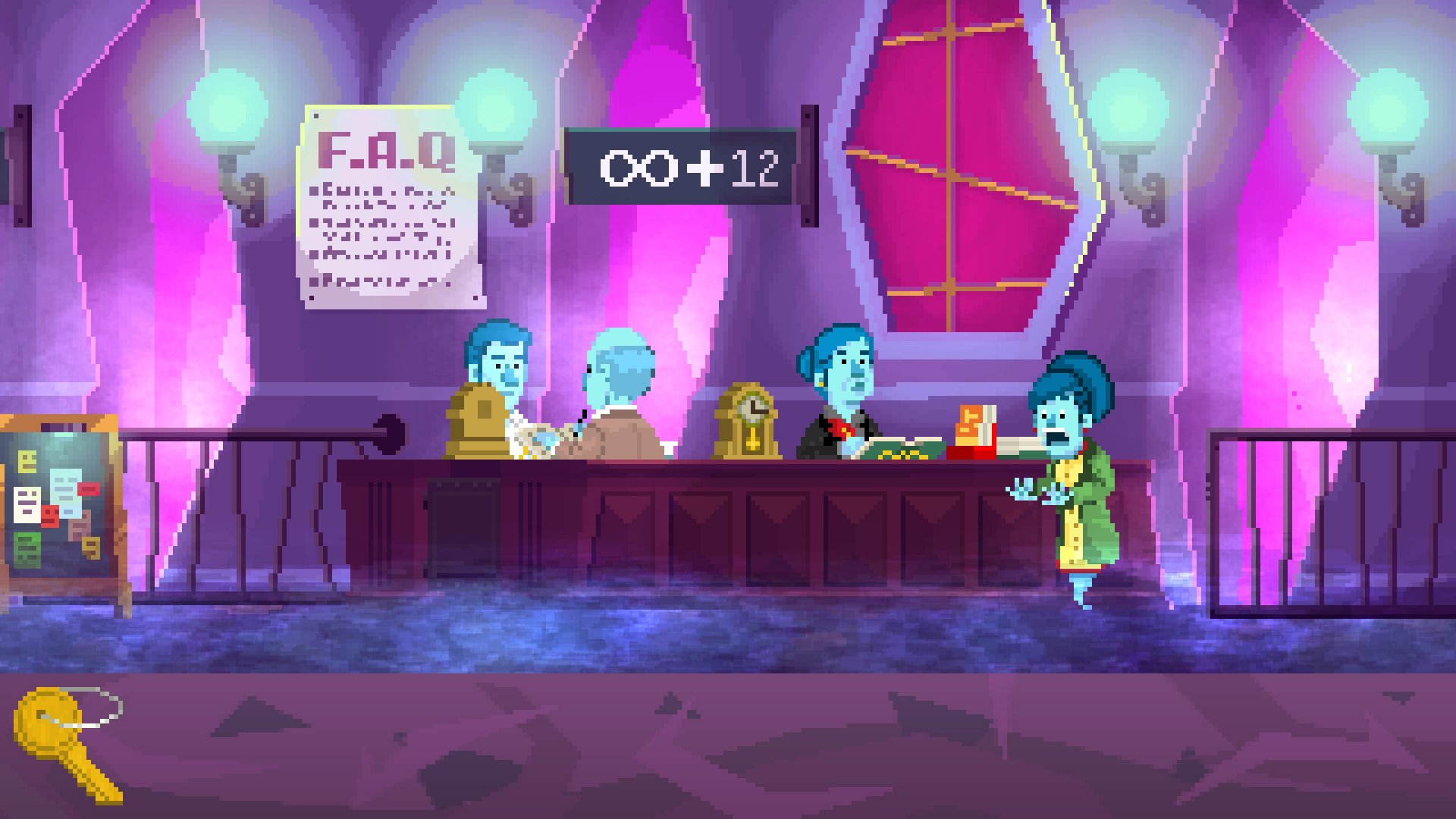
Getting around the realm of the dead (and later the living – again) is easy, with a simple one-button mouse interface. Everything from examining objects to moving about and chatting with the locals is handled through left clicks, with the option to double click to go faster. Interactive objects in the environment can be highlighted with the Tab key, and any available in the area will be shown as a white triangle. I found the hotspot indicators to be a bit small compared to other similar systems, but they work in a pinch when scouring particularly busy environments. The game can be paused with a press of the spacebar at any time, and the menu with save/load functions is accessed via an icon at the top right. Collected items are displayed at all times at the bottom of the screen in an inventory bar, depicted with charmingly chunky cartoon images.
Indeed, right off the bat, the entire presentation is stunning in its gorgeous retro aesthetic (even with a cursor ripped straight out of the early SCUMM era). Everything in Shadows of the Afterland is drawn in a colorful pixel art style, with cartoon flourishes that make everything pop. Each character is detailed with synced-up mouth movements and facial expressions that change to suit their mood in dialogue. All of the ghosts inhabiting the afterlife are light blue with a little wisp where their legs used to be, but fully clothed and still carrying any objects they had on them at the moment of their death. One specter carries around a red cape, indicating a less-than-victorious last hurrah with an angry bull, while another has a pillow at her side while adorned in the nightgown she wore during an unfortunate stumble in the dark.
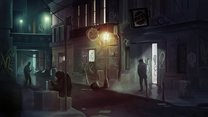
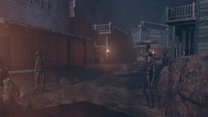
Backgrounds are equally full of personality, the buildings and interiors of the afterlife all appearing abstract, with purposefully disjointed architecture that gives a sense of twisted whimsy. The color palette here is equally abstract, with light blues, purples, and pinks making up the majority of the spirited locations Carolina visits. The surreal nature of the afterlife design is contrasted brilliantly with the mundane, down-to-earth look of the locations in the land of the living. The buildings and backgrounds there are precise and rigid, with realistic structures dominated by reds, grays, and greens. The music in both realms is largely whimsical and mysterious, often with lots of violin, flute, brass, and ethereal-sounding glockenspiel jingles. It’s not particularly bombastic, but serves as solid background fare to go along with your travels.
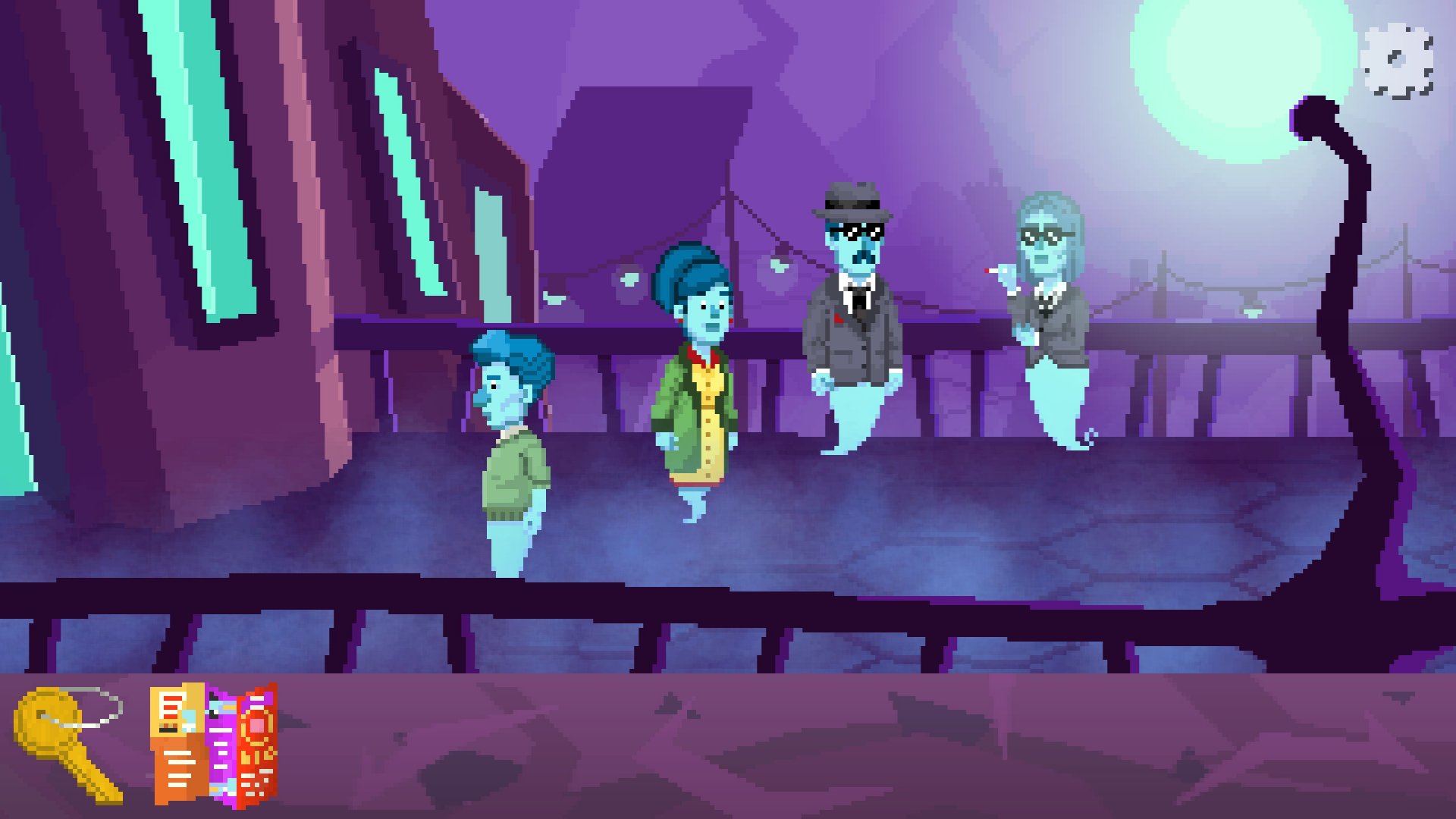
Instead of floating around, the still-breathing cast of Shadows of the Afterland are animated with meticulous walk cycles and other movements that feel much heavier than the blissful weightlessness of the ghosts in the afterlife. The choice of setting the story in Madrid during 1960 was deliberate, showing the daily struggles of people just trying to get by during a period when life was tough for a lot of them. In life, Pilar worked herself ragged as a maid trying to provide for her family, while her husband Salvador could not hold down a job. A woman at the local zoo wears an eye patch she obtained after attending a protest speaking out against Franco’s dictatorship.
Experiencing all of this as a policewoman from 1988 leads to some great interactions and moments that really endeared Carolina to me, especially with the standout voice performance by Ivy Dupler (though the entire cast brings their A-game with full speech throughout). After you gain the ability to head back to the not-yet-dead world, Carolina finds herself in 1960 instead of the life she remembers from the late 1980s. As a ghost, Carolina can no longer directly interact with the physical world around her, but she can possess a living host and move them around like a puppet by clicking over them when nearby.
Shadows of the Afterland
| Genre: | Mystery |
|---|---|
| Presentation: | 2D or 2.5D |
| Theme: | Afterlife, Paranormal |
| Perspective: | Third-Person |
| Graphic Style: | Pixel art |
| Gameplay: | Puzzle, Quest |
| Control: | Point-and-click |
| Game Length: | Short (1-5 hours) |
| Difficulty: | Medium |
The perspective of playing a protagonist out of time made me connect with Carolina’s experience a lot more than if it was simply someone from 1960 talking about daily life. There are multiple times while you’re exploring the afterlife where other spirits straight up don’t believe Carolina when she says she’s a police officer. Back in the living world, there is a section where the game requires you to possess a man’s body to speak with a sexist grouch who refuses to talk about matters of importance to a woman.
Being able to possess the living is a fun mechanic that allows for some unique puzzles that make full use of your ghostly form. Each person you take over has a separate inventory and speaks with the voice of the possess-ee, leading to new dialogue options that would not otherwise be available. One particularly involved sequence has you possessing all three members of a family, with each character having to pass items between one another while convincing the other non-possessed members that what you’re doing makes sense.
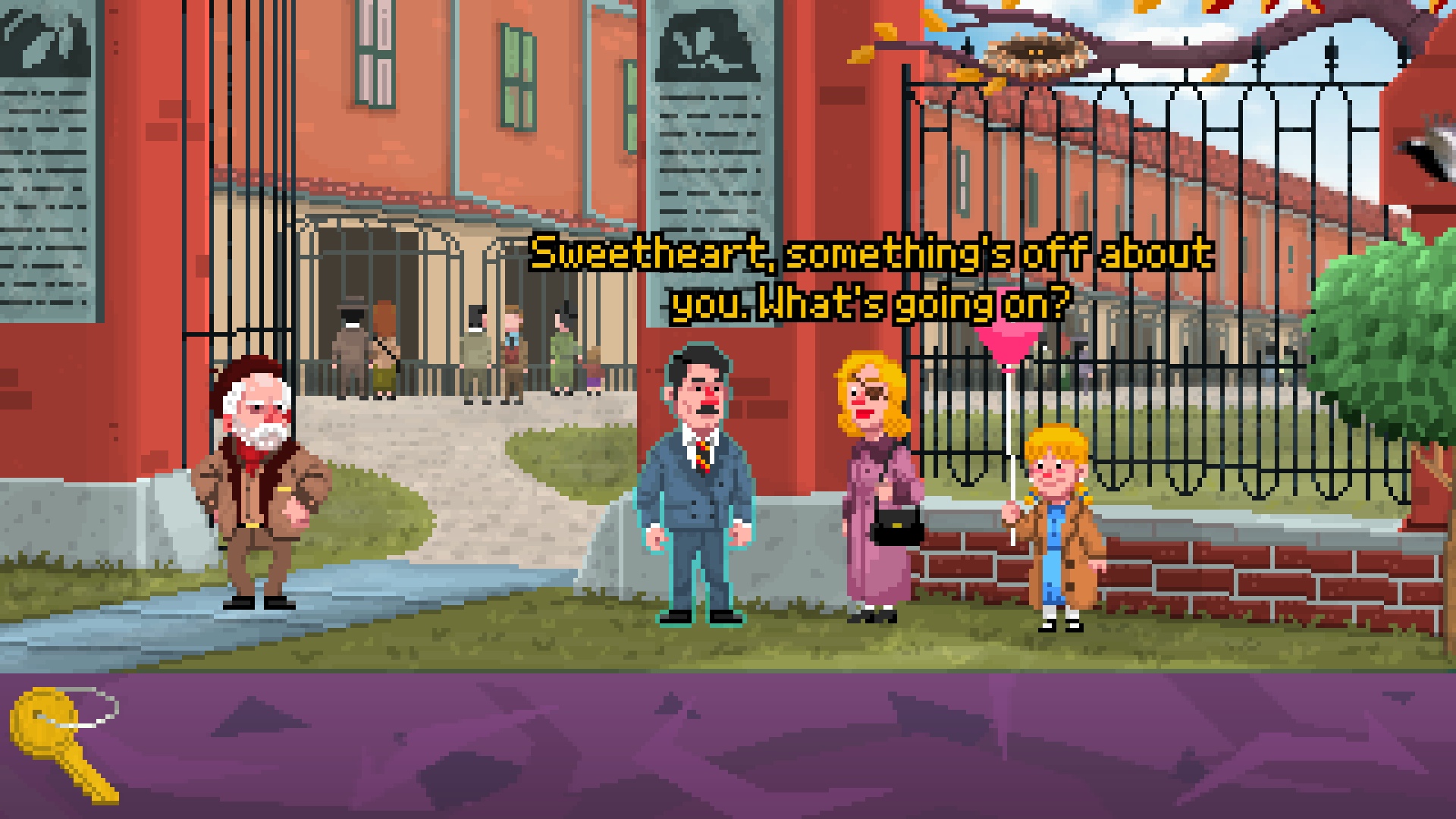
Due to its prevalence in the promotional material for the game, I was surprised that you don’t perform your first possession until roughly halfway through. I was even more surprised when it proved to be only one of a small handful of occasions where you utilize it. The family possession sequence scratched the complex puzzle itch I was looking for with its promise of people puppetry, but later sequences largely amounted to simply controlling the right person rather than balancing multiple item inventories and conversations at once. What’s here is really enjoyable, but I would have liked more layered puzzles in the roughly five-hour runtime dedicated to this unique mechanic.
That isn’t to say the puzzles outside these sections aren’t enjoyable too. Inventory obstacles abound in Shadows of the Afterland, with plenty of item-based teasers to keep adventurers thinking. Agents of the Elite Spectral Squad help escort lost souls from the living world to the spirit realm, but their stronghold and realm-hopping technology requires the use of special eyewear in order to fully visualize their inner workings, leaving you to track down the means of infiltrating their security while figuring out how exactly it works.
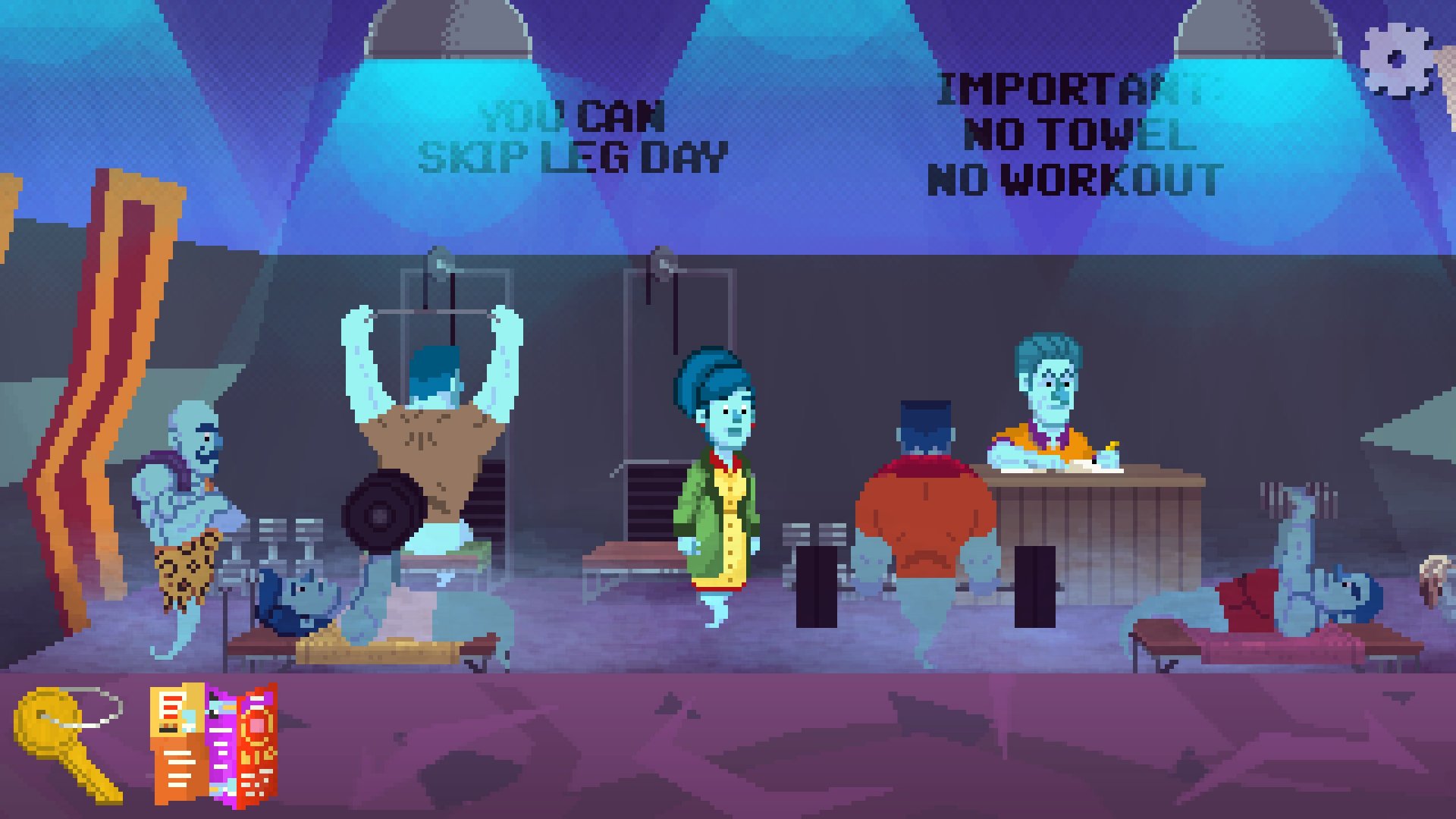
The Eternal Soul Foundry, where new souls are created, resembles a nursery with baby cribs lined up next to a bubbling pure soul cauldron (which you definitely, DEFINITELY won’t be using for any sort of nefarious purposes). One puzzle requires you to get absolutely shredded in order to fulfill a task for an ex-agent named César. Thankfully there’s a fully stocked ghost gym at your disposal, but they have very specific rules for anyone wanting to work out there. The setting weaves puzzle solutions into the world design in clever ways, which helps to make it feel believable as an actual place that could exist.
It isn’t a perfect dance of the dead, as there is some noticeable tonal inconsistency in the scenarios you encounter. Shadows of the Afterland is largely light-hearted, but the drama and grim realities of the world feel at times incongruent with more typical adventure game humor. Take, for example, the woman with the eye patch at the zoo: You know that she was injured in a protest that went south, but you end up using that reminder of a very real trauma in a very adventure gamey way shortly after you learn of her backstory. The same goes with many of the ghosts you meet, as nearly every spirit you talk to has an option in their dialogue tree to inquire how they met their end. Some are darkly humorous, like the charming salesman Gregorio bragging about how he sold so many new televisions that his TV tower toppled over. But just as many ghosts have legitimately tragic backstories, many of them referencing the Franco regime.
These tonal issues are minor nitpicks in the grand scheme of things, however, as the majority of the narrative experience here is fantastic. This is a beautifully realized world where death and rebirth are at the forefront thematically. A major aspect of the afterlife is the opportunity to be reincarnated, essentially recycling your soul into a new life rather than a new soul being brought into existence. Characters grapple with the idea of what makes them who they are, and whether they are worthy to ascend to some kind of greater plane or should continue on their path towards spiritual purity across many lifetimes.
All the while, Carolina puts her policing skills to the test in uncovering the circumstances that somehow brought her to the afterlife before she’s technically even born. The mystery of what happened to Pilar on that fateful night at the zoo gradually unravels to reveal a sinister plot that has wormed its way through the afterlife undetected. Eventually, bits and pieces of Pilar’s memories begin drifting into Carolina’s mind, and the different perspectives provide deeper insights that wouldn’t exist from just a single point of view. I genuinely wanted to see both Pilar and Carolina have happy endings, whatever they might be. I was especially invested in seeing Carolina dispense justice when it turned out the source of all of these undead misfortunes were caused by an outside source.
It’s a shame, though, that while I enjoyed the emerging villain’s backstory, I couldn’t shake the feeling that I was missing some sort of inciting incident that caused them to turn into the person they are now. You uncover the details behind the evil deeds, but by the time you start to learn a bit more about what makes them tick, the credits roll. While the ending ties up everything nicely, it seems like it comes surprisingly quickly after ramping up events dramatically in a hurry. The game doesn’t feel too short for the story it’s telling, but I was eager to go even deeper into the lore and backgrounds of its inhabitants.
Final Verdict
Shadows of the Afterland is a fantastic point-and-click adventure in a fascinating setting that begs to be explored to the fullest. The mystery surrounding Pilar’s death and Carolina’s presence is continually captivating through the threads that unravel, and the supporting cast of characters and scenarios elevate the story to some surprisingly emotional heights. Even with less spectral possessing than I would have liked and some roller coaster tonal shifts, this is a very special game that will undoubtedly hold a place in the hearts of adventure gamers everywhere. And for a game where your protagonist doesn’t have a pulse, that’s a pretty impressive feat.
Hot take
In every sense of the word, Shadows of the Afterland is a spirited point-and-click adventure that weaves together a gripping post-mortem mystery into an ironically lively setting with a lot of heart.
Pros
- Gorgeous pixel art and animation
- Fascinating contrasting worlds of the supernatural afterlife and the land of the living during 1960s Francoist Spain
- Intuitive puzzles utilize the unique setting in clever ways
- Entertaining story with lovable characters brought to life(?) by a stellar voice cast
Cons
- Some tonal inconsistency between generally light-hearted comedy and darker dramatic realities
- Ending is abrupt with a central antagonist that isn’t fully fleshed out
- Enjoyable possession mechanic is underutilized
Sam played Shadows of the Afterland on PC using a review code provided by the game's publisher.

- Advertisement
- Help support AGH by advertising with us




3 Comments
Want to join the discussion? Leave a comment as guest, sign in or register in our forums.
Playing the game as well now. I'm not that far into it yet but it sounds like we have very similar opinions. Good job with the review, as usual!
Reply
This has been high on my want to try list. Glad it got a good review,!
Reply
I just discovered another big plus of the game: the recap system when you continue after you've quit, showing a short montage of conversations you had earlier explaining why you are where you left off and what the current objective is. More adventure games should use this technique!
Reply
Leave a comment