
Rue Valley review
- 0 Comments

The ending lets it down, but you won’t regret playing this lengthy, time-looping narrative RPG
Rarely do I replay games with multiple endings. I don’t like the repetition, in combination with the fine-tooth combing needed to do one small thing differently which may (or may not!) lead to another outcome. For the same reason, I tend to stay away from games with time loops. Guess I just prefer more linear stories and games where you only have to do things once, and that’s it. Emotion Spark Studio’s narrative RPG Rue Valley, however, appealed to me with the cinematic presentation and user-friendly playability of its time-looping technique, so I decided I’d give it a try.
As Eugene Harrow, you are forced to live through the same forty-seven minutes over and over again, but each loop is just different enough to keep things interesting. Rue Valley focuses more on a flowing narrative than repetitive puzzling. It’s a very dialogue-driven, isometric game that prefers delving into human psychology instead of offering much in the way of puzzles or gameplay challenge. There are some issues with the voice-overs and animations, and the game fails to offer a decent resolution to its Groundhog Day mystery, but overall the blend of drama and humor makes for a very entertaining story.
It’s the year 2027 when we find ourselves in the desert town of Rue Valley. There’s not much to the area: a central motel, a gas station and graveyard to the south, a bar and a ranch to the north. Outside of town, a place you never actually visit but which is central to the storyline, lies the rocket base and headquarters of Coral Destiny, a privatised space exploration company determined to colonise Mars.
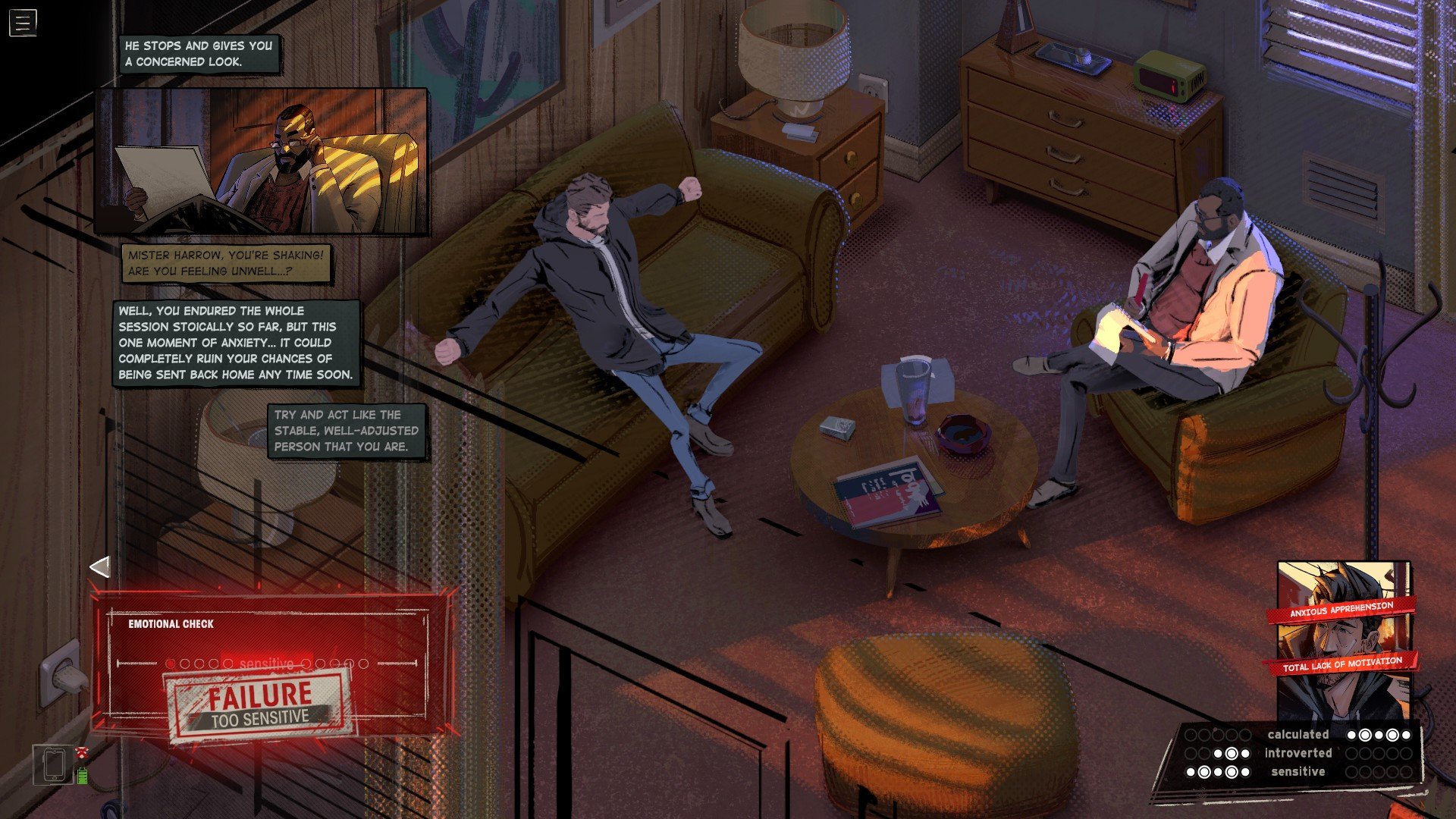
Eugene is a scruffy guy in his late twenties, down on his luck and feeling as if the entire world is against him. He’s been forced into court-appointed therapy sessions with one Dr. Finck, whose office is situated in Rue Valley’s motel. During my playthrough, I never quite discovered what exactly Eugene did to find himself in this predicament. I did learn he has plenty of issues to work out, and strange dreams to analyse. I didn’t manage to talk to Dr. Finck about them all, though that definitely is possible, depending on how well you manage your available actions – but more on that later.
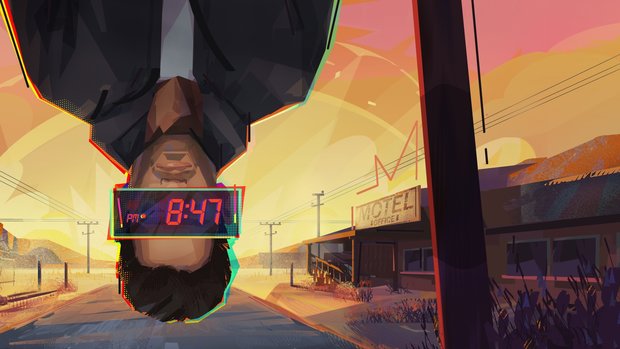
Rue Valley starts at 8 pm, when Eugene’s first session with Dr. Finck is drawing to a close. In-game time advances by performing actions or talking to characters. At 8:47 pm, the evening sky suddenly turns to fire, going from dark blue to a fierce red, a burning yellow and finally a piercing white that seems to swallow the world whole. A mysterious, loud, thunder-like noise drowns out everything else. It all gives the impression of a nuclear bomb going off somewhere nearby.
The next moment, however, it’s 8 pm again, with Dr. Finck once more addressing Eugene in his office, as if nothing happened and this is the first time they are seeing each other. Eugene, however, recalls what occurred and is fully aware that something strange is happening, and realizes soon enough that he’s stuck in a time loop. While he lacks the willpower to actually pick up the pieces of his life and make something of it, he does need to figure out what’s going on exactly and how to escape the loop.
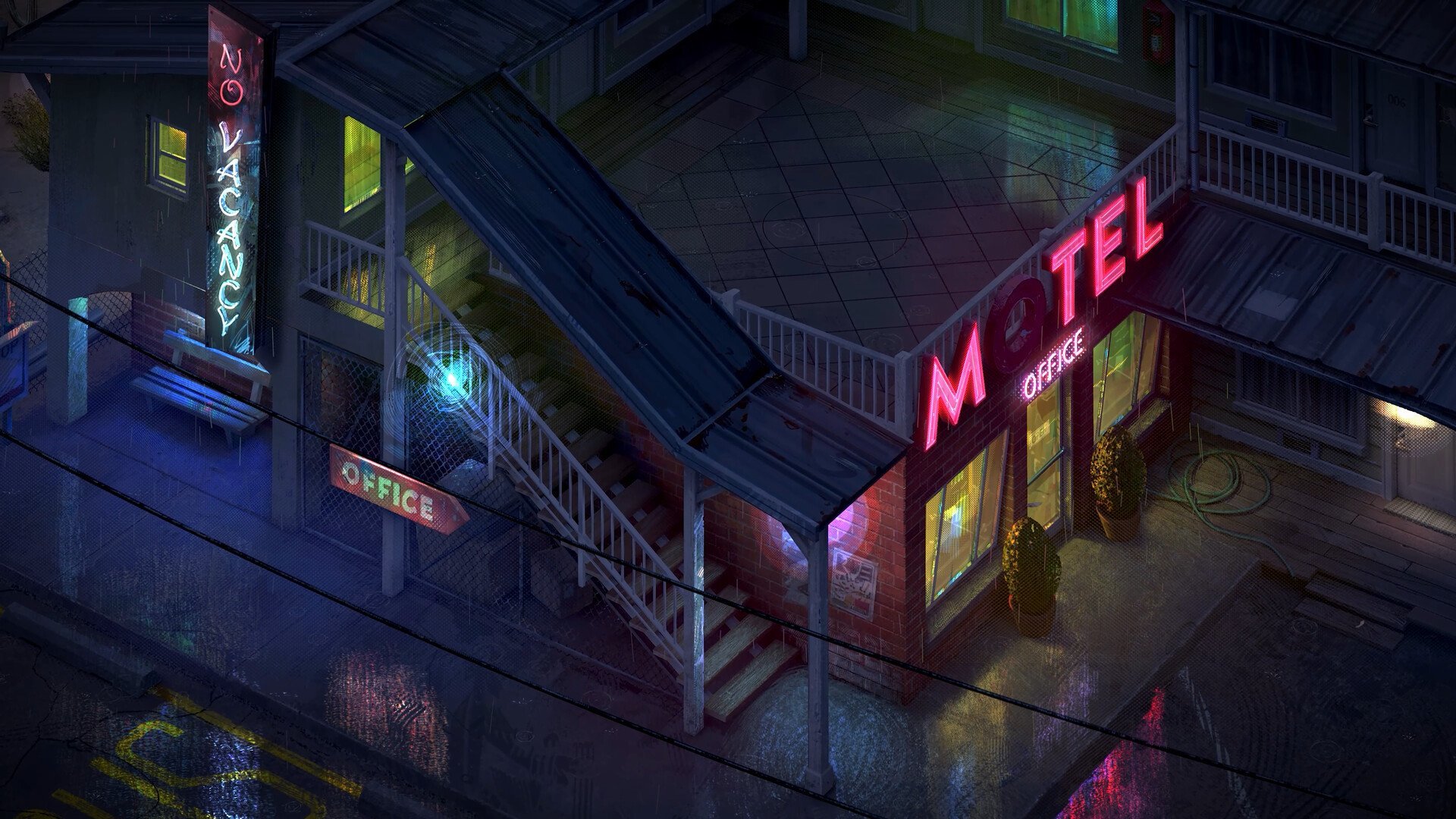
Eugene has been provided with a room at the motel as well, though it takes some effort getting the key from the receptionist, Robin, who is more interested in explaining everything about their electronic lock system. Once you have successfully obtained your keycard, you can choose whether to crawl in bed, or fall into it. Both choices lead to funny, cartoonish animations.
It’s a shame, then, that so many other actions you perform aren’t animated at all. It can be simple things, like Eugene accepting a sleeping pill from Dr. Finck, but the most striking example is when Eugene knocks on the door of a neighboring motel guest: a conversation will ensue, but despite the text explicitly stating that the door is opened, it actually remains closed and you never even see the other character emerge, just their portrait in the dialogue bar.
Rue Valley is presented in isometric style, but everything else screams “graphic novel.” The game’s main menu is made up of several comic-style panels, as are the close-up portraits of characters during conversation. Dialogue text, appearing on the left side of the screen, doesn’t scroll up but rather seems to flip into another page once it has reached the bottom.
This rundown, isolated world is subtly animated with power lines swaying in the wind, flickering lights, and rain showers. There are lots of sound effects like the patter of said rain, rumbling thunder, and the electric systems shutting down and restarting after a fierce lightning strike. The soundtrack never dominates what you see on screen. Most scenes are actually very quiet, reinforcing the desolation of the town. But some scenes use music for comedic effect, like when Eugene heads to another location and a jazzy lounge band accompanies his erratic driving style.
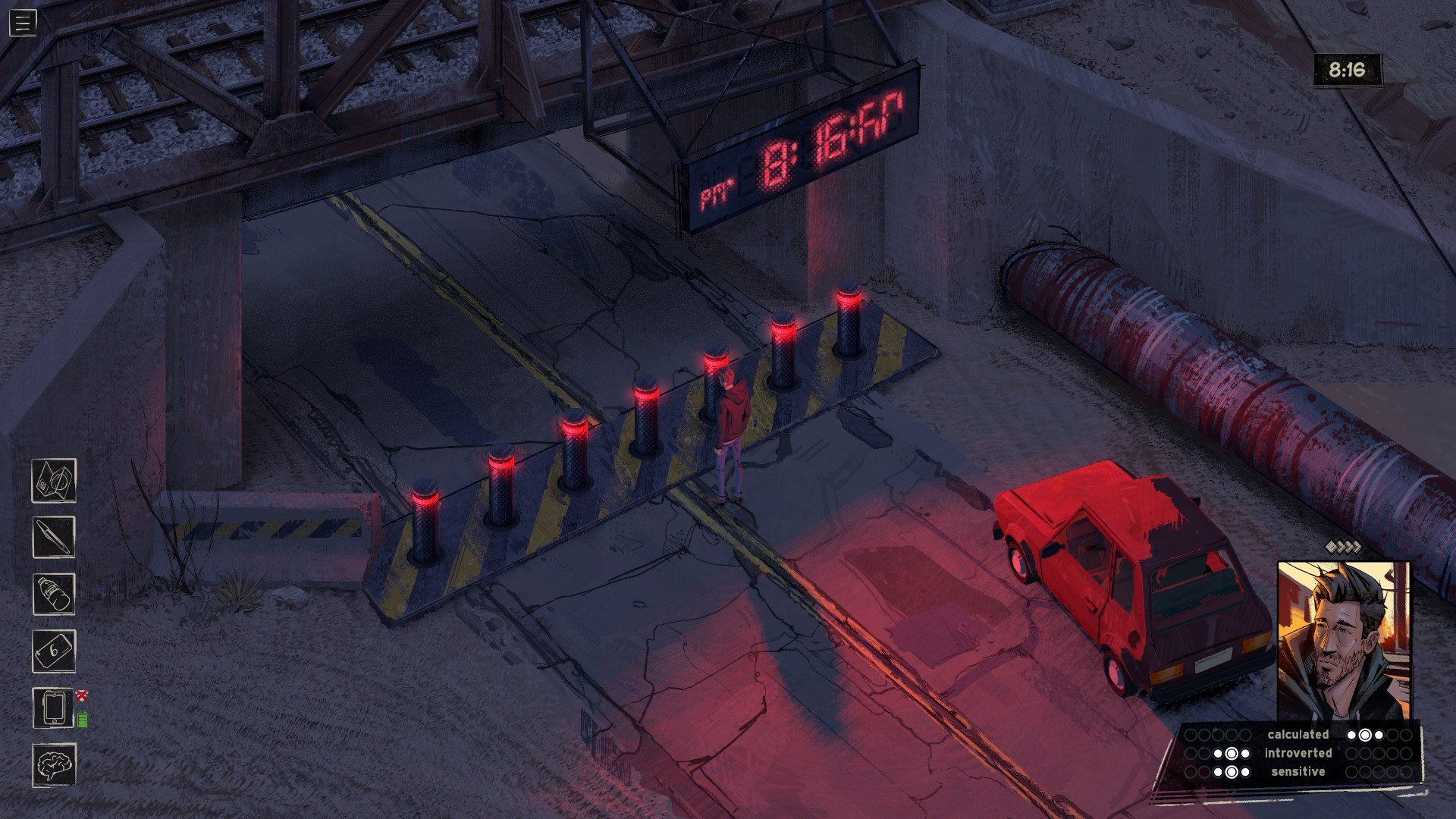
The rain, unfortunately, also plays a part in one of the flaws of the game. When you find yourself at the gas station listening in on a conversation between the owner and a customer, you learn that the latter is waiting for the rain to let up. After a while, they’ll mention the rain is indeed stopping. However, you can still see and hear the rain coming down just as hard as before. It’s one of several instances where what you hear doesn’t fit with what you see.
There are several inhabitants of Rue Valley you can interact with, such as Robin’s parents Anitta and Ben, who used to own the motel together but are now divorced, with Anitta having moved out to a bar with her new boyfriend Travis bartending. The most prominent family here are the Kays, who used to have quite the political history in the area and still own a ranch house, though the few remaining members are long past their glory days. Elderly Walter often vanishes from his room, even though the outside doors are locked and he doesn’t have a key. Mostly, though, Eugene will deal with Walter’s children: Alex, a paranoid conspiracy theorist and Maxine, the owner of the gas station. Finally, there’s another brother and sister duo: Frank, the mechanic at the gas station, and Riley, a former Coral Destiny astronaut.
Except for the narrator – which is actually Eugene’s inner voice – all characters are voiced, and voiced well. When you’re going to be talking to people over and over and over again, hearing them say the same things again and again and again, you want it to remain funny and insightful instead of irritating, and this cast definitely succeeds in avoiding that frustration. These roles are performed by talented actors who make these characters sound very human, but should you tire of the repetition, you can always fast-click through the dialogues.
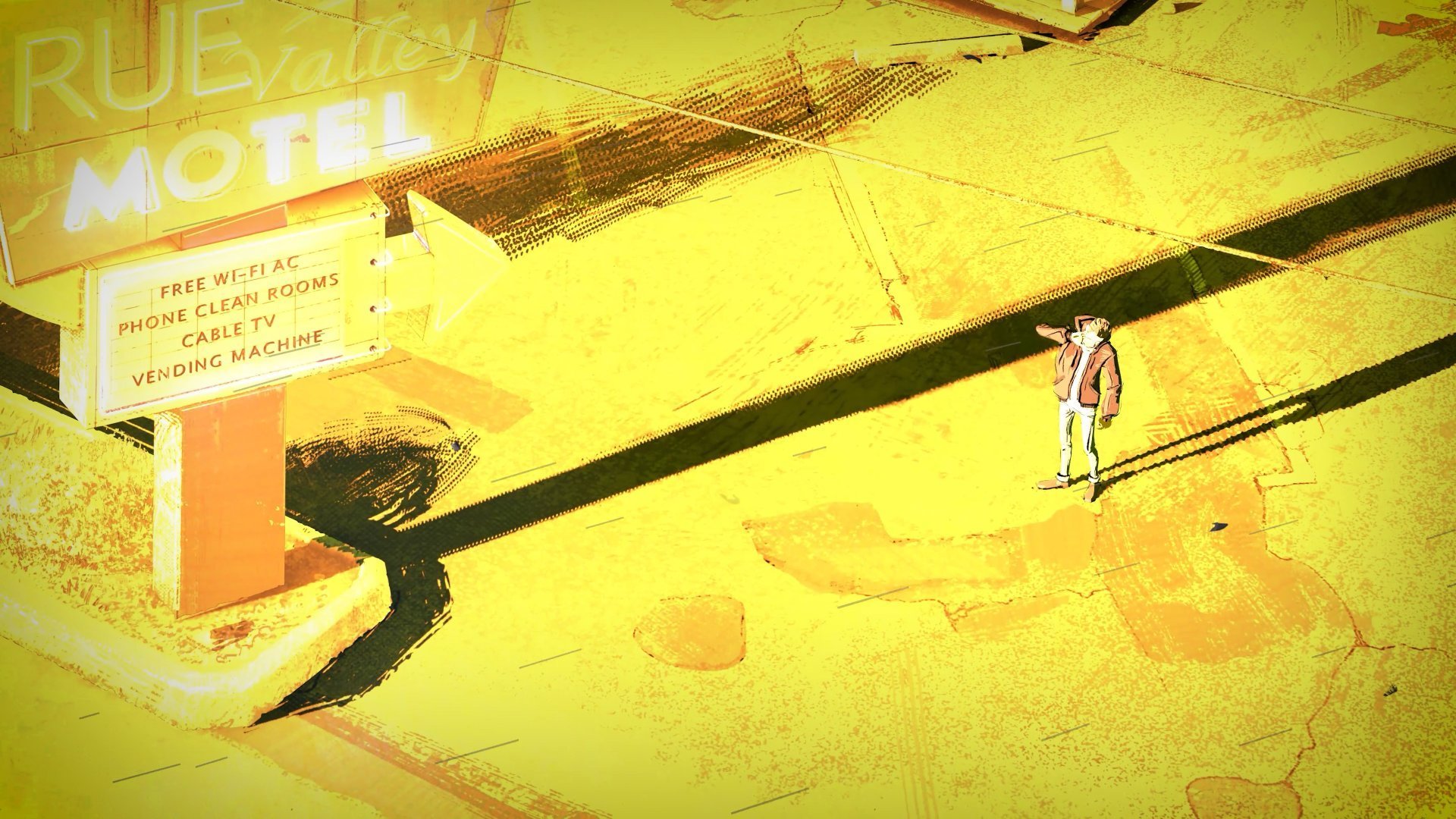
Quality voice-overs are also necessary in a game that focuses so much on human psychology. Rue Valley’s story is filled with insecurity, self-doubt, grief, guilt, love, obsession, making it a very serious, emotionally human tale – though not without its lighter moments, like when you can goof around with the sales representative who always calls you at 8:15 pm. Usually I would hang up on him, but sometimes when I didn’t immediately know where to go next I’d accept his call. I’d have preferred more extreme dialogue choices when talking to him, but perhaps that might have veered too much into comedy territory under the circumstances.
There are some audio hiccups, however. Not all lines are voiced for some reason, resulting in a very weird experience; sometimes with conversations where only every other line was voiced. And even then, the voiced lines might be entirely different from the on-screen text, as if the actors were more paraphrasing or giving their own spin on the content of their lines. To me it felt like the lines had actually changed for the voice-overs, but the developers failed to update the text as well. I quite enjoyed the writing itself, though since I’m no psychologist I don’t know how accurate some discussions actually are, especially the parts with Dr. Finck about dream interpretation and his psychoanalysis of Eugene. It definitely came over as believable to me.
Rue Valley
| Genre: | Drama, Mystery, Science Fiction |
|---|---|
| Presentation: | 2D or 2.5D, Isometric/Overhead |
| Theme: | Psychological, Time travel, Self-discovery |
| Perspective: | Third-Person |
| Graphic Style: | Stylized |
| Gameplay: | RPG, Choices matter, Narrative |
| Game Length: | Long (more than 10 hours) |
| Difficulty: | Low |
I mentioned Groundhog Day earlier, and much like how Bill Murray finally charms everyone in that film, Eugene will have a special moment with each and every character in Rue Valley. By learning who they are, he will also learn more about who he is himself, and ultimately this leads to the end of the story. There are always several leads you can follow up on, and it seemed to me very possible to pursue them in any order you want. At the same time, I regularly felt that the game was pulling me along a predefined course, offering shortcuts when it was obvious what I wanted to achieve during a particular loop.
Your biggest task in Rue Valley is exploration. Every major event is fixed in time, each character’s path set in stone. You just need to find out where and when everything occurs, where and when everyone is, and what you can use to your advantage to figure out what exactly is happening to you. Situations change when time progresses, people leave one place for another, and events might alter their moods, making them more willing to help you out or even block you off completely if you talk to them too early or too late.
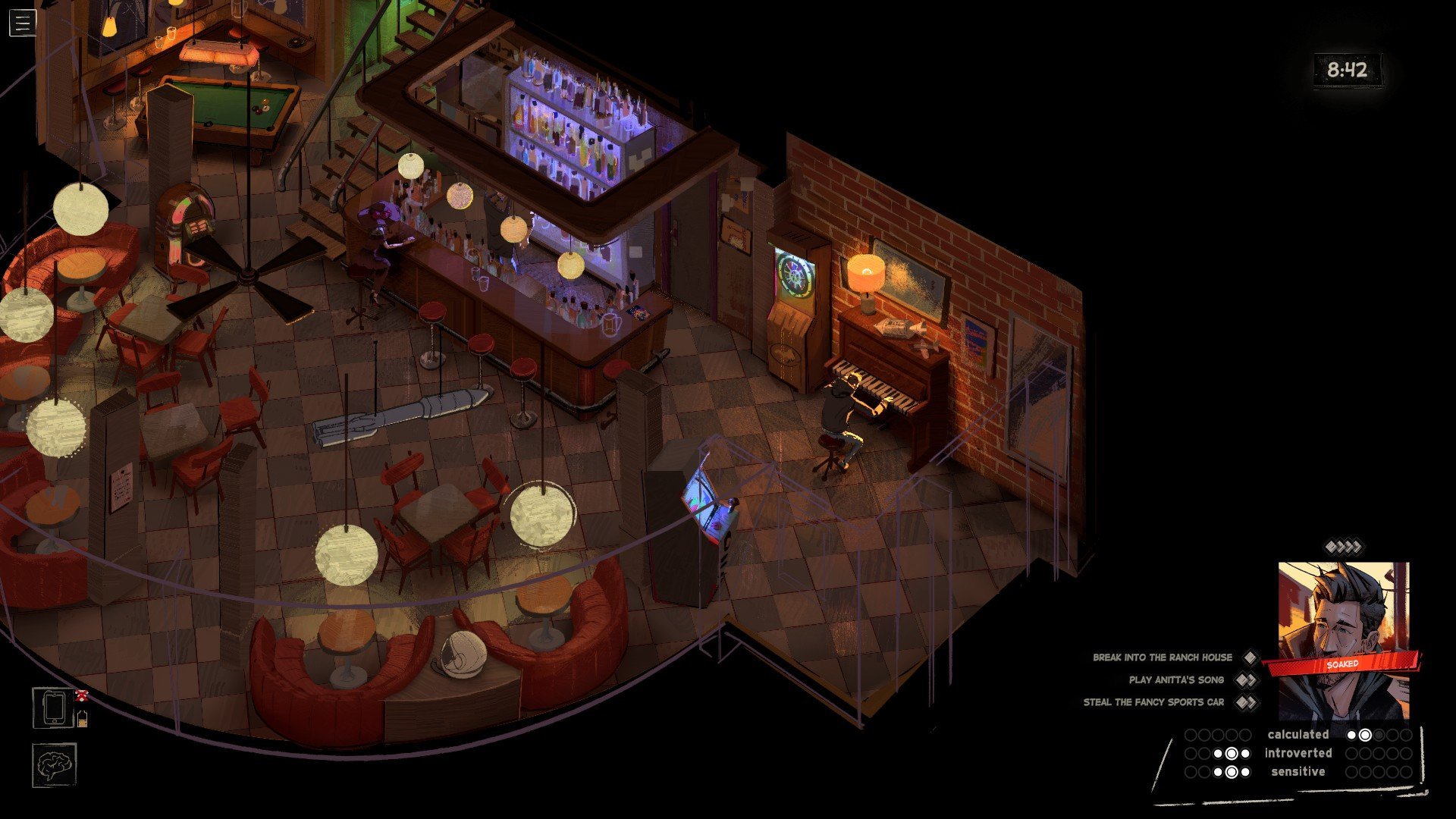
When you start the game and everything is still normal, you can’t keep track of the time. But once it’s established that Eugene is stuck in the time loop that always ends at the exact same time, a clock appears in the top right corner so you can keep track of the forty-seven minutes you have to gather as much information as you can in each single run.
Just like in a traditional adventure game, each location has a number of hotspots. Hover over them with your mouse and they become visible through some kind of graphic novel-style filter that makes them shimmer a bit. You can also press the right mouse button to highlight all hotspots on the current screen so you can make sure you haven’t missed anything.
Rue Valley doesn’t have any inventory puzzles, but there are a handful of items you can carry with you, some of which you can use to get your hands on information needed to progress, like a cell phone with internet access – so long as you are able to charge the phone somewhere and find the Wi-Fi codes of the places you visit. When the loop resets, however, so does your inventory, though Eugene will remember all the codes and phone numbers he has learned so you never have to search for them again.
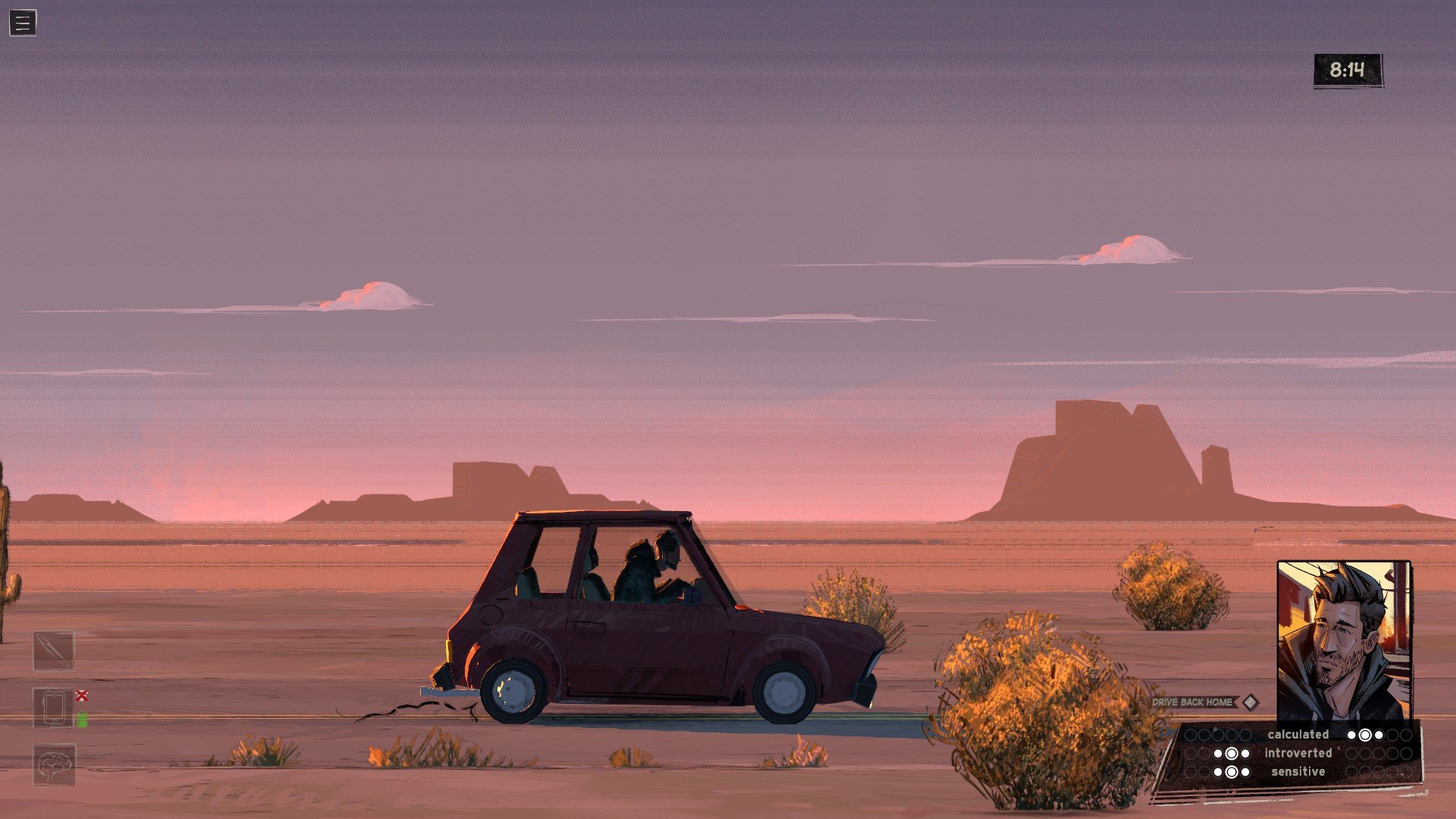
Before the game actually starts, you have the chance to determine Eugene’s personality. In true role-playing style, you have some points to divide between several character traits. You can make Eugene introverted or extroverted, sensitive or indifferent, impulsive or calculating. Each trait has two sub-traits that can dominate his behavior and influence the choices he can make along the way.
Your chosen personality traits determine your dialogue options. Some lines will only be available if you have a certain trait, while others might be blocked by that same trait. I found this didn’t seem to change the general course of the story much; the plot is very railroaded, and it’s only your experience on board this time train that might be different depending on how you act. In the end, the outcomes will always be the same, which is a missed opportunity to add even more endings to the two already here. Which is especially a shame, as the ending I got lacked a decent explanation and expected me to just go with the flow.
Along the way you might make the wrong decisions causing status effects, which have a negative impact on your personality and dialogue options available. These can range from physical injuries – for instance, when you try to break down a heavy door – to mental setbacks, such as a total lack of motivation due to incidents like becoming completely soaked in the rain or getting a wet sock from stepping into a deep puddle.
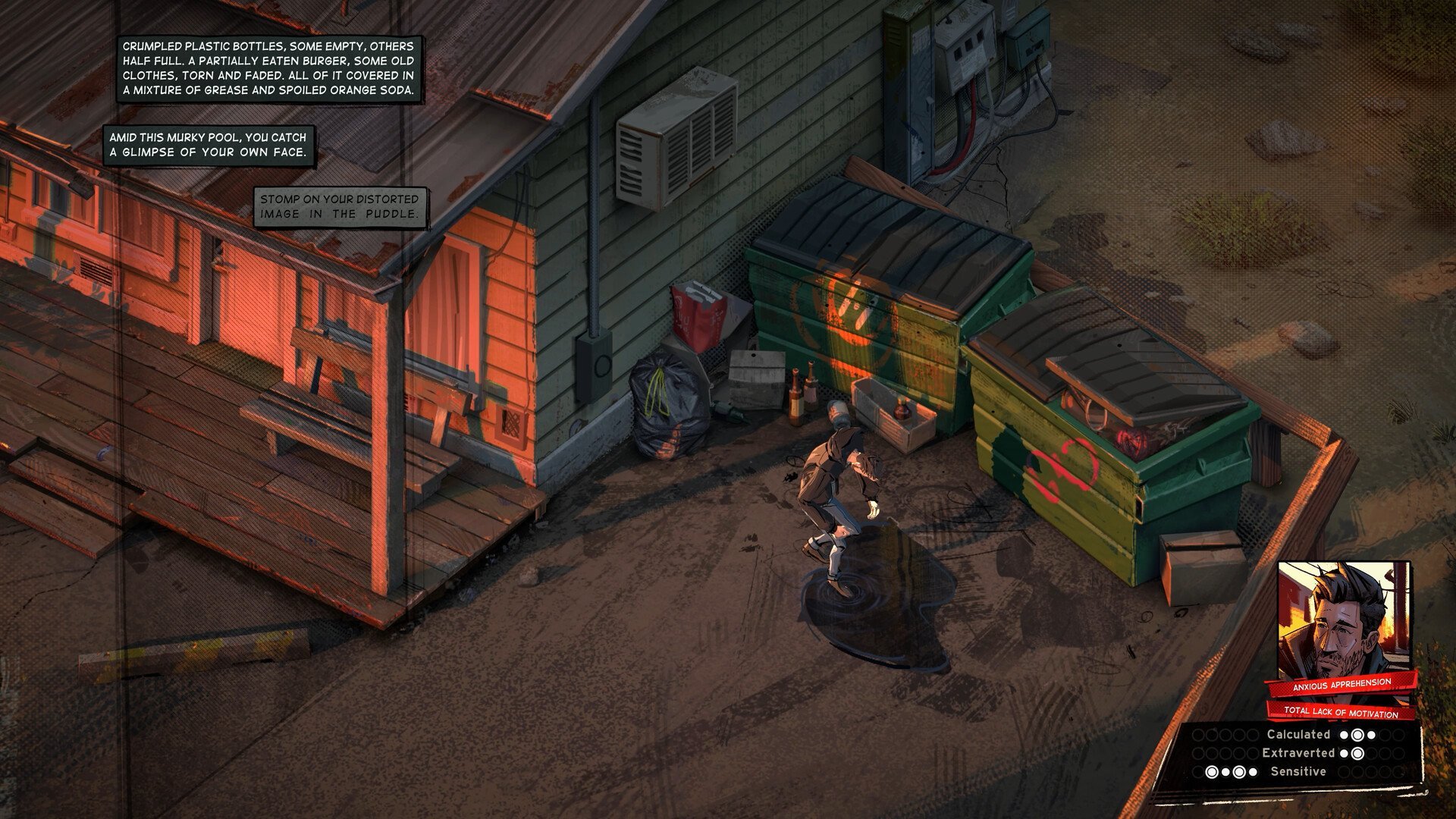
Sometimes a dialogue choice comes with an emotional check. I found these to appear quite randomly, and I rarely passed them. But I couldn’t really find a way to change my stats in a way that I would be able to succeed. For instance, during a conversation you might have the opportunity to ask someone a very personal question. The check will then look at Eugene’s introverted/extroverted personality traits. If it has developed too far in the wrong direction, the check will fail and Eugene’s inner voice will explain that he’s not confident enough to ask that question.
Rue Valley doesn’t have that open-world feel of Disco Elysium, nor its countless possibilities to roleplay your character to your preference. While playing, I never felt like all these elements formed a kind of obstacle to overcome; they just provided me with a unique playthrough based on how I shaped “my” Eugene. While this might tempt you to replay the game with “another” Eugene, to me it seemed that people’s reactions to my choices often would have fit all the other dialogue options as well.
Throughout Rue Valley you will find options to kill time, which you might want to do when waiting for a specific moment. Sometimes you can pass time efficiently, like picking up a book to read, but other times you have to be a bit more creative, like driving or walking up and down the road. The game is rather helpful at first in automatically skipping to the point you are interested in, such as when I sat down on a bench and could choose one of several future events. (Only after I was aware of their existence by having witnessed them during an earlier loop, of course.) However, doing so later on didn’t offer these options anymore, for reasons that still aren’t clear to me, which meant I had to go look for other means to progress time.
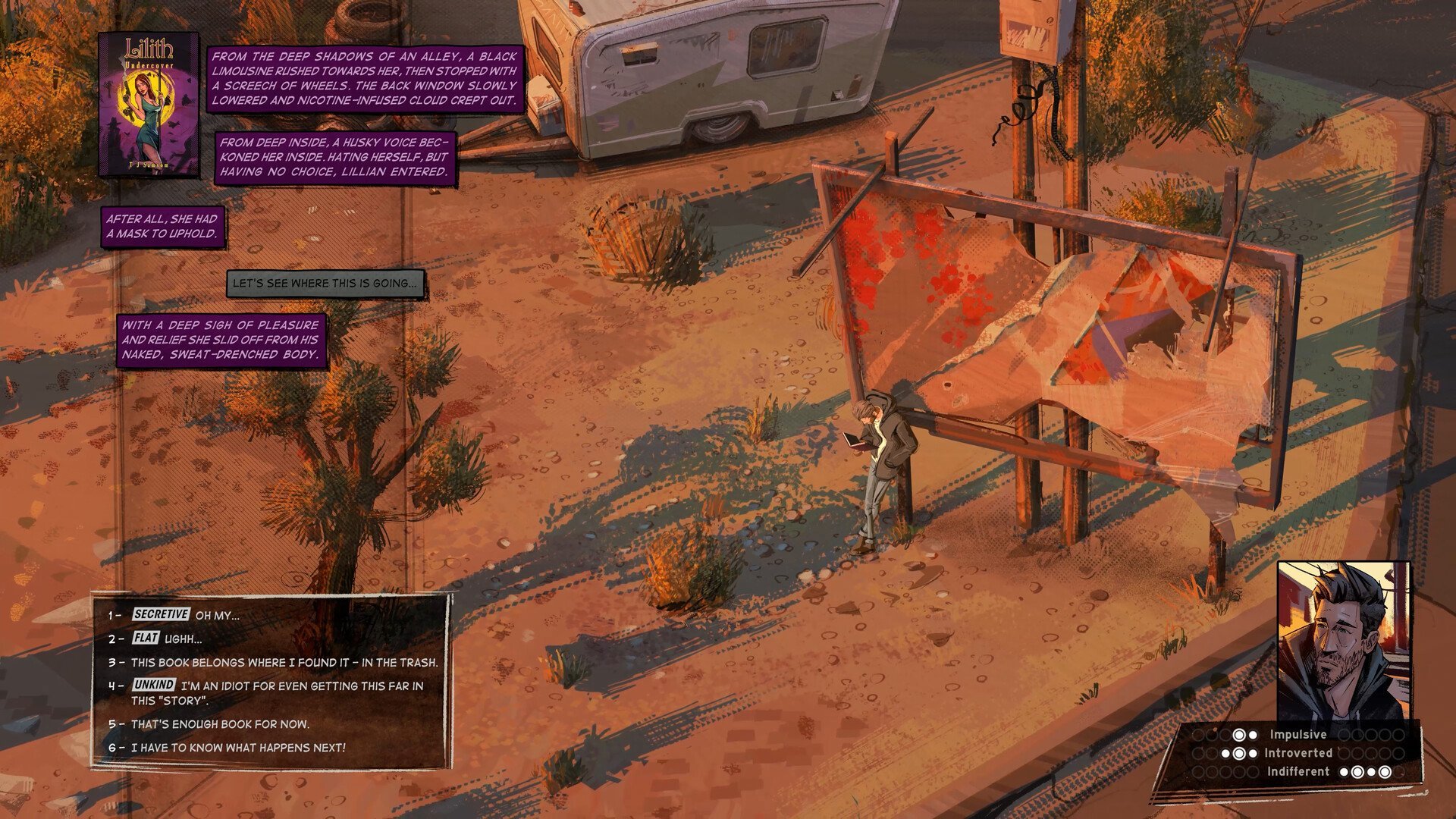
Rue Valley features a mind map, but it’s not used to make any deductions as you would in a detective or mystery game. This mind map works more as a journal or notebook, keeping track of all the information you have gathered, and any intentions you have which might succeed or fail. This overview of your plans further defines your dialogue options with other characters, or actions you can perform on objects. In order to activate such an intention, however, you need inspiration points. Thankfully you can find these all over town, most often by examining your surroundings, talking to people, etc. Interactions lead to inspirations, which then lead to other reactions, you might say.
Sadly, I found out the hard way there is a limit to the number of inspiration points – or at least, it’s possible to use them on things that aren’t necessarily important to reach the end of your journey. Some things are optional, like analyzing the dreams Eugene sometimes has between loops, while several key elements are important for moving the story in a positive manner. I finished the game after seventeen-plus hours just one inspiration point short of getting the good ending. Instead, my playthrough simply ended with a quick message that was anything but a satisfying reward for my troubles. Roll credits.
But it turns out I hadn’t missed all that much: the good ending too is a typical Groundhog Day finale, with no explanation of how our version of Bill Murray became trapped in the loop or suddenly woke up “tomorrow.” That would be okay if the game hadn’t been steering us so much into believing there might have been a possible scientific reason for the exploding sky, some mysterious radio signals, and the space-related projects of Coral Destiny.
In the end, it’s all about the why instead, with Eugene’s road to redemption coming down to helping one specific inhabitant of Rue Valley make amends with the past, which in turn teaches him to do it for himself. Contrary to all the other things you can try over and over again thanks to the time loop, you only get one shot at doing this, with your chance of success depending on how well you managed your interaction points throughout the game. If you fail, you can always reload one of your manual save files to give it another try, though you’ll probably have to go back a looooong way to really be able to make a difference. While I certainly didn’t rue my decision to play Rue Valley, the ending did leave a bad aftertaste.
Final Verdict
Despite some rough edges and shortcuts in terms of technical production, and a disappointing ending that leaves much to be desired, I enjoyed playing through this forty-seven minute time loop over and over again, partly because it very much guides you along the necessary path. Of course there’s repetition, but it’s not frustrating repetition, where you have to do the same tasks over and over again, just a tad differently to get a slightly alternate outcome as I have often experienced in similar games. Here you’re not aiming for that perfect run, you’re looking for all the pieces of the story puzzle, and when it comes to that, Rue Valley’s gaming experience and stylish presentation definitely succeed.
Hot take
It’s not as open-ended as other narrative RPGs and lacks a believable ending, but Rue Valley has an appealing graphic novel aesthetic and engagingly human time-looping story that avoids becoming too repetitive or frustrating each time it resets.
Pros
- Distinctive graphic novel aesthetic
- Role-playing elements offer replayability
- Flowing narrative prioritised over repetitive puzzling
- Relatable story focusing on human psychology, combining drama with comedic moments
- Talented voice actors bring the very human characters to life
Cons
- Not all dialogue lines are voiced or match the subtitles
- Plenty of missed opportunities to include more animations
- Ability to advance time can’t be used consistently
- Different personality traits and dialogue options don’t seem to impact the story much
- Disappointing ending leaves unanswered questions
Johnny played Rue Valley on PC using a review code provided by the game’s publisher.







0 Comments
Want to join the discussion? Leave a comment as guest, sign in or register in our forums.
Leave a comment