
Penelope Pendrick and the Art of Deceit review

- 0 Comments

The truth is, a great new detective series gets underway with a case that stands alongside the best Nancy Drew mysteries
When I was in elementary school, my mom bought me Nancy Drew: Secrets Can Kill, the first of dozens of HeR Interactive’s adventure games starring the titular detective. Even though I was terrified of the CD’s cover art, which featured eyes staring through a library bookshelf, once I worked up the nerve to open the case and pop in the disk, I was rewarded with discovering what would go on to become one of my favorite video game franchises. But after decades of spectacular mysteries, the studio took the series in a new direction (a.k.a. made it worse), so I set out on a treacherous quest to find the next best thing, a Nancy-like… Finally, my search is over. Julia Holdnack‘s Penelope Pendrick and the Art of Deceit so expertly recreates and builds upon HeR Interactive’s old formula, I’ve started to think of my beloved Nancy Drews as Penelope-likes. With a suspenseful mystery, an original story, smart puzzles, and a great script, Art of Deceit is an elite experience for not only Nancy fans, but for anyone who likes a good whodunit.
The adventure begins after a short flight to small-town Carlisle, Connecticut, where author turned amateur detective Penelope Pendrick has been hired by local police to investigate the disappearances of three people who all went missing within days of each other. In a race to recover them, players will interrogate evasive suspects, unearth buried secrets, expose broken relationships, survive dangerous encounters, snoop through personal belongings, and solve intricate puzzles. Also, do all the mundane (but in a fun way) casework you’d expect from the genre like making phone calls, following up with people when they don’t answer, setting your alarm clock, and checking things off your to-do list. Best yet, get as many pizzas delivered as you want! Once I ordered enough (it was a lot), I even found a fun surprise with my pie!
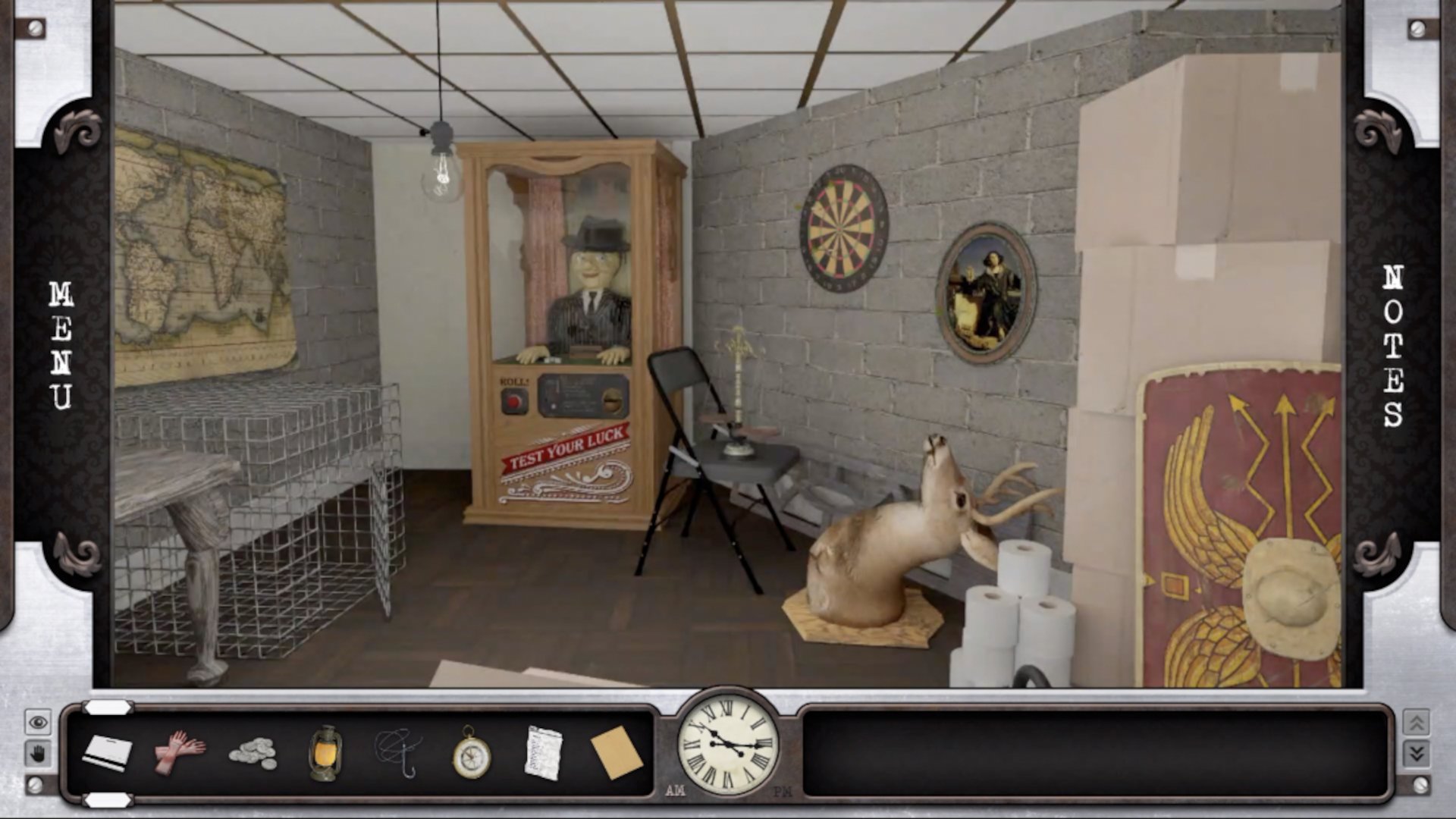
Of course, I also got very full. Luckily, I could walk it off by exploring Carlisle. Throughout the game, you gain access to six different locations, most of which reveal more of themselves to you as the plot progresses. Scenes are presented in first-person slideshow-style with occasional animations like water coming out of a faucet. From the run-down apartment building where you’re staying to a gorgeous backyard garden by the cliffside to a cluttered storage room complete with a creepy carnival animatronic, the environments are lifelike, detailed, and distinct. Travel across town is done by clicking where you want to go from a list of places, cutely stylized to look like a piece of loose leaf paper with addresses written on it.
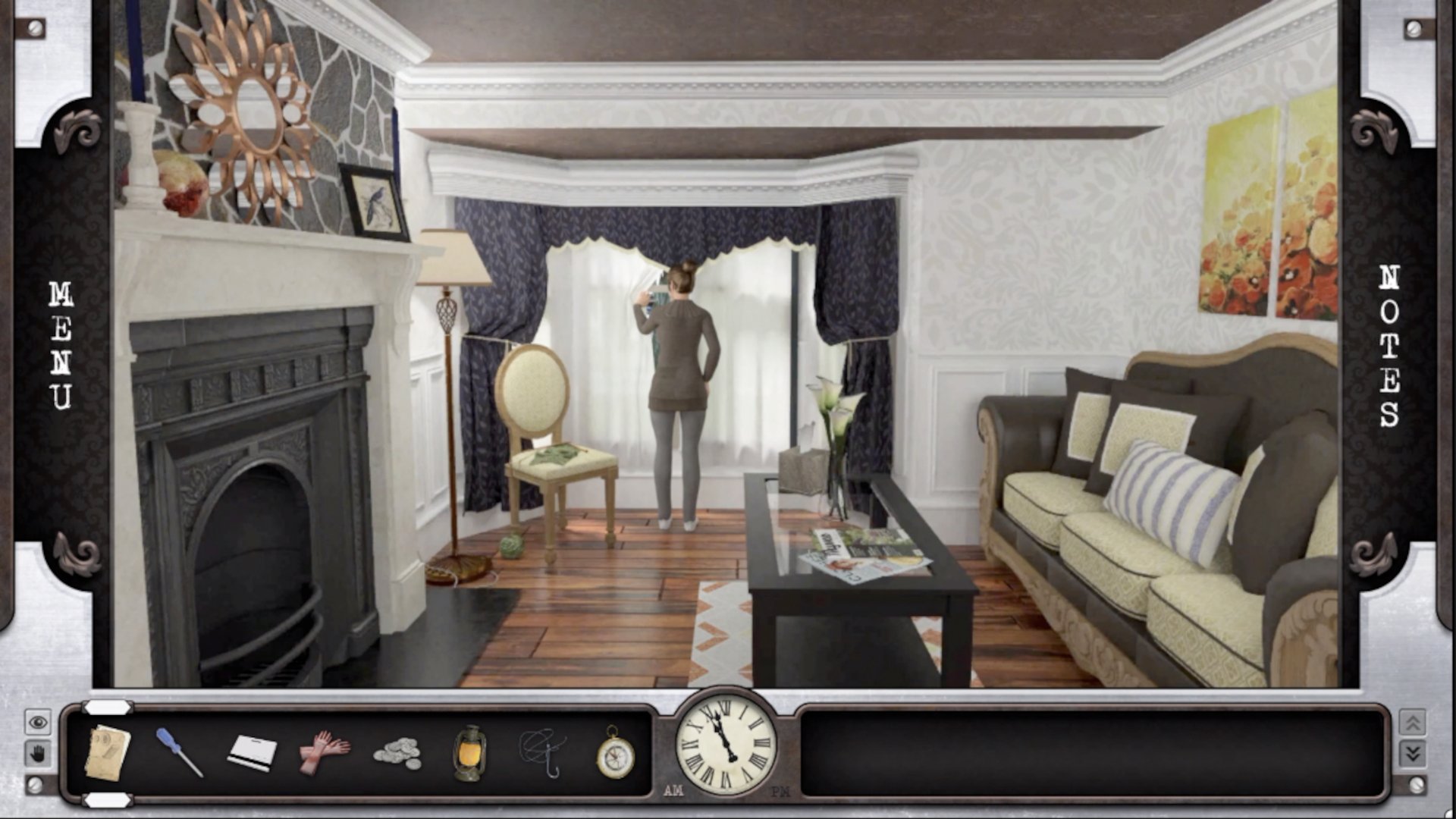
As you comb through the scenes in each location, the cursor icon lets you know which directions you’re able to move and when you can fluidly turn in place to get a full 360° view of your surroundings. Navigating is a little clunky at times; I clicked back and forth and spun around doing an awkward Wait, where’s the exit? dance more than once. But I never minded the chance to double check a scene in case I’d missed a hotspot, the cursor changing to identify them when moused over. Most lead to a puzzle or item, and even when one seems to lead to nothing, it might not always, because several hotspots are only fully interactive after arriving at the relevant point in the game. So if you find a box or a drawer that you can open but not take anything from, remember it. There’s likely an item inside you’ll need later on.
Adding something to your inventory, ever-present at the bottom of the screen, lets you “examine” it in a close-up 2D view. This function mainly serves as another showcase of the excellent graphics, but it’s also where you read documents and combine items. You’re generously alerted whenever you’ve picked up an object that needs to be joined with another – no more clicking everything in your inventory on that one item you can’t figure out what to do with!
And no more initiating conversations with suspects only to immediately tell them “Goodbye,” either, because the game removes the ability to talk to people if you’ve got nothing new to say. When there is something to chat about, dialogue boxes are designed to show when you’re selecting a single, one-time response out of several choices, and when you’ll be able to exhaust every option. These types of quality-of-life improvements help elevate Art of Deceit above the titles it’s inspired by, but they aren’t what make the game great…
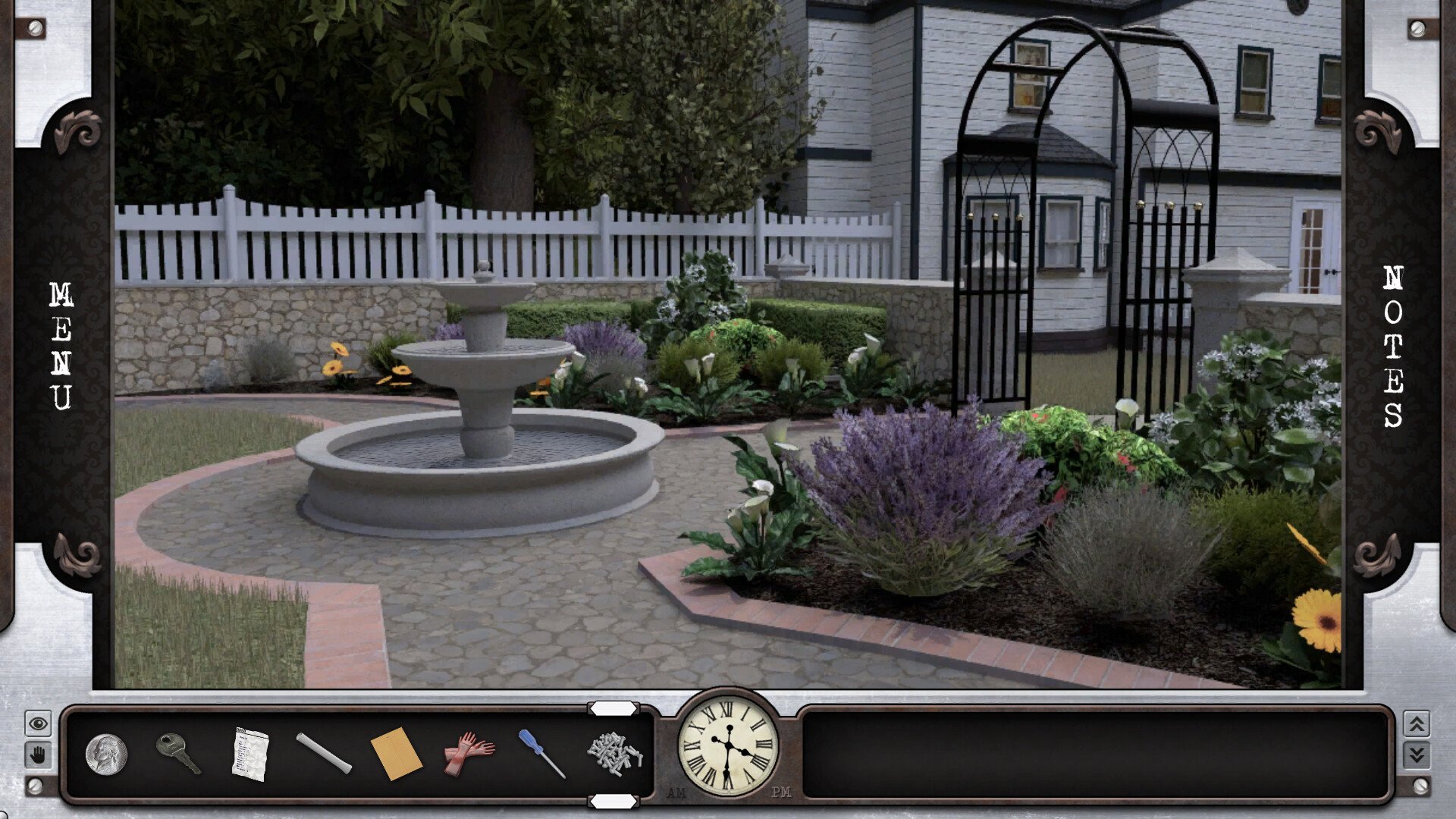
That’d be the gameplay itself, which is exciting and challenging. The puzzles are impressive, both in number and variety: logic, packing, spatial and deductive reasoning, ripped-up letter reassembly, dialogue trees, math, ciphers, and much more; it’s all accounted for. It’s also hard. Of the 17 ½ hours it took me to finish the game, many were admittedly lost to the local bookstore, where snippets of classic literature, everything from Dickens to Darwin, are available to read, but several hours were also spent toiling away at the most formidable puzzles. With a rare exception or two, the difficulty isn’t due to bad design, though. It’s the opposite! Whenever I solved something that took a while, I felt rewarded, not relieved. For me, the challenge level was perfectly balanced: tough enough to consider a walkthrough, but not so impossible that I actually looked at one. (Well, just once to check my work partway through an intimidating puzzle someone who didn’t fail high school geometry would probably be less scared of.)
Still, if daunting puzzles aren’t part of your detective fantasy, then Art of Deceit may not be, either. The game has two difficulty settings, but the only difference is a lack of Penelope’s case notes and to-do list in the harder mode. The puzzles are identical. Though there’s a comprehensive (and once again, cutely stylized) written tutorial at the start, there are no instructions or hints provided for individual puzzles. Explaining how to rotate pieces or input numbers into a safe would make the experience more accessible. As is, I repeatedly felt like my institutional knowledge of Nancy Drew controls was coming in handy too much in this, an unrelated game, albeit basically a spiritual successor to that series.
Penelope Pendrick and the Art of Deceit
| Genre: | Mystery |
|---|---|
| Presentation: | Panoramic nodes |
| Theme: | Crime solving, Missing persons |
| Perspective: | First-Person |
| Gameplay: | Investigative, Puzzle |
| Control: | Point-and-click |
| Game Length: | Long (more than 10 hours) |
| Difficulty: | High |
| Graphic Style: | Simulated realism |
At least banging your head against a hard puzzle always pays off due to how well-integrated they are into the story. Excluding when your neighbor makes you do her homework before she’ll talk to you, puzzles pop up organically with plot-driven purpose. (And that’s nothing against the homework itself, which was fun.) Even better, though, are the suspenseful sequences – several timed, where solving a puzzle or reacting quickly could mean your literal survival. The stakes may be high for Penelope, but don’t worry, they’re low for the player. If you fail, you’re simply prompted to “try again” from right before you irreparably botched the investigation by doing something like losing a suspect’s trust or dying.
Running clocks are used to build tension through more than just timed puzzles and quick time events. Learn people’s schedules, break into their homes or businesses to hunt for clues while they’re away, then break back out before they return. A clock is always visible within the interface, and another in your apartment has an alarm you can use to skip ahead to primo snooping hours. Just don’t accidentally click the wrong button when you need to set it, or else prepare to hear Penelope’s unskippable refresher about how the alarm works often enough to make you think you’re in a time loop.
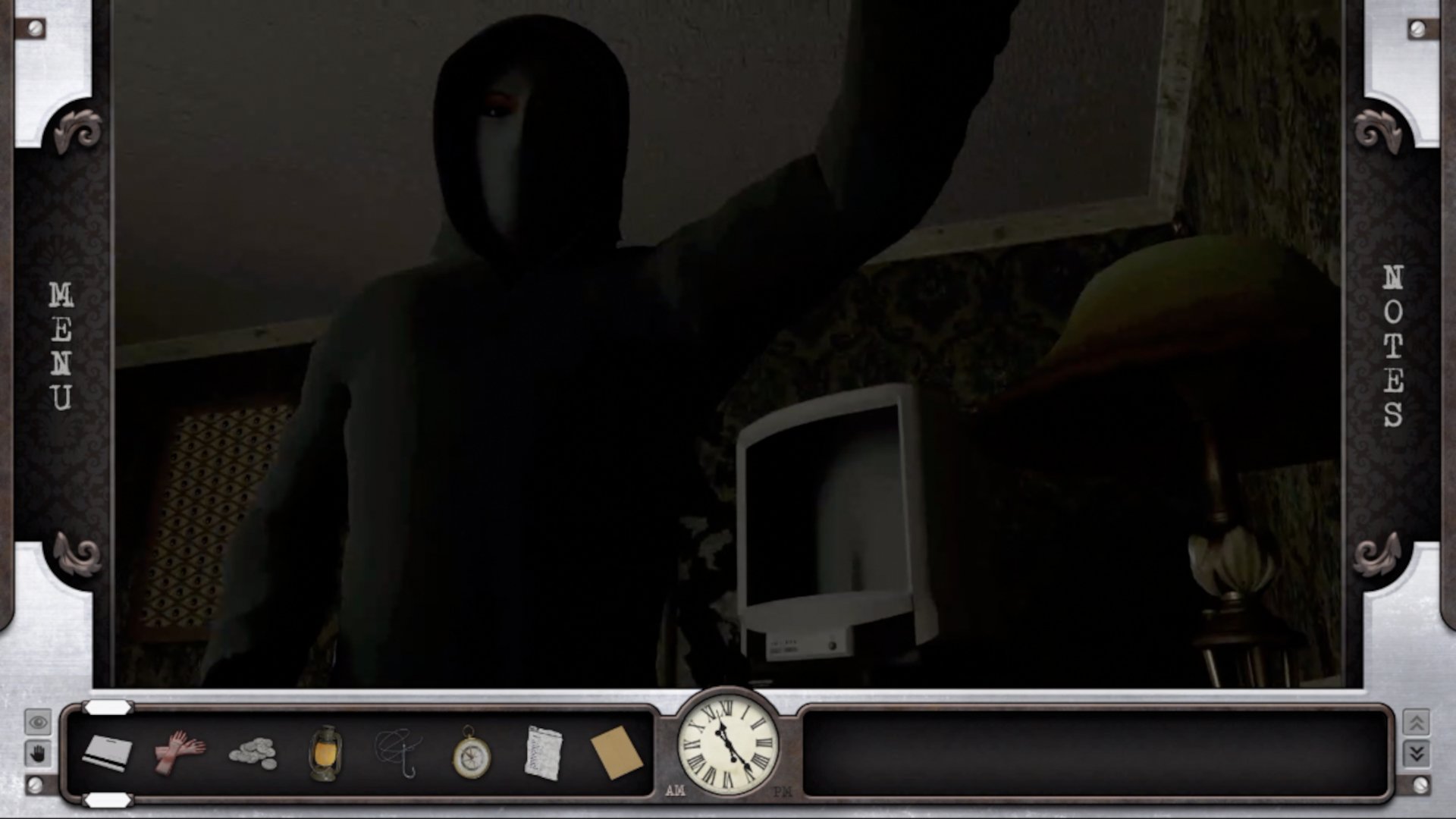
All of this sneaking and suspense is accompanied by a fitting soundtrack. Inquisitive melodies put you in an investigative mood, with the music appropriately intensifying during more thrilling or threatening moments. Thoughtful sound effects like clinking tiles, scraping windows, rustling pages, and alarms that keep blaring in the background while you do the puzzles they were guarding enliven each scene, further immersing you in already engaging environments.
But sometimes the game pulled me out of its world in small ways instead, such as the abrupt switch from that soundtrack I just complimented to complete silence when solving puzzles or reading. Penelope’s case notes and task list appear in a predetermined order, so if you don’t do things the “default” way, you’ll need to comb through passages you already read to ensure you don’t miss any updates. On the harder difficulty mode that removes these features, you still click through two now-empty notebook pages whenever you need to access the third, where the game periodically asks questions that must be answered (by typing the correct response) in order to progress the plot. You can also make progress by sleeping, as many special events like important phone calls and *insert spoilers here* happen overnight or right after you wake up.
Occasionally Penelope outright tells you to go to bed, but not every time it’s necessary, a difficult realization to have until after you’ve already realized it, even with a note in the tutorial about sleep potentially advancing the story if you get stuck. More than once, Penelope prompted me to hit the hay when I’d only been awake for less than an hour, even though the game is supposed to be a detective simulator, not a depression simulator... Naptime is relied on so heavily, it can bring the narrative flow to a halt. After one big break in the case, I tried to call my contact, a local police sergeant, only for Penelope to confusingly say she “didn’t need to talk to him right now.” Turns out, the conversation was going to happen automatically after I slept. Other legitimately monumental revelations never even make it to Sarge’s ears at all.
Unfortunately, the game’s deadliest momentum killer is its opening moments. You start at Penelope’s home desk, where she reads aloud the introduction to her novelisation of the investigation. She also rehashes her first case, finished shortly before this story begins, including who the culprit was and why. I would’ve preferred to experience it myself as a future release, Nancy Drew: Secret of the Old Clock-style. During this nearly four-minute unskippable intro, the only visuals are the narrated text appearing on a blank page as it’s being recited and a few expository Polaroids next to it on the desk. It’s ironic that Penelope mentions a critic who calls her writing “average,” because this opening – which is supposed to be Penelope’s writing – is contrived and long-winded. It’s an especially poor first impression because the rest of the writing is phenomenal!
The plot is creative, weaving real-life historical figures and events into an original, intriguing story with more twists than a pretzel. The reveals are doled out at perfect mystery-solving pace so that when you arrive at the final act, you’ve mostly grasped what’s going on, yet even then the surprises are far from over. The finale is a worthwhile reward after tackling a gauntlet of especially difficult endgame puzzles. Though I thought some characters got off easy after taking extremely drastic actions during the game, the conclusion is still satisfying – no loose ends or hokey cliffhangers. Solving a mystery so complex requires a fairly linear experience, but that doesn’t mean Art of Deceit is without replayability. Based on a few key choices, some characters’ fates can change, and because new autosaves are generated at a lot of checkpoints (too many, honestly), you don’t even need to start over to see the differences.
I recommend a second playthrough, though. The dialogue is so great, it warrants another pass to choose responses you didn’t before. Despite the seriousness of the case, the game is seriously funny, with references to the Nancy Drew series, perfectly pitched sarcasm (often coming from Penelope herself), situational jokes, and good old-fashioned witty writing. Every character made me laugh, even the supporting cast you only talk to by phone like the police sergeant and an eccentric historian. It helps that the entire script is voiced by exceptional performers. Penelope herself is a likeable lead, if very willing to steal stuff that might help the investigation, including change from the cash register at a small business.
The four suspects – your aloof neighbor, an uppity gallery owner, and a couple of lifelong Carlisle locals – are 3D-animated and multi-dimensional (personality-wise). Ignoring one tropey backstory that’s a blip in the script, each character has a rich personal history expertly crafted to keep you guessing about who the bad guy is. Everyone has a believable motive, and everyone’s motives get more compelling as you learn about them. The models are a little goofy, particularly during the ambitiously animated final sequence, but considering that developer Default Cube Games is essentially a one-person operation, it’s hard to think of slightly awkward animation as anything other than an exciting glimpse into what they’ll be able to achieve with their future releases. And there will be more, as post-credits, there’s a teaser for Penelope’s next case.
Final Verdict
If you can forgive the type of insignificant issues emblematic of a small indie studio’s first project, then Penelope Pendrick and the Art of Deceit is all but detective adventure perfection. At times the experience is so tailored to longtime fans of HeR Interactive’s Nancy Drew franchise that for the uninitiated, it could make the gameplay even more challenging than it already is (and it is), but anyone willing to brave the learning curve is in for a puzzle-packed, tightly plotted thrill ride. A first-class story with an A+ ending, ever-escalating tension, sharp graphics, tough (but fair) puzzles, and a stellar script full of funny, naturalistic dialogue brought to life by a talented cast – this point-and-clickstery is a must-solve!
Hot take
There’s nothing dishonest about Penelope Pendrick and the Art of Deceit. As advertised, it’s an homage to the classic Nancy Drew series, both a masterful emulation and an exciting evolution. Featuring challenging puzzles and a gripping mystery, you won’t need a magnifying glass to see that the era of a new girl detective has begun.
Pros
- Leisurely investigation mixed with exciting gameplay: snoop, sneak, survive brushes with death
- Detailed, lifelike environments and close-up item views
- Difficult puzzles are mostly satisfying to solve
- Suspenseful plot cleverly utilizes historical people and events
- Great, often funny script with well-voiced suspects that each have secrets to discover
- Moody music intensifies as the mystery does
Cons
- Long, static intro leaves a bad first impression
- No instructions or hints for individual puzzles
- Sleep mechanic is overused to trigger progression
- Can’t call police contact after major breaks in the case
Lizzie played Penelope Pendrick and the Art of Deceit on PC using a review code provided by the game's publisher.

- Advertisement
- Help support AGH by advertising with us






0 Comments
Want to join the discussion? Leave a comment as guest, sign in or register in our forums.
Leave a comment