
Riddlewood Manor review
- 0 Comments

Deviously challenging escape room puzzler both kooky and spooky balances fun with killer gameplay
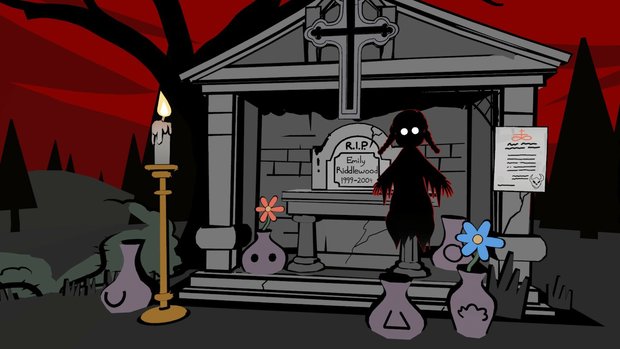
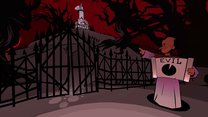
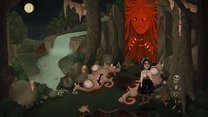
You look around at the creepy cartoon graveyard at the end of a winding trail leading up to a sinister house at the top of a hill. To one side is a monk holding a near-full pie chart on a poster board with a single word, “EVIL.” He points to the manor while making a small grunt in your general direction – well, there’s your goal. These first few seconds of Peanut Button’s Riddlewood Manor perfectly set the tone for the twisted, quirky puzzle-filled rooms that await. It isn’t a completely smooth ride due to some brutally difficult conundrums that would have benefitted significantly from a little built-in assistance, but mostly the challenge is welcome and the experience overall is undeniably charming.
Riddlewood Manor keeps things simple as far as setup goes. You aren’t told who you are or where you came from, but after appearing through a cross-shaped portal you’re greeted by monks with various sacred artifacts thrust upon you to exorcise the evil ghosts that haunt the titular spooky mansion. In order to do so, you’ll have to unravel the numerous brain teasers that bar your path because the Riddlewoods have built their home with devious contraptions in every room. Each specific location is presented like an escape room, filled with documents, items, and even the occasional NPC utilized as components for progress.
Presented in 3D slideshow fashion, each scene has four different primary viewpoints with you at the center. Left mouse clicks interact with any available points of interest; if something can be collected, you will pick it up and add it to your inventory that appears at the bottom of the screen by hovering the cursor over it. While you are locked in place, you can zoom the camera in and freely pan it in any direction by holding down the right button and moving the cursor; let go and the view will snap back to the closest of the four views. Right and left arrows are selectable on either side of the screen in any set scene, and clicking on either will rotate the area 90 degrees. Keyboard inputs are available for changing views and opening the inventory as well, but Riddlewood Manor is entirely playable with mouse controls.
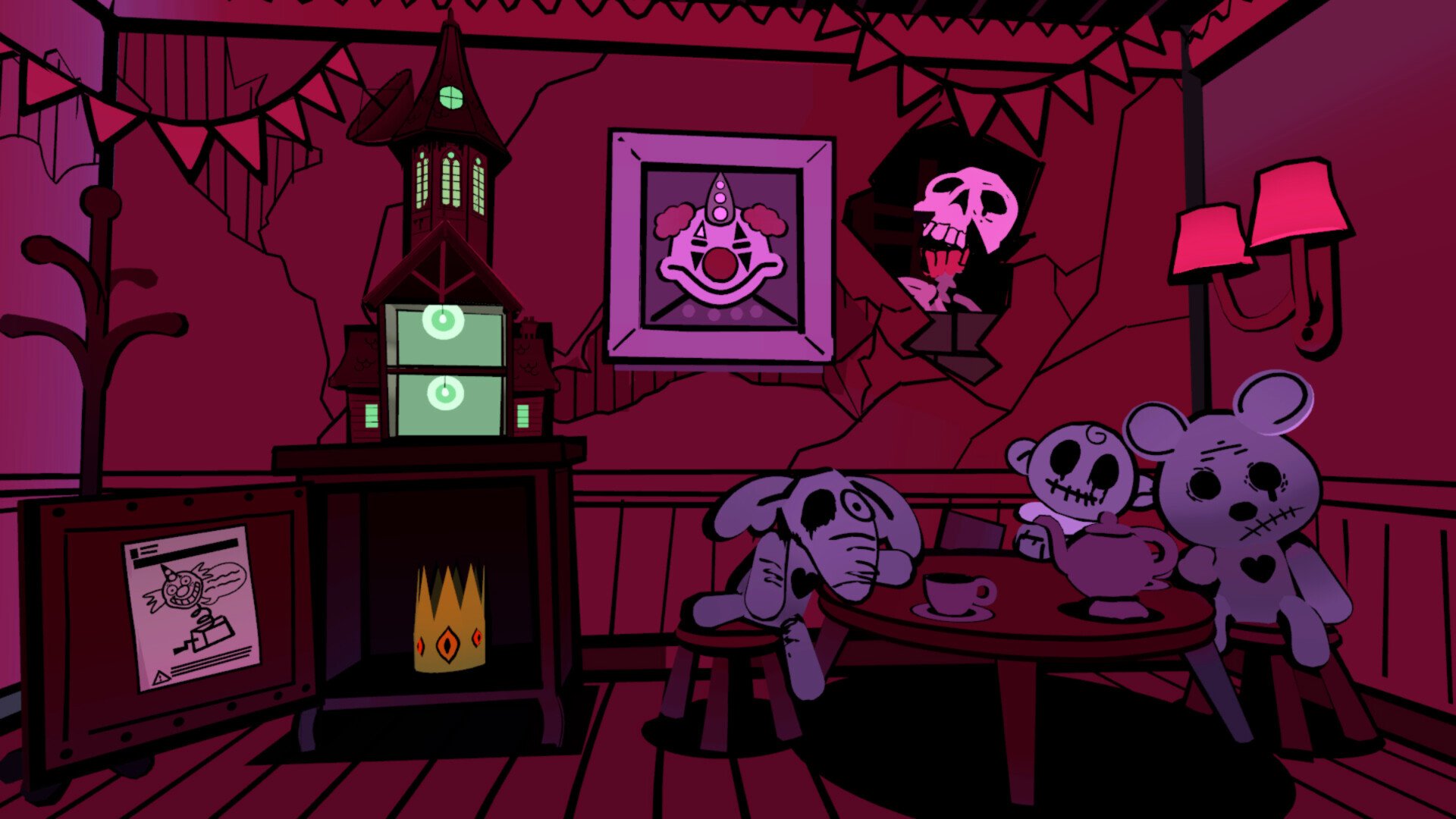
As you make your way through the manor, by reading documents or speaking with the phantasmal forms of the family members directly you begin to uncover the history of the Riddlewood ghosts who reside there: William, Margaret, and their daughter Emily. Emily’s spectral form is accompanied by a chilling, unspeaking demonic doll she calls Suzie, who stalks you as you explore but never directly harms you (at least, not at first). While her parents are objectively terrible people, you quickly find out that Emily’s story is much more complicated. For reasons you will slowly unravel, Emily’s soul has been split between three of her favorite stuffed toys, hidden and chained up in rooms deep within the manor. Befitting one summoned by holy monks, you task yourself with finding these soul pieces to save this little girl from whatever damnation her parents have wrought upon them all.
Every space you enter typically consists of one or two rooms, and in order to progress further into the manor you will have to solve one or more puzzles barring your path. These can range from inventory obstacles to logic deductions based off information you glean from various notes and clues in the environment – much like a real-world escape room. Whenever you enter a brand new location, you are no longer able to go back, only travel between any current adjoining rooms. The door behind you slams shut if you attempt to leave, accompanied by the spooky wailing of an unseen spirit. This limits the number of items you carry, which helps keep your inventory from becoming overwhelming to sort through. That isn’t to say the inventory resets between locations, though; if you have an item with you that wasn’t utilized in a previous room, you will still have it in the next location you enter. But there is one way you can lose all the items you’re holding: dying from one of the many hazards that are out to get you.
Your untimely death is an inevitability in Riddlewood Manor, whether from being eaten by a carnivorous plant, melting from acidic goo, or getting mauled by a demonic doll. Whenever you die, you lose everything you possessed but have the option to respawn right where you were or in any of the locations you have been to previously. At first I thought death was something to be avoided at all costs – after all, dying is typically a negative and I didn’t want to lose what I had already collected. The game even keeps a counter of the number of times you’ve died, reinforcing the notion that it’s something best avoided.
I soon realized, however, that my progress was retained regardless of where I restarted, so dying wasn’t really a punishment (or at least, not much of one). Instead it’s a way to revisit earlier rooms if you want to work on an optional puzzle (such as those required to unlock the secret ending) or look for any documents you might have missed. At times it’s actually a requirement to willingly meet your demise in rooms with doors shut tight behind you, in order to resume a multi-part quest somewhere else in the manor. While I understand now how the system works, the lack of indication that this is something you are encouraged to do rather than an unwanted setback is a bizarre choice that I’m not a huge fan of. Even a small note along the lines of “Sometimes death is a way out” would have been a welcome push in the right direction.
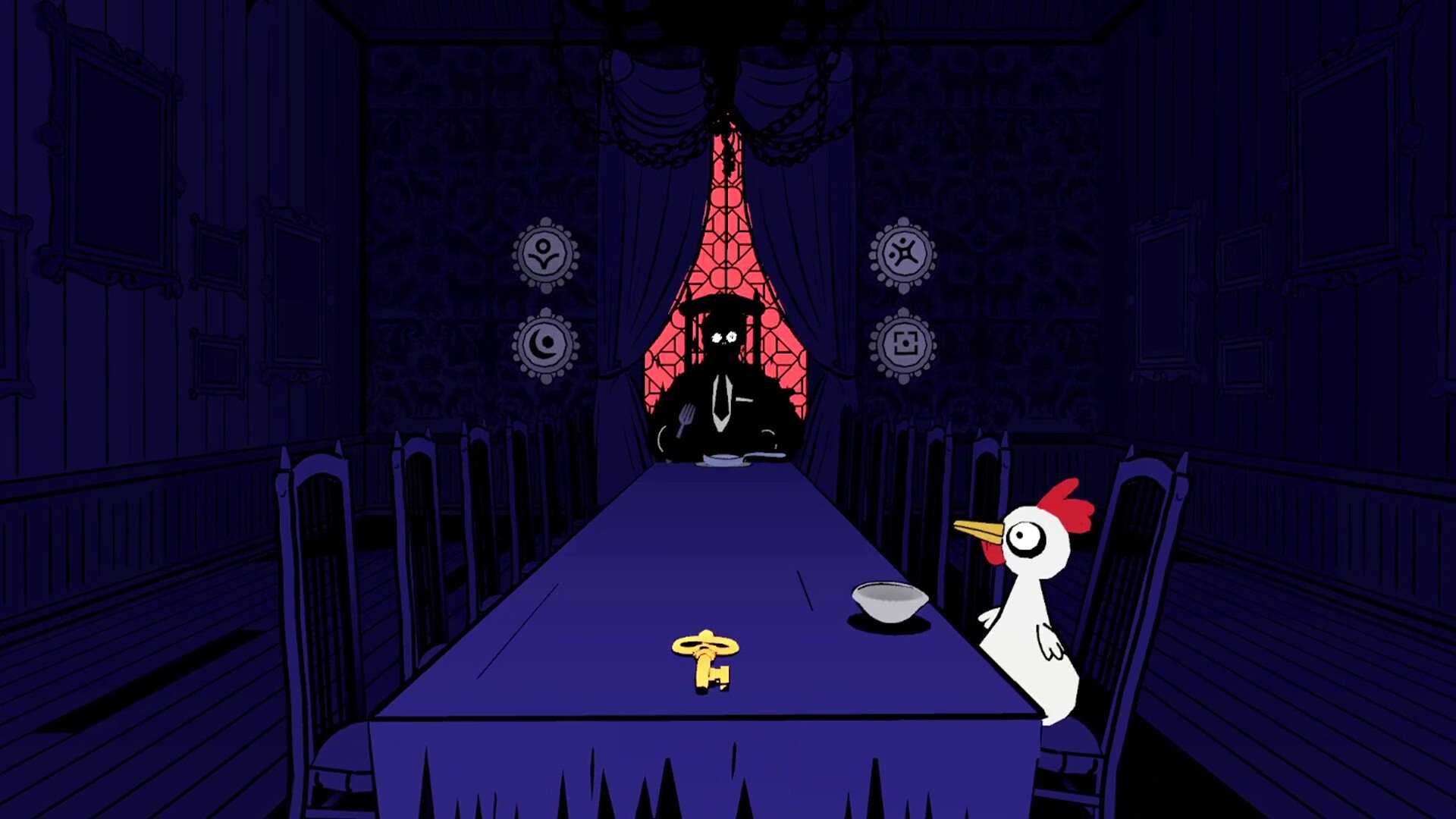
Your overall completion progress, along with your key item acquisition and total deaths, is shown on a map you can check at any time by clicking its icon at the top of the screen. The map shows which rooms you have accessed so far, along with any remaining rooms marked with a lock symbol. There’s a surprising amount of variety in the places you uncover, from the outdoor garden dotted with mysterious stone statues to a long foreboding dining room where the apparition of William Riddlewood towers over you and a rather confused live chicken.
Riddlewood Manor
| Genre: | Horror |
|---|---|
| Presentation: | 2D or 2.5D, Slideshow |
| Theme: | Paranormal |
| Perspective: | First-Person |
| Gameplay: | Puzzle, Exploration |
| Control: | Point-and-click |
| Game Length: | Short (1-5 hours) |
| Difficulty: | High |
| Graphic Style: | Cartoon |
The cel-shaded visual style adds plenty of personality to the quirky inhabitants and environments throughout the manor, and helps to balance the darker themes with a lighthearted tone. There are jump scares at times, but for players that don’t want to be surprised there’s a welcome option to put in a warning for when they will occur. Even with these jump scares, however, the game is never “scary” in the sense of it being bone-chilling to play. There’s one area where you meet a ghost reading Haunting for Dummies, and another where you’re yelled at by a screaming toilet. It’s much more Scooby-Doo than Poltergeist, and I can see it being a great spooky time for kids to play with a parent. And given how tough some of the challenges can get, having some extra help around isn’t a bad idea.
Puzzles in Riddlewood Manor can be brutally difficult, to the point where I had to write down notes of potential clues and symbols in nearly every room. One room lists symbol equivalents on its walls, showing what each represents in different contexts, and from the examples provided you have to narrow down the total number to unlock an electronic door. Another puzzle involves a grand piano that automatically plays music based on what you enter, and you have to uncover the specific sequence of musical inputs required to play the correct song. There’s a huge variety of puzzle types throughout the manor, and when all the pieces come together they can be incredibly satisfying to solve.
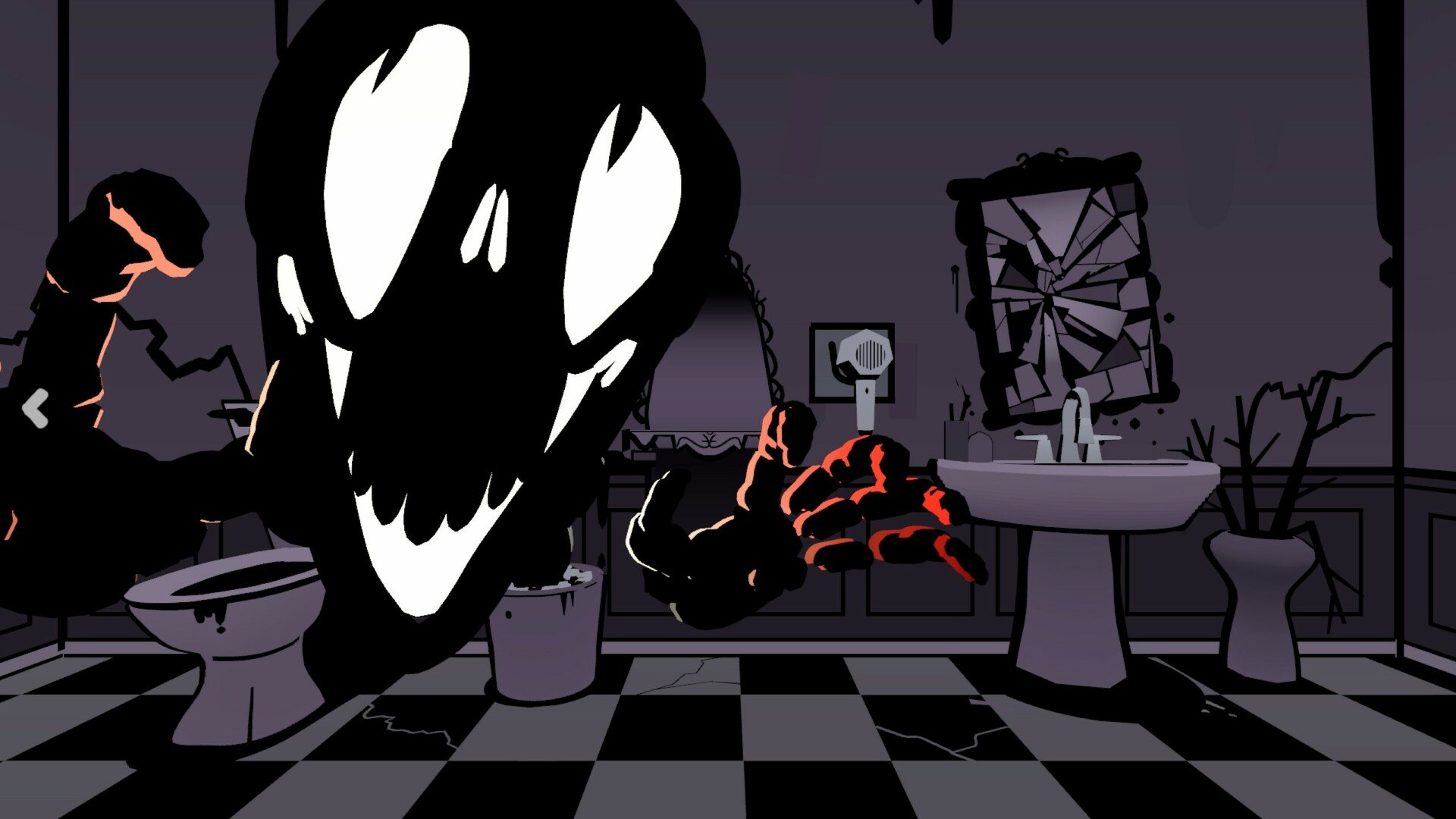
Unfortunately, the pieces don’t always come together, due at least in part to an unfriendly smart cursor. It has just the slightest tell whenever you move over a hotspot – changing from an open hand to a pointing hand with an outstretched finger. The effect is so subtle that I found myself not even realizing it was there until I had already finished the game – after having suffered long periods of tediously clicking all over the screen. Typically there is enough of an indication that an object is usable just by being something you’d expect to pick up (a saw, a key, a beaker… etc.). But this was definitely not the case in one section that nearly had me pulling my hair out.
In the garden there’s a patch of grass that sways slightly when you click on it but otherwise appears to be inconsequential to what needs to be done in that area. Meanwhile, a bird on top of the nearby hedge does not react at all when clicked on and doesn’t even prompt the usual slight cursor change. Naturally, I assumed the bird was just part of the environment and unrelated to the task at hand. After aimlessly going back and forth between that section of the garden and the one with the statues for solving a puzzle, I finally realized that the bird and grassy patch were indeed involved in a highly unintuitive way. Having even a small clue that the bird was not merely part of the backdrop would have significantly eased my frustrations with this section.
With some very complex conundrums to solve throughout the manor and its grounds, I was surprised to find that there is no hint system of any kind to help keep players moving forward. While not a requirement in puzzle games, there were several areas where just a small nudge would have gone a long way in negating seemingly endless pixel hunting.
Thankfully, any puzzle frustration is eased by some simple but effective sound design that brings this ghoulish world to life. A horrific living doorway makes delightfully disgusting squelches, while skeletons on pikes make hollow bone-y sounds as you rearrange them for a puzzle. Music is minimal, with many rooms having only the unsettling ambient sounds to keep you company. When it does play, it is suitably twisted and fun. One track incorporates music box-style sounds with violin, while another goes fully dramatic with a pipe organ front and center. There is a small bit of voice acting as well. The unseen protagonist remains silent and most of your time is spent reading documents and solving puzzles, but the Riddlewoods and a few of the holy monks outside all have spoken lines. Emily is a standout here, with her distant and purposefully emotionless delivery being both haunting and heartbreaking.
The game's finale occurs rather abruptly, with a surprisingly touching ending mixed in with some unanswered questions. There is a secret ending for those wanting to see all the game has to offer, with some extra puzzles that will take you all over the manor to uncover their final mysteries. Both the main ending and the secret ending provide a solid conclusion to the simple story of these troubled characters, even if I personally would have liked to see a bigger send-off.
Final Verdict
Overall, Riddlewood Manor is a formidable, charming, enjoyable jaunt through a creepy haunted house filled with some excellent brain teasers. While I’d have preferred more guidance in how its systems worked or the occasional pointer when missing a piece of a puzzle, this is a fun, light-hearted spookfest that players of all ages can enjoy. Even after my mouse nearly imploded under the weight of my grumpy clicking in some of the rooms, it was hard not to chuckle at a farting ghost or some other bizarrely amusing encounter. Never taking itself too seriously, this is a supernatural series of spectral spectacles worth exorcising for anyone who enjoys a good challenge.
Hot take
While it teeters on the brink of succumbing to genre pitfalls at times, Riddlewood Manor is a delightful series of ghostly escape rooms tied together with a playfully macabre tale about spirits and dark magic.
Pros
- Charming creepy-cute cel-shaded graphics
- Highly varied, genuinely challenging escape room-styled puzzles are usually satisfying to solve
- Simple yet engaging narrative with lots of silly moments to break up the spookiness
Cons
- Smart cursor change is far too subtle, leading to unnecessary pixel hunting
- No indication that death can be a good thing
- Brutal difficulty at times made worse by the lack of any hint system
Sam played Riddlewood Manor on PC using a review code provided by the game's publisher.

- Advertisement
- Help support AGH by advertising with us



0 Comments
Want to join the discussion? Leave a comment as guest, sign in or register in our forums.
Leave a comment