
The House of Tesla review
- 1 Comment
New historical character, same great puzzle-solving experience in a crackling adventure from the creators of The House of Da Vinci
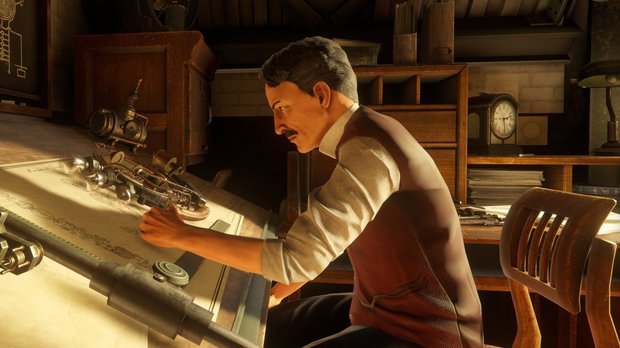
Nikola Tesla, born in Serbia in 1856, was an American engineer, inventor, and most of all - a dreamer. A lifelong, reclusive bachelor, he spent his years pursuing big ideas and inventing the technologies that made everyday electricity possible. He helped develop AC power, the type of electricity that safely travels long distances to our homes. He built the induction motor, a machine that spins using magnetic fields and is still found in appliances and factories today. He worked on early radio technology, helping lay the groundwork for wireless signals. His famous coil showed how electricity could jump through the air in bright, crackling arcs. Tesla dreamed of a world where power and communication could be sent wirelessly to anyone, anywhere. In this, he is considered one of the most visionary founders of modern lifestyle, industry, and technology.
The House of Tesla, a puzzle-heavy game with some narrative elements developed by Blue Brain Games (creators of The House of Da Vinci), explores the inventor’s life, along with his inventions, his struggles with financial backers, and his successes and failures. We also get a glimpse into his troubled mind and his life philosophy. With a playing time of about 10 to 12 hours, this complex, often difficult voyage through the genius scientist’s personal spaces is well worth the effort.
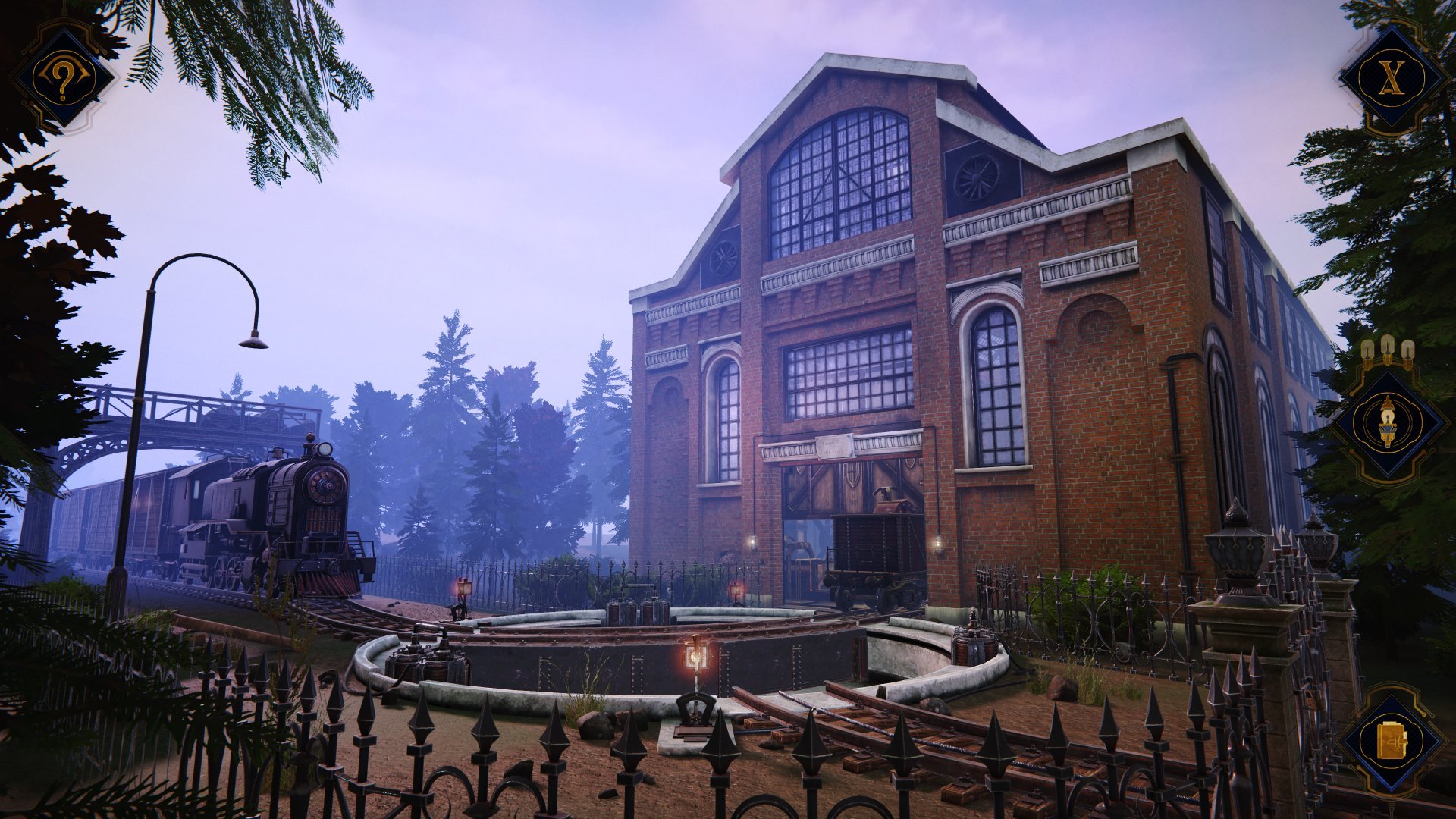
The game begins in darkness. Tesla is lying on the floor, half covered by debris, while rain falls through the broken glass roof. He does not remember how he got here or why his grand plans seem to have ended so badly. As he walks around his office, factory, Wardenclyffe laboratory (where he experimented with wireless communication), and what seems to be his personal home, he starts to assemble fragments from his past into a coherent picture. Little by little, these memories help him understand who he is and what happened here. As far as I understand, the plot of The House of Tesla is not an authentic biography of the inventor, but rather a representation of his inner voyage, based on recollections from key events throughout his life.
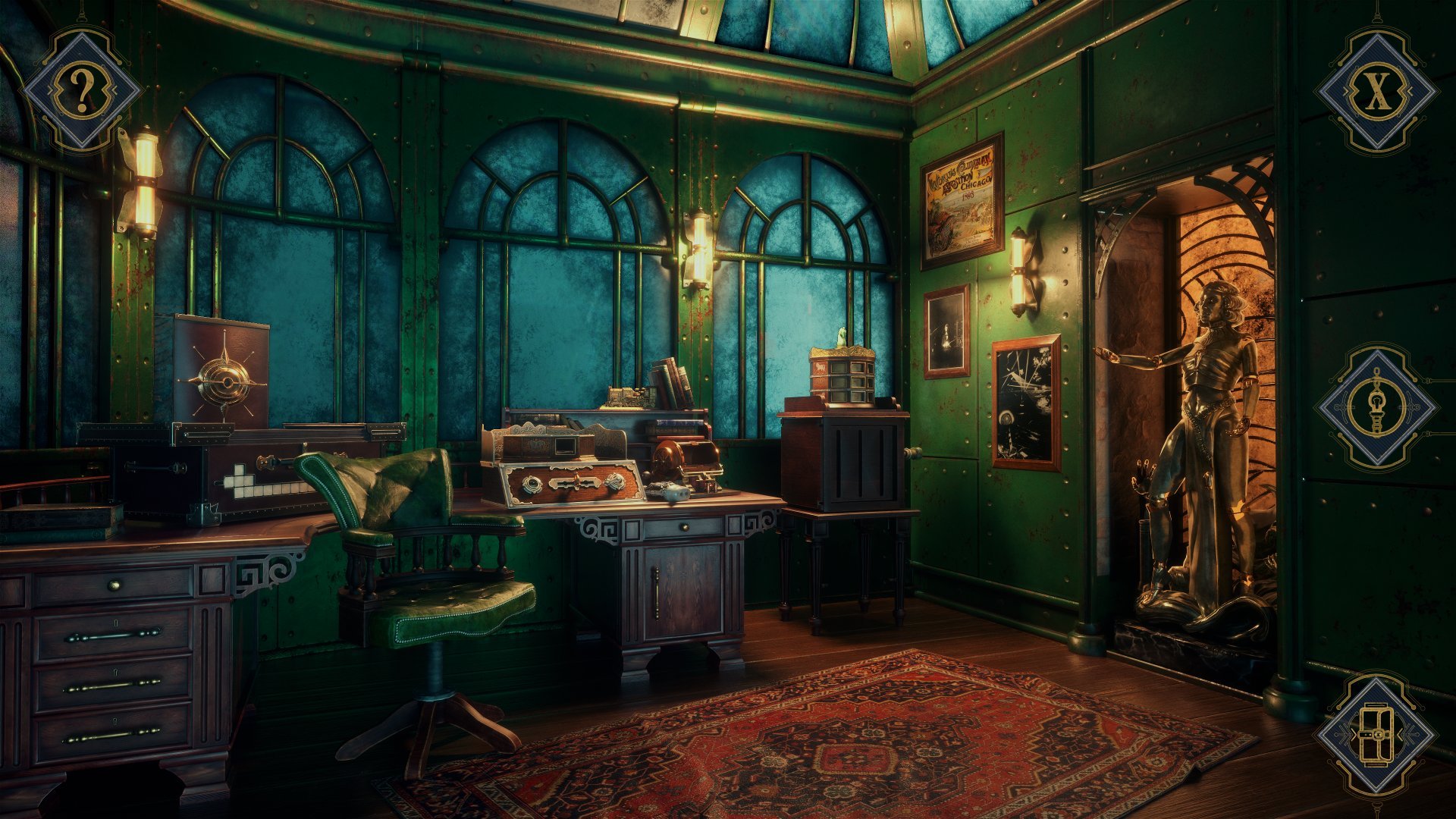
The game is divided into six chapters, played mostly from a first-person perspective but occasionally switching to a third-person view. Movement is node-based, which limits your movement compared to the free-roaming WASD control scheme. Some gamers may consider it a shortcoming, while I, on the other hand, feel it gives the game a nostalgic touch.
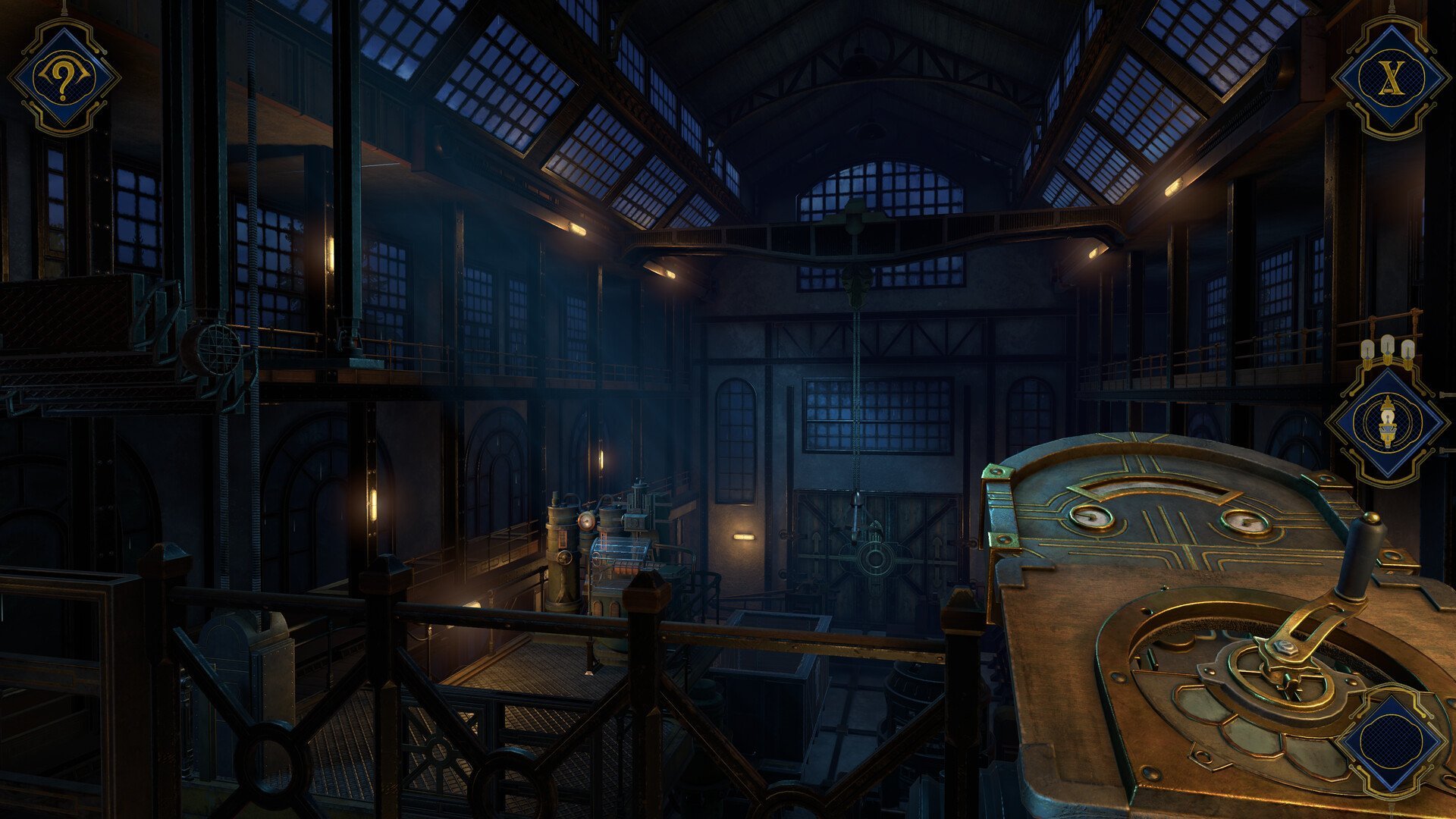
Visually, The House of Tesla is pure eye candy. Its photorealistic graphics are lush and colorful: electrical arcs crackle across elaborate contraptions, water ripples and flows through the laboratory as its reflection dances along the walls, while invisible power lines magically materialize through the aether. The various locations, as well as many of the machines and puzzle components such as knobs, handles, and clamps, are designed with meticulous attention to the smallest details. At no point does it feel as though the designers took shortcuts. Even some of the most mundane items – keys, cogwheels, valve parts, metal brackets, and hinges, appear highly polished and decoratively carved in Art Deco style. Meanwhile, on metal pipes, disks, control panels, and certain contraptions, subtle signs of wear emerge in the form of patina, rust, or grease marks.
Although most of the game takes place in offices and laboratories, these environments never feel cold or mechanical. The color palette leans heavily toward warm hues of brown, green, stone, and brass, a choice evident throughout but especially prominent in the final chapter at Tesla’s home. With the ability to rotate the view a full 360 degrees at many points, The House of Tesla delivers a deeply immersive and visually rich experience.
The only voiced character is Tesla himself. He does not participate in direct conversations, but instead provides narration at times that is somewhat dramatic, yet warm and emotional. It adds credibility to his character, giving you the impression of a fully realized individual, a visionary with a personal backstory. Other characters are not voiced, as Tesla recounts their actions and dialogue himself. Overall, whenever voice acting is present, it is very good.
Musical cues appear regularly throughout the game, which for the most part do not convey strong emotions beyond an overall sense of pleasantness. They consist of short, melodic phrases performed by a full orchestra. Each chapter features its own theme, although some are quite similar to one another. Despite recurring throughout the gameplay, the score never feels repetitive, as the cues are spaced out and separated by moments of silence rather than played continuously. I even found myself humming one or two of them after finishing a session. During memory flashbacks, the music adopts a more classical and dramatic tone. In these moments, it fits the unfolding events almost perfectly, adding a rich and effective audio layer to the drama.
Some episodes from the inventor’s life, as well as his inner thoughts, are revealed through scattered notes and “Tesla Memories” – fragments of his inner world representing his recollection of events, meetings and conversations. The latter function both as narrative devices and as symbolic spaces, allowing the player to step inside Tesla’s mind rather than merely explore his surroundings. They recount, for instance, his strong friendship with the author Samuel Clemens (a.k.a Mark Twain), and his struggles with financiers and investors such as the banker J. P. Morgan and the industrialist George Westinghouse. They also include his opinions on pseudo scientists such as the occultist Aleister Crowley.
Narratively, these memories deepen the portrait of Tesla as more than a brilliant inventor. They reveal a man burdened by his own genius, driven by dreams and ideals, even at the cost of severing personal ties and burning bridges behind him. They offer insight into Tesla’s motivations and the personal cost he had to pay for his dedication, adding a certain layer of introspection to what is otherwise more of a mental and logical challenge for the player.
Presented as frozen, static 3D tableaus, Tesla Memories are not merely an instrument for expanding on the protagonist’s character. Like the rest of the game, they are rich in puzzles that become more complex as you progress. They start with a relatively simple one, where Tesla is presented with a “mystery box” from a friend. In a later part of the game, one memory – taking place in an Egyptian exhibit at the 1893 World’s Fair – comprises one large, enclosed escape room. You have to solve about 15 puzzles of varying complexity only to get the part needed to open a locked door and exit the room.
The House of Tesla

| Genre: | Mystery, Science Fiction |
|---|---|
| Presentation: | Realtime 3D |
| Theme: | Historical, Technology |
| Perspective: | First-Person |
| Graphic Style: | Photorealism |
| Gameplay: | Edutainment, Puzzle |
| Control: | Direct Control |
| Game Length: | Long (more than 10 hours) |
| Difficulty: | High |
While important as a narrative device, there were occasions when I felt the abundance of puzzles in these memories was a bit superfluous, intended only as a means to prolong gameplay. For instance, the aforementioned mystery box is actually a three-faced slider puzzle which, when correctly solved, culminates in another one, requiring Tesla to pull and push handles to form an image of a sailing ship, only to get it open and receive a prized gift from Twain. Though logically rooted in the game’s universe, and the real purpose behind it is revealed immediately upon reaching the solution, it’s hard not to wonder whether this gift could have been presented by solving a simpler puzzle, or even none at all.
You’d better get used to it, however, because The House of Tesla is heavily laden with puzzles. You get to assemble and wire electronic devices, experience an early method of creating a punched card and a printed circuit board. You’ll activate a model train, and later fix a real electric one. You’ll turn on an array of red, blue and green bulbs using tiles and levers, and even get to light up the entire Chicago expo. You’ll also repair mechanical prey birds and present a fairy tale on a children’s paper-cutout theatre. You’ll fix broken engines, uncover ancient Egyptian artifacts, and even use an early type of machine to make a hot, delicious cup of coffee – which in itself is a part of another puzzle.
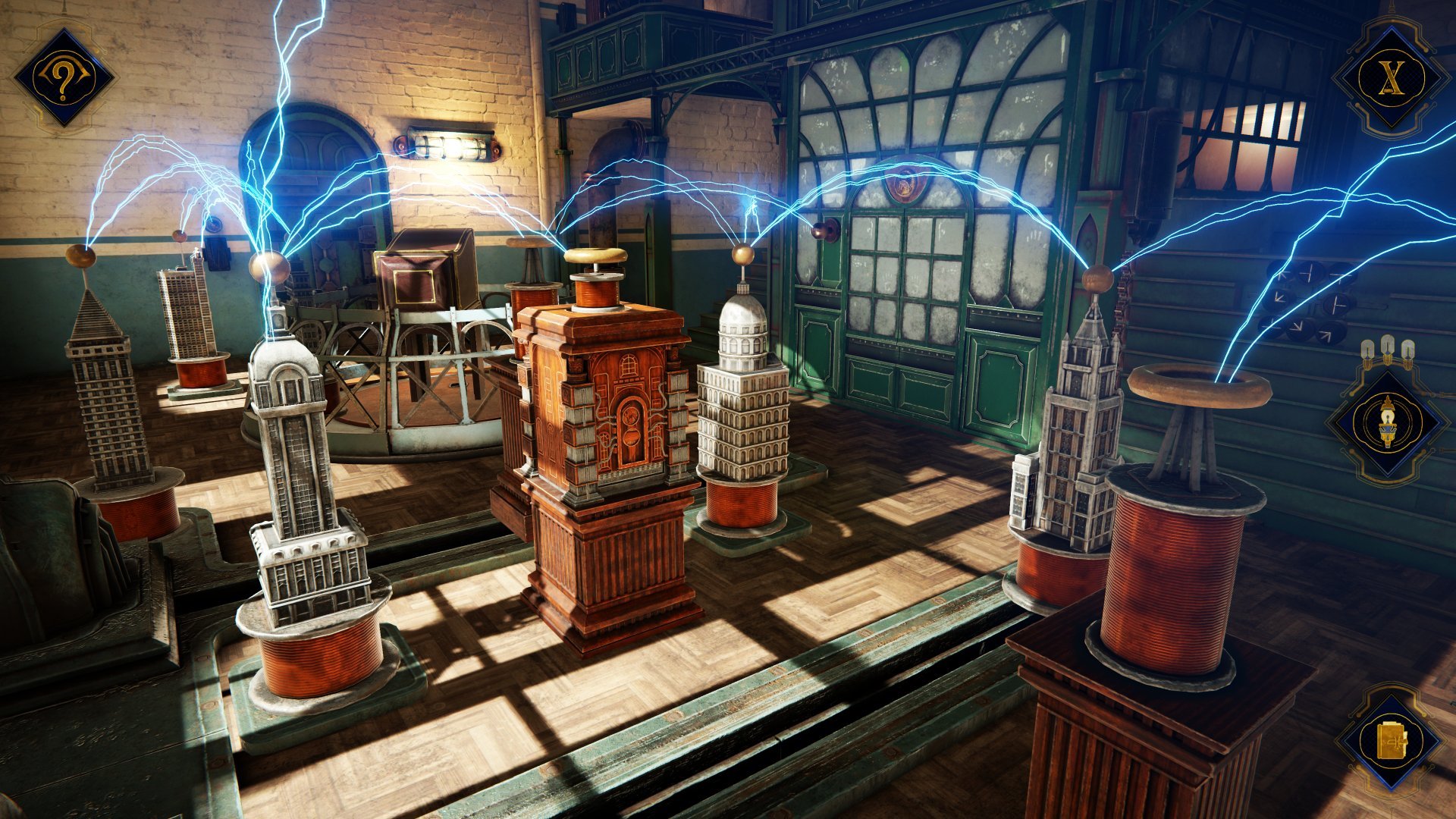
All the puzzles are variations on, or combinations of, classic types of mechanical challenges, such as sliders, mazes, and assembling, disassembling or fixing machines and devices, and connecting and activating electric circuits. Some puzzles reward you for solving them by uncovering an object locked behind other parts or inside a mechanism. For example, you must open the chest plate of a mechanical statue and keep it open long enough to grab a bottle and cup from a hidden compartment. Some puzzles are based on pattern recognition, i.e. assembling a picture or a part according to a drawing or other visual hint located nearby.
Besides these, there are copious amounts of re-arranging pipes, pressing buttons and handles, and operating taps, levers and valves. At one point you must slide tiles containing bits of metal conductor to fit the circuitry on a board required to operate the electrical train. In Tesla’s laboratory, the aforementioned mechanical statue will reward you with a light bulb, if operated in a different way, which will soon be needed in order to fix an electrical device. Later on, another labyrinth must be traversed to retrieve a missing crescent from the throne of Anubis, the Egyptian god.
The start of the game serves as a tutorial to the mechanics, but from there it doesn’t feel like there is a learning curve, since there are some relatively complex puzzles right from the start. For instance, one of the first requires you to fix broken gears and elevator parts using a sort of an analogue welding machine. After laying down a part on the workspace, you must manually “program” the machine to guide the welding head using a set of arrow keys and rotating dials. It’s a lot at first, but there was a point about a third of the way into the game when I got to understand its inner logic. This was very helpful in approaching certain puzzles for the first time, trying to understand what is required of me.
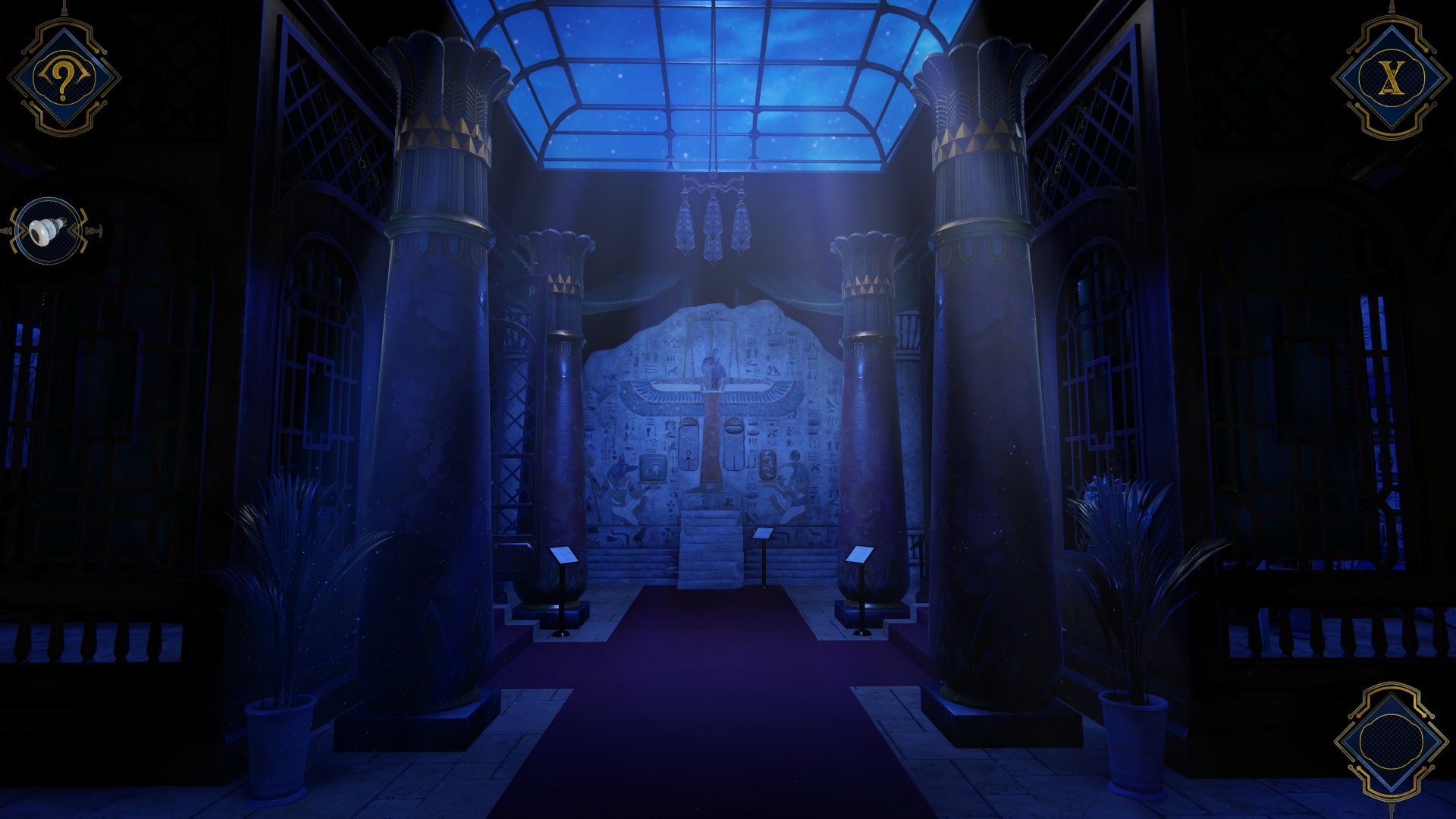
Difficult and plentiful as they are, none of the puzzle solutions feel arbitrary. All of them can be solved by careful observation, paying attention to details (even to the decorations on picture frames or on the contraptions themselves), and, of course, extreme patience, resilience and a good amount of trial and error. Thankfully some puzzles are self-explanatory, like guiding an electric boat model through an opening into the laboratory using a lever and a turning wheel, or replacing engine parts using a hand-controlled crane, or rotating metal disks to connect electrical conductors.
Solving some puzzles requires using the “prototype,” a half-finished experimental device that wirelessly channels electrical current between two points or more. It lights up the room with bright, light blue, ethereal power lines while its energy blurs your vision almost imperceptibly, making it feel dangerous and fascinating at the same time. Where the power lines converge, there is an almost mystical, vertical energy vortex. This prototype is used as early as the first chapter, as part of the solution to opening the electrical door of Tesla’s office.
Assisting with the difficulty, The House of Tesla has two convenient features. The first is a helpful hint system. Whenever you approach a puzzle, it is marked by a bright question mark in the upper left part of the screen. Pressing it reveals several numbered hint slots, usually between two to four hints for every puzzle. The first is a general one, like: “On the right side there is a work bench with a strange device. I should examine it.” The final hint leads you towards the solution, though still without giving too much away: “I think I should set the rotary mechanism according to the diagram,” or “Each branch of the tree bears different fruit, and is connected to the rotating parts on the sides. I just need to rotate them correctly.”
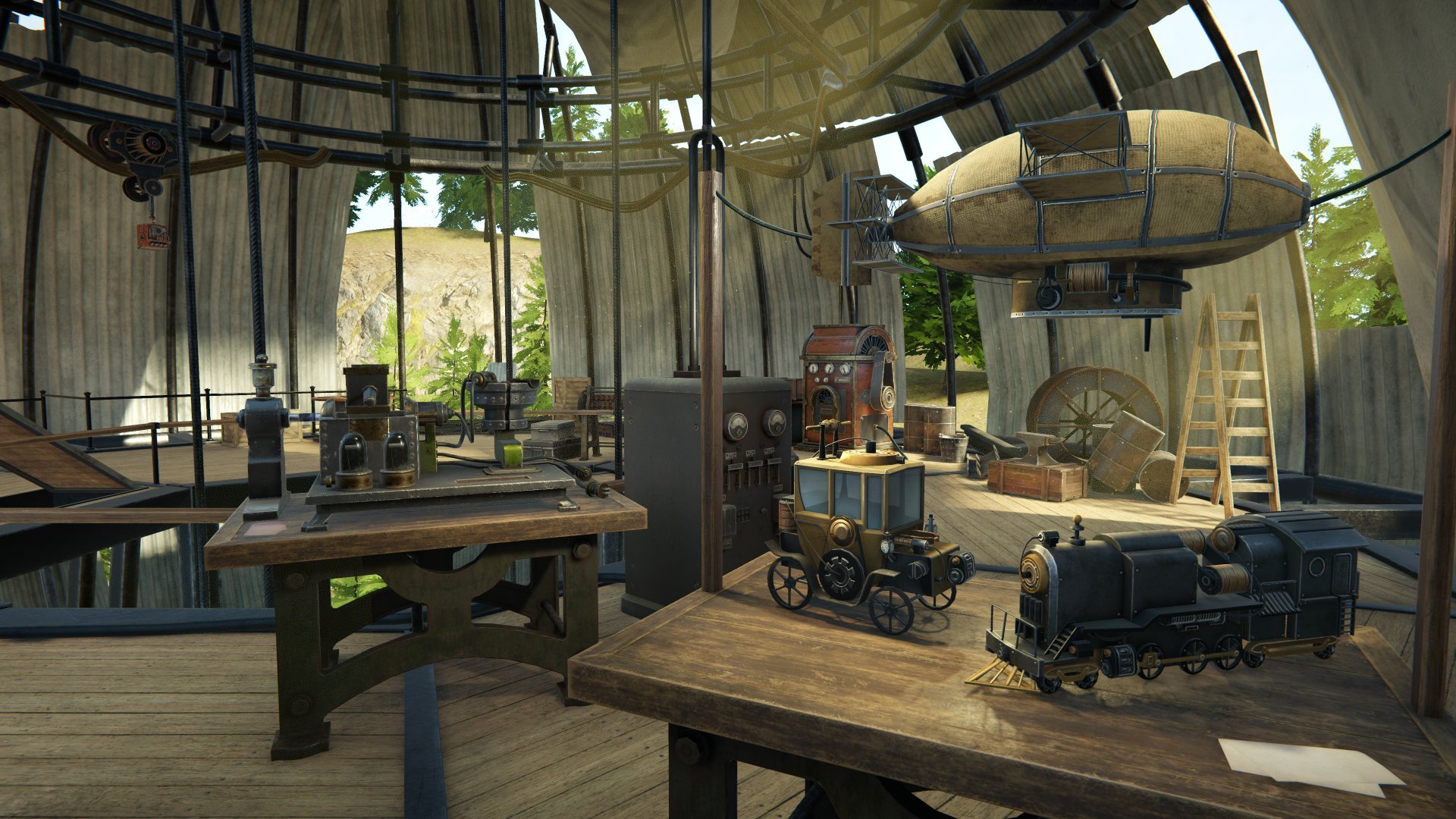
What I liked about this system is that it encourages you to try to solve the puzzle by yourself. Once the question mark is pressed, the hints do not appear all at the same time. Instead, a row of numbers appears. Over time, the slots are gradually filled with background colour. Once the first slot is filled, the first hint can be displayed, and so on. True, it doesn’t take the slots too long to fill (about 30 seconds or so), but during this time you can rack your brain trying to understand where the current hint is leading you. If you succeed, you’ll feel the great satisfaction of cracking the puzzle. If not, there is another hint just a few seconds away.
The second useful feature is the option to skip puzzles entirely. It’s available for almost all of them, except for some relatively simple ones. It appears in the form of a “play/pause” symbol in the bottom left corner of the screen. Like the hint system, you cannot use it right from the start, becoming active after about 30 seconds or so. Pressing the symbol pops up the question: “Would you like to skip this puzzle?” If you choose “yes,” the puzzle is automatically solved and you are free to continue your journey. After replaying some parts of the game, there seems to be no limit to the number of times you can use this option. Thus, it is both a convenient and too-tempting feature at the same time. All in all, I used it less than ten times throughout the game, mostly to relieve the burden of some dreaded slider puzzles.
As the story progresses, Tesla recounts his experiences, thoughts, and ideas in his notebook, which also features elaborate illustrations. This includes all the documents you discover across the various locations, such as personal notes and letters, invitations, posters, and newspaper clippings. Everything is neatly organized according to the order in which the locations are visited. The final pages serve as a reference guide, tracking the goals you have completed and the achievements you have unlocked. The notebook itself becomes both engaging reading material and a handy, easily accessible database.
All of this leads to a surprise ending and an unexpected twist. Without giving anything away, it sheds new light on the game to that point, with a tiny sprinkle of pseudo-science and conspiracy theories to boot. It made me contemplate the entire experience through the lens of some futuristic and philosophical ideas which, in hindsight, were there all along.
Final Verdict
Walking into The House of Tesla feels like stepping into an elaborate Rube Goldberg machine inspired by Nikola Tesla himself, creating the sense of a carefully designed puzzle space where science and spectacle meet. Some of it seems excessive, but the game encourages players to search, learn and meticulously observe each location, rewarding curiosity, problem-solving, and precision. From glowing electrical arcs to the whirr of mechanical contraptions, The House of Tesla is like a semi-fictional biographical journey through an inventive, mechanical game-universe inspired by, and worthy of, a troubled, genius mind.
Hot take
The House of Tesla’s biographical elements are very well integrated into the numerous puzzles in this beautifully designed mechanical puzzle lover's bonanza.
Pros
- Many different variations of mechanical puzzles
- Helpful hint system and option to skip puzzles entirely
- Rich, meticulously designed graphics
- Recollections from Tesla’s life add educational value
- Late surprise shines new light on preceding events
Cons
- The abundance of puzzle can feel like filler in places
- Certain challenges feel unnecessarily complex
- Puzzles are ALL of the mechanical kind
Eran played The House of Tesla using a review code provided by the game's publisher.

- Advertisement
- Help support AGH by advertising with us








1 Comment
Want to join the discussion? Leave a comment as guest, sign in or register in our forums.
I always took the Da Vinci games as a middle point between The Room and The 7Th Guest kind of puzzles (there are basically three models for first person adventures: Myst, The 7th Guest and The Room) where its problems were the uneven difficulty, pixel hunting (that can be a good point for others) and the sliders, because I hate sliders. I see Tesla is more of the same.
Reply
Leave a comment