
Scott Whiskers: The Search for the Golden Cat review

- 0 Comments

The series heats up with a jungle-set sequel that shines much brighter than its predecessor
After his adventures while looking for the missing cat Mr Fumbleclaw, Scott Whiskers returns to his normal life, which includes filling out crossword puzzles. Much to his delight, one such puzzle contest earns him the grand prize of a vacation in Guatemala. He won’t be doing any relaxing here, however, as no sooner has Scott entered the hotel and asked the receptionist about the local sights, than he is informed about a small nearby village that has known nothing but failed harvests and despair ever since a lightning strike destroyed the golden idol of their cat god.
This is the beginning of Fancy Factory’s sequel, Scott Whiskers: The Search for the Golden Cat. It features the still very enthusiastic animal-loving and extremely helpful main character Scott Whiskers, who continues breaking the fourth wall every chance he gets. The jungle locations make for a more adventurous experience than the urban setting of the previous title. And with lots of other improvements – not only graphically but also with intuitive puzzles and a dynamic, more concise dialogue system – this quest is far more enjoyable as well.
Scott is one of those rare people whose main purpose in life is to help each and every person he meets should they find themselves in a spot of trouble. Even when on a relaxing vacation, his natural kindliness takes the upper hand. The small town of Santo Tomas immediately captures his heart and he accepts the challenge of finding a replacement golden idol, which is rumored to be hidden somewhere in the jungle (his inner goodness reflecting a purer motivation than a certain heroic archeologist vowing to return a sacred stone to an Indian village).
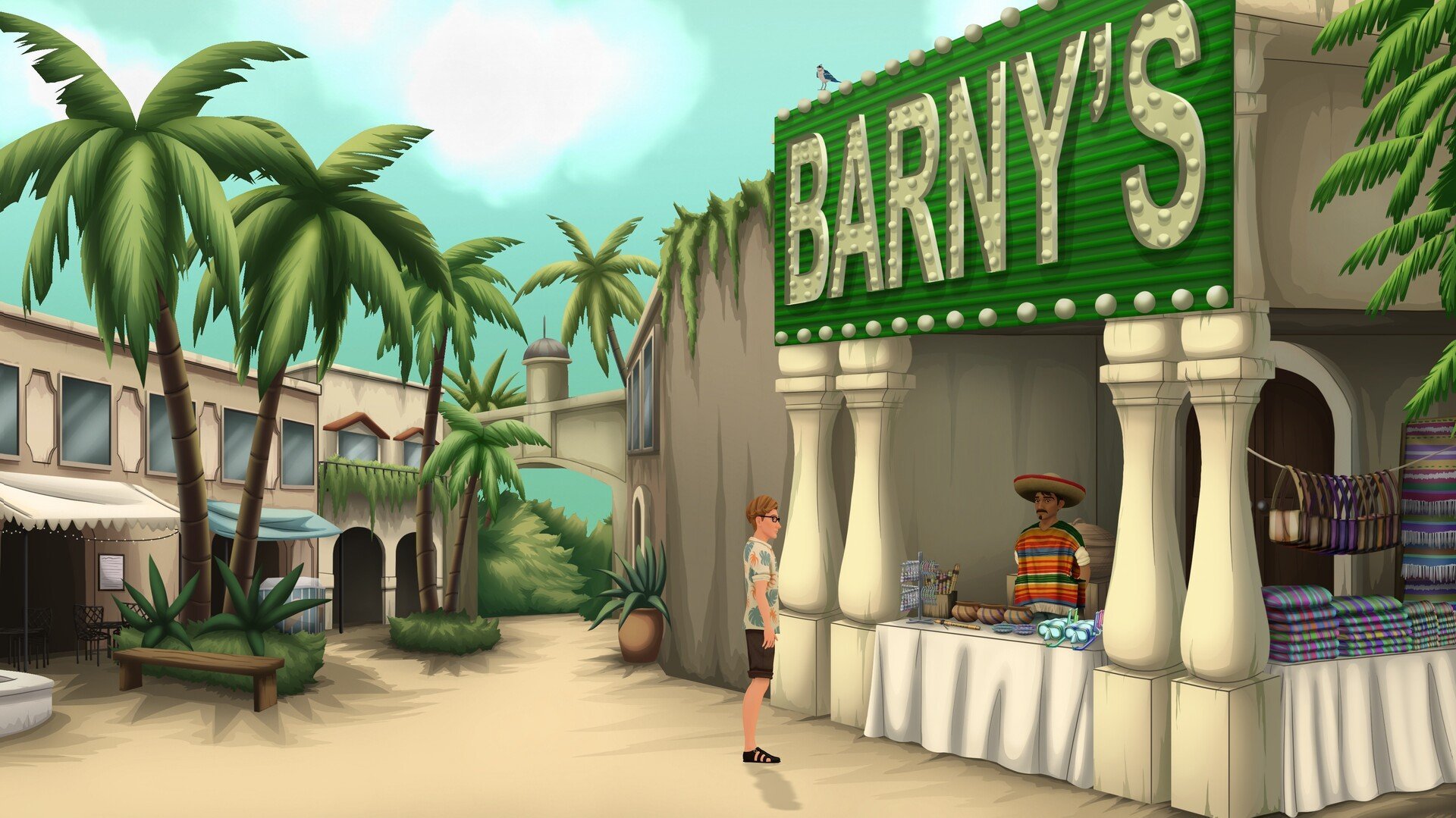
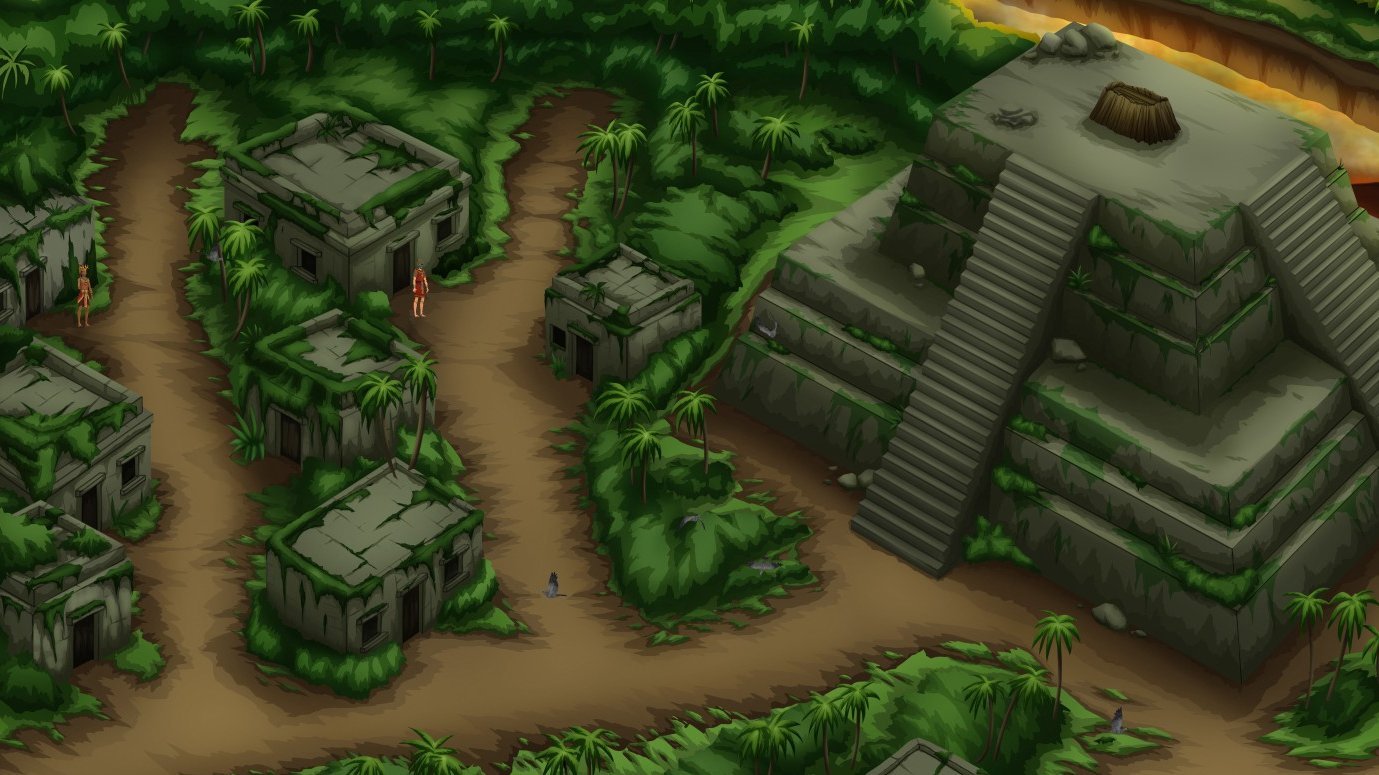
Guatemala offers some great adventure game locations, from the sandy beach with a sunken pirate ship (the captain’s quarters looking extremely similar to the one of a certain ghost pirate), a local zoo and museum, the towns of Santo Tomas and Pueblo Verde, an ancient site at a Mayan temple, and even the inside of a volcano. All the hand-drawn backgrounds look much more professional and with greater depth to them, no longer resembling pictures in a children’s storybook like in the first game. The 3D characters as well are more fine-tuned and better integrated into their surroundings. And should you not prefer these “modern” graphics, there’s an option in the menu to turn everything into pixel art instead. (Even though I am a fan of retro games, the effect of this filter didn’t really do it for me, so I only checked it out for a bit before switching back.)
Little animations liven up this vibrant Central American world as well, like kaleidoscopes of butterflies surrounding flowers, and airplanes flying overhead at the airport. The accompanying music has a huge Caribbean Beach Boys-ish vibe with lots of steel drums. It made me dream of visiting a faraway, exotic locale myself, though I was content to accompany Scott on his instead.
You’ll explore these vividly colorful scenes using the mouse. You can open up the inventory by clicking the backpack icon in the lower right corner, or by using the mouse’s scroll wheel. Right clicks change the cursor between examine and use. As was the case with the first game, you can cycle through three different comments when you examine hotspots multiple times. With some of the harder puzzles, this could have been used to give more guidance to what you are supposed to do, but the comments never seem to add any useful information and are really just there for fun.
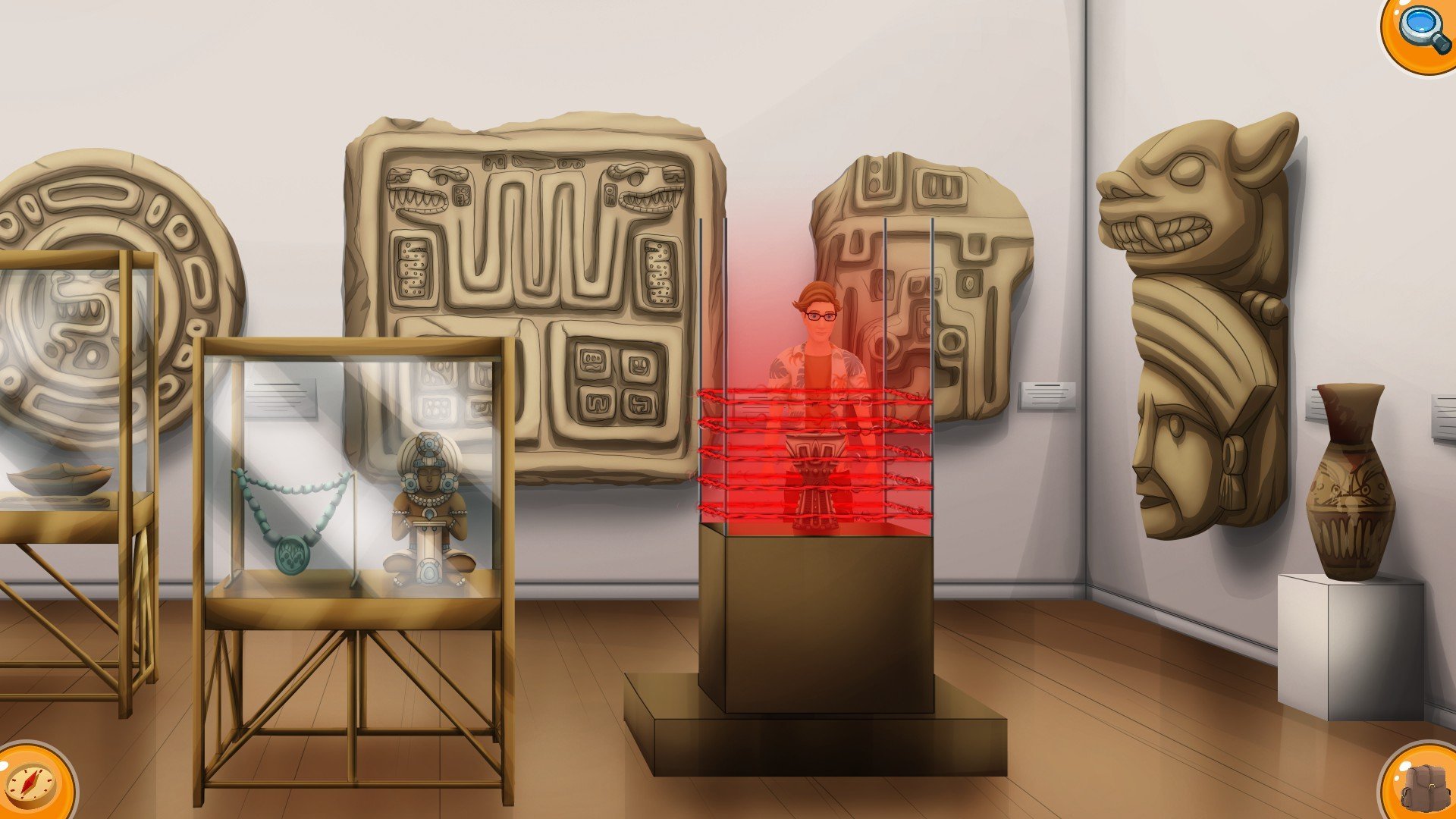
Each location has one or more characters to talk to, like the hotel manager and a maid who needs to be distracted so you can get into her supply cart, a surfer waiting for a huge wave to ride, the museum’s security guard whose key you have to steal, and several native townspeople with their own problems for you to solve, such as fixing a broken family of three, getting the closed-down zoo to reopen, and performing a pretend-human sacrifice to the gods. You’ll get a great feeling of accomplishment each time you fulfill a major task and are treated to a comic book-style cutscene, accompanied by Scott’s narration of the events. When talking to someone, a close-up portrait of them appears in the top left corner but without a dialogue box; the text still appears right above the in-game characters. While you’re at it, you can take a Polaroid shot of each character, which serves no purpose except to unlock achievements.
Having toned down most of the pop culture references of its predecessor, The Search for the Golden Cat is very much its own game this time. Its story is a mélange of mainly funny shenanigans with the occasional dramatic element. Scott gets into all kinds of amusing situations: walking upright on the seabed with only a snorkel, outwitting a cow blocking passage into town, freeing a pack of lemurs to help him climb a tree, and praying to the God of Storm and Destruction to aid him with a certain quest. Each character you meet is here for a reason and generally adds to the game’s humorous vibe, though you’ll mostly snicker rather than actually laugh out loud. Occasionally, though, Scott has to tackle more sensitive issues, like helping a little boy recover his lost goldfish, and listening to a woman complain about her husband leaving her and her son behind, giving the game more emotional depth.
Scott Whiskers: The Search for the Golden Cat

| Genre: | Mystery |
|---|---|
| Presentation: | 2D or 2.5D |
| Theme: | Cultural, Scavenger hunt |
| Perspective: | Third-Person |
| Graphic Style: | Illustrated realism |
| Gameplay: | Puzzle, Quest |
| Control: | Point-and-click |
| Game Length: | Medium (5-10 hours) |
| Difficulty: | Medium |
The game is fully voiced, with Michael Ayiotis once again returning in the role of Scott, performing him as a joyful, optimistic, sometimes ecstatic little geek who occasionally can come across as a bit annoying in all his enthusiasm. But he’s a loveable sort and played by the best voice actor of the lot. The actors for the Guatemalans sound a bit off, with strange accents and weird pronunciations of words, but I took that as fitting in a game featuring people who aren’t used to speaking English anyway.
A huge criticism of the first game was its loads and loads of dialogue, far beyond the necessary information to continue your journey. The Search for the Golden Cat, thankfully, has much more concise dialogues. There is still the occasional line of filler, but the conversations don’t go on and on anymore and are written well. The only thing I didn’t like was how after exhausting a particular topic, the character would always ask Scott something along the lines of “Anything else?” instead of immediately returning to the other dialogue options. Cute at first, but this over-politeness of each and every character after each and every dialogue topic quickly became tiresome.
Very helpful during these exchanges are the different colored dialogue options. White text refers to topics you can discuss at your leisure, while green options are the ones truly necessary to progress. Once chosen, white options turn gray and green ones get a slight yellow shade, to better differentiate between new topics that might pop up after you have made more discoveries. So if you don’t really care for chitchat that reveals background information about the characters and their world, you can limit your selections to what really matters for solving the puzzles.
It’s great to see that the developer listened carefully to all the feedback and criticisms on his previous title. There are still a couple of continuity errors in the dialogues, but far less than there were in the first game. Here it’s mostly a matter of Scott already addressing people by name before he actually learns them through conversation.
Another extremely handy feature is the adventurer’s notebook where Scott keeps a list of all his tasks and crosses them off when they are completed. It’s not a hint system, but I did regularly check the list to better focus my attention. Simply seeing the objective displayed in print was often enough to fire up my synapses to make the necessary links and fulfill the tasks before me. Otherwise I’m sure it would have taken me a bit longer than the seven hours I spent searching for that elusive Golden Cat.
As you progress through the game, you will uncover new settings that take you deeper and deeper into the heart of the jungle. You will often have to backtrack between these new and earlier locations. This is easily done using a fast-travel map, accessible through the compass icon in the bottom left of the screen. This shows an overview map of the region, where you see a miniature Scott hurrying from place to place. To save time within each location itself, you can also double-click when walking around and Scott will go into speedster mode, speed-walking wherever you direct him.
The puzzles are mainly of the inventory variety, but their difficulty was right up my alley. This was true of the first Scott Whiskers game as well; it seems the developer and I have a very similar mindset when it comes to challenge level. Nothing is ever too easy, but after some logical thinking I could always discern what to do or which inventory item I had to use where. Not once did I feel a solution was based on moon logic; everything made perfect sense to me, even if it required a bit of searching around first.
The only exceptions are a couple of code-related puzzles that took some heavy lifting. You need to find which numbers make up a keypad code to disarm a security system, but even then, the exact order of those numbers can only be brute-forced. Another puzzle involving rotating totem pole animal heads has a logical solution, but it’s a bit abstract and a red herring made the puzzle more difficult for me to solve than it actually was. There’s also a little overhead maze “puzzle” in which you have to guide a miniature Scott like a crawling hamster towards the other side, but it’s fun and nothing like the typical dreaded mazes often used in adventure games of yore, rest assured!
Final Verdict
Scott Whiskers: The Search for the Golden Cat is everything a sequel is supposed to be, keeping what already worked while improving on the first game’s weaknesses. Scott is a fun, well-voiced character who perhaps sticks his nose into other people’s business a little too much, but that’s precisely what gets him into positions where you need to use your wits to overcome all kinds of adventure gamey obstacles. The jungle is a fairly typical sort of setting for pulpy adventure stories, but developer Fancy Factory cleverly fuses it with the modern world, turning it into a vacation resort of sorts without being over-the-top touristy. There’s no fortune and glory in it, but whether or not you believe the Golden Cat really has supernatural powers, some good fun is reward enough to search for solutions to help a downtrodden Guatemalan community become prosperous once again.
Hot take
Scott Whiskers: The Search for the Golden Cat takes you on an entertaining point-and-click jungle adventure that improves significantly on its predecessor in a number of important ways.
Pros
- Improved graphics for both backgrounds and characters
- Exotic jungle locations to explore
- Handy checklist of objectives, fast-travel map and color-coded dialogue
- Most puzzles strike just the right difficulty balance
Cons
- Still some superfluous dialogue
- A couple puzzles aren’t as intuitive as the rest
Johnny played Scott Whiskers: The Search for the Golden Cat using a review code provided by the game's publisher.







0 Comments
Want to join the discussion? Leave a comment as guest, sign in or register in our forums.
Leave a comment