Richard Cobbett – Nighthawks
- 2 Comments

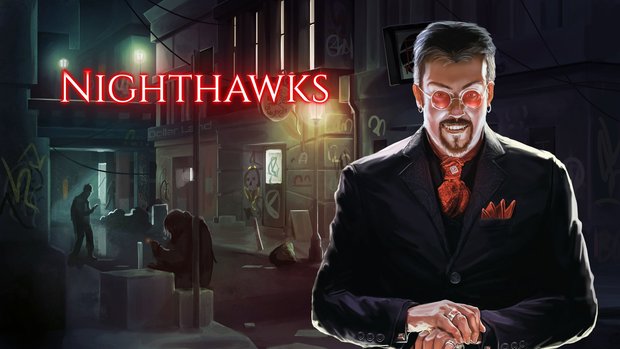
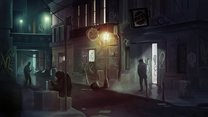
Being a creature of the dark isn’t all about blood packs and cool goth clothes. The Curiosity Engine’s upcoming vampiric narrative RPG Nighthawks will throw players into a world where every night is a fight for survival. Here the veil has been lifted and humanity knows that vampires walk among them. Rather than peering down from a regal old castle of stone, you play as a fledgling vampire turned just six months prior, who mingles on the streets of the run-down market district of a once-vibrant downtown hotspot.
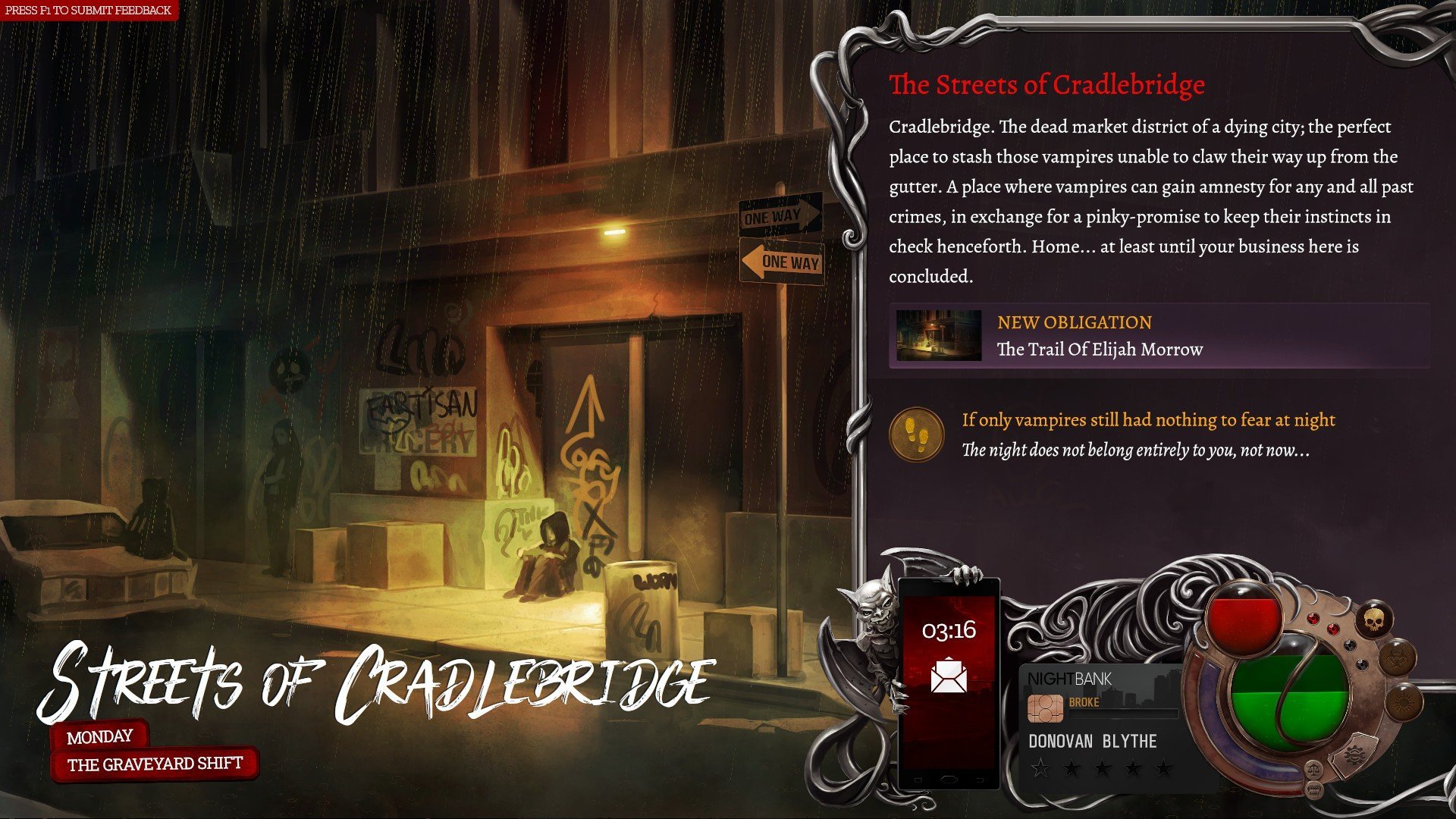
You are given a significant amount of freedom in creating the background and unique characteristics of your undead avatar. I made myself a dashing expert of the occult named Donovan Blythe, sired by a hedonist, my knowledge focused in the “New World” of massive skyscrapers and seedy alleyways of big cities. Your chosen background isn’t just for role-playing, though, as it also affects your base stats used for various skill checks. You’ll pick a unique supernatural “Gift” that unlocks new options in dialogue and quest lines. I chose “Corpsetalking” as my secret ability, as it promised the opportunity to speak with ghosts of the past through the bodies left behind, which sounded pretty useful.
After an unsuccessful attempt to track down your sire’s mortal vassal, you soon find yourself in charge of a failing nightclub that serves as the hub of your explorations in the dark underbelly of the city of Cradlebridge. From there, various characters you meet can be recruited as party members to allow for additional bonuses unique to that individual. It’s your story to uncover, and your un-life to experience. But remember: you’re a vampire, so you’ll need to feed on blood somehow.
The action is presented through still images stunningly painted by Ben Chandler, with slight animations overlaid on top. As you’d expect from any Wadjet Eye-published game, character dialogue is fully voiced, and Thomas Regin creates a deliciously fantastical gothic musical score with an orchestral flair. While combat is present in the game, it is handled through stat rolls and player choices rather than any kind of real-time battles. Narrative text details are displayed in a large window to the right of pictured characters and scenery, along with vials of green and red liquid representing your health and blood levels.
With so much going on under the hood, Nighthawks is far from a traditional adventure, but it is sure to appeal to any fans of character-driven storytelling. Only a couple hours into the game, I can already tell that I’ve just scratched the surface of what’s to come. It looks to be a massive experience, with many decisions to make that tailor your night walker to your preferences and determine the path you’ll take in a richly branching story. Given the script’s importance to this game, who better to help get us up to speed with what to expect than Richard Cobbett, former journalist and head writer and designer of the game?
Hi, Richard. Thanks for taking some time away from Cradlebridge to chat with us at Adventure Game Hotspot. With the release of Nighthawks rapidly approaching, I imagine there’s a lot of crunch time demands.
Hello. I’m Richard Cobbett. I’m the writer and programmer of Nighthawks, the vampire RPG set in a world where the secret has finally been revealed. There was screaming. There was panic. But then, inevitably, there was tomorrow… and now as the world approaches the ten-year anniversary of everyone learning that the stories were true, both humans and vampires find themselves having to answer the biggest question of them all – what happens next?
Please like my game, and also me. I am very tired.
I can imagine how tired you are, because you’ve come a long way. Before we dive into the world of Nighthawks, let’s talk a bit about your impressive career to this point. You’ve worked with many big name outlets as a journalist over the years, and as a writer on major indie titles like Sunless Sea and Sunless Skies. Was that transition from critic to creator something you always envisioned for yourself?
Absolutely. I always wanted to design and write games, to the point that as a kid I was always writing up ideas for sequels to games that I enjoyed, making things up on paper, or playing with stuff like GW-BASIC and various creation kit tools. Games journalism was something that had a more obvious in-road however, and it wasn’t until I went freelance that I was in a real position to start playing on the other side of the fence. On the plus side, it means I come to it with a pretty good bank of knowledge from playing a million and one other games… On the other, I don’t think I get to be too annoyed about people being mean to me if they don’t like what I make. Fair’s fair, I suppose. I will however say that if we get less than 98% when you review Nighthawks, I am absolutely pulling all of my advertising and declaring it a media conspiracy. So there.
You write a 98% game, and we promise to give it 98%! How have you seen your writing evolve as you’ve taken on bigger and more creative projects?

Aside from a small handful of people who knock it out of the park on their first effort (a group of people collectively known as ‘bastards’), the only way to get better at anything is to keep doing it, make mistakes, and then try to make more interesting ones next time. Working with Failbetter Games was an excellent education in writing interactive fiction specifically, not least because they put a lot of effort into editing and refining the writing in their games, and making you think about the meaning and importance of every word that you add to them.
For Nighthawks specifically, there were certainly elements from previous titles that I wanted to explore more. A particular focus was making the world feel like a living, breathing thing where characters have their own lives outside of whatever nonsense you’re dragging them into this time. Another was making full use of being able to convey world and detail through rich prose instead of primarily focusing on dialogue – getting to explore the smells, the texture, the crazy options and variety of verbs and opportunities you can only get away with when you don’t have to draw/model/animate everything that the player is going to be able to do. There’s a lot more of that I’d love to explore in future games, of course, but I think it’s a good start.
I know of more than a few people who’d be pinching themselves if they had the chance to consult on a game like Beyond a Steel Sky. What was your contribution to that game?
Not as big as I’d have liked, but Nighthawks was revving up in my head at that point. I worked quite a lot with Charles Cecil early on, throwing around story ideas, potential directions, and trying to nail down elements like what made the original BASS (Beneath a Steel Sky) so special and what needed to be continued in the sequel. After that, I’d mostly play various sections and try to give feedback from an external perspective – for instance, at one point Foster was going to sneak back into the city from a hidden side entrance, while I pushed the idea that he should get to go in more dramatically through the big imposing entrance that was looming over the player.
You’ve covered or worked on many adventure games over the years. Have you always felt a particular affinity for the genre?
100% so. Adventure games were the first genre I truly loved, way back in the 80s, on the Amstrad 1512. CGA graphics, 20MB HDD, running at a whopping 8Mhz. Those and RPGs like the Ultima series were ways of stepping into a whole other world in ways that no other genre could offer. It was always the story elements more than the puzzles that hooked me – exploring, trying things out and getting fun reactions, hunting for deaths in Sierra titles, and so on.
As a kid, obviously not knowing anything about game development except the end result, my dream job would have been making Sierra/LucasArts-type games. Even so, it fuelled a lot of my early playing around and experimentation, from simple stuff like editing the text files in Civilization to make the computer say hilarious things like ‘the anals of history’, to writing text adventures in first BASIC and then later on, more advanced tools like Inform and TADS. The idea of being able to sit down and make a world that people would live in, love, and come to consider home really did seem like magic to me at the time… and honestly, it still does.
Besides yourself, of course, who is The Curiosity Engine?
Oh, it’s just me and my cat. You need a fancy company name, if only to have something to put onto business cards. I suspect it will stay as just myself and a feline companion, with hopefully other contributors assuming that Nighthawks sells well enough to make future games.
How did your path lead you to the fine folks at Wadjet Eye Games as a publishing partner?
I’ve known Dave (Gilbert) for years, and we’ve often talked about one day doing something together. Nighthawks was just coming together as a concept at just the right time, when he had some time to let me borrow the wonderful Ben Chandler on art… and then was conveniently pot-committed when it turned out to need just a little more time than we initially planned.
You’ve certainly proven yourself up to the task of writing a game with an absolutely massive script. Please tell us a bit about Nighthawks.
In brief, Nighthawks is a text-based RPG set in a world where vampires have been exposed to the world. Eight years ago, the secret came out. Since then, a lot has happened, but perhaps the most important thing is the New Century Amnesty – the offer of a clean slate to all vampires willing to take it, in exchange for coming forward and agreeing to follow the rules from now on. You play one of those vampires, a new nightclub owner in the city chosen (very much against its will) to be the testbed for human/vampire reintegration and all the questions that it poses, on a rags-to-riches journey through the highs, lows and many surprises of a world in change. It’s dark, it’s funny, and much more warm-hearted than most vampire games, while never letting you forget that there’s many good reasons that vampires are usually thought of as monsters…
It’s a big game, with around a million words at this point, and a huge variety of stories that dig into every aspect of being a modern vampire – hunting and feeding and racing the dawn, of course, but also legacy, the stress of immortality, and the search for meaning even in death. Every night is a new adventure, which can be anything from going undercover at a gathering of human supremacists, to taking a quiet artistic trip around the city with a four-hundred-year-old aristocrat, to helping the Empress of the Rats negotiate peace at an abandoned carnival. As for what kind of vampire you are… well, that’s entirely up to you. Death is what you make it.
Is the story behind the game your own original idea?
Absolutely, although it actually began as something completely different. I’d been working on Sunless Sea when I felt the urge to download Unity (I’m now using Godot, but never mind) and just try to make something. Nothing too fancy. The gimmick I came up with as a test project was essentially Vampire: The Masquerade – Bloodlines in a Fallen London style. I made a prototype and put a screenshot online with a jokey ‘So, anyone got White Wolf’s e-mail address?’ type comment… and then about an hour later got a reply from them saying, basically, ‘Show us what you’ve got!’
In a word, gulp.
Knowing that they’d say ‘no’ but not wanting to waste the opportunity to both play in their sandbox for a while and practice my pitching, I wrote up a concept for a V:TM interactive fiction game set in London – not just a phenomenal city to do a vampire story, but pretty much an urban vampire in its own right. Anyway, needless to say, I was right and they said no – and of course, subsequently did the Various Things of New York series.
Even so, the idea of doing a vampire game of some sort had hooked itself in my brain, so I started playing around with questions like “what other creative space is there to play with?” For instance, how many vampire games have mechanically implemented things like the need to get home by sunrise, instead of being perpetually set in a nocturnal world. How many have explored other classic rules, like mechanically not being able to enter homes without an invitation, or the psychological effect of a lack of reflection leading you to eventually forget your own face?
The more I thought about it, the more interested I got by the possibilities.
To be clear, Nighthawks has very little to do with that original pitch, by design. Even ignoring legal and creative concerns, there’s simply no point just taking Vampire: The Masquerade and filing the serial numbers off. It will always feel like V:TM, and V:TM will always V:TM better than you. But that setting is only one way of doing a vampire story, as games like Vampyr and Legacy of Kain and Cabernet have demonstrated. For Nighthawks specifically, we obviously wanted something that would resonate with fans of things like Bloodlines – I adored that game, and it was unquestionably a big inspiration – but which could explore vampirism from a completely different direction.
And the first step? It seemed obvious. No more secrets.
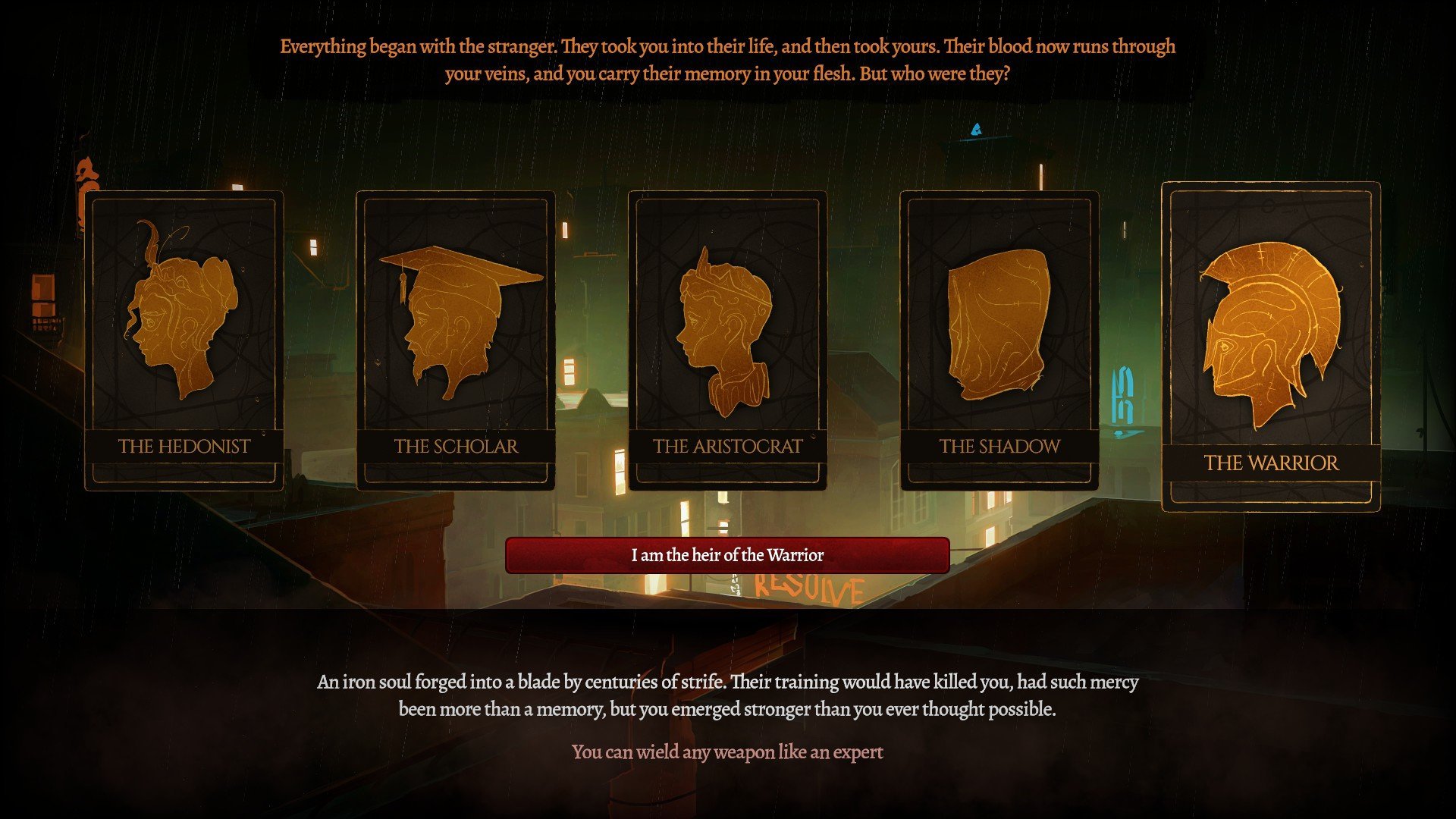
There’s a huge number of choices for players to craft their own unique creature of the night. What made you zero in on the particular categories available in Nighthawks?
One of the interesting things to me about Nighthawks as a setting is that it’s focused more on the future than the past. I wanted to avoid clogging up the lore with too many organisations and terms with Imposing Capital Letters, so character creation focuses on two key questions – your sire’s nature (as a way of shaping your own) and your bloodline – New World, Old Country, etc., acting more as a nationality than club membership. Both are essentially ways of steering towards various vampire archetypes… but to inform who you are, not forever define it.
Many “choices” in games end up being largely illusory. How much does player agency actually guide the narrative of this one?
My favourite example is that you have a couple of human companions, and the choice to take them into your Sanctuary, kill them, and eat them. I don’t recommend this! It won’t give you anything cool and it will cut you out of their stories, but it felt like an option that had to be there to be true to the fantasy. There’s a quick pause for the game to go “Just so you know, we’re actually doing this…” but after that… I’ve always hated false choices where the game will let you go “I want to do X” only to immediately overrule you with “No you don’t.” Even if the only result is a dope-slap for walking around naked or similar, I want something interesting to happen!
As far as the wider picture goes, every player will hit the same major plot points, with four endings at the end of the road. However, within that there’s a lot of flexibility… moral and otherwise… in terms of how you handle and resolve situations. For instance, there’s one story in Act 2 where you need to sneak into someone’s house, and as a vampire, you and most of your companions require an invitation to cross the threshold. You get one for yourself, but not the others, who have to wait outside while you poke around. However, if you bring a human companion instead, they can just walk through the door and join you for the search. It’s completely optional, but the kind of “Wait, what if I…?” thinking that I like to reward.
The fun thing about working in text is that while creating entire alternate paths for every potential solution is always going to be challenging, it’s very easy to throw in moments of responsiveness or callbacks or alternate ways around things to make it feel like the game is also paying attention to what you do. As a designer, there’s really nothing more satisfying than a player thinking they’ve found a loophole or shortcut you didn’t think of, only to find you waiting there with a respectful nod and a little bit of content just for them and maybe three other people… a little like how in Quest for Glory II you can sequence break all the way to the game’s second city long before you’re supposed to go there, only to be told to go away again. The fact that you can do that spoke to how much effort the Coles put into making that world feel real, in ways that are impossible to reflect on a balance sheet, but which still resonate literally decades later.
It’s the kind of thing that you can’t really justify when working on someone else’s game and on their dime, but you can absolutely go crazy with when it’s your own project. Suffice to say, there’s a lot of fun little stuff scattered around for people who like to go off-book, take different companions on different adventures, or look for loopholes and alternatives to problems.
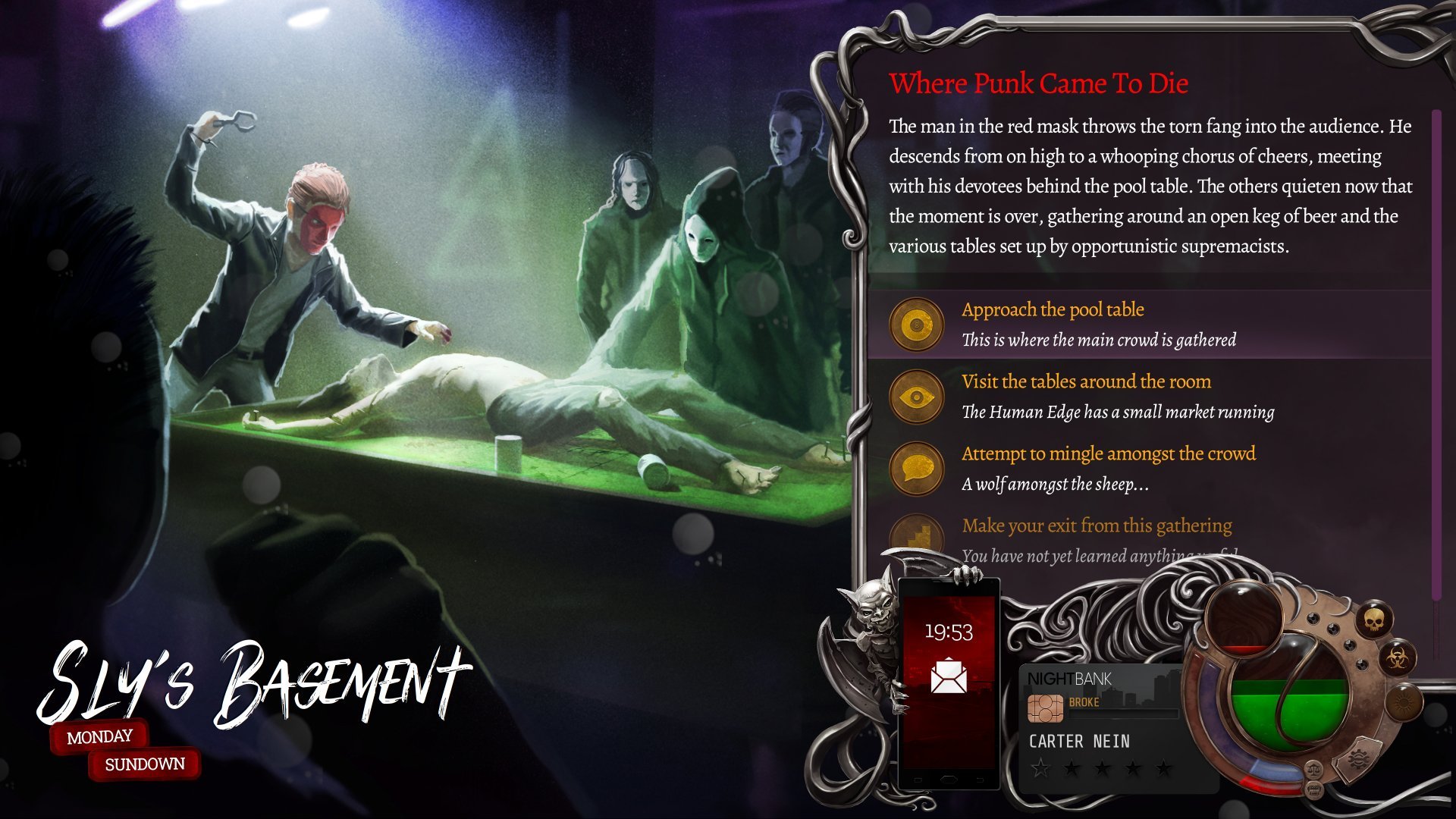
Even in the early hours of this game, I’ve noticed a heavy emphasis on consent being a key feature when choosing to drink the blood of the mortals around you. How do you approach the idea of morality in a game where you’re objectively a monster?
Ah, well, isn’t that one of the key questions? You’re a vampire… but does that make you a monster? In-universe, many would agree. Your stage magician companion Madame Lux outright shrugs off name-calling as ‘We are monsters. Some of us just have better marketing.’ However, as you play through, you’ll find that neither humans nor vampires have a monopoly on being terrible, and that the world is very much not black and white. For instance, you have the ‘nice’ option of drinking approved, licensed, bottled blood (it has to be human; animal blood won’t work) instead of hunting… but where is that coming from? It would be easy to make that a scary vampire conspiracy you get to ‘solve’, but it’s not, it’s regular ol’ capitalist pragmatism.
All of this ties in directly to the whole setting of the game – humans and vampires facing tough questions and trying to collectively figure out the best way forward. You can certainly embrace the darkness, abuse your powers and indulge the monster within… but you can also see it as something more positive. A second chance. Immortality as your forever playground.
Given all of that, and how many vampire powers revolve around domination to various degrees, consent felt like a very important factor. Again, it doesn’t have to limit you. You can be the vampire who goes hunting, rip people’s throats out, and see humanity as nothing more than a talkative herd there to serve your interests and desires. However, several stories will put you face to face with those issues, and show that even seemingly ‘nice’ vampires can easily find themselves morally slipping in the face of temptation, frustration or apathy. We take those very seriously (even if some characters can be flippant about them), because those are issues that stretch far beyond supernatural characters and deserve to be handled with respect.
As you mentioned earlier, unlike White Wolf’s vampiric RPG setting, Nighthawks unmasks its vampires to the human world. How did flipping the traditional secrecy of vampires on its head challenge you – or free you – during development?
It really changes everything, but the most important for me is that it flips the emotional core of the setting on its head. I’m hoping that the result will appeal to both fans of games like Vampire and others for the parts where the two worlds share elements of flavour, like the gothic film-noir vibe of the first act, but also work as an original setting that offers something very different.
For instance, in something like Vampire: The Masquerade, the night is inherently hostile. You’re in a brutal, cut-throat world largely built on isolation, betrayal and ambition. A nightclub isn’t a place to hang out, it’s a royal court where one wrong word is the difference between life and death. That’s not to say you can’t have friends, but typically they’re going to be seen as a weakness for others to exploit – or a sign of potentially suicidal naivety. You’re certainly not likely to wander in to find them arguing over the rules of Clue or arranging a relaxing trip to the spa.
Nighthawks is instead rooted in the concept that dark streets can lead to a brighter tomorrow, and what really drives most of the characters is the lingering question of what that means to them. Most of the main characters are united at the start of the game by being isolated, lonely, and stuck in bad patterns. With their biggest threat over, they’re free to lower their shields, and for the first time truly appreciate the benefits of vampirism instead of dwelling on the curse. The more that happens, the more we move away from the idea of damnation and personal horror as what it means to be a vampire and get to explore some completely different territory instead.
On a wider level, revealing the secret also gives us a fun opportunity to more openly play with a lot of the stock vampire rules and tropes. At one point, for example, a character comes in complaining that they got hit by a reversing car because the driver had only checked his mirror instead of remembering to do a manual check – another, related exchange involves the trials of putting on makeup without a reflection. Through news stories and exploration, you get to see how the world is adapting in terms of media, law and just general perception, from churches objecting to being asked to take down holy symbols from public areas to avoid hurting passing vampires, to the politically correct push to have people use the term ‘revenant’ instead. The world will hopefully feel living and breathing… even if many of the main characters aren’t.
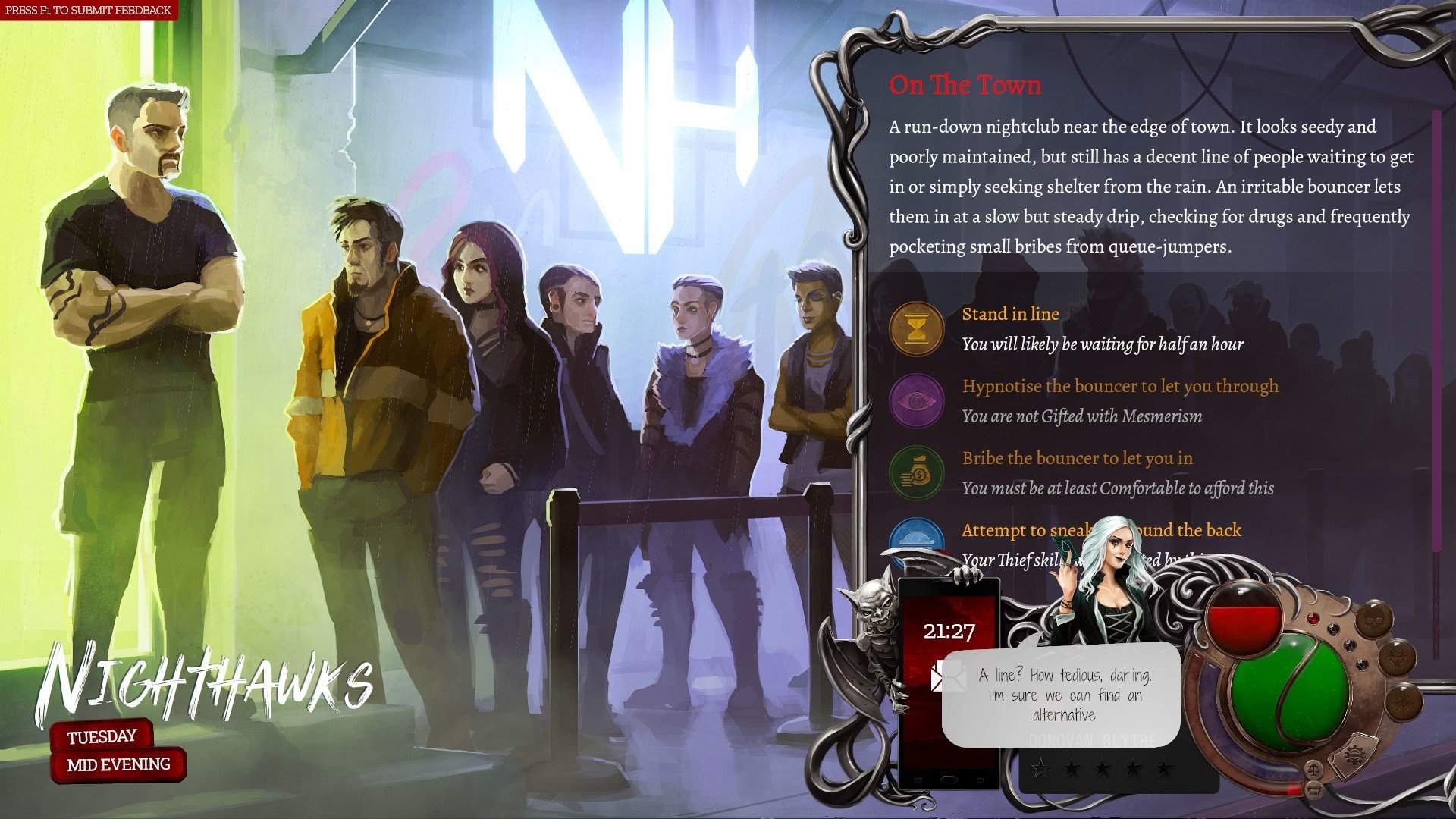
When thinking about modern-day vampires, what steered you towards a nightclub being the backbone of the inner workings of the story’s machinations?
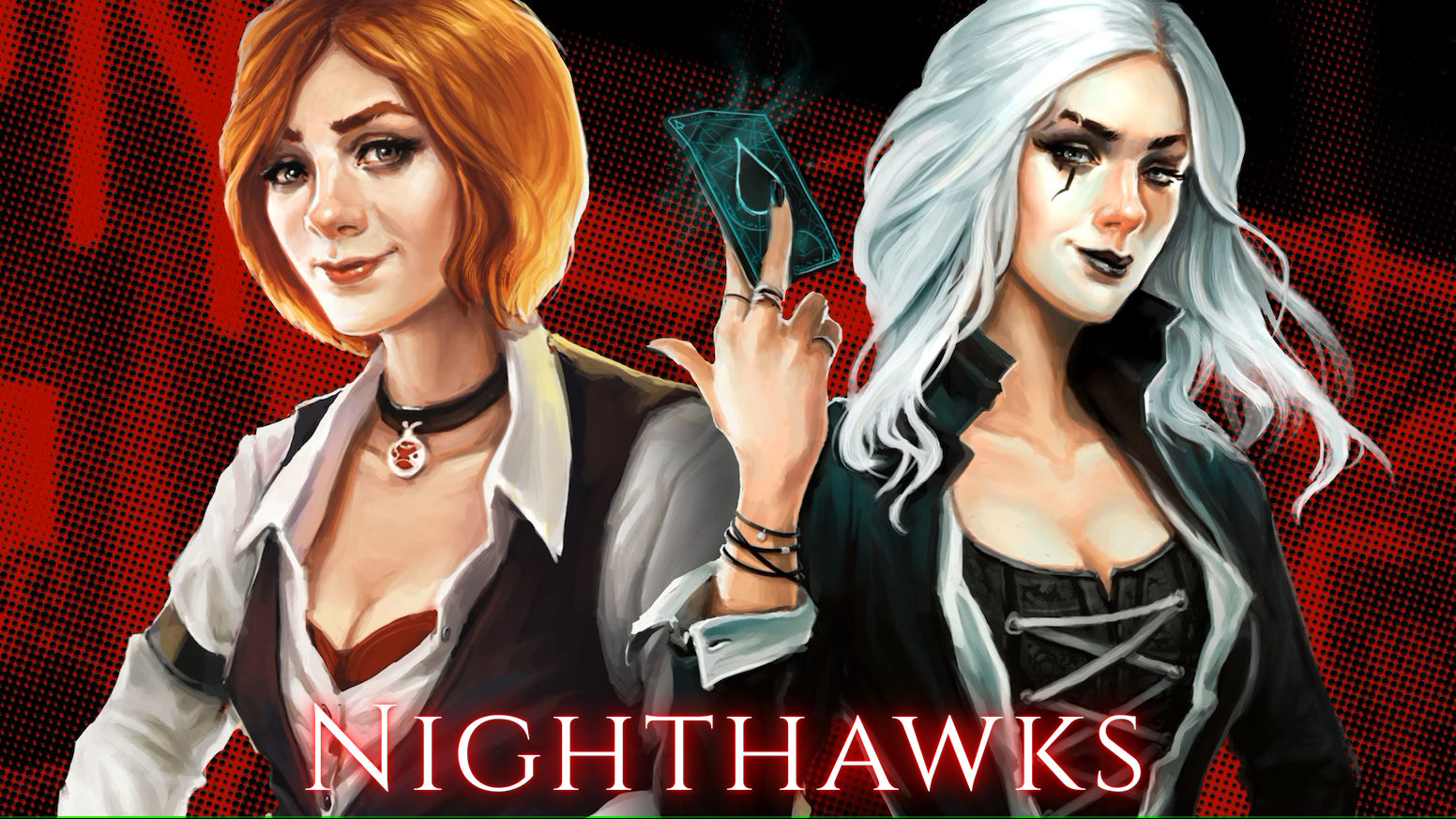
The ‘vampire nightclub owner’ thing is definitely a trope, but for good reason. Much like the painting of the same name, the central concept of Nighthawks as a club is to be a circle of light in the darkness, where characters who might otherwise never interact can come together to create a found family built on shared experiences, jokes, and even the occasional prank war.
A nightclub offers that opportunity for a shared space, darker corners for hunting and other more sinister purposes, as well as a business that the player can own and climb from rags to riches as the owner of without actually restricting them from going out and having adventures. It also acts as an excellent place to overhear rumours and stories, to keep the player in the loop, and, for plot reasons, a reason for them to be sucked into the wider vampire politics of the city.
Are you involved at all in the voice acting process? Wadjet Eye has assembled quite an impressive array of talent for the game!
The voices were all directed by Dave, like the other Wadjet Eye games. I worked with him on the auditions, but after that, it was mostly just providing the scripts and giving permission to change any awkward lines or Britishisms as required. Some of the characters have some… ah… ‘spicy’ lines, but it was important to me that everyone was comfortable with them.
The audition sides specifically offered examples of some of the worst so that everyone was okay with it. One of my favourite outtakes is Amelia Tyler (voice of the Baldur’s Gate 3 narrator, Hecate in Hades 2, and a million other things), who plays the gleefully sociopathic vampire PR crisis agent Monika Vail in Nighthawks, laughing about how she frequently read out her lines and only then realised just how terrible the words that came out of her lips actually were.
We have a really big cast though, all of whom are excellent and threw themselves into it. It was especially nice to have Arielle Siegel, Ivy Dupler and Ben Britton back to reprise their roles from waaaay back in the original demo, joined by both new voices and returning WEG favourites like Elsie Lovelock, Tiana Camacho, Frank Todaro, Sally Beaumont, Jay Britton… so many!
Having voices and someone of Dave’s experience and contacts handling that side of things was an immeasurable boon. They immediately made the characters feel so much more real, even if I do wince at some of the things that I asked our poor actors to say. There’s a standard snarky thing people sometimes say: “The writer must have been writing with one hand.” No. I promise, they were written while cringing at the thought of the inevitable eyebrow-raising in the booth!
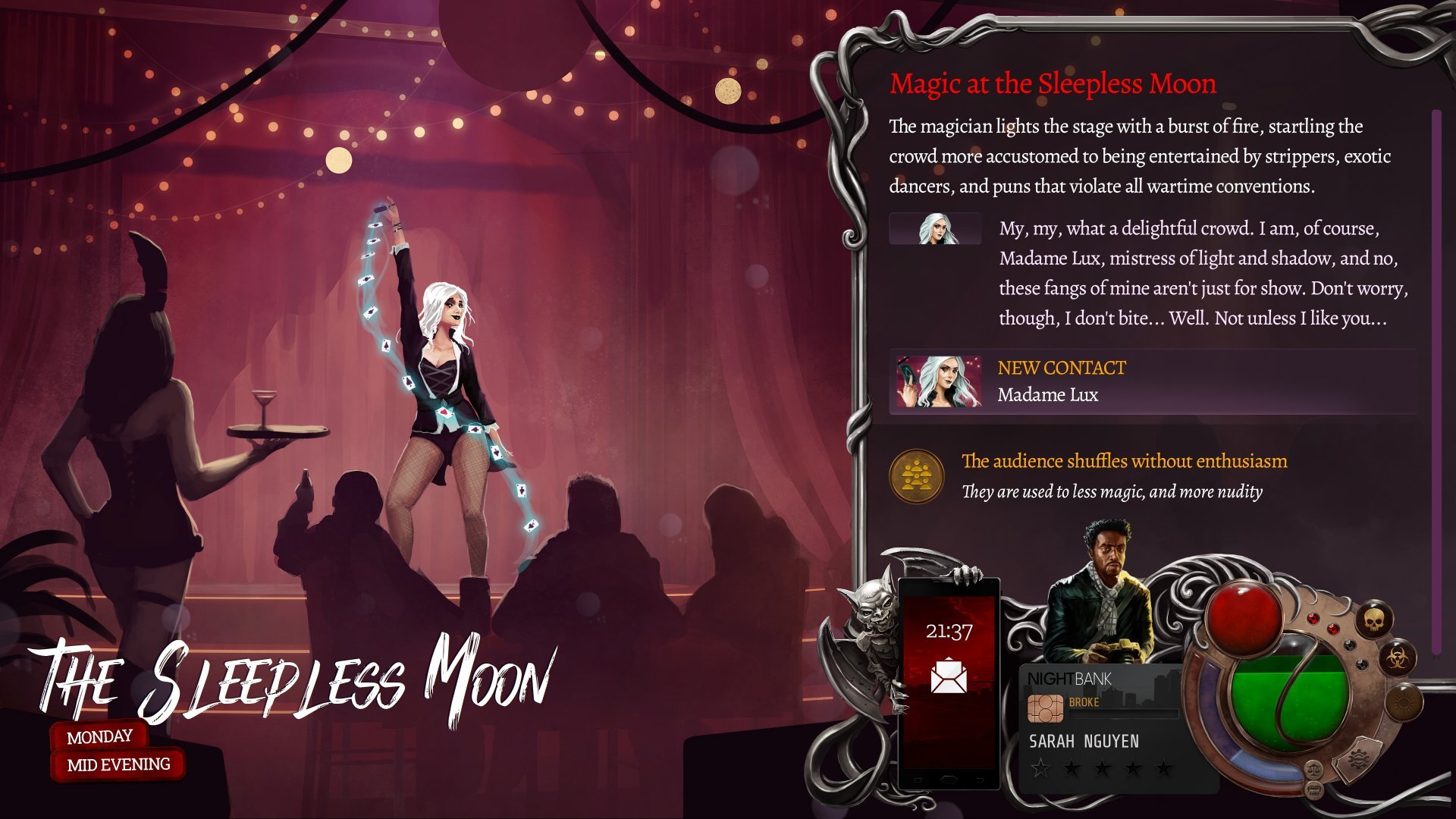
On Steam it says the game includes stories from “the hilarious to the horrific.” How do you strike a balance that feels right between such extremes?
Largely by not crossing the streams. The game is structured as a hybrid of free-roaming where you hang out with characters and investigate stories, and more locked off sequences that can be more tightly controlled. You never get a situation where you witness something truly horrific and then have the game do the narrative version of sitting on a whoopee cushion – there’s always an emotional buffer between major tonal shifts like that. It also helps Nighthawks has so many different stories that you get used to each having its own distinct theme, vibe and usually narrative mechanics. It’s an important part of preventing the player getting into a rut.
During my first couple hours playing Nighthawks, I fell in love with the silly “tutorial gargoyle pal.” Even without a voice, his personality shone through in his quips. Does he have a name, or is he forever doomed to remain anonymous?
In-game, he’s just called ‘Tutorial Gargoyle’, so… how about Toots? Seems appropriate! He was a random 3AM idea, really. Ben had drawn a gargoyle into the UI just as a bit of decoration. I was trying to think of a way of doing tooltips that felt a bit more integrated and had a bit of personality, and on a whim, I drew some glowing red eyes on the portrait and gave him a speech bubble. I wasn’t sure if it would work, but people really seemed to like him.
For those looking to check it out, when and where can we expect to find Nighthawks?
It's due out September 22, on Steam and GOG. Whether or not it comes to other platforms will really depend on how well it sells. Wishlist today!
Thank you so much, Richard, for taking time away from all the last bits of polish you and the team are surely putting on the game. I wish you all the best with the upcoming launch. Before we go, are there any final words you’d like to give aspiring bloodsuckers?
Please buy my game. Multiple copies, preferably.
More seriously, if you like it… or any other indie title… spread the word. The industry is a tough place at the moment, and especially for smaller developers who don’t have big (or any) marketing budgets to throw around to get eyes and juice the various algorithms, getting attention for a game really is like pulling teeth. Our only real weapon is the passion of players willing to share and talk about what they love, and in doing so, give us the ability to keep making more of it. I hope that Nighthawks will qualify, but if not, the same 100% applies to any other indie game that you happen to enjoy. Whether it’s Steam reviews or streams or Let’s Plays or whatever we’re calling tweets at the moment, every little bit helps more than you can imagine… even if it’s just brightening someone’s day by telling them you enjoyed their work.
Oh, and remember to thank the tutorial gargoyle. He’s rooting for you.

- Advertisement
- Help support AGH by advertising with us





2 Comments
Want to join the discussion? Leave a comment as guest, sign in or register in our forums.
I'll be honest, I was gonna pass on this one, but after reading the interview I kinda want to check it out now.
Reply
Really want to dive into this one! I've read all the Anne Rice books, and the Anita Blake series where "the veil has been lifted" as well. So I wonder what type of vampire I'll be...
Reply
Leave a comment