
Perfect Tides: Station to Station review
- 0 Comments

The next stop in Meredith Gran’s outstanding coming-of-age series is very different but every bit as brilliant as its acclaimed predecessor
Meredith Gran’s Perfect Tides was always going to be a tough act to follow. That game, the developer’s first, followed a year in the life of teenager Mara Whitefish as she tried to figure out who she wanted to be, and it was an achingly poignant character study that used the adventure genre’s strengths to put players directly into its young protagonist’s headspace. With its brilliant use of second-person Sierra-style narration to represent Mara’s thoughts, along with choice-focused gameplay that allowed you the chance to both enrich your playthrough with a plethora of optional activities and to miss out or get things wrong and keep going anyway, it was a coming-of-age story tailor-made for the interactive medium. Any follow-up would have its work cut out for it.
Well. Consider this new narrative garment expertly stitched. The sequel, Station to Station, is certainly a different game than its predecessor, just as the now college-aged Mara is a different person. As her focus and priorities have shifted, so have the ways the game chooses to let you experience them. However, it’s no less a brilliant and heartbreaking exploration of youth, time, and the process of growing into oneself. It’s a stirring, emotionally charged, and above all human work of art that looks on the past with love while moving to meet its audience in their eternal present. A searingly honest and at times nightmarishly immersive look at the delirious fusion of now and nowhere that is post-adolescence, this is a joyous declaration of possibility and another standout model of the adventure genre’s unique abilities as a medium for soulful, mature storytelling.
Perfect Tides ended in early 2001, with Mara standing on the precipice of a bigger world than she’d ever known. Her high school graduation wasn’t far off, and the relationships that defined her childhood were in flux; her family was preparing to move away from the sleepy island town where she’d lived her whole life, pushed out by money troubles; and she had just started the work of processing her father’s sudden death a few years beforehand. While she still didn’t know what direction she wanted her life to take—beyond that she hoped to be a writer—she had started to grasp the first contours of who she really was.
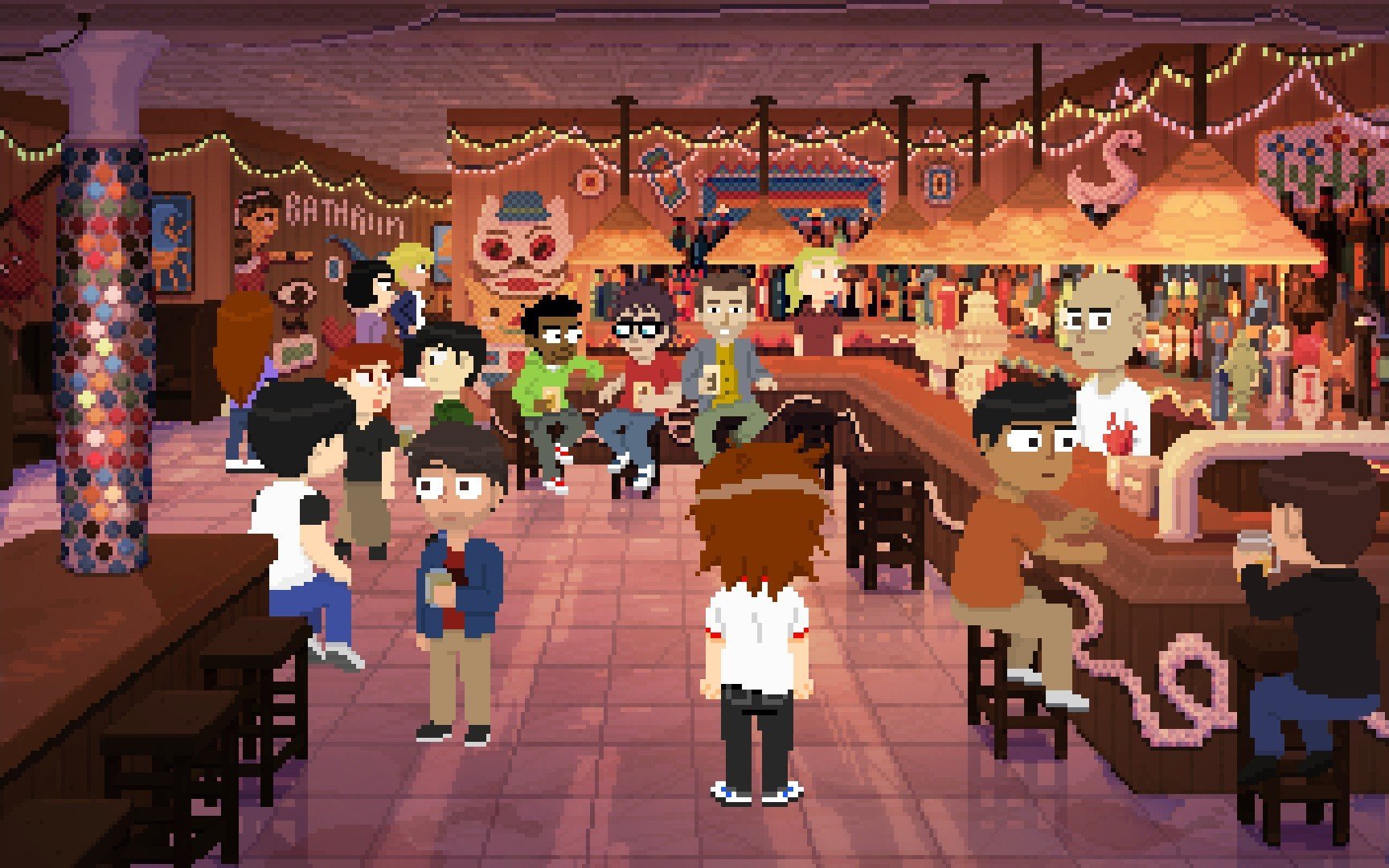
Station to Station begins in the spring of 2003, as Mara prepares to close out her freshman year at State University of Creative Studies (SUCS, for short), the big-city college she attends on a writing scholarship. Like the previous game, it follows a full year in Mara’s life, divided into four seasonal acts of four days each, the sum of which should take around ten hours to complete. As we join her, Mara is eighteen years old, legally an adult, and she’s doing her best to carve out an identity for herself separate from her home and family…as much as she can, at least, while commuting back and forth on the train from her mother’s apartment in the suburbs. But she’s making good progress! She’s earning money working at the school library, and she’s got a thriving friend group of her own in the city; she’s even cut her hair to facilitate eye contact. Not only that, she has a boyfriend, Adam, who she’s been seeing (long distance) for nearly a year.
Mara’s goals at the start of the game are twofold: first, gain the approval and respect of her writing professor, a novelist she idolizes, and second, take in as much of university life as she can to make up for the quiet isolation of her youth. Her chief accomplice in both endeavors is Daniel, a bit player in the previous game who, like Mara, now studies writing at SUCS. Since we last saw them, their shared interests and life goals have turned them into best friends and partners in crime. These days Mara winds up crashing on his couch more often than she takes the train home.
Everything starts to change for Mara when she and Daniel have a chance encounter with Andrew Stern, a writer they both admire who’s gained a large following via the burgeoning medium of blogging. He happens to be hosting a reading for up-and-coming writers to showcase their stuff, and invites them to attend and share something they’ve written. It’s an opportunity too big to pass up—so long as Mara can manage to put something together while balancing classes, her job, and her relationship with Adam.
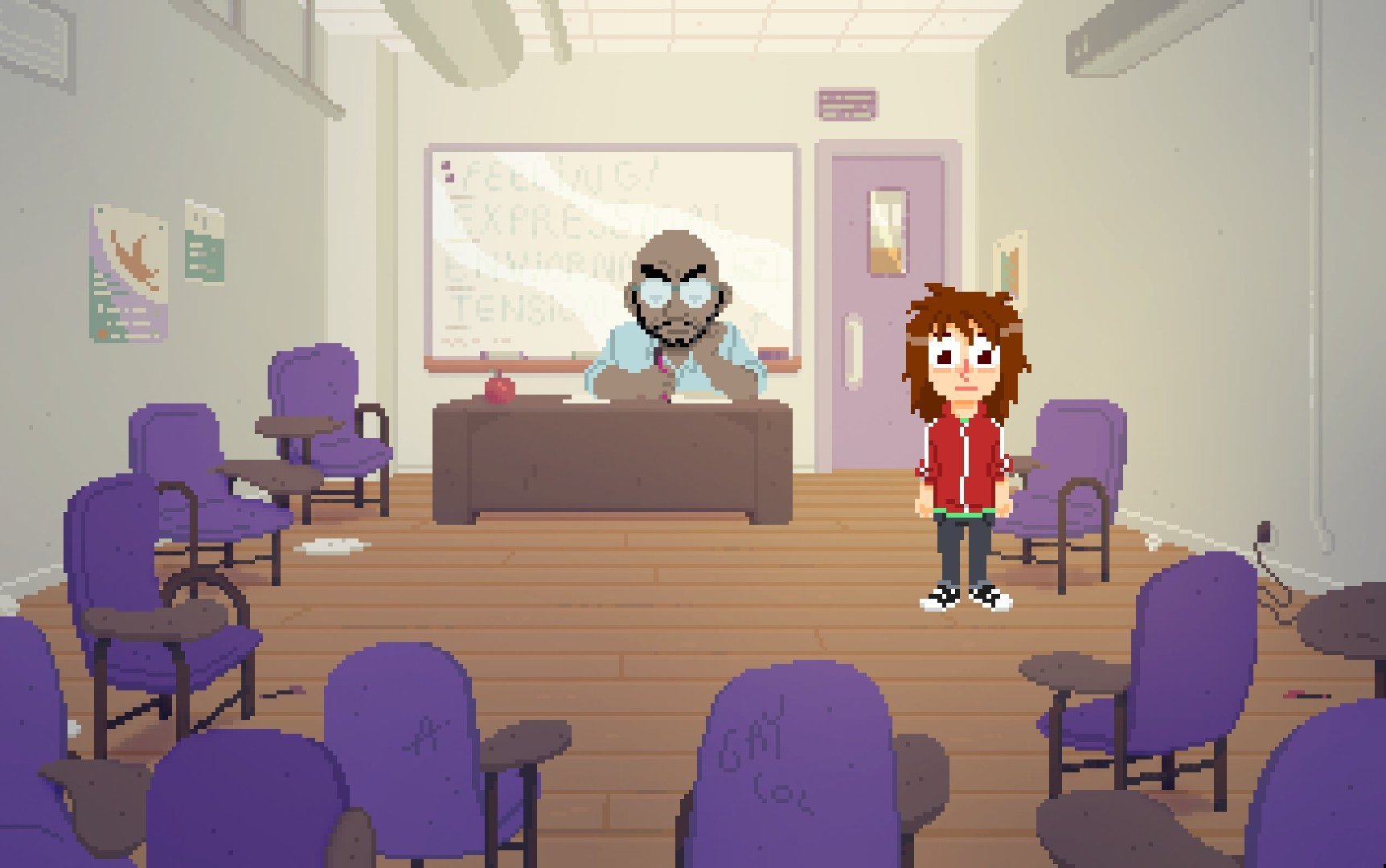
While the first Perfect Tides used an interface that was functionally identical to Sierra’s old hidden menu bar and cursor-cycling format, Station to Station adopts a radically different approach. While the hidden bar remains, gone are the old reliable verb icons, replaced by a single non-specific cursor; you left-click to walk or interact, you right-click to examine, and that’s it. You’ll know you’ve found something to interact with if your cursor glows red, though as in the original (and the classics that inspired it) you can examine any number of environmental details that don’t otherwise register as hotspots. When you meet somebody you can talk to, your cursor will change into a red speech bubble; click and hold it to bring up Mara’s phone, where she keeps separate tabs listing characters and topics of interest so that she can ask about them. (Lucky kid; that’s one more tab than any phone I ever owned in 2003.)
You do have an inventory, though it features in only a handful of out-and-out puzzles. The main focus is on the new icons in your menu bar, positioned to the right of your inventory. First and most important is the one that keeps track of Mara’s writing projects, which shows you a list of her assignments, their due dates and the subjects she can choose to address alongside a comical X-ray of her head and its contents. As you talk to people and experience more of what the city has to offer, Mara will discover new topics she might be able to write about; each new topic comes with a numerical counter representing Mara’s knowledge level, starting at zero and increasing as she learns more.
Aside from life experiences, your best bet for raising your knowledge score on a particular topic is to find and read books, which you’ll access via another menu button once you’ve found some. In practical terms, to read one is simply to get a summary of the thoughts it inspires in Mara. You can carry five books at a time but Mara generally only has time to read one a day. If she meets somebody with a book they might want to swap, she can offer one from her own stash. The books you’ll encounter run the gamut from novels to magazines to collections of essays. Some won’t have anything to offer in terms of advancement, but many will, and figuring out what to read in order to grow your knowledge of a given topic is one of the game’s ongoing challenges.
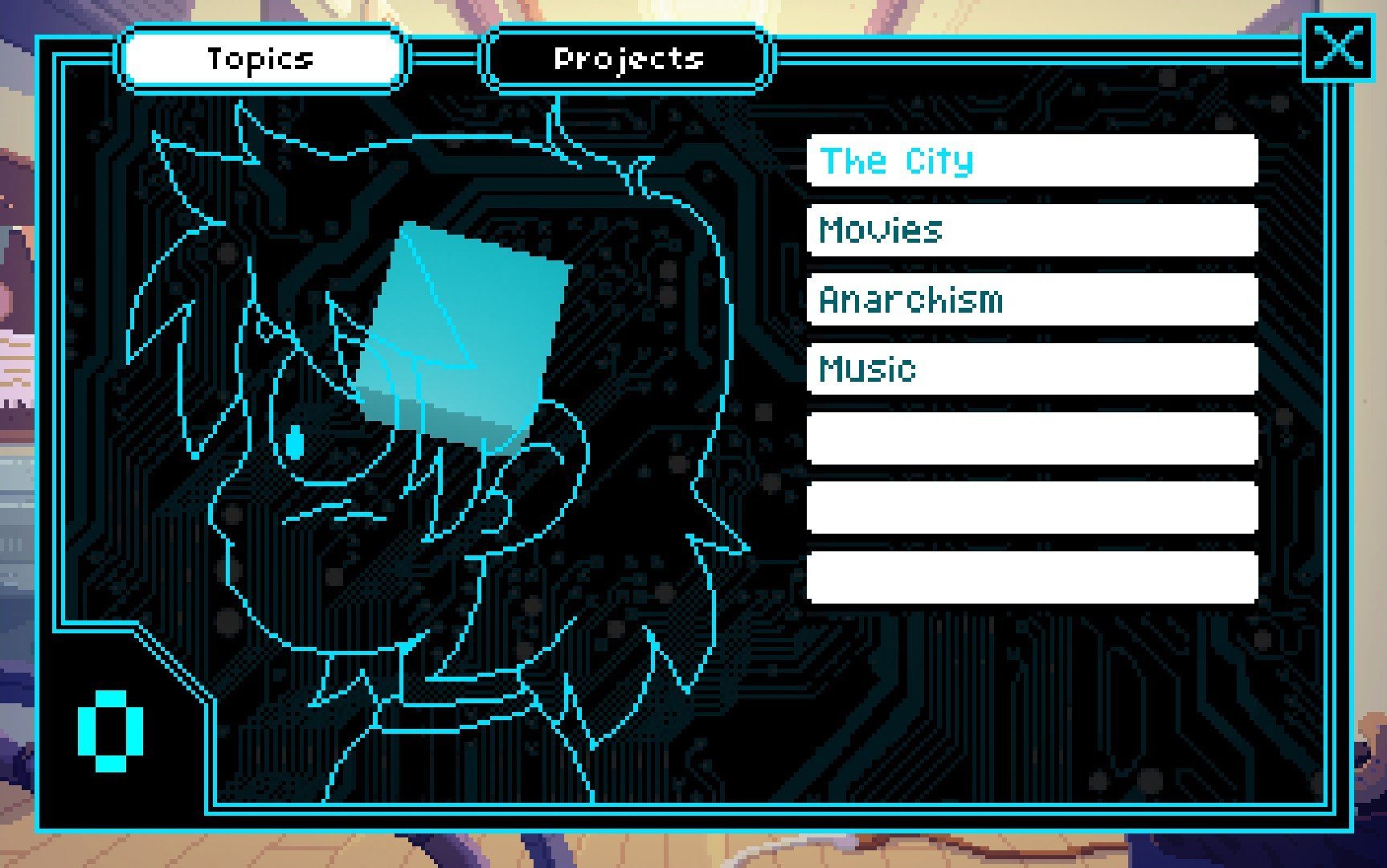
With so much of Mara’s life focused on writing, it makes sense that the gameplay would follow suit. Most in-game days come with a particular writing assignment that Mara is focused on, so the bulk of the puzzles center on Station to Station’s unique writing mechanic. When it’s time to write, you’ll sit Mara down at the nearest computer and open up the word processor, which takes you to the assignment/topic menu; there you’ll select your primary and secondary topics for a given assignment. If Mara’s been asked to write about an experience she had at a local concert, for instance, you might choose “Music” as your primary topic and “The City” as your secondary—or vice-versa, if you thought that was more appropriate.
To get the best score on an assignment you’ll have to make sure Mara is properly prepared when she sits down to write. This means finding and reading potentially relevant books (either at the library or from the open-air vendor outside), saying “yes” to events that might teach her something, choosing the best topics, and figuring out the optimal time to start. She’ll probably write a better paper about that concert once it’s actually happened, for instance, and it’s possible to snooze and lose entirely if you leave it too late to start. Mara will naturally write more cogently on topics where she has a higher knowledge score, but she still has to work within the parameters of the assignment; her knowledge of film won’t help much if the prompt is for an essay on music. Sticking to the same topics across different assignments for one class also runs the risk of lowering your score; part of university is about broadening your horizons, after all.
Perfect Tides: Station to Station

| Genre: | Drama |
|---|---|
| Presentation: | 2D or 2.5D |
| Theme: | Coming of age, Slice of life, Journalism |
| Perspective: | Third-Person |
| Graphic Style: | Pixel art |
| Control: | Point-and-click |
| Game Length: | Medium (5-10 hours) |
| Difficulty: | Low |
| Gameplay: | Choices matter, Narrative |
With Station to Station being an adventure game and not a college prep course, you won’t have to do any actual writing yourself, and the narration describes the final product for you rather than presenting Mara’s work to read. (Speaking as a one-time college writing student myself, this is, I assure you, an act of mercy.) Once you get your results back, the entry on the assignment menu will update to match how you did: green for excellent; yellow for acceptable but unremarkable; red for poor. You’ll also be able to review the grader’s thoughts on your work and why you scored as you did.
This is one of the many ways the game makes you actively feel Mara’s hopes, anxieties and frustrations as she tries to balance the pursuit of her dream with her day-to-day responsibilities. Unique mechanics often crop up at points in the story to directly simulate Mara’s emotions in that moment. During an intense fight with a loved one, for instance, a heart meter appears to represent her morale, diminishing or increasing based on how well your dialogue choices stick to Mara’s core argument. (You’ll have to load your game if it reaches zero, but the game autosaves beforehand.)
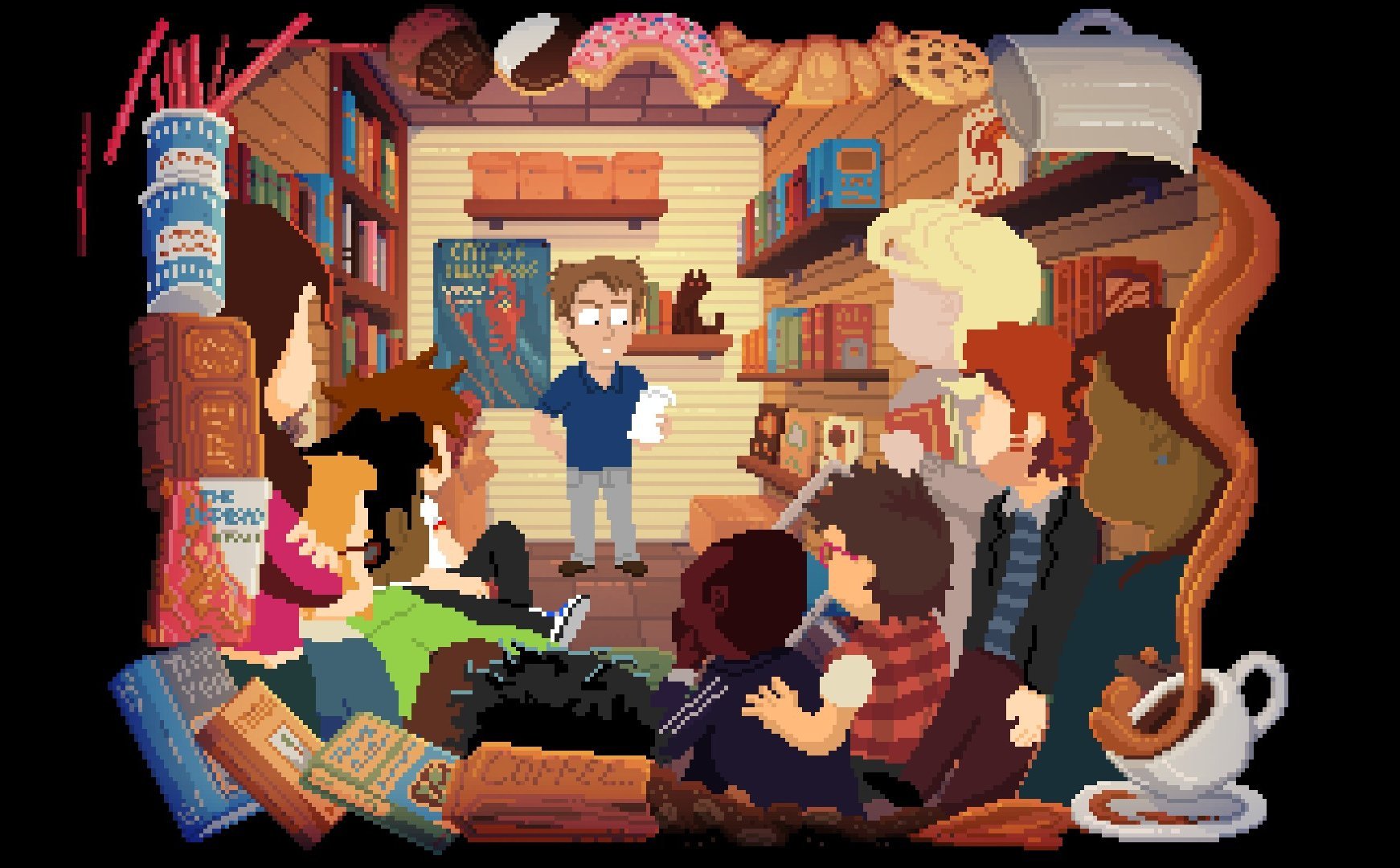
There’s a dress-up sequence that winks at games like Barbie Fashion Designer, in which Mara prepares herself to go out while a deliriously high-energy announcer (played, in the game’s only voiced dialogue, by the developer herself) berates her appearance and style. You’ll even be called on to read sheet music in order to play a snatch of piano; you’re provided what you need to get through it, however shakily, but while non-musicians probably won’t nail it on the first or second try, the point is that Mara wouldn’t either.
And then, midway through the game, comes a segment so inventive, so playful, so full of creative energy and so downright fun that I wouldn’t dream of spoiling it. It introduces no mechanics, presents no new challenges, and comes down, in fact, to the pressing of a single button…and yet it’s the most delightfully and infectiously interactive a game has felt to me in years. The sequence itself represents a high point in Mara’s young life, and at the end of it I felt just as giddy, triumphant and flushed with endorphins as she did. When the moment comes, you’re allowed to opt out, but if you can I implore you: just do what the DJ says.
At every turn, Mara’s success or failure feels like your own. This is true both for her writing—with certain story beats changing depending on how well you handle your assignments—and her personal life. You’re given a limited amount of time each day to attend to her many obligations, and you have to pick and choose what you devote your time to. If Mara has a paper due tomorrow, a shelving project to finish at work, an event she RSVP’d to, and a phone date with Adam, you’ll have to prioritize what you think she can actually get done. The game will generally let you know how much of your day a task will eat up, but it’s best to stay mindful. There’s no visible clock, and more than once I convinced myself I had enough time to go everywhere I needed only to have to triage something at the last minute. There are no fail states, but your choices will determine many of Mara’s personal outcomes; how satisfied you both are in the end depends on you.
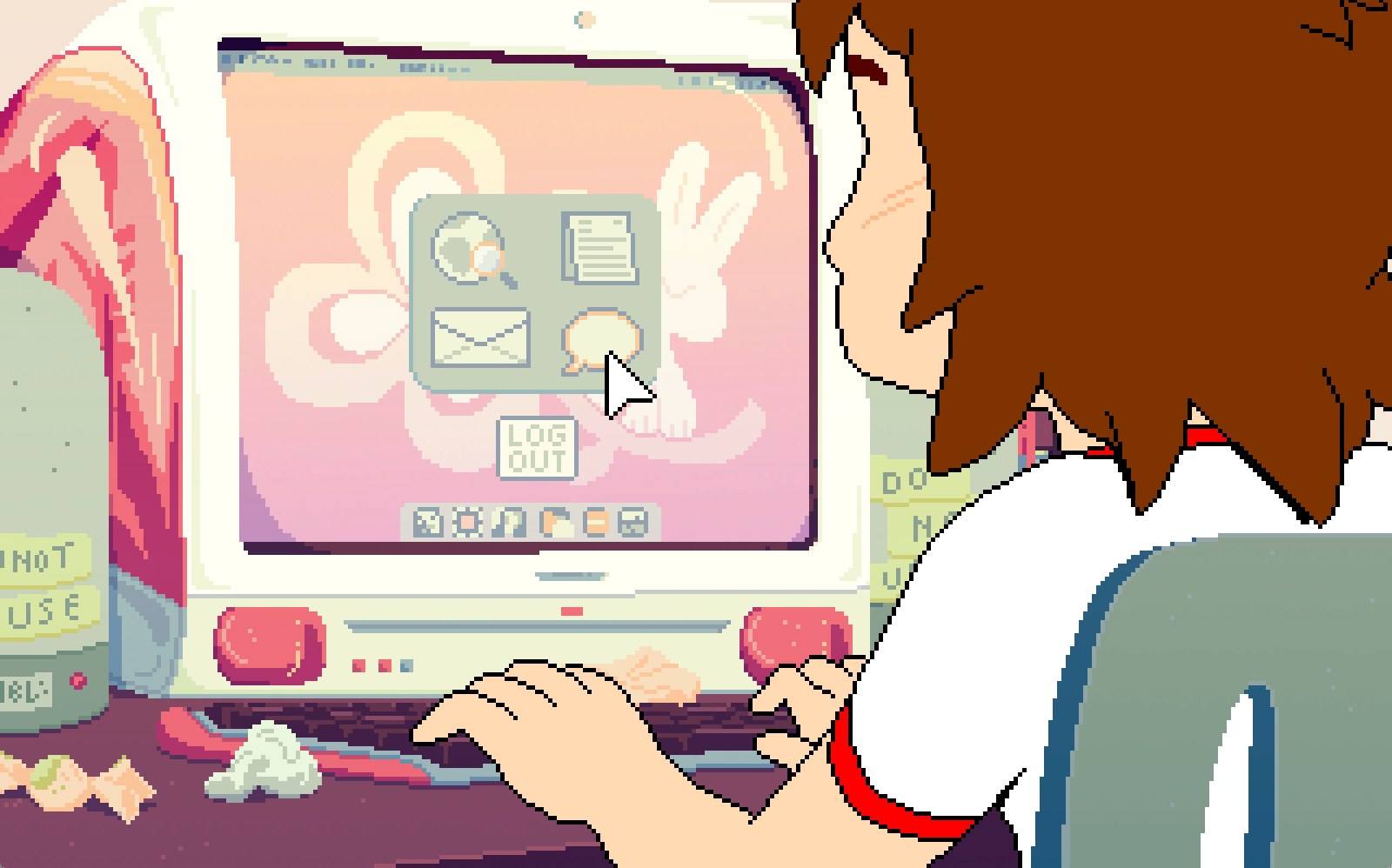
Uncertainty is baked into everything you do in Station to Station, just as it is in every aspect of Mara’s life. If you choose to hang out with a friend now, will you have time later to write your paper? When you choose a topic to write about, can you be sure it’s the one best suited to your strengths? Should you try to read another book first, or log on to Mara’s computer to see if anyone’s online who can help? There’s no way to know besides doing, and that’s your conundrum as much as it is Mara’s.
The first game stood out in part by never disengaging from Mara’s point of view, without judging her or coming to a halt to make sure players understood something Mara herself didn’t. Though she’s older and (relatively) wiser here, Mara still has plenty of figuring-it-out to do, and like its predecessor, the sequel allows her to speak for herself. An older player might recognize that Mara is making a questionable or even outright terrible decision—I definitely muttered “Oh, God damn it, Mara,” at one fraught moment—but the game always presents her thoughts in such a way that you understand why, at this point in her life, it feels right to her.
That’s part of the heartbreak of Station to Station, to which the title alludes. Mara knows this part of her life isn’t permanent; there’s some other Mara waiting down the line to take her place, who may regret the choices she makes now just as she currently cringes to recall her youthful misadventures. That time and that Mara once felt like forever; both exist only in memory now, and before long her time at university will join them. Even so, she has to live here now.
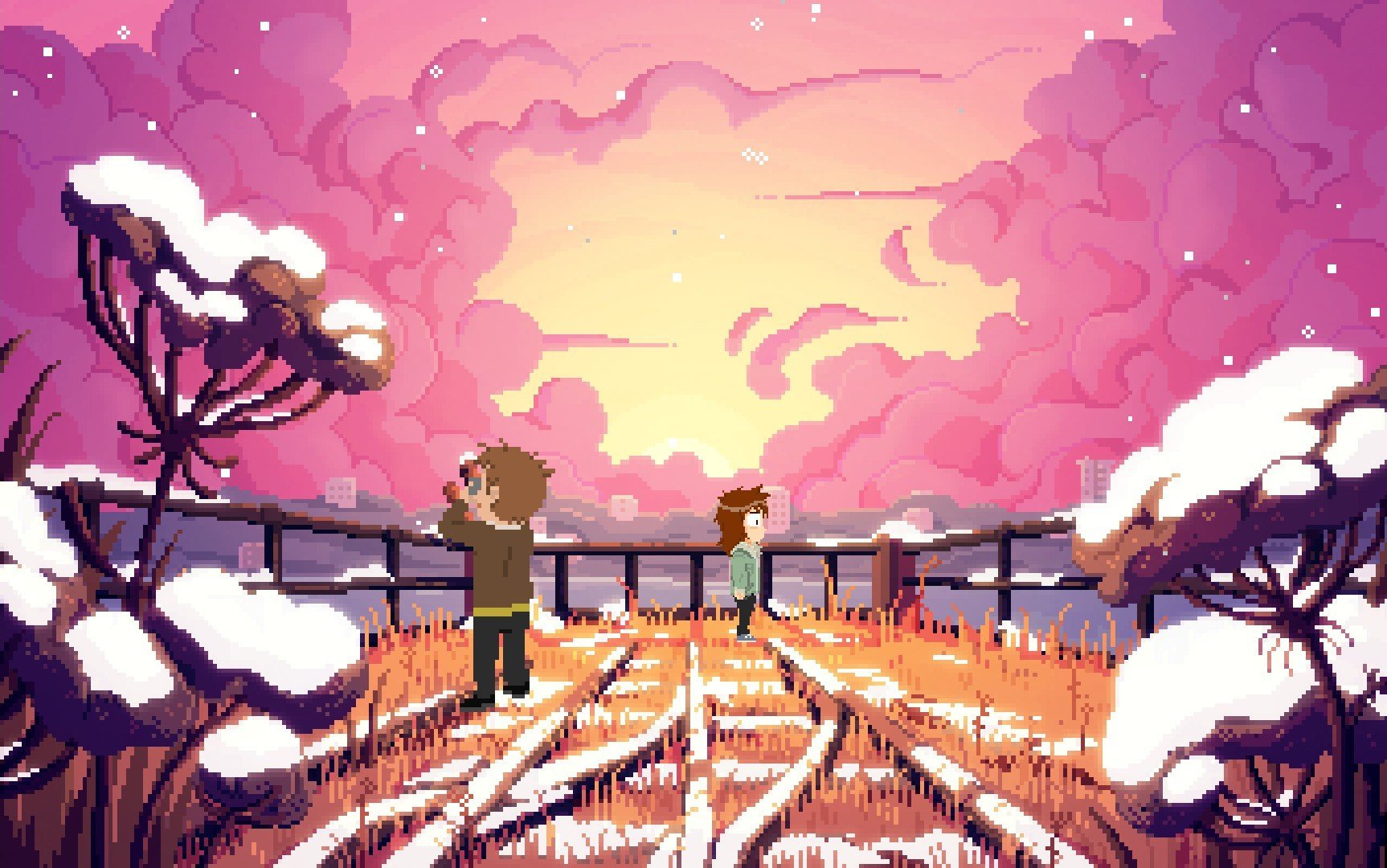
Mara is haunted not only by tomorrow but by today, with both hanging over her every thought and decision as she moves from youth to maturity. There are next steps to consider in her relationship; there’s the amorphous idea of what her writing career should look like; there’s the question of how permanent the friendships she’s developed will actually prove to be. A wistful sting of perpetual goodbye has crept into visits with her beloved Grandma Bea, who seems to have aged more each time Mara sees her—and yet, diminished as she may seem, Bea is still here for the time being. How to manage that time so both she and Mara can make the most of it?
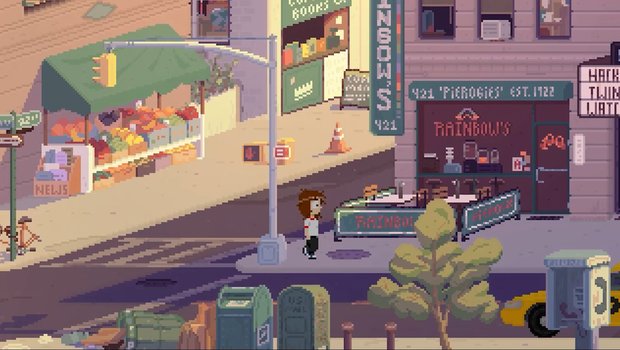
None of this would matter quite so much if Mara and her world didn’t feel real to us, but every aspect of the game’s presentation draws us further into its setting and its characters’ lives. The writing is consistently excellent, always grounded in Mara’s personality and what she’s feeling. In keeping with her character, it’s sometimes melodramatic, but it’s unflinchingly honest and often hilarious to boot. The ultra-detailed pixel art backgrounds by returning artist Soren Hughes create a bustling cityscape that’s both familiar and alive with the promise of new discoveries.
The main street outside SUCS is rich with little flourishes that make it seem authentic and lived-in, with lone traffic cones visible on corners, disassembled bicycles locked to street signs, and overturned garbage bins that the populace studiously ignores. Even smaller locales, like Mara’s favorite greasy spoon or the nearby train station, are full of beautifully animated background characters going about their lives. The character models are cartoonish enough to provoke giggles when the moment calls for it, but they possess such expressiveness that we feel the rawness of their less pleasant moments through the screen.
Composer Daniel Kobylarz follows up his work from the previous game with a bigger, bouncier synth score that feels at times like the work of a whole orchestra. If I found myself now and then missing the simpler, cozier melodies of the original Perfect Tides, then that’s just what leaving home for the big city feels like, isn’t it?
Like anything, Station to Station does have shortcomings, though they're trifling when looking at the whole. The ending feels less organic as a stopping point for Mara than the previous game’s did; there’s less sense that we’ve been witness to a discrete chapter of her life with a beginning, middle, and end. Certainly that lack of closure is appropriate, given where she is when we leave her, but the final curtain call comes a bit less readily than in Perfect Tides. There are also fewer points of direct connection to the original than some might have hoped for; a few memorable figures from Mara’s life, like her childhood friend Lily and her now-adult brother Timothy, make welcome reappearances, but some other characters it would have been nice to hear about go without even a mention. This, again, is natural and in keeping with what the game is trying to do, but I’d be lying if I said it wasn’t a little disappointing as well.
Most obtrusive to me was the script’s strange refusal to commit to identifying the city where Mara studies as New York, despite everything about it making that screamingly obvious. It’s only ever “the City,” and there are awkward substitutions whenever a borough, landmark, or nearby piece of geography comes up in conversation. (This despite the fact that the 9/11 attacks are referred to directly as having taken place there.) The game never offers a reason or justification for this, and I struggle to think of one that makes sense; nor can I come up with a way to justify the use of fake brand names (“Bepis-Cola” for Pepsi, “Retch.com” for an infamous 2000s shock site) when the first game consistently used the real-world equivalents.
Final Verdict
But those are small things, a few frayed threads in a tapestry that’s otherwise woven with painstaking care and artistry. Perfect Tides: Station to Station is simultaneously heartwrenching, hilarious, and life-affirming; a powerful and worthy follow-up to the original game that provides a natural continuation of Mara’s journey and a thoughtful exploration of youth, growing up, and the passage of time. Though the second in a series, it’s a different and unique game in many wonderful ways, and it stands on its own as a magnificent example of how to tell a story in an interactive medium. While there’s no word on whether Mara’s story will keep going, I hope it does, and that we’ll get to see the kind of person our decisions here helped to shape in her next phase of life and beyond. We probably won’t get to join Mara when she’s in her 80s, but if there’s a chance, that’s all the incentive I’d need to make it to 100.
Hot take
Station to Station is as worthy a follow-up to the brilliant original Perfect Tides as anyone could have hoped, continuing Mara’s story with the same insight, compassion and immersive writing while deepening and expanding its narrative through interesting new mechanics.
Pros
- Beautifully written narrative provides an excellent expansion of its predecessor’s themes
- Mechanic and puzzles centered on Mara’s writing fits the subject matter perfectly
- Numerous unique and creative sequences that help drive home the protagonist’s thoughts and feelings
- Art and music are excellent as ever
- THAT scene (you’ll know when you get there)
Cons
- Ending doesn’t necessarily feel like the most natural stopping point
- Strange avoidance of real-world place and product names is jarring after the first game used them freely
Will played Perfect Tides: Station to Station on PC using a review code provided by the game's publisher.

- Advertisement
- Help support AGH by advertising with us








0 Comments
Want to join the discussion? Leave a comment as guest, sign in or register in our forums.
Leave a comment