
Éalú review
- 0 Comments

It’s worth forking over some cheddar for this short but charming stop-motion puzzler about a wooden mouse caught in a maze trap
From Mickey to Mighty, Jerry to Mrs. Brisby, and Fievel to the little guy in that 90s Mouse Hunt movie, mice make good fictional characters. There’s just something about one of the smallest of Earth’s creatures overcoming all kinds of obstacles that makes them so appealing, proving that you don’t have to be big or strong to win the day.
When I first saw the trailer for the point-and-click stop-motion puzzle game Éalú, by indie Irish puppet, theatre art and film company Beyond the Bark, its cuteness immediately won me over. Its task is to guide a wooden toy mouse through a maze, solving a series of mechanical puzzles to open up the path to freedom. “Éalú,” after all, is Irish for “escape.” There’s not much story to this rather short brainteaser, but it’s well worth seeing through as the ending did nibble at my heartstrings.
But don’t let its charm completely fool you, as there are six puzzles to solve in total. Most are fairly easy to complete, with all the visual clues you need found scattered around the labyrinth. For instance, you need to align a series of planks to create a passage by pressing the correct buttons, match up two pieces of a wooden heart that swivel around at different intervals, and there’s a lockbox for which you need to find the correct combination.

However, there is also a near-diabolical one involving rotating discs you have to put in the correct pattern, and it took me quite a while to figure out how its inner mechanics worked exactly. Then there’s one that required me to copy the entire layout of the maze on a piece of paper – thankfully I had the help of my wife this time, who normally hasn’t the patience for true adventure games but is a fervent note-taking puzzler.
Next to that wee bit of frustration with its toughest challenges, we had a good two hours of fun. The game opens with the mouse sleeping in its nest, somewhere in a huge wooden-walled maze. This is an entirely hand-crafted game, so the mouse is an actual physical object, given the illusion of movement by its developer/puppeteer/camera person using a meticulous stop-motion film technique. There’s no dialogue, or indeed any form of narrative except for the little critter desperate to escape captivity to go roam in the wild again, as hinted at by a picture it drew and hung above its nest, showing it at the top of a hill gazing at the sun.
Éalú uses a simple, one-click interface. The standard cursor is an upwards-pointing arrow; when you hover it over something you can interact with, like an exit or a button to push, it changes into a dot. Click on the button and the mouse will move towards it and tap it with its snout; click on an exit and the mouse will move through it.

I did notice some delay between the moving animation and when the game registers your next click. Often I had to click twice, thinking the movement “cutscene” was done. But the mouse is constantly moving back and forth throughout the game, as if it’s nervous or shivering with anticipation to escape its prison. The animations of actually moving from room to room are seamlessly fitted to that jittery behavior, and with the cursor always remaining visible on-screen, it can be difficult to discern when you’re granted control again.
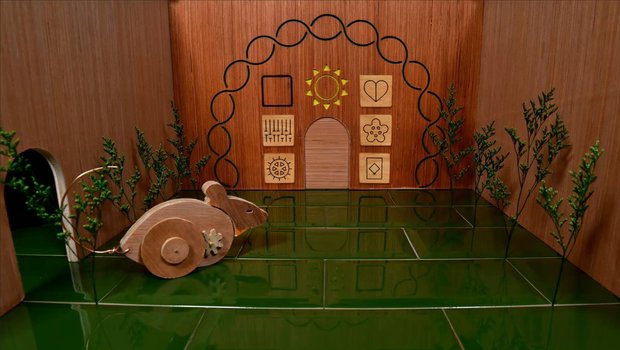
Each small room has been physically built from scratch, and the maze consists of several different “regions.” The transition between them is indicated by a different type of flooring, going from wood to concrete to green tiles with small trees popping out. You need a good sense of direction to navigate this labyrinth. The rooms can have two to four exits, and there are also dead ends (in the directional sense).
Éalú

| Genre: | Science Fiction |
|---|---|
| Presentation: | Full motion video |
| Theme: | Escape, Animal |
| Perspective: | Third-Person |
| Graphic Style: | Live action |
| Gameplay: | Environmental puzzler, Escape room |
| Control: | Point-and-click |
| Game Length: | Short (1-5 hours) |
| Difficulty: | Medium |
Many rooms look very similar, but some have unique features to help you keep your bearings. Besides the different flooring, a couple of rooms also have a pipeline running through them, some walls display the visual clues for the puzzles, and of course there are the puzzle rooms themselves. You have to solve these to open up closed doorways spread across the maze, giving you access to new areas and ultimately granting a path to the final exit.
Éalú is based on the music video of the song “Tomcat Disposables” by the game’s composer Will Wood, for which the toy mouse was created by Beyond the Bark’s Ivan Fisher-Owen. The game features samples from that song, but there are several new tracks as well. Each region has its own score, which helps to remind you in which part of the labyrinth you find yourself.
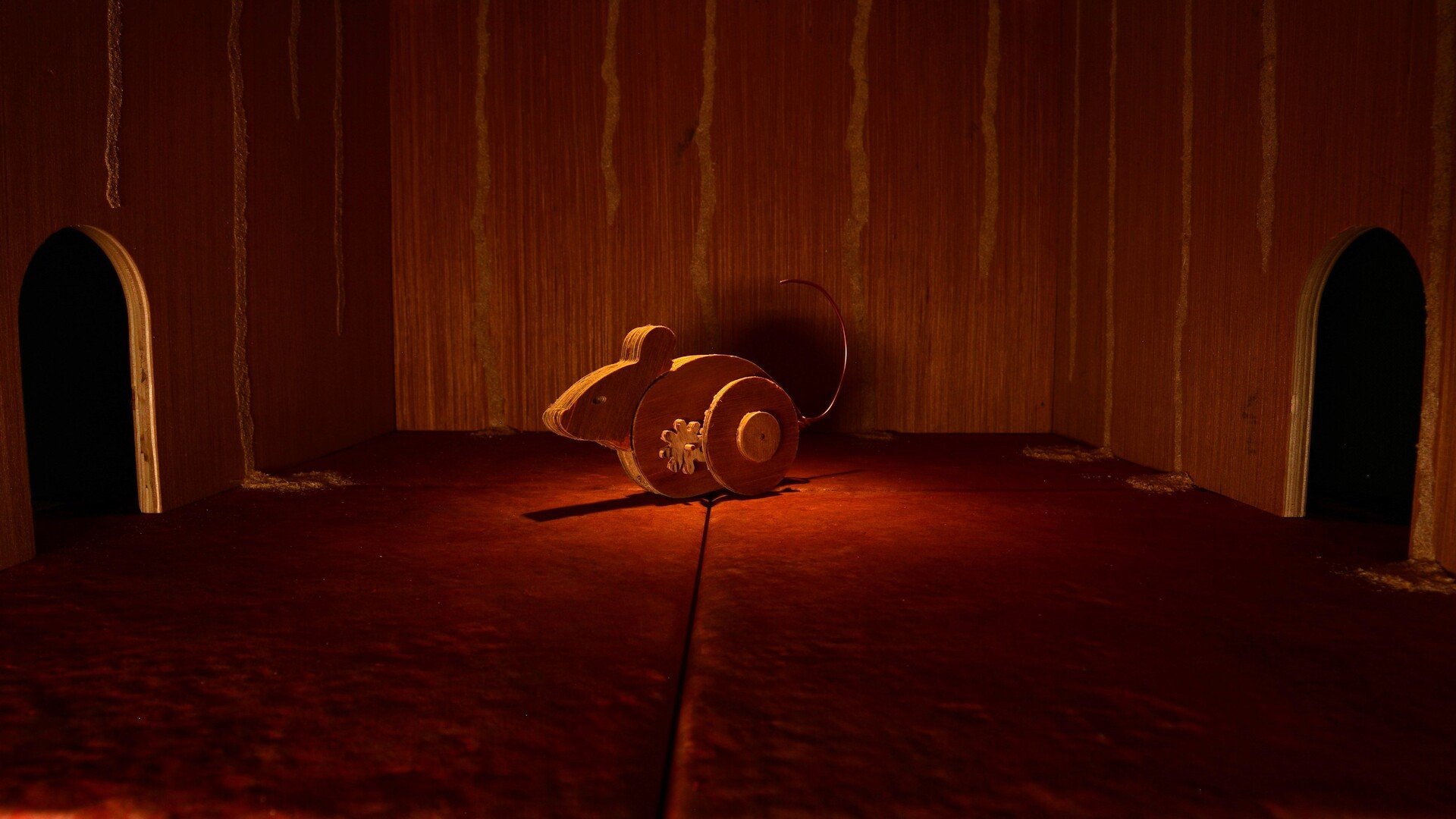
You’ll start off with a piano playing quick high notes to mimic the playful pitter patter of little mouse feet. Another part of the maze features an organ, which creates a more carnival-like atmosphere. There’s also a region that is very dark, with prominent shades of red and weird stuff growing on the walls which my wife and I dubbed “mouse hell.” Here the soundtrack doesn’t really sound like music, with instruments screeching and growling in a way that elicits a very haunting and uncomfortable feeling, as if there’s a cat nearby ready to gulp up your little mouse.
While I didn’t encounter any cats, you can die in this game. A mouse is a very defenseless creature, after all – even a toy one – and the maze holds many dangers in the form of booby traps. One innocent touch of the wrong object can mean the end, with the mouse being squashed between moving walls or a falling ceiling, or even sliced in half by a sudden blade. Like in a Sierra game of old, these deaths were very unexpected, because the objects causing them looked innocent enough and perhaps even necessary items to use later on. After the first couple, however, it was easy to recognize the new fatal situations I encountered ahead of time.
Dying sends you all the way back to your nest for another chance to navigate the maze. Compounding the issue is that the maze completely resets when this happens; any puzzles you might have already solved need to be redone. Fortunately, once you’ve learned the layout and know what to do, retracing your footsteps (or the equivalent for a wooden mouse on wheels) is quick and the solutions are very easy to repeat.
But dying has its rewards as well. As you respawn in your nest, you will notice the back wall adorned with pieces of paper showing the causes of your death, depicted by the objects you unwittingly touched. There are also two separate papers with tally marks beneath them; one for the pieces of cheese you’ve eaten, strewn throughout the maze; and one for the number of times you died. Reach a set number for each and they will open up secret doorways. These are optional achievements, however, and aren’t needed to find the ultimate exit.
Final Verdict
Éalú is a wordless brainteaser good for a couple hours of pure puzzling to escape a maze filled with mechanical obstacles, its stop-motion technique bringing a real wooden toy mouse to life working wonders. While I’m usually no fan of labyrinths in games, the sheer ambition of the developers actually handcrafting each room, then photographing each step the mouse makes, results in an impressive production that heightens the cuteness factor as well as the empathy you feel for the little fella. I wanted the mouse to make it to the end, hated each time it died, and thus tried to avoid it for the rest of the experience. And of course I cheered when I finally succeeded and saw my little rodent friend leave the labyrinth in an endearing final cutscene. With such a short play time, there’s no need to rush, taking your time to savor the experience. After all, the early bird may get the worm, but the second mouse gets the cheese.
Hot take
Helping a little stop-motion toy mouse escape its hand-crafted maze prison in Éalú will warm your heart like a cheese fondue on a cold winter evening.
Pros
- Extremely cute stop-motion toy mouse protagonist
- Entirely homemade environment
- Diverse soundtrack fits the varied settings and helps you navigate the maze
- Nice variety of easy and challenging mechanical puzzles
Cons
- Dying can be unexpected and completely resets the maze
- User interface doesn’t immediately respond after a movement animation
Johnny played Éalú on PC using a review code provided by the game’s publisher.

- Advertisement
- Help support AGH by advertising with us





0 Comments
Want to join the discussion? Leave a comment as guest, sign in or register in our forums.
Leave a comment