
The Empty Desk review
- 0 Comments
Supernatural corporate whodunit haunted by a fairly hollow story and light, repetitive gameplay
Brown & Williamson Tobacco Corporation was a major U.S. cigarette maker that gained widespread notoriety during the mid-1990s for boosting the addictiveness of its products. Former VP Jeffrey Wigand revealed that the company had added chemicals specifically to enhance nicotine absorption, making cigarettes more habit-forming and harder to quit. This revelation shed light on how the big tobacco companies intentionally tweaked their products to keep customers addicted, preferring cold profit over humane considerations. The controversy sparked public debate and regulatory interest, ultimately leading to the merger of Brown & Williamson with another tobacco company.
The Empty Desk, by Cheesecake Games, is a detective mystery with a supernatural narrative that exposes the dark secrets lurking beneath Blackthorn & Co.’s polished facade. The company is a business conglomerate, operating subsidiaries in nearly every area of life, from medical research and insurance to pensions, coffee and wineries. But all of this is merely a cover for more arcane pursuits. Though fictitious, it operates in a way reminiscent of Brown & Williamson. What is the hidden truth behind the company’s actions and public image? What is its goal beyond what it openly states? How does the company truly plan to achieve this goal? To answer these questions, and more, you’ll delve deep into the heart of Blackthorn & Co. in this atmospheric thriller that unfortunately isn’t able to match its level of intrigue with equally satisfying gameplay.
Detective Thomas Bennett is tasked, rather reluctantly just a week before retirement, with solving a homicide case at the company headquarters that no other detective wishes to investigate. Arthur Blackthorn, head of the business conglomerate bearing his name, has been found dead. Emily, his daughter, has vanished, and her fiancé has supposedly committed suicide, all over the course of one evening. Assisted remotely via radio by Sarah, a tech wizard, Bennett enters Blackthorn’s main office building in search of the truth. But Bennett also has a personal motive for accepting the case. He bears a personal grudge against the company for refusing to assist his beloved wife when she suffered a serious illness, despite having been covered by its medical insurance.
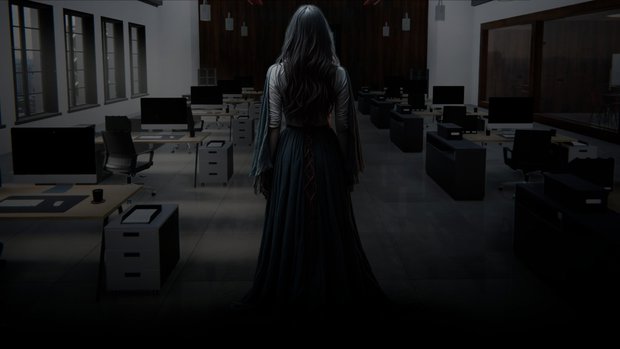
Once alone inside the building, Bennett finds himself guided, and at certain points even coerced against his will, by a ghostly woman whose identity isn’t revealed until the later stages of the game. As the game progresses, she helps Bennett in exposing the web of secrets, lies, deceit and fraud that has been woven by Arthur Blackthorn and his assistants. The plot unfolds slowly, allowing players to piece together the bits of information into a large, complete picture. It also carries a message relevant to almost each and every one of us, about corporate injustice, and the danger of too much power in the hands of too few people.
The Empty Desk is presented in free-roaming 3D from a first-person viewpoint. Movement is controlled by either keyboard (WASD keys) or gamepad. Among the usual options, there is one that I cannot recall in any other game, which allows players to choose whether to turn in-game jump scares on or off. Gameplay remains the same, only with or without some additional frights. I played with this feature turned on, but there were far fewer jump scares than I anticipated and didn’t add anything fundamental to the gameplay. Apart from one that was genuinely creepy and surprising, most are of the Halloween sort. On one occasion, even the detective himself quips “Is this the best you can do?”
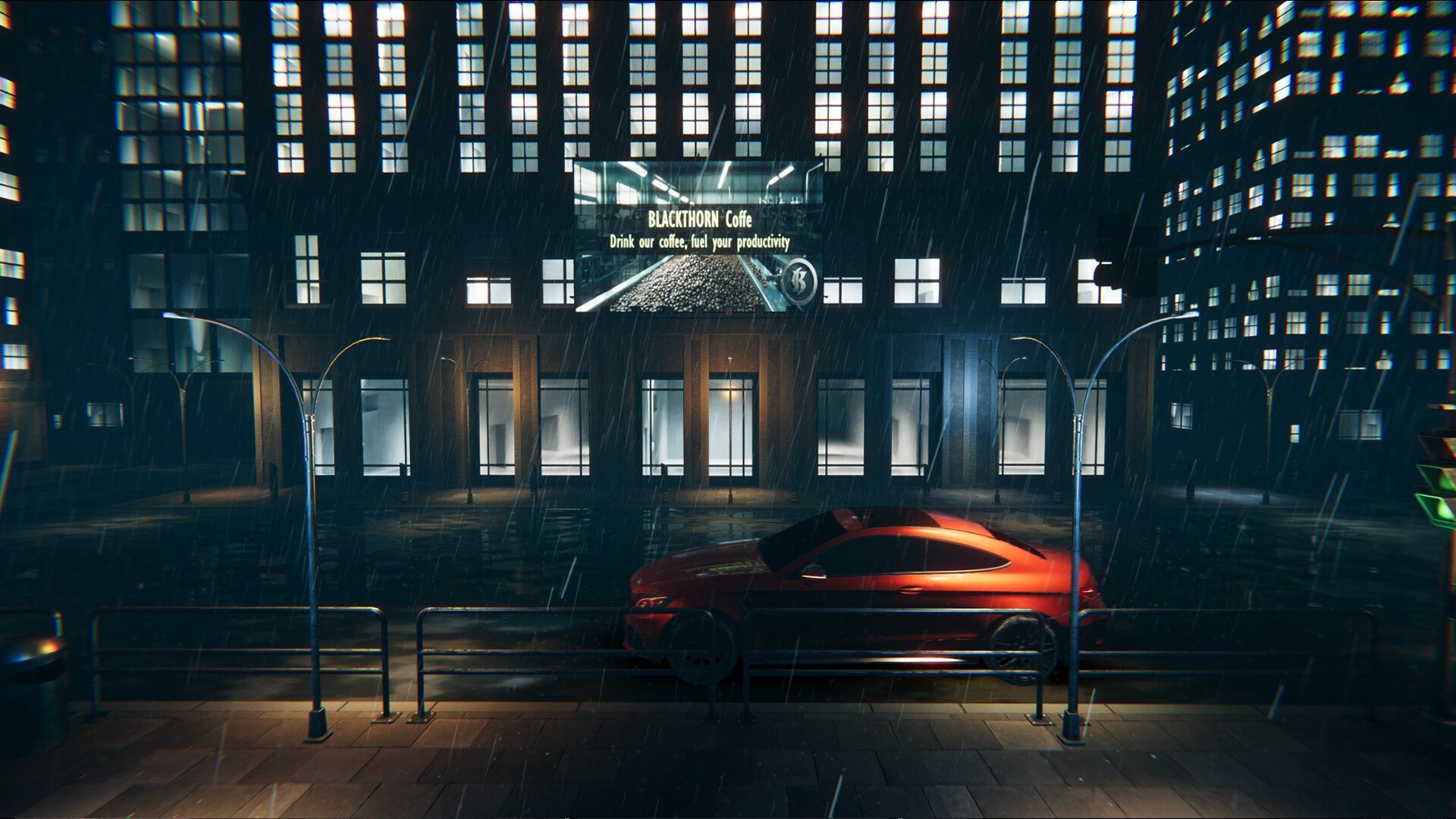
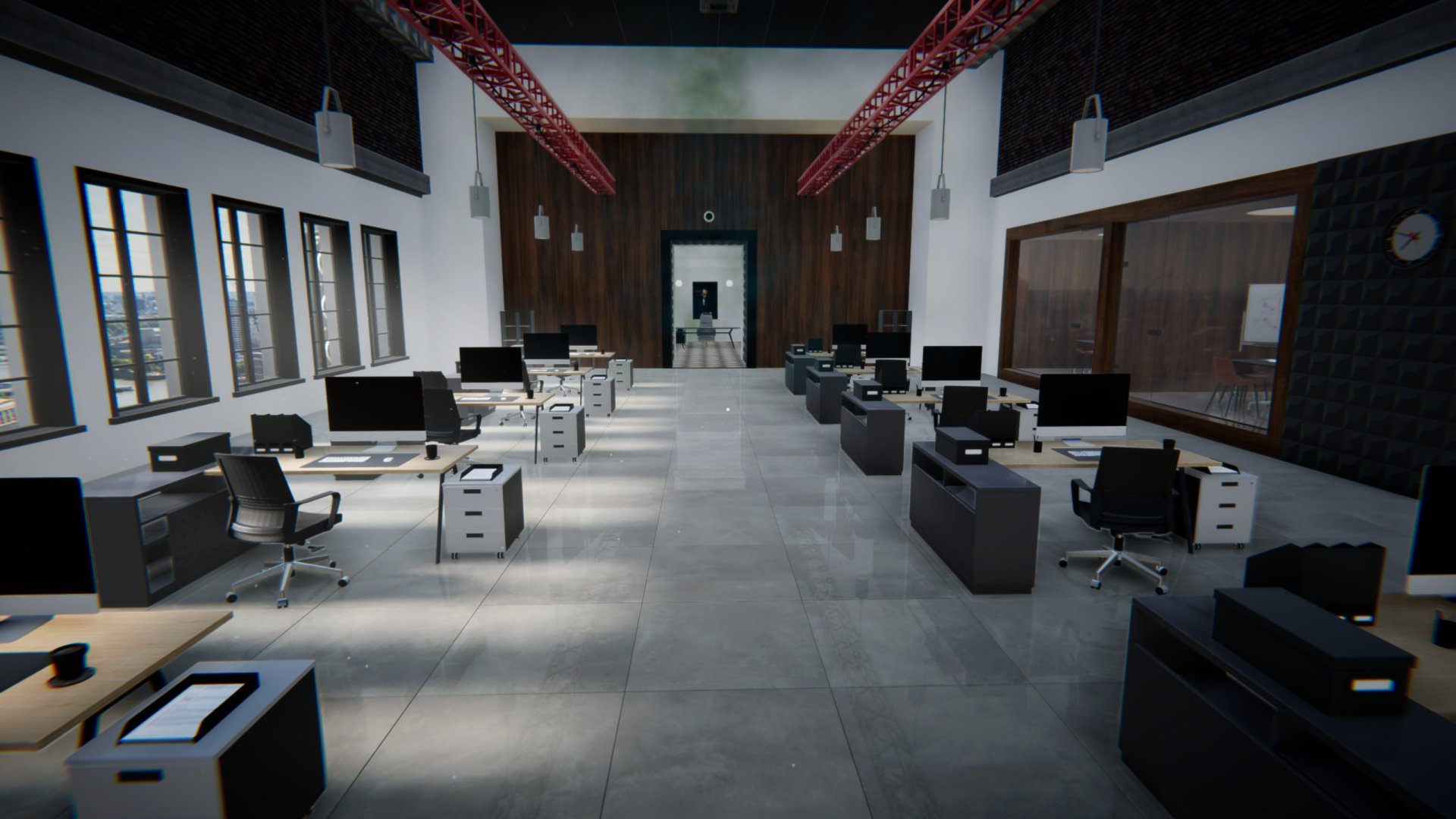
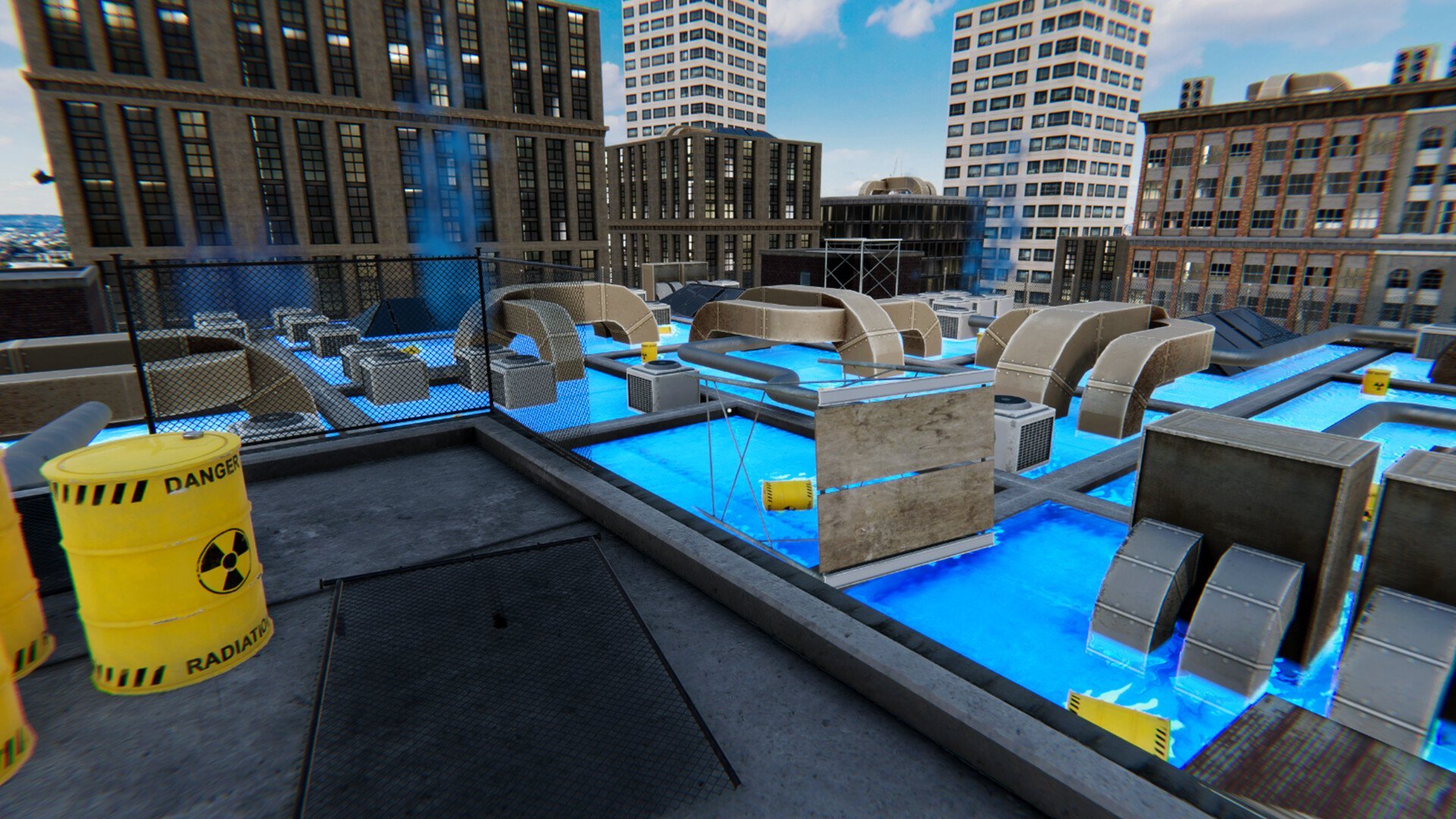
Graphics are crisp and sharp. They feature a desaturated color palette dominated by greys, blues, black and white, creating an emotionally distant atmosphere. The environments are realistically detailed but feel cold and even more clinical than you’d expect from a corporate workplace. For example, desks are devoid of any personal touches, and office spaces feature only motivational posters, if any at all. There is very little ambient animation beyond glimpses of flocks of birds or weather effects like rain that can be seen at times through the windows, but some scenes have more, like water gently rippling in the rooftop pool, and flies seen swarming around rotting food. Strangely, when you look out at the city itself, it’s bereft of any noticeable activity.
The Empty Desk is divided into nine chapters, each comprising one general larger objective achieved by accomplishing one or more certain tasks, from enjoying a hot cup of coffee to locating certain video tapes, documents and personnel files. Once an objective is received, it is duly written in Bennett’s notebook, and as soon as it is achieved it is stricken out and no longer accessible. Your goals are always clear, and the ways to accomplish them are simple enough. Bennett contacts Sarah whenever he needs her assistance, and sometimes she contacts him with useful information. Both scenarios happen automatically, at certain key points. For instance, she guides him to the correct elevator among the several dozen available. Another time she helps him by taking over the security cameras in order to deactivate them.
There are no inventory puzzles, mysterious mechanisms to operate or hidden codes to decipher. In one chapter, Bennett retrieves a code to open a safe, but once he gets it he does not even have to operate the locking mechanism or find an innovative way to open it. All he must do is stand next to the safe, and voila! Most of the tasks are of the fetch variety, leading to a lot of 3D scavenger hunting and tedious backtracking. For example, some files or video cassettes are located on bottom shelves in the archive, sometimes partially hidden by cardboard boxes or the shelves themselves. Though there’s nothing too difficult or complex, it becomes repetitive over time, especially since most of the game takes place on the same floors in Blackthorn and Co.’s HQ.
The Empty Desk
| Genre: | Mystery |
|---|---|
| Presentation: | Realtime 3D |
| Theme: | Crime solving, Whodunit, Missing persons |
| Perspective: | First-Person |
| Graphic Style: | Photorealism |
| Gameplay: | Investigative |
| Control: | Direct Control |
| Game Length: | Short (1-5 hours) |
| Difficulty: | Low |
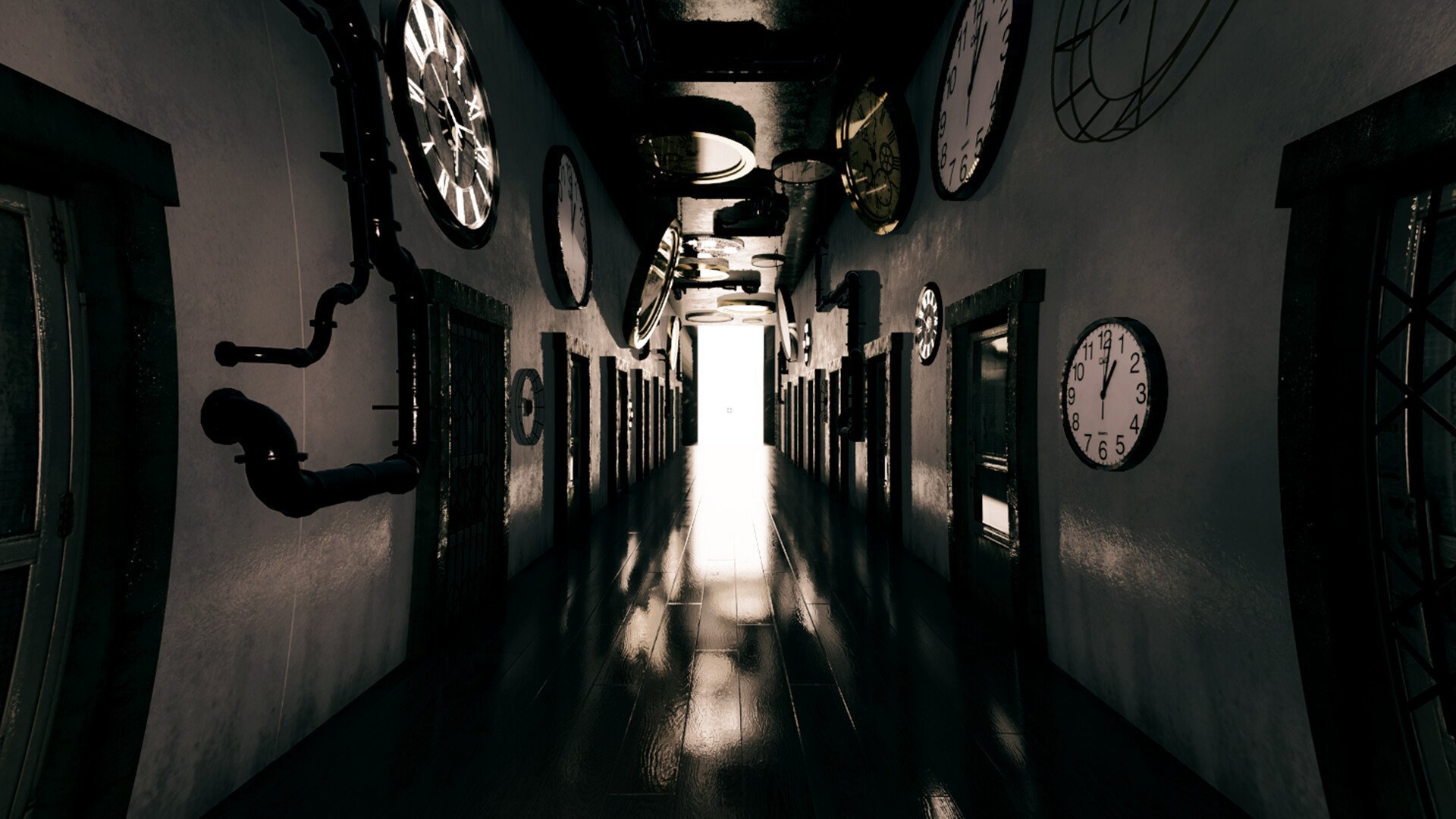
It feels as if the offices themselves, with their twisting hallways and many rooms, are a maze you must go through repeatedly, each time to achieve a different objective. Later, when Bennett starts to lose his grip on reality, there is an actual maze in which he must find six keys in a surreal setting born of his turbulent mind. This labyrinth is dimly lit, with numerous, almost identical doors and countless clocks covering its walls, floor and ceiling. The keys are small and could be anywhere; it took me more than an hour of losing my way inside this maze to find them all. There’s no getting around it, either, as the keys are required to unlock a mystery box containing evidence Bennett has long been looking for.
A line in one of the chapter titles mentions that all clues are hidden in plain sight. This is true enough, but it also refers to a near total lack of interactivity. You can only open doors with items behind them that are relevant to achieving your current objective. You cannot enter other rooms, inspect the ubiquitous filing ledgers, open random cabinets, browse through the endless paperwork on workers’ desks, or peek inside archive boxes. You can inspect them, with Bennett usually dismissing them while quipping something along the lines of “useless junk,” but this absence of optional interactivity made me feel like something was amiss in the grand design, perhaps some additional information that could have quenched my curiosity about some other activities of this shady business conglomerate.
For some puzzles, you’ll use a camera Bennett receives from the ghost. The camera helps you scan the contents of boxes, bags and filing ledgers, locate relevant evidence and present it to the spirit. It also has special properties like an apparent blacklight lens that allows you to locate hidden clues like missed calls on a phone, dried blood stains and graffiti. You can only take six pictures before the battery is depleted. In order to recharge you must enter the “corridor of silence,” where the ghost inspects your findings. She then accepts or rejects each object according to its relevance to the current objective. During this session, the camera is recharged, allowing you to continue your search, if necessary, until all the required items are photographed and approved. This process may take more than one session to complete, which can be tedious and tiresome.
You will also collect coins along the way. There are 100 of these, located anywhere around the office building. They can be found inside toilet bowls, on shelves, beneath desks, inside flower pots or under pillows. Collecting enough of them opens personal files of the game’s characters, from the chief police inspector to Emily’s fiancé, shedding light on each individual’s dealings with Blackthorn & Co. and their private issues with it. This feature, though not essential to the story and gameplay, fleshes out the narrative by giving each person their own backstory.
Bennett’s thoughts appear only as unvoiced subtitles, but his conversations with the ghost, Sarah and the chief inspector are voiced along with text bubbles and static portraits of the speaker. Even when the ghost displays itself before the detective, she appears as a frozen avatar, and there is no facial animation or lip synching. Dialogues can conveniently be advanced by clicking the left mouse button.
As for the acting, it is not bad but pretty unremarkable. While characters speak with a consistent tone, there is a noticeable lack of emotional depth or variation that could have brought more life to the story. One example is a flashback phone conversation between Emily and her father about an upcoming wedding celebration. It takes place when Emily has begun to suspect her father’s real motives, while realising he has too much control over her and her life. But the dialogue is delivered flatly by both, as if the actors are simply going through their lines, instead of imbuing the conversation with at least some of the emotions it’s supposed to evoke in their characters. Another example is the ghost herself. Though a major figure in the game, she sounds tired, yet also like she’s trying hard to be scary. Even during the climax, when you are faced with both a revelation and a difficult moral decision, the delivery feels indifferent instead of conveying fear, anger, disappointment, despair – or any emotion at all.
Music is minimal, almost absent, so outside of conversation The Empty Desk’s audio mostly consists of abstract sounds, punctuated by ambient effects such as clicking buttons, papers rustling and doors opening, along with the detective’s footsteps echoing through empty hallways. While the sound design, like the voice acting, is fairly average, it contributes a bit to the game’s general atmosphere, adding a layer of barely noticeable unease with the constant hum of distant machines. You feel it more than you hear it.
Though the story proves to be intriguing, there are quite a few plot holes and illogicalities that render it almost unbelievable. Even the premise itself: Bennett is sent to investigate a huge crime scene – an entire massive high-rise office building. He arrives without any assistance apart from Sarah over the radio. Why isn’t there also a forensics team, a photographer, and some other policemen to assist and protect him? Another example occurs when a fire breaks out (threatening to burn many barrels of nuclear waste that nobody seems to have noticed or cared about). The main power is down, but real fire suppression systems are designed with exactly this in mind, operating on emergency power. Not here. Not now. The fire rages on, sprinklers still and dry, and yet Bennett is allowed to roam the floor, oblivious to the flames and the immediate danger surrounding him.
After about three or four hours of gameplay, the so-called climax has the detective facing a moral choice between two options – one bad, the other worse. But no matter which one you choose, the game ends practically the same way, the only difference coming from a short monologue delivered by the ghost. The decision you made has no apparent influence on the actual ending to the story itself. It’s not particularly thrilling even the first time around, but what could have been an emotionally unsettling scene ends up being an especially disappointing denouement upon reloading the lone autosave and replaying from the beginning of the chapter.
Final Verdict
The Empty Desk is not a bad game, but it falls far short of what it could have been as a powerful and deeply emotional narrative. And though it has its eerie and scary moments, they do not add up to a satisfying horror experience either. The supernatural elements add some nice touches, but they sometimes seem superfluous, and the game might have played much better as a straight police drama interwoven with personal tragedy. Instead its intriguing premise is bogged down by average voice acting, limited interactivity, and repetitive gameplay. According to the developers, this is the first installment in the Detective Bennett: Solved Cases series. I’d certainly be interested in another, but hopefully lessons will be learned from a debut that leaves plenty of room for improvement.
Hot take
The Empty Desk is a supernatural whodunit with components of conspiracy theories made into an average game with some serious shortcomings.
Pros
- Intriguing plot with supernatural elements
- Nice, clean graphics
- Overall eerie atmosphere with optional jump scares
- Clear objectives are easy to accomplish
Cons
- Repetitive gameplay with lots of backtracking and scavenger hunting
- Mediocre voice acting and sound design
- Lack of puzzle challenge or even environmental interactivity
- Superficial narrative never evolves into something deeper
Eran played The Empty Desk on PC using a review code provided by the game's publisher.

- Advertisement
- Help support AGH by advertising with us






0 Comments
Want to join the discussion? Leave a comment as guest, sign in or register in our forums.
Leave a comment